Chapter 7 - Theorems/ideas - Matrix Algebra
 Studied by 0 people
 Call Kai
 Learn
Learn Practice Test
 Spaced Repetition
 Match
Match Flashcards
 Knowt Play
1/10

There's no tags or description
Looks like no tags are added yet.
Name | Mastery | Learn | Test | Matching | Spaced | Call with Kai |
|---|
No analytics yet
Send a link to your students to track their progress
11 Terms
Symmetric Matrices
A matrix A is symmetric if:
AT = A
Must be square
Entries mirror across the diagonal
If you see AT = A → strong eigenvalue guarantees
Theorem 1 - Orthogonality of Eigenvectors
If A is symmetric, then eigenvectors corresponding to distinct eigenvalues are orthogonal
Guarantees:
No Gram-Schmidt needed between different eigenspaces
Fast construction of orthonormal eigenbasis
Orthogonal Diagonalization
A matrix A is orthogonally diagonalizable if
A = PDPT
where P is orthogonal and D is diagonal
Meaning:
P-1 = PT
Columns of P are orthonormal eigenvectors
Simplifies powers and quadratic forms
Symmetric - Orthogonally Diagonalizable
A matrix A is orthogonally diagonalizable if and only if A is symmetric
This is a two way equivalence
“Can I diagonalize with an orthogonal matrix?” - check symmetry
Theorem 3 - Spectral Theorem
If A is symmetric, then:
All eigenvalues are real
Geometric multiplicity = algebraic multiplicity
Eigenspaces are mutually orthogonal
A is orthogonally diagonalizable
This theorem ends all diagonalization questions
Spectral Decomposition
If A = PDPT with orthonormal eigenvectors ui :
A = picture
Each term is rank - 1
Each uiuiT is a projection matrix
Shows how A acts direction by direction

Quadratic Form
A quadratic form on Rn is a function:
Q(x) = xTAx
where A is symmetric
Off diagonal entries create cross terms xixj
Change of Variable in Quadratic Forms
If x = Py, then
xTAx = yT(PTAP)y
Guarantees:
New matrix is PTAP
Used to remove cross terms
Theorem 4 - Principle Axes Theorem
If A is symmetric, there exists an orthogonal change of variables that transforms
xTAx into yTDy
with no cross-product terms (so no distorted axes, they’ll be orthogonal)
Quadratic form becomes diagonal
This is guaranteed for symmetric matrices
Classification of Quadratic Forms
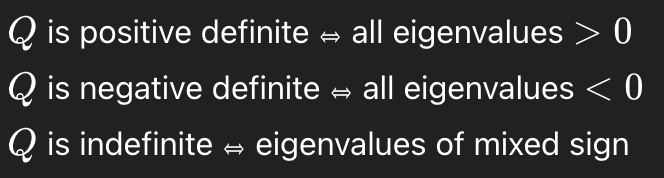
A quadratic form Q(x) = xTAx is:
This determines shape of level curves

Theorem 5 - Quadratic Forms & Eigenvalues
If A is symmetric:
No completing the square needed
 Note
Note  Flashcards (57)