FDS Chapter 1 - MT Part 2
 Studied by 0 people
 Call Kai
 Learn
Learn Practice Test
 Spaced Repetition
 Match
Match Flashcards
 Knowt Play
1/21

There's no tags or description
Looks like no tags are added yet.
Name | Mastery | Learn | Test | Matching | Spaced | Call with Kai |
|---|
No analytics yet
Send a link to your students to track their progress
22 Terms
data files
store the database itself
data dictionary
stores metadata about the structure of the database, in particular the schema of the database
indices
can provide fast access to data items.
a database index provides pointers to those data items that hold a particular value
DDL interpreter
interprets DDL statements and records the definitions in the data dictionary
DML compiler
translates DML statements in a query language into an evaluation plan consisting of low-level instructions that the query evaluation engine understands
it performs query optimization; that is, it picks the lowest cost evaluation plan from among the various alternatives
Query evaluation engine
executes low-level instructions generated by the DML compiler
transaction
a collection of operations that performs a single logical function in a database application (atomicity, consistency. durability)
transaction-management component
ensures that the database remains in a consistent (correct) state despite system failures (e.g., power failures and operating system crashes) and transaction failures
concurrency-control manager
controls the interaction among the concurrent transactions, to ensure the consistency of the database
okey
basa
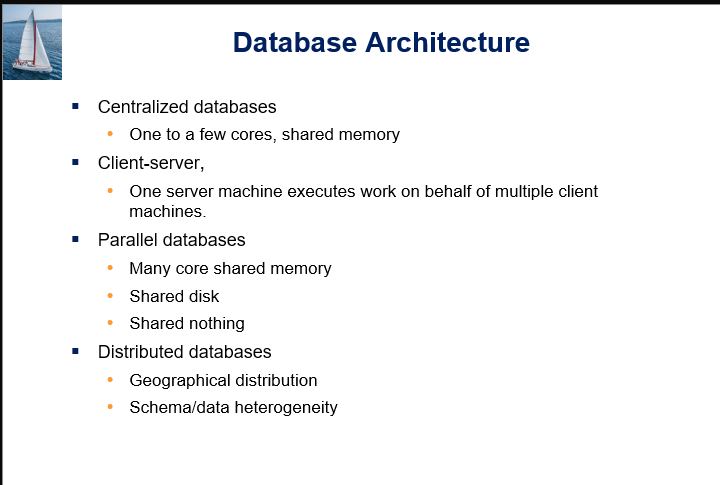
two-tier architecture
database application:
the application resides at the client machine, where it invokes database system functionality at the server machine
three-tier architecture
the client machine acts as a front end and does not contain any direct database calls
the client end communicates with an application server, usually through a forms interface
the application server in turn communicates with a database system to access data
naive users
Database Users:
are unsophisticated users who interact with the system by using predefined user interfaces, such as web or mobile applications
application programmers
Database Users:
are computer professionals who write application programs. they can choose from many tools to develop user interfaces. schema and physical-organization modification
sophisticated users
interact with the system without writing programs. instead, they form their requests either using a database query language or by using tools such as data analysis software. analysts who submit queries to explore data in the database fall in this category
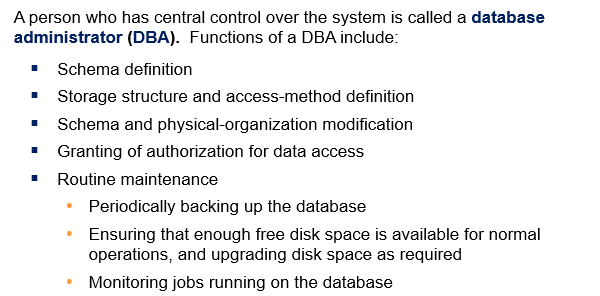
Database Administrator (DBA)
a person who has central control over the system is called?
1950s and early 1960s
Data processing using magnetic tapes for storage
tapes provided only sequential access
punched cards for input
Hard disks allowed direct access to data
network and hierarchical data models in widespread use
Tedd Codd defines the relational data model
Would win the ACM Turing Award for this work
IBM Research begins System R prototype
Oracle releases first commercial relational database
High-performance (for the era) transaction processing
1980s
Research relational prototypes evolve into commercial systems
SQL becomes industrial standard
Parallel and distributed database systems
Wisconsin, IBM, Teradata
Object-Oriented database systems
1990s
Large decision support and data-mining applications
Large multi-terabyte data warehouses
Emergence of Web commerce
2000s
Big data storage systems
Google BigTable, Yahoo PNuts, Amazon
“NoSQL” systems
Big data analysis: beyond SQL
Map reduce and friends
2010s
SQL reloaded
SQL front end to Map Reduce systems
Massively parallel database systems
Multi-core main-memory databases
 Note
Note  Flashcards (84)