DNA Replication unit 2 lecture
 Call Kai
 Learn
Learn Practice Test
 Spaced Repetition
 Match
Match Flashcards
 Knowt Play
1/97

There's no tags or description
Looks like no tags are added yet.
Name | Mastery | Learn | Test | Matching | Spaced | Call with Kai |
|---|
No analytics yet
Send a link to your students to track their progress
98 Terms
DNA used in 2 ways
DNA in cell serves as template to copy itself during DNA replication
new DNA passed to 2 new cellsDNA composed of genes
genes contain information to make proteins during protein synthesis
DNA has two main jobs:
It copies itself (DNA replication)
It gives instructions to make proteins
1⃣ It copies itself (DNA replication)
Before a cell splits into two new cells, it must make a copy of its DNA.
Why?
Because:
Each new cell needs a full instruction book.
You can't divide without giving each new cell DNA.
So:
One cell → copies DNA → splits → now 2 cells each have DNA.
2⃣ It gives instructions to make proteins
DNA is made of genes .
Genes are like:
Individual recipes inside the big recipe book.
Each gene:
Contains instructions to make a specific protein.
Proteins:
Build your body
Control reactions
Help cells function
So:
DNA → Genes → Proteins → Everything your body does
Cell cycle
time of interphase and cell division
the life of a cell from one division to the next.
It has 2 main parts :
Interphase (prep time)
Cell division (splitting)
What Is the Cell Cycle?
The cell cycle is simply:
The life of a cell from one division to the next.
It has two big parts:
Interphase (preparing stage)
Cell division (splitting stage)
interphase
non dividing stage of cell cycle
time between end of one cell division to beginning of next cell division
Interphase (The Preparation Stage)
is when the cell is not dividing yet .
It is just:
Growing
Copying DNA
Getting ready to split
Think of interphase like:
🏫 A student preparing for a big test.
You don't take the test yet…
You study first.
Interphase has 3 stages:
⏳ INTERPHASE = “GET READY PHASE”
This is when the cell is NOT dividing yet — it's just preparing.
💡 Think:
Interphase = “I'm getting ready to split”
It has 3 stages :
3 stages to interphase
G1, S, G2
G1 Phase (First Growth Phase)
What's happening?
Cell grows bigger
Makes proteins
Makes organelles
Prepares to copy DNA
Think:
The cell just divided.
Now it needs to rebuild and grow.
“Grow first”
“Let me grow and get strong.”
G1
cells produced by cell division grow and prepare for DNA replication
🔵 S Phase (Synthesis Phase)
(means “to make”)
This is the MOST IMPORTANT part.
This is when:
👉 DNA is copied.
Before… phase:
Cell has 1 copy of DNA.
After … phase:
Cell has 2 identical copies.
Why?
Because when the cell splits,
each new cell must get one copy.
So … phase = Copy machine time 🖨
S- synthesis
time when DNA replicated
DNA is copied (replicated)
💡Why?
So when the cell divides, both new cells get the same DNA
💡 Catchy phrase:
S = “Same DNA made”
G2 Phase (Second Growth Phase)
Now the cell has:
Grown
Copied its DNA
In … the cell:
Double-checks DNA
Fixes mistakes
Makes final proteins
Prepares to divide
Think:
You studied (G1),
You copied notes (S),
Now you're reviewing before the test
G1
Grow and gather supplies
S
Copy the instruction book
G2
Double check everything
cells prepare to divide
👉 Final preparation before splitting
Cell checks DNA
Fixes mistakes
Gets ready to divide
💡 Catchy phrase:
G2 = “Get ready to split”
Cell division
(how cells make new cells)
prokaryotes- binary fission/ (simple cells like bacteria)
DNA replicates
cell elongates
wall forms between 2 DNA’s and 2 cells separate
-
eukaryotes- mitosis and cytokinesis
(complex cells like humans)
They divide using:
Mitosis (division of nucleus)
Cytokinesis (division of whole cells)
💡 Simple idea:
Mitosis = divide DNA
Cytokinesis = divide the cell
Cell Division types
There are two types of cells :
Prokaryotes (bacteria)
Eukaryotes (plants, animals, humans)
They divide differently.
Prokaryotes → Binary Fission
“splitting into two”
Very simple process:
Step 1⃣ DNA copies itself
Step 2⃣ Cell gets longer (elongates)
Step 3⃣ A wall forms in the middle
Step 4⃣ Cell splits into two identical cells
That's it.
Think of it like:
One balloon stretching
A wall forming in the middle
Two balloons
No nucleus. Very simple system.
Eukaryotes → Mitosis + Cytokinesis
are more complex.
They divide into 2 parts:
1⃣ M… → nucleus divides
2⃣ C…→ cell splits in half
Because …
Have a nucleus
Have more DNA
Have chromosomes
So their division is more complicated.
Watson/ Crick model of DNA structure- 1954
DNA composed of 2 chains of nucleotides
forms DNA double helix
Watson and Crick
In 1954, … discovered the structure of DNA.
4 different DNA nucleotides
each composed of 3 parts
deoxyribose sugar (5 carbon sugar)
phosphate group
nitrogen base
DNA = long chains of nucleotides
“Sugar + Phosphate + Base”
DNA Shape
DNA is:
Made of 2 chains
Twisted together
Forms a double helix
It looks like:
A twisted ladder.
4 nucleotides distinguished from each other by nitrogen bases
adenine (A), thymine (T), cytosine (C), guanine (G)
sugar to phosphate covalent bonds between nucleotides form sides of helix
strands antiparallel to each other
What DNA Is Made Of?
DNA is made of nucleotides .
Each nucleotide has 3 parts:
1⃣ Deoxyribose sugar (5 carbon sugar)
2⃣ Phosphate group
3⃣ Nitrogen base
Think of each nucleotide like a LEGO piece.
arranged in opposite directions (one strand-)
sugar to phosphate
The 4 Nitrogen Bases/ 🔤 4 DNA bases
These are what make each nucleotide different:
A = Adenine
T = Thymine
C = Cytosine
G = Guanine
The Sides of the DNA Ladder
Sugar—Phosphate—Sugar—Phosphate
These are connected by strong covalent bonds .
This forms the “backbone” of DNA.
Antiparallel Strands
The two strands run in opposite directions.
One goes:
Sugar → Phosphate
The other goes:
Phosphate → Sugar
This opposite direction setup is called:
👉 The two strands go in opposite directions
💡 Think:
“One goes up, one goes down”
You don't need to memorize chemistry — just remember:
They run opposite ways.
🌀 DNA SHAPE
👉 DNA forms a double helix (like a twisted ladder)
Structure:
Sides = sugar + phosphate
Middle = base pairs
🔗 What holds DNA together?
other strand- phosphate to sugar
one strand- sugar to phosphate
hydrogen bonding holds complementary strands together
Chargaff’s rule for base pairing
A to T, T to A, G to C, C to G
What Holds the Two Strands Together?
The middle “rungs” of the ladder are held together by:
Hydrogen bonds.
These are weaker than covalent bonds.
They connect the bases in the middle
Chargaff's Rule
Bases only pair like this:
A pairs with T
G pairs with C
Never:
A with C
T with G
Easy memory trick:
🍎 Apple Tree → A–T
🚗 Car Garage → C–G
“A with T, G with C — always!”
This is called complementary base pairing .
DNA
… made in nucleus and functions in nucleus of eukaryotic cells
… in nucleoid region of prokaryotic cells
…. structure measured/ determined by x ray crystallography- Franklin and Wilkins
DNA replication
is semiconservative
each double strand has 1 old and 1 new strand- antiparallel
each DNA strand in double helix serves as template for synthesis of new DNA strand
new complementary DNA bases inserted according to sequence on DNA template stran
DNA replicated
during the S phase of cell cycle
DNA replication enzymes
DNA helicase, DNA polymerase, DNA ligase
DNA helicase
relaxes, unwinds and separates 2 strands of double helix at fork
each DNA strand functions as template strand
🍴 WHAT IS A REPLICATION FORK?
👉 At each end of the bubble, there's a Y-shaped opening
That Y-shape = replication fork
💡 Think:
The fork is where DNA is actively being copied
SW:
Bubble = open space
Fork = working area where copying happens
🫧 WHAT IS A REPLICATION BUBBLE?
👉 DNA normally looks like a twisted ladder (double helix)
When copying starts:
The DNA unzips in the middle
This open area = replication bubble
💡 Think:
Like opening a zipper in the middle of a jacket
🔁 HOW COPYING STARTS
👉 An enzyme called DNA polymerase :
Finds the starting point ( origin of replication )
Starts building new DNA
DNA polymerase
enzyme complex with different enzymes controlling different steps
finds origin of replication
start sequence for replication
forms replication bubble
moves replication forks along DNA template strands
adds nucleotides complimentary to DNA template strand
forms new DNA strand complimentary to template
DNA ligase
connects new DNA pieces together into 1 strand
DNA Replication
DNA polymerase finds origin of replication sequence in DNA
forms replication bubble with 2 replication forks at origin of replication
DNA replicated in opposite directions from origin
antiparallel
2 DNA strands at replication fork- …
characterized as leading strand and lagging strand
2 DNA strands replicated differently from each other
leading strand
oriented correctly for enzyme to read directly
DNA polymerase synthesizes new DNA strand toward replication fork
new DNA synthesized continuously from template strand
DNA bases complementary to template strand added to new strand
👉 This side is going the right direction
DNA polymerase copies it smoothly
Built continuously (no stopping)
💡 Catchy phrase:
= smooth and continuous”
lagging strand
oriented backwards for enzyme to read directly
DNA polymerase synthesizes new DNA away from replication fork
requires RNA primers to replicate DNA along lagging strand
forms short DNA pieces between RNA primers- Okazaki fragments
forms RNA- DNA- RNA- DNA along the lagging strand
👉 This side is going the wrong direction
So it has to be copied in pieces
🔴 LAGGING STRAND - How it works
1. Needs RNA primers
👉 Little “starter pieces” to begin copying
2. Makes short chunks
👉 Called Okazaki fragments
💡 Think:
Like copying DNA in small puzzle pieces
3. RNA is replaced with DNA
👉 The temporary RNA gets swapped out
4. Pieces are glued together
👉 Enzyme: DNA ligase
💡 Catchy phrase:
“Ligase = glue”
RNA primers replaced by DNA
forms DNA- DNA- DNA- DNA along lagging strand
DNA ligase connects DNA pieces on lagging strand into 1 continuous strand
Eukaryotic DNA
composed of DNA and histone proteins
DNA organized into separate linear pieces- not circular
chromosomes- visible DNA
form during S phase of cell cycle
DNA twists around histones
becomes shorter and thicker
replication bubbles occur in several places along each DNA piece- never at the ends
eukaryotic organisms characterized by chromosome number
all members of a species have same DNA characteristics
same chromosome number
always more than 1 chromosome
same genes in same locations on chromosomes
genes code for the same products
chromosome numbers and amount of DNA differs between species
🧠 Where Is DNA Located?In Eukaryotes:
DNA is inside the nucleus
🧠 Where Is DNA Located? In Prokaryotes:
No nucleus.
DNA is in the nucleoid region.
How Did Scientists Figure This Out?
Rosalind Franklin and Maurice Wilkins used:
X-ray crystallography
This helped show:
DNA is twisted
DNA is a double helix
Watson and Crick used that data to build the model.
Prokaryotes
Divide by binary fission
Simple split into two
Eukaryotes:
Divide by mitosis and cytokinesis
More complex
DNA
Double helix
Made of nucleotides
Each nucleotide = sugar + phosphate + base
4 bases: A, T, C, G
Base pairing: A–T and G–C
Strands are antiparallel
Held together by hydrogen bonds
What Does “Semiconservative” Mean?
Semi = half
Conservative = keep something
means:
👉 Each new DNA has:
1 old strand
1 new strand
Think of it like this:
Original DNA:
Old strand A + Old strand B
After replication:
New DNA #1 → Old A + New copy
New DNA #2 → Old B + New copy
So each new double helix keeps one original strand.
What Is a Template Strand?
is like a stencil or pattern.
Each old DNA strand acts as a guide.
Because of base pairing rules:
A pairs with T
G pairs with C
If the old strand says:
A – T – G – C
The new strand must be:
T – A – C – G
The old strand tells the new one what to be.
That's why we say:
“Each strand serves as a template.”
When Does DNA Replication Happen?
It happens during:
👉 S phase of interphase.
Remember:
G1 = Grow
S = Synthesize (copy DNA)
G2 = Get ready to divide
So S phase = Copy time 🖨
The Enzymes (The Workers)
Think of replication like a zipper factory.
There are 3 main workers:
DNA Helicase (The Unzipper)
What it does:
Breaks hydrogen bonds
Separates the 2 strands
Creates a replication fork
Imagine unzipping a jacket.
= the zipper pull.
Once it separates the strands,
each strand can now be copied.
DNA Polymerase (The Builder)
This is the most important enzyme.
It does many things:
✔ Finds the starting point (origin of replication)
✔ Builds new DNA
✔ Adds matching bases
✔ Moves along the strand
Think of polymerase as:
👷 A construction worker adding bricks.
If template says A → polymerase adds T
If template says G → polymerase adds C
It builds the new strand by following base pairing rules
Origin of Replication & Replication Bubble
The origin of replication is:
👉The starting spot on DNA.
Polymerase finds it.
When helicase opens the DNA there,
a bubble forms.
That open area = replication bubble.
The two open ends = replication forks.
Replication moves outward from there
DNA Ligase (The Gluer)
Sometimes DNA is made in pieces.
✔ Connects DNA pieces together
✔ Makes one continuous strand
Think like glue or tape.
= “glue-ase”
Putting It All Together (Step-by-Step)
Step 1: Helicase unzips DNA
Step 2: Each old strand becomes a template
Step 3: Polymerase adds matching bases
Step 4: Ligase connects pieces
Step 5: Two identical DNA molecules form
Each one has:
1 old strand
1 new strand
Semiconservative replication.
DNA replication
is the process where DNA unzips, each strand acts as a template, enzymes build matching strands, and two identical DNA molecules are made — each containing one old strand and one new strand.
DNA polymerase can only build in …
ONE direction.
Where Does Replication Start?
Origin of Replication
This is the starting spot on the DNA.
DNA polymerase finds this specific sequence.
When replication starts:
Helicase opens the DNA
A replication bubble forms
Inside the bubble:
There are 2 replication forks
Think of it like:
Unzipping a zipper from the middle → it opens both directions.
Replication moves in opposite directions from the origin.
The Problem — Antiparallel Strands
DNA strands run in opposite directions (antiparallel).
One goes this way →
The other goes the opposite way ←
But here's the key:
👉 DNA polymerase can only build in ONE direction.
Because of this, the two strands must be copied differently.
That's where:
Leading strand
Lagging strand
Leading Strand
This strand is positioned the “correct” way.
Polymerase can move smoothly toward the replication fork.
SW:
✔ Built toward the fork
✔ Built continuously
✔ No stopping
Think of it like:
A smooth highway — no stops.
Polymerase just keeps adding bases:
A → T
G → C
All the way down.
Lagging Strand
This strand faces the wrong direction.
Polymerase still can only build one way.
So instead of building smoothly, it must:
✔ Build away from the fork
✔ Build in short pieces
These short pieces are called:
👉 Okazaki fragments
So lagging strand is:
Stop → build a piece
Stop → build a piece
Stop → build a piece
“RNA starts the job”
DNA is built after the primer
DNA polymerase adds DNA bases
RNA gets removed
The cell takes out the RNA primers
DNA replaces it
Now everything becomes DNA
DNA ligase connects it
Makes one smooth strand
RNA is ONLY temporary
Why Does It Need RNA Primers?
DNA polymerase cannot start building by itself.
It needs a small starting piece.
That starting piece is:
👉 RNA primer
So on the lagging strand:
RNA primer → DNA piece → RNA primer → DNA piece
Then later:
The RNA is removed
DNA replaces it
Now it becomes:
DNA – DNA – DNA – DNA
DNA Ligase
After all fragments are made:
They are still separate pieces.
✔ Connects the fragments
✔ Seals them into one continuous strand
Think of glue.
easy dna concept
Imagine:
Helicase opens DNA like a zipper.
On one side:
Polymerase runs smoothly (leading strand).
On the other side:
Polymerase keeps jumping and building pieces (lagging strand).
Then ligase glues the pieces together.
Why This Happens
Because:
DNA strands are antiparallel
Polymerase only builds in one direction
DNA + Histones (How DNA Is Packed)- eukaryotic dna
DNA is VERY long.
If you stretched out all DNA in one cell, it would be about 2 meters long 😳
So how does it fit inside a tiny nucleus?
It wraps around proteins called histones .
Think of it like:
🧵 Thread (DNA)
🧶 Spools (histones)
DNA wraps around histones → forms chromatin.
When it wraps tightly:
It becomes shorter
It becomes thicker
It forms chromosomes
Linear DNA (Not Circular)- eukaryotic dna
Prokaryotes:
Have circular DNA
Eukaryotes:
Have linear DNA
Organized into separate pieces
Each piece is called a:
👉 Chromosome
Humans have 46 chromosomes (23 pairs).
Important:
Eukaryotes always have MORE than one chromosome.
🧫 4⃣ When Do Chromosomes Become Visible?
During S phase:
DNA is copied.
But chromosomes become clearly visible when:
The cell prepares to divide (mitosis).
That's when DNA becomes tightly packed.
Loose DNA = chromatin
Tight DNA = chromosome
Replication Bubbles in Eukaryotes
Because eukaryotic DNA is VERY long:
Replication does NOT start in just one place.
It starts in MANY places at once.
Each starting point forms:
A replication bubble
Important:
Replication bubbles happen along the chromosome,
but NOT at the ends.
This makes replication faster.
Chromosome Number in a Species
Every species has a specific number of chromosomes.
All members of the same species:
✔ Have the same chromosome number
✔ Have genes in the same locations
✔ Have similar DNA organization
Example:
All humans → 46 chromosomes
All dogs → 78 chromosomes
But:
Different species = different chromosome numbers
Same Genes, Same Locations
Within a species:
Genes are found in the same spots on chromosomes.
Example:
The gene for eye color is in the same location in all humans.
That's why:
We are the same species.
Our bodies are built using the same instructions.
But different species:
Have different genes
Different amounts of DNA
Different chromosome numbers
Big Picture Summary- Eukaryotic DNA:
Is inside the nucleus
Is wrapped around histones
Forms chromosomes
Is linear (not circular)
You have multiple replication bubbles
Species have fixed chromosome numbers
Same species:
Same chromosome number
Same genes in same locations
Different species:
Different chromosome numbers
Different amounts of DNA
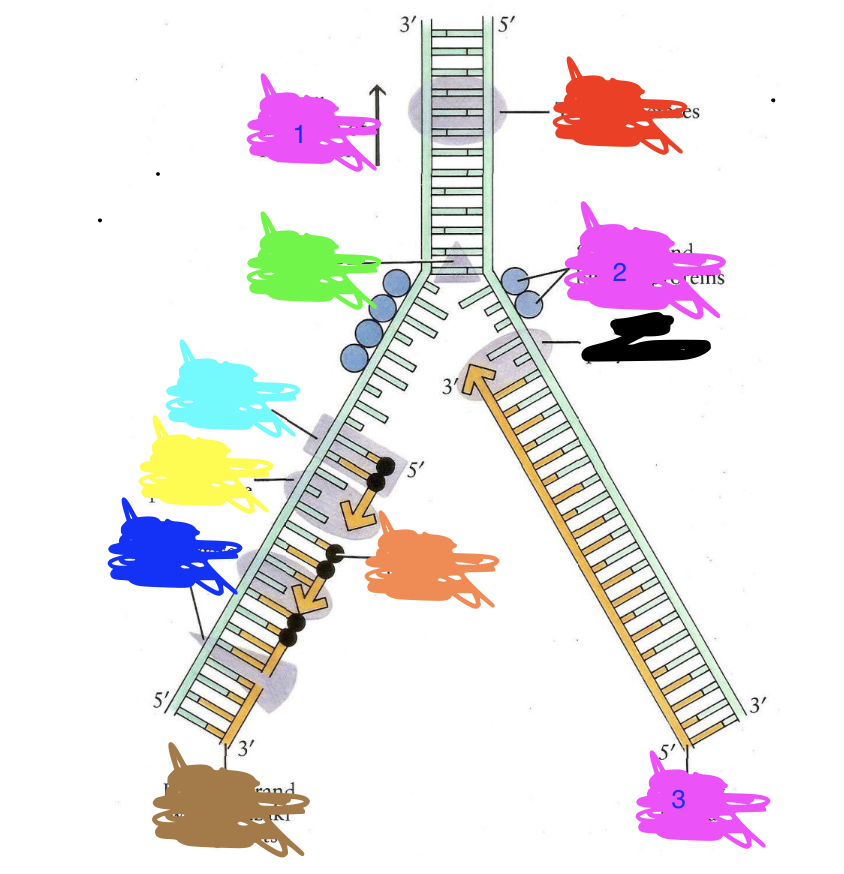
what’s 1
overall direction of replication
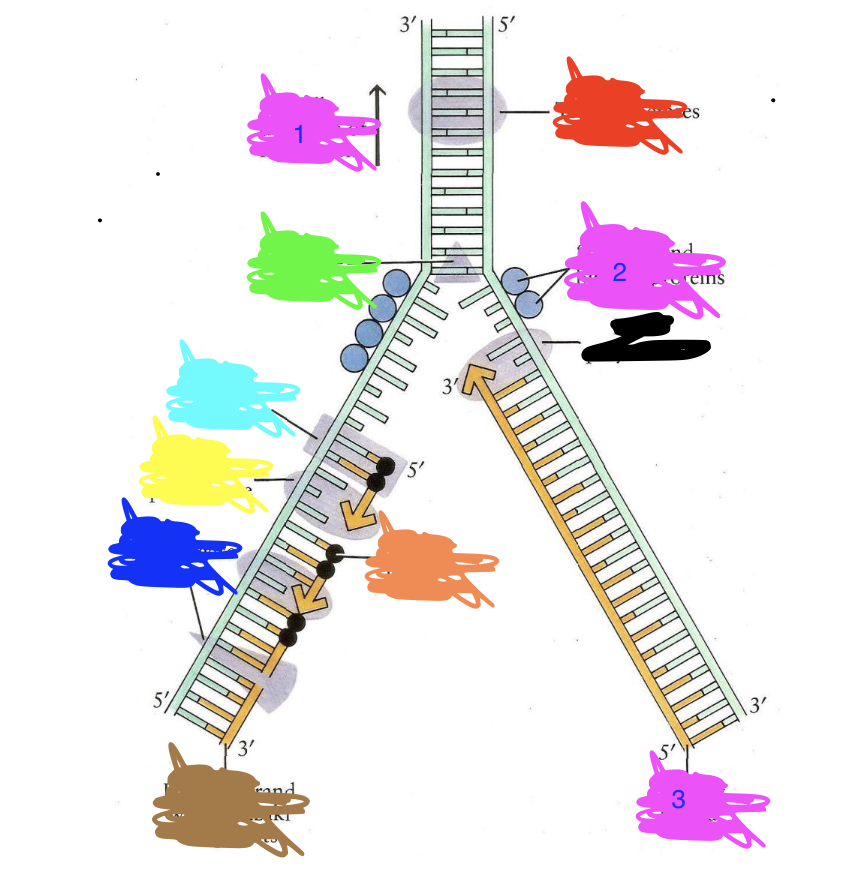
light green
helicase-unzip
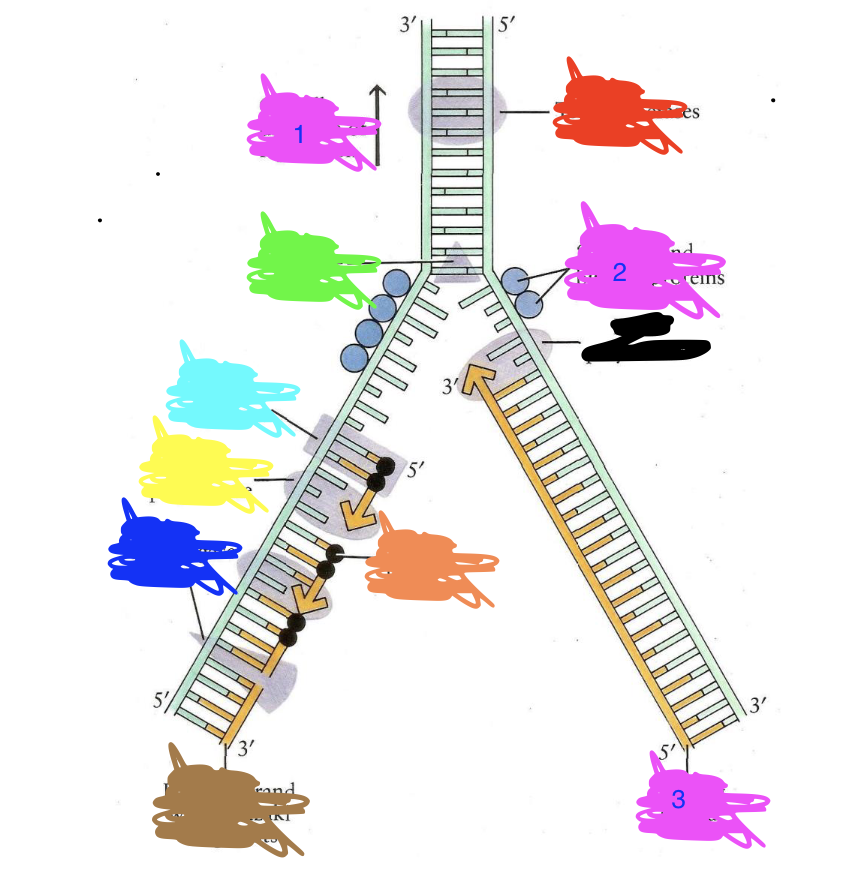
light blue
rna primase
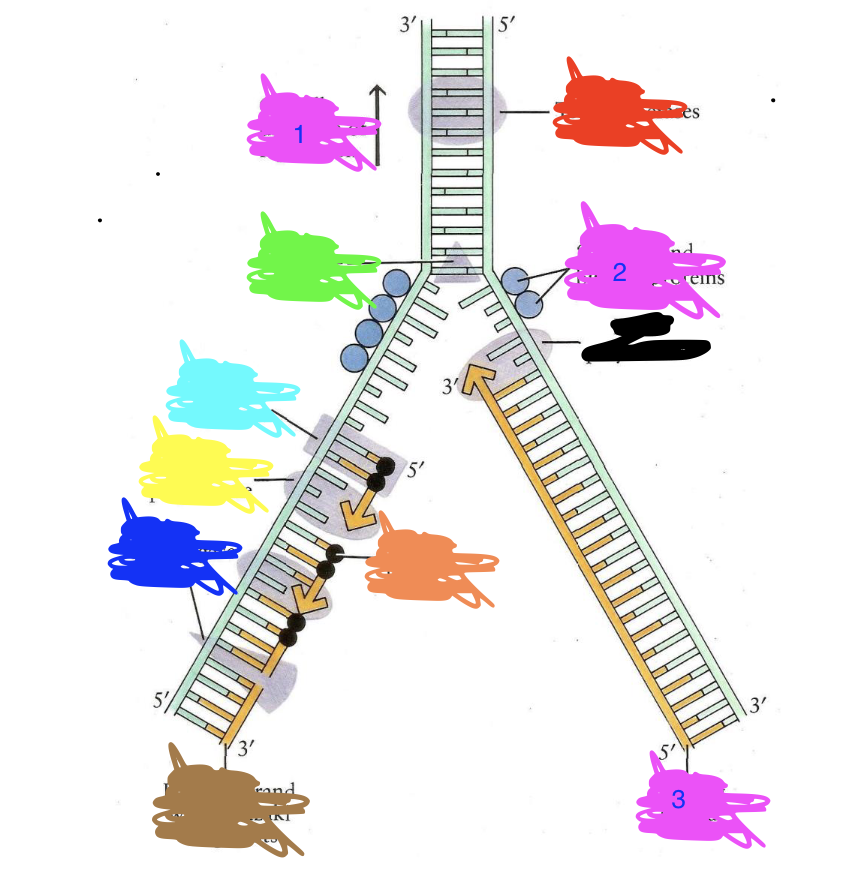
yellow
dna polymerase
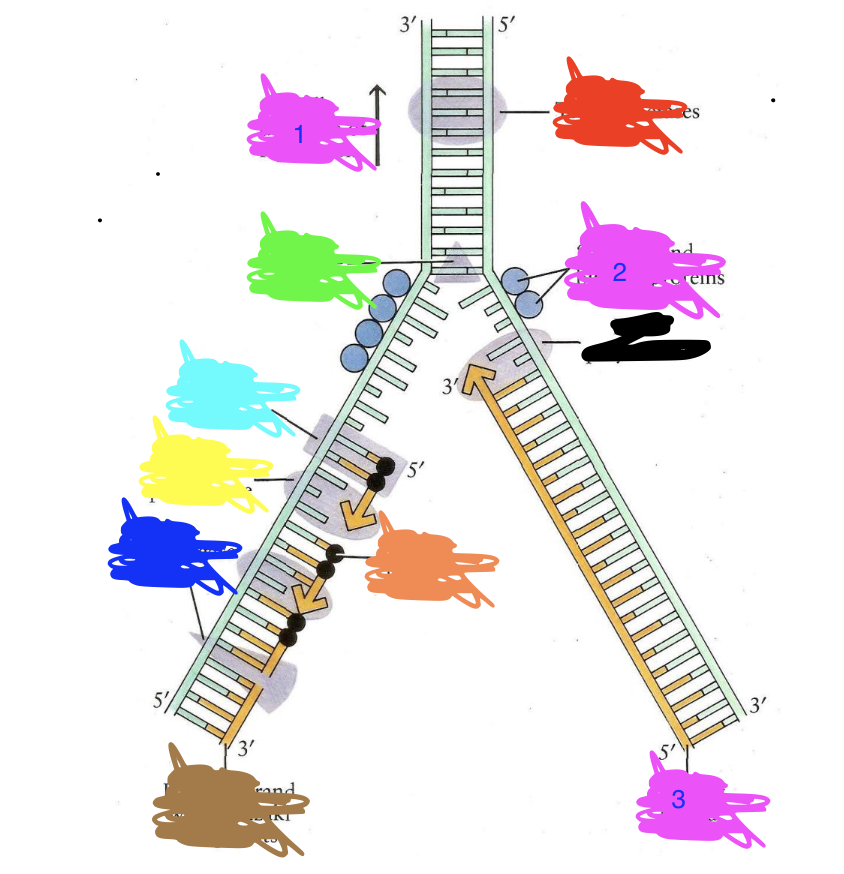
dark blue
dna ligase
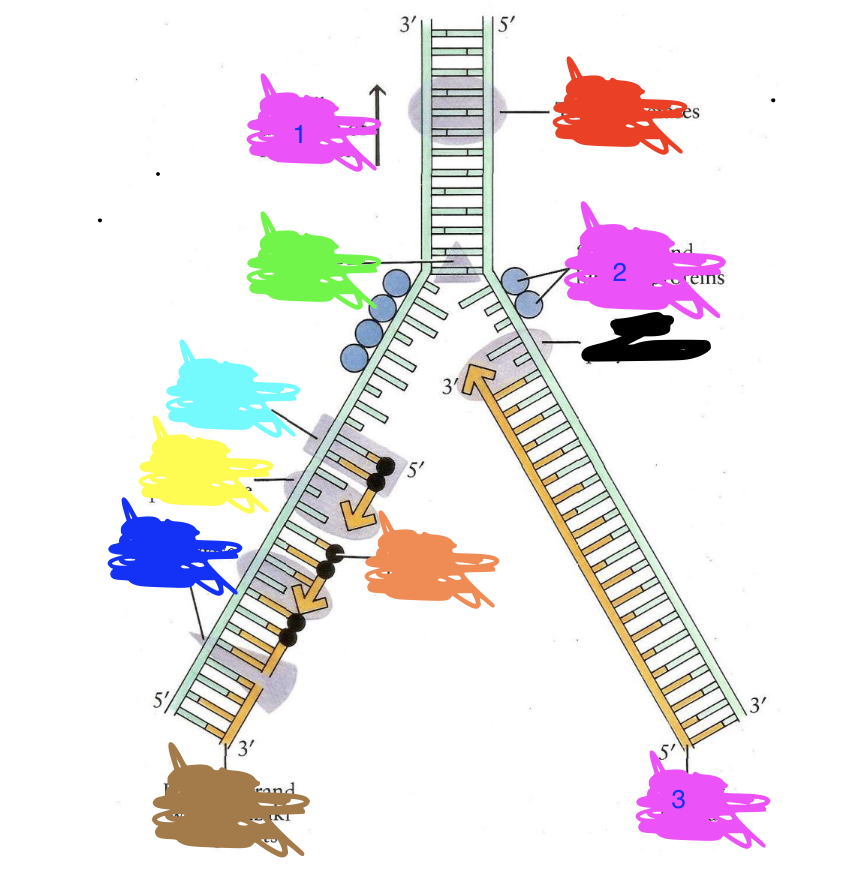
brown
lagging strand with okazaki fragments
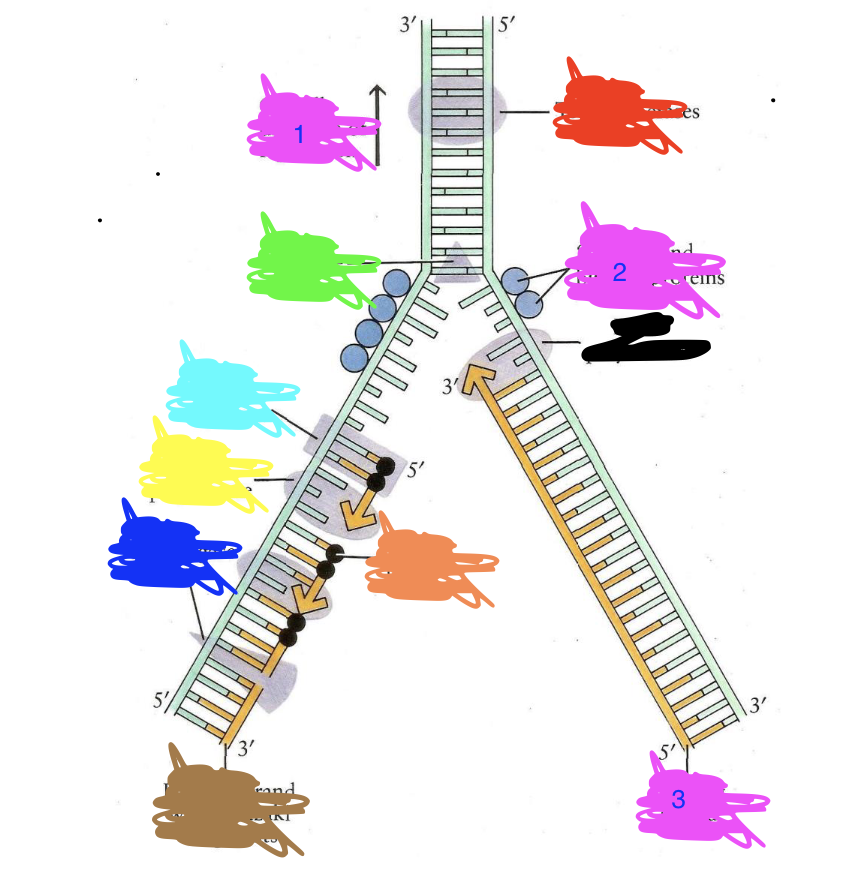
orange
rna primer
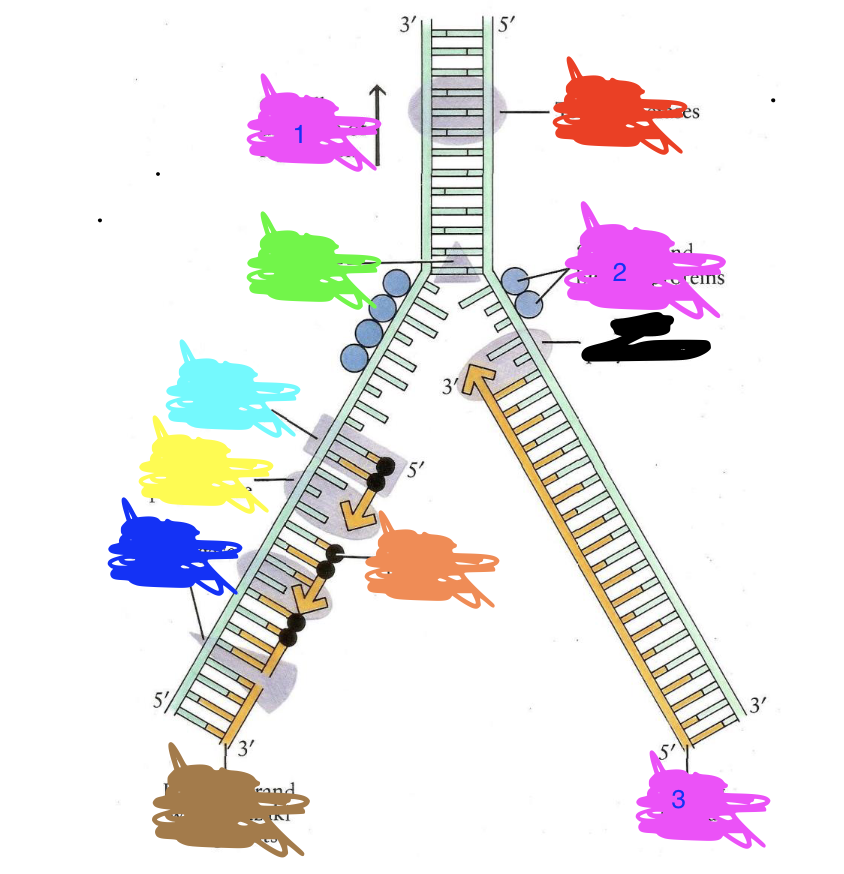
red
topoisomerases
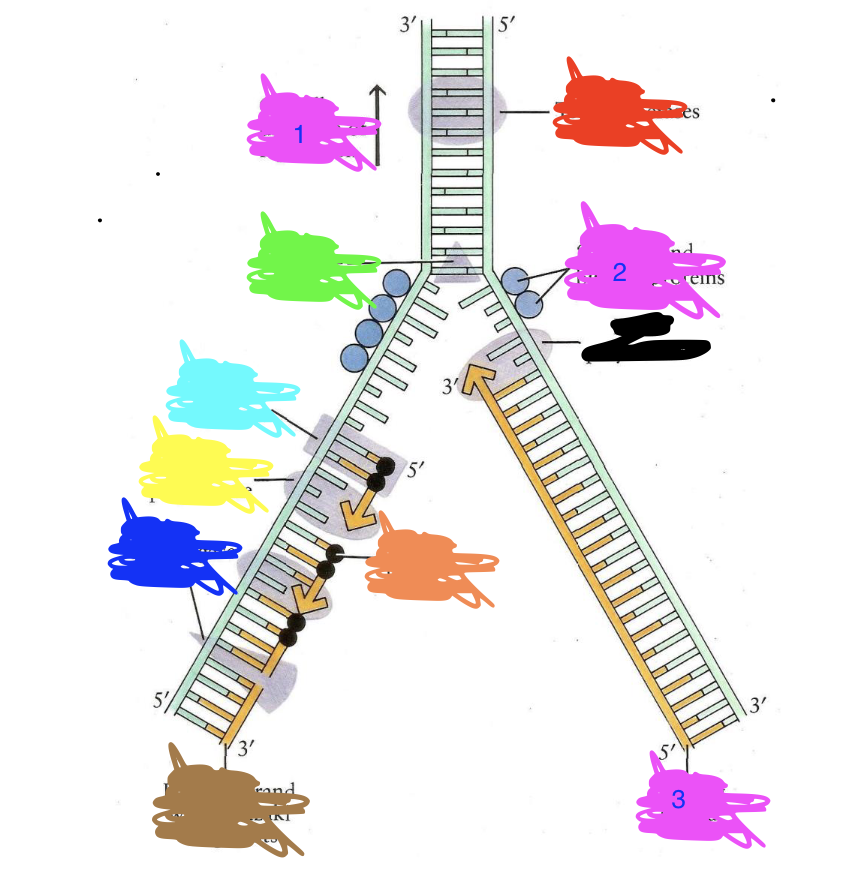
2
single strand binding proteins
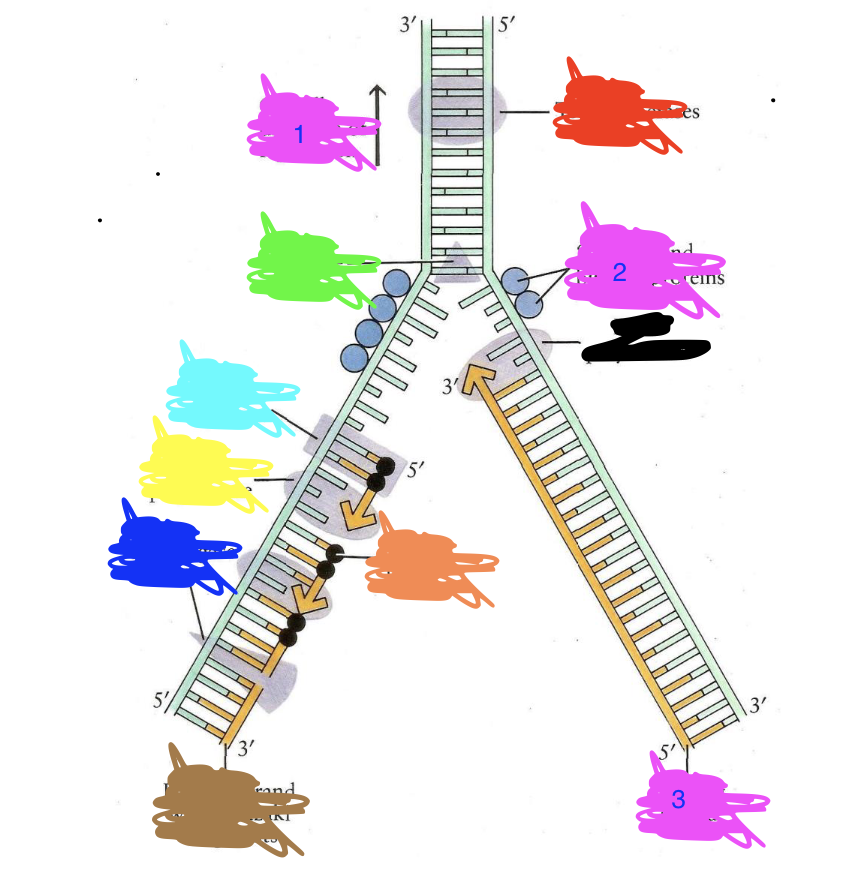
black
dna polymerase
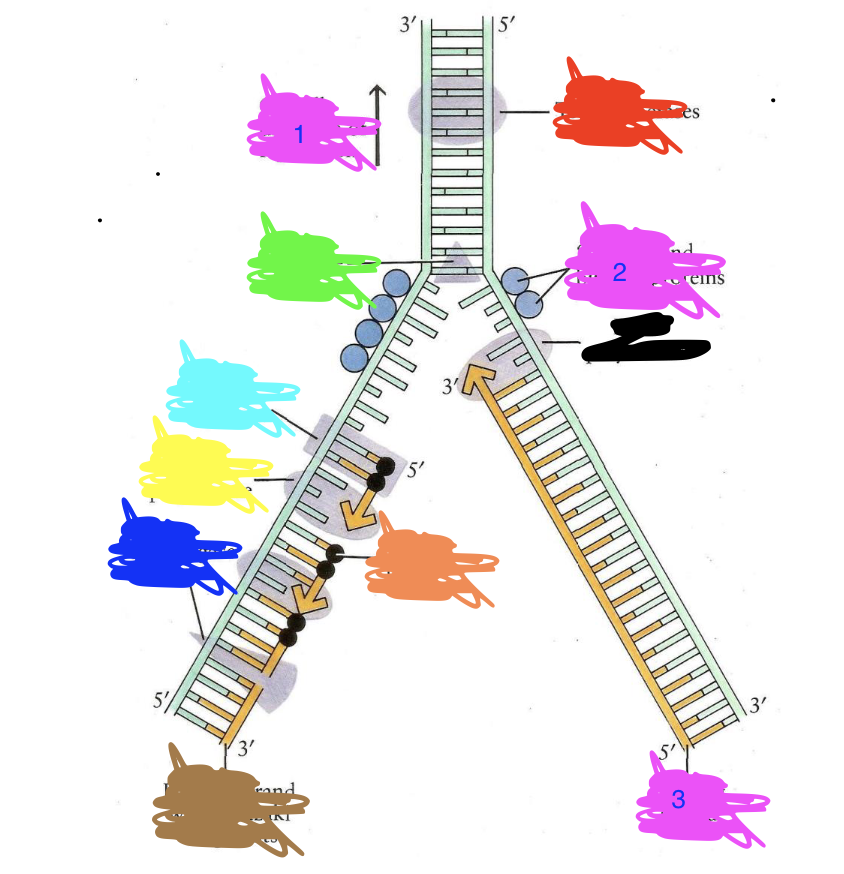
3
leading strand

