CE-CM3: M5 PLANNING & SCHEDULING AON (PRECEDENCE DIAGRAMMING METHOD, PDM)
 Call Kai
 Learn
Learn Practice Test
 Spaced Repetition
 Match
Match Flashcards
 Knowt Play
1/20

There's no tags or description
Looks like no tags are added yet.
Name | Mastery | Learn | Test | Matching | Spaced | Call with Kai |
|---|
No analytics yet
Send a link to your students to track their progress
21 Terms
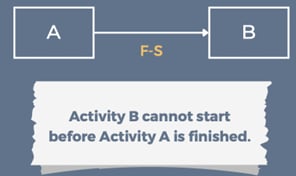
Finish to Start Relationship
The concrete cannot be placed until the formwork has been built.
The doors cannot be hung until door frames have been installed.
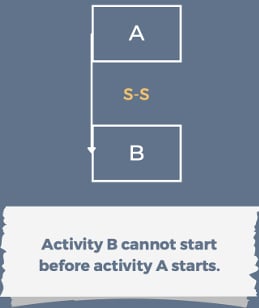
Start to Start Relationship
Excavation of a foundation cannot start until clearing and grubbing begins (usually with a certain lag).
Laying felt on the roof cannot start until sheathing has started (also usually with a lag).
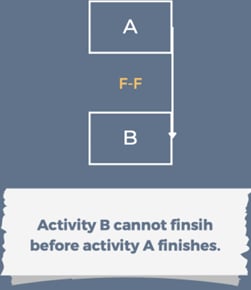
Finish to Finish Relationship
Landscaping cannot be finished until the driveway is finished.
Backfilling a trench cannot finish until the pipe in the trench has been laid.
Start to Finish Relationship
this is uncommon and almost non-existent
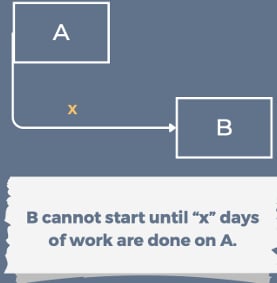
Lag Relationship
this can be shown for any of the normal three precedence relationships and represents a time lag between two activities
Early Start
the earliest time that an activity can start as determined by the latest of the early finish times of all immediately preceding activities
Early Finish
The earliest time an activity can finish. It is determined by adding the duration of the activity to the early start of the activity
EF = ES + duration
Late Start
the latest time that an activity can start without delaying the project completion. It is determined by subtracting the duration of the activity from its late finish
LS = LF – duration
to the early start of the activity (LS = ES + TF)
Late Start t can also be computed by adding the total float of an activity to the____.
Late Finish
The latest that an activity can be finished without delaying the entire project completion. It is computed by adding the total float to the early finish date
(LF = EF + TF)
Free Float
The amount of time that an activity can be delayed before it impacts the start of any succeeding activity.
The smallest lag value of all links leaving from the activity node.
Total Float
The amount of time that an activity can be delayed before it impacts the completion date of the project.
Determined by adding the TF of the last activity to the lag value of the link between the last activity and the immediately preceding activity.
Lag
the amount of time that exists between the early finish of an activity and the early start of a specified succeeding activity
LAG(AB) = ES(B) - EF(A)

Nodes
will be represented with squares/rectangles to identify the diagram as a node diagram. Node defines the “start side” and “end side. ”
Milestone
usually drawn as diamonds to emphasize that they have no duration; thus no sides.
Do not connect nodes from top to bottom. Connect only the sides
Recommendations for Proper Node Diagram Drawing state that:
left side represents the start side, and the right side represent the end (finish) side.
They should be designed from left to right in an almost chronological order
Recommendations for Proper Node Diagram Drawing state that:
“Relationship lines can be horizontal, inclined, or broken, however, they should be positioned, in general, from left to right.
Do not combine relationship lines
Recommendations for Proper Node Diagram Drawing state that:
These relationships are independent from their start to their end. Besides, one of them may carry a lag while the other one may not (or may carry a different lag).
Try to minimize line crossings
Recommendations for Proper Node Diagram Drawing state that:
When two lines must intersect, make a “jump” on one of them to indicate that they do not intersect or meet.
Start the network with one node and finish it with one node
Recommendations for Proper Node Diagram Drawing state that:
If the network starts with only one activity, then there is no need for an additional node. If it does not start with only one activity, then insert PS (Project Start) milestone node at the start and tie it to those activities that start the network.
Redraw the network diagram if needed
Recommendations for Proper Node Diagram Drawing state that:
Redraw to minimize lines crossing and relocate activities to be as near as possible to their predecessors and successors.

