Chapter 17: Intro to Metabolism and Fatty Acid Oxidation
 Studied by 0 people
 Call Kai
 Learn
Learn Practice Test
 Spaced Repetition
 Match
Match Flashcards
 Knowt Play
1/15

There's no tags or description
Looks like no tags are added yet.
Name | Mastery | Learn | Test | Matching | Spaced | Call with Kai |
|---|
No analytics yet
Send a link to your students to track their progress
16 Terms
What is metabolism?
Metabolism is the sum of all chemical reactions that occur in living organisms to maintain life. It is divided into two main processes:
Catabolism: Breakdown of molecules to release energy.
Anabolism: Synthesis of complex molecules using energy.
Metabolism is responsible for energy production, biosynthesis, and waste elimination.
What are Catabolism and Anabolism? How are they related? What examples were discussed?
Catabolism: Decomposes large molecules into smaller ones, releasing ATP and reducing equivalents (NADH, FADH₂).
Example: Glycolysis, Fatty Acid Oxidation (Beta-Oxidation).
Anabolism: Uses energy to build complex biomolecules.
Example: Gluconeogenesis, Fatty Acid Synthesis.
Relation: They are opposing pathways but linked through energy carriers (ATP, NADH, NADPH, FADH₂).
What metabolic pathways exist among organisms?
Phototrophs: Use light energy (e.g., plants).
Chemotrophs: Obtain energy from chemical compounds (e.g., animals, fungi).
Autotrophs: Use CO₂ as a carbon source (e.g., plants, cyanobacteria).
Heterotrophs: Use organic carbon sources (e.g., humans, bacteria).
What are chemotrophs?
Chemotrophs extract energy from chemical compounds through oxidation-reduction (redox) reactions.
Examples: Humans, fungi, and many bacteria.
Types:
Chemoautotrophs: Use inorganic molecules (H₂, Fe²⁺) as an energy source.
Chemoheterotrophs: Use organic molecules (glucose, fatty acids) as an energy source.
What are phototrophs?
Phototrophs convert light energy into chemical energy through photosynthesis.
Example: Plants, algae, cyanobacteria.
Process:
Light excites electrons → Energy is used to produce ATP & NADPH → Drives carbon fixation into glucose.
What are autotrophs?
Autotrophs fix carbon from CO₂ to synthesize their own organic molecules.
Types:
Photoautotrophs: Use light + CO₂ (e.g., plants, cyanobacteria).
Chemoautotrophs: Use inorganic molecules + CO₂ (e.g., nitrifying bacteria).
What are heterotrophs?
Heterotrophs obtain carbon from organic molecules (e.g., glucose, amino acids).
Types:
Photoheterotrophs: Use light for energy, but need organic carbon (e.g., some bacteria).
Chemoheterotrophs: Use organic compounds for both energy and carbon (e.g., humans, animals).
How are metabolic pathways regulated in general?
Feedback inhibition: End product inhibits earlier enzymes in the pathway.
Allosteric regulation: Small molecules activate or inhibit enzymes.
Covalent modification: Phosphorylation/dephosphorylation regulates enzyme activity.
Gene expression: Regulates enzyme synthesis.
How are ATP, NADH, NADPH, and FADH₂ used to facilitate metabolic reactions?
ATP: Primary energy currency, powers anabolic reactions.
NADH & FADH₂: Electron carriers that donate electrons to the electron transport chain (ETC) for ATP production.
NADPH: Used in biosynthetic (anabolic) reactions to provide reducing power.
What do ATP, NADH, NADPH, and FADH₂ look like?
ATP: Adenine base, ribose sugar, three phosphate groups (high-energy bonds).
NADH & NADPH: Nicotinamide ring accepts electrons as hydride ions (H:⁻).
FADH₂: Flavin ring accepts two hydrogen atoms.
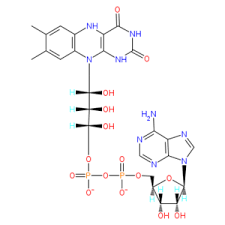
What are the reduced vs. oxidized forms of NADH, NADPH, and FADH₂? Where does the reduction/oxidation occur on each molecule?
NAD⁺ → NADH (Reduced at nicotinamide ring).
NADP⁺ → NADPH (Reduced at nicotinamide ring).
FAD → FADH₂ (Reduced at isoalloxazine ring).
How are ATP/GTP used in biochemical pathways?
ATP: Drives endergonic reactions, muscle contractions, and transport.
GTP: Used in protein synthesis (ribosomes) and signal transduction (G-proteins).
What is a more reduced vs. more oxidized form of carbon, and what do the molecules look like?
Reduced forms (high energy): Alkanes (-CH₃), Alcohols (-OH).
Oxidized forms (low energy): Carboxylic acids (-COOH), CO₂.
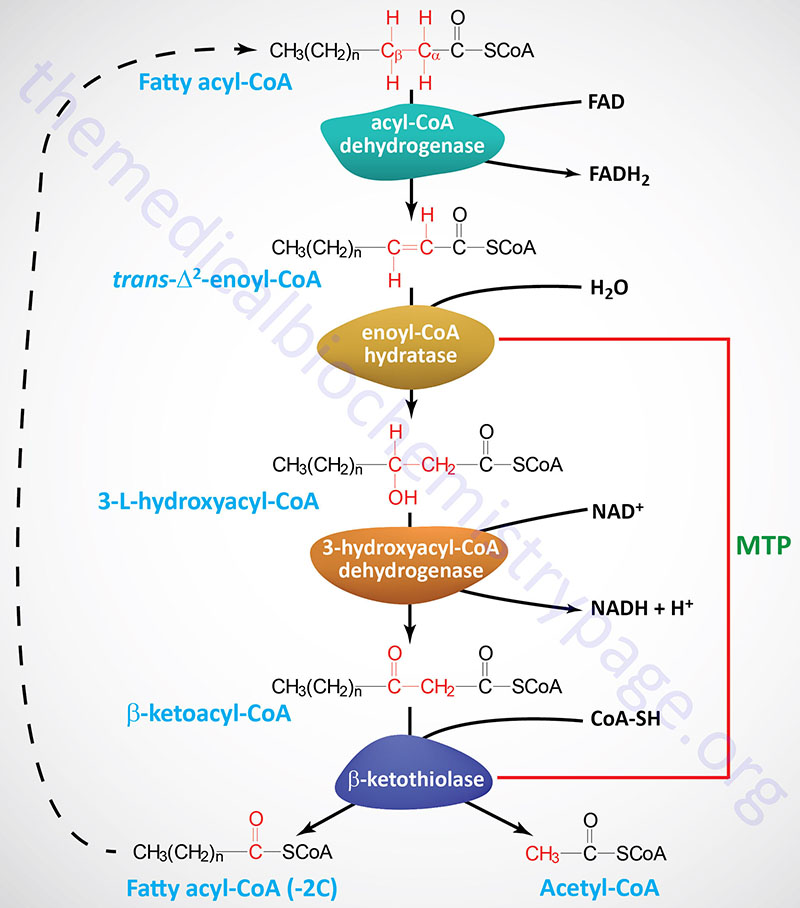
What is Fatty Acid Oxidation (Beta-Oxidation), why does it occur, where does it happen, what are the reaction steps, what enzymes are involved, and what intermediates are formed?
Why? To generate ATP from stored fat.
Where? Mitochondria (Liver, Muscle cells).
Steps:
Activation (Fatty acid + CoA → Acyl-CoA) by Acyl-CoA Synthetase.
Transport into mitochondria via Carnitine Shuttle.
Beta-Oxidation cycles (Each cycle removes 2 carbons as Acetyl-CoA).
Enzymes & Reactions:
Acyl-CoA Dehydrogenase: Creates a double bond.
Enoyl-CoA Hydratase: Adds H₂O.
L-Hydroxyacyl-CoA Dehydrogenase: Forms keto group.
Thiolase: Cleaves Acetyl-CoA & shortens chain.
Final Products: Acetyl-CoA, NADH, FADH₂.
What is Ketogenesis, why does it occur, where does it happen, what are the final products?
Why? Occurs when glucose is low, providing alternative energy for the brain.
Where? Liver mitochondria.
Steps:
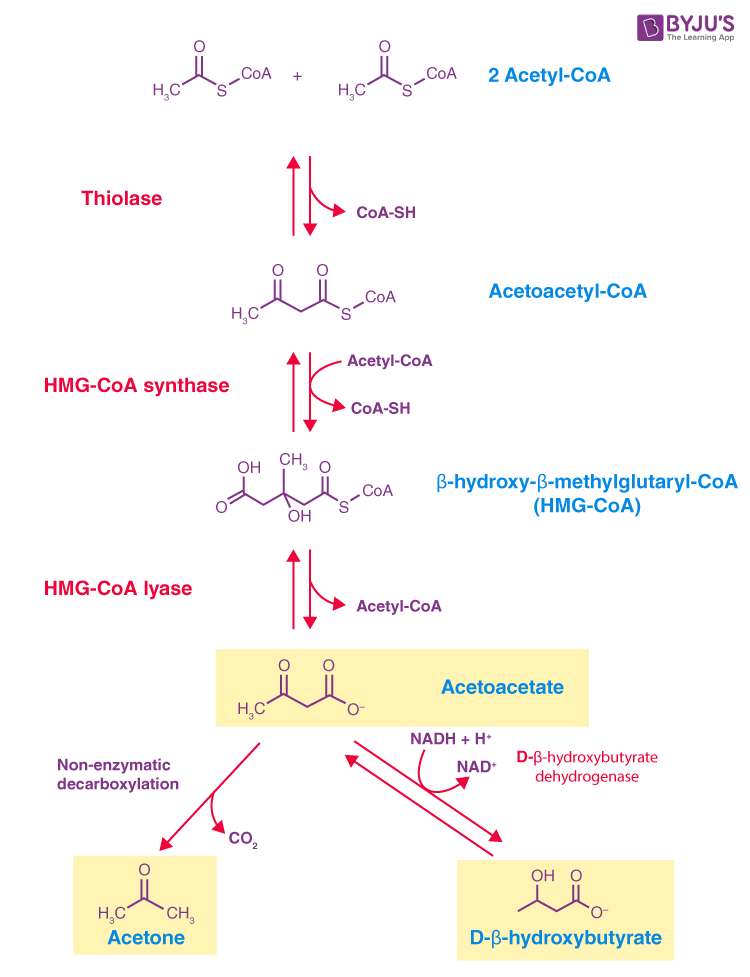
Acetyl-CoA accumulation (from Beta-Oxidation).
Conversion to ketone bodies:
Acetoacetate → Converted to β-hydroxybutyrate or acetone.
Final Products:
Acetoacetate, β-Hydroxybutyrate, Acetone (can cross blood-brain barrier).
What is Diabetic Ketoacidosis, how does it happen, and what are the symptoms?
Cause:
Type 1 Diabetes (low insulin → high glucagon).
Excess ketogenesis → blood acidification.
Symptoms:
Fruity breath (from acetone).
Deep, rapid breathing (to expel CO₂).
Nausea, vomiting, confusion.
Severe dehydration (due to hyperglycemia —> really high blood sugar bc body doesn’t have enough insulin).
 Note
Note  Flashcards (42)