[PO2] Convergence and its Anomalies
 Call Kai
 Learn
Learn Practice Test
 Spaced Repetition
 Match
Match Flashcards
 Knowt Play
1/30

There's no tags or description
Looks like no tags are added yet.
Name | Mastery | Learn | Test | Matching | Spaced | Call with Kai |
|---|
No analytics yet
Send a link to your students to track their progress
31 Terms
Vergence
⭐ simultaneous, coordinated movement of both eyes in opposite directions to maintain single binocular vision and focus on objects at varying distances
⭐ it is a crucial function of the visual system that allows for proper depth perception and spatial awareness.
⭐ can be horizontal, vertical, or torsional
Tonic
Fusional
Accomodative
Proximal
TYPES OF VERGENCE
Tonic Vergence
⭐ when looking at far / at rest
⭐ Vergence produced by the normal tone of the extraocular muscles.
⭐ Occurs without accommodation (no focusing effort).
⭐ Occurs without any stimulus for binocular fusion.
⭐ Moves the eyes from the anatomical position of rest (the position if the eyes had no nerve stimulation).
⭐ Brings the eyes to the physiological position of the eyes, which is their normal resting alignment when the muscles have tone.
⭐ even when you are not looking at anything, your eye muscles are not completely relaxed. They naturally keep the eyes a little bit turned inward.
Fusional Vergence
⭐ movement of both eyes that enables the fusion of monocular images producing binocular vision
⭐ sometimes your two eyes see slightly different pictures. Your brain quickly moves the eyes so the pictures match and become one.
Accommodative Vergence
⭐ Vergence that occurs when the eyes accommodate (focus).
⭐ The stimulus for accommodative vergence is blurred retinal images.
⭐ Accommodative vergence is measured using the AC/A ratio.
⭐ The AC/A ratio shows how much convergence occurs for a certain amount of accommodation.
⭐ when you look at something VERY close, your eyes focus and turn inward at the same time.
Proximal Vergence
⭐ due to the awareness of a fixation object near or far in the absence of disparity and of cues for accommodation.
⭐ this includes also vergence that is due to a subject’s intent to fixate an object in the dark.
⭐ this happens when your brain knows something is close, so your eyes prepare by turning inward.
AC/A Ratio
⭐ measurement of the convergence induced by accommodation per diopter of accommodation
⭐ Use: To determine the change in accommodative convergence that occurs when the patient accommodates a given amount.
⭐ Unit: Prism Diopters/1 Lens diopter
⭐ Normal ranges: 3-5 prism diopter (ex: 3:1, 5:1)
example:
⭐ 2:1 = insufficiency
⭐ 6:1 = high ratio
Examination of Vergence
⭐ Important information needed to evaluate vergence abnormalities:
Ocular alignment measurements (e.g. H test)
Near point of convergence (NPC)
Near point of accommodation (NPA)
Fusional vergence amplitudes
AC/A ratio (Accommodative Convergence / Accommodation)
⭐ With this data then we can separate disorders of vergence from other disorders of oculomotor alignment, disorders of convergence from disorders of divergence and convergence or divergence excess from insufficiency syndrome.
B/R Recording
⭐ When testing convergence, you move a small target (like a pen) slowly toward the patient’s nose.
Example Recording
⭐ If the patient sees double at 8 cm and single again at 12 cm, you write:
NPC = 8 cm / 12 cm (B/R)
8 cm = Break
12 cm = Recovery
Break point (B/R Recording)
⭐ This is the point where the patient first sees double (nag-double).
Recovery point (B/R Recording)
⭐ After the patient reports double vision, you move the target away.
⭐ The point where the patient sees single again (nag-isa ulit) is the (BLANK).
Near Point of Accommodation (NPA)
⭐ the closest distance at which your eye can clearly focus on an object.
⭐ It is the nearest point where you can see something clearly without it becoming blurry.
Example
⭐ If you slowly bring a book or your finger toward your eyes:
At first, you see it clearly.
When it becomes too close, it becomes blurry.
⭐ The distance just before it becomes blurry is the (BLANK).
Convergence Insufficiency
Convergence Excess
Divergence Insufficiency
Divergence Excess
ANOMALIES OF VERGENCE
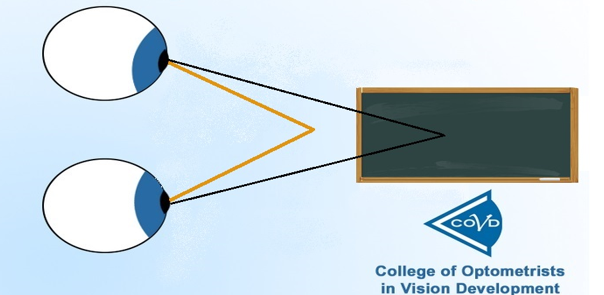
Convergence Insufficiency (CI)
Meaning:
⭐ A sensory and neuromuscular problem of the binocular vision system, characterized by a reduced ability of the eyes to turn towards each other or sustain convergence.
What happens:
⭐ The eyes struggle to turn inward when looking at something close.
⭐ There is a reduced ability of the eyes to turn toward each other or maintain convergence.
Example test – Pencil Test (Near Point of Convergence):
A pencil is slowly moved toward the patient’s nose.
The patient says when the pencil starts to double (Break).
The pencil is moved back until the patient sees single again (Recovery).
⭐ If the doubling happens too early, it suggests convergence insufficiency.
Symptoms:
⭐ It can cause Diplopia, Blurred Vision,
⭐ Headache when looking at near by things
Simple idea:
➡ The eyes are weak at crossing inward for near work like reading.
Convergence Excess (CE)
Meaning:
⭐ An eye muscle imbalance where the eyes move inward more than needed, especially when looking at near objects.
⭐ We refer it as esophoria or esotropia.
What happens:
⭐ The eyes over-converge during near tasks.
⭐ This can make the eyes work too hard.
Symptoms:
⭐ Blurred Vision at far, near or both; headaches;diplopia; ocular fatigue; excess blinking and head tilting. Dizziness
Treatment:
⭐ Vision Therapy
⭐ Prescription of eyeglass with therapeutic prisms
Simple idea:
➡ The eyes cross too much when focusing on something close.
Divergence Insufficiency (DI)
Definition
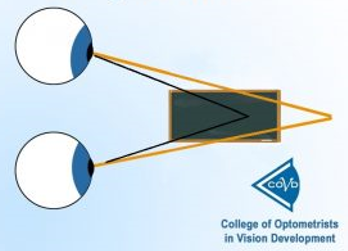
⭐ A condition where there is esotropia or high esophoria at distance.
⭐ Much lower esophoria or normal eye alignment at near.
⭐ Considered an unusual form of strabismus.
⭐ Characterized by esotropia and diplopia only at distance.
⭐ Single binocular vision is usually normal at near.
Symptoms
⭐ Diplopia (double vision)
⭐ Eyestrain
⭐ Headache
⭐ Blurred vision at distance
⭐ Dizziness
Treatment
⭐ Vision therapy
⭐ Prescription eyeglasses with therapeutic prisms
What happens:
⭐ The eyes remain too converged when they should relax outward for distance.
Simple idea:
➡ The eyes cannot spread outward properly when looking far away.
Divergence Excess (DE)
Meaning:
⭐ A condition where the eyes diverge (move outward) more than needed, especially when looking at far objects.
⭐ can be described clinically as exophoria or exotropia at far, greater than the near deviation by at least 10 prism diopters.
What happens:
⭐ One eye may drift outward at distance.
⭐ Often seen in distance viewing situations.
Symptoms:
⭐ Asymptomatic: when the deviation occurs with either deep suppression, asthenopia.
⭐ Some DE patients complain of distance blur because they over accommodate to keep their eyes aligned.
Treatment:
⭐ Vision Therapy
⭐ Base in prisms
⭐ Surgery
Simple idea:
➡ The eyes spread outward too much when looking far away.
Convergence Insufficiency (CI)
AC / A ratio: low
Phoria present: greater exophoria at near
Convergence Excess (CE)
AC / A ratio: high
Phoria present: greater eso at near
Divergence Insufficiency (DI)
AC / A ratio: low
Phoria present: eso greater at distance / far
Divergence Excess (DE)
AC / A ratio: high
Phoria present: greater exo at far
Convergence

Divergence

Right supravergence

Left supravergence

Right infravergence

Left infravergence

In-cyclovergence

Ex-cyclovergence

Divergence Excess
Divergence Insufficiency