Integumentary System & Skin Histology
 Call Kai
 Learn
Learn Practice Test
 Spaced Repetition
 Match
Match Flashcards
 Knowt Play
1/363

There's no tags or description
Looks like no tags are added yet.
Name | Mastery | Learn | Test | Matching | Spaced | Call with Kai |
|---|
No analytics yet
Send a link to your students to track their progress
364 Terms
What are amino acids primarily known as
Building Block of proteins
Amino acids join together through what type of bond?
A. Hydrogen bond
B. Ionic bond
C. Peptide bond
D. Lipid bond
Peptide bond
Two or more amino acids joined together form a:
Peptide
What is the main function of proteins in the skin?
Build and repair tissues
Which protein is primarily responsible for skin strength?
Collagen
Which protein gives the skin its elasticity?
Elastin
Keratin is mainly found in the:
Epidermis
Collagen and elastin are located in the:
Dermis
What happens when protein production decreases in the skin?
Wrinkles and sagging
Proteins help the skin by:
Supporting tissue repair
Enzymes are classified as what type of substance?
Proteins
Essential amino acids must be obtained through:
A. Sun exposure
B. Water intake
C. Diet
D. Exercise
Diet
Where does protein synthesis occur in the cell?
Ribosomes
Peptides in skincare products are used to:
Signal skin to produce more collagen
Why are peptides commonly used in anti-aging products?
They stimulate protein production
What is keratin’s main role?
Protect and strengthen the outer skin
Elastin allows the skin to:
Stretch and return to shape
Amino acids are delivered to the skin through the:
Bloodstream
The breakdown of protein into amino acids occurs during:
Digestion
Why is protein important for wound healing?
It builds new tissue
Touch is considered:
One of the first senses to develop
2. Sensory nerve fibers in the skin are responsible for:
A. Producing oil
B. Detecting stimulation
C. Regulating hormones
D. Producing melanin
Detecting stimulation
3. What is the main role of nerve sensors in the skin?
A. To create proteins
B. To detect environmental changes
C. To regulate blood flow only
D. To form new cells
To detect environmental changes
Which of the following is NOT a sensation detected by nerve sensors?
Digestion
Sensory nerves send messages to the:
Brain
Motor nerves send messages from the brain to the:
Body to create a response
Pulling your hand away from a hot stove is an example of:
Reflex response
What type of nerves are responsible for feeling sensations like touch and pain?
Sensory nerves
Which sensation would most likely trigger an immediate protective reaction?
Palm
Massage affects the body by:
Stimulating nerves and reducing stress
Massage can promote:
Circulation
Increased touch and interaction have been shown to:
Reduce stress levels
Sensory nerve fibers are most abundant in the:
Fingertips
Why are fingertips highly sensitive?
They have a high concentration of nerve endings
What is the function of motor nerves?
Carry responses from the brain to the body
The sensation of cold is detected by:
Nerve receptors
Sensory perception helps the body to:
Respond to environmental changes
Which system is primarily responsible for processing sensory information?
Nervous system
What is the relationship between sensory and motor nerves?
Sensory nerves send signals, motor nerves respond
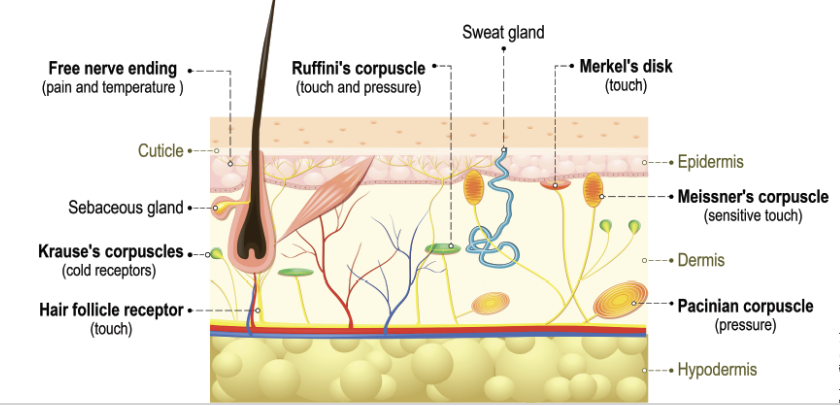
Which nerve receptor is responsible for detecting pain and temperature?
Free nerve endings
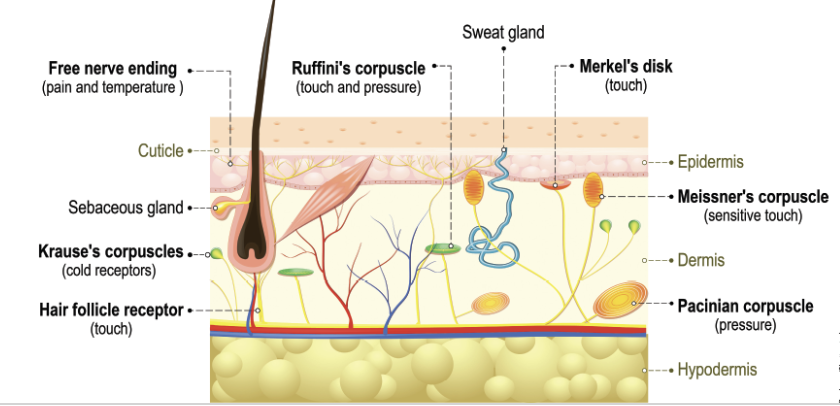
Which receptor is MOST associated with deep pressure?
Pacinian corpuscle
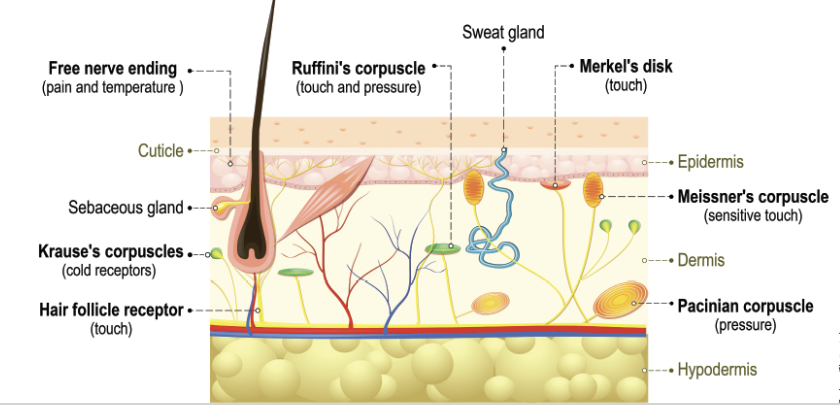
Light, sensitive touch is primarily detected by:
Meissner’s corpuscle
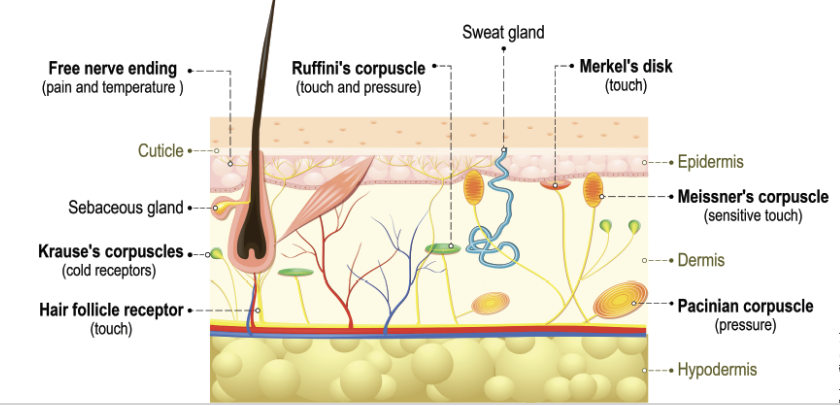
Merkel’s disks are primarily responsible for:
Touch
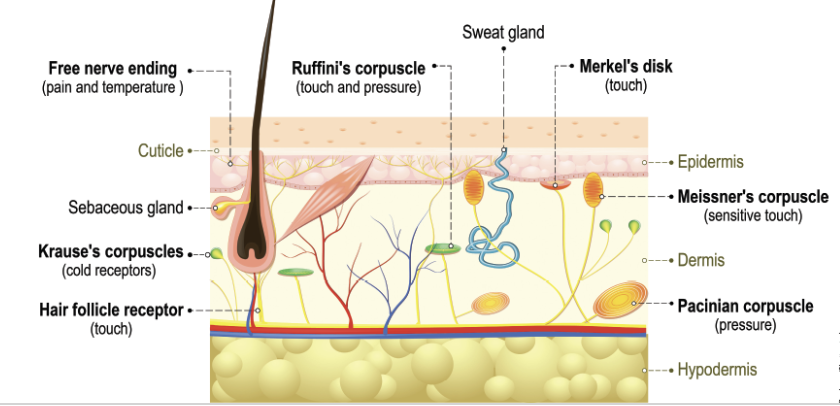
Which receptor detects cold sensations?
Krause’s corpuscles
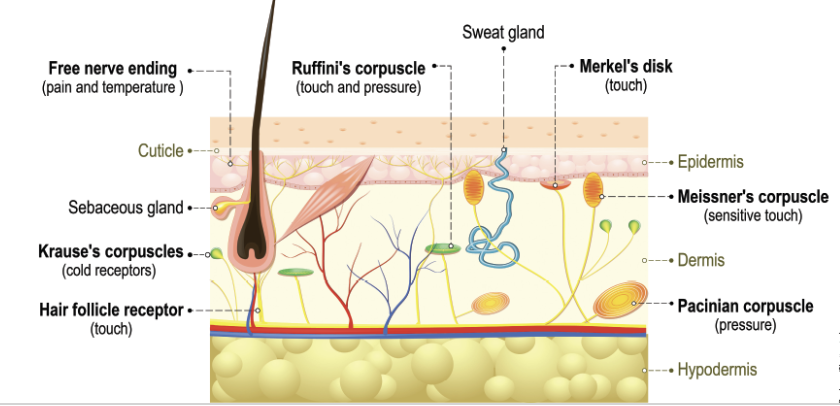
Ruffini’s corpuscles respond to:
Touch and pressure
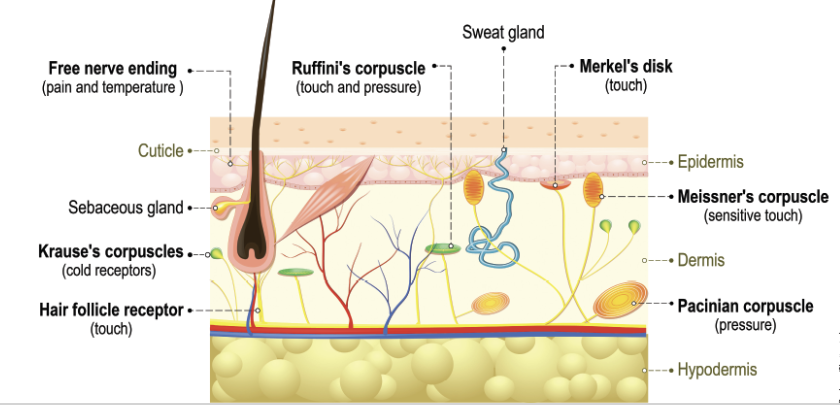
The hair follicle receptor is MOST sensitive to:
Movement of hair/touch
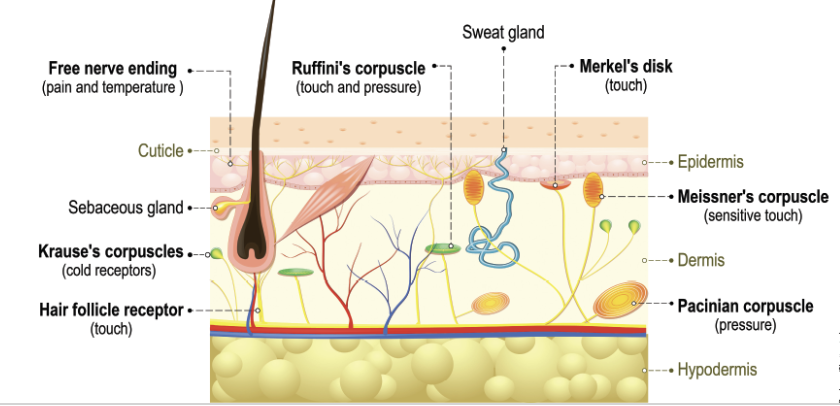
Which layer of the skin contains the most sensory receptors?
Dermis
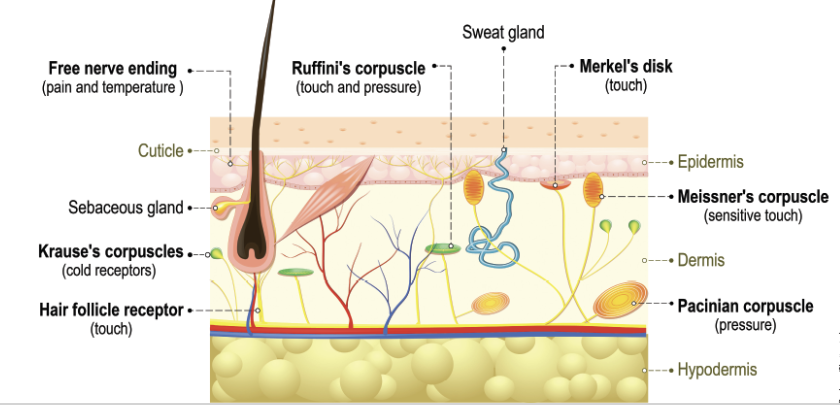
Pacinian corpuscles are typically found in the:
Deep dermis/hypodermis
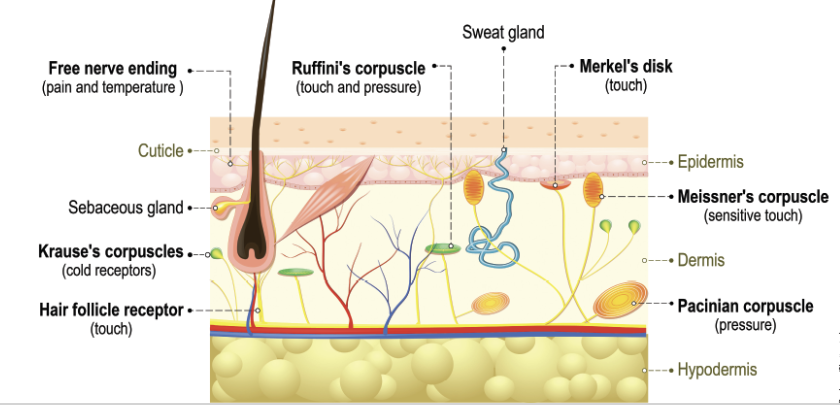
Meissner’s corpuscles are located closer to the:
Epidermis
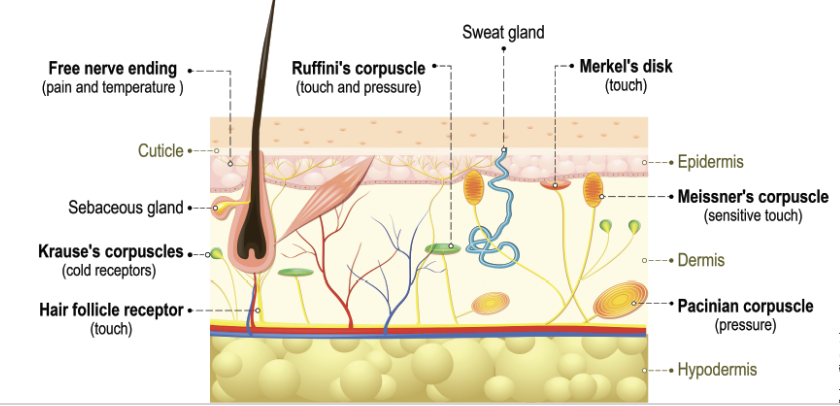
Which structure is responsible for oil production in the skin?
Sebaceous gland
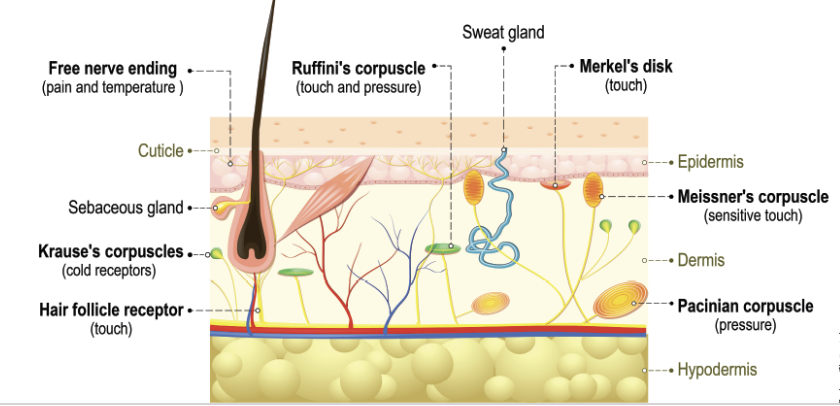
Sweat glands are primarily involved in:
Temperature regulation
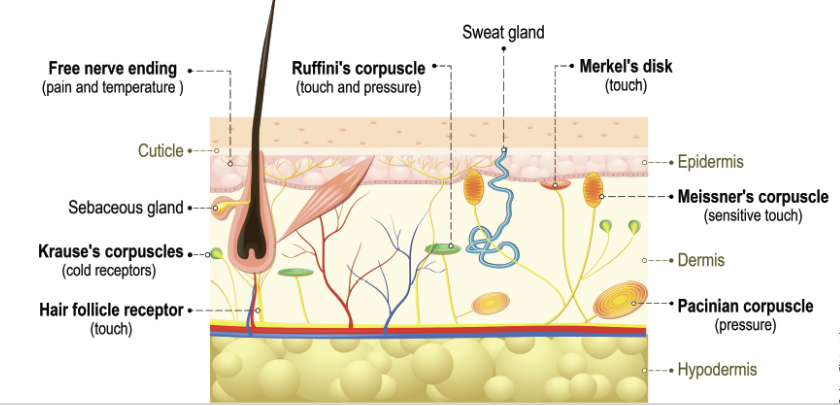
Which receptor would respond FIRST when touching a hot object?
Free nerve endings
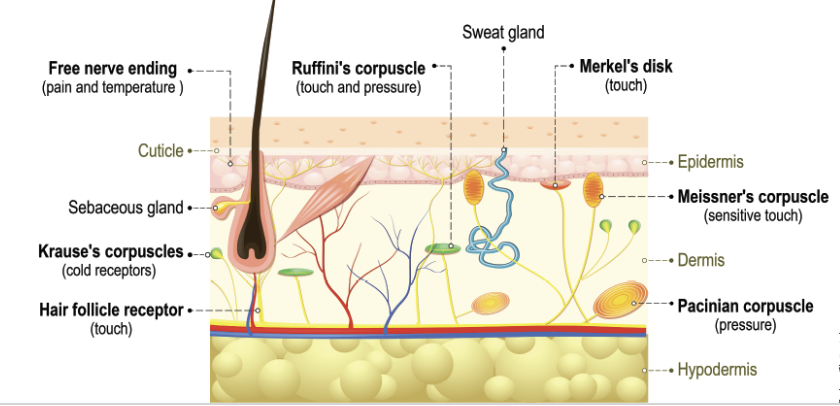
Deep pressure applied during a massage stimulates:
Pacinian corpuscles
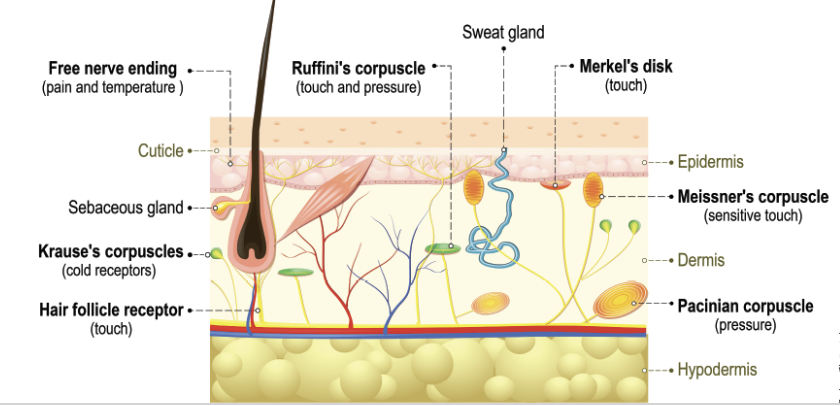
Which receptor is MOST responsible for detecting sustained pressure and skin stretch?
Ruffini’s corpuscle
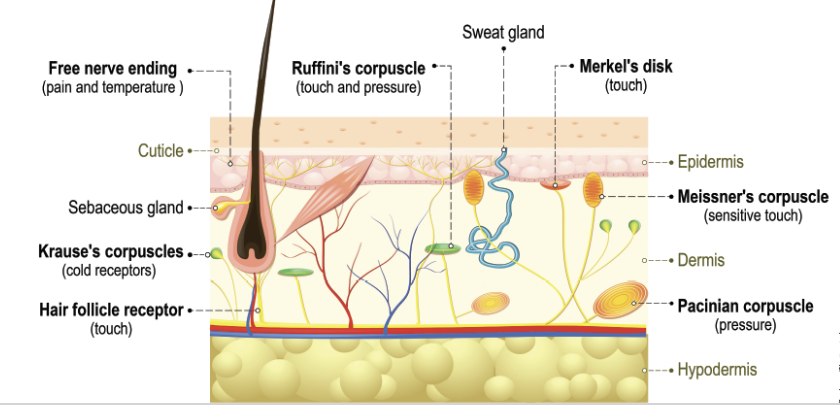
16. The epidermis is BEST described as:
A. The deepest layer
B. The middle layer
C. The outermost layer
D. The fatty layer
The outermost layer
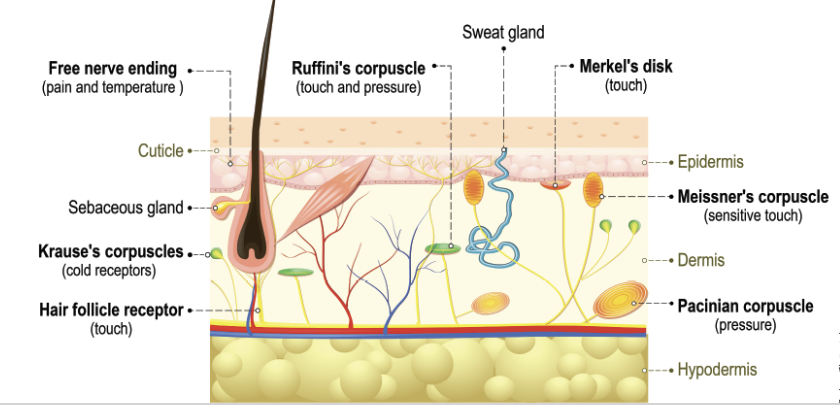
The hypodermis primarily contains:
Fat and connective tissue
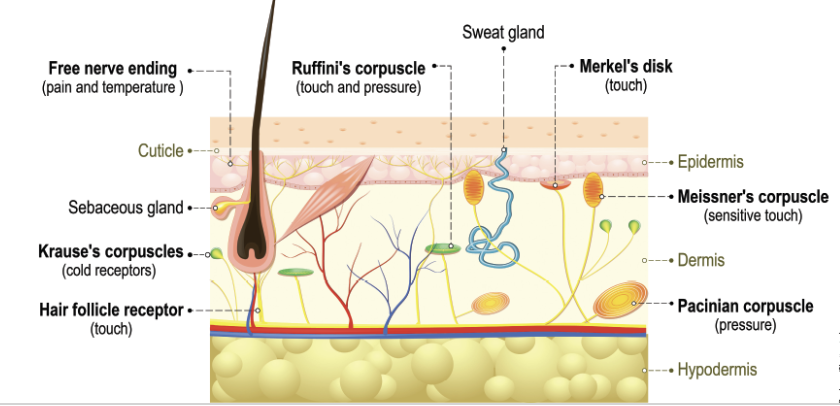
18. Which receptor is MOST sensitive to very light touch and texture?
A. Pacinian corpuscle
B. Meissner’s corpuscle
C. Ruffini’s corpuscle
D. Free nerve endings
Meissner’s corpuscle
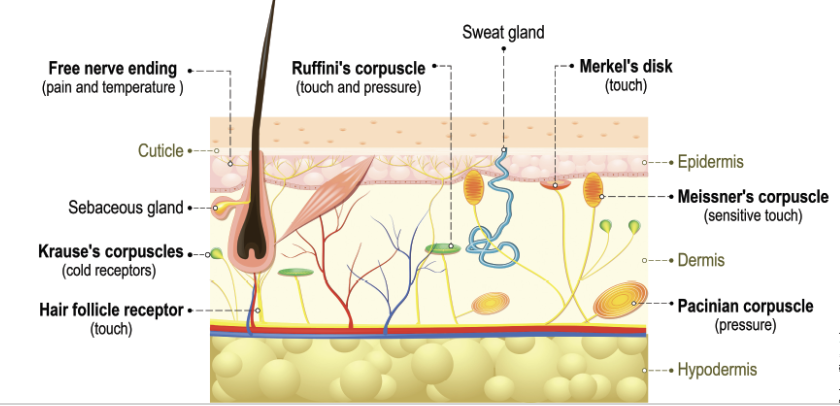
19. Which structure is directly associated with hair movement sensation?
A. Merkel’s disk
B. Hair follicle receptor
C. Pacinian corpuscle
D. Sweat gland
b
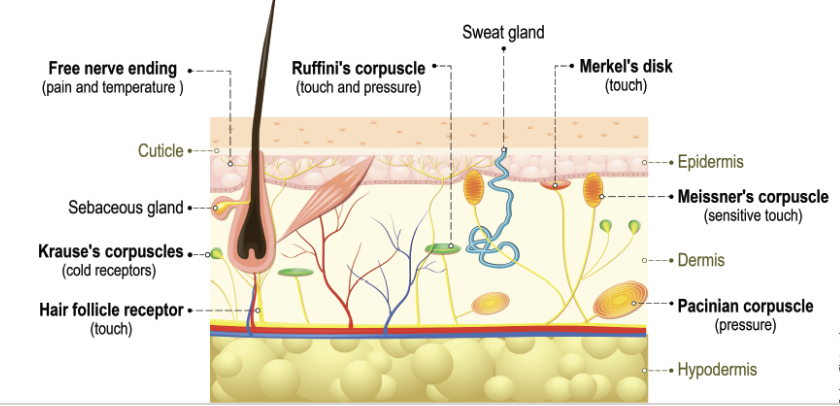
20. Why are multiple receptor types necessary in the skin?
A. To produce oil
B. To detect different types of stimuli
C. To reduce blood flow
D. To increase pigmentation
b
1. The skin is BEST described as:
A. A thick, weak covering
B. A thin, protective barrier
C. A soft internal organ
D. A non-functioning layer
B
2. What is the primary role of sebum on the skin?
A. To dry the skin
B. To exfoliate dead cells
C. To protect against external factors
D. To increase pigmentation
C
3. The acid mantle is composed of:
A. Proteins and enzymes only
B. Sebum, lipids, sweat, and water
C. Blood and oxygen
D. Melanin and keratin
B
4. The hydrolipidic film refers to:
A. Only water on the skin
B. Only oil on the skin
C. Oil-water balance on the skin surface
D. Sweat production
C
5. “Hydro” in hydrolipidic means:
A. Oil
B. Water
C. Protein
D. Acid
B
6. “Lipidic” refers to:
A. Water
B. Protein
C. Oil
D. Enzymes
C
7. The average pH of the acid mantle is:
A. 7.0
B. 4.0
C. 5.5
D. 8.5
C
8. Why is the skin’s pH important?
A. It increases oil production
B. It protects against pathogens and supports enzymes
C. It changes skin color
D. It removes dead skin cells
B
9. The barrier function primarily protects against:
A. Hair loss
B. Irritation and water loss
C. Muscle damage
D. Bone injury
B
10. TEWL stands for:
A. Total epidermal water level
B. Trans epidermal water loss
C. Thermal energy water loss
D. Tissue evaporation water layer
B
11. TEWL refers to:
A. Water gained by the skin
B. Oil production
C. Water loss through evaporation
D. Sweat retention
C
12. Lipids in the skin function to:
A. Dry out the skin
B. Increase sensitivity
C. Protect and maintain barrier function
D. Remove bacteria
C
13. Lipids are found in the:
A. Bloodstream
B. Intercellular matrix
C. Sweat glands
D. Hair shaft
B
14. The intercellular matrix is BEST described as:
A. Dead skin cells only
B. Fluid between epidermal cells
C. Blood vessels
D. Muscle fibers
B
15. Damage to the barrier layer can lead to:
A. Increased hydration
B. Fewer skin issues
C. Sensitivity, aging, and dehydration
D. Hair growth
C
16. The stratum corneum is part of the:
A. Circulatory system
B. Barrier function
C. Digestive system
D. Nervous system
B
17. Which of the following helps prevent TEWL?
A. Removing all oils
B. Strong exfoliation daily
C. Healthy lipid barrier
D. High pH products
C
18. A disrupted acid mantle may result in:
A. Balanced skin
B. Increased protection
C. Increased risk of infection
D. Reduced sensitivity
C
19. Which of the following BEST supports barrier repair?
A. Harsh cleansers
B. Alcohol-based products
C. Lipids and hydration
D. Over-exfoliation
C
20. The skin’s first line of defense against microorganisms is the:
A. Dermis
B. Acid mantle
C. Muscle layer
D. Blood vessels
B
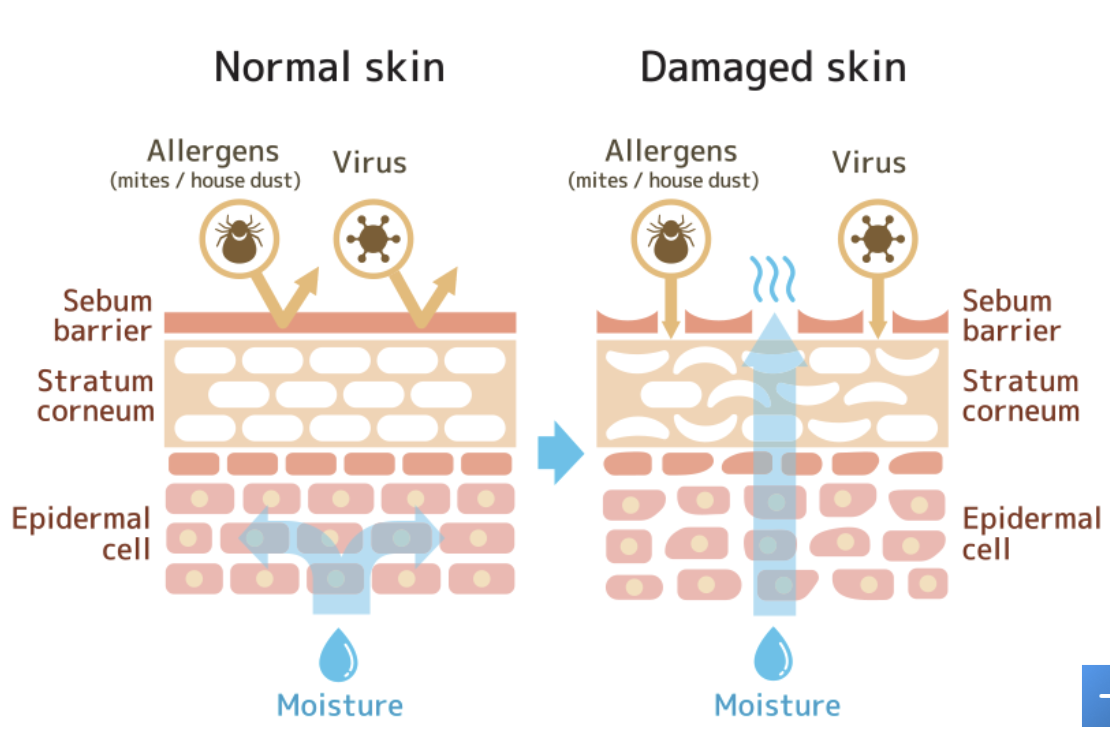
In normal skin, the sebum barrier functions to:
A. Allow water to escape
B. Block moisture from entering
C. Protect against allergens and pathogens
D. Increase TEWL
c
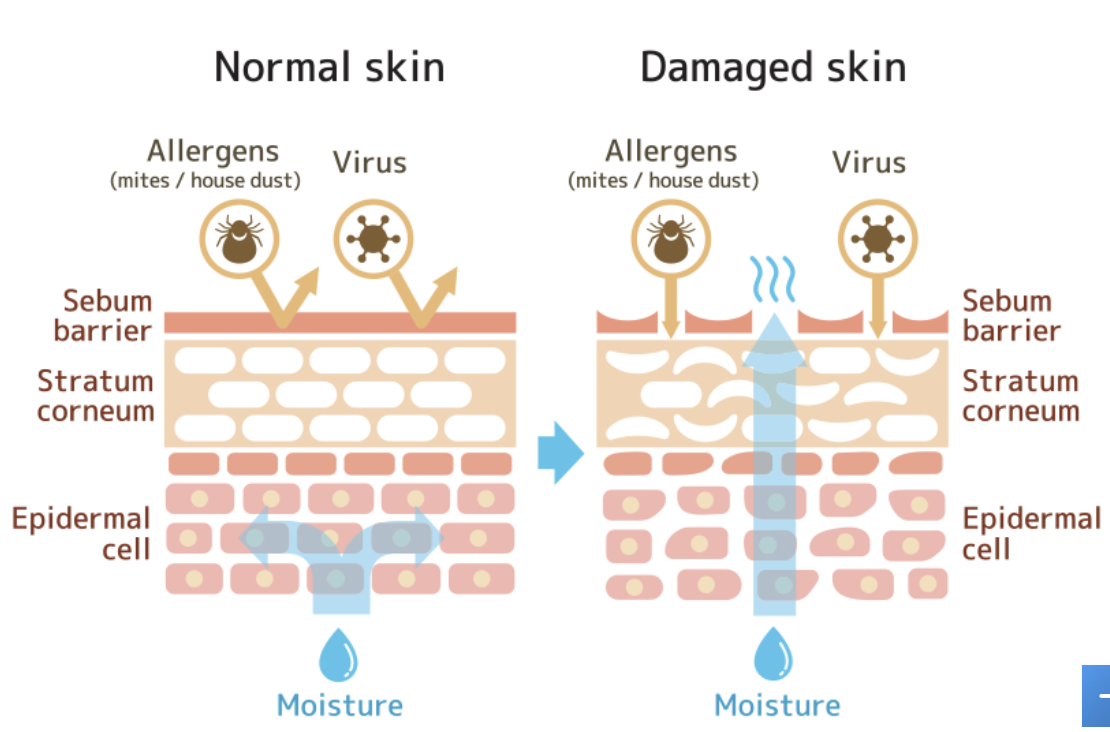
2. The stratum corneum in healthy skin appears:
A. Broken and uneven
B. Loose and separated
C. Compact and tightly packed
D. Missing
c
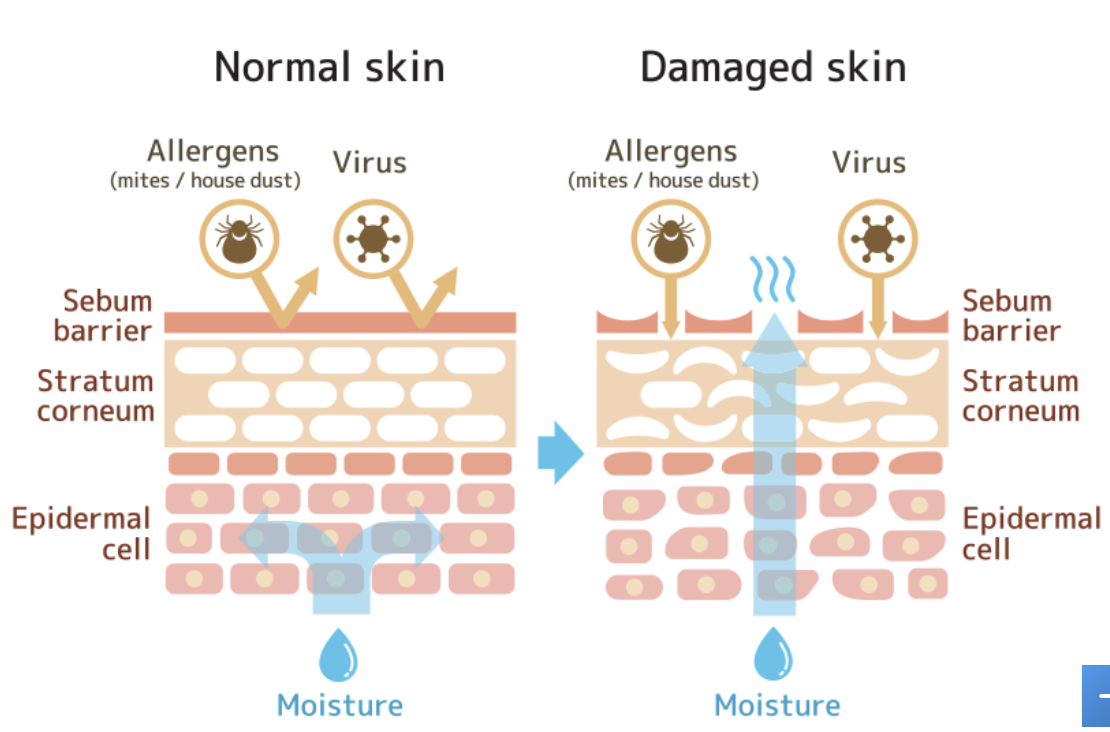
3. In damaged skin, what happens to the barrier?
A. It becomes stronger
B. It becomes thicker
C. It becomes compromised and weak
D. It produces more melanin
c
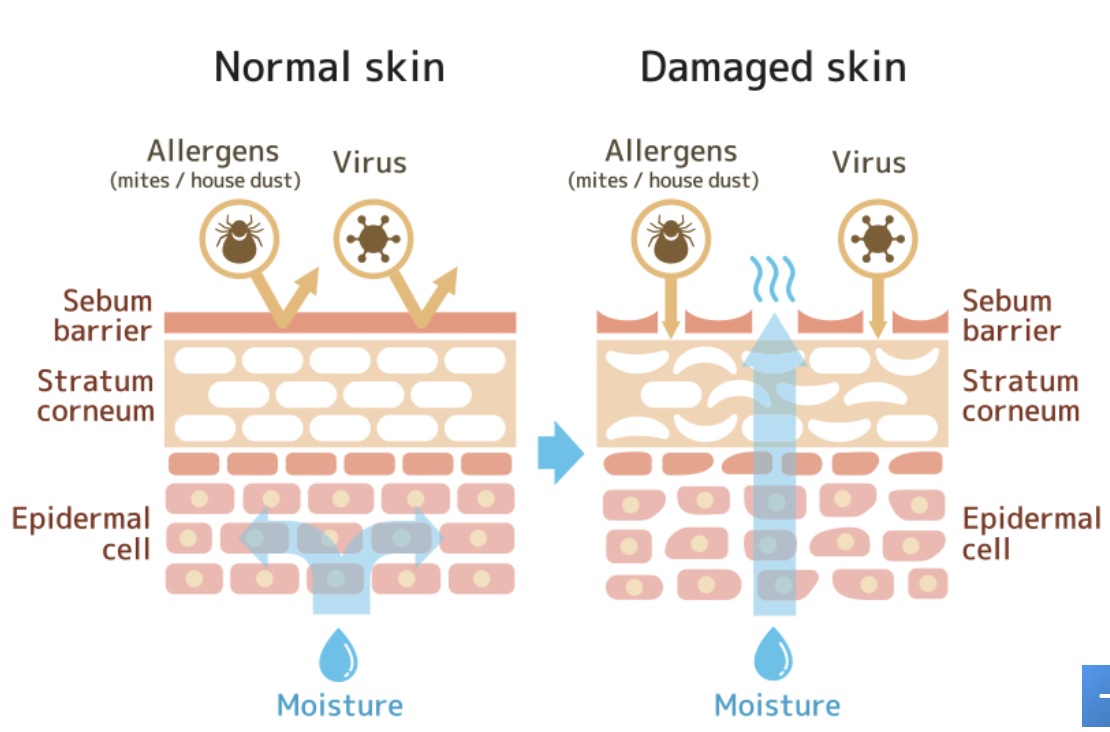
4. TEWL increases when:
A. The barrier is intact
B. The skin is hydrated
C. The barrier is damaged
D. The pH is balanced
b
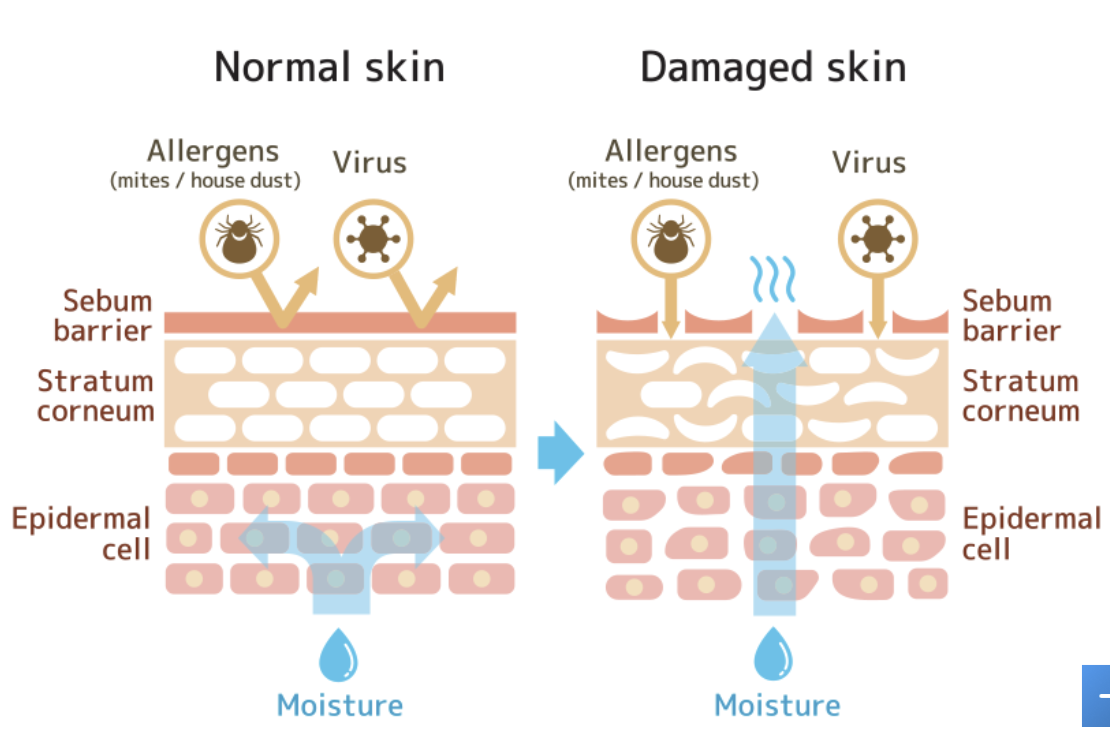
5. In normal skin, moisture is:
A. Rapidly lost
B. Properly retained
C. Blocked completely
D. Converted to oil
B
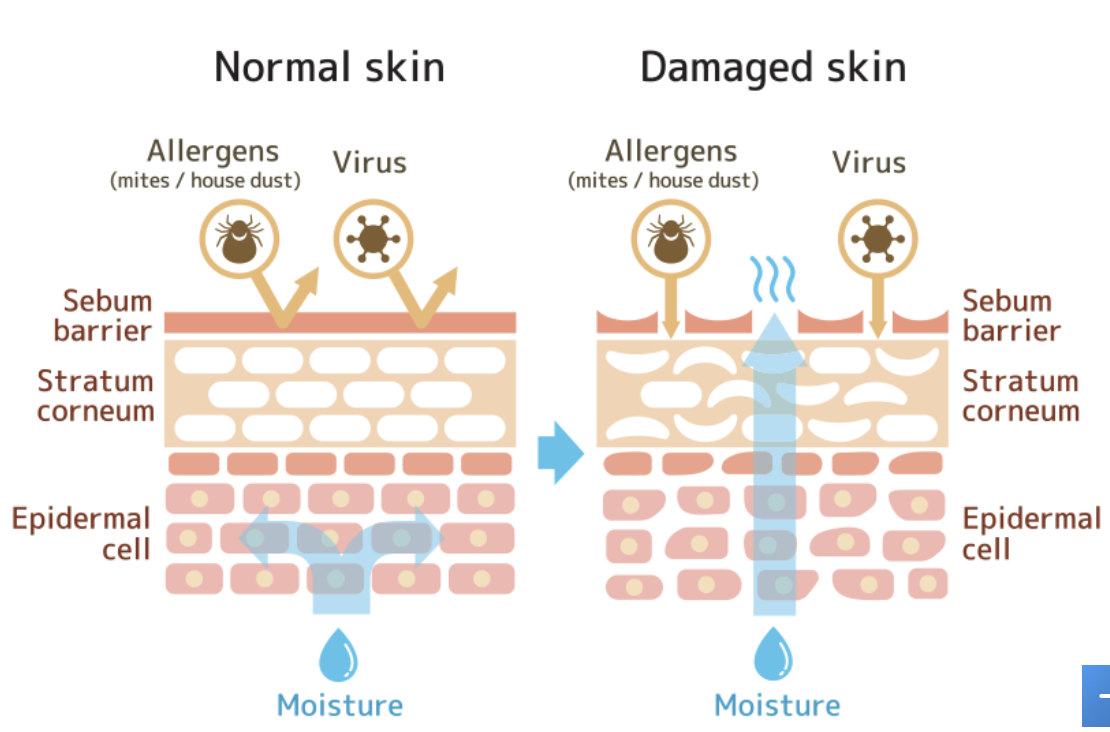
6. What do the arrows moving upward in damaged skin represent?
A. Oil production
B. Sweat glands
C. Water loss (TEWL)
D. Blood circulation
c
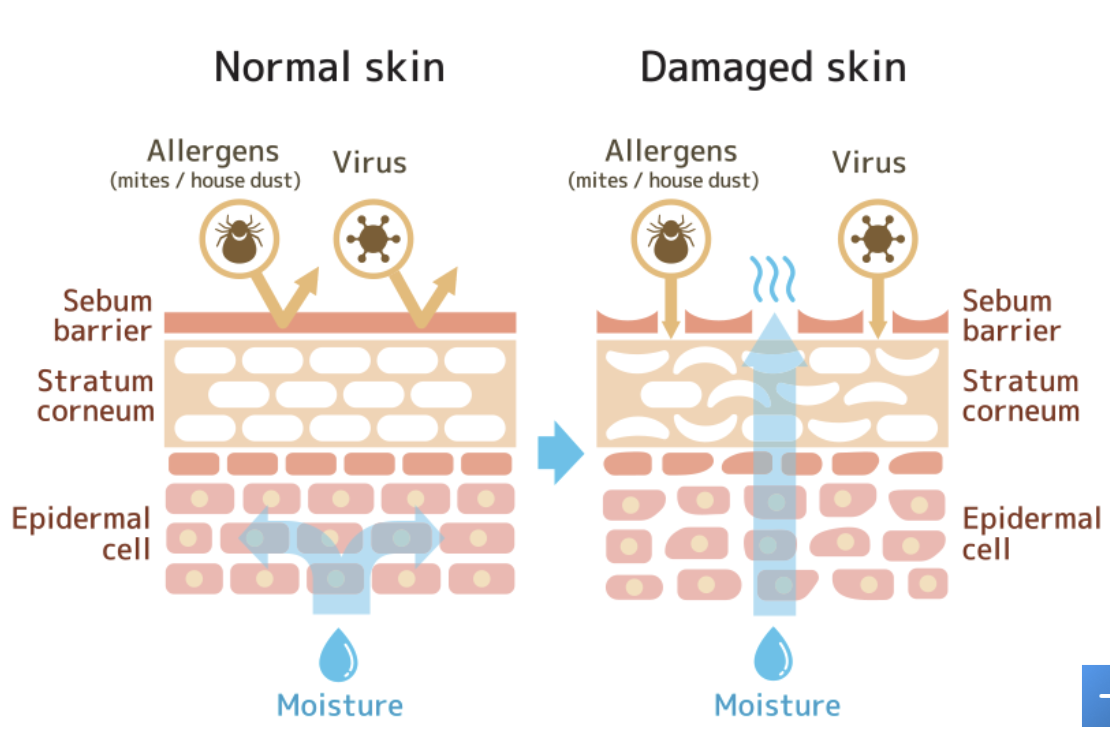
7. Allergens and viruses are able to penetrate more easily when:
A. The skin is hydrated
B. The barrier is intact
C. The barrier is compromised
D. Sebum is balanced
c
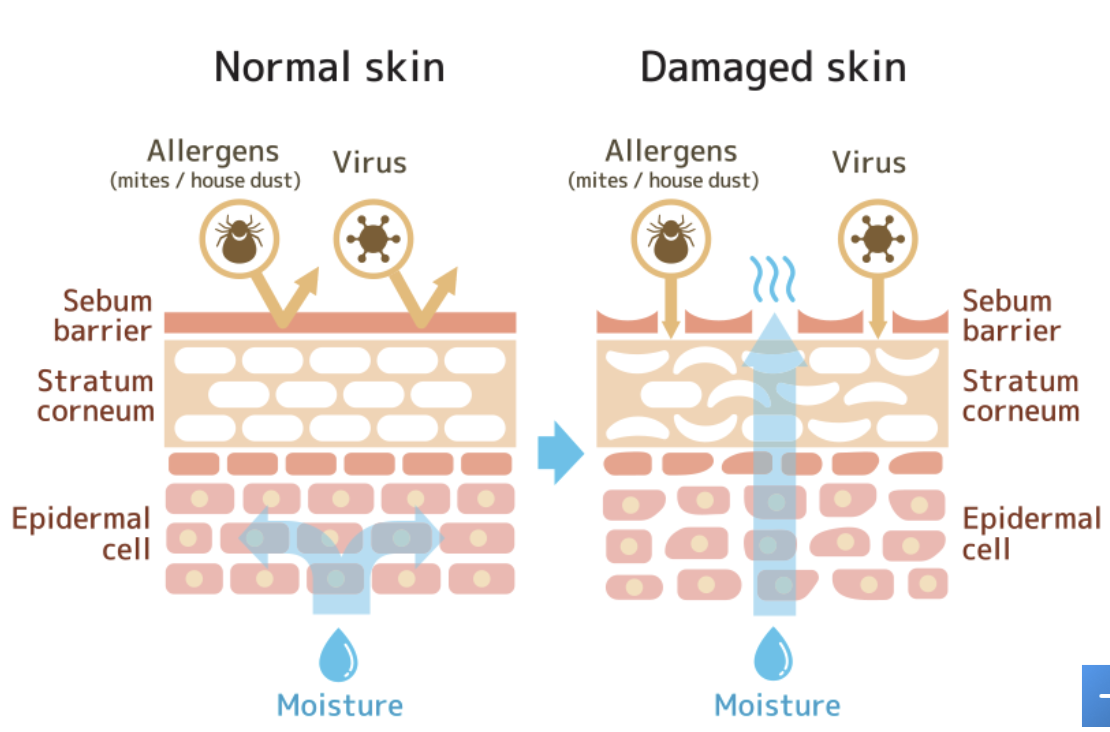
8. The sebum barrier is located on the:
A. Dermis
B. Surface of the skin
C. Hypodermis
D. Blood vessels
b
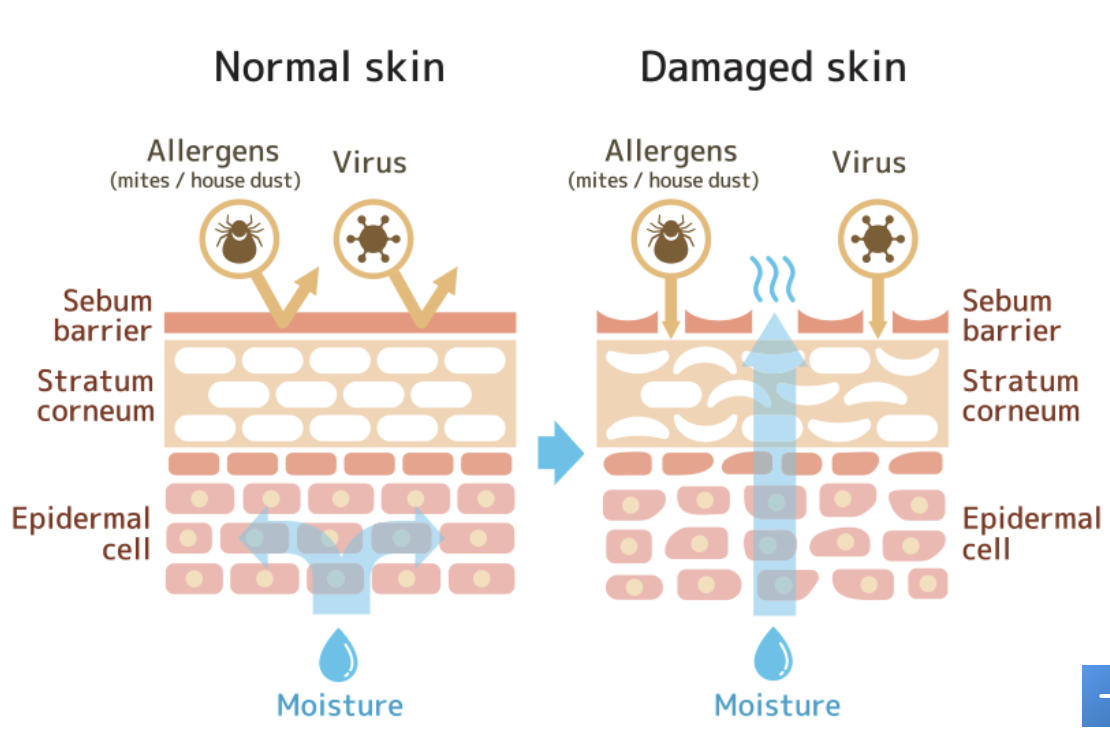
9. The primary function of the stratum corneum is to:
A. Produce oil
B. Protect and prevent water loss
C. Regulate blood flow
D. Detect sensation
b
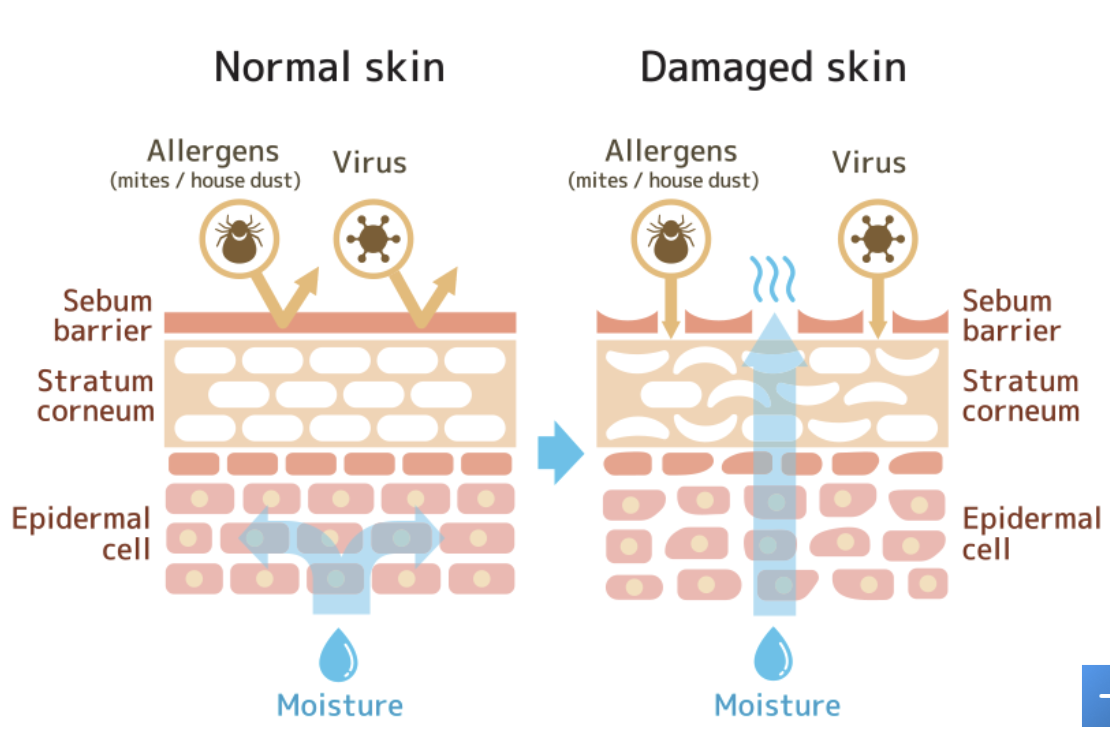
10. In damaged skin, epidermal cells appear:
A. Tightly packed
B. Organized
C. Separated and irregular
D. Larger and stronger
c
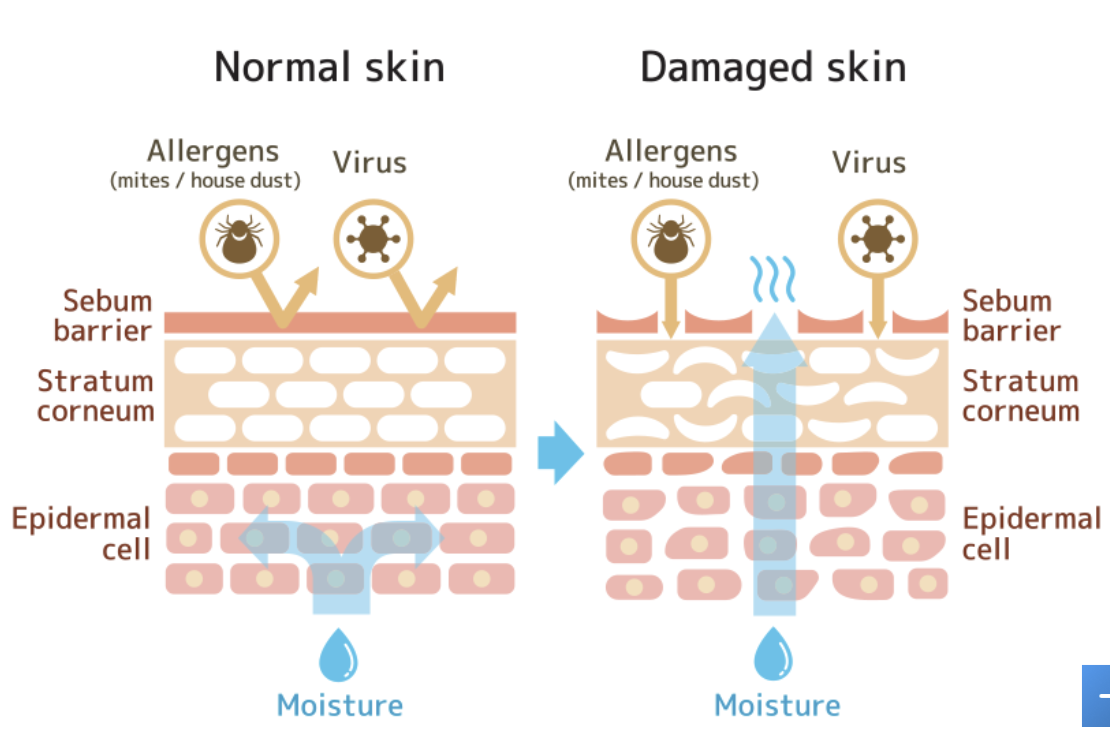
11. What is the main consequence of increased TEWL?
A. Oily skin
B. Dehydration
C. Increased elasticity
D. Pigmentation
b
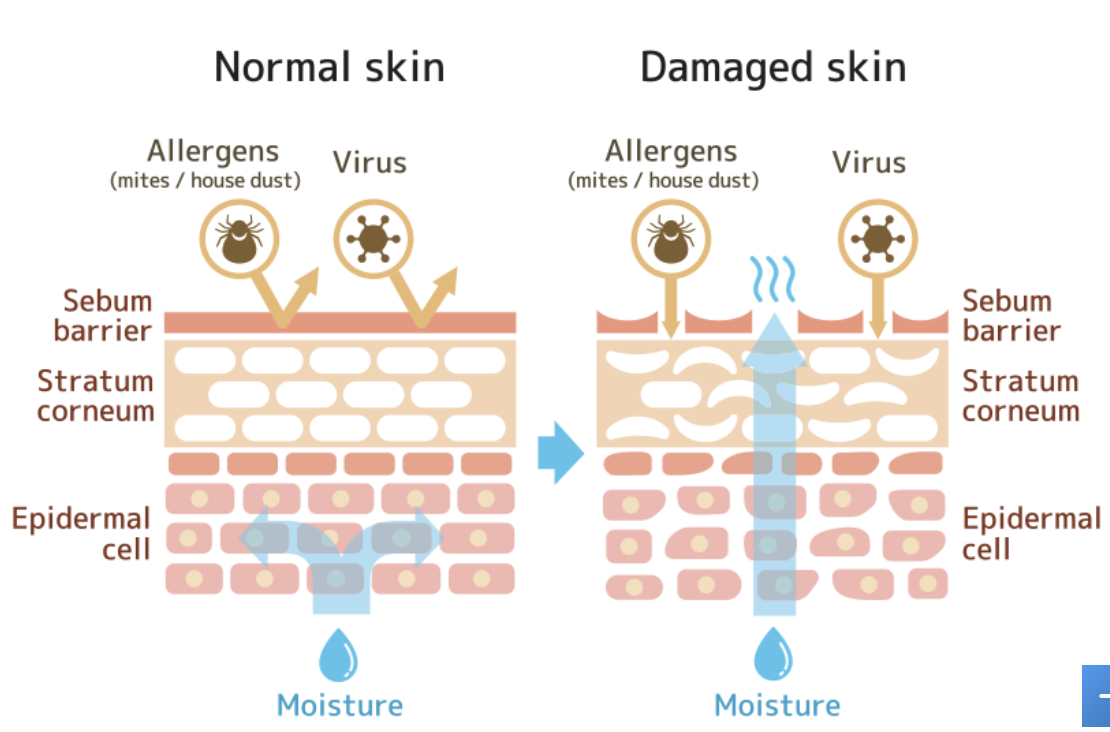
12. Healthy skin prevents entry of:
A. Oxygen
B. Nutrients
C. Allergens and pathogens
D. Water
c
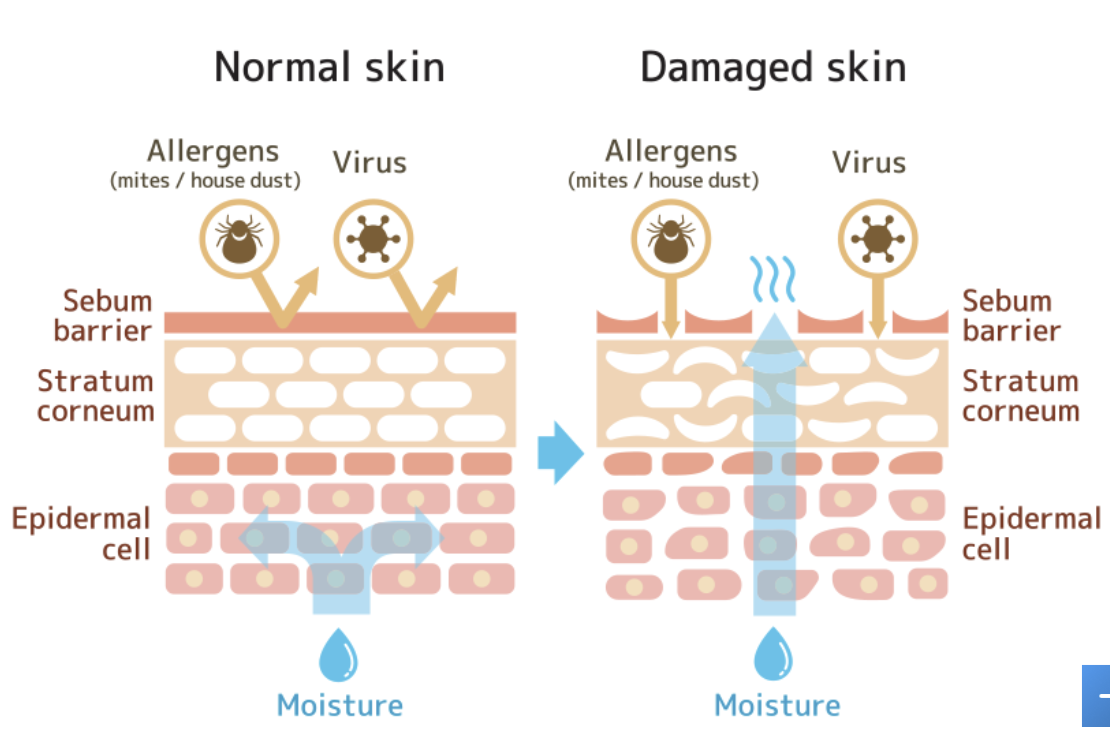
13. Which condition is MOST likely with a damaged barrier?
A. Balanced hydration
B. Reduced sensitivity
C. Increased irritation
D. Decreased TEWL
c
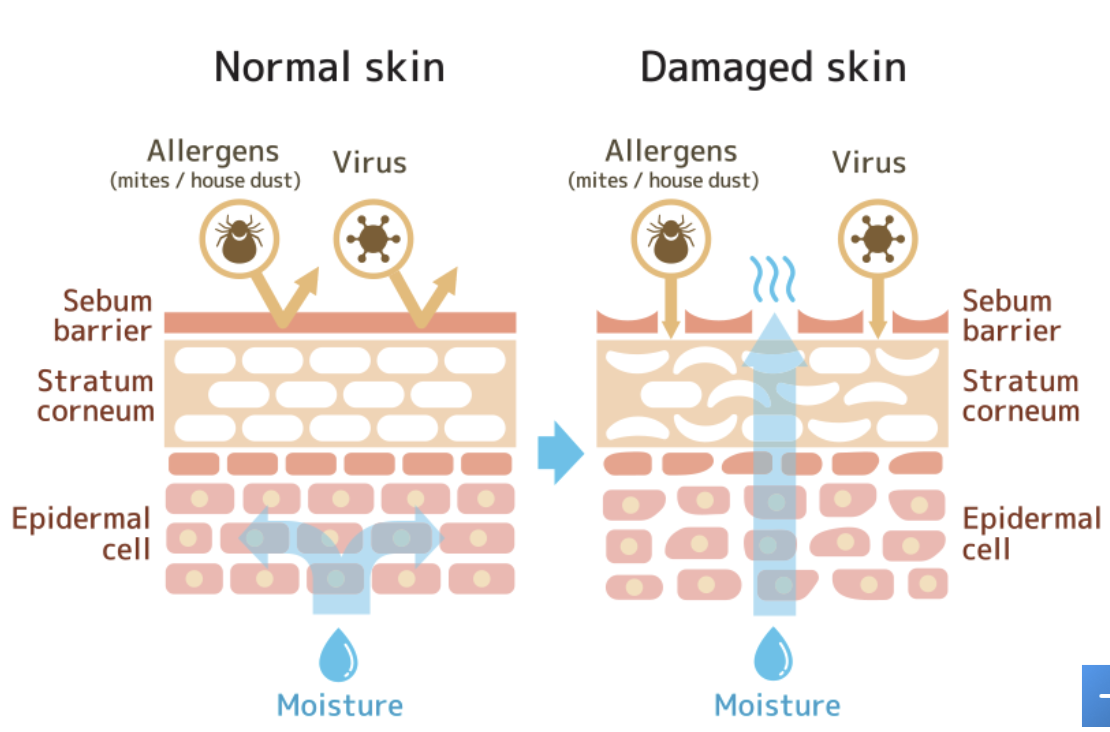
14. The lipid barrier helps to:
A. Break down proteins
B. Maintain moisture balance
C. Increase heat
D. Remove melanin
b
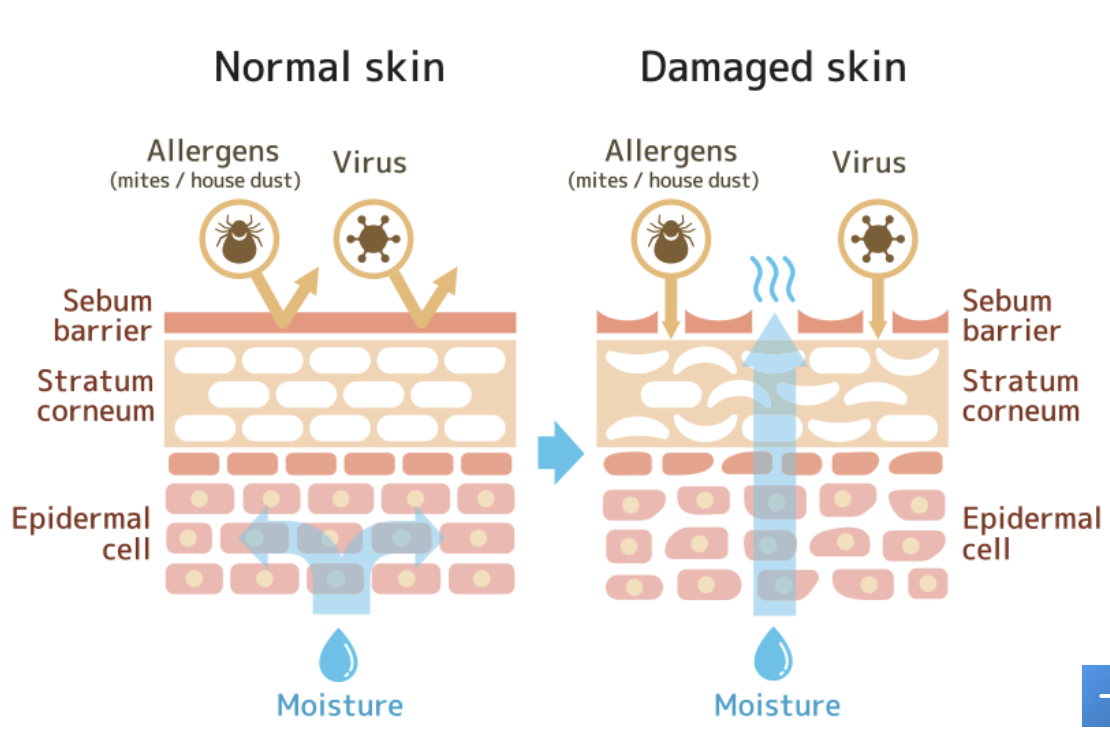
15. What happens to moisture in damaged skin?
A. It is locked in
B. It evaporates easily
C. It turns into oil
D. It increases
b
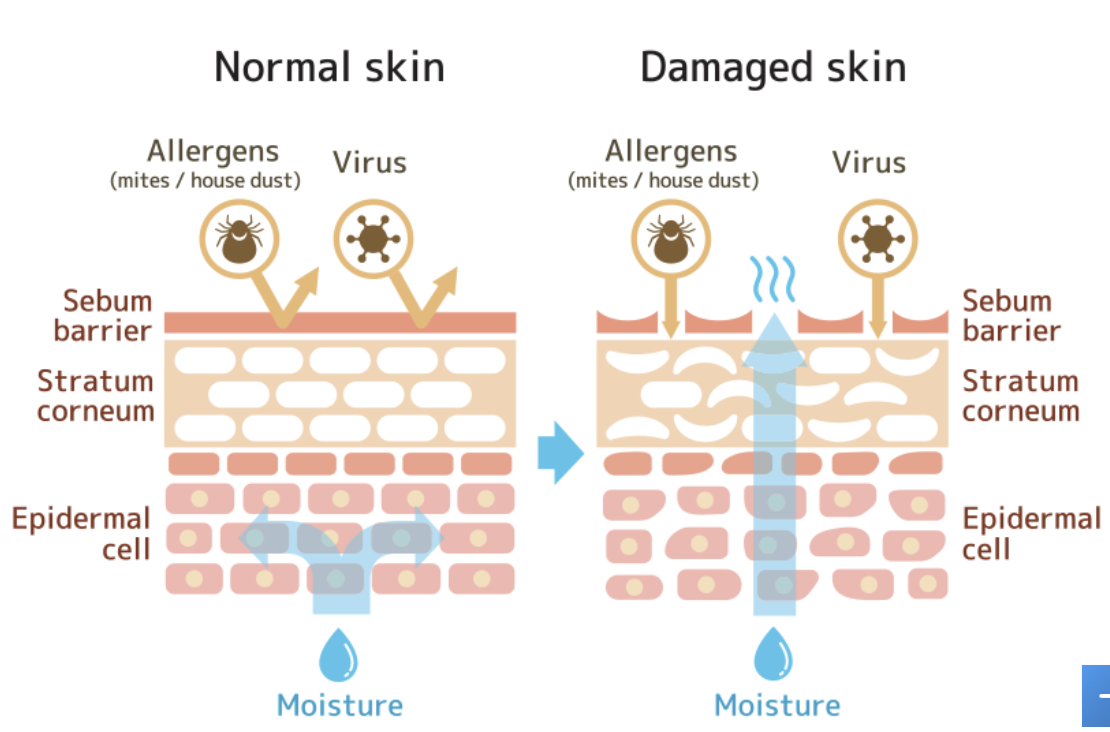
16. The image shows that a healthy barrier:
A. Allows penetration of viruses
B. Prevents water retention
C. Blocks harmful substances
D. Increases sensitivity
c
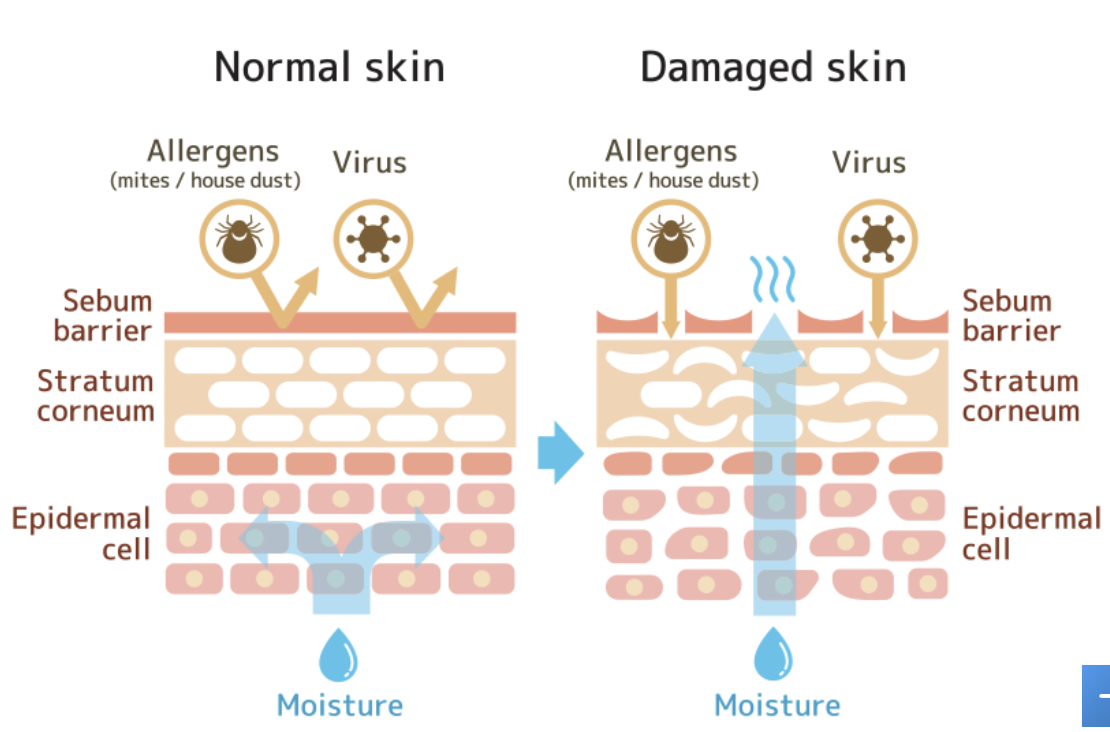
17. Which layer is directly involved in barrier protection?
A. Muscle layer
B. Stratum corneum
C. Bone
D. Blood layer
b
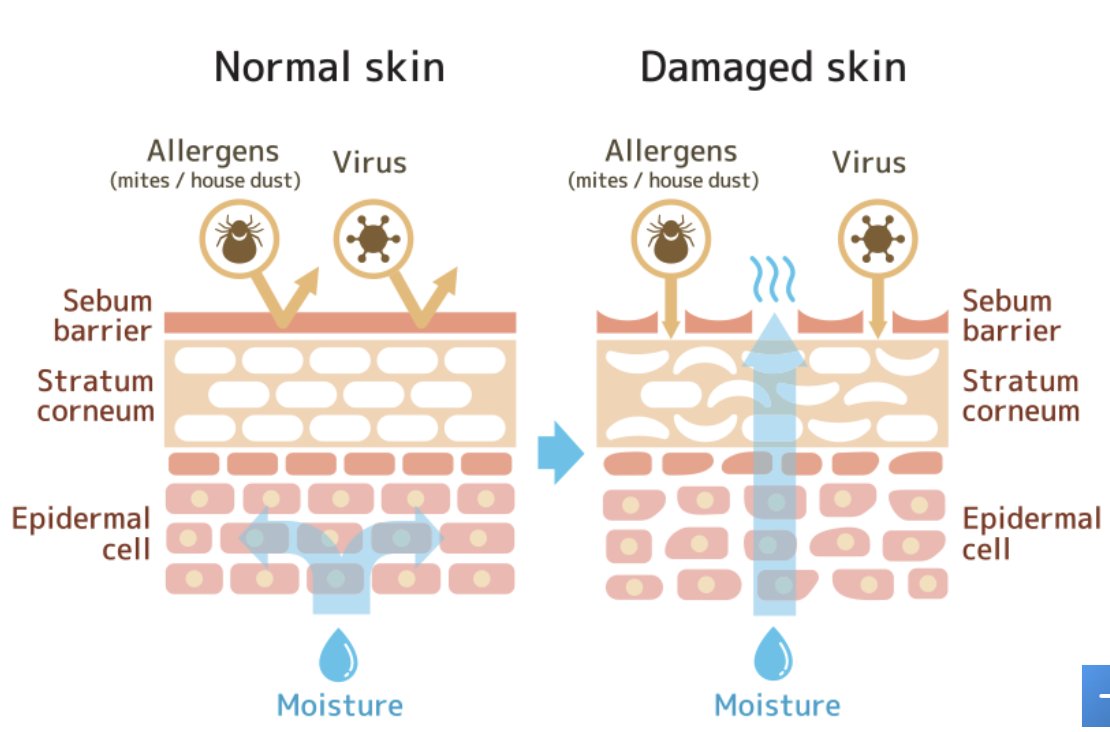
18. A compromised barrier leads to:
A. Improved protection
B. Less product absorption
C. Increased penetration of irritants
D. Reduced sensitivity
c
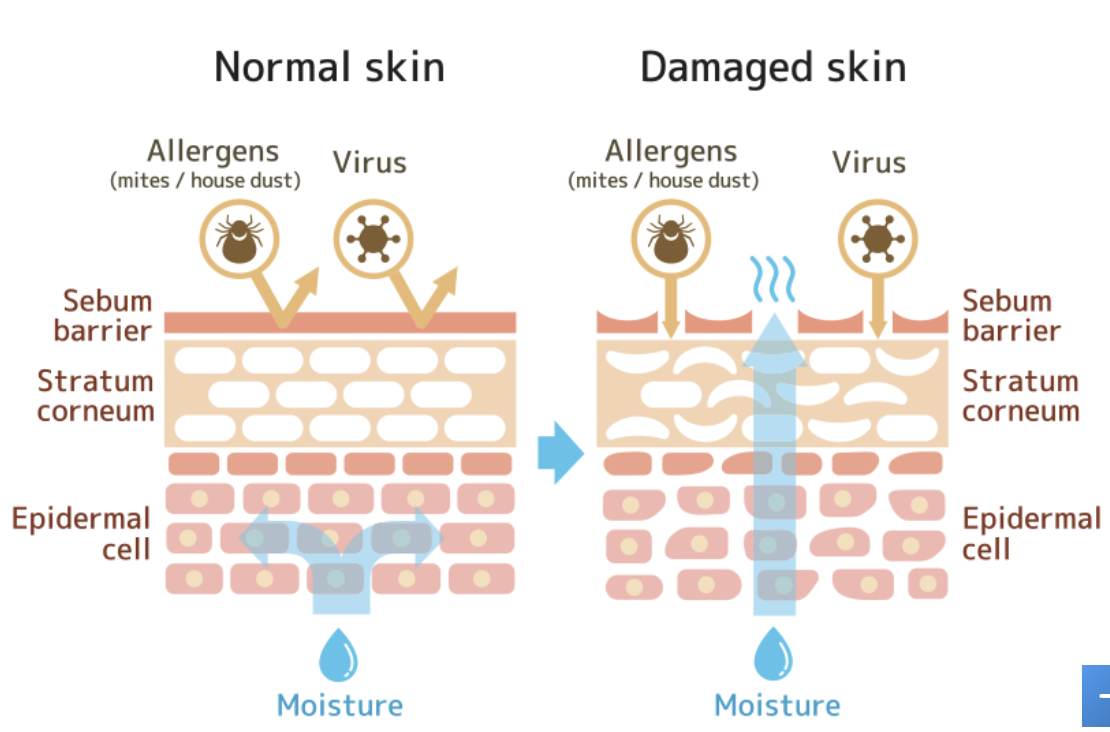
19. Which of the following BEST describes damaged skin?
A. Smooth and compact
B. Balanced oil and water
C. Cracked and permeable
D. Fully protected
c
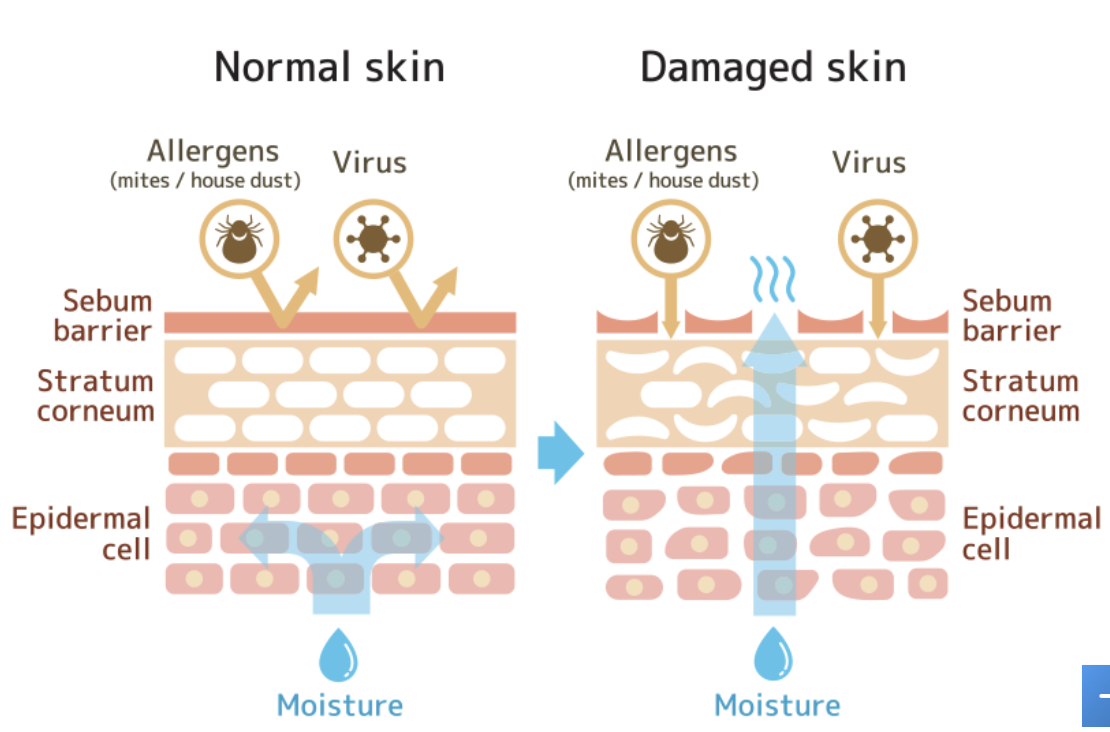
20. Why is maintaining the skin barrier important?
A. To increase TEWL
B. To prevent dehydration and infection
C. To remove all oils
D. To stop cell turnover
b
1. Melanocytes are responsible for producing:
A. Keratin
B. Collagen
C. Pigment
D. Lipids
c
Explore top notes

Explore top flashcards
