Fishy Glub Glub Exam
 Call Kai
 Learn
Learn Practice Test
 Spaced Repetition
 Match
Match Flashcards
 Knowt Play
1/119

There's no tags or description
Looks like no tags are added yet.
Name | Mastery | Learn | Test | Matching | Spaced | Call with Kai |
|---|
No analytics yet
Send a link to your students to track their progress
120 Terms
Fishes
>35,000 extant spp. - >100 jawless spp, ~1,100 cartilaginous spp; 60% marine, 1% brackish, rest FW; higher diversity in tropics
Marine Fish Hot Spot
Indo-Pacific
FW Fish Hot Spot
Continenets
Fish Defining Features
Chordate and Craniate
Chordate
dorsal hollow nerve chord or nodochord; post-anal tail; gill slits or gill pouches
Craniate (clade)
brain case; mostly have vertebrates, paired fins, gills, and ectothermic
Class-level Clades
Myxini, Petromyzontida, Chondrichthyes, Osteichthyes
Myxini Clade
Hagfishes
Petromyzontida Clade
Lampreys
Chondrichthyes Clade
Sharks and Rays
Oesteichthyes Clade
non-tetrapod
When to use the term “fish”
one fish or multiple of the same type of fish
When to use “fishes”
multiple types of different fish
binomial nomenclature
minimum 2-part name; 1st part is genus (always capitilized); 2nd part is the specific epithet and unique for each species (always lowercase and never stands alone)
Major Fish Groups
Classes, Orders (suffix “-iformes”), Families (suffix “-idae”)
Biological Species
reproductively distinct
Evolutionary Species
distinct ancestor → descendant lineage (better than bio spp.)
Clade
complete taxonomic group; stem ancestor + all descendants
Monophyletic (single ancestor) Clade
valid clade
Paraphyletic Clade
incomplete/omission; ancestral lineage but missing some descendants
Polyphyletic Clade
different ancestors; fundamental issue with tree
Character
inherited trait
Plesiomorphy
ancestral (“older”) trait - connects
Apomorphy
derived (“newer”) trait - separate
Synapomorphies
shared apomorphies within 2+ taxa; recent homology
Taxonomic Character Types: Morphological
meristic (countable structures - fin rays, myomeres, vertebrae), morphometric (measurable structures - lengths, ratios), and anatomical (qualitative/descriptive)
Taxonomic Character Types: Physiological
internal/functions
Taxonomic Character Types: Cytological
cell structure
Taxonomic Character Types: Behavioral
must be live so hard to use
Taxonomic Character Types: Biochemical
proteins, RNA, DNA (best); green gene v. red gene
Genetics in Systematics
replaces other methods, complements other methods; super clades (fish)
What are the super clades?
Jawless (Agnatha) and Jawed (Gnathostoma)
Are cartilaginous or bony fish older?
cartilaginous
Voucher Specimen
positively identified for documentation purposes
Physical Fish Collections (dead)
voucher specimen; standardized documentation; long-term preservation; curated at museums, universities, and private collections (largest is Smithsonian, 2nd largest is California Academy of Sciences)
Type Species
clade-level representative (like entire genus or family)
Taxa naming follows the “Principle of Priority”
1st valid name = official one; usually used for family level and below
Categories of Type Specimens
Primary and Secondary
Primary Type Specimen
most valuable
Primary Type Specimen: Holotype
original specimen
Primary Type Specimen: Syntypes
multiple specimens in place of one holotype
Primary Type Specimen: Lectotype
selected representative syntype to proxy for holotype
Primary Type Specimen: Neotype
replacement holotype
Secondary Type Specimen
not holotype and not holotype replacements; supplement to primary type specimens
Secondary Type Specimen: Paratype
additional type-series specimens; came from the same holotype collection
Secondary Type Specimen: Paralectotype
leftover syntypes if a lectotype is selected
Secondary Type Specimen: Topotype
shared locality as the primary type; can source from different collections; most common
Secondary Type Specimen: Allotype
opposite-sexed paratype to the holotype
(DNA) Barcoding
Short mtDNA - G55 bp of cytochrome oxidase subunit 1 gene; globally used for all animals
Osteology
the study of bones
How to (directly) study fish skeletons
Dissections and “Clearing and Straining” Technique
Diessctions
Skinning + De-fleshing
Dehydrate (ethanol)
Processing (dermestids, ants, labor)
De-Greasing (ammonia)
Whitening (H2O2 - optional)
Tools: Knives, scalpels, brushes
“Clearing + Straining” Technique
Fix + Preserve - formalin/ethanol (DNA is inert)
Cartilage Stain - Alcian blue
Bone Stain - Alizarin red S
Clearing - trypsin (but keeps collagen)
Storage - glycerin
Cranium
braincase + sense organs
upper skull
Neuro-cranium
Chondrocranium
embryonic cartilage origin; ossifies into bone (osteichthyes)
Dermatocranium
dermal bones (scale derived); overlies chondrocranium; lacking in chondrichthyes
Neurocranium spatial regions
Ethmoid
Orbital
Otic
Basicranial
Lower Skull
Branchio-cranium (not true cranium)
Branchial Complex
true gill support bones
Fish Gill
1o lamellae on one gill arch (gill filaments); high surface area
How many gill pairs do most bony fish have?
4
Gills: Ventilation Path (water)
mouth → gills → operculum
Counter-current exchange
Deoxygenated blood pumped into lamellae
water circulates past lamellae
Gas equalization (diffusion)
Oxygenate blood exits gill
Requires water flow
Buccal Pumping
pump water from mouth into both opercular chambers; most fishes
Ram Pumping
swim with mouth partially or completely open; sustained swimmers
Hagfish Breathing
Nose breathers - single, central nostril; nostril → velum pumping → gills OR Pharyngeo-Cutaneous Duct (PCD) - left side only, largest opening at end of gills, can blow water out of it OR can breathe through skin
Lamprey Breathing
gill breathers (two-way gill system)
Fish Suck
most fishes suction feed
Old Suck
jawless fish (hagfish, lamprey)
New Suck
most teleosts (modern day bony fish); protrusible jaws (“Gape”)
Gape
maximum mouth opening
Random Suck
various spp. (rays, eels); non-protrusible jaws (bowfin); pharyngeal jaws
Pharyngeal Jaws
work as inner jaws; movable with muscles; bony fishes only; best developed where don’t suck (morays) and need to chew more (parrotfish) and also cichlids for some reason; upper jaw = modified upper pharyngeal tooth plates (from arches #1-4); lower jaw = modified #5 gill arch
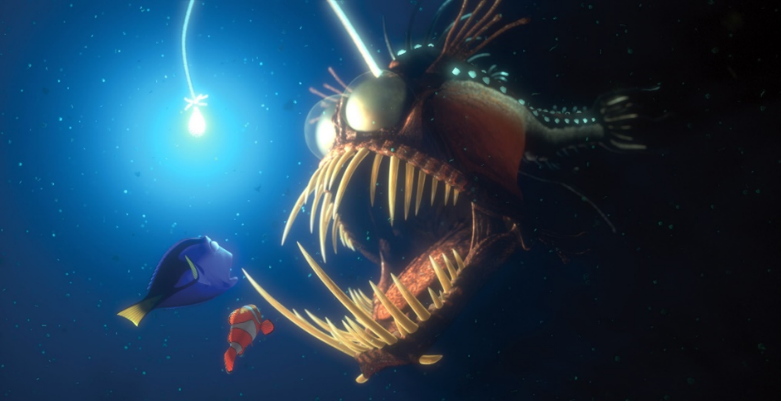
Teeth: Elongate
for stabbing, holding; usually recurved (e.g anglerfish)
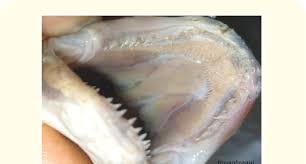
Teeth: Villiform
small, needle-like; stabbing, holding (for smaller prey)
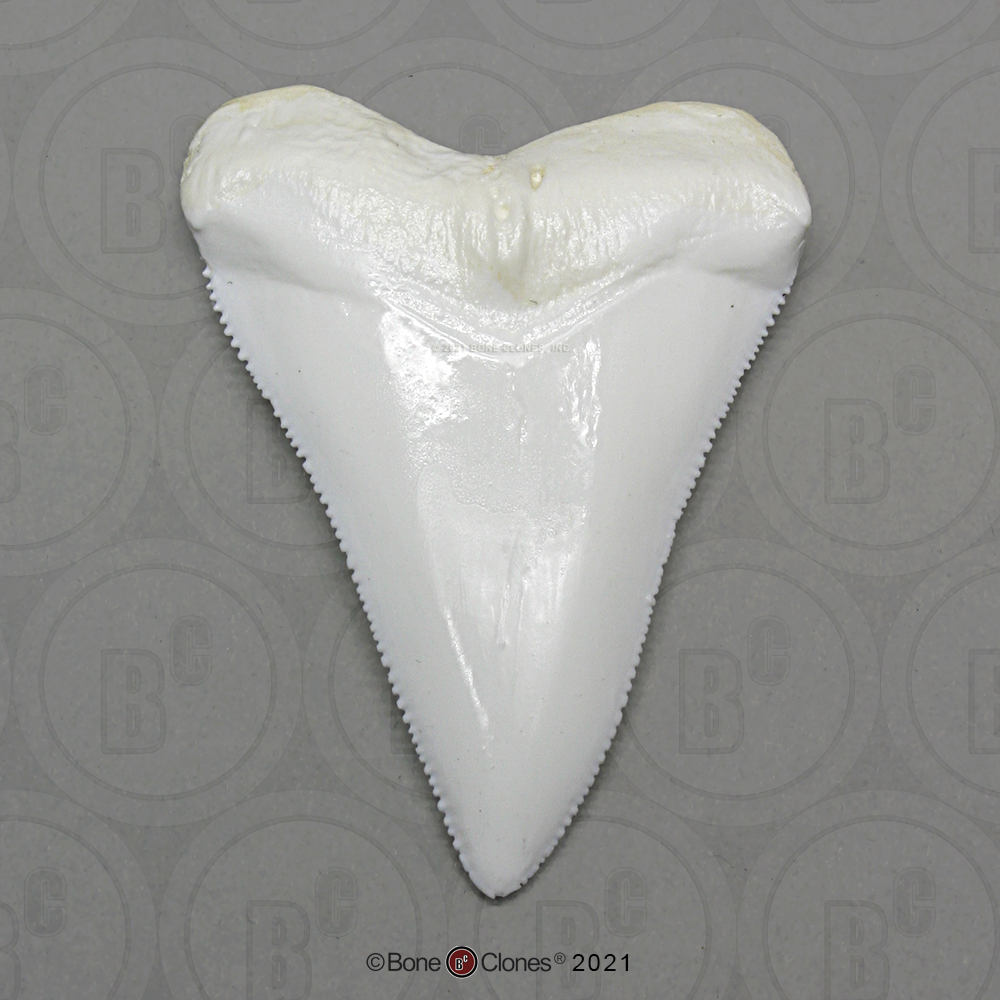
Teeth: Triangular
not grabbing prey but taking chunks out; slashing
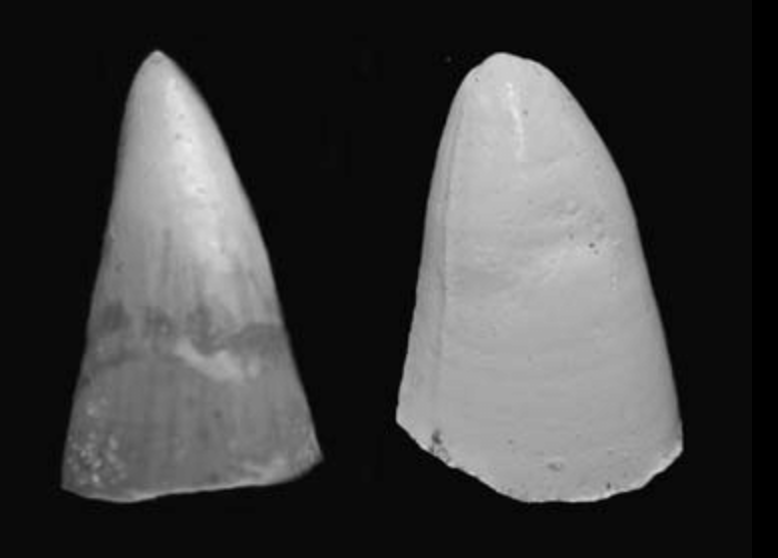
Teeth: Caniniform
conical pointed; curved or straight; piercing, holding (higher bite force)
Teeth: Cardiform
short, fine-pointed; densely packed into; brush-like rows; holding
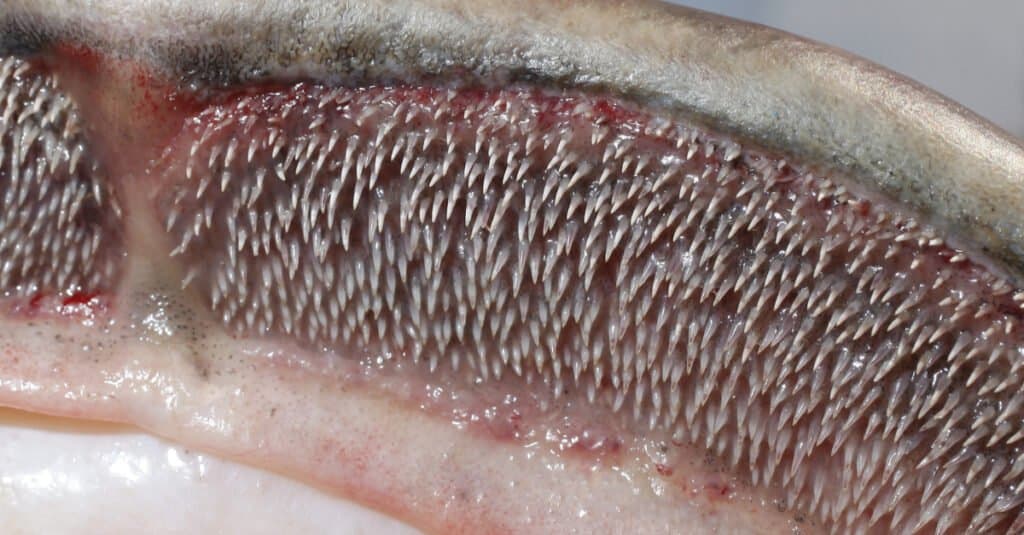
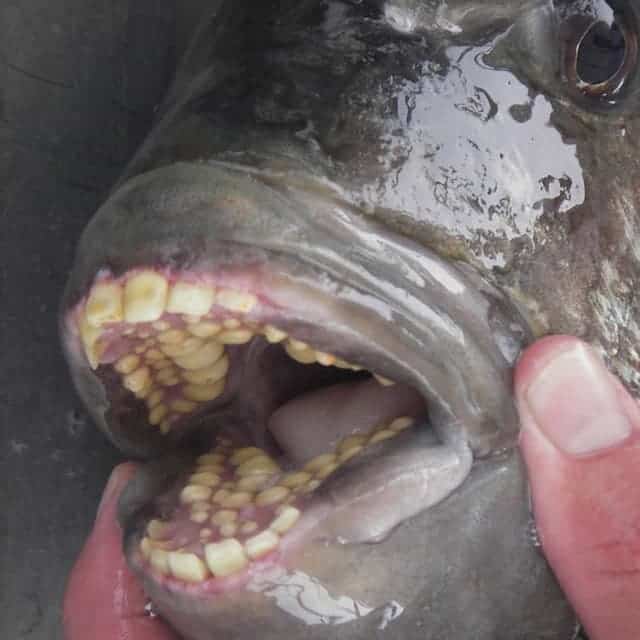
Teeth: Molariform
thick, flattened; crushing, grinding
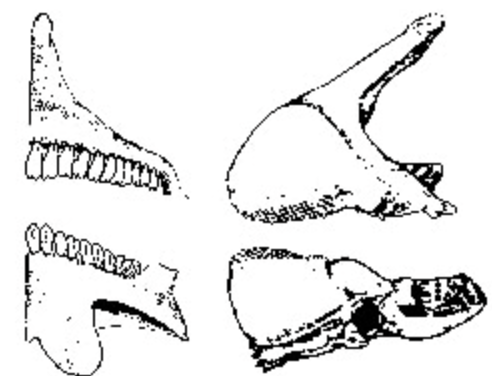
Teeth: Incisors
laterally flattened; often fused into beak; cutting
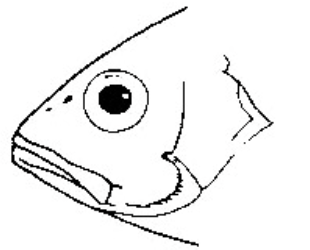
Mouth Position: Terminal
most fishes; pointy-end forward
Mouth Position: Superior
least common; upward feeding
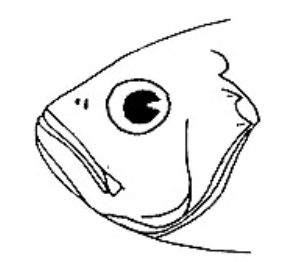
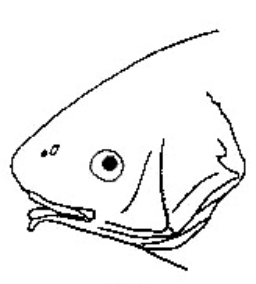
Mouth Position: Sub-terminal (inferior)
sucking-shaped mouth
Notochord
ancestral chordate feature - muscle attachment (for swimming); mostly cartilage - hagfishes (ancestral) and extant lobe-fins (derived)
Vertebral Column (vertebrae)
wraps around notochord + replaces it; bone or cartilage; all other fishes (mostly)
Myomere
Fish body segment
Mono-spondylous
1 vertebra per myomere
diplo-spondylous
2 vertebra per myomere; lots of sharks, more body flexibility; elasmobranch, lungfish, bowfin tails
Pleural Ribs
“ventral ribs”; protect “viscera”; left + right pairs; attached to (vertebral) parapophyses
Urostyle
last vertebra; (often) elongate
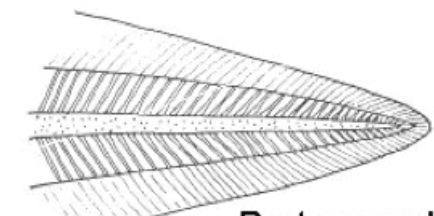
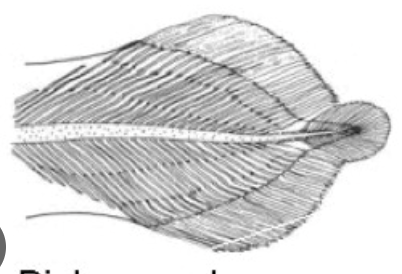
Caudal Fin Shape: Proto-Cercal
unspecialized, ancestral shape; lancelets, agnathans, gnathostome larvae
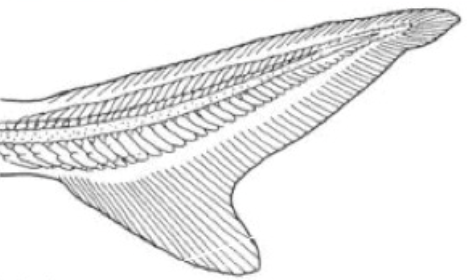
Caudal Fin Shape: Hetero-Cercal
unequal-lobed; vertebrae extends into upper (or lower) fin lobe; Chrondrichthyes, primative bony fishes (sturgeons, gars)
Caudal Fin Shape: Homo-Cercal
equal-lobed; most bony fishes
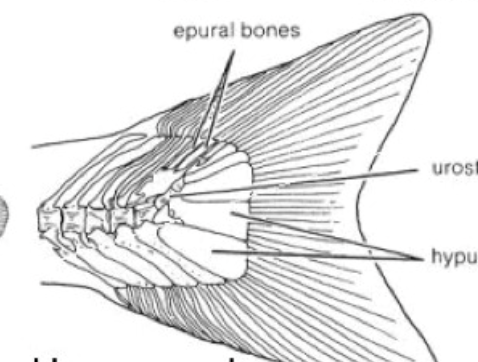
Caudal Fin Shape: Lepto-Cercal
2o derived protocercal shape; lobe-fins, rattails; various eels
Pectoral Girdle on Elasmobranchs
Sharks - Coraco-scapular cartilage
Rays - wraps around head
Pelvic Girdle on Elasmobranchs
ischio-pubic cartilage
Pectoral and Pelvic Girdles
Supports for paired fins; missing in jawless fishes; fish appendiculars not attached to vertebrae
Dorsal Myomeres
Ep-Axial Mass
Center of Myomeres
Horizontal Septum

