Module 4
 Call Kai
 Learn
Learn Practice Test
 Spaced Repetition
 Match
Match Flashcards
 Knowt Play
1/161

There's no tags or description
Looks like no tags are added yet.
Name | Mastery | Learn | Test | Matching | Spaced | Call with Kai |
|---|
No analytics yet
Send a link to your students to track their progress
162 Terms
Cellular Respiration Equation
C6H12O6 + 6O2 + ADP + Pi → 6H2O + 6CO2 + ATP + heat
How can metabolic activity be measured?
energy food eaten - wastes excreted; ATP produced; heat produced; amount of H2O produced; amount of oxygen used up/carbon dioxide produced
What is the easiest way to measure metabolism?
gas exchange; amount of oxygen used up or carbon dioxide produced
Basal Metabolic rate (BMR)
rate at which an animal consumes oxygen while at rest, with an empty stomach, under normal temperature and moisture conditions
Metabolism is required for
a minimal resting lifestyle with no spontaneous activity, no digestion of food, and no physical thermal, or psychological stress
Maximum metabolic rate (MMR)
maximum rate at which oxygen can be transported from the environment to the tissue mitochondria; can be induced by activity/stress
Aerobic energy metabolism parameters
basal metabolic rate is the flood (lower) and maximum metabolic rate is the ceiling (higher)
Aerobic scope
capacity of an organism to increase its aerobic metabolic rate above maintenance level
Aerobic scope equation
MMR - BMR
Glucose
source of energy; produced from digestion of food; stored and oxidized to provide chemical energy
Site of cellular respiration or fermentation
cytoplasm & mitochondria
Mitochondria
organelles that are membrane-bound with two different membranes
Cristae
inner membrane highly folded
Glycolysis occurs in
cytoplasm
Glycolysis
glucose → pyruvate
Glycolysis products
2 pyruvate, 2 ATP, 2 NADH
If oxygen is present, pyruvate…
enters the mitochondria for citric acid cycle
If oxygen is not present, pyruvate …
undergoes fermentation
Fermentation
pyruvate → lactate
Fermentation products
lactic acid, 2 NAD+ (regenerates for glycolysis)
Link Reaction
pyruvate → Acetyl CoA; links the products of glycolysis with the aerobic processes of the mitochondria
Link Reaction Products
acetyl CoA, 2 NADH, 2 CO2
Krebs Cycle = Citric Acid Cycle = TCA Cycle
Acetyl CoA produces NADH and FADH2 molecules to feed electrons in Electron transport chain to generate cell’s ATP
Krebs Cycle = Citric Acid Cycle = TCA Cycle products
2 NADH, FADH2, GTP → ATP, 2 CO2
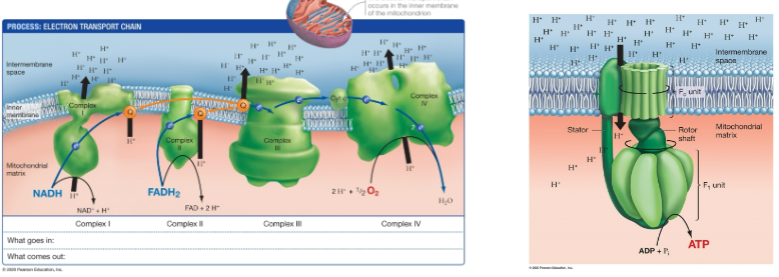
Electron Transport Chain (ETC)
final stage of aerobic respiration; releases energy stored within reduced hydrogen carriers to synthesize ATP; drives transport of protons across inner membrane from the matrix to intermembrane space for a proton gradient & electrons reduce O2 to water; hydrogens pass through ATP synthase to produce ATP into the mitochondrial matrix
Where does link reaction occur?
mitochondria matrix
Where does Krebs cycle/Citric Acid Cycle/TCA Cycle occur?
mitochondrial matrix
Where does Electron Transport Chain occur?
inner mitochondrial membrane
Oxidative Phosphorylation
ETC releases energy stored within the reduced hydrogen carriers to synthesize ATP; derived from oxidation of hydrogen carriers (NADH, FADH2)
Proton Gradient
higher concentration of protons (H+) in intermembrane space than in mitochondrial matrix
Final Electron Acceptor
oxygen
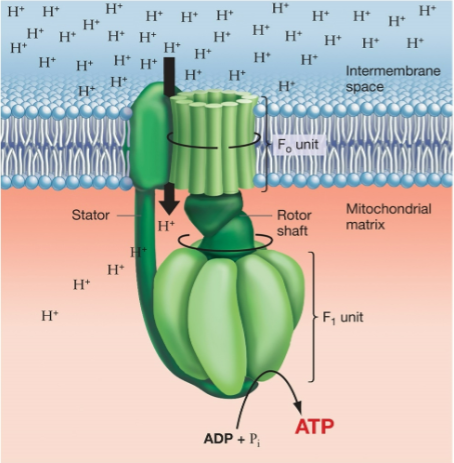
ATP Synthase
proton-driven rotor and ATP-generating enzyme; F0 unit spins as protons pass through; shaft transmits the rotation to the F1 unit, causing it to make ATP from ADP and Pi
Summary of Cellular Respiration
electrons carried by NADH & FADH2; products (~29-34)ATP and water; protons transported outside of inner membrane drive ATP synthase;
Ingestion
the process of bringing food into the digestive tract
What does ingestive provide?
chemical energy for synthesizing ATP, carbon-containing compounds and minerals for building complex macromolecules
Digestion
mechanical and enzymatic breakdown of food
Why is digestion required?
difficult for macromolcules to enter the cell
Alimentary Canal
complete digestive tract that consists fo a tube with a mouth at one end and an anus at the other end
Digestive System
alimentary canal + organs; functionally connected to all body systems & anatomically connected to nervous, cardiovascular, endocrine, and lymphatic systems
Digestive System order
mouth → esophagus → stomach → small intestine → cecum → large intestine → anus
Mouth
buccal cavity; mechanical digestion (teeth, tongue, saliva moistens) & chemical digestion (saliva)
Salivary amylase
digests carbohydrates
lingual lipase
digests lipids (fats)
Esophagus
long, muscular tube that transports food to the stomach; lined with epithelial cells to resist abrasion; no digestion/nutrient absorption; uses peristalsis
peristalsis
smooth muscles contract and relax in coordinated fashion
Stomach
mechanical digestion (muscle contraction), chemical digestion (gastric juice- HCl lowers pH to 1.5-2.0 & mucous to protect stomach lining), enzymatic digestion; no nutrients are absorbed
pepsin
digests proteins
nervous system stimulates gastric cells to produce
gastric juice
chyme
an acidic mixture of food and gastric secretions that passes from the stomach to the small intestine; made by muscles contractions mixing materials
Small Intestine
major site of nutrient absorption; digestion of protein, fats, carbohydrates; undigested food sent to colon; uses peristalsis
How does the small intestine increase surface area?
folding with villi and microvillia
Villi
highly folded surface containing finger-like projections
Epithelial cells
absorb nutrients from digested food; in small intestine
Dense Capillary network
in villi/small intestine; allows nutrients to be released to blood stream; rapidly transports absorbed products
Suspension feeder
any strategy to take food particles out of water column; active and passive; usually can’t move
passive filter feeder
straining suspended matter and food particles from water with a mesh; depends on water flow
passive filter feeder examples
barnacles
Active filter feeder
create own water currents to strain food with mesh; makes own water flow with pump
Active filter feeder examples
mussels, tunicates
Songes
intake through small pores (ostia); expel water out osculum
Deposit feeder
obtaining nutrients from particles that settle on substrate; gain nutrients from microalgae and bacteria
Deposit feeder examples
spaghetti worms; sea cucumbers
Sea Cucumbers
use branched, sticky tentacles to collect organic particles from mud or sand; sediment passes through their alimentary canal where organic matter is digested; inorganic particles are excreted
Herbivores
eat plants or seaweeds
Herbivore examples
muskox, periwinkle snails
Periwinkle snails
use radula to scrape plant material or biofilm off rocks; radula rolls food particles back toward the mouth
Radula
ribbon-like structure covered with hundreds of microscopic chitinous teeth
Consumers
receive energy by consuming other organisms
Carnivore
an animal that feeds on fleshc
carnivore examples
nemertean worm, orcas, sea anemones
Omnivore
food of both plant and animal origin
Nemertean worm
feeds on polychaete worms that burrow in the sand; everts it’s proboscis (elongated appendage from the head of an animal), latches onto its prey and injects with a neurotoxin
Defenses for Prey
chemical, morphological, behavioral
Chemical defense examples
sponges, algae
Morphological defenses
color, spines, shells
Aposemantism
(color) highly noticeable and distinct from harmless organisms; show harmful so don’t eat
Crypsis
(color) avoid detection by other organisms; blends in
Nematocysts
explosive organelles found in all Cnidaria; capsule contains a coiled, hollow, usually barbed thread; projected in self-defense or to capture prey
Behavioral defense example
scallops, urchins, snails
Sea anemone
escape response when touched by sea star; “floats” away; feels touch by chemical cues
Cymothoa exigua
eats tongue of fish; sits in tongue space to eat food that the fish gets
microbiology
study of microscopic organisms such as bacteria, viruses, fungi, protozoa, and algae
Microbiome
collective genomes of all microbes in an environment
microbiota
community of microorganisms themselves
Human body contains roughly as many bacterial cells as
human cells
Herbivores microbial C/N ratio
higher due to plant-based diets (more carbon) and longer intestine
Carnivore microbial C/N ratio
lower with faster turnover and protein-rich diets
What does the microbiome digest?
nutrients not digested or absorbed by teh host
Postbiotics
non-living microbial byproducts that provide a beneficial effect on the host
True/False. There is no gut microbiota variation across animals.
False
Macronutrients
elements required in large amounts for growth and development (P, K, C, H, O, Mg, N)
Micronutrients
elements required in trace amounts for vital biochemical functions (Fe, Cu, Ni, Zn, Mn, Cl)
Limiting Nutrient
nutrients that limit the growth, abundance, or distribution of a population of organisms in an ecosystem due to their scarcity
Common limiting Nutrients in soil and aquatic systems
phosphorous, nitrogen, iron
Law of the Minimum
productivity dictated not by total resources available, but by the scarcest resource (limiting factor)
Can N2 be used for growth by living organisms?
no
Nitrogen Cycle
abundance N2 is fixed by microorganisms to form nitrogen compounds that are used by other organisms to sustain life
Ammonification
process converting organic nitrogen (amino acids, proteins, and nucleic acids in dead plants, animals, or microbes) into inorganic nitrogen like ammonia (NH₃) or ammonium (NH₄⁺)
pH < 7.5, NH3 is
converted rapidly to NH4+
Decomposers
earthworms, termites, slugs, snails, bacteria, and fungi use enzymes to degrade plant material

