Nat.5 Physics - Electricity
0.0(0)
Studied by 6 people Call Kai
 Learn
Learn Practice Test
 Spaced Repetition
 Match
Match Flashcards
 Knowt Play
Card Sorting
1/23

Earn XP
Last updated 8:52 AM on 4/20/23
Name | Mastery | Learn | Test | Matching | Spaced | Call with Kai |
|---|
No analytics yet
Send a link to your students to track their progress
24 Terms
1
New cards
Conductor
Low resistance material which conducts electricity
2
New cards
Current
Electric charge transferred per unit time
3
New cards
Electric charge
A charged particle experiences an electric force when it is in an electric field
4
New cards
Electric field
An area where there is an electric force on a charge.
5
New cards
Insulator
High resistance material, does not conduct electricity
6
New cards
Potential Difference
The energy given to each coulomb of charge as it passes through the power supply
7
New cards
Electrical Power
Electrical energy transformed each second
8
New cards
Voltage
The energy given to each coulomb of charge as it passes through the power supply
9
New cards
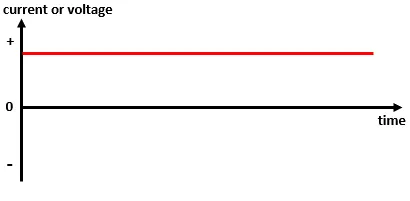
Direct Current (D.C)
A direct current flows through the terminals in only 1 direction.
10
New cards
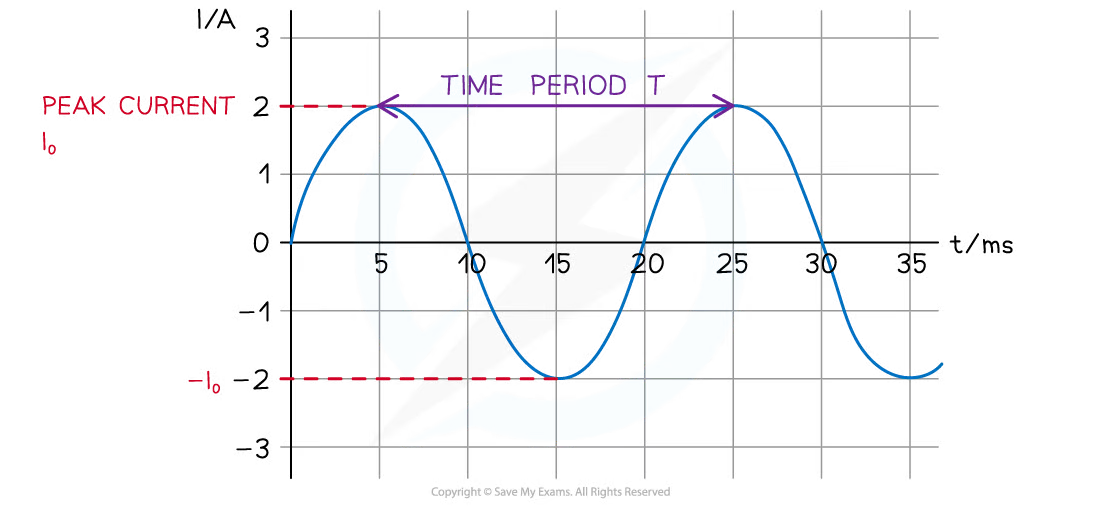
Alternating Current (A.C)
An alternating voltage supply causes an
alternating current to flow i.e. it repeatedly
changes the direction it flows through
the terminals.
alternating current to flow i.e. it repeatedly
changes the direction it flows through
the terminals.
11
New cards
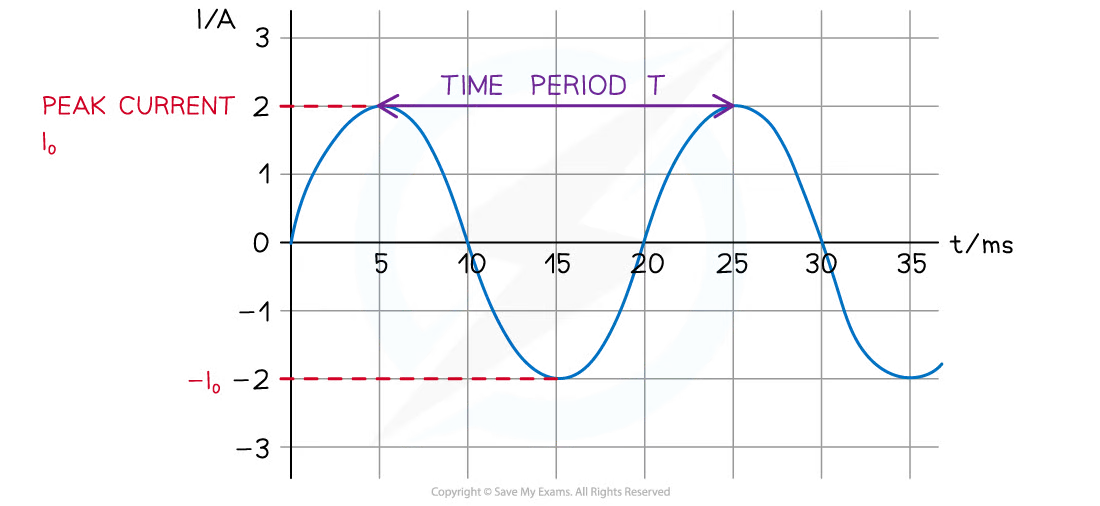
Resistance
measure of the opposition to the flow of
charge in an electrical circuit
charge in an electrical circuit
12
New cards
Ohm's Law
V=IR
13
New cards
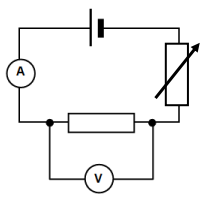
Experiment To Verify Ohm's Law
1. Record values of current (I) from the ammeter and
Voltage (V) from the voltmeter
2. Change the resistance of the variable resistor 3 more
times and record values of I and V at set intervals.
3. Plot a graph of Voltage (y-axis) and Current (x-axis), a
straight line through zero shows that current is
directly proportional to voltage.
Voltage (V) from the voltmeter
2. Change the resistance of the variable resistor 3 more
times and record values of I and V at set intervals.
3. Plot a graph of Voltage (y-axis) and Current (x-axis), a
straight line through zero shows that current is
directly proportional to voltage.
14
New cards
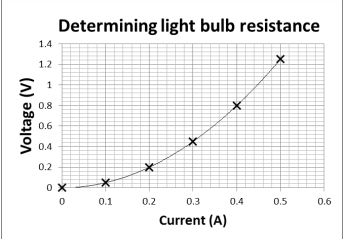
The Resistance of a Filament Lamp
as we increase the voltage of the supply, the current through the filament
increases which causes the filament to heat up. This in turn causes an increase in the
resistance of the filament. This causes the line to curve.
increases which causes the filament to heat up. This in turn causes an increase in the
resistance of the filament. This causes the line to curve.
15
New cards
TURD
As temperature increases, resistance decreases
16
New cards
LURD
As light increases, resistance decreases
17
New cards
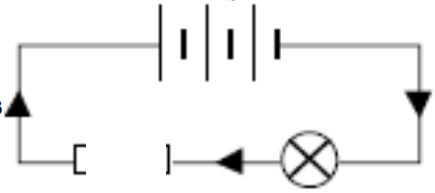
Series Circuits
A series arrangement of components is where they are in line with
each other, in one single loop (i.e. connected end-to-end.)
each other, in one single loop (i.e. connected end-to-end.)
18
New cards
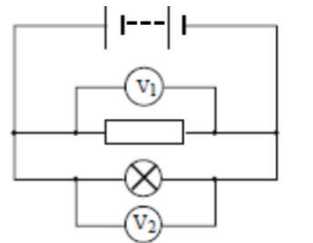
Parallel Circuits
A parallel arrangement of components is where they are connected across each
other where the current has more than one path through that part of the circuit.
other where the current has more than one path through that part of the circuit.
19
New cards
Current in Parallel Circuits
Is = I1 + I2
20
New cards
Voltage in Parallel Circuits
VS = V1 = V2
21
New cards
Current In Series Circuits
Is = I1 = I2 = I3
22
New cards
Voltage in Series Circuits
VS = V1+ V2
23
New cards
Resistances in Series
𝑅𝑇 = 𝑅1 + 𝑅2 ...
24
New cards
Resistances in Parallel
1/Rt=1/R2+1/R1

