Lecture 3 - Discrete-Time Solow Growth Model
 Studied by 0 people
 Call with Kai
 Learn
Learn Practice Test
 Spaced Repetition
 Match
Match Flashcards
 Knowt Play
1/21

There's no tags or description
Looks like no tags are added yet.
Name | Mastery | Learn | Test | Matching | Spaced | Call with Kai |
|---|
No analytics yet
Send a link to your students to track their progress
22 Terms
What is the basic setup of the discrete-time Solow model, and what question is it designed to answer?
model how capital accumulation (ΔK) affects output and whether this growth is sustainable
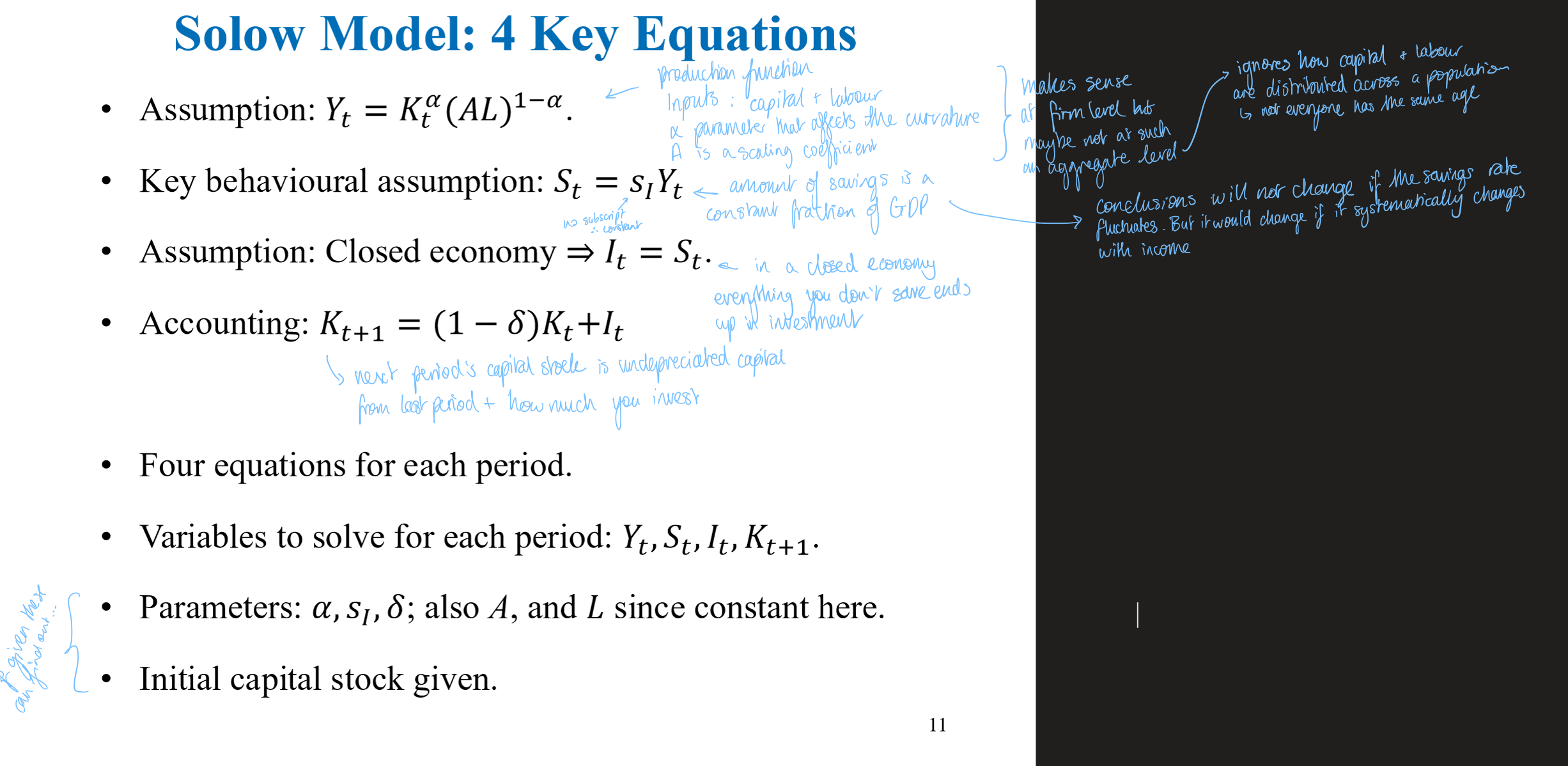
4 → 3 equations
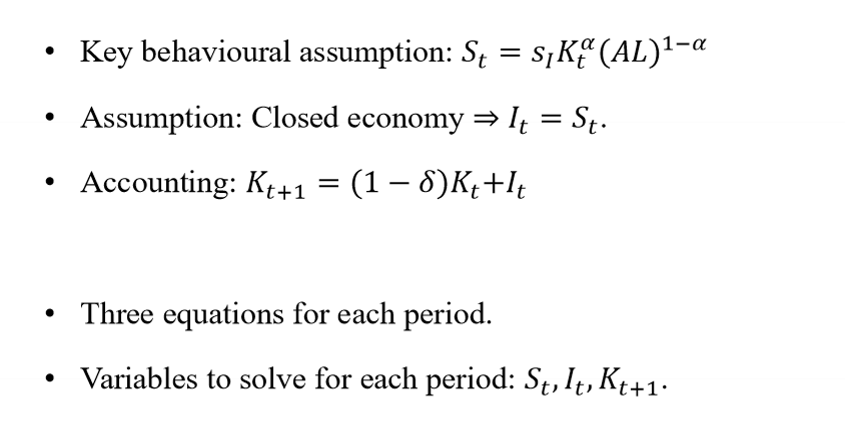
4 → 1 equations
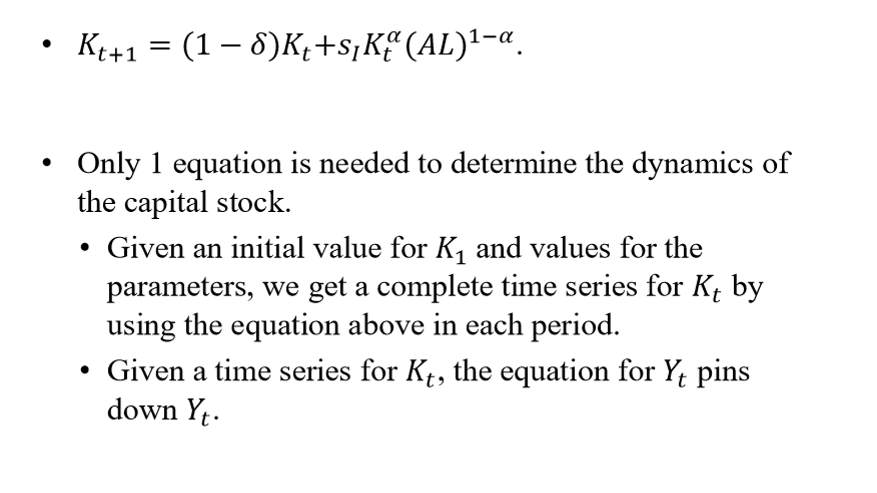
Solow Model Alternative notation
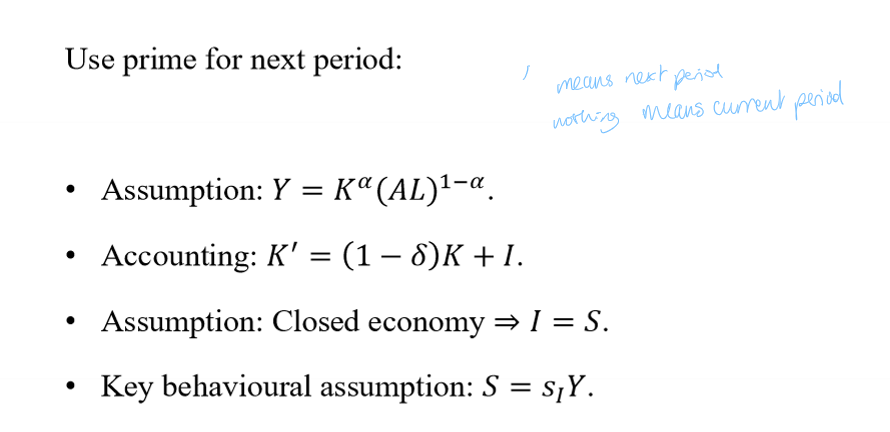
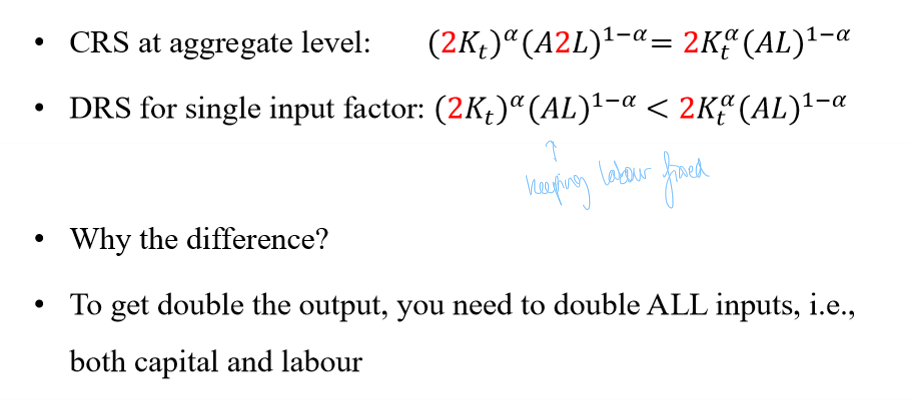
CRS & DRS
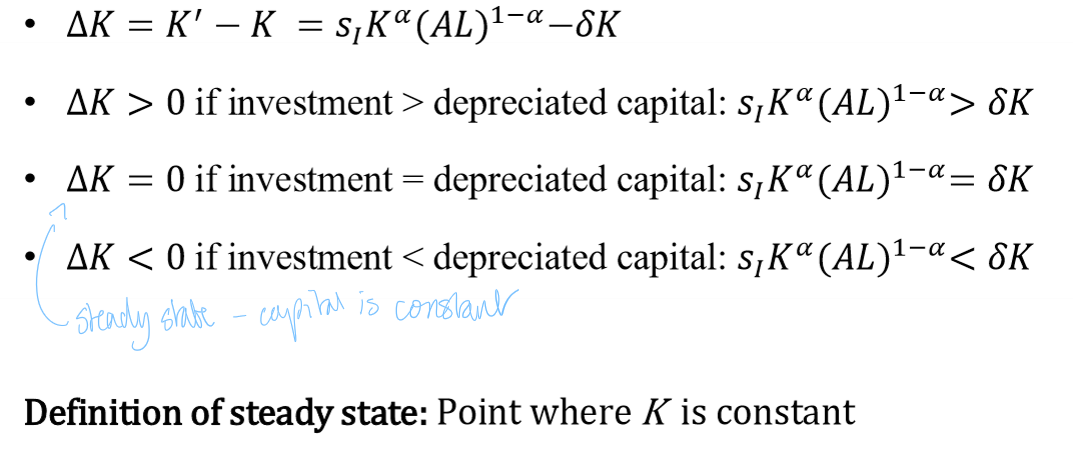
How does capital evolve in the Solow model, and what defines the steady state?
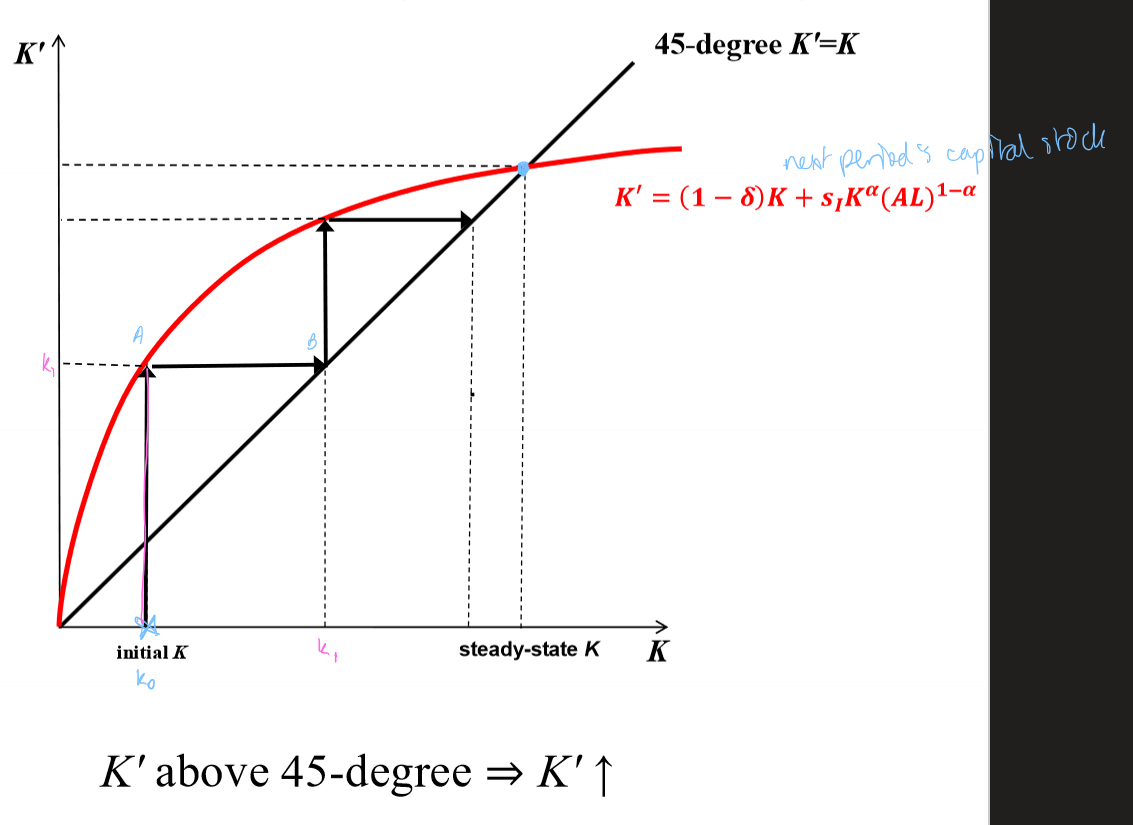
Change in the capital stock = next period’s capital minus today’s capital (investment minus depreciation)
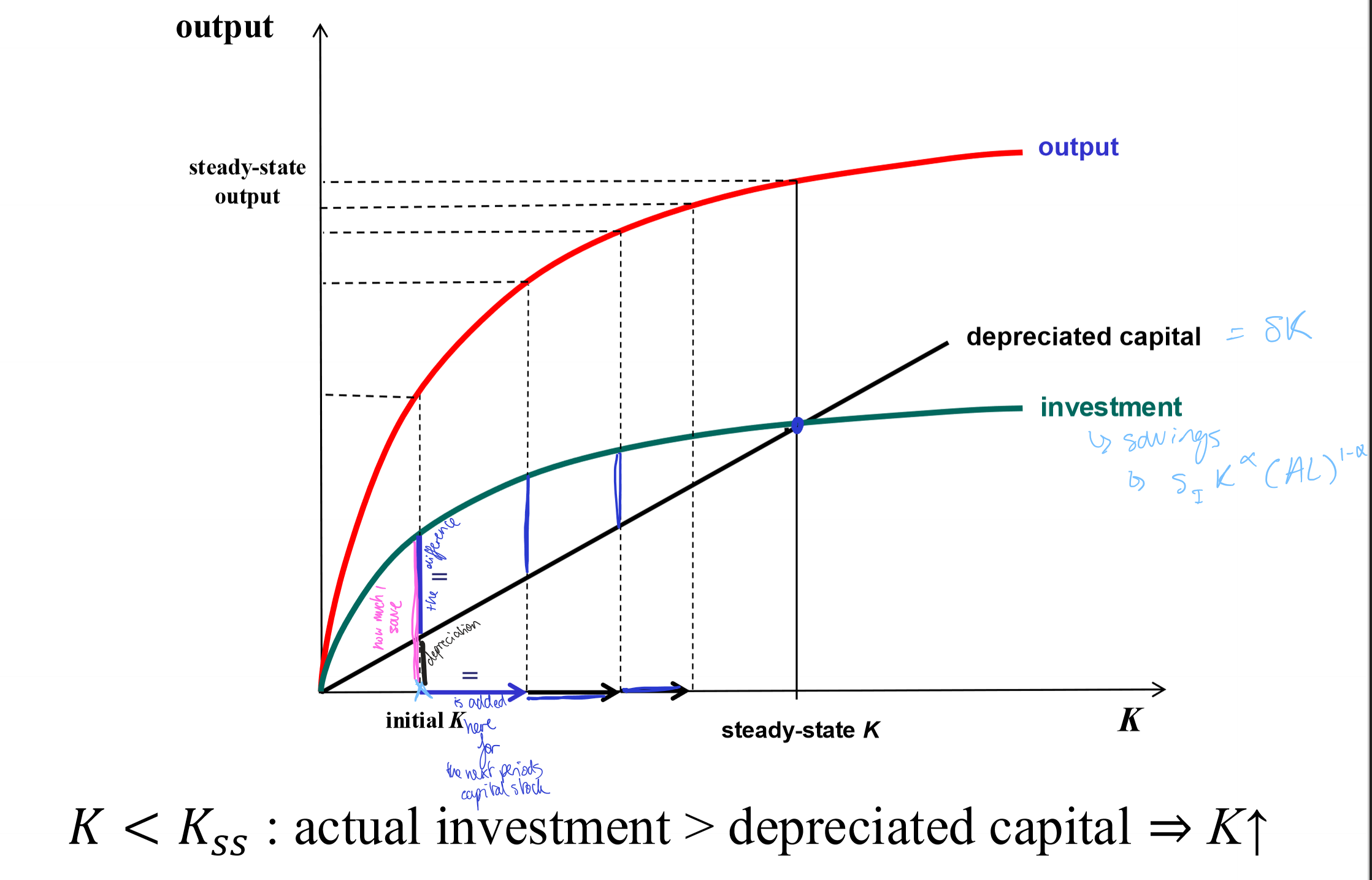
Starting below steady state
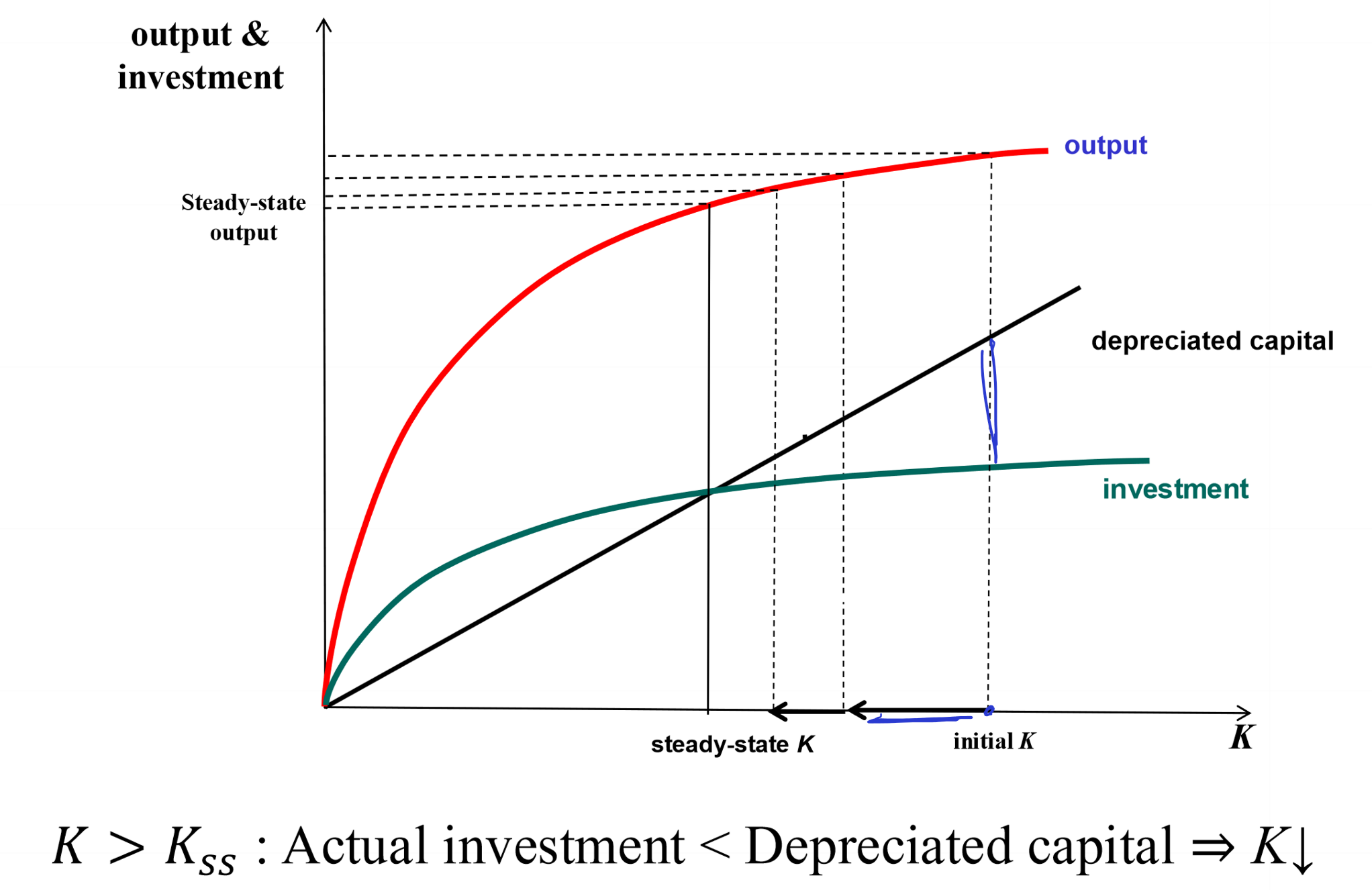
Starting above steady state
K,K’ space, when economy starts below steady state
Only works in discrete time
Key Implications Solow Model #1
Eventually no growth bc
A is constant
and diminishing returns
Growth higher for poor (ie low K) countries (conditional on having same A, sI , 𝛿)
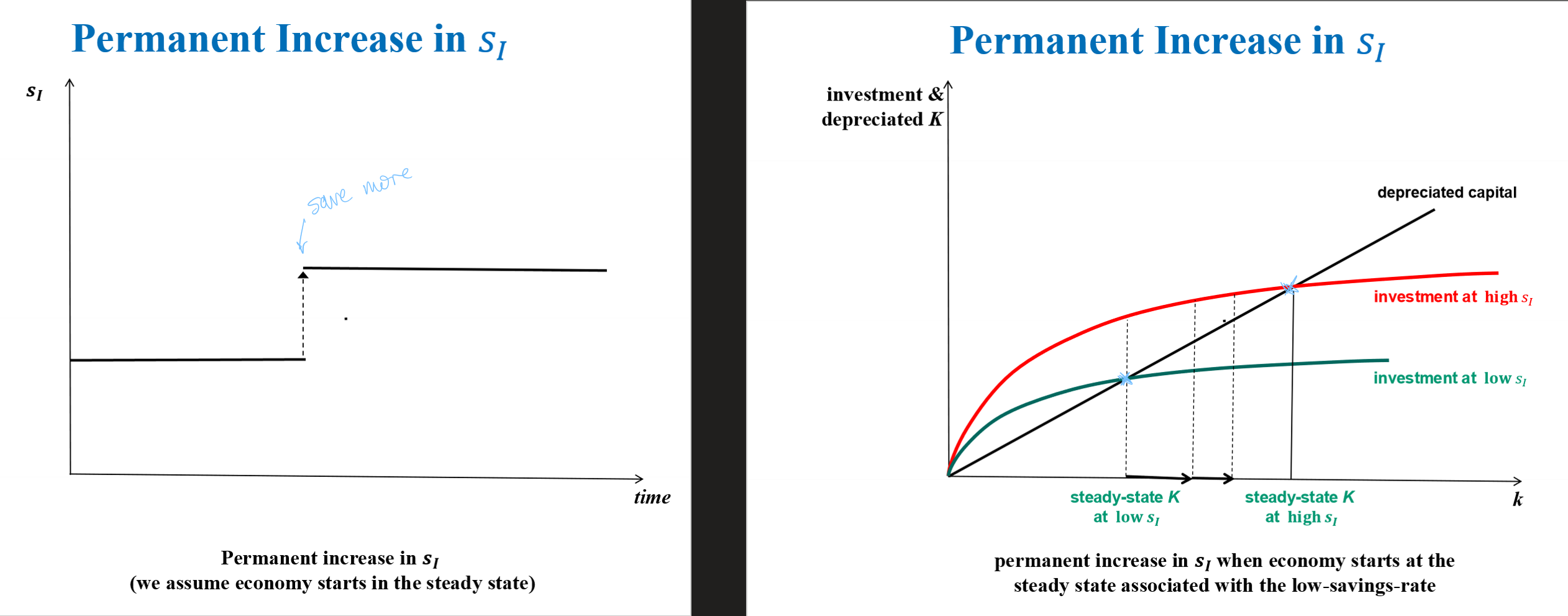
Permanent Increase in sI - will they grow faster
If a country starts saving more permanently - will they grow faster
in the end the growth is not higher because growth rate in the steady state is equal (rn it’s 0)
when add TFP growth and population growth, growth rate won’t be 0 but will still be 0 but will still be equal in two steady states
during transition there is a temporary higher growth rate
dies out bc of diminishing returns to scale
Key Implications Solow Model #2
Permanent increase in savings rate ⇒
Higher steady-state per capita output level,
Faster growth during transition,
No permanent effect on growth
How does the Solow model and growth accounting explain China’s rapid growth, and what limits does it imply for future growth?
China had a very high growth rate
Growth was reinforced by structural transformation, with labour shifting from low-productivity agriculture to higher-productivity manufacturing.
Very high savings rate
Reforms expanded property rates
Increased foreign investment
Part of observed growth may be “recovery” because earlier events (e.g., the Cultural Revolution) temporarily destroyed/undermined the economy, so later growth partly reflects catching back up
The Solow model implies that China cannot sustain high growth indefinitely through higher savings alone; as diminishing returns to capital set in, future growth increasingly depends on TFP growth.
Solow Growth Model: Successes
It can explain growth bursts after large destructions of capital/infrastructure,
e.g. in Germany and Japan after WWII.
It can at least partially explain growth bursts after countries increase savings rate:
fast growth of communist countries after WWII.
China’s growth and “growth miracle” of Asian Tigers (Hong Kong, Singapore, South-Korea and Taiwan).
It can explain GDP convergence for similar countries.
Solow Growth Model: Failures
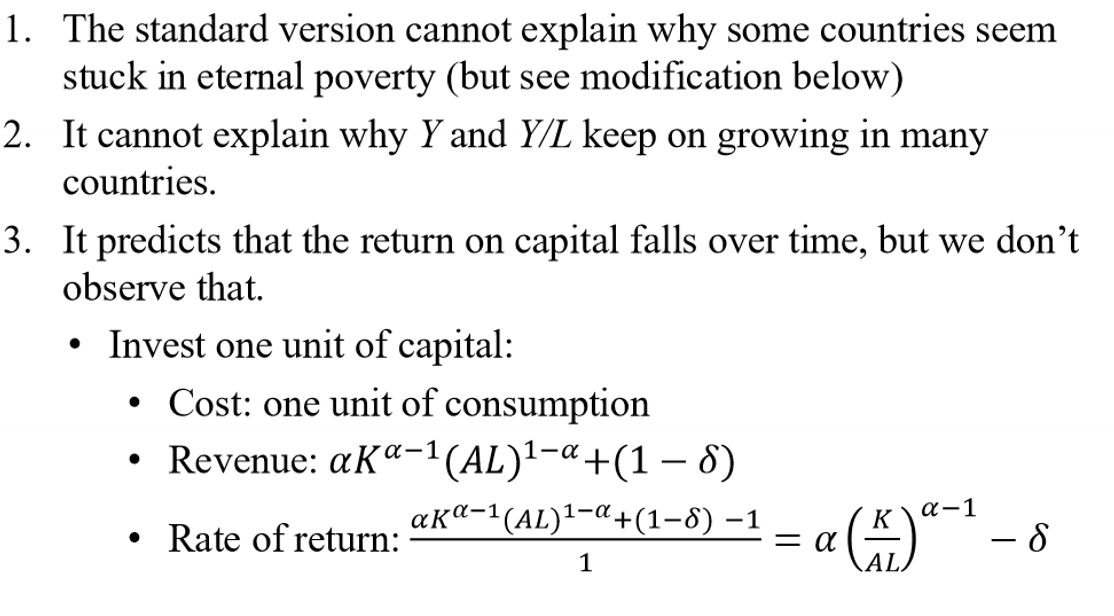
4. It says nothing about TFP growth which we know is important.
That is, it can only handle exogenous TFP growth.
5. It cannot explain the lack of GDP convergence that we also see in the data.
Is there convergence?
Yes if countries are similar
If Solow model is correct, then
• Low initial K (and Y) imply faster growth
• As Y increases, then subsequent growth should slow down
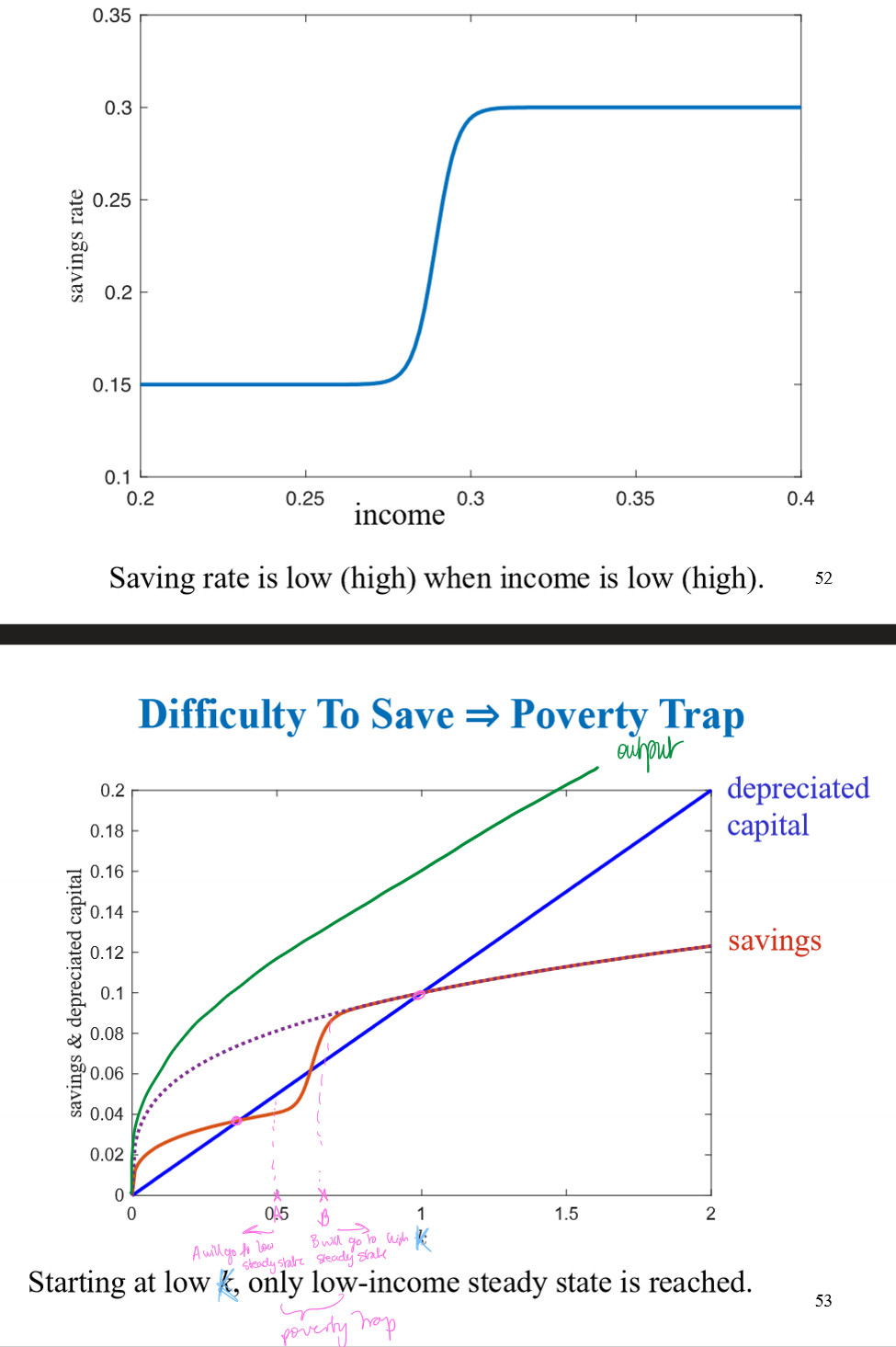
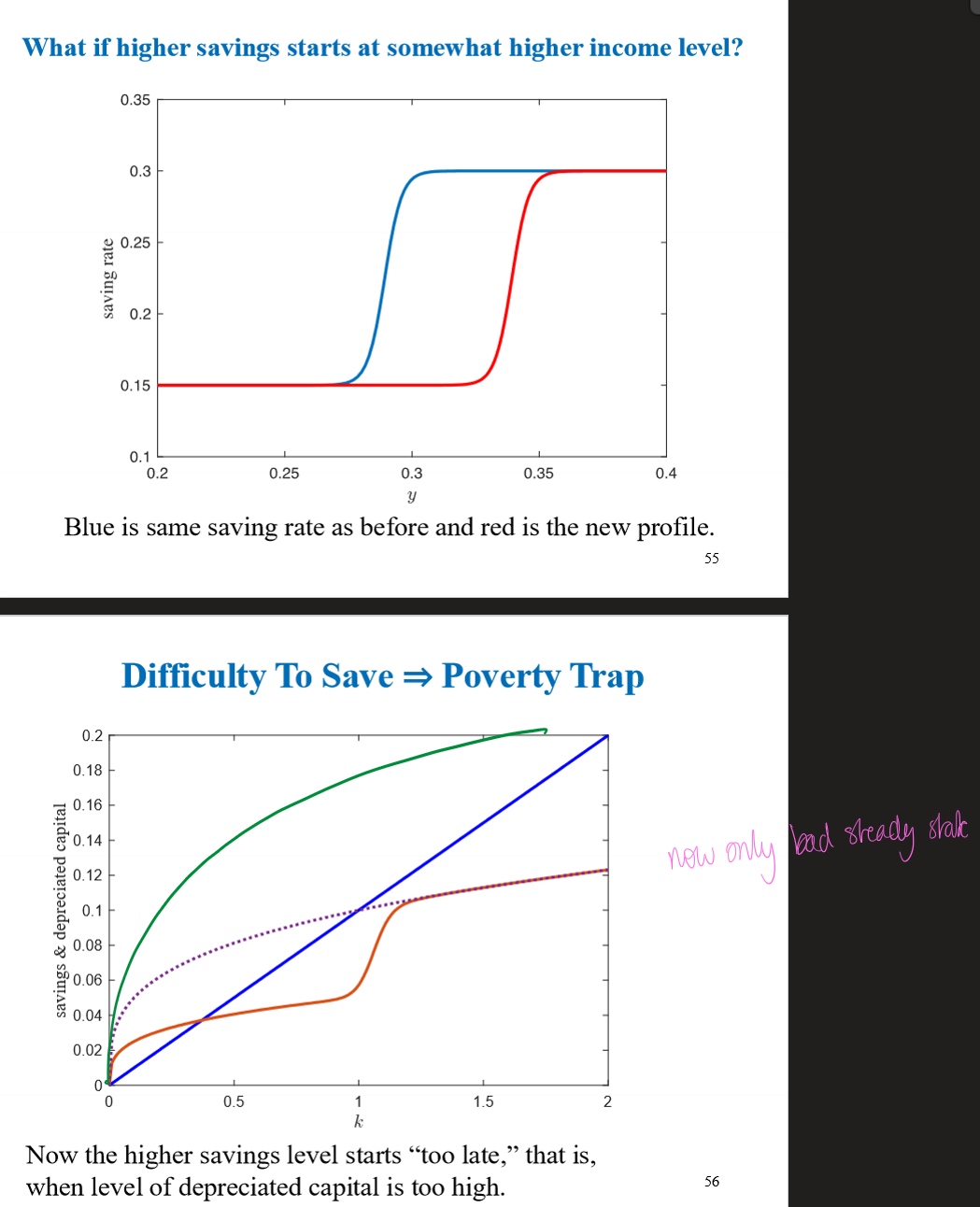
Poverty trap
Solow Assumption: amount saved is a constant fraction of output.
But saving rates are likely to be lower when income is low. (i.e., for poor countries).
Model predictions can be quite different.
Poverty trap + Foreign Aid
The poverty trap model provides an explanation for why foreign aid has not been successful, namely foreign aid has simply not been large enough to push the country out of the bad steady state.
So, economists like Jeffrey Sachs have argued for a “Big Push” in terms of foreign aid
What if higher savings start at somewhat higher income level
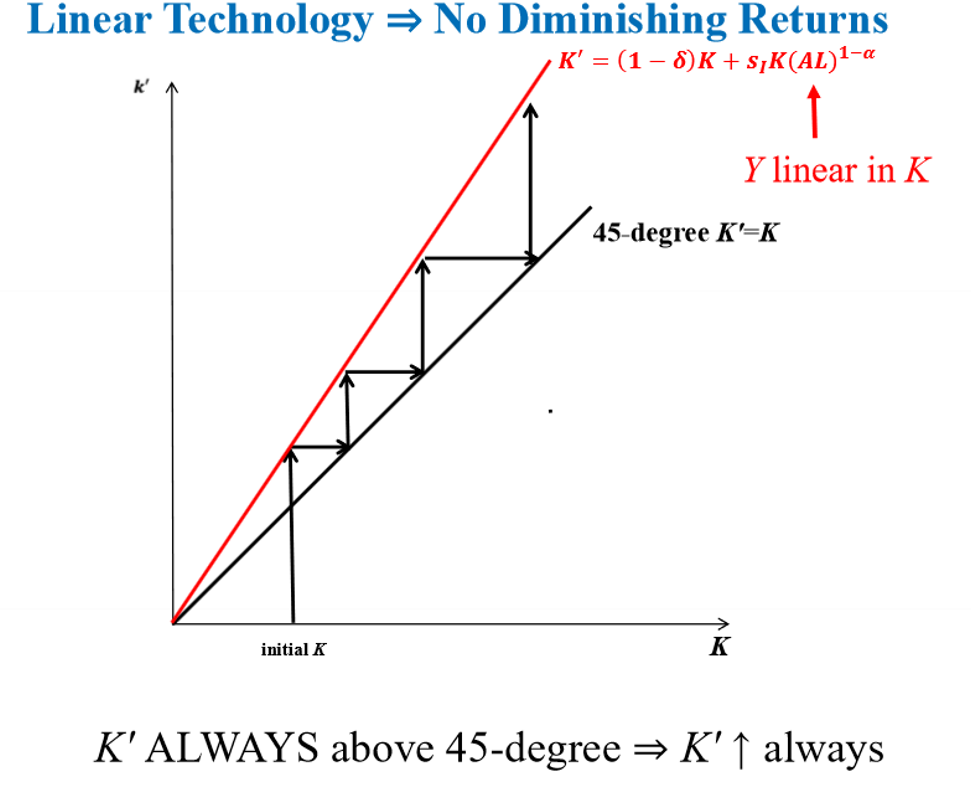
Why is decreasing returns to scale crucial in the Solow model, and what happens if technology is linear in capital?
The assumption of decreasing returns to scale in capital is key for the Solow result that savings cannot generate long-run growth.
If technology is linear in capital (no diminishing returns), output is linear in K.
In this case, the capital accumulation equation implies K′ is always above the 45-degree line.
Capital keeps increasing forever, so long-run growth through saving is possible.
Therefore, diminishing returns are what prevent perpetual growth via capital accumulation in the standard Solow model.
What fundamental question does the Solow model raise, and how does the Romer model answer it?
The Solow model raises the question: how does the real world overcome decreasing returns to scale?
Without overcoming diminishing returns, sustained growth is impossible in Solow.
The Romer model answers this by introducing permanent TFP growth.
In the Romer model, TFP growth is endogenous, not exogenous.
Summary
Growth accounting shows that both capital accumulation and TFP matter for economic growth.
The Solow model implies:
Continued growth is not possible through high savings alone.
Sustained growth requires TFP increases.
A poverty trap can arise if the savings rate depends on income.
The data show that:
The Solow model can explain specific growth episodes and countries.
Similar countries display convergence.
Many poor countries do not catch up
 Note
Note  Flashcards (201)