Advanced Electronic Materials and E-waste Management
 Studied by 0 people
 Call with Kai
 Learn
Learn Practice Test
 Spaced Repetition
 Match
Match Flashcards
 Knowt Play
1/4

There's no tags or description
Looks like no tags are added yet.
Name | Mastery | Learn | Test | Matching | Spaced | Call with Kai |
|---|
No study sessions yet.
5 Terms
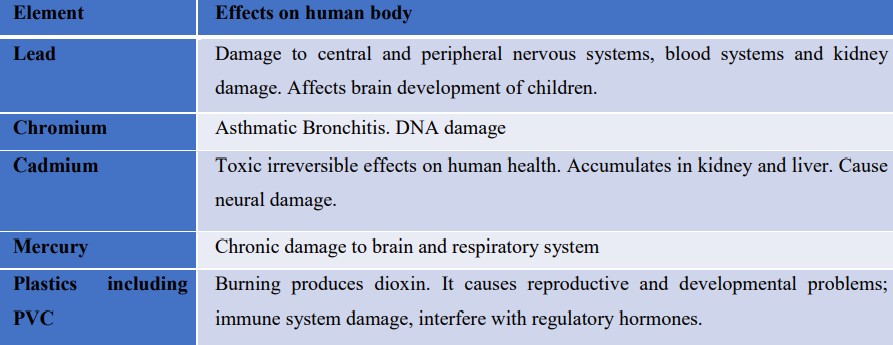
Effects of E-Waste on the Human Body
What are microelectronics?
Electronic circuits and devices built at a very small scale (micrometers or nanometers). They include transistors, sensors, microchips, etc.
What are Stretchable and Wearable Electronics?
Stretchable and Wearable Microelectronics are advanced devices designed to be worn directly on the skin or integrated into clothing, moving and stretching seamlessly with the human body.
These devices do not use hard and brittle silicon like rigid silicon wafers, and metal materials.
Instead, they use soft, biocompatible materials that are both conductive (let electricity flow) and elastic (can stretch and return to their original shape).
Stretchable electronics are made on flexible, elastic materials like rubbery polymers, silicones, or soft plastics. They can bend, twist, and stretch like skin, but still work as circuits.
Wearable electronics are devices you can wear on the body like clothes, wristbands, or skin patches. They continuously monitor health and the environment while being comfortable.
What are some commonly used materials in Stretchable and Wearable Microelectronics?
Conductive polymers like PDMS – polydimethylsiloxane. These are special plastics that can conduct electricity. They are naturally more flexible than metals.
Conductive inks with silver, graphene, or carbon nanotubes.
Tiny droplets of a non-toxic liquid metal alloy like gallium alloys are embedded inside a soft, stretchable rubber-like material (an “elastomer” like silicone). When you stretch it, the droplets elongate and maintain an electrical connection. They are designed in special patterns so that they can be stretched easily. They use spring-like wires and stretchable interconnects.
 Note
Note  Flashcards (88)