Neurones
 Studied by 0 people
 Call Kai
 Learn
Learn Practice Test
 Spaced Repetition
 Match
Match Flashcards
 Knowt Play
1/14

There's no tags or description
Looks like no tags are added yet.
Name | Mastery | Learn | Test | Matching | Spaced | Call with Kai |
|---|
No analytics yet
Send a link to your students to track their progress
15 Terms
What is the function of a sensory neurone?
To transmit a nerve impulse (action potential) from a receptor (e.g., Pacinian corpuscle) to the Central Nervous System (CNS).
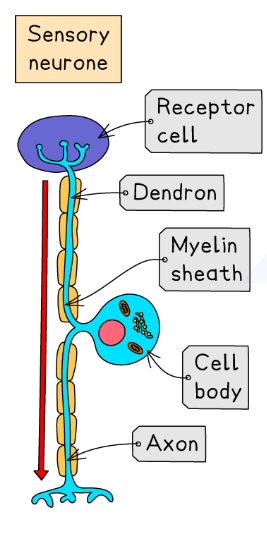
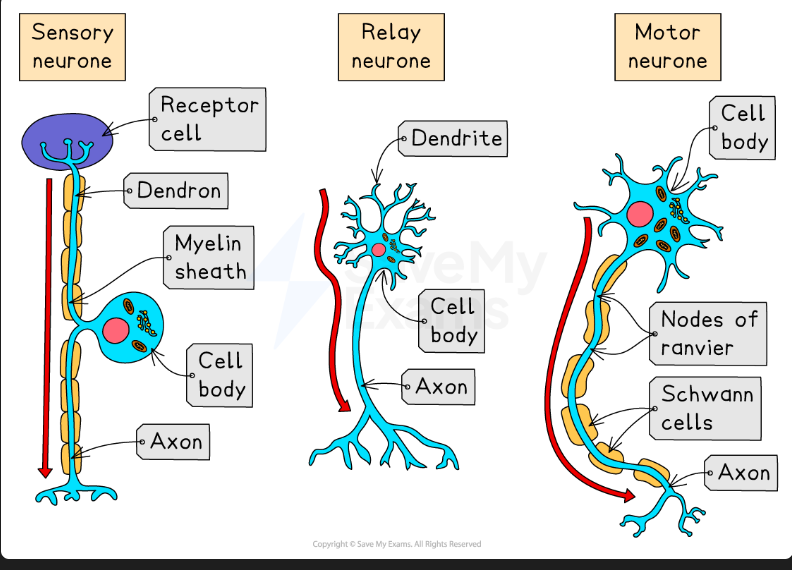
Describe the structure of a sensory neurone.
It has a long dendron which carries the impulse from the receptor.
The cell body is located part-way along the neurone (in the dorsal root ganglion, outside the CNS).
It has a shorter axon which carries the impulse into the CNS.
What is the function of a motor neurone?
To transmit a nerve impulse (action potential) from the Central Nervous System (CNS) to an effector (e.g., a muscle or gland).
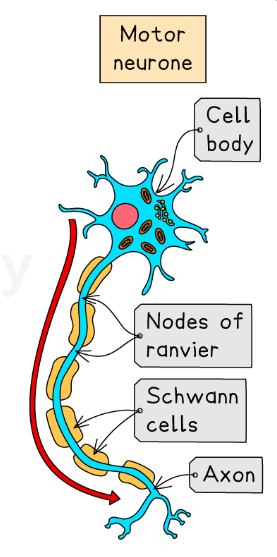
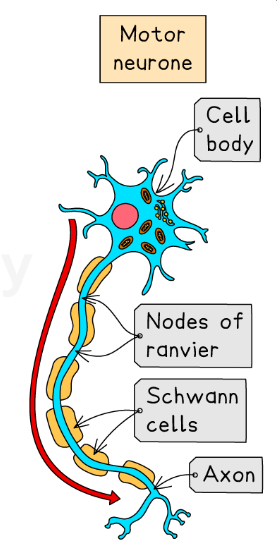
Describe the structure of a motor neurone.
The cell body is located at one end of the neurone, within the CNS (in the grey matter).
It has a long axon that carries the impulse to the effector.
It has short dendrites that connect to the CNS.
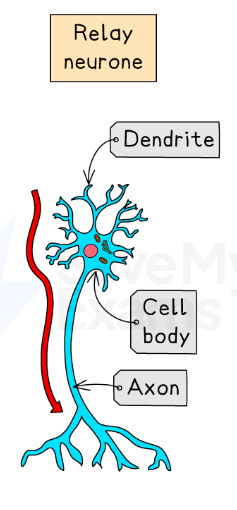
What is the function and location of a relay neurone?
Function: To connect different neurones, typically a sensory neurone to a motor neurone.
Location: Found entirely within the CNS (brain or spinal cord).
What is the myelin sheath?
A fatty (lipid-rich) layer that surrounds and insulates the axon of many neurones. In the peripheral nervous system, it is formed by Schwann cells wrapping around the axon.
What is the function of the myelin sheath?
It is an electrical insulator. It prevents the movement of ions across the axon membrane, forcing the action potential to "jump" between nodes, thus speeding up nerve impulse conduction.
What are the Nodes of Ranvier?
The small, exposed gaps between the Schwann cells in the myelin sheath. The axon membrane is exposed here, and these are the only places where ion exchange (and thus an action potential) can occur.
What is saltatory conduction?
The way an action potential is propagated in a myelinated neurone. The impulse "jumps" from one Node of Ranvier to the next. This is much faster than continuous conduction.
How does conduction differ in a non-myelinated neurone?
The neurone lacks a myelin sheath.
Depolarisation must occur along the entire length of the axon membrane.
This is a continuous "wave" of depolarisation, which is much slower than saltatory conduction.
Compare the structure of a myelinated sensory neurone with a myelinated motor neurone. (4 marks)
Similarity: Both have a long axon (or dendron + axon) and are myelinated by Schwann cells.
Difference 1 (Cell Body): In a sensory neurone, the cell body is located part-way along the neurone (in the dorsal root ganglion). In a motor neurone, the cell body is at one end (within the CNS).
Difference 2 (Dendrites): The motor neurone has short dendrites connected to its cell body. The sensory neurone has a long dendron (functionally an axon) and no dendrites on its cell body.
Difference 3 (Direction): Sensory neurone transmits impulses to the CNS; motor neurone transmits impulses from the CNS.
Explain how a myelinated axon transmits a nerve impulse much faster than a non-myelinated axon. (5 marks)
The myelinated axon is insulated by the myelin sheath.
The sheath prevents ion exchange except at the Nodes of Ranvier.
This forces the action potential to "jump" from one node to the next, a process called saltatory conduction.
In a non-myelinated axon, the impulse must be regenerated at every point along the membrane in a continuous wave.
Saltatory conduction is much faster as it does not have to depolarise the entire membrane.
Describe the role of Schwann cells in nerve impulse transmission. (3 marks)
Schwann cells form the myelin sheath (1 mark).
They do this by wrapping themselves around the axon (1 mark).
The sheath acts as an electrical insulator, which (by enabling saltatory conduction) speeds up nerve impulse transmission (1 mark).
In a reflex arc, a stimulus is detected by a receptor, and a response is carried out by an effector. Identify the three types of neurone involved in this arc, in the correct order. (3 marks)
Sensory neurone (transmits from receptor to CNS)
Relay neurone (connects neurones within the CNS)
Motor neurone (transmits from CNS to effector)
State three structural features of a neurone that are adaptations for its function. (3 marks)
Long axon: To transmit impulses over long distances.
Myelin sheath: To insulate the axon and speed up transmission.
Nodes of Ranvier: To allow for saltatory conduction.
Many mitochondria (in terminal): To provide ATP for the Na+/K+ pump and for synthesising neurotransmitters.
Many voltage-gated channels: To allow for depolarisation/repolarisation.
Dendrites: To connect to and receive signals from other neurones.
 Note
Note  Flashcards (106)