Ornithology
 Studied by 0 people
 Call Kai
 Learn
Learn Practice Test
 Spaced Repetition
 Match
Match Flashcards
 Knowt Play
1/95

Earn XP
Description and Tags
The list of facts and birds that I will need for the first test.
Name | Mastery | Learn | Test | Matching | Spaced | Call with Kai |
|---|
No analytics yet
Send a link to your students to track their progress
96 Terms
-iformes
The suffix for a aves class order
-idae
The suffix used for a birds family name
Paleognathae
Sub order of the ratites
Aves super orders
Paleognathae - ratites
Neognathae - all other birdssuperorder classification in birds
Ratites
Struthioniformes
Rhiformes
Casuariiformes
apterygifomres
tinamiformes
Ostriches
Struthioniformes
Largest living bird
fastest running bird
2 toes
Ostriches
Struthioniformes
Rheas
Rheiformes
3 toes
Emu & Cassowaries
Casuariiformes
3 toes with long claws
Emus are mello Cassowaries are NOT
Kiwis
Apterygiformes
Has nostrils at tip of beak and good sense of smell
hair like feathers
lays largest egg to body size ratio
Birds with a good sense of smell
Tinamous
Tinamiformes
can fly but weakly
4 toes
Neognathae
Order of all other birds besides ratites
Waterfowl: ducks geese swans, screamers
Order: Anseriformes
Screamers
Order: anseriformes
Family: anhimidae
rudimentary webs on feet, spurs on wings, no uncinate process, no penis
Magpie goose
Order: anseriformes
Family: anseranatidae
1 species in the family
Feet are only partially webbed
True water fowl
Order: anseriformes
Family: anatidae
3 webbed toes
Has a penis
Dabblers
Waterfowl that will sit high on the water and feed on the surface of the water
Feet are located more center body
Divers
Fully dive under the water to hunt for food.
Sits low on the water
Feet often located further on their back
Tree Ducks
Walks on land
Perches
Tropical
Forages on land or shallow waters
Geese
Ducks
Squeek
Live on water
Eat in water
Fowl: quail, turkey, pheasents, chickens, grouse, peacock
Order: Galliformes
Short round wings, heavy bodies and fat
Strong runners NOT strong fliers
Pigeons and Doves
Order columbiformes
Pigeons and Doves
Order: columbiformes
Produces crop milk (1 out of 3)
Breeding season is year round
Only Order where all species are threatened
Order Mesitorithiformes
Common name: mesites
Mesites
Order: mesitorithiformes
endemic to Madagascar
Nearly flightless
all 3 species are threatened
Sandgrouse
Order: pterocliformes
Breast feathers can hold water
Bustards
Order Otidiformes
Heaviest Extant flying bird
Heaviest extant flying bird
Order Otidiformes
Bustards
Turacos
Order Musophagiformes
Arboreal birds resembling a slim chicken with a long tail and crest
Vegetarian diet
unique pigments
Vegitarian diet in birds
Eats green leaves and fruit not seeds
Cuckoos, roadrunners anis
Order cuculiformes
Zygodactyl feet
many cuckoos are brood parasites
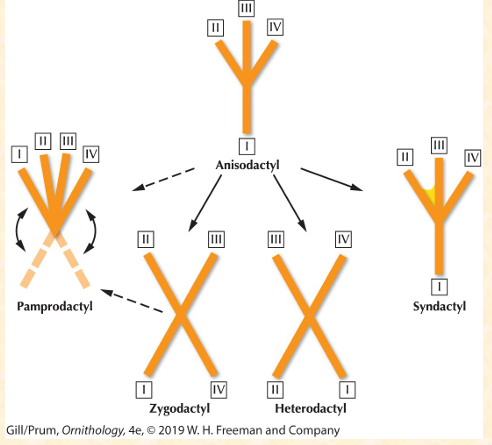
Syndactyl
1 faces back from left to right in front is 2,3,4.
2 and 3 have webbing between these toes
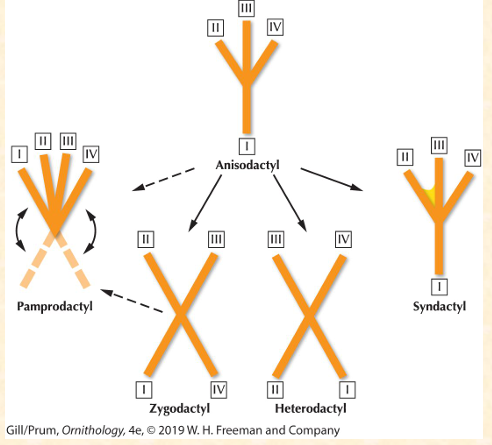
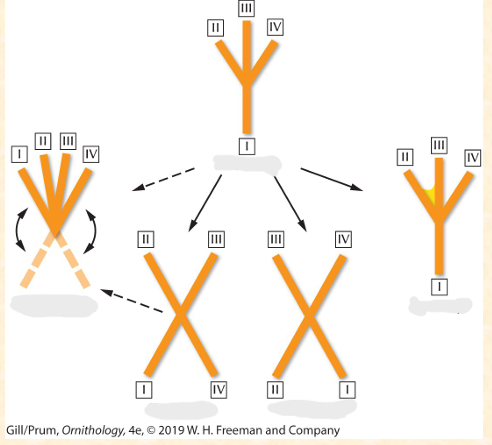
anisodactyl
1 faces back. In front is 2,3,4 from left to right
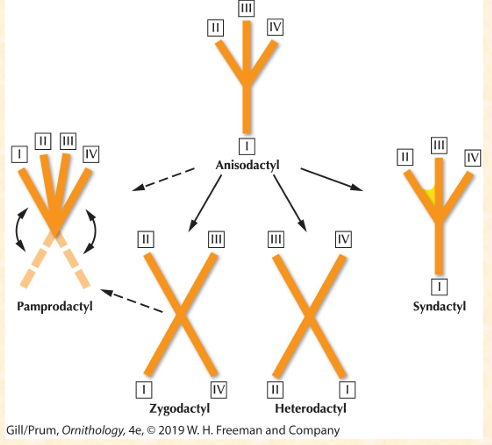
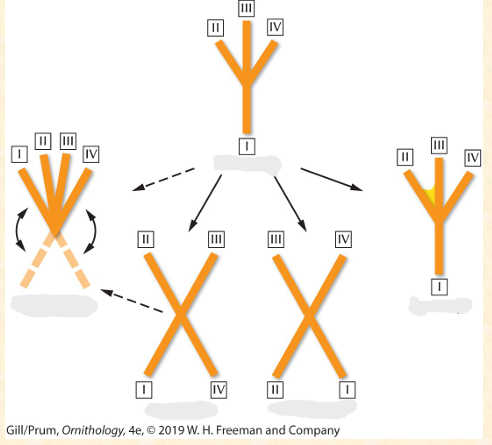
Heterodactyl
Feet are in an X shape back from left to right is 2,1 then the front are 3,4
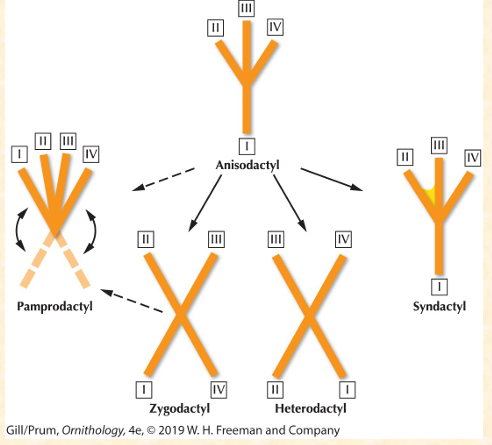
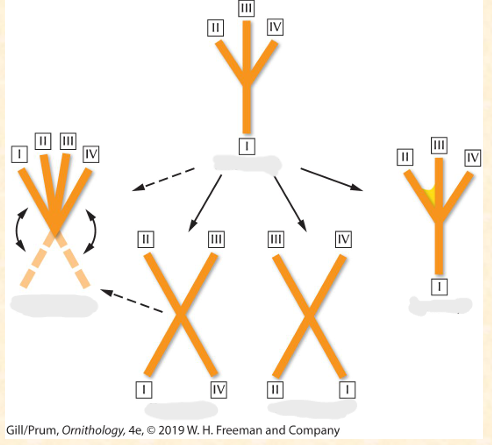
zygodactyl
Feet are in an X shape and start from left to right on the back is 1,4 then front is 2,3
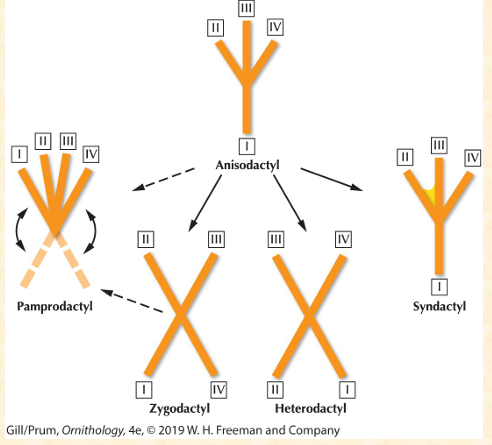
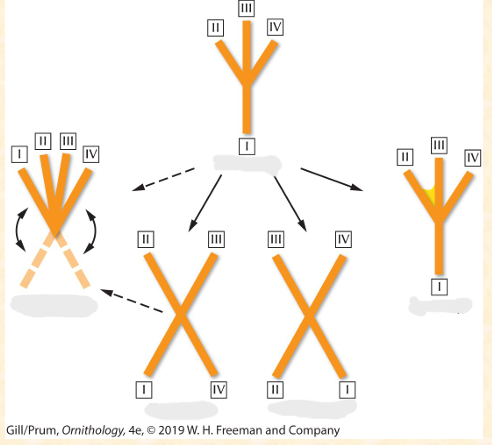
pamprodactyl
Toes can all be in front or in an X shape. Toes 1 and 4 are reversable. If all are in front then it goes 1,2,3,4 if they are reversed then in a zygodactyl formation.
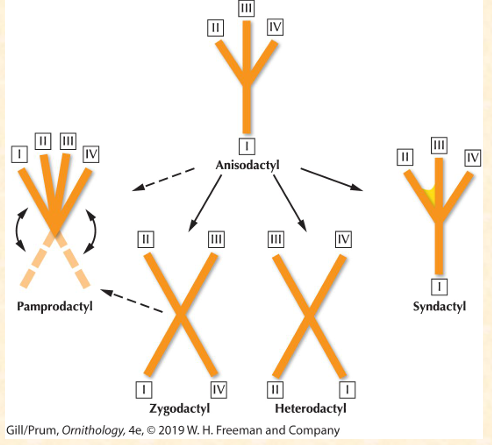
How birds toes are decided ( toe 1, 2,3,4)
1 will be the longest going in ascending order
Anisodactyl formation
Syndactyl
Heterodactyl
Zygodactyl
Pamprodactyl
Nocturnal Orders/common names
Goat suckers: Nightjars, poorwills, nighthawks
Order Caprimulgiformes
Cryptic plumage
Tiny bills yet wide open gapes
Rictal bristles
Small legs and feet
Noctural
Rictal Bristles
Mouth feathers
Potoos
Order Nyctibiiformes
Nocternal insectivores
superb camoflauge
Haunting calls that sounds like crying
Echolocation using birds
Oilbird
Order steatornithiformes
Oilbird
Order Steatornithiformes
Noctural , cave dwelling frugivore
echolocation
Nocturnal Birds
Frogmouths
Order Podargiformes
Superb camouflage
Nocturnal insectivores
Owlet-nightjars
Order Aegotheliformes
Nocturnal insectivores
long tail
Swifts & Hummingbirds
Highly aerial
tiny feet cannot walk
Crains, rails, coots
Order: Gruiformes
Wide variation
Shorebirds, gulls, terns, alcids, puffins
Charadriiformes
a very diverse order
3 main groups:
alcids - catch fish underwater
Gulls - dive from above
shorebirds
Flamingos
Order: Phoenicopteriformes
Tropical saline waters
Bent filter-feeding bill
Pink coloration depends on diet
Produces crop milk
Grebes
Order: Podicipediformes
Divers with lobed toes
Legs set far back on body
Silky feathers
Elaborate courtship displays
nest is a floating platform of vegetation
Carry young on back
eats own feathers
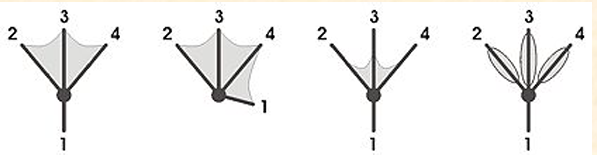
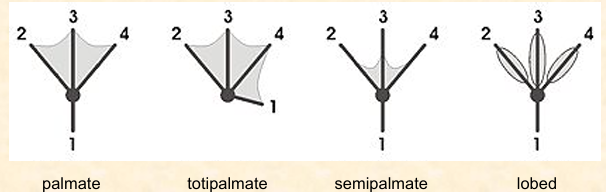
Lobed Feet 1,2,3,4? What is the use?
Flat paddle like flaps on toes to help swim in water
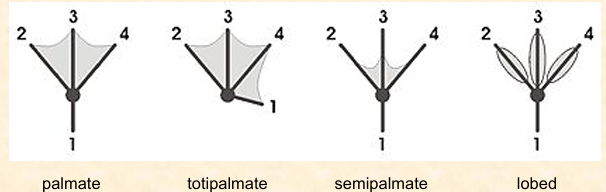
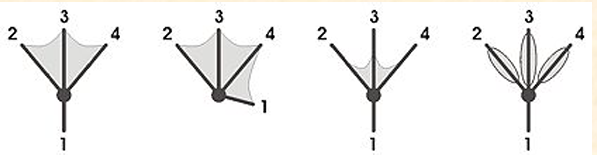
Semipalmate
Partial webbing used mainly on shorebirds to help running on soft material like sand or mud with out sinking
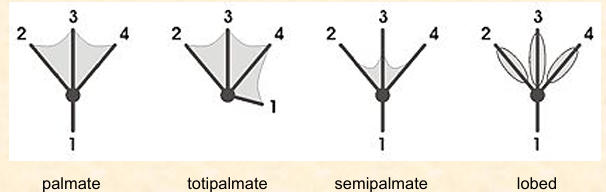
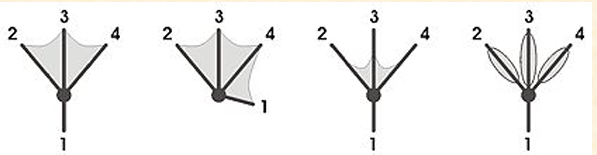
Totipalmate
All 4 toes are webbed used for strong swimmers or divers.
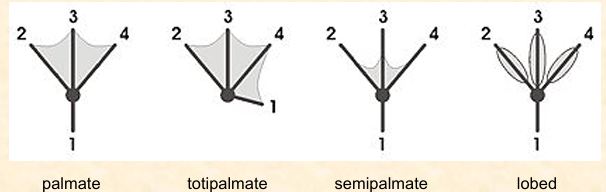
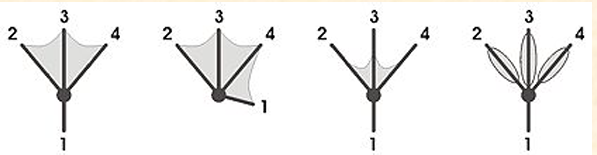
Palmate
Toes 2-4 are connected toe 1 is behind the foot.
Better for simi aquatic/land birds
Hoatzin
Order Opisthocomiformes
Entirely herbivorous
Chicks 2 digits have claws
What toes are webbed in palmate?
what toes are webbed in totipalmate
What part of the foot and toes are webbed on a semipalmate?
What toes are webbed/how on a lobed foot?
What bird & order has a horizontal profile?
Sunbittern Order Eurypygiformes
Sunbittern & kagu
Order Eurypygiformes
Sunbitter has short legs and a horizontal profile
Tropic Birds
Order: Phaethontiformes
Loons
Order Gaviiformes
Divers
Sharp heavy bills
Legs set far back on body
swim very low in water
Legs set far back on body
Grebes - Podicipediformes
Loons - Gaviiformes
The 3 orders that produce crop milk?
Pigeons - columbiformes
Flamingos - phenicopteriformes
Male emperor penguins - sphenisciformes
Penguins
Order sphenisciformes
Flightless, yet with distinct keel
Front wings modified into paddles (strong swimmers)
Tube-nosed seabirds, albatrosses, shearwaters, petrels, fulmars, storm-petrels, diving-petrels
order Procellariiformes
Tubular nostrils used to smell and find food
Very long lived
Can drink seawater
Storks
Order Ciconiiformes
no syrinx = mute
Boobies, gannets, cormorants, anhingas, frigatebirds
Order suliformes
Totipalmate feet
Small gular pouch
Birds with totipalmate feet
Boobies,gannets,cormorants, anhingas,frigatebirds - suliformes
Pelicans - pelecaniformes
Pelicans, bitterns, herons, ibises, egrets spoonbills
Pelecaniformes
Waders: neck often bent into an S in flight
Pelicans: totipalmate feet
New world Vultures
Order Cathartiformes
perforate nostrils (can see through them)
Good sense of smell (in some)
Diurnal birds of prey: hawks, eagles, kites, Old world vultures osprey, secretary bird, Osprey
Strong hooked bill and talons
order accipitriformes
Osprey - zygodactyl feet
Birds with Zygodactyl feet
Cuckoos, roadrunners, anis - cuculiformes
Osprey - accipitriformes
Cuckoo-roller - Leptosomiformes
Owls
Order: Strigiformes
large, forward-facing eyes with CONICAL sclerotic ring
Strong hooked beak and talons
2 suborders: Barn owls and typical owls
Strong cultural signifigance
Mousebirds
Order Coliiformes
Small, crested, gray or brown birds with long tails
Pamprodactyl feet
Mainly frugivorous
Birds with Pamprodactyl
Mousebirds - Coliiformes
Cuckoo-roller
Leptosomiformes
Zygodactyl feet
inhabits forests
Males iridescent females are more crypticlaly colored
Trogons, quetzals
Order: Trogoniformes
Richly colored, iridescent plumage, long tail
Short stout bill
small weak heterodactyl feet
Birds with Heterodactyl feet
Trogons & quetzals - Trogoniformes
Hoopoes, wood hoopoes, hornbills
Order: Bucerotiformes
Cavity nesters
Syndactyl feet
Birds with Syndactyl feet
Hoopoes,woodhoopoes, hornbills - Bucerotiformes
Kingfishers & allies
Order: Coraciiformes
Burrow-nesters
Woodpeckers, toucans, barbets, honeyguides, jacamars, puffbirds
Order: Piciformes
Highly specilized bills and tail feathers
zygodactyl feet
cavity-nesters
Seriemas
Cariamiformes
found in open habitats
Falcons & caracaras
Order: Falconiformes
Strong hooked bill and talons
tomial tooth on bill (except caracaras)
pointed wings
Parrots macaws lovebirds, cockatoos, etc
Order: Psittaciformes
Hooked beak
zygodactyl feet
highly intelligent
Birds with zygodactyl feet
Parrots, macawas, lovebirds, etc - Psittaciformes
 Note
Note  Flashcards (42)