BIOL112: Ecosystems & Conservation
 Studied by 1 person
 Call Kai
 Learn
Learn Practice Test
 Spaced Repetition
 Match
Match Flashcards
 Knowt Play
1/74

There's no tags or description
Looks like no tags are added yet.
Name | Mastery | Learn | Test | Matching | Spaced | Call with Kai |
|---|
No analytics yet
Send a link to your students to track their progress
75 Terms
what is conservation biology
what reasons made it emerge as a distinct discipline
(conservation biology)
the branch of biology concerned with conserving different species (conserving biodiversity) - managing populations, ecosystems, and environments using various tools to ensure this
thinking about biodiversity amongst human development, in cities, and amongst farming of land - using these landscapes while conserving the species
overlap with many other disciplines, namely the many laws / policies / management practices / funding / sociality that underpin this - must consider effects of legislations on social / productivity / cultural context
(emergence)
increased concern on environmental degredation
realisation of an extinction crisis
recognition of the need for integrated and sustainable land management
what are the 3 guiding principles of conservation biology
evolution is the basic axiom (established fact) that unites all of biology
the ecological world is dynamic and largely non-equilibrial
the human presence must be included in conservation planning
what is biodiversity
name and describe the 3 levels
(biodiversity)
the diversity within a population / species, looking at species richness (S) - total number of species, and species evenness (E) - relative abundance of species
(3 levels)
genetic diversity - looking at genetic variation within & between populations (different kinds of alleles)
species diversity - looking at the variety of species in an ecosystem / biosphere (allowing us to aim conservation efforts to those in most need)
ecosystem diversity - looking at the diversity of ecosystem types that occur in an area (different kinds of biomes)
have we discovered all biodiversity?
no, still lots to be discovered - still new species being discovered despite high number already
first species described were large and obvious, so we now are discovering hidden species in underexplored environments (e.g. oceans, marine volcanoes, underground) and in biodiversity hotspots (genetics highlighting differences between similar species)
define these terms:
native / indigenous
endemic
exotic / alien / introduced / non-native
naturalised
invasive
(native / indigenous) species occurring naturally in an area / reached by themselves, where they come back to breed
(endemic) native species that do not occur anywhere else in the world
(exotic / alien / introduced) species brought to an area by humans / human dispersal
(naturalised) introduced species that can maintain wild populations in the area introduced to
(invasive) naturalised species that are spreading rapidly and causing negative impacts
what is a biodiversity hotspot
provide an example
what is their implication for conservation
a relatively small area, with a high concentration of endemic species, and many endangered / threatened species
e.g. NZ, SW Australia, Rainforests, Tropical environments
(conservation) are targetted and focused on for conservation, as they have many species so each are even likelier to disappear without help - especially if human disturbances and climate change are affecting these areas
what are ecosystem services
name and define the 4 of them
the ways we are reliant on ecosystems for our lives / wellbeing of society, directly or indirectly - highlighting the importance of biodiversity
(provisioning)
obvious services, the products we obtain from these ecosystems
e.g. food, freshwater, fuel, fibre, biochemicals
(regulating)
benefits we get from regulating processes of the ecosystem
e.g. climate regulation, disease regulation, water regulation, water purification, pollenation - all these processes give us benefits
(cultural)
non-material benefits we get from ecosystems
e.g. spiritual and religious views, recreation, ecotourism, aesthetics, inspirations, education, sense of place, cultural heritage
(supporting)
services underpinning every other ecosystem service
e.g. soil formation, nutrient cycling, primary production
why should we care about biodiversity
morally - we messed it up so we should fix t
ecosystem services - we rely on biodiveristy in ecosystems for our lives and wellbeing of society (provisioning, regulating, cultural, and supporting services)
give some examples of past extinction events (natural & human)
what types of organisms usually go extinct first
various extinction events occurring naturally, to do with disturbances (e.g. meteorites), or glacial activity (e.g. sea level rise & falls)
but have artificially been done by humans - many associated with periods of human expansion due to various reasons (e.g. overharvesting, bringing new invasive species)
e.g. Australia (arrival of Aboriginal people from SE Asia, ~60,000ya), North America (arrival of people from Siberia, ~20,000ya), New Zealand (arrival of Polynesian people, ~700ya)
the first organisms that go extinct are bigger things (Megafauna), as these are beneficial for human food, easy and efficient food gathering to hunt
e.g. Wooly Mammoth, American Lion, Ground Sloth
the next organisms to go extinct are those vulnerable to harm caused by species we introduce
e.g. NZ bird extinctions (~40%) / frogs / skinks / geckos still ongoing caused by human disturbance &| introduction of mammalian predators (not adapted to), NZ Adam’s mistletoe, NZ Little Spotted Kiwi once had a wide distribution but have declined to only be in island sanctuaries
what are the problems with calculating modern extinction rates
how can we combat modern extinctions
we are currently in the middle of it, so hard to calculate anyway
also difficult as: most species are not described, and difficulty to prove extinctions (as we cannot search everywhere possible)
(combatting extinctions)
easiest thing to do is protect our ecosystems via conservation, which then protects species within by default (even if undiscovered / hidden)
we can infer if a greater lost of ecosystem area occurs, a greater loss of species will occur
this is evidenced by biodiversity hotspots - large range of species per area, but having also a large proportion of threated / endangered species, and high rates of human disturbance
therefore aim actions on biodiversity hotspots
name the 5 key drivers of biodiversity change (/decline)
which ones have occurred / had the most effect in NZ
climate change
over-exploitation
pollution
habitat loss
invasive species
(New Zealand)
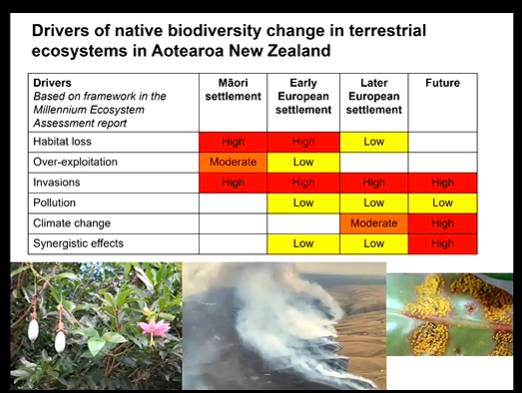
have all occurred in NZ at different stages (Maori settlement → European settlement → present)
they interact to cause worsened effects (e.g. invasive species may become more successful with climate change if more adapted to)
the worst one overall = invasive species, worst in the past = habitat loss, worst into the future = climate change
how does climate change affect biodiversity
direct effects (e.g. extreme weather events, extreme conditions, loss of native species unadapted to the conditions, invasion of exotic speces)
indirect effects (e.g. interactions with other factors (e.g. invasive species more adapted to changed conditions), disturbances not adapted to by our speices (e.g. forest trees not fire adapted, drought causing forest dieback of younger individuals (affect later generations and replenishing), competition with invasive species
indirect effects socially (e.g. reduced funding to conservation as money goes towards combatting other climate change related issues (e.g. infrastructure damage from weather events)
how does over-exploitation affect biodiversity
over-exploitation is the human harvesting of wild plants / animals at rates exceeding their natural ability to regenerate populations
e.g. NZ occurred early on from Maori arrival (overhunting of moa) → European Settlement (overharvesting of timber forests), however Maori were able to learn how to harvest species sustainably (Rahui - ban on harvesting species if populations get too low)
still occurring all around the world (e.g. Bluefin Tuna - a main predator but species declining due to overhunting, e.g. Mammals - 25% are in danger of extinction with 1/3 due to over-exploitation, e.g. Western lowland Gorilla - hunting and habitat loss, e.g. Yangtze River Dolphin - hunting and human disturbance (tangled in fishing gear, collisions with boats & ships) and habitat loss and pollution
how does pollution affect biodiversity
not as important to terrestrial systems, but still affects freshwater environments on land
e.g. NZ Banks Peninsula soils where trees are harvested are high in phosphorus, and harvesting results in soil erosion into freshwater systems (lakes) resulting in nutrient imabalnce → eutrophication → algael blooms
e.g. nutrient runoff of farming waste & fertilisers into freshwater sysstems → nutrient imbalance → eutrophication → algael blooms
e.g. nutrient runoff into freshwater systems causing high nitrate levels in NZ drinking water
e.g. NZ National Policy Statement for Freshwater Management (2020) - aims to sort this through various management practices to look after our waterways (e.g. plantation zones surrounding systems)
how does habitat loss affect biodiversity
all driven by humans and human settlement globally
small scale - local people destroying habitats (e.g. cutting down trees for firewood for cooking and heat)
large scale - industry harvesting, converting forests to agriculture / palm oil plantation / infrastructure
results in loss of forests, grasslands, wetlands, shrublands - which all have important support for native and endemic species, causing harm to biodiversity
e.g. some countries do replant trees to maintain a balance of those cut down (e.g. China, Russia) but so much irreversible damage has already been done
e.g. roads are a major threat (give access to areas to deforest)
e.g. deforestation a big threat in the Amazon (forest → farmland), causing biodiversity loss and spiralling effects (more fires, more loss)
e.g. NZ harvesting of Kauri mature forest for timber
how did habitat loss occur in Maori settlement of NZ
what evidence supports this and why (3 types)
deforestation in various regions (agriculture - kumara, security around tribal sites, clear travel routes, accidental), however this was still able to regenerate as they did not use mass fire for deforestation (like Europeans)
~700 ya
(evidence)
cultural oral traditions and histories
pollen records preserved in layers of sediments in wetlands (build up layers to trap pollen, tough pollen with no oxygen so are presevered well), which can be identified for species, and estimated the age and sequence (layers, degredatiom) - showing which predominated at which times
these work together with charcoal in the soil, specific types of charcoal show the wood that was harvested to then burn, and if an increase is correlating with a decline in the pollen count in the record - suggests fire used for deforestation
the pollen record greatly changed before vs after Maori arrival, and was lots of charcoal appearing - thus evidencing deforestation
how did habitat loss occur in European settlement of NZ
where did this occur most
what types of habitats incurred most loss
deforestation and habitat destruction to clear space for farming, infrastructure, accidental - etc (is ongoing) - this unable to regenerate due to burning (un-adapted systems to fire) / overgrazing / competition with invasive species
occurred most in the South Island (flatter, better for settlement - access / farming / drier), which spiralled due to drier systems, worsening disturbances like fires, and preventing regeneration
resulted in changing of many types of species / environments, through introduced plantations
main target to forests, which made up most of undisturbed NZ - causing great biodiversity loss as our species are therefore forest adapted - so struggled when this was removed
also main target to wetlands (~90% lost), which have important support for other ecosystems & human services (Carbon sink, sponges to soak in water and mediate flooding, release of stored water to mediate droughts, house bird and fish species)
this caused positive feedback loops - more flooding, more droughts => more habitat loss
habitat loss caused cultural loss for Maori
also caused destruction by introducing various destructive species (e.g. grazers, invasive, new plants to farm)
what is fragmentation
what type of biodiversity loss is this
what are its consequences to biodiversity
give an example
fragmentation is the formation of small, unconnected patches of environments, resulting in these environments being no longer identical to originally
a type of habitat loss
(Effects)
not instant, they occur over time as biodiversity decreases, size decreases, and things spiral
can result in species loss, being too small to sustain them
cause loss via changes in environmental conditions (= edge effects, different environmental conditions on the edge of patches, e.g. less moisture / more wind sun light / more predation risk / risk to invasive species / opens up understorey)
can worsen competition with invasive species (may be better at survivng edge conditions)
can alter disturbance regimes (Regeneration following disturbances required to sustain populations and refresh generations) - removing usual disturbances, or introducing new ones unadapted to
(Example)
Riccarton Bush was created to prevent flooding, but NZ Kahikitea trees living here regenerate after flood disturbance (creates nutrient abundance to support young), so by reducing flooding, Kahikitea species couldnt survive here effectively => gradually replaced by Pokaka and Mahoe trees
how do invasive species cause biodiversity loss
what are the typical characteristics of successful invaders
these are exotic species (not naturally part of the ecosystem - human brought), which have naturalised (made self-sustained populations), AND cause a negative impact on our environment (generally to native & endemic species)
these cause biodiversity loss by outcompeting native & endemic species in environments, changing the compositions of these environments, and therefore causing even more harm as they disrupt ecosystem structures => impacting even more native & endemics
(typical characteristics)
large native range, where they were abundant, with a broad diet, and tolerance with a wide range of conditions (so able to survive various conditions)
r-selected, short generation times, female able to colonise alone
larger sized than relatives, associated with humans
what is the pattern of invasion for invasive species
how is this helpful / tricky for conservation
a general pattern which varies between species, but still holds as a general baseline
(lag phase / delay phase) arrive as an immigrant, can take a while / short time, before becoming self-sustaining
this length of this phase is influenced by: detection of invader growth / number and arrangements of imigrants / environmental conditions (particularly good / bad, or particularly bad for another speices to open up opportunities by reducing compeition) / natural selection among rare or new genotypes adapted to this new location (among the immigrants)
(exponential growth phase) rapid reproduction, population numbers quickly increase
(stability phase) population growth plateaus, and population size is maintained (maximum that can be supported by the environment, natural limit)
(eruptive oscillation) can also drop back down due to resource limitation / competition
(implications for conservation)
we have most knowledge about invasive species in the stability phase (obvious) - so these can be targetted for eradication methods
however, the tricky thing is figuring out species in the lag phase, as it would enable identification and eradication early on while still easy to do - before exponential growth
what are the worst invasive species in NZ and why
how were invaders brought here and when
what invaders were brought
why were these sustained
our worst invaders were predators / mammals - which drove many mammal unadapted / mammal adjacent (via compeition) species to extinction
also the plants weer bad (modifying ecosystems to cause a flow on effect), and the ungulates (can change ecosystems by declining plant numbers via grazing)
(invasions)
were brought before humans via Australia & Pacific areas through wind patterns
initial Maori settlement brought a few species (e.g. rats, dogs, some plants)
European settlement brought many species (mammals, birds plants) for various reasons (hunting, comfort / climatisation, economy, by accident, sport, utility)
plants were brought also for various reasons (ornamental / agriculture - clover, ryegrass, pine, kiwifruit / accidental - on clothing, hidden in seed mixtures)
(what made them successful)
mammals successfully invaded due to our lack of mammals (lack of diseases / competition), repeated introductions, hard work to maintain populations by climatisation societies / farmers / etc, and suitable environmental conditions
describe the Brushtail Possum invasion to NZ
why was it brought
why does it do well
why is it bad
(invasion)
Australian endemic, introduced to establish fur industry
inhabit our pasture-forest margins
(success)
introduced at various parts, at various times (repeated)
have a broad diet they switch seasonally (foliage, flowers, fruit, seed, fungi, vertebrates, invertebrates, adult birds, eggs, nestlings)
(harm)
one of our worst pests, have broad impacts (predator to birds / disease spreaders to our farming species like bovine TB / feed on our plants)
eat eggs / nestlings / adult birds
eat snails (however a cultural tradition only one population does - showing their smarts and adaptability)
describe the Stoat invasion to NZ
why was it brought
why does it do well
why is it bad
(invasion)
introduced to control rabbit populations (another pest species introduced for fur trade & food, but had rapid growth & negative effects on agriculture)
(success)
(harm)
intelligent, perfectly evolved predator, hunt by sight and smell, smart and able to learn and evade traps
predates on our native birds which were vulnerable to them (e.g. smelly, ground-dwelling, not adapted to mammalian predators) - causing lots of endangerement, damaging our biodiversity
e.g. Kaka, vulnerable eggs / nests / females to stoats, previously widespread but now scarce and reliant on predator control (oj offshore islands, struggled to reestablish onland)
e.g. Kakapo
describe the Ungulate invasion to NZ
why was it brought
why does it do well
why is it bad
(invasion)
deer species / thar / chamois / goats
(success)
(harm)
divided in efforts for conservation / no social will to remove, due to importance in hunting / sport
impact our environments via browsing of plants (are herbivores) selectively, removing palatable species (certain ones, young generatins, understorey, etc)-
this alters long-term vegetation success / generation success, as younger generations are prevented from growing up into the forest, so only older trees remain, who eventually die => changing forest composition
this would have flow on effects to the environment
also trample species (plants & animals)
describe the Wilding Conifer invasion to NZ
why was it brought
why does it do well
why is it bad
(invasion)
introduced confiers arent harmful at their core, but these wilding ones are self-sown / unwanted, spreading across the landscape
introduced for forestry / money / timber / plantations - important for the economy and forestry
(success)
can occasionally spread seeds far via wind dispersal, enabling new populations to start, which expand and grow exponentially if unnoticed (e.g. near Queenstown)
(harm)
the most concerning ones (widespread issue, but worse in colder / higher elevation) do well in alpine / tussocks / open grasslands, as they require lots of light so exploit and overgrow other species in the environment
changes soil, habitats, environmental compositions => causing flow on effects to native species (changing what they are adapted to, reducing fitness)
name the 4 conservation priorities in the future for NZ
Protection of native habitats (remnant areas, namely across lowland rural NZ)
Restoration of native habitats (to increase area, namely in lowland areas)
Weed control (especially on public conservation land)
Animal Pest control across native habitats
what is an important social aspect to consider for future conservation efforts in NZ
conservation efforts in partnership with Maori and non-Maori people of NZ - people have so much effect on conservation, everyone needs to be working together for efforts to be successful
(Maori)
also must consider it from a colonisation POV, as taking away land, and legislations around what can and cannot be done on Maori land,is alike the depossession and resettlement faced by Maori under European colonisation (& subsequent loss of rights, culture, sacred sites)
especially apparent as conservation often involves the government buying land, or legislations surrounding what can and cannot be done on certian areas of land - in the name of conservation
easy to look at this as beneficial for the species being conserved, however must consider the social aspects - is alike land theft, so instead work in partnership, managing and being aware of differing viewpoints
for NZ conservation to protect native habitats,
what areas are targetted
how are they protected
(areas of target)
lowland / flat native forest habitats are of target, as these areas have been highly developed (flat, easy to develop on, good conditions for farming & living - suitable for productive land use) - therefore there is little representation of remnant patches in these areas, and few are protected
NZ was predomanantly forested before human settlement (~80%) of various forest types, but much has been destroyed now, with most protected land being of Beech forest - wheras what was dominant in the past was Broadleaf forest
33% of NZ land is protected (private & public (national parks, conservation parks, forest parks, DOC land) conservation land) - but this is not randomly distributed, it mostly includes alpine / wet / mountanous areas (undeveloped areas due to poor conditions unsuitable to productive land use)
(how are they protected)
due to high development, most of these remnant patches are within Sheep & Beef farmland, hasnt been protected by conservation, but is owned and upkept by the farmers
landowners rely on this land for money to survive, so must balance biodiversity AND social outcomes
therefore cannot slap on legislation (taking / buying land, forcing management, repossession) - better to work in partnership and educate them to manage this biodiversity (happy outcomes for all)
National Trust Covenants are a good strategy, they allow the land to be bought and farmed on, but hold current and future owners to a set of Covenant rules around good biodiversity practices - which have space for negotiation (positive outcomes for biodiversity AND social)
NOTE - legal protection does not always ensure protection of biodiversity / the remnant, things like pests may still have effects if not managed (multiple things must be managed)
for NZ conservation to restore native habitats,
what areas are targetted
what strategies are carried out
give some examples
(areas of target)
native lowland / flat habitat remnants, as much of this has been destroyed / degraded / damaged, as these areas and conditions are well suited for productive land use / urban development
(strategies)
different strategies based on the different levels of recovery, depending on the damage
main goal is to speed up ecological succession by facilitating the process - working WITH nature to get the environmental processes moving to the end point (restoration) faster, not forcibly
this speeding up is important for us to see the otucomes, for recreational purposes, to facilitate biodiversity, and to have better recovery outcomes by strengthening environments BEFORE future degradation / damage occurs while they may still be vulnerable
(Natural Regeneration)
minimum interference management, removing / managing degrading factors (e.g. livestock, feral animals, invasive and pest species - Gorse is a big issue)
then just leaving regenerate (may require a source of seed however, if not there naturally may have to do active strategy)
e.g. Port Hills abandoned farmland, regeneration under successional canopies (could not remove the Gorse, so had to leave it, but managed anyway)
(Active Regeneration)
getting around the problem of seed sources by actively intervening, planting and transferring species, and allows management of the problem of Dense Grass Sward (introduced into these changed environments due to pasture land use)
requires more time and money, but quicker and more efficient than natural strategy
can do Direct Seeding OR manage invasive grasses (herbicide, cultivate, mow it down) - shown to be most effective to remove this biomas, to remove conservation)
can also do Enrichment Planting to support new generations / previous plantings
may have to come back for sequential plantings, to promote new successions (especially if one part of the ecosystem is needed BEFORE other species can effectively survive)
e.g. UC Cass field station, 4th year of planting Native Beech (some starting to established, some brosed by deer) - an issue being the dry environment & grasses
e.g. Tiromoana Bush
for NZ conservation to control weeds,
what is a weed
give some examples
what are some management approaches
(weeds)
a plant that is fully naturalised (exotic → self-mainained) in natural habitats, with ‘more than minor’ impacts (=> invasive species)
vines (e.g. Old Man’s beard), Trees / Shrubs (e.g. Crack willow), e.g. Herbs (Wild Ginger)
e.g. Gorse, Broom (grasses that are big problems)
e.g. Kahili / wild Ginger - herbacious poster species of invasion, once was the poster species for gardening (a lot of weeds orginating as ornamental introductions)
e.g. Wilding Conifers, government persuaded o put money into projects to combat the issue, allowing science to be brought in to inform efforts - important due to a window of opportunity (no seed bank yet, too young) - but funding has now been reduced
(strategies)
approaches differ depending on the area
may spray poision overhead via helicopter (large), may inject poision to trunks / plants directly, may pull out / mow down plants
for NZ conservation to control Animal pests,
what is of target
what is being done, and what are the limitations
(target)
invasive predator mammals (e.g.stoats, possums, rats), as these are our native species worst threat (namely our birds), causing / have caused, drastic biodiversity declines and extinctions
(what is being done)
goals and ideas to eradicate them entirely, but not realistic at the moment so just aiming to decline numbers (sustained control)
DOC funding must be prioritied, cannot do everywhere all at once (lack of technology & resources also), based on species threat, ecosystem representativeness, and conserdiations of past management to inform likelihood of future success
e.g. Predator Free offshore NZ Islands (e.g. Campbell Islands 11,300ha, entirely eradicated cats & rats)
however must do this mainland too, as not all species will live on a conservation island to restore populations - so must do ongoing work to have predator-free areas for conservation on mainland too
e.g. Ecosanctuaries - fenced sanctuary areas sectioning off smaller areas of native habitats, to target and more efficiently manage predator eradication - to ensure atleast some protection
give an important / established example of NZ conservation to control Animal Pests
(Battle for our Birds via 1080)
DOC chooses certain areas to target each year, for carrying out a certain method for poision to control predator mammal pests numbers
must balance the cons of 1080 - it is a dangerous poision with negative effects (e.g. Kea take bait and try eat it - however managed with training efforts to associate with harm) - but doing nothing is worse, the cons are balanced by the major pros (of effective predator control)
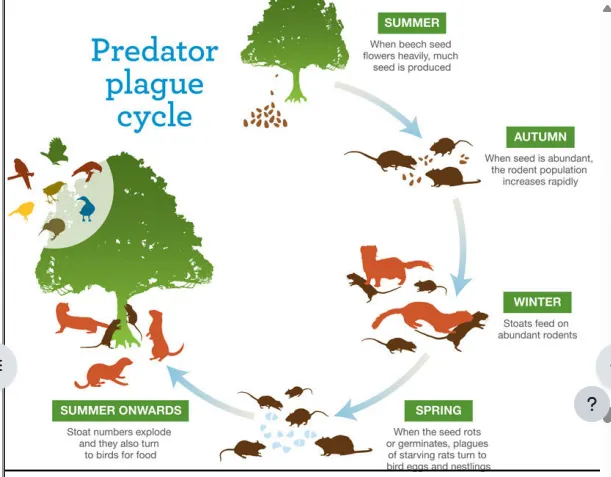
the key things for timing of poision, are looking at seasonal routines of Stoat / Possum / Rat species, when their population numbers are greatest as to when to target - based on production cycles of their main food sources (because these cause rapid population growth, so when they start to run out, starving Rats and Stoats are forced to feed on Birds)
Rimu & Mountain Beech dont seed every year, so can model when trees produce seeds, and when there will be an abundant crop (and thus increased population growth & number of pests), poisions can be prepared and lined up, targetting many predators at once
seedfalls in summer, then numbers rise greatly after, which happens to align with many nesting opportunieis (e.g. Mohua) - so targetting before the nesting, solves the problem (crasheds the growth)
if timing is done right, can crash population numbers to prevent rapid growth - ensuring effective tracking, modelling, predictions, and manegement
has shown success in terms of rat numbers (majorly reduced tracking rates before & after 2023 operations)
also shown success in terms of Bird Nesting success -more success in treated areas (e.g. South Island Robin, Rock Wren, Rifleman in Marlborough Sounds) - which can be the difference between a declining population, and a population that can sustain itself
what does an ‘ecosystem approach to ecology’ refer to?
what is an ecosystem defined as
taking a whole ecosystem, and thinking about the finer trophic processes going on, in terms of how energy and nutrients are cycled around the ecosystem
how energy flows, and how chemicals / nutrients flow, via being transferred and transformed between organisms (energy), and recycled (nutrients)
the ecosystem refers to ALL the organisms living in the community - depending on the scale - AND the abiotic facors affecting it
how does energy flow through an ecosystem
a one-way flow of energy
energy comes into the ecosystem as light (from the sun - the fundamental input of energy for trophic levels for most life)
this light energy is absorbed by photosynthesising organisms (plants, phytoplankton), and converted into chemical energy (stored as food in their biomass)
this plant material is eaten by other organisms, and used to do work
energy is not recycled, it is then eventually lost via heat
name and define the two main trophic groups
name their subgroups
give examples of each
(autotrophs)
primary producers
they produce their own food, creating matter (synthesising sugars & organic compounds) from the input of light energy (sun)
e.g. plants, phytoplankton, algae - anything green (also some using sulfur in deep ocean vents)
(heterotrophs)
primary consumers (herbivores), secondary consumers (carnivores), tertiary consumers (carnivores that eat carnivores), detritivores / decomposers (fungi, bacteria)
they cannot create their own food, they obtain energy / nutrients / organic compounds (matter), by breaking down and absorbing this from primary producers, which can be converted to cellular energy (ATP)
what is an energy budget for an ecosystem
what trophic group does it depend on
this is the energy coming in and being transferred around an ecosystem
this therefore depends on primary production, the total product of photosynthesis / the amount of light energy converted to chemical energy (via mass), by autotrophs, over a given time period
also therefore depends on limiting abiotic / biotic factors in an environment (aquatic systems = limited by light & nutrients, terrestrial systems = limited by temperature & moisture & nutrients)
what is the idea of ‘the global energy budget’
so much solar radiation hits the Earth each day, but only a small amount reaches and is used by photosynthesising organisms (~1%) - as much is reflected off land and water -, so not much is used for primary production (thus put into the Earth’s ecosystem’s energy budget)
this shows that photosynthesis is not a very efficient process (not making use of all energy input available) - but this small amount does add up, being capable of producing ~150 billion tonnes of organic material per year
this 1% can also vary throughout different types of ecosystems within Earth’s global one (snow = high reflectance of sunlight, low absorbance with less primary producers, forests = low reflectance of sunlight, high absorbances with abundant primary prodcuers)
(human energy budget)
we are part of the ecosystem, so our activities also depend on this energy budget
all types of energy we use to power our society (hydro, wind, fossil) come from light energy been transferred and transformed - except geothermal & nuclear
what is gross primary production
what is net primary production
these look at primary production in the ecosystem of interest
expressed as energy (kJ) OR mass of vegetation biomass (kg) per unit area per unit time
not to be confused with total biomass of photosynthetic organisms present in a given time and area (much is standing crop, has been there for a while)
(Gross Primary Production)
aka GPP
the total primary production (total amount of light converted to chemical energy / matter)
(Net Primary Production)
aka NPP
the GPP minus the energy used by the primary producers for respiration (NPP =GPP - R)
therefore plants that dont respire, grow much faster
how would NPP differ between different environments? give some examples
(NZ alpine tussock grassland)
low standing crop
low NPP therefore (not much energy captured, so slow growing)
(NZ alpine forest)
high standing crop
low NPP however (doing lots of respiration, so slow growing)
(NZ exotic pasture)
low standing crop (only because it is readily being eaten by cattle)
high NPP however (because their puspose is to maintain efficiency of money-making on the farm (high energy budget)- so targetted & modified to respire less, with applied good conditions (input like fertiliser) => quick growing
(NZ plantation forest)
high standing crop
high NPP (targetted to be fast growers, to be efficient in forestry money-making)
how would you measure (above ground) NPP…
in fast turnover ecosystems
in smaller areas
in larger areas
differ between ecosystems, as they have their own differences
(fast turnover ecosystems)
e.g. grasslands, pasture
can directly measure as they have few biomass - can cut down drymatter, and weigh to find amount per hectare
this would be with the per unit time known, as they turnover often
(smaller areas)
can use capacitance probe = measure soil moisture, then modelling with sequential samples of biomatter to calculate NPP
can calibrate with quadrants = of clipped biomass, sorted into the species of interest
can measure with diameter tapes = then re-measure after the unit time, to see how much NPP based on biomass added (good for old species e.g. trees)
(larger areas)
can use remote sensing techniques = taking advantage of how chlorophyll (present in primary producers / photosynthesisers) absorbs lots of visible light VS few near infrared (warmth light)
therefore can use this to measure biomass and rate of photosynthesis, via the ratio of these wavelengths absorbed on different parts of the globe, based on the known wavelengths absorbed by different things (e.g. snow, clouds, vegetation, soil, water) to distinguish what are plants

what is primary production like in aquatic systems
how efficient
what are the limiting factors
(limiting factors)
Light = limits NPP (as energy input is the first requirement to produce => a strong regulator), as light only reaches so far down (photic zone - 50% of light only reaches the first 15m
therefore we would expect a NPP gradient increasing from Poles → Equator (sun only hitting half of the year VS high sunlight levels), however nutrient availability prevents this
Temperature = follows a similar pattern to light (thermocline), important to make biochemical reactions (photosyntehsis & producing matter) quicker, would also suggest a global gradient but nutrients limit this again
Nutrients = limits NPP (N, P, Fe) as they are requiried to primary produce (create matter and biomass) after input of light energy,
photic zones are rich in light, but low in nutrients (quickly eaten by cytoplankton), as nutrients accumulate deeply (but no energy here!) - chlorophyll and matter production requires a balance of the two
therefore primary producers can only inhabit this thin sliver of the ocean surface (light), where they are not as efficient as possible (not enough nutrients)
do different ecosystems differ in primary production / contribution to Earth’s total production?
give an example
yes!
(example)
open ocean (65% of surface area) VS tropical rainforests (3% of surface area) - both produce a similar percentage of Earth’s NPP
large and unproductive VS small and highly productive - different energy budgets to work with, so different outcomes in levels of primary production
what is primary production like in freshwater systems
how efficient
what are the limiting factors
(limiting factors)
Light & Temperature = closely linked (e.g shaded creek = poor light & temperature), are limiters due to light being required as an energy input for photosynthesis to begin, and due to temperature determining the efficiency of these reactions (speeds up biochemical processes)
Nutrients = not enough is not often faced (close to land, runoff of other biomass nutrients sustains them) - however too much nutrients can be a limiting factor
this is because it removes the limiting factor for green algae & diatom populations (not the natural ones in the ecosystem - phytoplankton), causing outbreaks (eutrophication), which then has negative effects for the rest of the population, removing DO, light, and outcompeting etc
highly depends on adjacent land use however, mostly from human activites of sewage, fertiliser use - running off into freshwater in the rain
what is primary production like in terrestrial systems
how efficient
what are the limiting factors
(limiting factors)
Light = NOT a limiting factor, unlike freshwater & aquatic systems
Moisture = the main limiting factor, as it varies greatly across topography, measured in terms of evapotranspiration (plant sweat = evaporation of water off leaves) as this shows the rate of plants using this moisture (PP rate)
Temperature = speeds up photosynthesis by speeding up chemical reactions, therefore biomass is created quicker (increases NPP)
e.g. high NPP in tropics VS deserts (not limited by temperature nor water VS good temperature but limited by moisture)
Nutrients = on more local scales, mineral nutrients in the soil (soil fertility) limit NPP as while light & water is important to drive photosynthesis, nutrients are required to use light energy to make matter (primary produce)
e.g. informs farming land use - Taranaki, volcanic ring of young soils (nutrient-rich), moving into older soil (nutrient poor) - informs farming land use, dairy farming (fast growth pasture) VS sheep and beef (just requires grazing) => despite same levels of temperature & moisture in the area
e.g. agriculture, this is why farmers apply nutrients (a main limiting factor for local areas, despite if temperature and moisture are good)
define
oligotrophic
mesotrophic
eutrophic
hypertrophic
what do these describe?
these are measures of nutrients in freshwater systems
oligotrophic = poor in nutrients, abundant in oxygen deeper down
mesotrophic = moderate levels of nutrients & also algae
eutrophic = rich in nutrients, causing abundant levels of algae & diatoms, harming the rest of the ecosystem by removing DO
hypertrophic = extremely rich in nutrients, excessive growth of algae & diatoms, causing severe harm to the rest of the ecosystem
what does ‘detritus’ refer to in the flow of energy in ecosystems
who feeds on this
why is this important
(detritus)
organisms that die, and dont go on to feed anything else - non-living organic matter, biomass, dead food webs - seemingly the dead end of energy / nutrient cycling
(detritivores)
AKA decomposers, e.g. fungi, bacteria
organisms that get energy from detritius
these are the major linkage between trophic levels, all pathways end here, as they break down this biomass, to make the organic matter / nutrients available to other organisms - enabling recycling
this is important as while energy is unlimited and not recycled, nutrients are limited so must be recycled to continue fuelling ecosystems
they burn off the energy from the detritus to fuel their decomposition (via heat), and leave the nutrients available, via secreting enzymes (fungi via hyphae spread throughout soil - that digest organic material → simple structures like sugars → are available for absorption from others)
are aided by animals (invertebrates like worms) who scavenge detritus and break it down into smaller pieces in their stomachs
what does secondary production refer to
refers to when heterotrophs, converts chemical energy in their food → their own biomass / reproductive output, in a given time period
e.g. foliage, hair, milk, offspring
what does ‘production efficiency’ refer to in ecosystems
how do you calculate this
describe what it is made up of
(production efficiency)
looks at the secondary production of an individual, so the growth done by heterotrophs fuelled by primary production
differs between ectotherms (dont have to maintain temperature) who have more VS endotherms (must maintain tempearture)
calculate as Net Secondary Production / Assimilation of Primary Production
(Net Secondary Production) = refers to net energy stored as biomass (represented by growth and reproduction) - so the net amount of secondary production done
(Assimilation) = refers to the total energy (primary production biomass) taken in and actually used for growth / reproduction / respiration (EXCLUDING primary production ingested, but not used / lost = feces, incomplete ingestion)
what does ‘trophic efficiency’ refer to
what consequences does this have for food chains / trophic levels
regarding the flow of energy through ecosystems
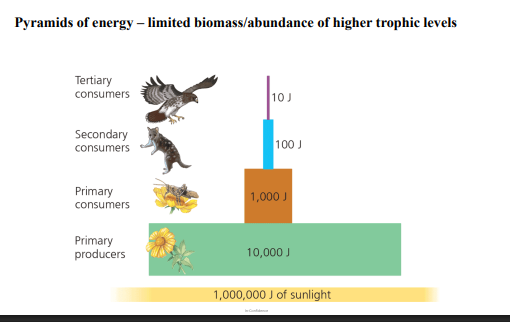
trophic efficiency = % of production (energy), transferred from one trophic level to the one above (primary producers → primary consumers → secondary consumers → tertiary consumers)
accounting for only reproductive and growth outputs, as these are all the energy that is transferred - not accounting for waste / used for respiration and survival / incomplete ingestion (energy that is consumed / lost)
(consequences)
results in a multiplicative loss of energy up through trophic levels
this is because primary producers only convert 1% of sunlight reaching the Earth, into biomass - only 10% is then converted to biomass (secondary production) in primary consumers - and so on (varies from 5-20% between trophic levels - generally a 10% loss per however)
so energy is progressively lost up trophic levels (represented via ecological pyramids of production measuring J)
can also be thought of in terms of biomass (g/m2), which follows a similar trend (multiplicative loss of biomass up trophic levels, due to recieving less energy)
this is because successive trophic levels require those below them to give them fuel, so as they less and less, those above lessen too
how does the idea of trophic efficiency have consequences to society
the dynamics of energy through an ecosystem, have consequences on the dynamics of the population / ecosystem / abundance / species making it up
therefore, us wanting a specific land use / farming / ecosystem - it requires changing the dynamics of energy
(meat farming)
if we want to be secondary consumers (eating meat which eats plants), it requires much more land area for farming (vs if we were primary consumers eating plants), due to the multiplicative loss of energy between trophic levels (getting the same amount of energy from meat, requires lots of energy input from plants, vs just eating plants directly)
therefore lots of land is used for meat farming, despite it only being a portion of our diet
to try combat this, intesnive beef farming methods have been developed (e.g. large feed lot systems, shipping in grains and legumes to feed the animals (rather than having their food in the ecosystem around them) to try get maximum conversion of grain → beef
however has additional consequences, concentrating waste and leading to concentrated pollution
very different in NZ (grass-fed, grazing on land), but still face issues of needing lots of water to create the reproductive output / secondary production (milk), to be shipped in from outside of the eenvironment
note - Chicken and Pork are cheaper, having a higher production efficiency (per input, more biomass / secondary production VS beef)
what is the ‘green world hypothesis’
what question does this address
addresses - why is the world still green if herbivores eat plants (and they go on to feed the rest of the food chain etc)
hypothesises that herbivores actually consume relatively little plant biomass compared to the total in the world, because plants limit their consumption via a variety of factors including…
plants have defenses against herbivores
abiotic factors limit herbivores
biotic factors limit hervivore population numbers (intraspecific competition, interspectific interactions - predation, parasitism, disease) - which therefore limits plants consumed
their lifecycles are slowed down by the fact that plants are not very nutrient dense (essential for growth & secondary biomass production), so they must assimilate lots (eat lots of plants but excrete lots as waste) - so nutrients are a limiting factor of their diet (not energy)
they also dont consume all year round
what two types of process cycle chemicals (nutrients) in an ecosystem?
from a trophic POV which group is most important for this?
what is the general model of chemical cycling (resoivers and stored forms?)
biological and geological processes (= biogeochemical cycles)
largely driven by decomposers - as these processes occur in the soil (a critical store of nutrients & resoiver nutrients pass through - plants get most of their nutrients from here via roots (water & nutrients), which passes on to the rest of the ecosystem)
they largely determine the rate of nutrient cycling, therefore rates can differ in different ecosystems (depending on decomposition rates) - as this requires water & warmth for efficiency
e.g. tundra (takes decades) vs tropical forests (takes 1-2 years)
also depends on the rate of absorption by the plants (therefore the type of lifestyle they are adapted to, for specific nutrients needed)
(general model)
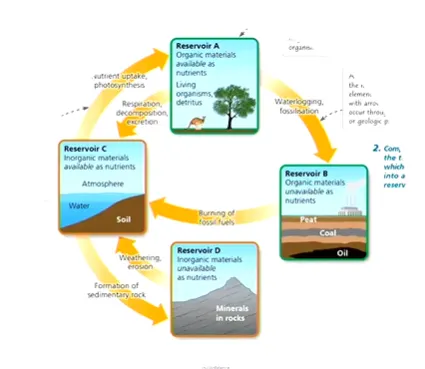
processes move chemicals between organic (available to organisms) and inorganic (inavailable to ecosystems at that point in time)
Reservoir A = organic material, available as nutrients (e.g. nutrients in living organisms, detritus)
conveted to B via watterlogging & fossilisation
converted to A via respiration & decomposition & excretion
Reservoir B = organic material, unavailable as nutrients (e.g. fossil fuels, layered in the earth)
converted to C via fossil fuel burning
Reservoir C = inorganic materials available as nutrients (e.g. nutrients in atmosphere, water, soil)
converted to D via weathering & erosion
converted to A via nutrient uptake & photosynthesisReservoir D = inorganic materials unavailable as nutrients (e.g. minerals in rocks)
converted to C via formation of sedimentary rock
name the 4 biogeochemical cycles important for nutrient (chemical) cycling in ecosystems
what is a biogeochemical cycle?
(Biogeochemical cycle) = a geological process with an abiotic reservoir (chemicals unavailable) → chemicals come out and become available to producers → producers eat these and transfer to consumers → everyone dies and becomes detritus → decomposers break them down → chemicals available to producers / abiotic reservoir again
the water cycle (not biogeochemical but still important)
the carbon cycle
the nitrogen cycle
the phosphorus cycle
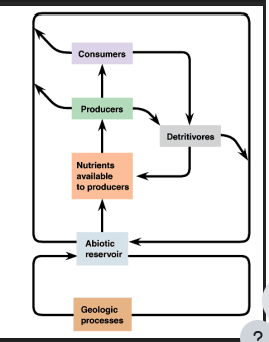
describe the water cycle
why is this important for ecosystems
a simple cycle, water enters the atmosphere via evaporation & evapotranspiration, as water vapour
this is returned to the land via precipitation (key types = convective: coming up and going down, oreographic: rising air masses forcing water vapor out, frontal/cyclonic: fronts of air meeting and forcing water vapor out)
can undergo atmospheric rivers, waves of water vapor moving through the atmosphere horizontally (vs vertically as normal)
(important)
water is a limiting factor in terrestrial ecosystems, so this cycle is important to ensure they are always provided with more water (cycling the used stuff) to enable survival
describe the carbon cycle
why is this important for ecosystems
a biogeochemical cycle of nutrient cycling, cycling carbon
organic available carbon is stored in the atmosphere as CO2, which can be used by plants on land, and plankton in the ocean (cycled to the land) - via photosynthesis
this can be returned to the atmosphere as CO2, via breathing out as waste after respiration, or decomposers breaking down plant material (detrituts)
however, it can become stored in unavailable forms, if carbon-containg detritus is not broken down, and instead layers up and is compressed by pressure eventually over time - forming fossil fuels (carbon locked in the ground)
this can then be released back into the atmosphere only through burning
(importance)
carbon is the buildijg block of life, needed for all types of growth for organisms, so it is important this is cycled around the environment, from dead plants who have used it, to new plants who now need it
describe the nitrogen cycle
why is this important for ecosystems
cycled from the atmosphere to the ecosystem, via 2 natural pathways (atmospheric deposition & nitrogen fixation)
atmospheric deposition cycles N from atmosphere → ecosystem, via rain (N dissolved within) or dust, into the soil
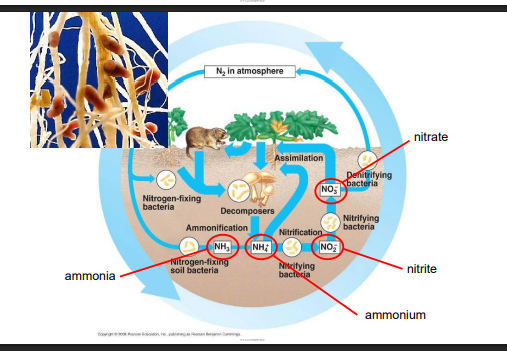
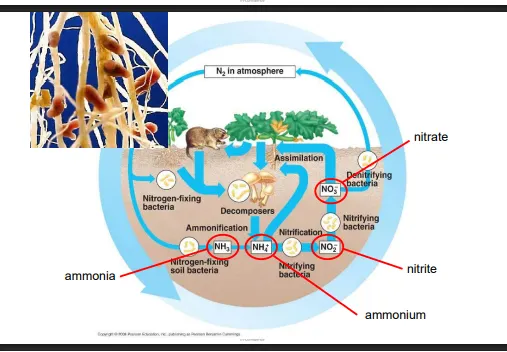
nitrogen fixation (much more common) cycles N from atmosphere → ecosystem, via N fixing bacteria, who convert atmospheric N2 (unavailable to plants), to available forms (→ ammonia → ammonium → nitrite → nitrate (ammonium & nitrate available to plants)), so that producers and consumers can then use these (cycled into food chain)
N fixing bacteria mostly live in the soil around plant roots (mutualism behaviour commonly developed, e.g. root nodules of legumes, kowhai, kakabeak)
N fixing bacteria may also live in animal stomachs (those who require more N due to feeding in low quality habitats - e.g. Huhu beetles feeding on dead wood), who convert atmospheric N2 inhaled in, to avaialble N as this is required to break down wood in the first place
can also cycle to the atmosphere via lighting (fixes & falls out as rain) - very minor
decomposers also help break down detritus into simpler organic compounds with N accessible to bacteria
(returning N to the atmosphere)
denitrifying bacteria also exist (especially in areas with lots of water), who transfer nitrate (avialable) → N2, so N doesnt endlessly accumulate in soil, so it can move around, and to prevent accumulation of harmful N compounds
(importance)
organisms require N to create nitrogenous organic compounds, like amino acids, like nitrogenous bases in DNA - is probably the 2nd foundational chemical for life
therefore it is important to have this cycled between the atmosphere, and ecosystems, and between dead and alive plants
name and describe the man-made version of the nitrogen cycle
(Haber Bosch process)
uses energy to convert N2 → NH3 (atmospheric → available)
named the detonator on human population growth, as this enables creation of fertiliser (nutrients, especially N, are great limiters in plants), to enable more efficient plant growth (Farming), in areas which may not have had the fertility to support intensity beforehand
this enabled enough agriculture to feed our vast population, which both are still increasing - overcoming the limitations of the natural N cycle
describe the Phosphorus cycle
why is this important to ecosystems?
very simple process, as it does not involve cycling between the atmosphere via gases - this cycle only occurs in the soil
all phosphorus (occuring in the available phosphate form) for an ecocystem is available there from the start in an undisturbed system (via weathering off rocks & runoff aided by precipitation)
this is then cycled around the local environment (soil / humus→ plants → eaten and used for secondary biomass → die and are decomposed into the soil)
plant uptake can be aided by Mycorrhizal Fungi (fungi networks associated with plant roots) due to P often being limiting nutrient (not heaps going around)
however this local cycle is not complete, some leaks (runoff & leaching) and accumulates in the ocean as sediments (unavailable to terrestrial ecosystems)
this is cycled back to land via seabirds (marine life feeds on runoff P → seabirds feed on marine life → birds fly over land and poop → is available to the food chain)
(artificially)
therefore can artificially be brought back to the land by digging up rocks at old seabird colonies (layers and condensed under pressure to lock P in rocks) & digging up sedimentation from the ocean floor
this can be applied to farming systems to maintain productivity via fertiliser
this overcomes the already limiting factor of P, and gets over the problem of removing biomass from the local ecosystem, so taking away the P meant to cycle throughout (becomes even more limiting)
(importance)
P is also another critical chemical building block for life, being used in DNA, ATP
how can decomposition rates be measured in an ecosystem
why may this be helpful
(helpful?)
gives insight into biogeochemical / nutrient cycling, as this largely depends on decomposition rates
so may suggest limiting factors in the environment, help that may be required, etc
(measuring)
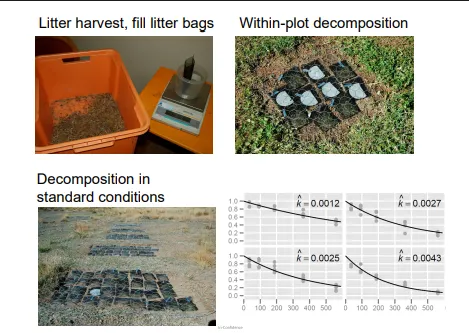
can fill litter bags / plots within the environment with biomass / detritus (litter) from the ecosystem, and measure the decomposition rate
this can be done with different litter types, to see how they decompose differently over time, and can look at different specific nutrients to see how they break down
litters with high nutrient profiles decompose faster, as bacterias can use these better and be fuelled on them more efficiently, to then continue decomposing
this can also be modelled for different conditions (e.g. do it in the lab vs within-plot)
what is the role of vegetation in nutrient cycling & storing?
what are the consequences of this for human activity? (and give an example)
vegetation / biomass / detritus of nutrient rich plants will decompose faster (as they provide more nutrients to fuel decomposers, so they can more efficiently survive and continue decomposing)
therefore, systems differ in how nutrient rich their vegetation is, depending on abiotic conditions
(tropical systems) nutrients are stored in vegetation, held on to in the plant rather than readily stored and absorbed from the soil - as these are wet environments so soil is unable to hold onto nutrients (would disslve & flow away)
(grassland systems) nutrients are stored in soil, where they can be readily absorbed by plants when needed (rather than hoarding in vegetation), as nutrients are in no danger of going away
(consequences)
therefore, nutrient storing greatly depends on the specific ecosystem and the environment conditions
so changing vegetation structure of an area, greatly impacts nutrient availablility (e.g. forest removal, harvesting, tilling)
therefore agriculture results in nutrient loss (biomass removed from soil in harvest, which in natural systems would instead remain in the ecosystem to enable chemical cycling)
therefore farming must involve adding these nutrients back somehow (e.g. fertiliser), but it may have additional effects on the microbial community (and the health of the rest of the ecosystem)
pesticides may also need to be used due to unwanted aspects of the natural environment, which can then impact soil biota again (microbes) to affect nutrient storage
also promotes soil erosion and nutrient loss (harvesting, tilling, activity, over-grazing), to further lose these removed nutrients - so this is another issue that must be addressed (land degradation)
(consequence example)
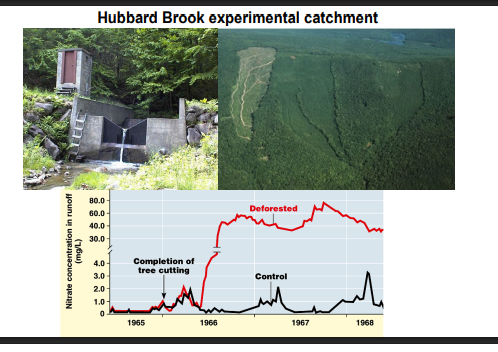
the Hubbard Brook experiment, sampled water in cachments that went past farmland (forestry) and joined together in a pinch point, as a means of seeing how quickly nutrients flowed out of the ecosystems when farmed on
as deforestation occurred, decomposition was promoted, which raised N levels in these waters - however this showed that all this N was released from the biomass in the local ecosystem, and flushed away
what is the main cause of human impacts on ecosystems
what ecosystem processes does it impact?
(what does it impact?)
chemical / nutrient cycling in ecosystems
therefore this has flow on effects throughout the whole ecosystem
(main causer)
human population growth! there have been massive increases in numbers over the years (exponential population growth - peak / carrying capacity hasnt been reached yet)
this cant just happen alone, it also requires dramatic increases in resources, to maintain the current standards of living (we eventually wont have enough resources to continue as is - where ideas of mars come in) - however sitll on the same global ecosystem
(consequences)
these resources (e.g. food, clothes, cell phones, plastic, food packaging, newspapers, internet use, water use) require environmental inputs (chemical & energy) thus disrupt natural cycles
even worse so when energy inputs are from non-renewable sources (most), so this completely disrupts ecosystem cycles, by removing it forever (eventually will come back to get us)
research suggests we use 38% of global NPP, and much of this remaining NPP is not even available to us - so the end cap of our living standards is approaching
what is a main ecosystem of target for human impacts
what can these show about civilsations over time
forests! of all types
the states of forests (type, quality) can be looked at over time, to track rice and fall of global civilisations (all fuelled by energy & nutrients from these areas)
e.g. to fuel megacities and giant populations of today, forests have been cut down for palm plantations, rice paddies, maize fields, etc
what does ‘the solution to pollution is dilution’ refer to?
why is this no longer viable for human society / good to ecosystems?
(meaning)
this is the idea that adding water or air to a pollutant (spreading it across a larger area), lessens the harmful effects of it
(today)
was originally a good idea in theory, but with the exponentially growing population’s exponentially increasing demands, so many pollutants are produced that they can no longer be diluted
however also not very good for ecosystems when thinking about it, as these pollutants will still have an effect, and one over a larger area -just more of a gradual one rather than immediately toxic
name 4 of the ways humans are negatively impacting ecosystems
disrupting chemical cycles in the biosphere (carbon cycle, P cycle, N cycle)
combusting fossil fuels
concentrating toxins
depleting atmospheric ozone
how is human activity impacting the N cycle
how does this harm ecosystems
how does this harm us too?
to overcome nutrient limitation for agriculture (N is the main limiter for plants, and with removing biomass in harvest / over-grazing, N fixing bacteria & ecosystem processes are disrupted, so is not cycled efficiently) - we must replace N, but at a faster-than-natural rate
(methods) - plowing soils to speed up decompososition (also allows in more N2) & adding N-containing fertiliser & legume cultivation (e.g. white clover) to harbor N-fixing bacteria to fix N in the soil for future crops
(consequence) - the N added exceeds the critical load (the amount of added N that can be absorbed into ecosystems without damaging it)
(outcome) - excess N leaches out of terrestrial ecosystems (via sewerage / factory waste / animal waste), into freshwater & marine systems, resulting in issues of eutrophication
this disrupts these ecosystems by adding excess nutrients, which causes excessive growths of certain parts of the population (algae), which causes an imbalance and harms the rest of the ecosystem (removes DO, changes tolerated conditions)
(human consequence) - we are part of this ecosystem, so are also affected, in terms of excess N in our drinking water (harmful)
how is human fossil fuel combustion harmful in terms of toxic chemicals?
what has the societal response been to this?
fossil fuel burning (e.g. diesel, petrol) involves burning both carbon AND other chemicals throughout them (involved in chemical cycling) - burning of which releases them into the atmosphere
these chemicals (e.g. sulfur, nitrogen oxides - volatile organic compounds), then react with water in the atmosphere, producing acidic compounds (e.g. sulfuric acid, nitric acid)
these compounds eventually come out of the atmosphere (via water cycle), but as acid rain (rainfall with acidic pH)
these harm ecosystems changing the pH of soil and water - changing the conditions these organisms are adapted to, killing plants & aquatic organisms (which likely has flow-on effects)
(societal response)
recognised as a problem and strategies have been implemented to address it, as this is an easy problem to fix (compared to excess CO2 for example)
this is because, the processes driving it (burning fossil fuels), can be modified (add scrubbers on coal burner chimneys which remove these oxide combounds) easily, to prevent these oxide compounds from reaching and reacting in the atmosphere
this has resulted in an upward trend for rainfall pH
how can human activity result in toxins becoming concentrated in ecosystems
give 3 examples
(how?)
via successive trophic levels of food webs
in nutrient cycles, nutrients (namely toxins) carried through trophic pathways can get magnified up trophic levels (biological mangification - inversely trending to energy reduction up trophic levels) due to successive levels not being able to process these toxins, so they accumulate (stored in each organism via fat etc)
energy is lost up trophic levels, but nutrients become concentrated as they cannot be processed (whilst energy is used and lost)
(PCBs)
polychlorinated biphenyls, get concentrated in Herring Gull eggs, from phytoplankton → zooplankton → smelt (small fish) → lake trout → herring gull eggs
concentration increasing up this food chain, as each successive trophic level, eats many individuals of the trophic level below
(DDT pesticide)
these chemicals became concentrated in human blood levels, being used to treat the plants we eat (and probably the plants we feed our other food sources like animals), so concentrated up our previous trophic levels
these were said to cause birds to have thinner eggshells, and therefore cause death & population decline - so suggested to be harmful to humans too
started US environmental movements (Silent Spring written in 1962 - Rachel Carson)
(NZ pest control toxins)
brodifacum / talon, is a common poision against rodent & mustelids (stoats & ferrets), which people are concerned about it causing accumulation issues of toxins
however, killing these predators effectively is very important for ensuring and protecting biodiversity in NZ (especially with our mammal predator unadapted native birds), therefore the harm of the toxins, and the harms of uncontrolled exotic predation - must have their costs balanced
note - poisions like 1080 do NOT have accumulation effects
how did human activities deplete atmospheric ozone
why is this harmful
how was this addressed by society
(depleting ozone)
the ozone layer is a layer of O3 molecules in Earth’s atmosphere, which protect life from the damaging effects (mutations → cancers, skin cancer, cataracts) of UV radiation incoming from the sun
research showed that is gradually thinned from 1975-2000, namely over Antarctica
this was caused by use and accumulation of CFCs (chloroflurocarbons - chemicals used in fridges, aerosol cans & manufacturaing processes)
CFCs catalyse the breakdown of O3 molecules, therefore reduce ozone and the ozone layer thickness
(harmful)
increases the amount of UV radiation reaching Earth, causing more harmful mutations and associated effects, and disrupting ecocystems and the entire biosphere (changing the conditions of the atmosphere)
(societal response)
since it was noticed, it has been addressed and the layer has been thickening since
this occurred via the 1987 Montreal Protocol, where everyone did their part globally, showing worldwide cooperation to stop issues and undo harm
however, this is one of the few examples - only because CFC alternatives were easily available and cheap & viable to replace, with minimal changes to the process
in the present, some are able to be used in small amounts if an important reason (e.g. biosecurity uses = important to ensure biodiversity, a cost to balance)
however there is tight regulations and levels are monitored via satellites and countries / companies are held accountable for breaking this protocol
how does human activity disrupt the carbon cycle
what does this cause
why is this harmful
(how?)
human activity increases atmospheric CO2 concentration, by taking C stored in unavailable forms (fossil fuels - coals / petrol / oil / gas), and releasing this into the atmosphere - disrupting the cycle as the rest of it cannot act to remove these excess levels (was in perfect balance, increasing one aspect drastically means the rest of the system will not be able to keep up)
this has been seen via increased atmospheric CO2 levels since the industrial revolution, marking the beginning of fossil fuel burning to power many proceses important for society (food production, clothing production, electricity, cars and machinery)
(what does this cause?)
has the major effect of global warming via the greenhouse effect - CO2 in the atmosphere absorbing heat reflected off Earth, and re-radiating it to maintain heat / energy to the surface, which would otherwise escape (required for life)
so therefore adding CO2, means more heat is retained (impacts Earth’s heat budget, retains more energy than needed and can be effectively used in the ecosystems)
this is shown by evidence of major correlation between increasing global temperature & atmospheric CO2 over time, which completely deviates from modelled predicted global temperatures over time without excess human activity (way out of the norm of the million year system)
also evidenced by naturally uneven global heating, having increased warm patches, and less cold patches - worldwide AND that warmest years on record, are all more recent years (a clear trend)
also evidenced by massive changes of glaciers (e.g.Park Pass Glacier) in short periods of time (more melting, getting smaller)
(why is this harmful?)
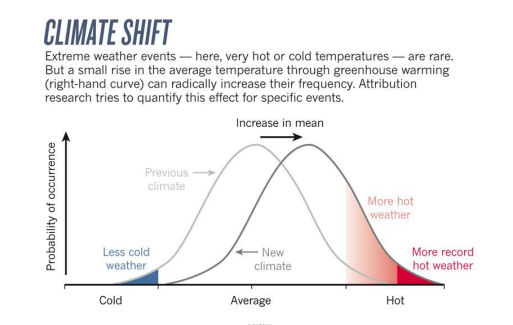
causes shifts in climate (climate is a distribution, has extreme hots & colds at the upper and lower limits, with the most common climates a median one), so increasing the mean temperature, shifts the distribution to higher temperatures
this means that temperatuers in the upper extremes can reach higher levels, and temperatures that used to be the upper extremes will now occur more commonly
this has worrying effects for ecosystems & environments, who are unadapted to these high temperature levels / rapidly changing temperature, so may cause population & biodiversity declines
hotter causes increased drying, so levels of fires increase (very disruptive to ecosystems & biodiversity if not evolved to withstand & do succession after fires - or as often / severe as this drying will cause)
more energy absorbed in Earth’s system increases weather severity, as there is more energy available to drive weather processes and put water into the atmosphere (more severe rain / floods / storms / atmospheric rivers / winds / cyclones)
increases humidity levels, to such a height where some countries have multiple extreme days annually with humidities nearly lethal to humans (32 VS 35 lethal) (so humid we cannot sweat & regulate body temperature → causing death via heat exhaustion - shown via wet bulb temperatuers, which simulate the act of sweating as water around these bulbs evaporate)
so if humidity like this is lethal to humans, it likely has / has already had devastating effects on other parts of the cosystem
why is global warming so hard for society to address?
the solutions are simple - reduce CO2 emissions by: switching to renewable energy sources / planting trees to absorb excess CO2
however these are hard to implement, as they require global cooperation of everyone, on all levels, to change their standards of living / lifestyle / production / companies - to implement
also the fact of being driven by the consumerist capatalist system, intertwined with political influence (big money tied up in oil) - so many aspects and influences maintaining it as a problem
what is the idea of the Anthropocene?
why is this suggested to be occurring in the present?
(Anthropocene) = a decisive break from previous preiods of Earth’s history, a new geological epoch
this is suggested to be occurring for Earth currently, due to all the human activity driven changes in the environment (= highest atmos CO2 in 4 million years / major changes in global land use / nutrient overuse and runoff causing eutrophication wastelands / irreversible large scale soil changes / rich biomes changing to deserts / mass extinctions)
these are likely to lead to an irreversible cascade of Earth changes, to cause a very different future to the past, and to what is predicted
thought to be occurring at various times (first farming, industrial revolution, atmoic era?) but changes most profound since 1950s
key implications to biodiversity being under threat, showing the importance of conservation
 Note
Note  Flashcards (33)