RPD Final Impressions (Quiz 4)
 Studied by 0 people
 Call with Kai
 Learn
Learn Practice Test
 Spaced Repetition
 Match
Match Flashcards
 Knowt Play
1/92

There's no tags or description
Looks like no tags are added yet.
Name | Mastery | Learn | Test | Matching | Spaced | Call with Kai |
|---|
No study sessions yet.
93 Terms
Of the five phases for the sequenc of partial denture treatment, what phase does the following happen in?
- Fabrication and delivery of RPD
- Oral and written instruction
Phase IV
What type of impression material are the following:
- Rigid materials
- Thermoplastic
Non-elastic
What type of impression material are the following:
- Hydrocolloids
- Polysulfide (Mercaptan Rubber-Base)
- Polyether
- Silicone
Elastomeric
Elastomeric hydrocolloids are used in which types of trays?
- Stock
- Custom trays
Which type of elastomeric impression material has these disadvantages?
- Low tear strength
- Less surface detail
- Not dimensionally stable
- Difficult control of the length and width of impression borders (usually overextended impressions)
Irreversible hydrocolloids
Which type of elastomeric impression material has these advantages?
- Hydrophilic
- Inexpensive
- Pour well with stone
- Pleasant taste and odor
Irreversible hydrocolloids
Elastomeric- mercaptan ruber-base (polysulfide) is used in which types of trays?
- Custom tray (for uniform thickness)
- Altered cast technique
Which type of elastomeric impression material has these disadvantages?
- Slow recovery from elastic deformation
- Poor long-term dimensional stability (loss of reaction byproduct)
- Unpleasant odor
Mercaptan ruber-base (Polysulfide)
Which type of elastomeric impression material has these advantages?
- High tear strength
- Long working and setting time (8-10min) --> better for border molding
- Acceptable accuracy
Mercaptan Ruber-Base (Polysulfide)
Which type of elastomeric impression material has these disadvantages?
- Short working and setting time
- Low flexibility, stiffness
- Low tear strength
Polyether impression materials
Which type of elastomeric impression material has these advantages?
- Good accuracy
- Hydrophilic --> good wettability
Polyether impression materials
Which elastomeric material can be used for all 3 trays (stock tray, custom tray, & altered cast technique)?
silicone
Which type of elastomeric impression material has these advantages?
- High accuracy
- Excellent dimensional stability
- Good tear strength
silicone
Which type of elastomeric impression material has these disadvantages?
- Expensive
silicone
What is the working time of silicone impression material?
3-5 min
Which impression material is both hydrophillic and hydrophobic?
silicone
What are the two goals of impressions?
Accurately record the...
- Remaining teeth
- Full extension and detail of the edentulous area (anterior and posterior)
What two features of the maxilla are KEY to capture when taking impressions?
- Pterygohamular notches
- Entire palate
What are KEY features needed when taking a mandibular impression?
- Buccal shelves
- Retromolar pads
- Facial vestibule
- Lingual vestibule
T/F stock trays can be plastic or metal AND can be perforated or unperforated
true
What does perforation of stock trays help with when taking impressions?
retention of impression material
Are plastic trays used with adhesive?
Yes
Are metal trays used with adhesive?
No
_________ trays are more rigid while _________ trays bend more easily
Metal, plastic
The trays needs to cover all the anatomical landmarks. When using a stock tray, how much larger than the outside surface of the residual ridge should it be?
3-5 mm
Why does this happen when taking impressions?
- The impression material outside of the confines of the tray will be unsupported
- Any area not covered by the tray will not be recorded
- Resulting in under-extended final impression and under-extended RPD
tray too small
What causes under-extended final impressions/under extended RPDs?
tray too small
What causes overextended final impressions?
tray too big
How do you modify a stock tray?
Rope wax, modeling compound, or heating and opening the plastic/thermoplastic trays
If properly dimensioned stock tray is not possible, what should be fabricated?
Custom tray
When should you use a stock tray?
When minimal border molding is required:
- Tooth supported cases (Class III and IV)
- Short edentulous areas and minimal bone loss (otherwise, border molding with custom tray is necessary for proper flange extension)
T/F: A stock tray should be used when minimal border molding is required
true
Which tray can you use for tooth supported cases and short edentulous areas?
stock tray
Stock trays can be used with which kennedy classes?
III and IV
When preparing to place the impression material into the tray, what material can you use for tooth-supported impression?
Alginate
When placing alginate impression material in the oral critical areas (cingulum/occlusal rest seats' preparations), what should you do to best capture the edentulous areas?
Border molding movements (should be minimal)
When you remove an alginate impression, what should you look for when assess the quality?
- All anatomic landmarks are captured
- Surface areas of major connectors entirely captured
- All aspects of abutment teeth were recorded (rest seats, lingual and buccal aspects where reciprocal and retentive arms will be located)
After taking an alginate impression, you should disinfect and pour the impression immediately with what type of dental stone?
Type V
If you cannot pour alginate immediately, how can you store it?
Store in 100% humidity and pour within 30-60 minutes
Tooth supported or tissue supported impression?
- Taken at rest
tooth supported
Tooth supported or tissue supported impression?
- Impression taken in function
tissue supported
Tooth supported or tissue supported impression?
- Taken with no pressure
tooth supported
Tooth supported or tissue supported impression?
- Impression taken under pressure
tissue supported
Tooth supported or tissue supported impression?
- Taken with minimum support
tooth supported
Tooth supported or tissue supported impression?
- Taken with maximum support
tissue supported
Tooth supported or tissue supported impression?
- More movement can lead to loose abutments
tooth supported
Tooth supported or tissue supported impression?
- Overly displaced tissue can become inflamed, impaired accompanied with bone resorption
tissue supported
Tooth supported or tissue supported impression?
alginate can be used
tooth supported
T/F with stock trays, border molding movements are done but should be minimal
true
What two reasons would you use a custom tray over a stock tray?
- Anatomy (presence of tori)
- Need border molding
When you have a class IV case where the flange is necessary to compensate for bone resorption, or tissue supported situations, which tray would you use for impressions?
custom tray
Stock tray or custom tray?
- Less lab time
stock
Stock tray or custom tray?
- More lab time
custom
Stock tray or custom tray?
- Less accurate
stock
Stock tray or custom tray?
- More accurate
custom
Stock tray or custom tray?
- Have anatomical limitations
custom tray
What three areas do you draw to outline the tray on a maxilla?
- Draw a line at the depth of the vestibule
- Draw the outline of the custom tray; 2 mm short of the depth of the vestibule
- Draw the outline of the spacer; 2 mm short of the outline of the tray. (4mm shorter than the depth of the vestibule)
When making a custom tray, once vaseline is applied and the cast is outlined, what is the next step?
block undercuts and add wax spacer
When trimming excess of the baseplate wax, how much space should the triad be from the vestibule?
4 mm short of depth of vestibule
When trimming excess of the baseplate wax, how much space should the triad be from the posterior?
Wax should be a little short of the line connecting the pterygo-maxillary notches
When making the custom tray, should you add extra layers of wax over teeth?
Yes, one to two additional layers
What do you add to the areas where there are teeth before curing the triad to create vertical stops and maintain space for the impression material?
2x2 windows
Once the triad is complete but not cured, what do you place over the teeth areas once windows are made?
aluminum foil
What do you fill the 2x2 windows with before curing?
more triad
How long do you cure the triad tray for?
- 1-2 minutes
- Turn tray over to cure intaligo for another 1-2 minutes
- Tray should be cooled by running water from time to time in order to avoid wax melting
- Final cure for about 4-5 minutes
T/F: Remove all the wax on the cured triad for border molding
False - Remove the wax and aluminum foil only on the teeth. The rest of the wax should be maintained during border molding and removed only before taking final impression.
How much shorter is the triad once cured, from the vestibule?
2mm
What are the primary bearing areas of the mandible?
- Buccal shelf
- Retromolar pad
What are factors influencing support of distal extension base?
- Contour and quality of residual ridge (secondary bearing areas, firm/dense soft tissue, round ridge form)
- Denture base coverage (broader=better)
- RPD design (rest location)
- Type and accuracy of impression (viscosity of impression material, rigidity of trays, impression techniques)
- Occlusal loan applied (depends on number of artificial teeth, width of occlusal tables)
- Fit of the denture base (intimate contact between intaligo of denture base and residual ridge)
The altered cast technique is recommended for which classes on the mandible?
I and II (mandibular distal extension)
What is the purpose of the altered cast technique (also called dual technique)?
To capture the residual ridges in their functional form and in relation to the remaining teeth
These are advantages of which impression tray?
- Improves fit of the denture bases
- Reduces the number of postoperative visits
- Preserves the residual ridges
- Improves stress distribution
altered cast technique
T/F the metal framework is required back from the lab in order to perform the altered cast technique
true
What are the first two steps when using the altered cast technique once the metal framework is tried in the patients mouth?
- Apply triad to metal
- Do border molding in new custom tray
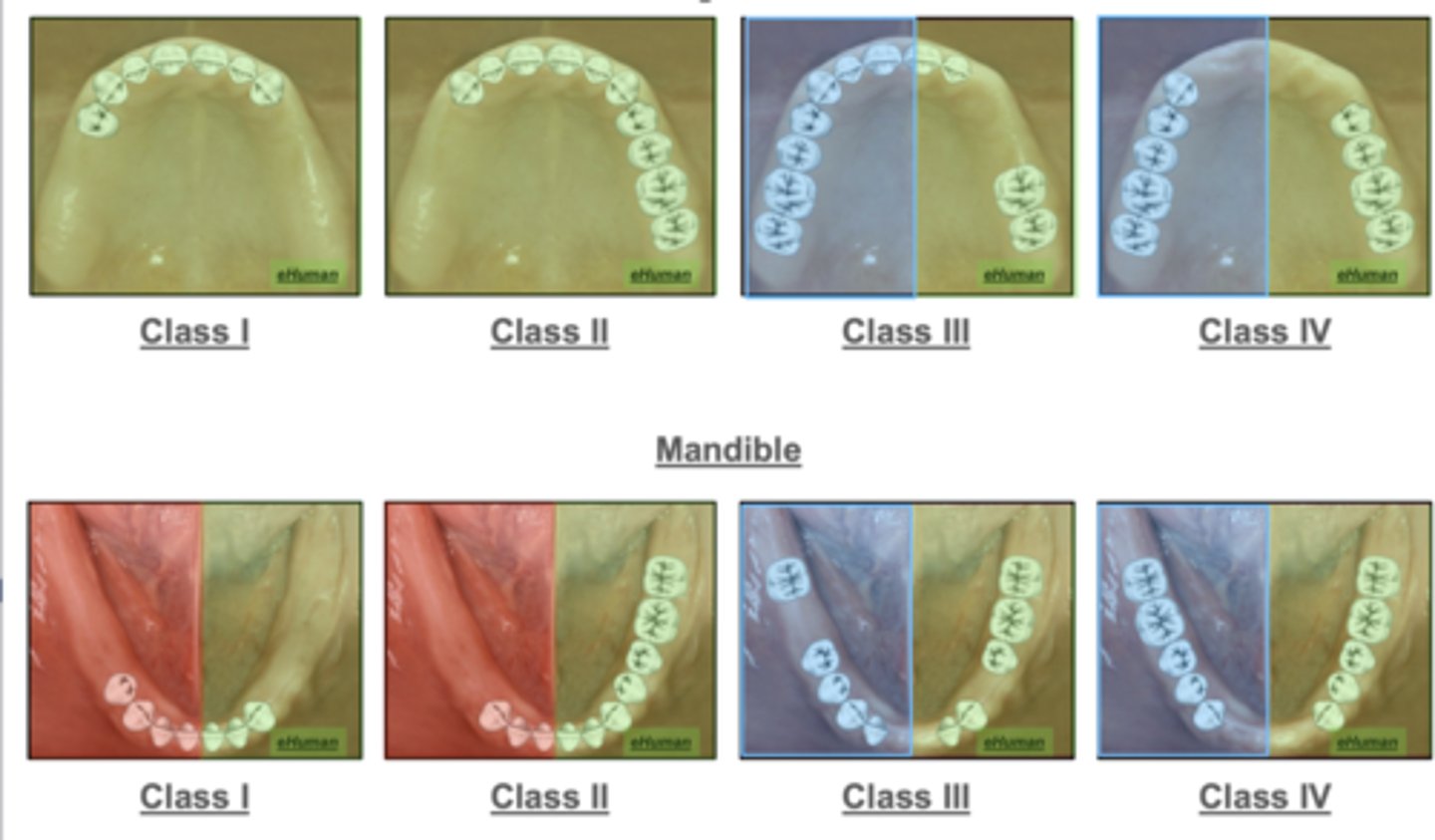
What final impression technique is used for the blue colored images?
Stock
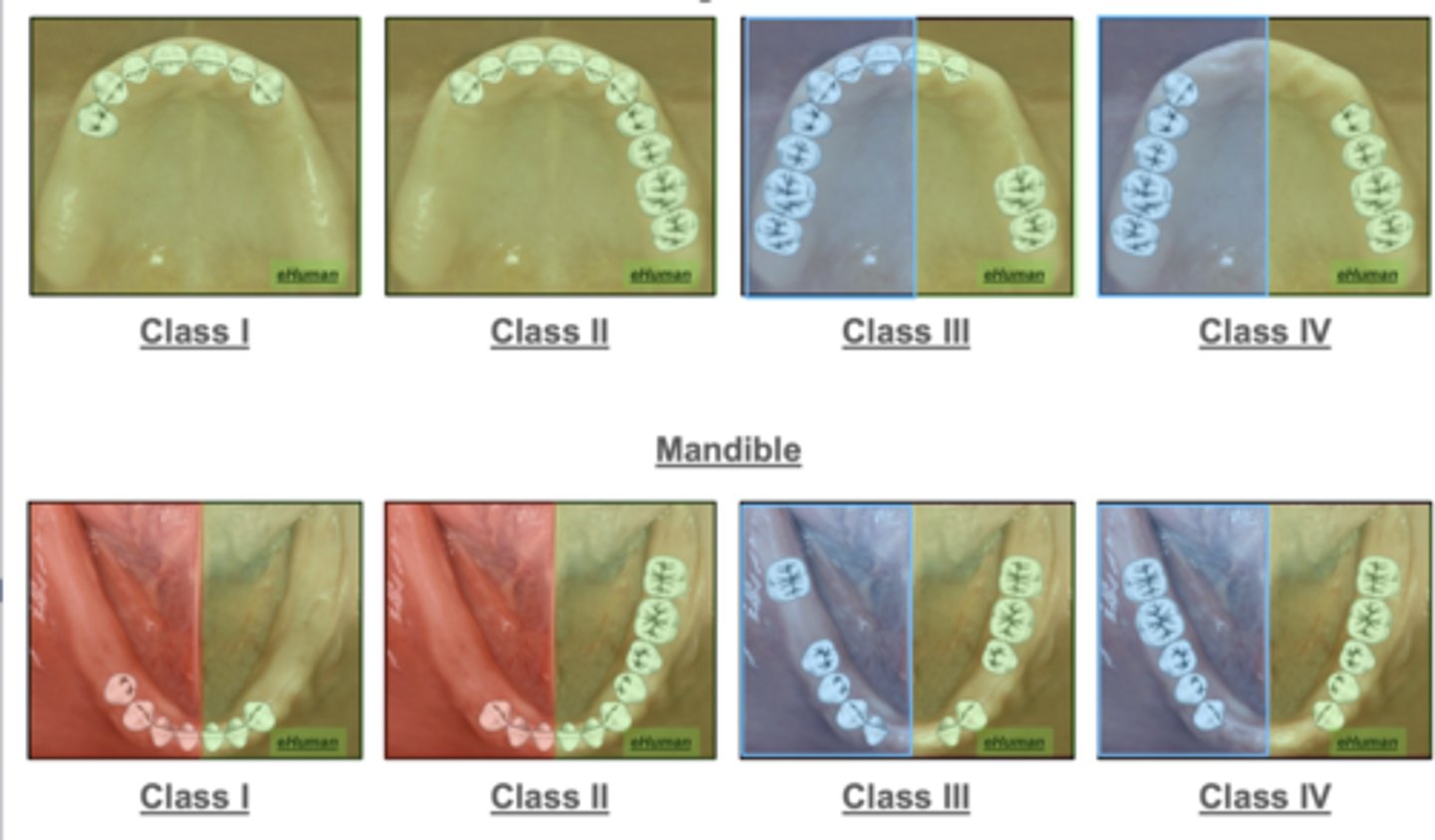
What final impression technique is used for the green colored images?
Custom
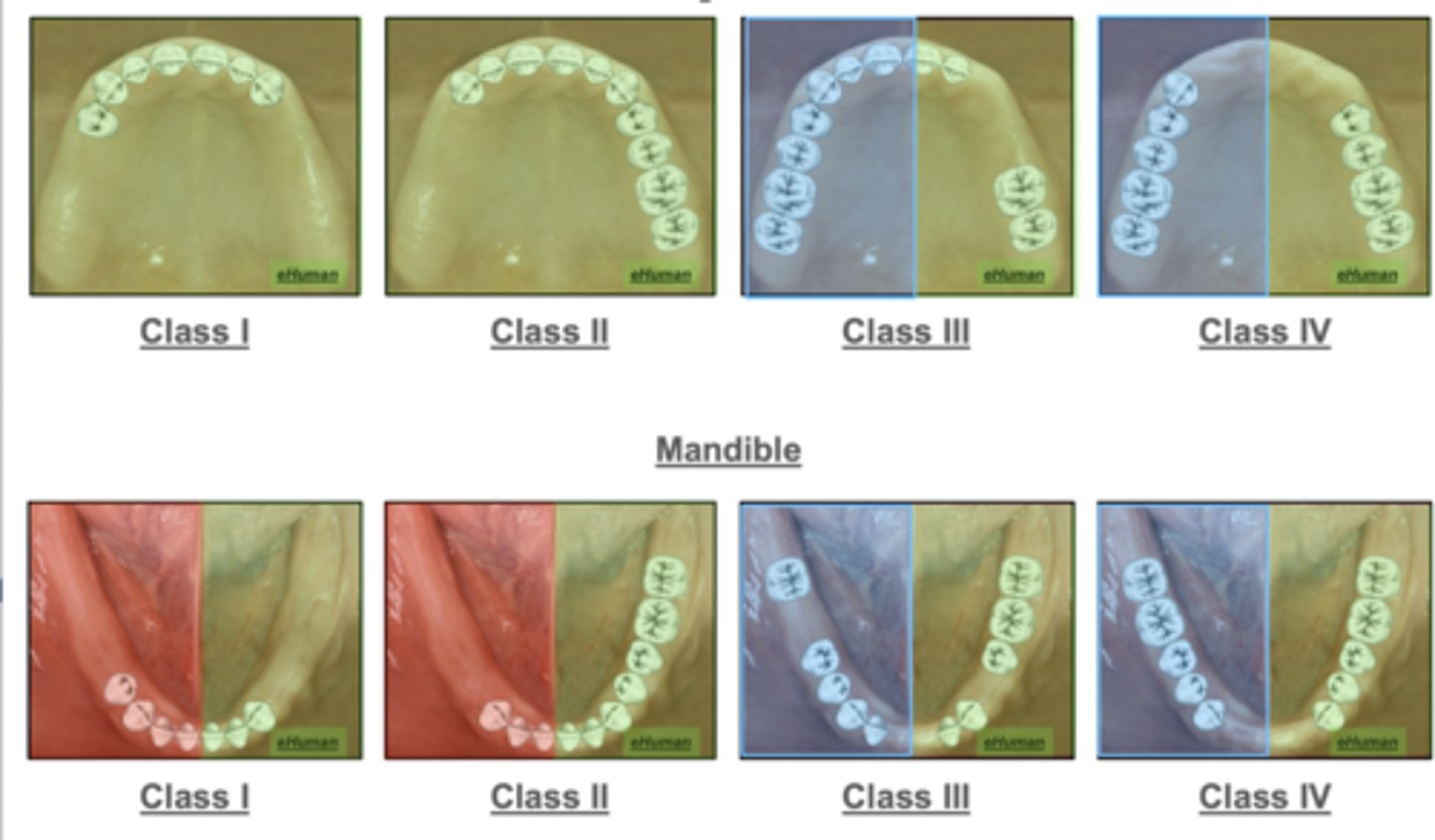
What final impression technique is used for the red colored images?
Altered cast technique
Once triad is added to the metal framework for the altered cast technique, the acrylic should be ___-___ mm short of the buccal vestibule
2-3mm
Which structure is captured with border molding with these actions?
Cheek is:
- Elevated
- Pulled downward
- Pulled outward
- Pulled inward
- Pulled forward for the action of the orbicularis oris
- Pulled backward for the action of the buccinator
buccal frenum and shelf
Which structure is captured with border molding with these actions?
- Hold down the framework and instruct the patient to close his mouth hence contracting the masseteric muscle.
masseteric notch
Which structure is captured with border molding with these actions?
- Patient opens his mouth as wide as possible
retromolar pad
Which structure is captured with border molding with these actions?
- Tongue touching the cheeks.
mylohyoid area
Which structure is captured with border molding with these actions?
- Ask patient to move his/her tongue forward.
retromylohyoid fossa
Once border molding is done on the metal framework, what do you do with the metal framework now?
attach to cast (cast has cutout portion where border molding was completed)
What do you attach to the impression once it is mounted back on the cast?
roping wax
Roping wax should be ___-___ mm above the border molding impression
2-3 mm
Roping wax should be ___-___ mm wide for land area around the border molding impression
3-5 mm
How many rows of roping wax are necessary for the retromolar pad area?
more than 2 rows
What type of wax is added around the cast once roping wax is added?
boxing
What is the last step once boxing wax is set up?
Pour type III dental stone
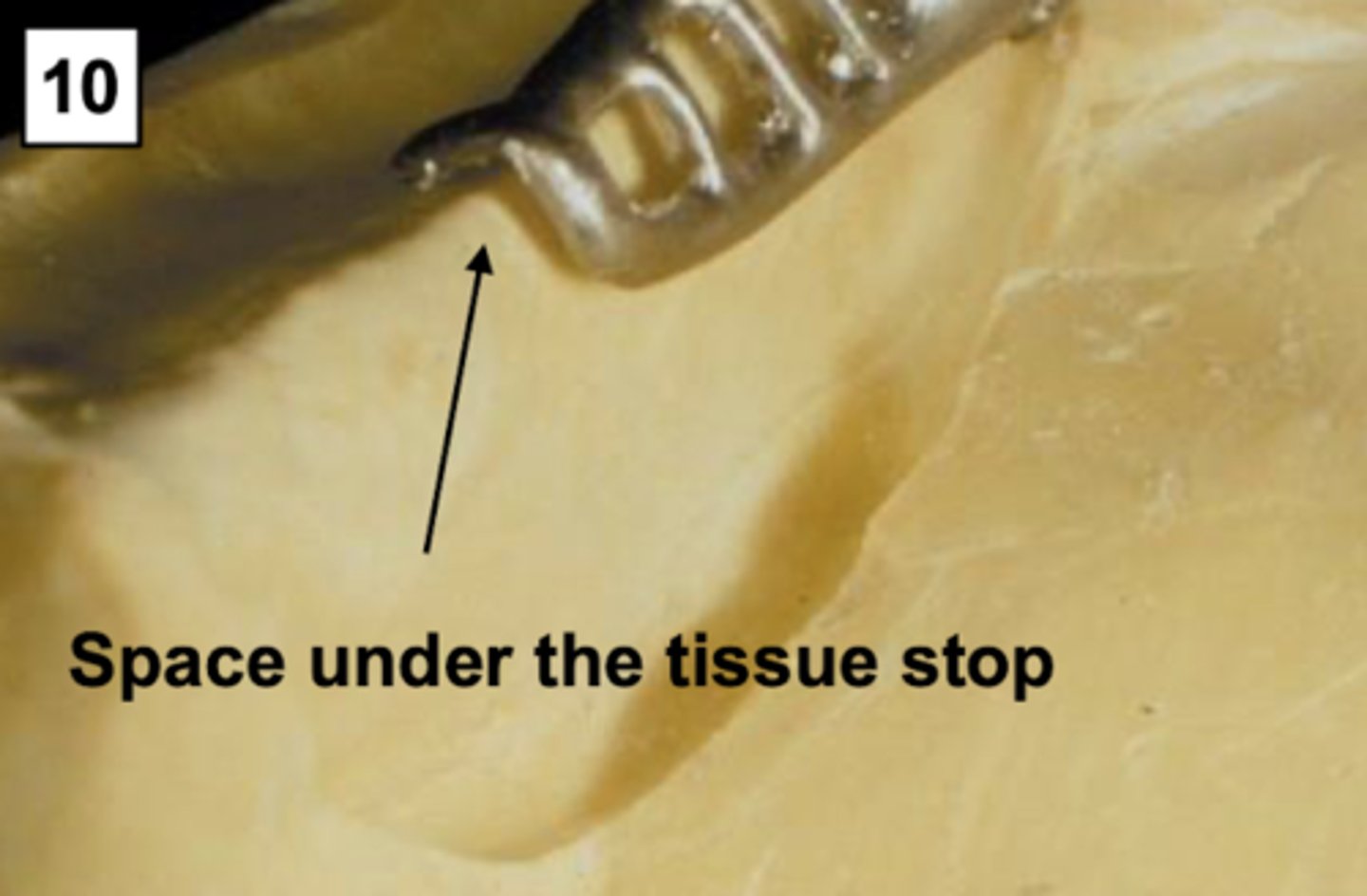
Check the fit of the tissue stops. If there is space under the tissue stop, what should you do?
Fill with cold curing resin
T/F The altered cast technique provided the least amount of movement from the occlusal loading at the time.
true
T/F In a one piece cast, underextension was noted in 22% of cases but no underextension was found in the altered cast impression procedure
true
 Note
Note  Flashcards (60)