6.1 acclimatisation + severe forms
 Studied by 0 people
 Call Kai
 Learn
Learn Practice Test
 Spaced Repetition
 Match
Match Flashcards
 Knowt Play
1/21

There's no tags or description
Looks like no tags are added yet.
Name | Mastery | Learn | Test | Matching | Spaced | Call with Kai |
|---|
No analytics yet
Send a link to your students to track their progress
22 Terms
If a person remains at high altitude for days to weeks, the body undergoes long-term physiological adaptations, known as acclimatisation,
which improve oxygen delivery and utilisation.
One of the most important changes is
an increase in erythropoietin (EPO) production.
The kidneys detect low oxygen levels in the blood and increase transcription of genes encoding for EPO,
leading to an up to 1000-fold rise in EPO synthesis.
EPO then stimulates the bone marrow to produce more red blood cells (RBCs),
increasing haemoglobin levels and enhancing the blood’s ability to transport oxygen to tissues
Another critical adaptation involves
the production of vascular endothelial growth factor A (VEGF-A).
Low oxygen levels stimulate smooth muscle cells and macrophages to increase VEGF-A secretion,
which promotes the formation of additional capillaries within tissues.→ improves blood perfusion → more oxygen to be delivered to cells.
Additionally, hypoxia triggers red blood cells (RBCs) to increase production of 2,3-Bisphosphoglycerate (2,3-BPG).
This molecule binds to haemoglobin and reduces oxygen-haemoglobin affinity, making it easier for oxygen to be released to the tissues.
As a result, oxygen unloading at the cellular level is enhanced,
improving oxygen availability where it is most needed.
prolonged tissue hypoxia leads to an increase in endothelial nitric oxide synthase (eNOS),
the enzyme responsible for producing nitric oxide (NO).
Nitric oxide acts as a vasodilator, relaxing the smooth muscle of blood vessels and increasing their diameter.
This allows greater blood flow and enhances oxygen delivery to tissues.
If the body's compensatory mechanisms fail, altitude sickness can develop.
This condition is most commonly seen at altitudes above 2000 to 3500 meters and may present in different forms.
The mildest form is acute mountain sickness (AMS),
which occurs due to increased cerebral blood flow and intracranial pressure.
It is thought to result from excess VEGF-A and nitric oxide (NO),
which cause excessive cerebral vasodilation.
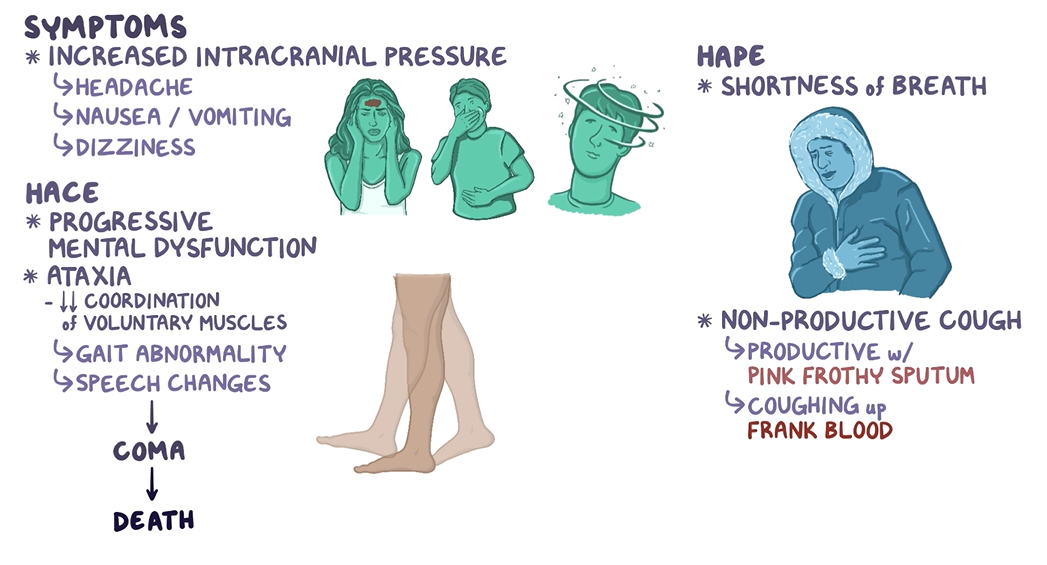
The increased pressure compresses neurons, leading to symptoms such as .
headache, dizziness, nausea, and difficulty sleeping
If AMS worsens, it can progress to high-altitude cerebral oedema (HACE), a life-threatening condition
Increased cerebral vascular pressure causes plasma fluid to leak into brain tissue, leading to oedema (swelling)
Symptoms of HACE include
confusion,
loss of coordination (ataxia),
and altered consciousness,
requiring immediate descent to lower altitude and medical intervention.
A different but equally dangerous condition is high-altitude pulmonary oedema (HAPE),
which typically occurs above 3500 meters
Unlike HACE, HAPE is caused by exaggerated pulmonary vasoconstriction and insufficient nitric oxide production,
leading to severe pulmonary hypertension.
This excessive pressure damages the capillary walls,
causing fluid leakage into lung tissue.
The accumulation of fluid impairs oxygen exchange, leading to
severe shortness of breath,
coughing (often with pink, frothy sputum),
and cyanosis (bluish skin due to low oxygen levels)
Like HACE, immediate descent and oxygen therapy are critical for survival.
 Note
Note  Flashcards (39)