Unit 2 Part 1 AP Psychology: Cognition
 Call Kai
 Learn
Learn Practice Test
 Spaced Repetition
 Match
Match Flashcards
 Knowt Play
1/98

There's no tags or description
Looks like no tags are added yet.
Name | Mastery | Learn | Test | Matching | Spaced | Call with Kai |
|---|
No analytics yet
Send a link to your students to track their progress
99 Terms
Cognition
All mental activities associated with thinking, knowing, remembering, and communicating
Metacognition*
"Thinking about our thinking" ; examining how we are thinking, biases we may have, and how we approach a task
Cognitive Biases*
Systematic ways of thinking that interfere with a person's ability to draw rational and objective conclusions
Concepts*
Mental grouping of similar objects, events, or people
Prototypes*
A mental image of the best example of a specific concept or category
Schema*
Mental representation of a set of connected ideas. More complex mental framework for several related topics compared to a concept
Assimilation*
Allows us to make sense of new information/situations be relating it to our existing schemas
Accommodation*
Occurs when we take in new information and then change the schema in order to incorporate the new information
Executive Functions
A set of cognitive processes that help us manage and coordinate our thoughts/actions to achieve goal-directed behavior.
Prefrontal Cortex
Plays a key role in executive function processes
Trial and Error
Process of trying different solutions until you find one that works
Algorithms*
A specific set of step-by-step instructions designed to perform a task or problem
Heuristics*
A mental shortcut or "rule of thumb" used for problem-solving and decision-making, allowing for quick and efficient judgments
Representativeness Heuristic*
A heuristic we use to judge how closely something represents, or matches our prototype for a given category
Availability Heuristic*
Estimates the likelihood of events based on their availability in memory
Confirmation Bias*
Tendency to search for info that supports our preconceptions and to ignore or dismiss contrary evidence
Mental Set*
tendency to approach decision-making in a particular way based on past experiences, habits, or previously successful strategies
Priming*
Involves exposing people to certain stimuli that unconsciously influences subsequent behavior or decisions
Framing*
A cognitive bias in which the way the info is worded influences how people perceive it and make decisions based on it
Gambler's Fallacy*
Occurs when people believe that the outcomes of random events are influenced by previous outcomes, even if they're independent
Sunk Cost Fallacy*
Occurs when people continue investing resources (time, money, effort) into something because they have already invested significant resources into it
Creativity*
Ability to produce novel and valuable ideas within any discipline including art, music, architecture, math, science and engineering
Convergent thinking*
A question only has one correct answer, limits creativity
Divergent thinking*
when a question can have many possible responses, promotes creativity
Functional fixedness*
cognitive bias that limits a person's ability to see alternate uses for familiar objects because they're fixated on common use
Memory
Persistence of learning over time through encoding, storage, and retrieval of info
Recall*
Retrieving info that is not currently in your conscious awareness but learned at an earlier time (Ex. fill in blank tests)
Recognition*
Identifying items previously learned (Ex. multiple choice question tests)
Relearning
Learning something more quickly when you learn it a second or later time
Biological Approach
Focuses on memory as the product of interconnected neural networks
Long term potentiation*
Physical basis for learning and memory; refers to the increased efficiency in neural firing resulting from repeated connections between neurons
Encode*
Get info into our brain
Store*
Retain encoded info overtime
Retrieve*
Later get info back out of our brain
Three-Stage Multi-Store Model*
Information processing idea can be applied to memory through sensory, short-term, and long-term memory
Sensory Memory*
Immediate, very brief recording of info picked up by sensory organs
Short-term memory*
Temporarily holds a few select items in consciousness before it is either stored or forgotten
Long-term memory*
relatively permanent and limitless storehouse of the memory system; includes knowledge, skills, and experiences
Iconic memory*
A momentary sensory memory of visual stimuli; duration: few tenths of a second
Echoic memory*
A momentary sensory memory of auditory stimuli; duration: 3-4 seconds
Capacity*
Amount of information that can be held; essentially unlimited space
Effortful processing
Encoding that requires attention and conscious effort
Automatic processing*
Encoding that does NOT require attention and conscious effort; occurs without our conscious awareness
Automatic Processing Track*
creates implicit memories(skills well learned that they become automatic and don't require conscious attention)
Effortful Processing Track*
Creates explicit memories(involves facts and experiences that one can consciously know and "declare")
Semantic memories
Facts and general knowledge
Episodic emories
Events in one's own past
Role of Selective Attention
Ability to focus your conscious awareness on a particular stimulus while blocking out competing stimuli
7 pieces
Amount of information (plus or minus 2 pieces) that our short-term/working memory can typically hold
Central Executive of our working memory*
Directs and focuses our attention on the stimuli needed for us to accomplish our working mmeory tasks
Phonological loop*
a memory component that briefly holds auditory information as you engage in active conscious processing
Visuospatial sketchpad*
memor component that briefly holds info about an object's appearance and location in space
Maintenance rehearsal*
Information is repeated to keep it actively present in working memory for a brief period
Elaborative rehearsal*
Cognitive strategy of actively connecting new info to existing ones, creating meaningful associations/visuals; transfers it from short-term to long-term
Parallel Processing
Processing multiple aspects of a stimulus simultaneously
Sequential processing
Processing one aspect of a stimulus at a time
Levels of processing*
Process verbal information at two different levels: shallow and deep
Structural encoding
Based on the physical appearance of a word
Shallow processing*
focuses on the physical appearance of a word(eg. is it long, short, typed) rather than its meaning
Phonemic encoding
based on the sound of a word
Deep processing*
involves semantic encoding, which involves the meaning of words; leads to better retention
Chunking*
Organizing info into familiar, manageable units enables us to recall it more easily
Mnemonics*(aka mnemonic devices)
techniques to use vivid imagery and organizational devices
Method of loci* (aka Memory Palace)
Visualize a familiar location and mentally place items you want to remember in that space
Hierarchies*
Organizing knowledge into broad concepts divided and subdivided into narrower concepts and facts to promote efficient retrieval
Distributed Practice*
We retain information better when our encoding is distributed over time
Spacing effect*
the tendency for distributed study/practice to yield better long-term retention than is achieved through massed study/practice
Memory Consolidation*
Neural process of converting short-term memories into long-term
Hippocampus*
plays an important role in memory formation; acts as a loading dock where the brain temporarily holds info to be transferred for storage elsewhere
Case Study: Henry Molaison*
Had his hippocampus removed to help reduce seizures and was unable to form new long-term explicit memories (anterograde amnesia)
Infantile amnesia*
As adults, our conscious memory of our first 4 years is largely blank
Factors of infantile amnesia
1: we index much of our explicit memory with help of language; 2: The hippocampus matures last, and as time goes on, more gets retained
Amygdala
Part of the brain's limbic system involved in emotion-related memory formation
Retrieval Cues
Bits of info that you associate with a specific memory
Retrospective memory*
Refers to remembering experiences of info we learned in the past (retro = older)
Prospective memory*
pertains to our intended future actions; concerned with remembering to do something in the future (p for present)
Context-Dependent memory*
Putting yourself back in the context where you experienced something easier can prime your memory retrieval
State-Dependent Memory*
When we learn, when in a specific internal state may be more easily recalled when we are again in that state(physical or mental)
Mood-congruent memory*
The tendency to recall experiences that are consistent with one's current good or bad mood
Serial-Position Effect*
Tendency to recall best the last items in a list initially(recency effect) and the first item in a list after a delay (primary effect)
Highly superior autobiographical memory*
rare condition that leads people to remember an abnormally large number of their life experiences in vivid detail
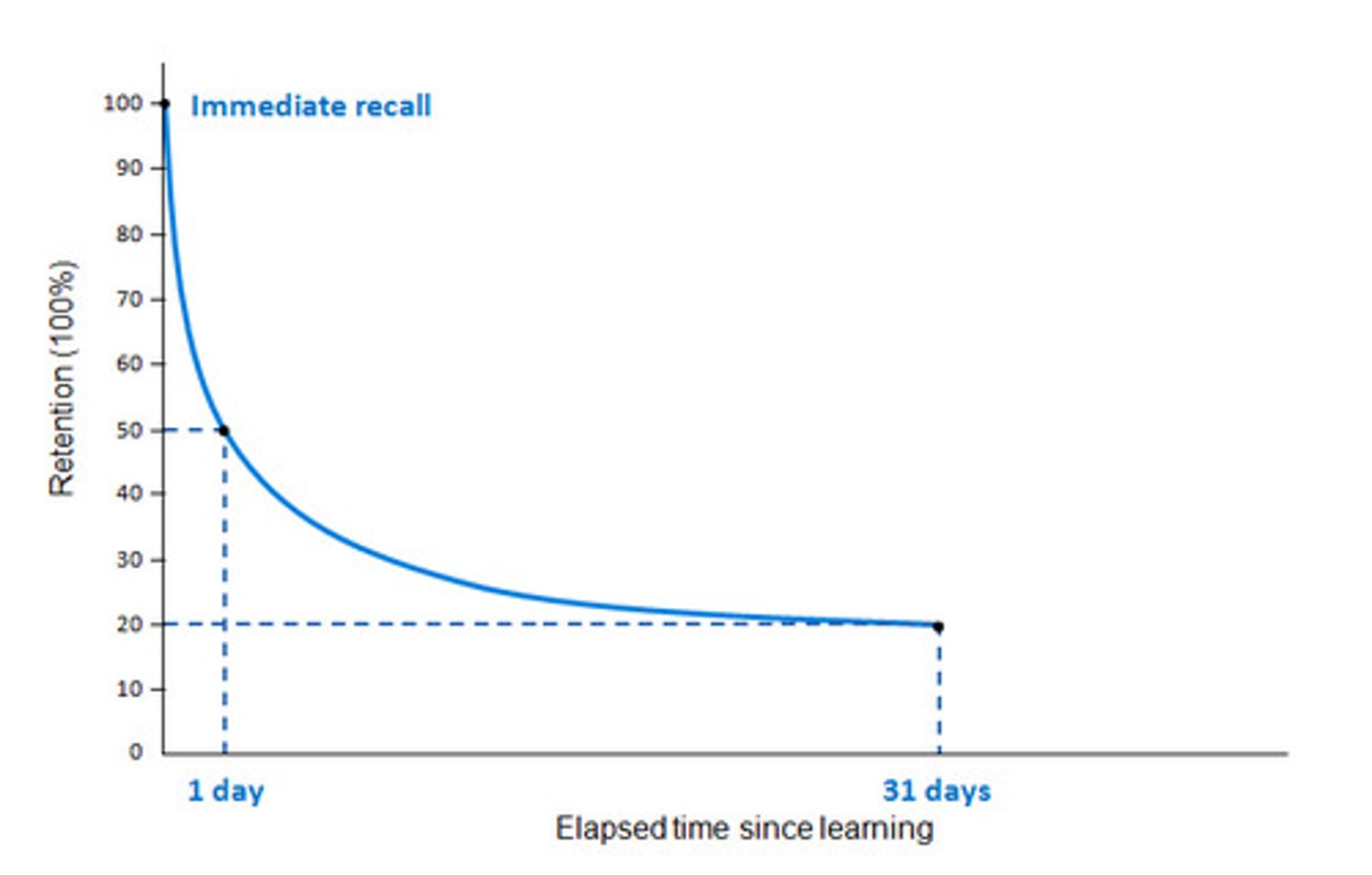
Ebbinghaus' forgetting curve*
The course of forgetting is initially rapid, but then levels off with time
Encoding failure
Items need our attention to make it into our working memory
Storage Decay
Even encoding something well, we sometimes later forget
Retrieval failure
occurs when something is stored in our long-term memory but we can't access it
Tip-of-the-tongue phenomenon
Inability to recall a word or idea while being certain it's in your memory
Interference
When some other info blocks the recall of info
Proactive interference* (forward-acting")
prior learning interrupts new info recall (pr = previous)
Retroactive interference* ("backward-acting")
new learning disrupts recall of old info (re = recent)
Freud's concept of Repression*
We keep painful or unacceptable memories out of our conscious awareness in order to protect our self-image or miinimize anxiety
Most memory researchers believe this about repression:
Repression rarely if ever, occurs
Amnesia
temporary or permanent loss of memory
Anterograde amnesia*
An inability to form new explicit memories, but the person CAN recall their past
Retrograde amnesia*
Inability to recall past info or experiences, but your procedures remain intact and you CAN form new memories
Misinformation effect*
occurs when a memory has been corrupt by misleading info
Imagination inflation*
Once misinformation and false memories are planted, people will fill in rich details
Source amnesia* (source misattribution)
inability to remember the origin of a memory while retaining its substance
Hindsight Bias*
"I knew it all along" ; we tend to believe after learning an outcome we should've foreseen it
Overconfidence*
overestimating the accuracy of your beliefs/judgements; allows to be happier and easier decision-making, but risk for errors; "we don't know what we don't know"

