Physics 141 ch 7 and 8 (torque)
 Call Kai
 Learn
Learn Practice Test
 Spaced Repetition
 Match
Match Flashcards
 Knowt Play
1/35

There's no tags or description
Looks like no tags are added yet.
Name | Mastery | Learn | Test | Matching | Spaced | Call with Kai |
|---|
No analytics yet
Send a link to your students to track their progress
36 Terms
Two equal-magnitude forces are applied to a door at the doorknob. The first force is applied perpendicular to the door, and the second force is applied at 30° to the plane of the door. Which force exerts the greater torque about the door hinge?
a. both forces exert equal non-zero torques.
b. the second force (applied at an angle)
c. the first force (applied perpendicular to the door)
d. both forces exert zero torque.
c. the first force (applied perpendicular to the door)
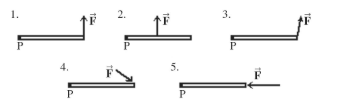
As shown in the figure, a given force is applied to a rod in several different ways. In which case is the torque about the pivot P due to this force the greatest?
1
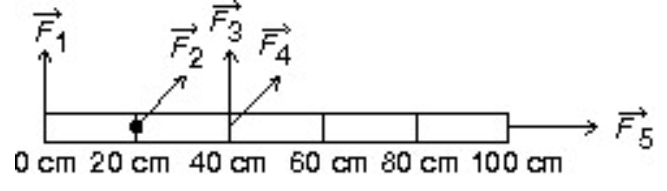
Five forces act on a meter stick as shown in the figure below. Which of these forces cause zero torque? (there could be more than one correct choice.)
F2 and F5
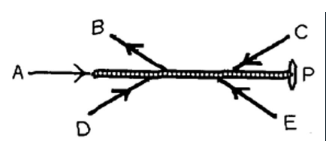
Five forces act on a rod that is free to pivot at point P, as shown in the figure. Which of these forces is producing a counter-clockwise torque about point P? (There could be more than one correct choice.)
Force C
A 75-N force exerted at the end of a 0.34-m long torque wrench produces a torque of 20 N ∙ m. What is the angle (less than 90°) between the wrench handle and the direction of the applied force?
51.66 degrees
T/F: Center of gravity of an abject need not be inside the object.
true
Center of Mass: Three masses, 1.0 kg, 2.0 kg, and 3.0 kg, are located at (0.0 m, 0.0 m), (1.0 m, 1.0 m), and (2.0 m, -2.0 m), respectively. What is the location of the center of mass (or center of gravity) of this system?
a. (-1.3 m, 0.67 m)
b. (1.3 m, 0.67 m)
c. (-1.3 m, -0.67 m)
d. (1.3 m, -0.67 m)
d. (1.3 m, -0.67 m)
Which of the following is in static equilibrium?
a. a rock resting on the ground
b. a rock sliding at constant velocity across a frictionless surface
c. a rock rotating in place on a frictionless surface
d. a rock falling off a cliff
e. a rock rotating at a constant rate as it slides at constant velocity across a frictionless surface
a. a rock resting on the ground
The conditions that the sum of forces and the sum of the torques both vanish:
a. are sufficient to calculate the forces on a solid object in equilibrium only if the object is elastic
b. hold for every solid body
c. are always sufficient to calculate the forces on a solid object in equilibrium
d. hold for every solid body in equilibrium
e. hold only for elastic solid bodies in equilibrium
d. hold for every solid body in equilibrium
What conditions should be met for an extended object to be in static equilibrium?
a. both Fnet =0 and 𝜏net =0
b. 𝜏net =0 only
c. either Fnet =0 or 𝜏net =0
d. Fnet =0 only
a. both Fnet =0 and 𝜏net =0
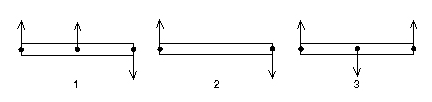
Three identical uniform rods are each acted on by two or more forces, all perpendicular to the rods. Which of the rods could be in static equilibrium if an additional force is applied at the center of mass of the rod?
a. Only 1 and 2
b. Only 3
c. Only 2
d. Only 1
e. All three
b. Only 3
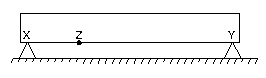
A uniform plank XY is supported by two equal 120-N forces at X and Y, as shown. The support at X is then moved to Z (half-way to the plank center). The supporting forces at Y and Z are then:
a. FY = 160 N, FZ = 80 N
b. FY = 200 N, FZ = 40 N
c. FY = 240 N, FZ = 120 N
d. FY = 40 N, FZ = 200 N
e. FY = 80 N, FZ = 160 N
e. FY = 80 N, FZ = 160 N
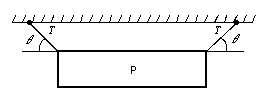
A picture P of weight W is hung by two strings as shown. The magnitude of the tension force of each string is T. The total upward pull of the strings on the picture is:
a. 2T cos θ
b. 2W cos θ
c. T cos θ
d. T sin θ
e. 2T sin θ
e. 2T sin θ
A force of 30 N stretches a very light ideal spring 0.63 m from equilibrium. What is the force constant (spring constant) of the spring?
a. 41 N/m
b. 34 N/m
c. 48 N/m
e. 62 N/m
c. 48 N/m
Springs: A 10-kg mass, hung by an ideal spring, causes the spring to stretch 2.0 cm. What is the spring constant (force constant) for this spring?
a. 20 N/m
b. 0.0020 N/cm
c. 5.0 N/cm
d. 0.20 N/cm
e. 49 N/cm
e. 49 N/cm
Springs: An ideal spring stretches by 21.0 cm when a 135-N object is hung from it. If instead you hang a fish from this spring, what is the weight of a fish that would stretch the spring by 31.0 cm?
a. 145 N
b. 91 N
c. 279 N
d. 199 N
d. 199 N
An ideal spring stretches by 14 cm when a 140-N object is hung from it. If instead you hang a fish from this spring, what is the weight (in Newton) of a fish that would stretch the spring by 40 cm?
400 N
A 93-N force exerted at the end of a 0.37-m long torque wrench produces a torque of 15 N ∙ m. What is the angle (less than 90°) between the wrench handle and the direction of the applied force?
25.84 degrees
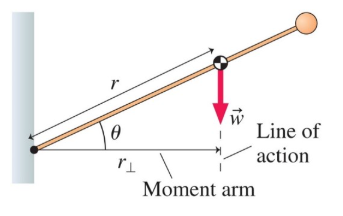
A flagpole extends from a wall at an angle of θ= 27° from the horizontal. Its center of gravity is 1.6 m from the point where the pole is attached to the wall. Magnitude of the gravitational torque on the flagpole about the point of attachment is 46 N.m. Calculate mass of the flagpole in kg.
3.29 kg
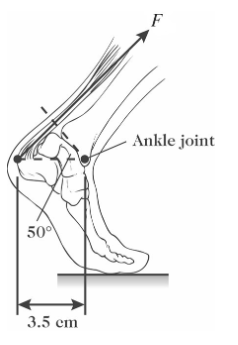
The figure shows a person's foot. In that figure, the Achilles tendon exerts a force of magnitude F = 817 N. What is the magnitude of the torque that this force produces about the ankle joint?
18.38 N•m
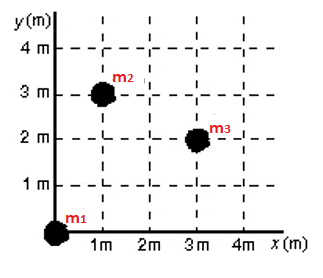
Three masses m1 = 5 kg, m2 = 19 kg, and m3 = 7 kg are placed as shown in the figure below. The y coordinate in meters of the center of gravity of the three-particle system shown below is:
2.29 m
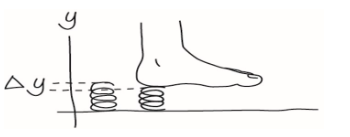
Several companies manufacture running shoes that have thick heel pads containing steel springs to launch a runner back into the air after a heel strike. When a 69 kg runner rocks back on his heels so that all of his weight is supported by the heel springs, the springs each compress by 1.8 mm. When he is running hard and hits the ground on one heel, the force compressing the spring is 4 times his weight. By how much do the springs compress during a heel strike? Write your answer in cm. 10mm=1cm.
1.44 cm
A spring with spring constant k= 111 N/m is used to pull a 25 N wooden block horizontally across a tabletop. The coefficient of friction between the block and the table is μk=0.20.
By how much, in cm, does this spring stretch from its equilibrium length?
4.5 cm
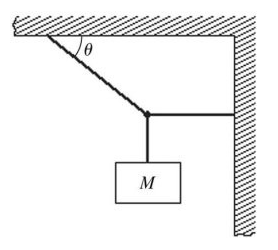
Equilibrium: The figure shows a block of mass M hanging at rest. The light wire fastened to the wall is horizontal and has a tension of 54 N. The wire fastened to the ceiling is also very light and makes an angle θ =390 with the ceiling. Find M in kg.
4.46 kg
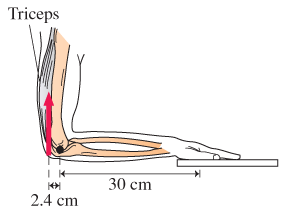
Hold your upper arm vertical and your lower arm horizontal with your hand palm-down on a table, as shown in the Figure. If you now push down on the table, you’ll feel that your triceps muscle has contracted and is trying to pivot your lower arm about the elbow joint. If a person with the arm dimensions shown pushes down hard with a 99 N force, what force must the triceps muscle provide? You can ignore the mass of the arm and hand in your calculation.
1,237.5 N
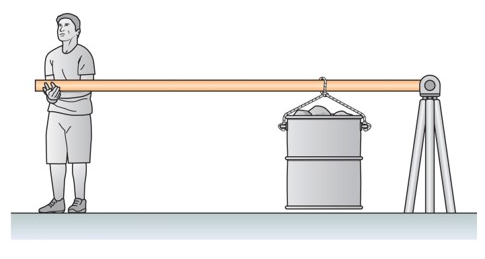
A participant in a “strongman” competition uses an old-fashioned device to move a large load with only muscle power. A 1 ton (910 kg) bucket of rocks is suspended from a sturdy, lightweight beam 0.71 m from a pivot. The man lifts the beam at its end, 4.7 m from the pivot, and holds it steady. What is the force on the beam from the pivot?
7,570.81 N
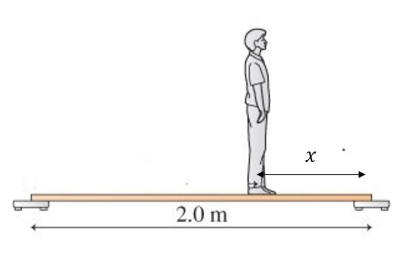
A 2.0 m long, rigid board with negligible mass rests on a bathroom scale at each end. A person of mass 80 kg stands at a distance of x =0.31 m from the right end. What does the left scale read in newtons?
121.52 N
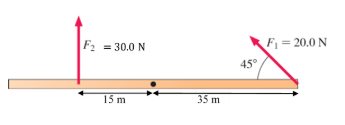
Forces F1 and F2 act on a straight rod as shown in the figure below. Calculate the net torque, in N⋅m, about the pivot point marked dot.
44.97 N⋅m
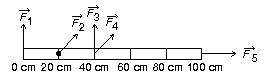
The figure shows forces acting on a meter stick, which is constrained to rotate around the axis indicated by the dot •. Which force(s) create a positive torque around that axis?
a. F2, F3, F4, and F5
b. F3 and F4
c. F5 only
d. F1 only
e. F3 only
b. F3 and F4
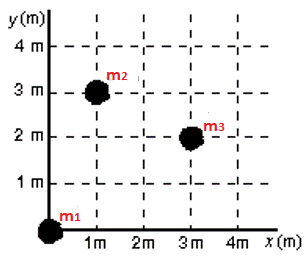
Three masses m1 = 5 kg, m2 = 15 kg, and m3 = 9 kg are placed as shown in the figure below. The y-coordinate (in meters) of the center of gravity of the three-particle system shown below is:
2.17 m

For which of the following situations Fnet ≠ 0 and 𝜏net = 0?
B
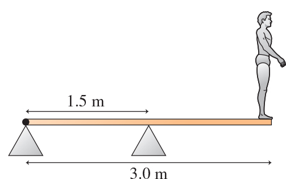
A 63 kg diver stands at the end of a 24 kg springboard, as shown in the Figure. The board is attached to a hinge at the left end but simply rests on the right support. What is the magnitude of the vertical force exerted by the hinge on the board in Newton?
617.4 N
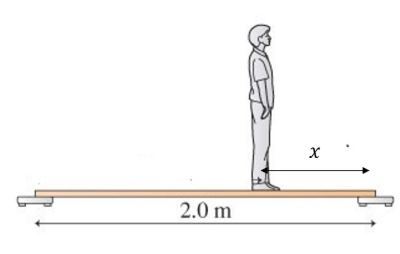
A 2.0 m long, rigid board with negligible mass rests on a bathroom scale at each end. A person of mass 52 kg stands at a distance of x =0.57 m from the right end. What does the left scale read in newtons?
145.24 N
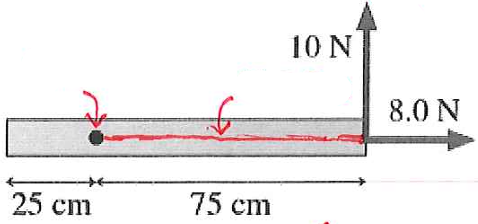
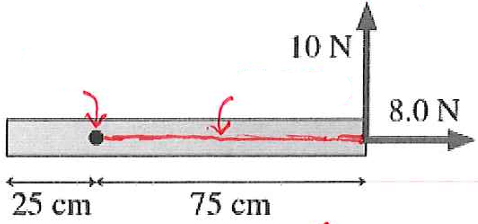
What is the net torque on the bar shown in the figure, about the axis indicated by the dot?
7.5 N⋅m
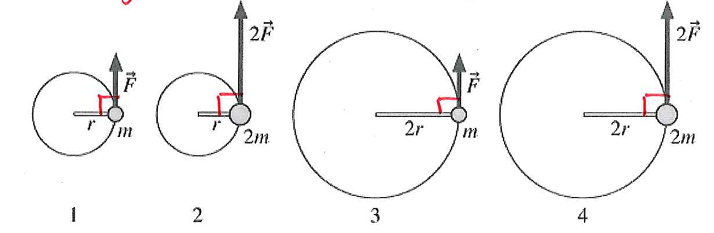
Balls are attached to light rods and can move in horizontal circles as shown in the figure. Rank in order, from smallest to largest, the torques 𝜏1 to 𝜏4 about the centers of the circle.
𝜏1<𝜏2=𝜏3<𝜏4
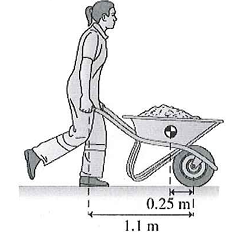
A woman is pushing a load in a wheelbarrow, as in the figure. The combined mass of the wheelbarrow and the load is 110 kg, with a center of gravity 0.25 m behind the axle. The woman supports the wheelbarrow at the handles, 1.1 m behind the axle.
a. what is the force required to support the wheelbarrow?
b. what fraction of the weight of the wheelbarrow and the load does this force represent?
a. 245 N
b. the fraction equals 0.23 which is small. this is why the wheelbarrow is useful.