Ch. 15 The Autonomic Nervous System

0.0(0)
studied byStudied by 0 people
0.0(0)
full-widthCall with Kai
learnLearn
examPractice Test
spaced repetitionSpaced Repetition
heart puzzleMatch
flashcardsFlashcards
GameKnowt Play
Card Sorting

1/31

encourage image

There's no tags or description

Looks like no tags are added yet.

Study Analytics
Name
Mastery
Learn
Test
Matching
Spaced
Call with Kai

No study sessions yet.

32 Terms

1
New cards

Autonomic Nervous System vs Somatic Nervous System

The ANS controls subconscious processes, such as maintaining our heart rate, body temperature, and performing digestion.

The SNS allows us to consciously control our body, particularly through the movement of skeletal muscle.
<p>The ANS controls subconscious processes, such as maintaining our heart rate, body temperature, and performing digestion.</p><p>The SNS allows us to consciously control our body, particularly through the movement of skeletal muscle.</p>
2
New cards

The ANS consists of motor neurons that:

  • Innervate smooth muscle, cardiac muscle, and glandular tissue.

  • Make adjustments to ensure optimal body functionality.

  • Operate via subconscious control.

<ul><li><p>Innervate smooth muscle, cardiac muscle, and glandular tissue.</p></li><li><p>Make adjustments to ensure optimal body functionality.</p></li><li><p>Operate via subconscious control.</p></li></ul><p></p>
3
New cards

Autonomic vs Somatic:

  • Autonomic organs include cardiac muscle, smooth muscle, and glands. Somatic effectors primarily include skeletal muscle.

  • Autonomic neurotransmitters include acetylcholine and norepinephrine. Somatic neurotransmitters only include acetylcholine.

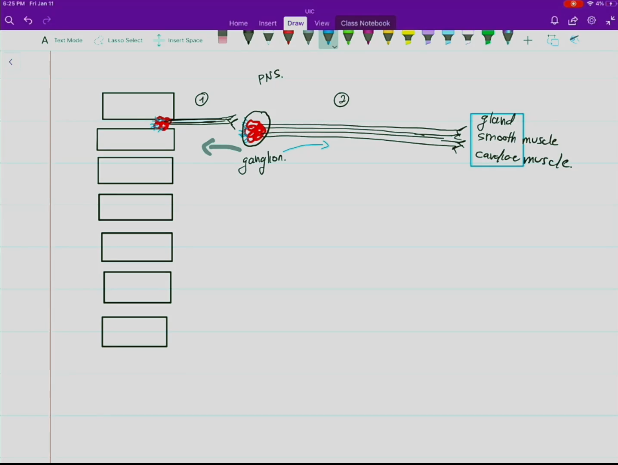
  • Autonomic efferent pathway involves two seperate neurons, a preganglionic and post ganglionic neuron. Somatic efferent pathway only involes on neuron.
<ul><li><p>Autonomic organs include cardiac muscle, smooth muscle, and glands. Somatic effectors primarily include skeletal muscle.</p></li><li><p>Autonomic neurotransmitters include acetylcholine and norepinephrine. Somatic neurotransmitters only include acetylcholine.</p></li><li><p>Autonomic efferent pathway involves two seperate neurons, a preganglionic and post ganglionic neuron. Somatic efferent pathway only involes on neuron.</p></li></ul><p></p>
4
New cards

Preganglionic Neuron

  • Located in the CNS

  • Releases acetylcholine as its neurotransmitter.

  • Synaptic cleft located between the preganglionic neuron and the postganglionic neuron at the site of the ganglion.

  • Has a thin, lightly myelinated axon leading to the ganglion.
<ul><li><p>Located in the CNS</p></li><li><p>Releases acetylcholine as its neurotransmitter.</p></li><li><p>Synaptic cleft located between the preganglionic neuron and the postganglionic neuron at the site of the ganglion.</p></li><li><p>Has a thin, lightly myelinated axon leading to the ganglion.</p></li></ul><p></p>
5
New cards

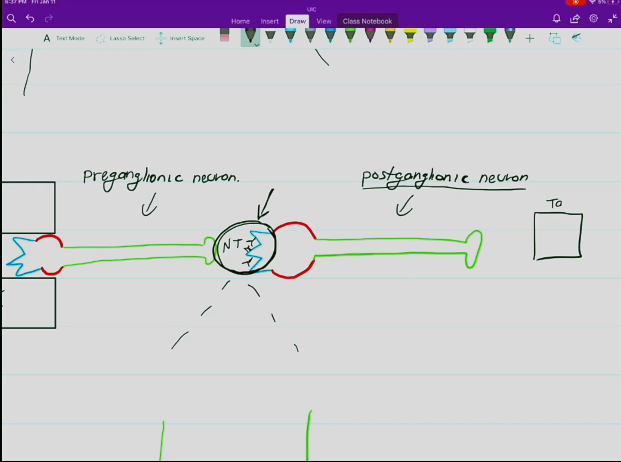
Postganglionic Neuron

  • Located in the PNS

  • Releases either acetylcholine or norepinephrine as its neurotransmitter, as either could have a stimulatory or inhibitory effect, depending on the target organ.

  • Synaptic cleft located between the postganglionic neuron and the target organ.

  • Has a nonmyelinated axon leading away from the ganglion that extends towards the effector organ.
<ul><li><p>Located in the PNS</p></li><li><p>Releases either acetylcholine or norepinephrine as its neurotransmitter, as either could have a stimulatory or inhibitory effect, depending on the target organ.</p></li><li><p>Synaptic cleft located between the postganglionic neuron and the target organ.</p></li><li><p>Has a nonmyelinated axon leading away from the ganglion that extends towards the effector organ.</p></li></ul><p></p>
6
New cards

Autonomic Nervous System Divisons:

  • Parasympathetic (chill tf out)

  • Sympathetic (tweaking)

<ul><li><p>Parasympathetic (chill tf out)</p></li><li><p>Sympathetic (tweaking)</p></li></ul><p></p>
7
New cards

Parasympathetic Role: + da secret name

  • Promote maintenance activities such as digestion, diuresis, and defecation. “Rest and digest”

  • Lowers blood preasure, heart rate, and respiratory rate.

  • Increases activity in the gastrointestinal tract.

  • Constricts pupils for close vision.

Thoracolumbar
<ul><li><p>Promote maintenance activities such as digestion, diuresis, and defecation. “Rest and digest”</p></li><li><p>Lowers blood preasure, heart rate, and respiratory rate.</p></li><li><p>Increases activity in the gastrointestinal tract.</p></li><li><p>Constricts pupils for close vision.</p></li></ul><p></p><p>Thoracolumbar</p>
8
New cards

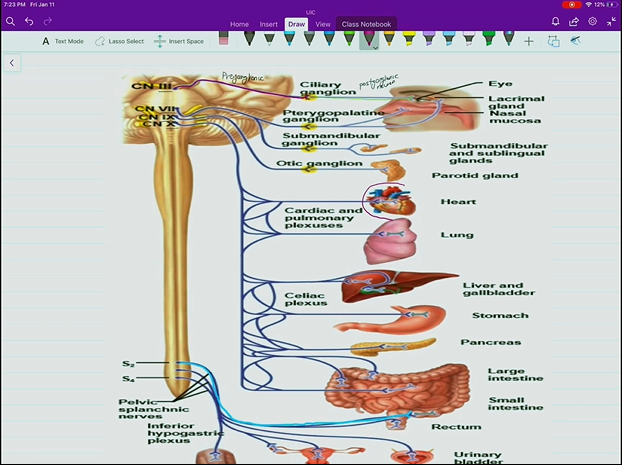
Parasympathetic Anatomy:

  • Preganglionic fibers originate from the brainstem or from the sacrum. Including CN 3, 7, 9, and 10. S2, S4.

  • Preganglionic fibers are much longer than the postganglionic fibers, nearly reaching the target organ with the synapse.
<ul><li><p>Preganglionic fibers originate from the brainstem or from the sacrum. Including CN 3, 7, 9, and 10. S2, S4.</p></li><li><p>Preganglionic fibers are much longer than the postganglionic fibers, nearly reaching the target organ with the synapse.</p></li></ul><p></p>
9
New cards

Sympathetic Role:

  • Mobilizes body during activity; “Fight or flight” system

  • Exercise, Excitement, emergency, embaraessment

  • Heart rate up, mouth dry, cold, sweating, dilating pupils.

  • During intense physical activity it can shunt blood to skeletal muscles and heart, dilate bronchioles, force the liver to release glucose.
<ul><li><p>Mobilizes body during activity; “Fight or flight” system</p></li><li><p>Exercise, Excitement, emergency, embaraessment</p></li><li><p>Heart rate up, mouth dry, cold, sweating, dilating pupils.</p></li><li><p>During intense physical activity it can shunt blood to skeletal muscles and heart, dilate bronchioles, force the liver to release glucose.</p></li></ul><p></p>
10
New cards

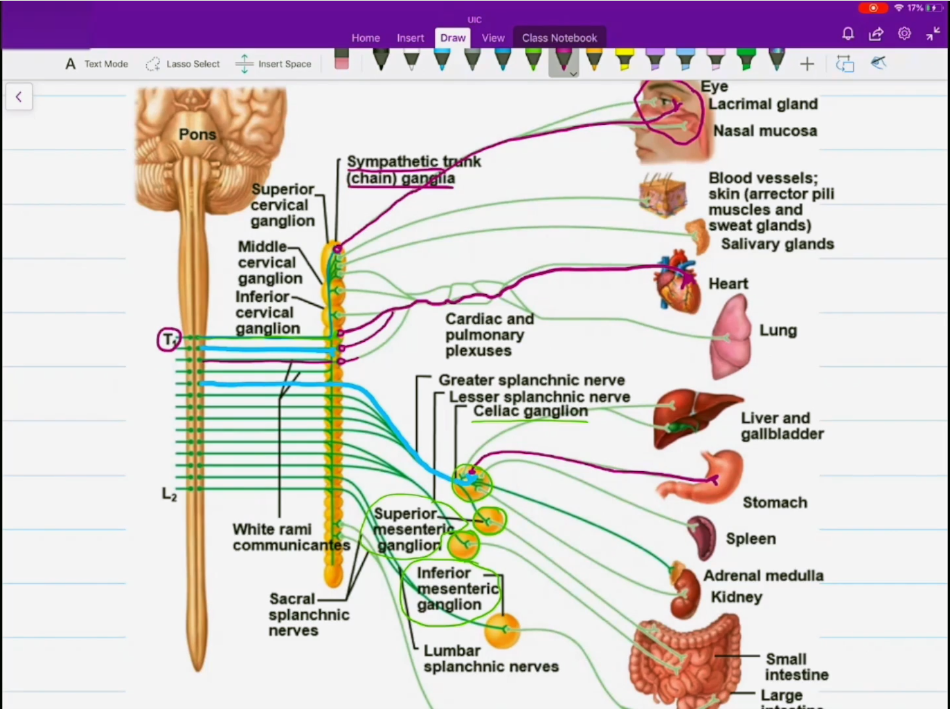
Sympathetic Anatomy

  • Originiates between T1 - L2, from the lateral horns of the vertebrae.

  • Preganglionic fibers pass through white rami communicantes and enter the sympathetic trunk/chain/paravertebral ganglia.

  • This time post is the big one and pre is the small one

  • oh yeah and the celiac, superior mesenteric, and inferior mesenteric ganglion kinda just f off to wherever they wan go
<ul><li><p>Originiates between T1 - L2, from the lateral horns of the vertebrae.</p></li><li><p>Preganglionic fibers pass through white rami communicantes and enter the sympathetic trunk/chain/paravertebral ganglia.</p></li><li><p>This time post is the big one and pre is the small one</p></li><li><p>oh yeah and the celiac, superior mesenteric, and inferior mesenteric ganglion kinda just f off to wherever they wan go</p></li></ul><p></p>
11
New cards

sympathetic trunk paravertebral ganglia

Where the preganglionic and postganglionic fibers meet in the sympathetic division.
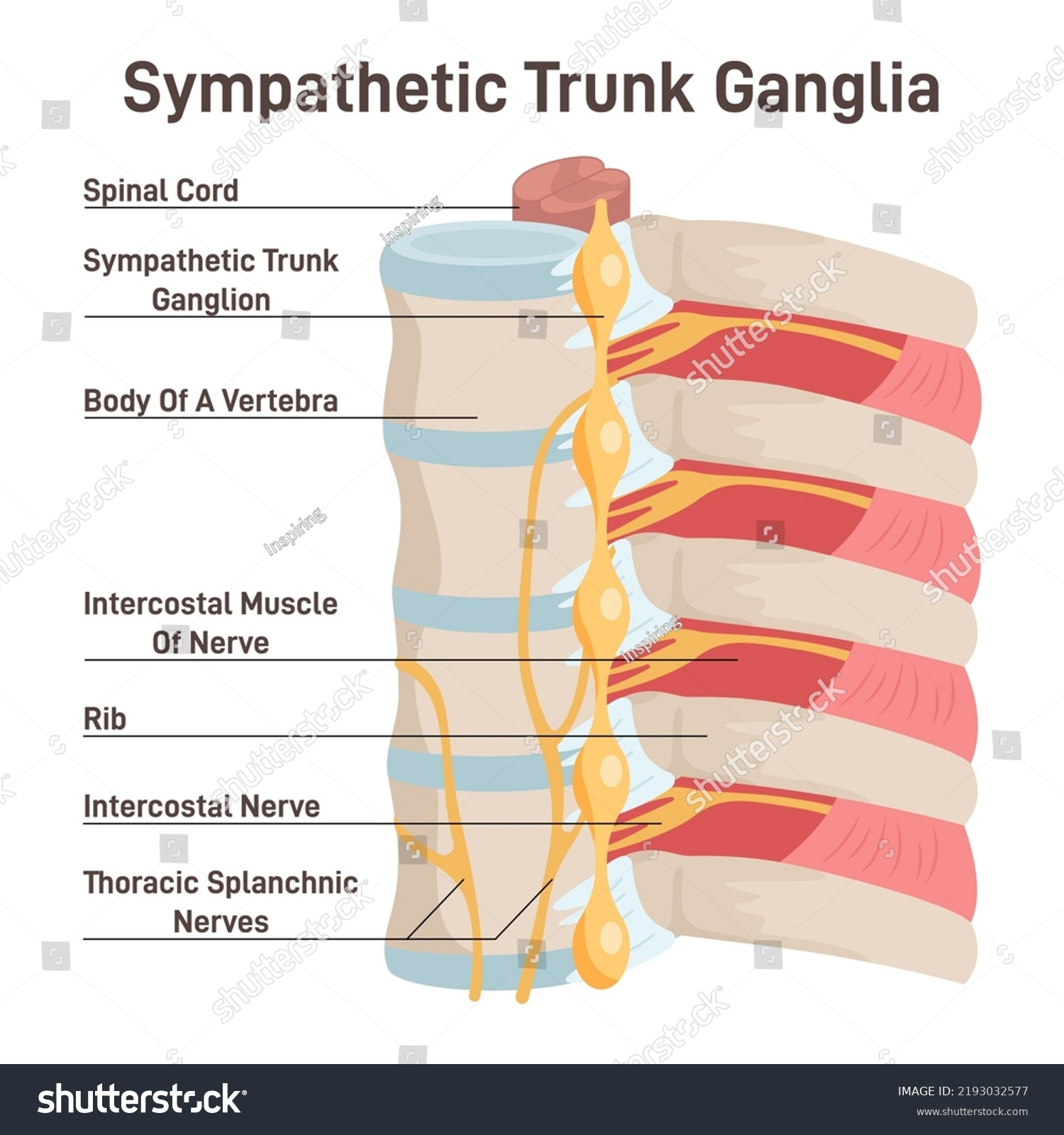
<p>Where the preganglionic and postganglionic fibers meet in the sympathetic division.</p>
12
New cards

Neurotransmitters and Receptors of the Parasympathetic Nervous System:

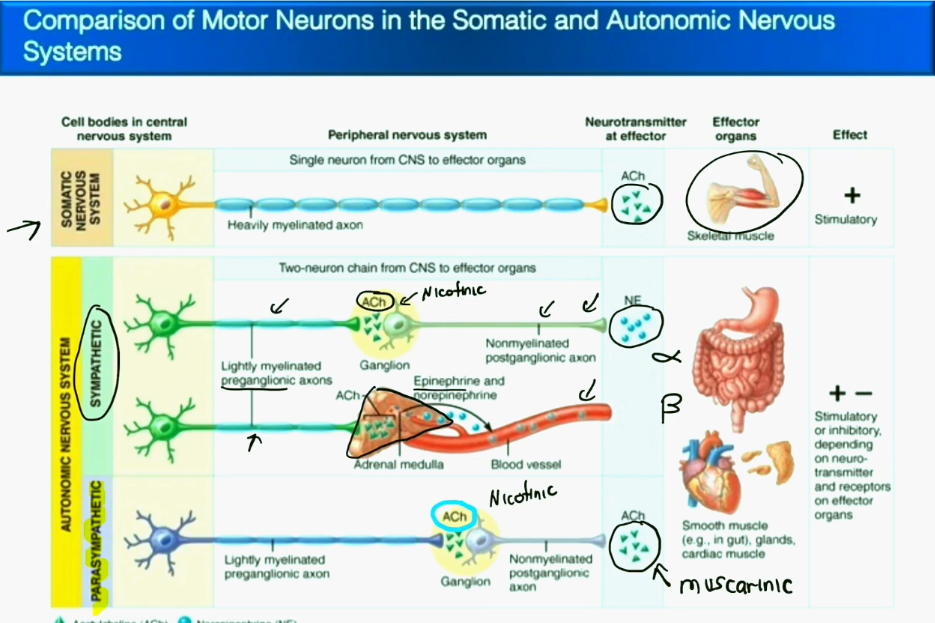
Preganglionic body begins in the CNS, the preganglionic axon releases acetylcholine (ach) from its terminal end into the nicotinic receptors of the postganglionic body. The postganglionic axon will then release acetylcholine (ach) into the muscarinic receptors of the gland/smooth muscle/cardiac muscle.
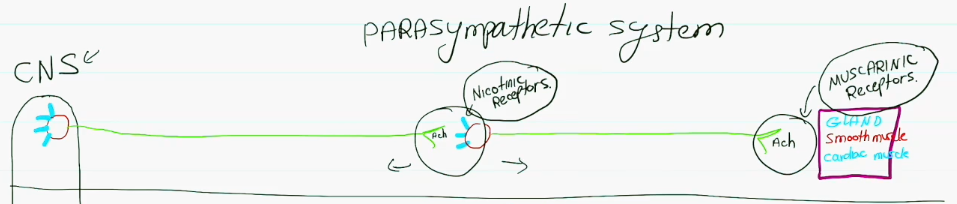
<p>Preganglionic body begins in the CNS, the preganglionic axon releases <strong>acetylcholine (ach)</strong> from its terminal end into the <strong>nicotinic receptors</strong> of the postganglionic body. The postganglionic axon will then release <strong>acetylcholine (ach) </strong>into the <strong>muscarinic receptors</strong> of the gland/smooth muscle/cardiac muscle.</p>
13
New cards

Neurotransmitters and Receptors of the Sympathetic Nervous System:

Preganglionic body begins in the CNS, the preganglionic axon releases acetylcholine (ach) from its terminal end into the nicotinic receptors of the postganglionic body. The postganglionic axon will then release norepinephrine (NE) into the alpha or beta receptors of the gland/smooth muscle/cardiac muscle. UNLESS the postganglionic axon is releasing into a sweat gland, in that case it will release acetylcholine (ach) into the muscarinic receptors of the sweat gland.
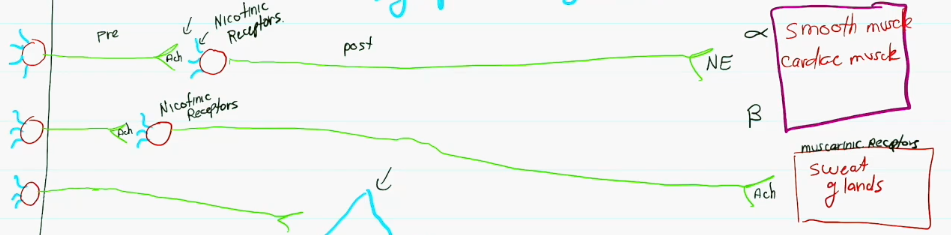
<p>Preganglionic body begins in the CNS, the preganglionic axon releases <strong>acetylcholine (ach)</strong> from its terminal end into the <strong>nicotinic receptors</strong> of the postganglionic body. The postganglionic axon will then release <strong>norepinephrine (NE) </strong>into the <strong>alpha</strong> or <strong>beta</strong> receptors of the gland/smooth muscle/cardiac muscle. <strong>UNLESS</strong> the postganglionic axon is releasing into a sweat gland, in that case it will release <strong>acetylcholine (ach) </strong>into the<strong> muscarinic receptors </strong>of the sweat gland.</p>
14
New cards

Neurotransmitters and Receptors of the Sympathetic Nervous System: (the special one)

Preganglionic body begins in the CNS, the preganglionic axon releases acetylcholine (ach) from its terminal end into the nicotinic receptors of the adrenal gland (it counts as a neuron and an organ). The adrenal gland will then secrete adrenaline.
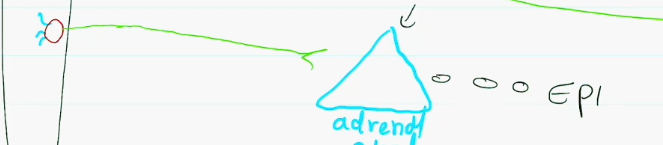
<p>Preganglionic body begins in the CNS, the preganglionic axon releases <strong>acetylcholine (ach)</strong> from its terminal end into the <strong>nicotinic receptors</strong> of the adrenal gland (it counts as a neuron and an organ). The adrenal gland will then secrete adrenaline.</p>
15
New cards

Neurotransmitters and Receptors of the Somatic Nervous System:

Preganglionic body begins in the CNS, the preganglionic axon releases acetylcholine (ach) from its terminal end straight into the mf muscle via Nicotinic Muscle receptors.
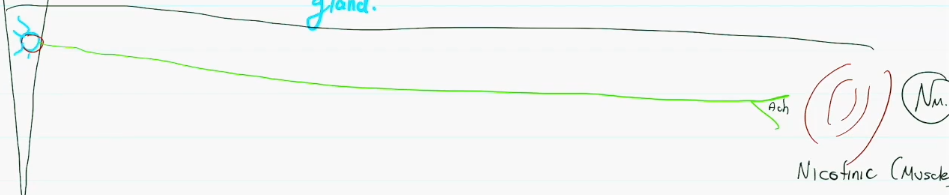
<p>Preganglionic body begins in the CNS, the preganglionic axon releases <strong>acetylcholine (ach)</strong> from its terminal end straight into the mf muscle via Nicotinic Muscle receptors.</p>
16
New cards

Neurotrannsmittersss and receptors picture
knowt flashcard image
17
New cards

Muscarinic Receptors

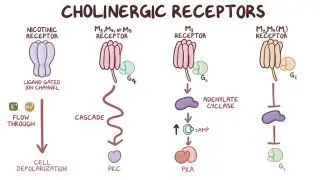
  • They are found on all cells that are stimulated by postganglionic cholinergic fibers (Synaptic knobs).

  • Effect of ach on the receptor varries greatly depending on the organ.
<ul><li><p>They are found on all cells that are stimulated by postganglionic cholinergic fibers (Synaptic knobs).</p></li><li><p>Effect of ach on the receptor varries greatly depending on the organ.</p></li></ul><p></p>
18
New cards

Effect on Eyes:

Constricts the pupil so you see less.

Ur chilling, u dont need to see predators bruz
<p>Constricts the pupil so you see less.</p><p>Ur chilling, u dont need to see predators bruz</p>
19
New cards

Effect on Heart:

Decreases the heart rate and by extension blood preasure

Again ur chilling bruz, ur body doesnt need a ton of oxygenated blood.
<p>Decreases the heart rate and by extension blood preasure</p><p>Again ur chilling bruz, ur body doesnt need a ton of oxygenated blood.</p>
20
New cards

Effect on lungs

Decreases the rate of respiration,

ur chilling, u dont need oxygen for atp
<p>Decreases the rate of respiration,</p><p>ur chilling, u dont need oxygen for atp</p>
21
New cards

Effect on Digestive System

Increase activity

Now that your chilling we can stock up on macro and micro nutrients for when ur not chilling
<p>Increase activity</p><p>Now that your chilling we can stock up on macro and micro nutrients for when ur not chilling</p>
22
New cards

Bladder

U finna be pissing hella

Ur in a safe place, u can pee now no predator gonna catch u lacking
<p>U finna be pissing hella</p><p>Ur in a safe place, u can pee now no predator gonna catch u lacking</p>
23
New cards

Glands

Secreate a lot of salavia (for eating), tears (for emotional release), etc.
<p>Secreate a lot of salavia (for eating), tears (for emotional release), etc.</p>
24
New cards

Andrenergic Receptors

  • Two major classes: Alpha and Beta

  • Both are involved in the sympathetic nervous system, affected by norepinephrine

  • Effects depend on if an Alpha or Beta receptor is receiving.

25
New cards

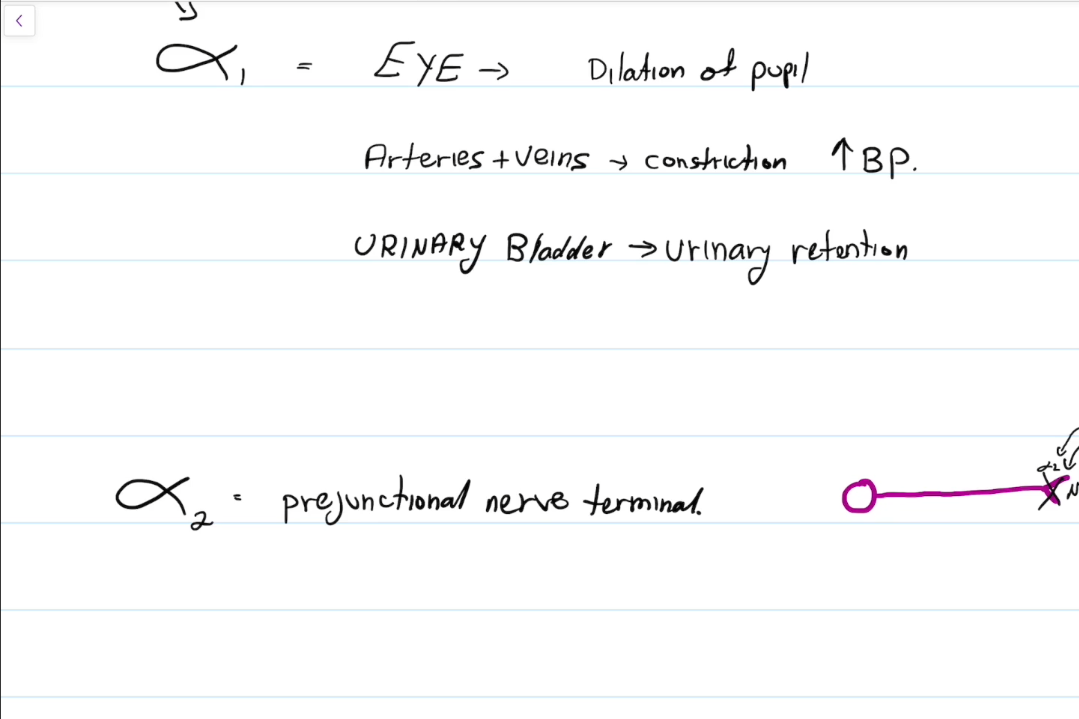
Alpha 1

Eye, increases dilation

Arteries and veins, increases constriction

Urinary bladder, retains urine.
<p>Eye, increases dilation</p><p>Arteries and veins, increases constriction</p><p>Urinary bladder, retains urine.</p>
26
New cards

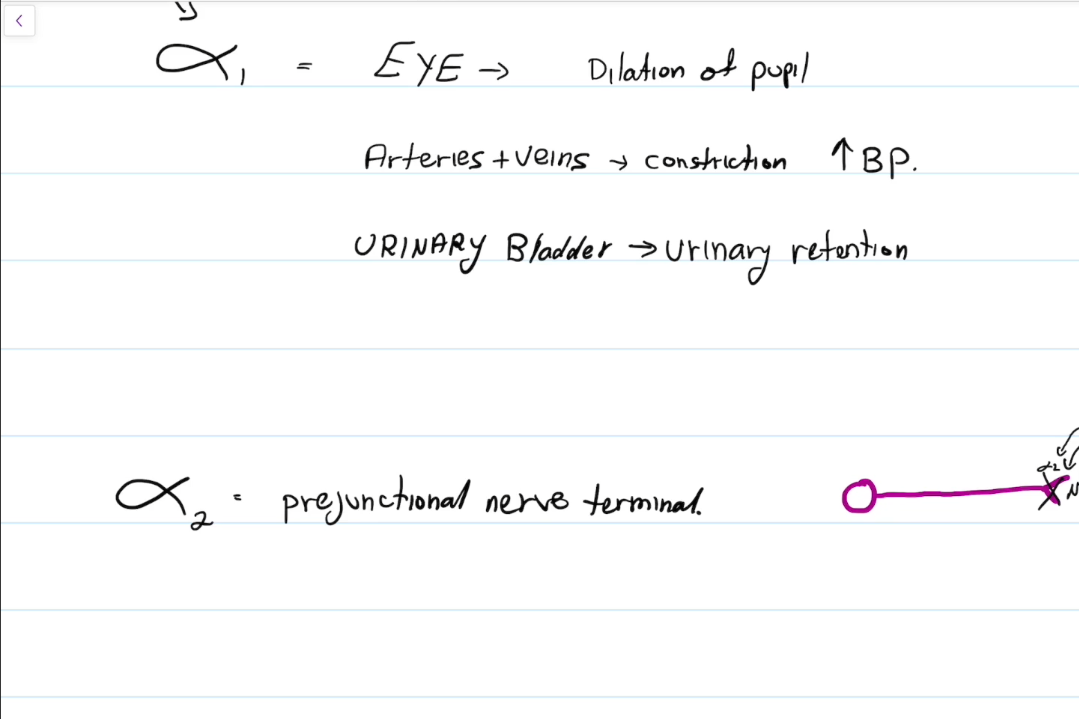
Alpha 2

Prejunctional Nerve:
Basically, alpha 2 detects if there is too much norepinephrine being sent and will restrict its release.
<p>Prejunctional Nerve:<br>Basically, alpha 2 detects if there is too much norepinephrine being sent and will restrict its release.</p>
27
New cards

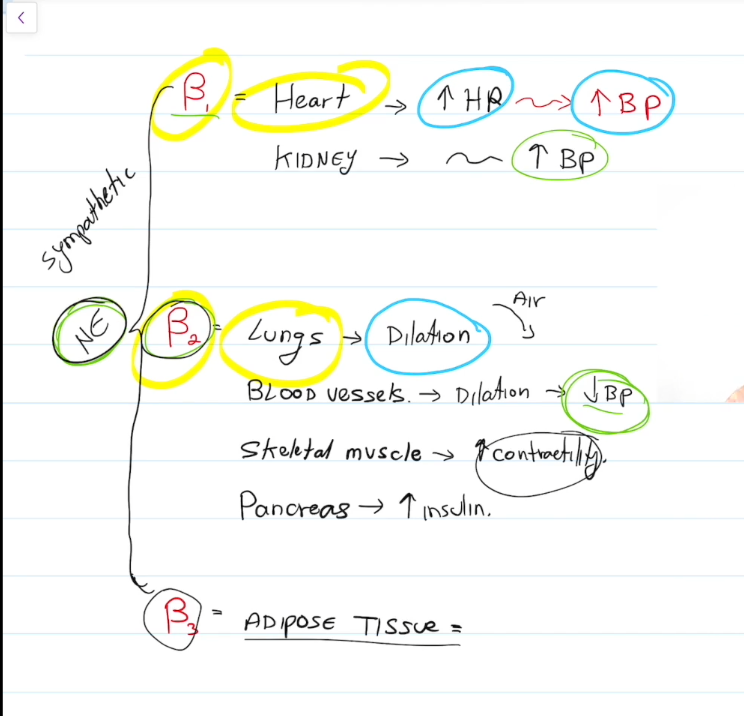
Beta 1

Heart, increase heart rate and therefore increases blood pressure.

Kidney, stimulates the release of adrenaline and increases blood pressure
<p>Heart, increase heart rate and therefore increases blood pressure.</p><p>Kidney, stimulates the release of adrenaline and increases blood pressure</p>
28
New cards

Beta 2

Lungs, dilate and increase air intake.

Blood Vessels, dilate and decrease blood pressure

Skeletal muscle, contract em

Pancrease, increase insulin
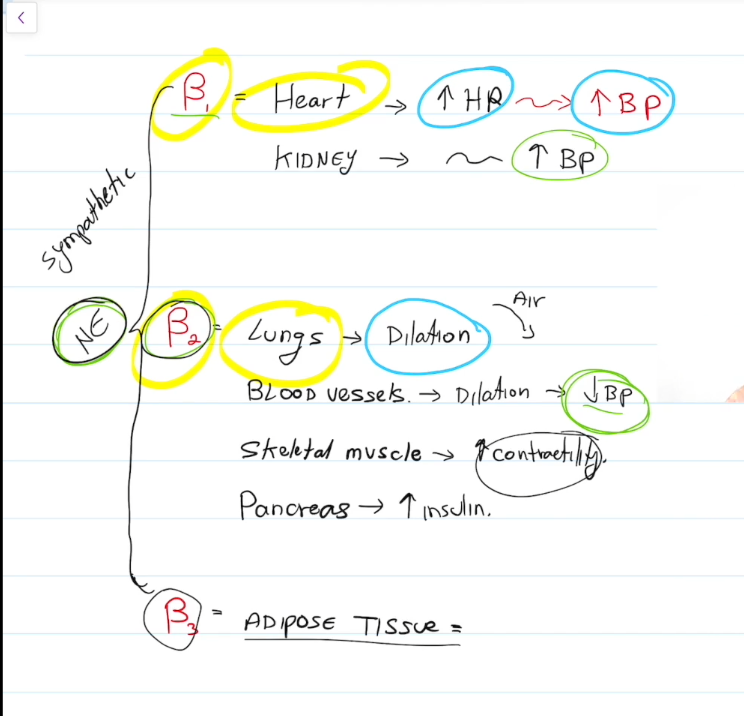
<p>Lungs, dilate and increase air intake.</p><p>Blood Vessels, dilate and decrease blood pressure</p><p>Skeletal muscle, contract em</p><p>Pancrease, increase insulin</p>
29
New cards

Beta 3

Break down fat in adipose tissue
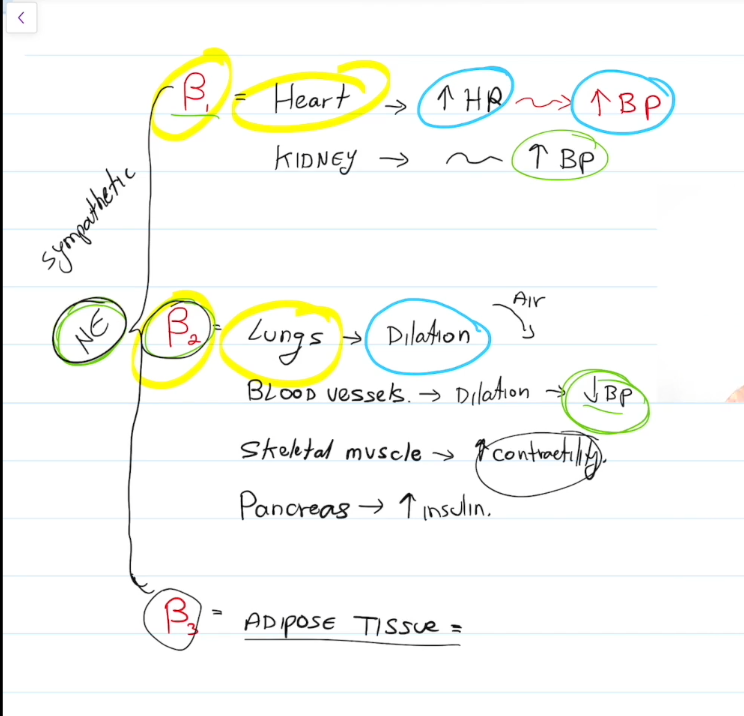
<p>Break down fat in adipose tissue</p>
30
New cards

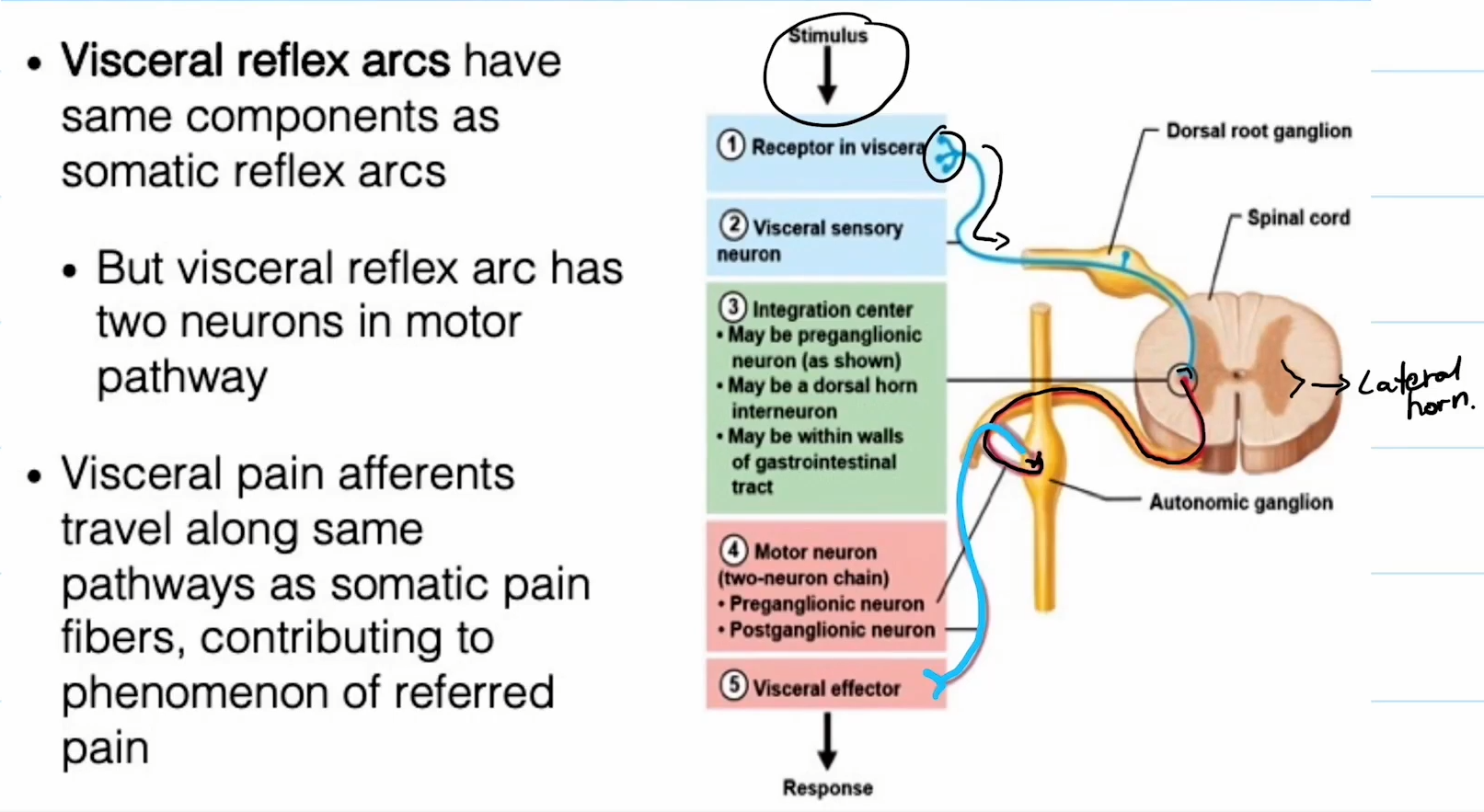
Visceral Reflexs

  • Visceral reflex arcs pretty much have the exact same components of somatic reflex arcs. The only difference is that it has two neurons in the motor pathway.

  1. Receptor in viscera.

  2. Travels to the visceral sensory neuron.

  3. Integration center analyzes the information.

  4. Motor neuron delivers response.

  5. Visceral effecter kicks in.

<ul><li><p>Visceral reflex arcs pretty much have the exact same components of somatic reflex arcs. The only difference is that it has two neurons in the motor pathway.</p></li></ul><ol><li><p>Receptor in viscera.</p></li><li><p>Travels to the visceral sensory neuron.</p></li><li><p>Integration center analyzes the information.</p></li><li><p>Motor neuron delivers response.</p></li><li><p>Visceral effecter kicks in.</p></li></ol><p></p>
31
New cards

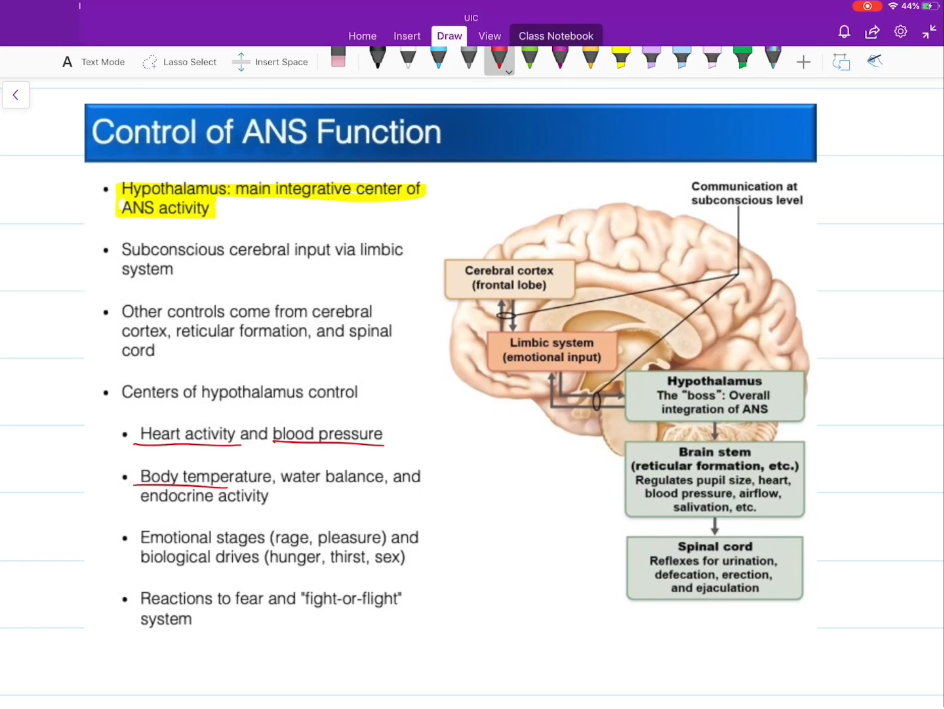
What controls the ANS?

Hypothalamus

<p>Hypothalamus</p>
32
New cards

How does parasympathetic and sympathetic work together?

Basically one opposes the other and allows for precise control of visceral activity.
<p>Basically one opposes the other and allows for precise control of visceral activity.</p>

Explore top flashcards