Chromatin Structure and Modifications
 Studied by 0 people
 Call with Kai
 Learn
Learn Practice Test
 Spaced Repetition
 Match
Match Flashcards
 Knowt Play
1/40

Earn XP
Description and Tags
Lecture 3
Name | Mastery | Learn | Test | Matching | Spaced | Call with Kai |
|---|
No analytics yet
Send a link to your students to track their progress
41 Terms
What is Chromatin?
DNA and histone proteins that package DNA and regulate gene accessibility.
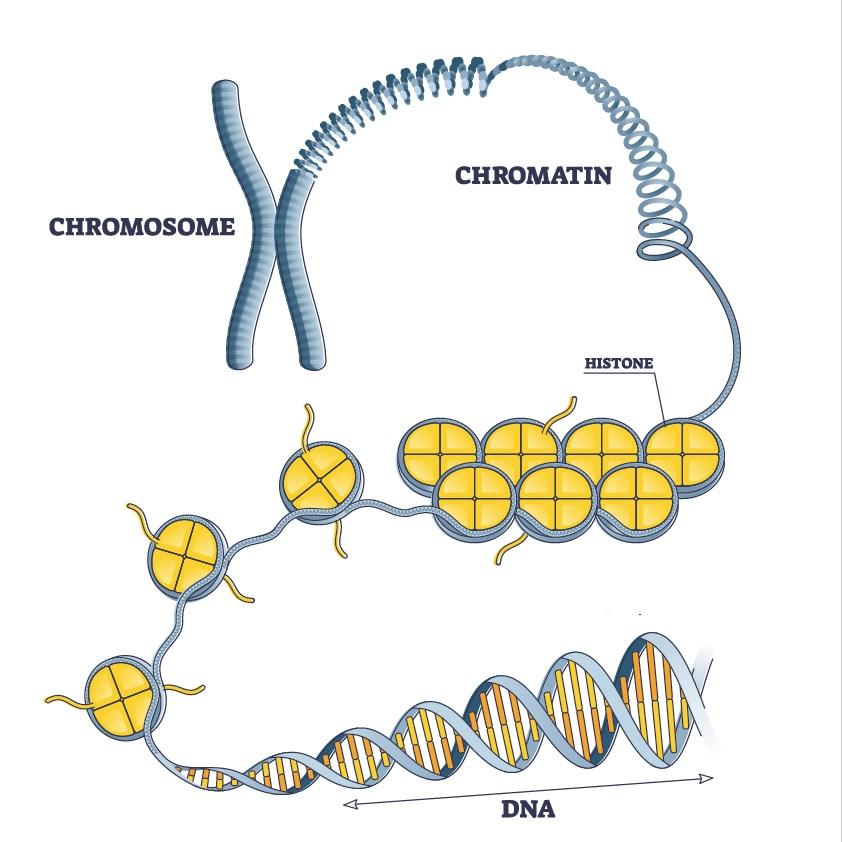
How much DNA is in one nucleus?
~2 meters of DNA is packed into 5-10 µm nucleus.
Main function of chromatin?
Packages DNA and regulates DNA accessibility.
Why must DNA be packaged?
Unpacked DNA is too long and cannot be efficiently expressed or regulated.
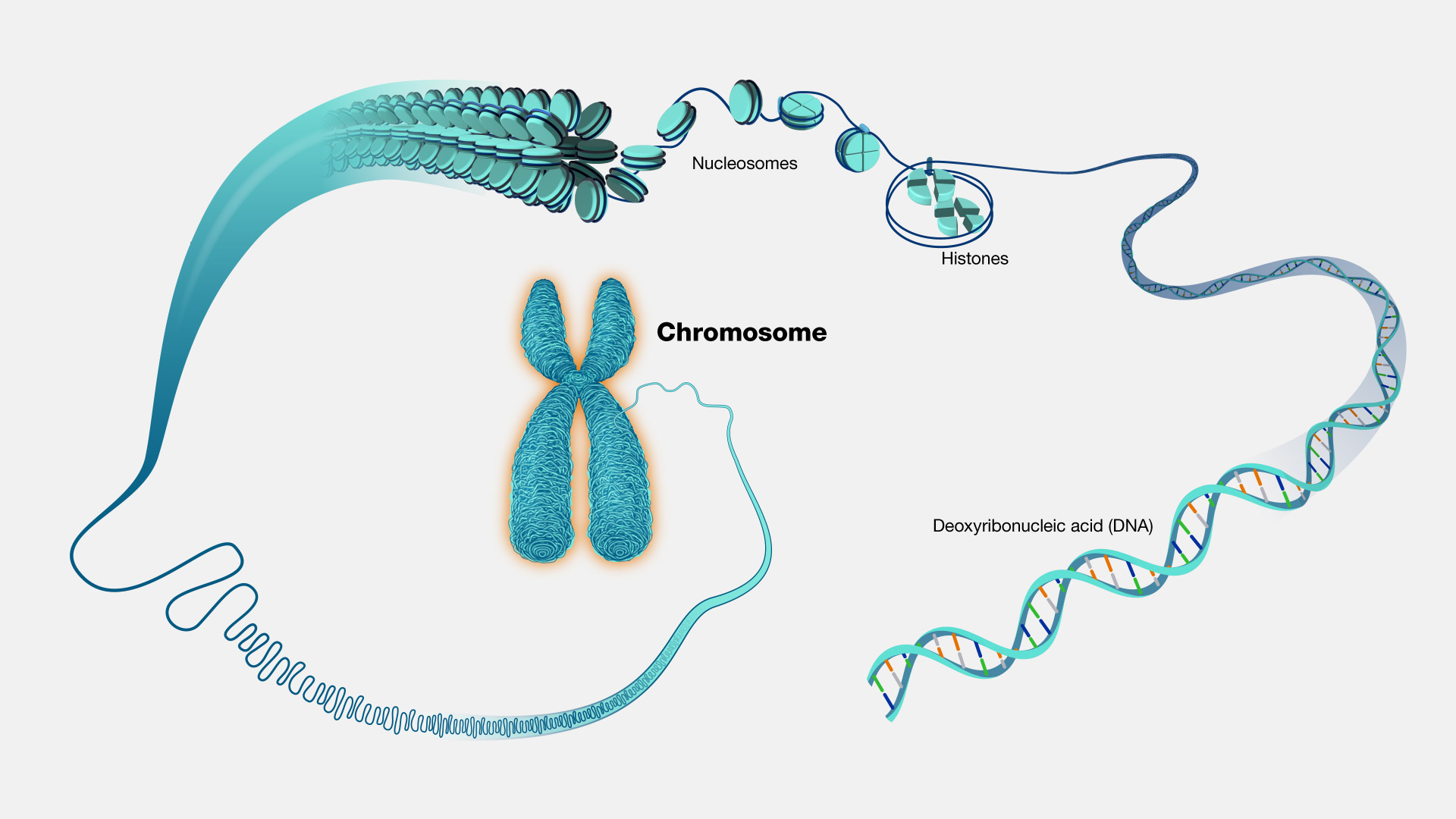
What are chromosomes?
Long DNA molecules containing many genes.
Does chromosome size correlate with number of genes?
No - size does not determine gene number or phenotype.
What must every linear chromosome contain?
Centromere
Two telomeres
Origins of replication
What is a nucleosome?
Basic unit of chromatin structure.
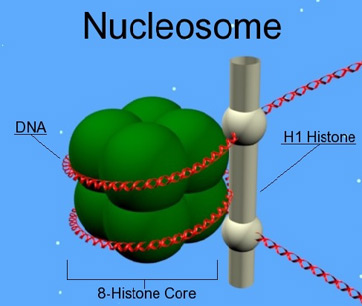
What is the nucleosome made of?
DNA wrapped around a histone octamer.
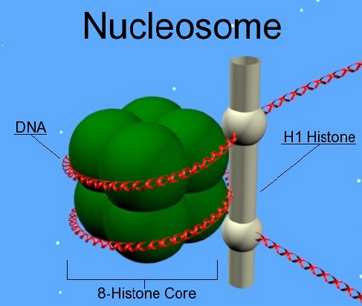
Histone octamer composition.
2x H2A
2x H2B
2x H3
2x H4
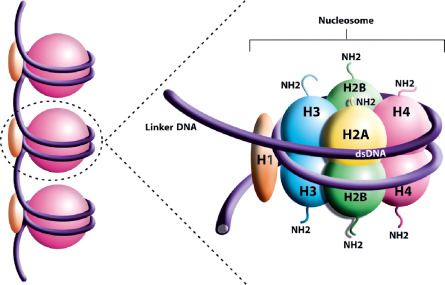
Why does DNA bind histones easily?
DNA is negatively charged; histones are positively charged.
What is linker DNA?
DNA between nucleosomes.
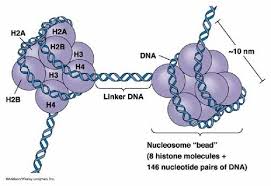
What is histone H1?
Linker histone that stabilizes nucleosomes and promotes chromatin compaction.
“Beads on a string” refers to:
Nucleosomes connected by linker DNA.
Levels of chromatin packaging (order)
DNA → nucleosome → 30 nm fiber → looped domains → condensed chromosome.
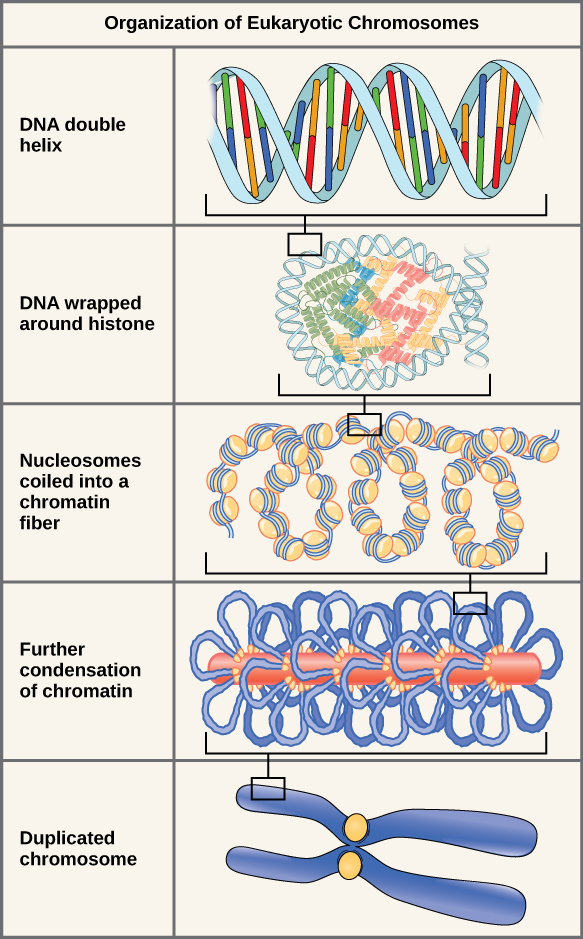
Total compaction achieved.
~10,000 - fold DNA compaction.
What are histone tails?
N-terminal extensions of histones that undergo chemical modifications.
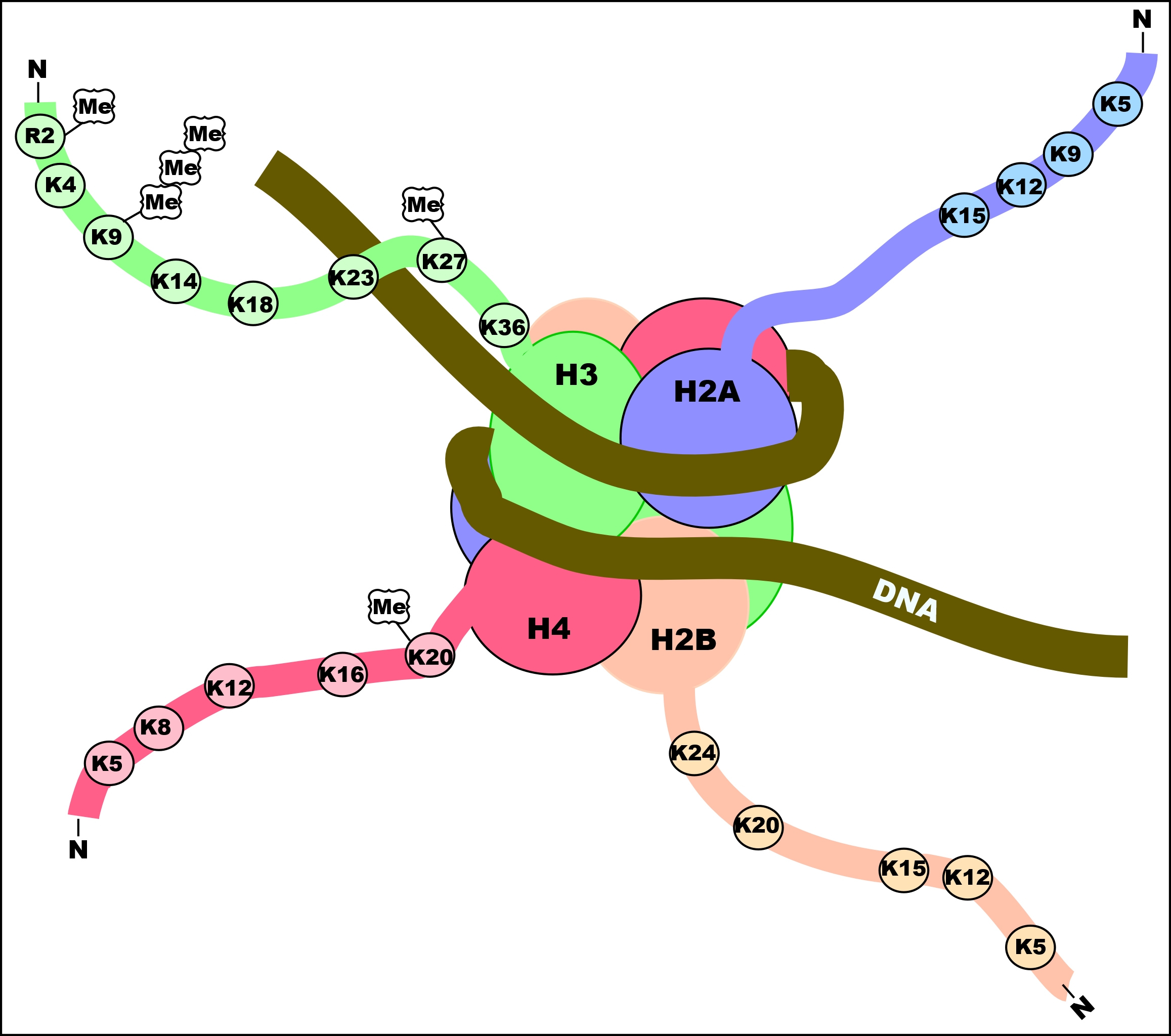
Why are histone tails important?
They control chromatin structure and gene expression.
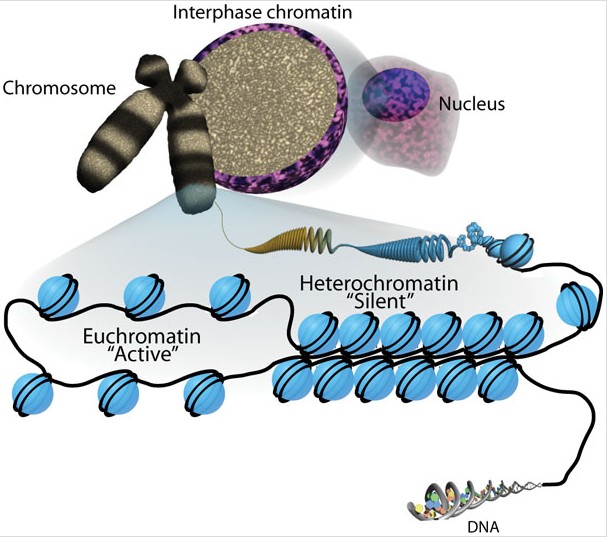
Heterochromatin.
Highly condensed
Transcriptionally silent
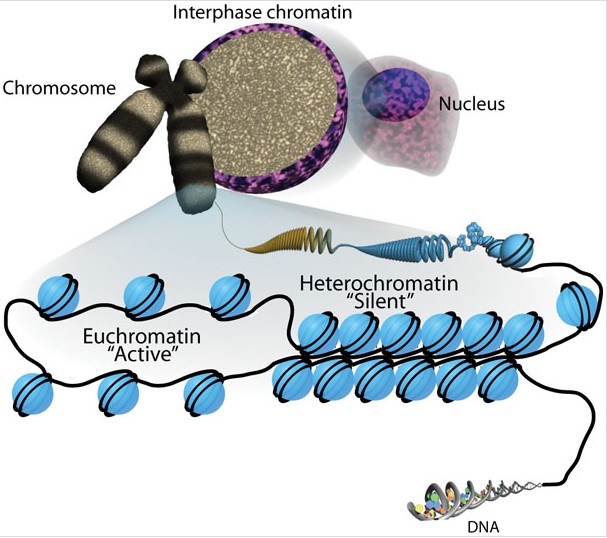
Euchromatin.
Loosely packed
Transcriptionally active
Which chromatin type is usually expressed?
Euchromatin.
What influences gene expression most?
Degree of chromatin compaction.
What does “heterochromatin is self-propagating” mean?
Silenced chromatin can spread to neighboring regions during replication.
Position-effect variegation.
Gene expression depends on proximity to heterochromatin.
What are histone modifications?
Covalent chemical changes to histone tails.
Purpose of histone modification?
Alters chromatin structure and gene activity.
Example effect of modification.
Neutralization of positive charge → looser DNA binding.
Writers.
Enzymes that add histone modifications.
Erasers.
Enzymes that remove histone modification.
Readers.
Proteins that recognize histone modifications.
Histone variants.
Alternative histones inserted at specific genome locations.
Purpose of histone variants.
Provide chromatin diversity and regulate transcription.
Chromatin inheritance.
Chromatin structure is transmitted during DNA replication.
Epigenetics
Heritable changes in gene expression without DNA sequence change.
Histone acetylation
Addition of an acetyl group to lysine residues on histone tails. It neutralizes the positive charge → weakening the histone-DNA interaction → opening chromatin and increasing transcription.
Histone methylation.
Addition of one, two, or three methyl groups (aka trimethylation) to lysine residues on histone tails. Although context dependent, it is often associated with chromatin condensation and gene silencing.
Histone Phosphorylation.
Addition of phosphate group to histone residues (usually serine or threonine). involved in chromatin dynamics, signaling, and DNA damage response.
H3K9me3
Trimethylation of histone H3 lysine 9 → heterochromatin formation.
Cellular memory (epigentics)
Maintenance of epigenetic states through cell division.
X-chromosome inactivation
Random silencing of one X chromosome in female cells to equalize gene dosage. Gene expression changes without altering DNA sequences.
Genomic imprinting (epigenetics)
Patent of origin specific gene expression controlled by epigenetic marks (DNA methylation). Maternal and paternal chromosomes are not functionally equivalent.
 Note
Note  Flashcards (86)