Chapter 19: Electric Charges, Forces, and Fields
 Studied by 0 people
 Call with Kai
 Learn
Learn Practice Test
 Spaced Repetition
 Match
Match Flashcards
 Knowt Play
1/61

There's no tags or description
Looks like no tags are added yet.
Name | Mastery | Learn | Test | Matching | Spaced | Call with Kai |
|---|
No study sessions yet.
62 Terms
for lightning, you need…
electric charge (many electrons)
voltage (millions-billions of volts)
charge is…
quantized
charge exists in integral multiple of a fundamental unit of charge, symbolized by e
quarks are an exception because they can exist in fractional charges
Fundamental Charge
e = 1.6 x 10^-19 Coulombs (C)
the charge carried by a single proton (+e) or the negative charge of a single electron (-e)
Electric charge is always…
conserved
charge is not created, only exchanged
A positively charged atom has…
A negatively charged atom has…
more protons than electrons
more electrons than protons
Charge Equation
q = ne
q: total charge
n: number of elementary charges
e: fundamental charge
measured in Coulombs
n = ±1, ±2, ±3, …
A metallic object holds a charge of -3.8×10^-6 C.
What total number of electrons does this represent? (e = 1.6×10^-19 C is the magnitude of the electronic charge.)
How about 1 C of charge?
q = ne
n = q/e
n = -2.4×10^13 electrons
n = 0.6 electrons
A defibrillator has a charge of 0.3 C. If the magnitude of the electronic charge is e = 1.6×10^-19 C, what is n?
q = ne
n = 1.8×10^18 electrons going to the heart
Conductor
physical medium/object (copper wire or metallic object) that contains a sea of free electrons
allows electric current to flow easily through them in response to electric force
charges redistribute very easily
10^(28)/m³ = 10^(22)/cm³
10²⁸ electrons per cubic meter is the same density as 10²² electrons per cubic centimeter
Do charges redistribute easily in conductors or insulators?
conductors
Current
the flow of electric charge, typically measured in amperes (A). It represents the movement of electrons through a conductor.
need a wire, for example
Insulator
not many free electrons
charges do not redistribute
ex: plastic, glass, rubber
When a conductor is charged in a small region, the charge…
readily distributes itself over the entire surface of the material
When insulators are charged by rubbing…
only the rubbed area becomes charged
there is no tendency for the charge to move into other regions of the material
Semiconductor
characteristics between conductors and insulators
ex: silicon and germanium
Initially, sphere A has a charge of -50e and sphere B has a charge of +20e. The spheres are made of conducting material and are identical in size. If the spheres then touch, what is the resulting charge on sphere A?
-50e + 20e = -30e
this is split equally between the two spheres because they are conductors of equal size, which then redistributes
-15e
Copper vs. Silver vs. Gold as Conductors
Silver
Highest electrical conductivity
Lowest resistivity
Free electrons move the easiest
BUT (tarnishes and expensive)
Copper
Slightly less conductive than silver
WAY cheaper
Very ductile and flexible
Doesn’t corrode badly
Gold
Conductivity slightly worse than copper
Does not oxidize (corrosion-resistant)
Extremely stable over time
EXPENSIVE
Charging by Conduction
charged object (rod) is placed in contact (touching) with another object (sphere)
some electrons on rod can move to the sphere
when rod is removed, the sphere is left with a charge (same charge as rod)
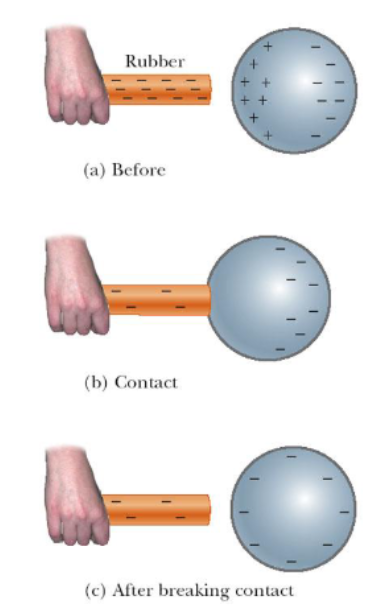
In charging by conduction, the object being charges is always left with…
a charge having the same sign as the object doing the charging
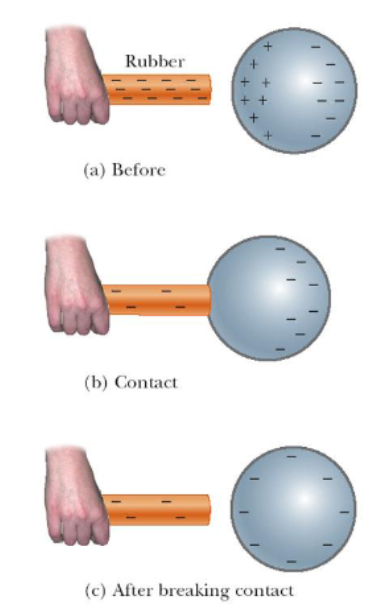
Charging by Induction
a negatively charged rubber rod is brought near an uncharged sphere
the charges in the sphere are redistributed
some of the electrons in the sphere are repelled from the electrons in the rod
a grounded conducting wire is connected to the sphere
allows some of the electrons to move from the sphere to the ground
the wire to ground is removed, the sphere is left with an excess of induced positive charge
charging by induction requires no contact with the object inducting the charge
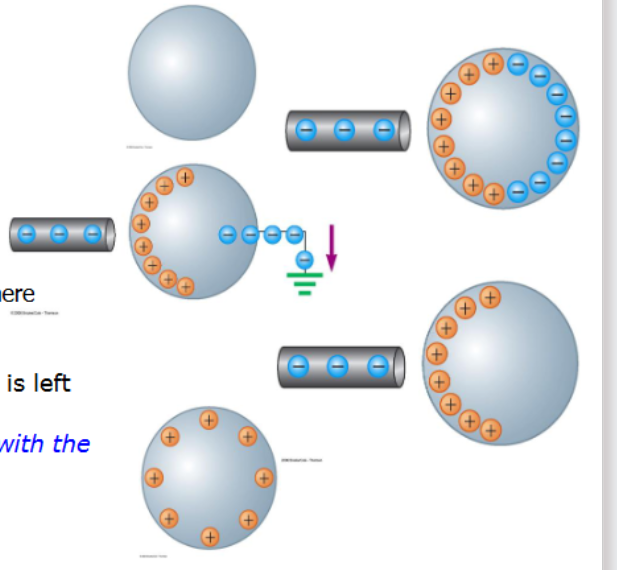
Conduction vs. Induction
Conduction:
physical contact
generate same polarity
Induction:
no physical contact
do grounding
generate opposite polarity
Charge Polarization
the charged object (on the left) induces charge on the surface of the insulator
this realignment of charge on the surface of an insulator is known as: polarization
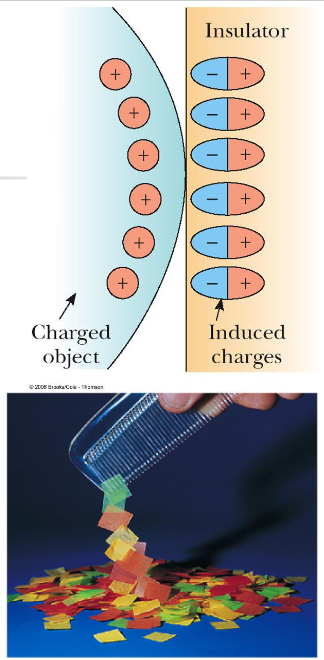
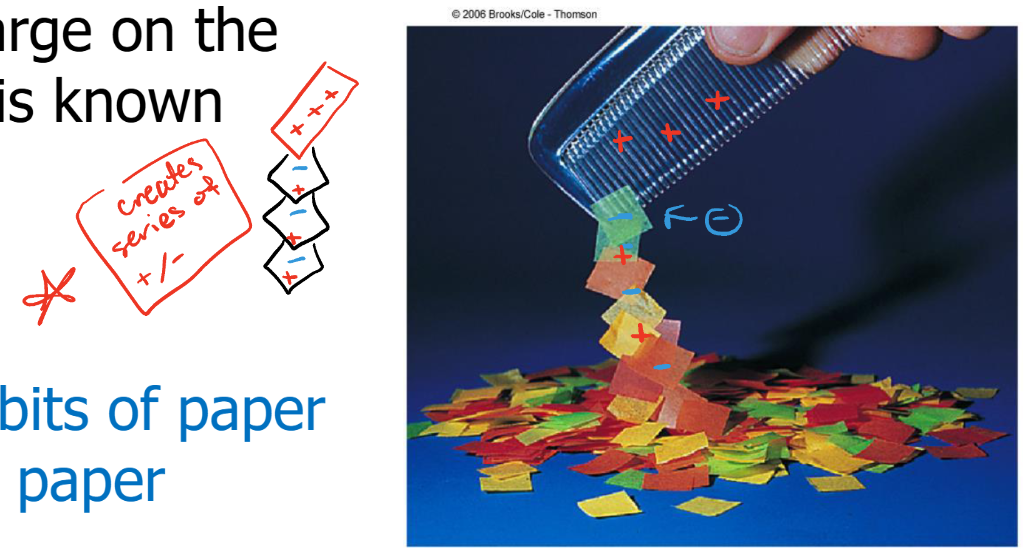
Charge Polarization: comb & paper
a charged comb attracts bits of paper due to polarization of the paper
if comb is positive, paper polarizes to be negative on closer side and positive on the far side, and continues on the other pieces of paper, forming a chain
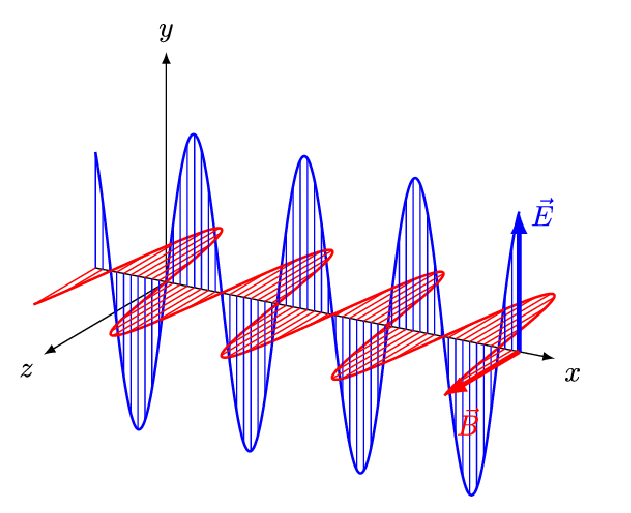
Light: Animation
blue wave: electric field
red wave: magnetic field
both self-generating fields
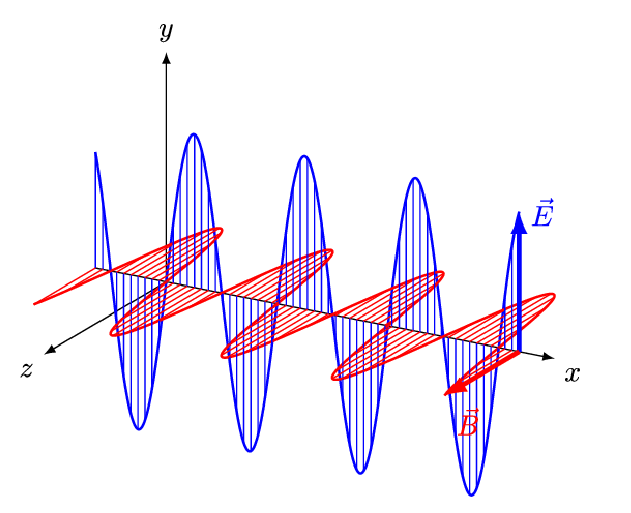
Light
electromagnetic wave
doesn’t need medium to travel
self-generating electric and magnetic field
speed = v = c = 3 x 10^8 m/s
also 300 × 10^6 m/s
Example of Polarization: Bees
when the bee moves, its wings get a slight positive charge from interacting with the air (electrons free in clouds etc. from friction and air flow)
this helps the bee collect pollen because the pollen will stick to the slightly charged wings (just like pieces of paper stick to a charged comb)
Polarizing Glass vs. 3D Glass
polarizing glass blocks light and has vertical fences
3D glass has one vertical fence and one horizontal fence
Coulomb’s Law
F = ke( |q1||q2| )/ r²
ke = Coulomb Constant = 8.9875×10⁹ N m²/C²
F → electric force (Newtons)
vector quantity: direction matters
q₁, q₂ → charges (Coulombs)
r → distance between charges (meters)
Works best for point charges or spherical charges far apart: charges in the μC range
Inverse square law
Force is proportional to…
q1q2
1/r²
mass leads to…
charge leads to…
magnet leads to…
gravitational field
electric field
magnetic field
If body P, with a positive charge, is placed in contact with body Q (initially uncharged), what will be the nature of the charge left on Q?
in contact = conduction
conduction = same charge
Q must be positive
According to Coulomb’s Law, force increases if…
Charges get bigger
Distance gets smaller
Coulomb Inverse Square Law
Doubling distance = force ÷ 4
Gravitational Force
F = G (m1m2)/r²
Electrical Force vs. Gravitational Force
both are inverse square laws
the mathematical form of both laws is the same
masses replaced by charges
electrical forces can be either attractive or repulsive; gravitational forces are always attractive
electrostatic force is stronger than the gravitational force
Two point charges are separated by a distance, d. q1 = -5e, q2 = +2e. Which charge experiences the strongest electric force (greatest magnitude)?
the force is the same magnitude for both charges
F = ke (|q1|q2|)/r²
think of Newton’s Law, equal and opposite reaction
Coulomb’s Law for Multiple Charges
the resultant force on any one charge equals the vector sum of the forces exerted by the other individual charges that are present
remember to add the forces as vectors
Use Coulomb’s Law to find the force from each charge individually
Treat each force as a vector (direction matters!)
Add them vectorially → superposition (F1, net = F12 + F13 + F14 + F15 + F1n, …
Vector Equations
A (QI)
B (QII)
C (QIII)
D (QIV)
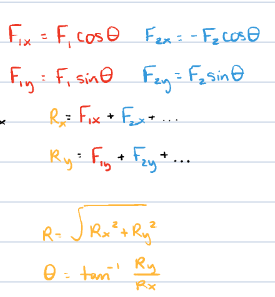
A:
Ax = Acosθ
Ay = Asinθ
B:
Bx = Bsinθ
By = -Bcosθ
C:
Cx = -Ccosθ
Cy = -Csinθ
D:
Dx = Dcosθ
Dy = -Dsinθ
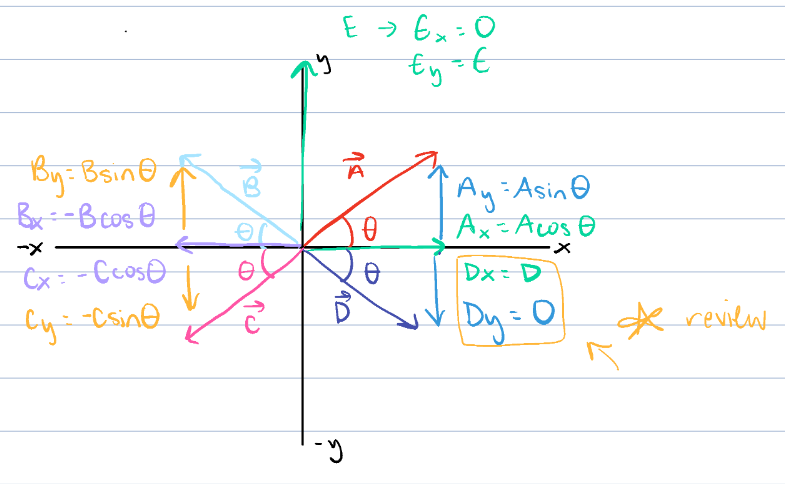
If the vector is directly on the x-axis…
Dx = Dcosθ = D
Dy = 0
Adding Vectors Graphically
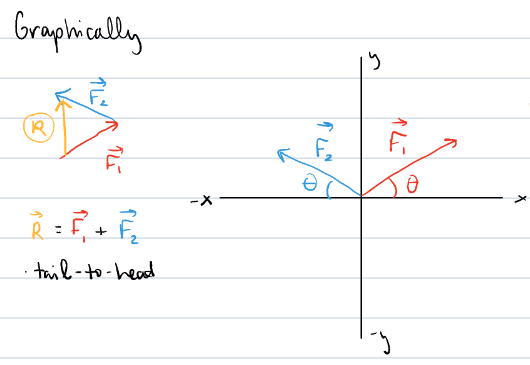
Adding Vector’s Mathematically
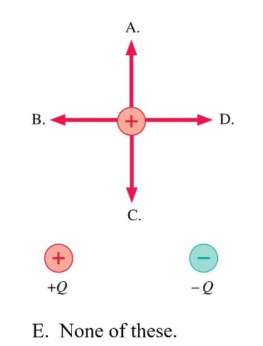
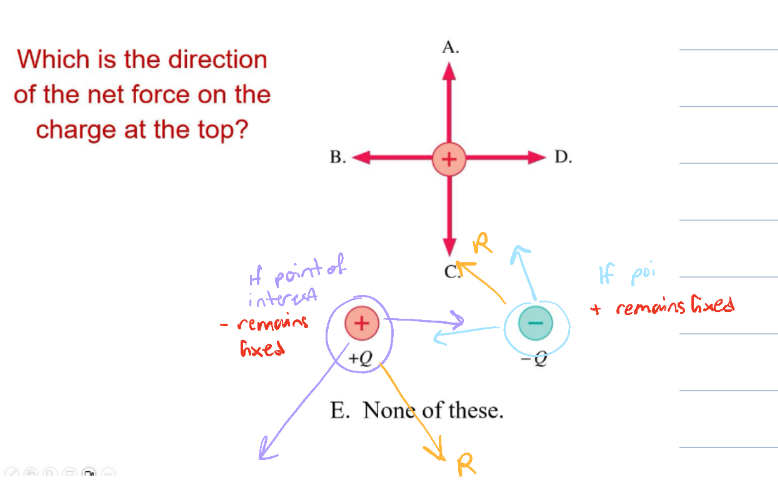
Which is the direction of the net force on the charge at the top?
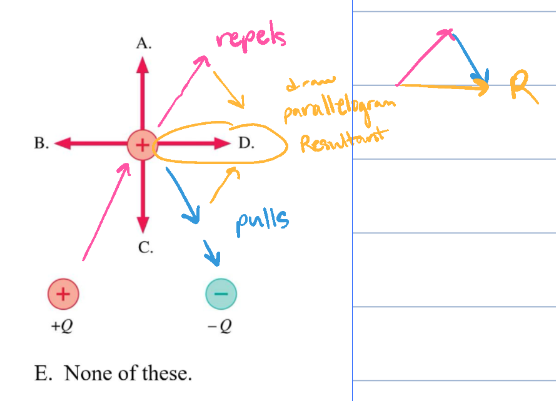
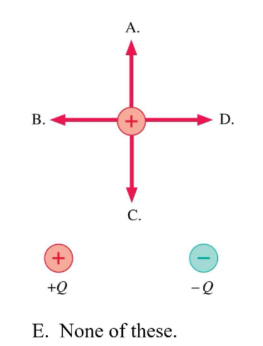
What is the direction of the net force if the bottom left or bottom right charges are the point of interest?
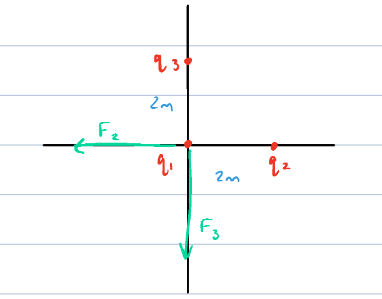
A particle with charge 2microC is placed at the origin. An identical particle, with the same charge, is placed 2 m from the origin on the x axis, and a third identical particle, with the same charge, is placed 2 m from the origin on the y axis. The magnitude of the force on the particle at the origin is (ke = 8.9875×10^9 N*m²/C²).
If you are asked to find the force of q³, what will happen?
|F2| = |F3| based on where q’s are
|F2| = k(q1q2)/r² = 8.9×10^9 (2×10^-6)²/2²
2² cancels on top and bottom
F = 8.99×10^-3 N
q1 = q2, q3 = 2×10^-6 C
Find Resultant now:
Rx = -F2
Ry = -F3
R = sqrt( (-F2)² + (-F3)²) = 1.3×10^-2 N
if asked to find force of q³, the F arrows will move and the Resultant will be different
The Electric Field
A region around a charged object where other charges experience a force. It is defined as the force per unit charge at a point in space.
particle 2 pushes on particle 1 for example, despite a distance
object 1 fills space around itself with a field, when object 2 is placed in field, field acts on object 2
E = F/q0 = keQ/r2
units: N/C
vector quantity
If an object has mass, it produces…
a gravitational field
If an object has charge, it produces…
an electrical field
The direction of the electrical field is defined as…
the direction of the electric force that would be exerted on a small positive test charge, q0, at that point
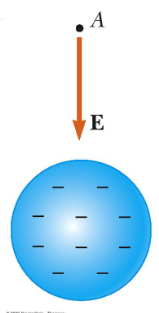
The electric field produced by a negative charge is directed…
toward the charge
negative source charge attracts positive test charges
The electric field produced by a positive charge is directed…
away from the charge
positive source charge repels positive test charge
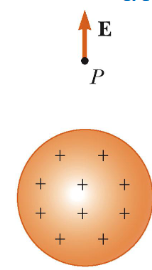
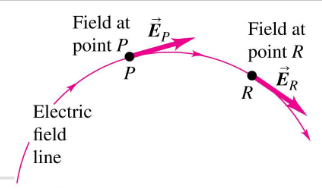
Electric Field Lines
aid to visualize electric field patterns
drawn pointing in the direction of the field vector at any point
the electric field vector, E, is tangent to the electric field lines at each point
the number of lines per unit area through a surface perpendicular to the lines is proportional to the strength of the electric field in a given region
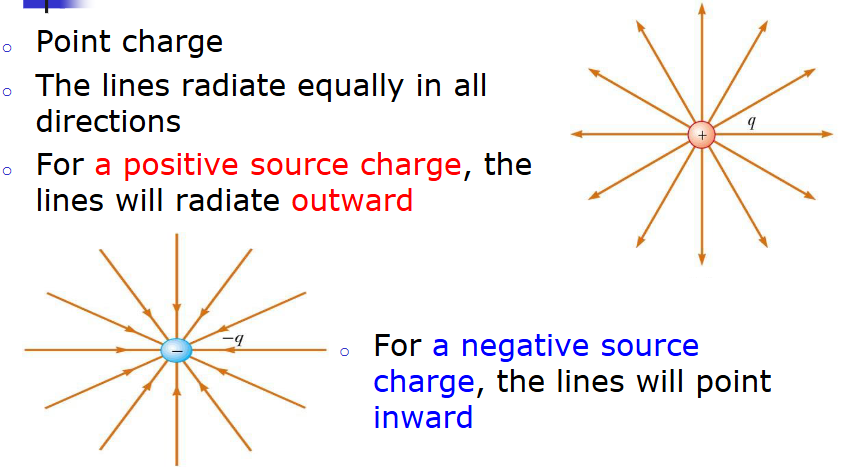
Electric Field Line Patterns - Point Charge
for a positive source charge
for a negative source charge
surround point charge, radiate equally in all directions
for a positive source charge, the lines will radiate outward
for a negative source charge, the lines will point inward
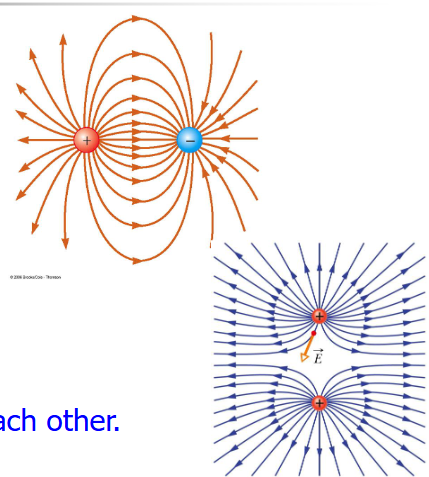
Electric Field Line Patterns - Dipole
electric dipole = 2 equal and opposite charges
the high density of lines between the charges indicates the strong electric field in this region
no two field lines can cross each other
Electrostatic Equilibrium
when no net motion of charge occurs within a conductor, the conductor is said to be in electrostatic equilibrium
Isolated Conductor
electric field is zero everywhere inside the conducting material
any excess charge on an isolated conductor resides entirely on its surface
the electric field just outside a charged conductor is perpendicular to the conductor’s surface
on an irregularly shaped conductor, the charge accumulates at locations where the radius of curvature of the surface is smallest → at sharp points
Faraday Cage
A structure that shields its contents from external electric fields by redistributing charge, ensuring the electric field inside remains zero.
In an isolated conductor, if the electric field just outside a charged conductor is not perpendicular to the conductor’s surface, what would happen?
the component along the surface would cause the charge to move
it would not be in equilibrium
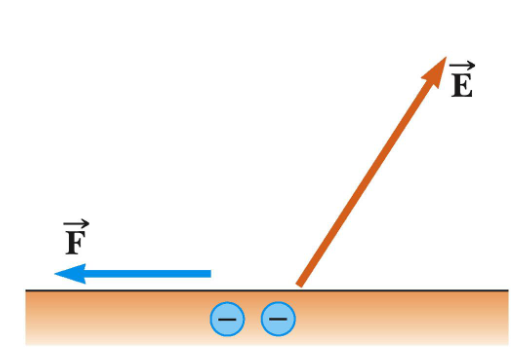
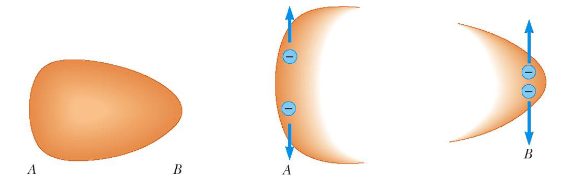
In an isolated conductor that is irregularly shaped, what is true?
the charge accumulates at sharp points
any excess carge moves to its surface
the charges move apart until an equilibrium is achieved
the amount of charge perunit area is greater at the sharp end(s)
the forces from the charges at the sharp end(s) produce a larger resultant force away from the surface
it’s why a lightning rod works (pointy)
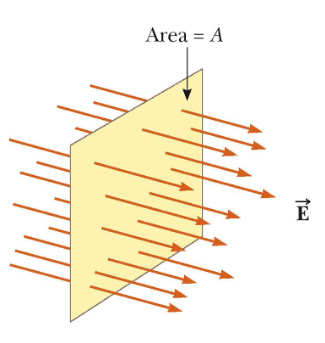
Electric Flux
Φ = E*A*cos(θ)
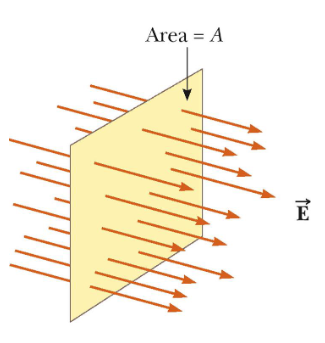
Electric field through a surface
field lines penetrating an area A perpendicular to the field
the perpendicular to the area A is at an angle θ to the field
In electric flux, when the area is constructed such that a closed surface is formed, flux lines passing into the interior of the volume are…
negative
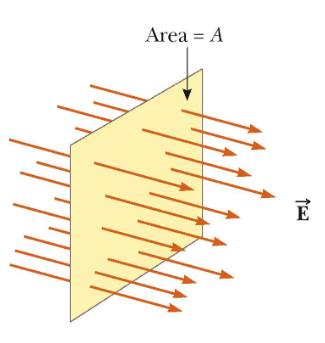
In electric flux, when the area is constructed such that a closed surface is formed, flux lines passing out of the interior of the volume are…
positive
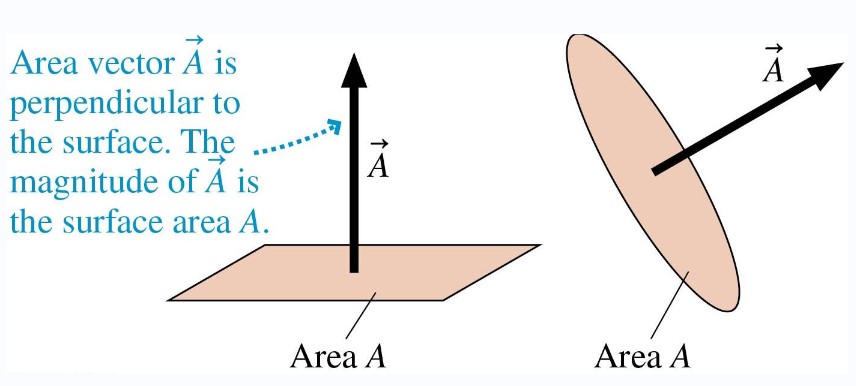
The Area Vector
a vector that points perpendicularly to a surface area, with a magnitude equal to the area of the surface. It is used in calculating electric flux through that surface.
A(→) = An̂
vector in direction of n̂, perpendicular to the surface
vector with magnitude A equal to the area of the surface
vector A(→) has units m²
 Note
Note  Flashcards (20)