Ad and promo test 2 study guide
 Call Kai
 Learn
Learn Practice Test
 Spaced Repetition
 Match
Match Flashcards
 Knowt Play
1/192

There's no tags or description
Looks like no tags are added yet.
Name | Mastery | Learn | Test | Matching | Spaced | Call with Kai |
|---|
No analytics yet
Send a link to your students to track their progress
193 Terms
What does it mean for an ad to resonate?
Connect with the audience
It is important for ads to connect with the audience and to resonate with them over time.
Dr.J story-> thanksgiving with a big family -> saying part from this ad-> Budweiser ad during Monday night football-> football ad 1999-> Whasssuppp ad used in so many social media and pop culture references-> used in the office for example.
Bad example for college of Drake- Drake + experience and it was D+
Why do ads fail to resonate with audiences?
They lack a big idea
An ad needs to have a central theme that people need to take away-> the positioning comes through here (this can kill ads)
Weak central theme
Too many competing ideas
They fall short on execution
Copy is uninspiring -> doesn’t connect with audience
Unattractive design elements
Production techniques could be bad
When ads fail to do this, they waste the firm’s money and the consumer’s time.
What examples of audience resonance did we discuss in class?
Mt Dew kickstart -> puppy monkey baby-> rationale is based on a lot of marketing research related to cultural stuff. They combined the top google searches at the time.
Johns town local food establishment-> Our sons family restaurant-> very monotoned people process thing peripherally if they want to choose something like food
Dent crafters-> Tommy whatever his name is -> resonates with Omaha/ Nebraska people
Skittles-> touch something and it tuns into skittles -> serious take on touching something and it turns into skittles
Apples-> apple auto healing your credit-> reverend rob
What happens when ads don’t resonate well with audiences?
If ads don’t connect then it is a waste of time and money for firms-> people will tune them out which are downsides to not resonating to the ads we create
What does it mean for an ad to be strategically relevant?
ads get us to think about a lot of things, but what are they getting us to think about?-> funny can help with the resonance but can hinder the relevance
Ads must be relevant to the sponsor’s marketing strategy, or they will fail – even if they resonate well with the audience
Resonance is a necessary, but insufficient condition for successful advertising
What happens when ads are not strategically relevant?What examples of strategic relevance did we discuss in class?
If they are not strategically relevant then what are consumers really thinking about? Draws away from the overall purpose go the ad. Must make sure that you are getting your marketing objectives across with strategic relevance (resonate and relevant)
It is false that all ads purpose or objective is to entertain. -> Steve Jobs thought that if commercials were too funny they would miss the strategic relevance component -> funny enough -> Justin long
Ad campaign: Justin long -> get a Mac
What is creativity? What are the different ways we can define creativity?
Creativity is often in the eye of the beholder
Its different for different people
Is creativity an art? Is creativity a science?
What other contexts did we compare creative to?
Creativity can be anything as it is seen different by each individual. Creativity can be a science as to come up with something new and unique. Creativity is an art form and we can take inspiration from anywhere.
Why does creativity matter?
creativity matters because it informs, reminds, persuades, and resonates
How does creativity help ads inform?
Attracts attention and interest, get us thinking about things, attention economy
Common technique play on words or verbal metaphors
Visual queues provide instant non-verbal signals or viewers (ship your pants k mart)
How does creativity help ads remind?
Create interesting memorable, and entertaining advertisements to transform those reminders
Takes an everyday situation and adds exaggeration in the delivery (Doritos Time Machine commercial)
How does creativity help ads persuade?
Must be reinforced by non-verbal elements creatively
Music is a powerful tool simulating emotions and nostalgia
Used to trigger memories of existing g concepts which can be built upon in the ad.
We can use story lines from movies and pop culture, don’t have to do all that work we just are extending the message
How does creativity help ads resonate?
There are also other methods besides humor to resonate with people for a long time
Some resonate because they stimulate other emotions with a response that is created
Ex. Extra gum
What impact does color have psychologically in advertising?
Color ties into creativity-> something subtle we can tap into schemas with
Convey important non-verbal info in ads
When used properly it can do more of the heavy lifting in an ad
Strategically use colors to create predictable emotions and responses among consumers
All this stuff is very strategic but consumers rarely stop to think long about how color impacts our choices
What does each color symbolize to consumers?
Red
Symbolize action, masculine appeal,
Used for meat, soups, frozen food, mens products
Typically second to blue
Brown
Earthiness, age, warmth, comfort, woods, mellowness
Used for food and cosmetics
Yellow
High impact to get consumers attention -> conjunct with black (high impact)
Corn, lemon, suntan products
Green
Health and freshness perceived by consumers ‘mint products, non geo, organic, health foods, soft drink, vegetables
Blue
Coldest color
Perceptually people think of coldness, different blues mean different things
Ice impressions
Sweet when using lighter tints of blue
Black
Convey sophistication, high end merchandise ‘works well as a background t contrast with many other colors
Orange
Most edible color
Evokes perception of autumn and holidays in the fall
Flavorful things to eat and drink
What is the creative strategy?/ What other names for creative strategy are there?
The creative strategy is a written statement of the most important issues to consider in the development of the ad campaign.
The creative strategy is the creative team’s guide for developing the ad campaign.
It is typically referred to as a creative brief, a work plan, or a copy strategy.
The creative strategy receives input from both the client and the agency.
campaign strategy, marketing strategy
Who formulates the creative strategy?
What elements should be considered as part of the creative strategy?
Guide or roadmap for developing the ad campaign -> put together by the creative team (creative brief, work pan, or copy strategy)-> creative strategy receives input from both the client and the agency
What is the message strategy?
an explanation of an ad campaign’s overall creative approach
Main idea, details about how the plan will be executed, rationale for execution decisions
developed from information provided in the creative strategy (and any additional research conducted by the agency)
What main questions should be addressed by the message strategy?
How will the product be positioned?
Who are the best prospects for the product?
What is the key consumer benefit?
What is the brand’s current image?
What is the product’s unique advantage?
What are the elements of the message strategy?
verbal, non verbal, technical
What do the verbal, non-verbal, and technical elements entail?
verbal:
Guidelines for what the ad should say
Relationship of the copy to the media
carrying the message
Non Verbal:
Overall nature of the ad’s visuals / graphics
Relationship of the visuals to the media in
which the ad will appear
Technical:
Preferred approach for executing the ads
Mandatories – specific requirements for
every ad (branding, contact info, logos, etc.)
Definition
What are the 5 steps of the creative process?
explore, visualize, strategize, implement, and evaluate
What does it mean to Explore (Creative Process - Step 1)?
Search for new information, paying attention to unusual patterns.
The raw materials for ideas are facts, experiences, feelings, knowledge, etc.
Look in new and uncommon places for
information
Know the advertising objectives
Brainstorm to generate new ideas
What does it mean to Visualize (Creative Process - Step 2)?
Search for the BIG IDEA and implement it.
Create a mental picture of the ad before any copy is written or artwork has begun (conceptualization)
What is a ‘Big Idea’ in Advertising?
It is the central theme of the campaign that connects everything together. If forms the foundation upon which everything in the campaign is built.
It is the most important thing that can be communicated to the target audience. It is the claim that makes the strongest appeal. It is the strongest selling point for the product, service, or brand.
It is a bold, creative concept that connects consumer desirewithproductbenefitsinanovel,freshway. It makes the audience stop, look, and listen.
What examples of ‘Big Ideas’ did we discuss in class?
We discussed the “Get a Mac” campaign and we discussed Mayhem from Allstate, Geico How happy are customers who switch…, and Chevy ‘like a rock"‘
Why are ‘Big Ideas’ important to advertising success?
It is the most important thing that can be communicated to the target audience. It is the claim that makes the strongest appeal.
What does it mean to strategize (Creative Process - Step 3)?
to adapt, imagine, reverse, connect, compare, eliminate, personify, parody and develop methods to being creative
What are the different creative strategies discussed in class?
to adapt, imagine, reverse, connect, compare, eliminate, personify, parody
Adapt
change contexts, think about what else the product might be, aside from the obvious.
Imagine
use imagination to think outside of the box -> let your imagination fly and think outside the box.
reverse
look at things backwards, think about it backwards, take another perspective, creates perception of the opposite of what is expected ex. The adopted child holding the parent. Ex. Scary ad with kids and how they view their parents when drunk
Connect
bring two unrelated ideas together, tap into existing mental files to connect concepts, allow existing ideas to do the heavy lifting in the ad ex. Darth Vader the force ad with Volkswagen
compare
take one idea and use it to juxtaposition another to help differentiate and define each other.
eliminate
subtract something that matters and see what happens. Try breaking some rules of violating social norms. Boy band not dancing ad
personify
make the product or service come alive by depicting it as a living person
strategy
helps to breathe life into the product/ brand aka mayhem.
perody
have a good time, make fun of a situation, lighten the mood, joke around, make people laugh, don’t be serious
What does it mean to implement (Creative Process - Step 4)?
addressing each level of the Creative Pyramid (Think of it as an Advertising ‘To-Do List’)
What is the creative pyramid?
Implement the BIG IDEA by carefully addressing each level
What are the elements of the creative pyramid? In what order do we address them?
Top - down
Action
desire
credibility
interest
attention
How does each element of the creative pyramid impact advertising?
Top - down
Action- where ads fail, motivate consumers to do something. Is the call to action can be explicit and is effective , outline next steps for consumers.
desire-encourage consumers, to envision enjoying the benefits of a product or service, picture yourself or imagine, involves showing consumers,
credibility- want clips to be backed up by facts, use spokespeople or influencers, use research, reviews to also lend credibility.
interest- carries consumer to body of the ad, must keep the consumers involved, appeal to needs and wants, how problems can one solved
attention- first goal of any ad, ad is a stimulus and must break through all of the perceptual screens to be perceived., headlines, visuals, colors etc.
What does it mean to evaluate (Creative Process - Step 5)?
The practicality and progression of the BIG IDEA should be routinely evaluated.
What is the purpose of the evaluation stage?
The purpose of this step is to produce better ideas, by challenging them.
What questions should be answered as part of the evaluation stage?
Certain questions need to be answered:
Is this idea an Ah! or an Uh-Oh?
What’s could be wrong with this idea
What are its weaknesses and limitations?
What are my biases? The audience’s?
How might others(mis)perceive this idea?
How did Marketing contribute to the emergence of TV (and video) as a communication medium?
Consumers view TV (Video) as the most influential, persuasive, and exciting medium.
If we think about the history of advertising, video was a major breakthrough
There are a lot of forms of video, and TV is a major groundbreaking version of advertising.
Why do we have free Over-the-Air TV in the US?
Because of major tv networks Marketing provides a lot of value, if it was not for advertising we would not have radio, free OTA Tv, monthly subscriptions, etc.
What are the characteristics of TV viewership in the US?
The average American watches
≈ 4.5 hours of TV daily. By age 65, that’s more than 9 years of TV.
The average child sees ≈ 30,000 TV commercials each year in the United States.
How many hours of TV does the average American adult watch each day?
roughly 4.27 hours
How does TV viewing differ by age group?
18-34: 1.54 hours
35-49: 3.43 hours
50-64: 5.50 hours
65+ 7.15 hours
How many commercials does the average American child see each year?
The average child sees ≈ 30,000 TV commercials each year in the United States.
How do consumers perceive TV in terms of its influence, excitement, and persuasive ability?
most influential medium→
Ex. Dr.J creating yt accounts pretending to be a woman. -> older technology could not do this, like personalizing ads and collecting data about you
What are the advantages of TV advertising?
Mass Coverage
• 98% of households have at least 1 TV
Targeting Selectivity
• Ability to target audience by programming
Prestige
• Consumers perceive TV as most authoritative
Creativity & Impact
• Demonstrations via sight, sound, & motion
Relatively Moderate CPM
• Cost Per Mille (1000) Impressions (Exposures)
What is mass coverage? How many people have TVs?
98% households have at least 1 tv
People can see and hear it, get the more creative or visually appealing aspect that is not included in radio
Tv has high airtime and production cost, because of the reach it actually makes the cost worth it
Sometimes you have to pay the price to get to your target audience and eat the cost if that is the only way to reach them (ex. Newspapers costing $46 to reach 1000 people)
What is targeting selectivity? Creativity & Impact? Prestige?
Targeting Selectivity
Ability to target audience by programming
Prestige
Consumers perceive Tv as most authoritative
Creativity and Impact
Demonstrate via sight, sound, motion
Relatively moderate CPM
Cost per Mile (1000) Impressions (Exposure)
What is CPM? What does it measure? What is the CPM range for TV advertising?
Cost per mille (1000)
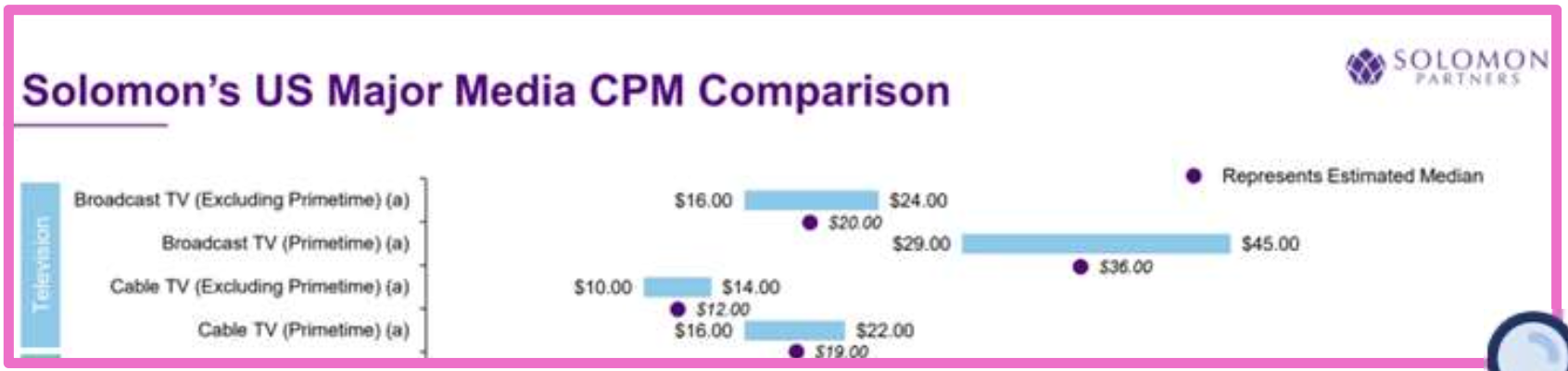
How does the CPM of TV compare to other media choices for advertising?
TV is one of the more expensive options
What are the limitations of TV advertising?
Expensive Production Costs
Expensive Airtime Costs
Heavy Competition
Long Lead Times
Zipping, Zapping, & ______
Fragmented Media Delivery
Consumers don’t pay attention during the commercial break
Zapping-> you change the channel to something else when commercial comes on
Zipping-> using a DVR and recording a show and skipping the commercials
Be on your other devices (Zoning) aka zoning out to go do other things like get a snack, or use the bathroom
What types of costs are associated with TV advertising?
Ad Rates for TV programming
TV ads are a lot of money and (Sunday Night football is $828, 501)
The number 1 factor that drives the pries is viewership
Expensive Production Costs
Expensive Airtime Costs
What is the marketing term for changing the channel to avoid commercials?
zapping
What is the marketing term for fast forwarding to avoid commercials?
zipping
What is the marketing term for multitasking to avoid commercials?
zoning
How do networks determine pricing for TV advertising?
Average Cost for a 30 Second TV Spot
What challenges do TV advertisers face today?
Zipping, Zapping, Zoning?
Time Shifting?
Streaming Services?
Social Media Content?
What are advertisers doing to counter fragmented viewing behaviors?
Other media options for different forms of video advertising:
Frequency
Content Type
Suggested
Length
Content Tips
Used to be able to go ons streaming services and have no ads, but now not so much
Over the top-> watching reruns of the office ex. -> not through cable so over a Roku or firs stick, chrome cast, including through a smart tv so its coming through internet and not cable.
Connected tv -> subset of OTT an actual device actually connected to the tv CTV-> a connected tv that supports video streaming
What is fragmented media delivery?
the different social media channels or other services now to watch media and tv (Hulu, TikTok, YouTube, etc.)
How do streaming services impact TV advertising?
More services are starting to implement ads and to pay a price more for no ads
Why have streaming services recently integrated ads into their platforms?
to make more money and pertain to different markets on different platforms
How are advertisers responding to new forms of entertainment media?
they are finding new ways to resonate with audiences and adjust their content to fit different platforms
What is OTT? What is CTV? How do they differ? What examples did we discuss?
Connected tv -> subset of OTT an actual device actually connected to the tv CTV-> a connected tv that supports video streaming
What is AVOD? What is SVOD? How do they differ? What examples did we discuss?
Advertising based video on demand -> ad supported and are available at a lower cost for consumers
Subscription based video on demand -> services charge a monthly fee
YouTube has gotten so bad at making ads a little jostling
What are storyboards?
Before we begin video editing, we should map out our ideas with a storyboard.
This helps us to make sure we’ve included everything we need for the ad.
It also helps us to determine if everything will fit in the allotted time for the ad.
Like a comic book, you should be able to read it with stills, visuals sound effects, elements that would show what the actual production might look like
We use them asa roadmap for ideas -> get all the ideas down on paper and include everything we need in the ad
What are the main elements that should be included in storyboards?
• One full page of storyboards per 30 seconds of video
• Visuals (typically drawings or sketches for each scene) • Script of audio copy that will be spoken in the ad
• Outline of body copy that will appear in the ad
• Plan for sound effects that will be used in the ad
• Plan for music that will be played in the ad
• Timing elements outlining length of each scene
• Notes for other elements that will be used in the ad
What are the different formats for video ads?
straight announcement
presenter
testimonial
demonstration
musical
slice of life
What is a straight announcement commercial? What are its characteristics?
Oldest and simplest type of commercial
Announcer delivers a sales message
Adaptable to almost any product or
situation
Announcer can deliver the sales
message on camera or as a voice
over
Does not require elaborate production, which saves money
ex. td ameritrade
What is a presenter commercial? What are its characteristics?
Uses a person or character to present the product and present the sales message
Presenters may be celebrities, experts, professionals, or actors playing a role
Presenter doesn’t have to be a real person (i.e., animation).
ex. ed Sheeran ketchup commercial
What is a testimonial commercial? What are its characteristics?
A satisfied user explains how effective the product or service has been for them
If celebrities are used, they should be believable and not distract from the product
Satisfied customers are a good source for testimonials because they can genuinely be very persuasive
What is a demonstration commercial? What are its characteristics?
Products or services are demonstrated in real life situations to help viewers visualize how they will perform
Demonstration can persuade audiences more effectively, and (sometimes) more quickly than a spoken message
The video medium is uniquely suited for visual demonstrations
What is a musical commercial? What are its characteristics?
Music and/or jingles in video ads can be used to help ads resonate and remain salient for longer periods of time
Music and/or jingles can provide continuity to an ad campaign over time
Various sources for music
Buy the rights from owner
Use music in the public domain
Compose an original song or jingle
ex chilis baby back rib commercial
What is a slice of life commercial? What are its characteristics?
Dramatizes a real-life situation
Often deals with problems of a
personal nature (such as personal hygiene)
Hint dropped, product tried, happy ending
to problem
Good at getting attention and creating
interest
Believability can be difficult to achieve
Actors must be highly credible, trustworthy, and persuasive(ex. poo pourie commercial)
What are the “best practices” & recommendations for creating effective video ads? What examples did we use?
begin at the finish
create an attention getting opening (snickers)
keep things simple (budweiser and geico commercial)
Remember that Characters Are Living Symbols of the Product (head and shoulders commercial with the NFL)
Make Demonstrations Dramatic but Believable (ex. SNL jar opener)
Let the Visual Elements Speak for Themselves (apple MacBook Air ad )
What does it mean to begin at the finish? Why is this important?
Concentrate on the final impression the commercial will make
What does it mean to create an attention getting opening? Why is this important?
An opening that is visually surprising or full of action, drama, humor, or human interest sets the context and allows a smooth transition to the rest of the commercial.
What does it mean to use characters as living symbols of the product? Why is this important?
Characters should be appealing, believable, non-distracting, and relevant.
What does it mean to keep things simple? Why is this important?
Ideas should be easy to follow.
Keep the number of elements to a minimum.
What does it mean to make demonstrations dramatic but believable? Why is this important?
Relate to people problems but also maybe in a humorous or exxageraated way to play on everyday struggles someone might be facing to help solve the problem they have
What does it mean to let the visual elements speak for themselves? Why is this important?
Some of the best TV ads communicate just as well with the sound turned off.
Use conversational language.
Avoid “ad talk,” hype, and puffery.
What are the characteristics of audio listeners in the United States?
Of all daily ad-supported audio time spent by adults in the US
67% is Spent Listening to OTA (Terrestrial AM/FM) Radio
19% is Spent Listening to Podcasts
11% is Spent Listening to Streaming
Audio
3% is Spent Listening to Satellite Radio
How much time to Americans spend listening to audio?
Americans spend about 20% of their days listening to audio, which is about 4-5 hours per day, on average.
How does this differ by age cohort?
18-34-year-olds spend about 50% of their listening time on radio, and about 35% of their listening time on podcasts.
Older listeners spend about 75% of their audio time on radio.
How much time is spent listening to different types of audio media?
67% is Spent Listening to OTA (Terrestrial AM/FM) Radio
19% is Spent Listening to Podcasts
11% is Spent Listening to Streaming
Audio
3% is Spent Listening to Satellite Radio
What are the most common radio formats (genres) in the US? Which formats (genres) are the most popular?
Adult contemporary and country are big -> country and contemporary are the most popular music genres for most age groups
News talk is more popular amongst men
Advertisers typically purchase radio based on a stations format rather than its programs, as most stations adopt a standard programming format
News/Talk
Adult Contemporary Country
Rock
Alternative
Top 40
Classic Rock Sports
Pop Contemporary Spanish
Easy Listening Jazz
Classical
Classic Hits
What are the main advantages of radio advertising?
Repeated Exposure & Impact • Can Build an Audience Quickly
Targeting Selectivity• Specialized Formats Select Audience
Cost Efficiency • Among the lowest CPM
Timeliness• Short Lag Times to Implementation
Imagery Transfer • Transfer of Visuals from Other Media
Local Relevance & Impact • Transfer of Visuals from Other Media
What is repeated exposure and impact?
can build an audience quickly→ repeatedly saying or projecting an ad so it sticks with people
What is targeting selectivity?
specialized formats select audience
What is cost efficiency? How does the CPM of radio relate to other media choices?
among the lowest cpm, radio is one of the cheaper options for cpm
What is timeliness?
short lead times to implementation
What is imagery transfer?
transfer of visuals from other media
ex. You see an ad on YouTube, and you hear the audio and you can imagine the visuals because you have seen the ad before
What is local relevance & impact?
radio works well on the local level
What are the main drawbacks of radio advertising?
How does the lack of visual media impact audio advertising?
How does audience fragmentation impact audio advertising?
How does the brevity of audio advertisements impact audio advertising?
How does listener attention and distraction impact audio advertising?
Lack of Visual Media-> does not stick with consumers as easily
Advertisements Are Brief (Require Repetition)
Follow-Through (Action) Can Be More Difficult
Audience Fragmentation Across Stations
Listeners Typically Are Otherwise Occupied
Measurement Challenges (with OTA Radio)

