Lecture 8 - Illness, Beliefs, and Family Resilience
 Studied by 1 person
 Call Kai
 Learn
Learn Practice Test
 Spaced Repetition
 Match
Match Flashcards
 Knowt Play
1/70

There's no tags or description
Looks like no tags are added yet.
Name | Mastery | Learn | Test | Matching | Spaced | Call with Kai |
|---|
No analytics yet
Send a link to your students to track their progress
71 Terms
What are the 4 key components of Tanner's Clinical Judgment Model?
Noticing, Interpreting, Responding, and Reflecting.

What does 'Noticing' involve in Tanner's Clinical Judgment Model?
Recognizing cues and making sense of data.
What model is used to assess family functioning in family nursing?
The Calgary Family Intervention Model (CFIM).
What is the purpose of the NCSBN Clinical Judgment Measurement Model?
To recognize cues, prioritize hypotheses, generate solutions, take action, and evaluate outcomes.
What is a key skill for nurses according to Lasater (2007)?
Clinical Judgment.
What is the difference between analytic and intuitive reasoning patterns in nursing?
Analytic involves step-by-step thinking
Intuitive relies on gut feelings based on experience.
What does the McGill Model of Nursing emphasize?
Supporting family health by helping families learn to cope and encouraging continuous growth.
What is the focus of the Strengths-Based Family Nursing approach?
To recognize and cultivate positive aspects, skills, and resources within the family.
What is the goal of a strengths assessment in family nursing?
To identify internal strengths and external resources of the family.
What is the difference between strengths and deficits in family nursing?
Strengths focus on positive aspects, while deficits focus on what is wrong or missing.
What are some examples of internal strengths in a family system?
Traits like optimism, resilience, and skills like problem-solving.
How can nurses help families develop strengths?
By transferring strengths from one experience to another, cognitive reframing, and teaching new skills.
What is the purpose of using open-ended questions in family assessments?
To explore perceptions of concerns and recognize family strengths.
What is the importance of providing specific feedback to families?
It boosts their sense of competence and creates a context for change.
What is the outcome of effective family nursing interventions?
Families gain insight, feel collaborative, and appreciate their role in the partnership.
What does 'In-Action' reflecting involve?
Thinking while doing during patient care.
What does 'On-Action' reflecting involve?
Thinking after an event to review what was learned.
What does 'For-Action' reflecting involve?
Thinking ahead and creating a plan to improve.
What is a key strategy for mobilizing resources in family nursing?
Using an ecomap to explore family connections and networks.
What should nurses consider when calling forth strengths?
How potentials and strengths could be used to achieve goals and solve problems.
What is the role of the nurse in the Strengths-Based Family Nursing model?
To form a partnership with the family and help them use their strengths to cope and achieve goals.
What is a common resource families may have?
Support networks, community resources, and financial assets.
What is the primary goal of mobilizing and using resources in family nursing?
To help families identify needs and decide on the specific fit of resources.
How can nurses assist families in regulating resources?
By problem-solving together to minimize problems and maximize benefits.
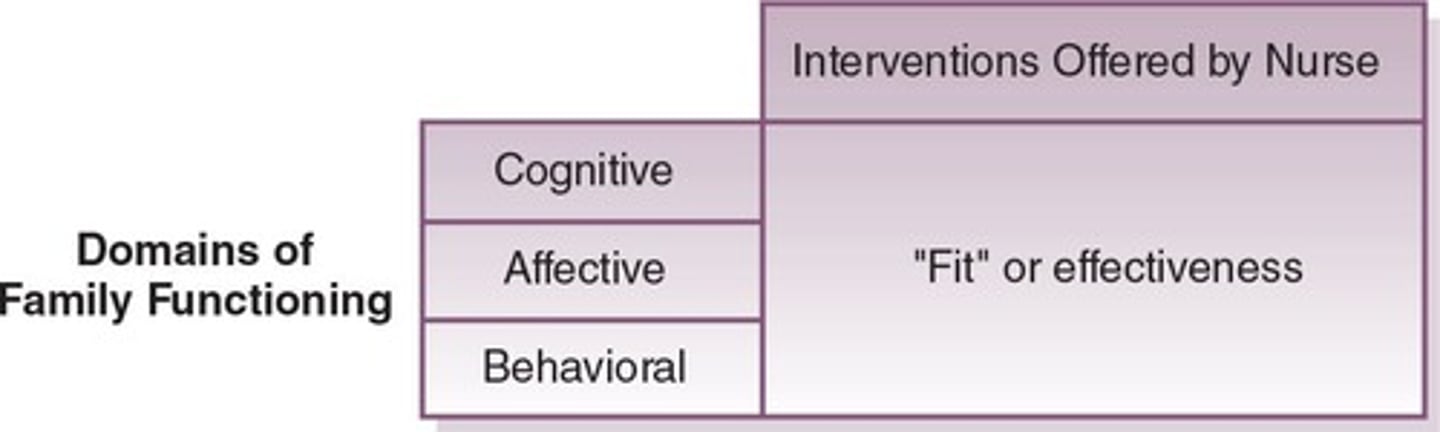
What is the Calgary Family Intervention Model (CFIM)?
An organizational framework that conceptualizes the intersection between family functioning and nursing interventions.
What is a key characteristic of the CFIM?
It is strengths-based and resiliency-oriented.
What factors affect a family's openness to nursing interventions?
History of family interactions, relationship with the nurse, and health status.
What are the three domains of family functioning in CFIM?
Cognitive
Affective
Behavioral
What is the goal of interventions within the cognitive domain?
To change perceptions and beliefs of family members regarding health problems.
What types of emotions may slow problem-solving efforts in the affective domain?
Emotions such as being overwhelmed, concerned, sad, or angry.
What is the goal of interventions within the behavioral domain?
To help families interact and behave differently to increase support.
What is the ultimate goal of nursing interventions according to CFIM?
To aid family members in discovering new solutions to alleviate suffering.
What is meant by 'fit' in the context of CFIM interventions?
Fit is determined through therapeutic conversation and collaboration with the family.
How can one intervention affect family functioning?
One intervention can simultaneously affect all three domains of family functioning.
What is accommodation in the context of nursing interventions?
An observation of a pattern of behavior that occurs over time.
What does validating or normalizing emotional responses involve?
Reassuring families that their feelings are normal.
Why is encouraging the sharing of illness narratives important?
It helps express the impact of illness on various family members.
What does encouraging family members to be caregivers involve?
Supporting family members who may feel intimidated by the thought of providing care.
What is the purpose of encouraging respite for family caregivers?
To alleviate feelings of guilt associated with taking a break.
What types of rituals should nurses inquire about with families?
Daily, yearly, or culturally significant rituals.
How can nurses help families gain an understanding of their health experience?
By facilitating assessment and intervention simultaneously.
What is the role of the nurse in the CFIM?
To offer interventions without insisting on particular changes.
What is the significance of focusing on family strengths?
It helps families see themselves differently and promotes coping.
What is the relationship between emotional responses and problem-solving?
Intense emotions can impede problem-solving efforts.
What can nurses do to help families interact differently?
Invite family members to engage in specific behavioral tasks.
What is the importance of therapeutic conversation in CFIM?
It helps determine the fit of interventions based on family experiences.
How do interventions create a context for change?
They provide a structured environment for families to make necessary changes.
What may interrupt rituals in families?
Chronic illness or hospitalization
What are the two types of interventive questions?
Linear and Circular
What is the intent of linear questions?
To investigate and explore the description/perception of a problem
What is the effect of linear questions?
Constrains further understanding and may imply the nurse knows best
What do circular questions aim to achieve?
To effect change and facilitate behavioral change
How do circular questions differ from linear questions?
Circular questions focus on relationships and connections, while linear questions focus on cause and effect
What are the four types of circular questions?
Difference
Behavioral Effect
Hypothetical
Triadic
What do difference questions explore?
Differences between people, relationships, ideas, time, and beliefs
What do behavioral effect questions examine?
The effect of one family member's behaviors on another
What do hypothetical/future-oriented questions inquire about?
Speculative outcomes and coping strategies for future scenarios
How should interventions be developed according to IFNA competencies?
Through collaborative decision-making with the family
What is the goal of nursing interventions in family care?
To enhance family strengths, resilience, and coping strategies
What does the dynamic nature of interventions imply?
Interventions may change as the family's situation evolves
What is the significance of systems theory in family nursing?
It views the family as a system where changes in one part affect the whole
What does the IFNA competency 1.5 focus on?
Demonstrating nurse/family partnership to achieve health and care goals
What is the purpose of evaluating family interventions?
To assess the adequacy and success of interventions over the course of care
What should nurses incorporate according to IFNA competency 2.4?
Useful questions, both linear and interventive
What is the focus of IFNA competency 2.10?
Evaluating with families the success of intervention strategies
What is the main focus of the Cognitive domain in nursing questions?
Understanding and knowledge related to health and illness
What is the main focus of the affective domain in nursing questions?
Emotions and feelings related to health and illness
What is the main focus of the behavioral domain in nursing questions?
Actions and behaviors related to health and illness
What is an example of a difference question?
Who in the family is most worried about how HIV is transmitted?
What is an example of a behavioral effect question?
What do you feel when you see your son crying during his treatments?
What is an example of a hypothetical question?
If your loved one passes away, how do you think your family will cope?
 Note
Note  Flashcards (59)