The humanistic approach
 Studied by 0 people
 Call Kai
 Learn
Learn Practice Test
 Spaced Repetition
 Match
Match Flashcards
 Knowt Play
1/5

There's no tags or description
Looks like no tags are added yet.
Name | Mastery | Learn | Test | Matching | Spaced | Call with Kai |
|---|
No analytics yet
Send a link to your students to track their progress
6 Terms
Free will
All the other approaches considered so far are determinist to some degree, however the humanistic approach is quite different. It claims that human beings are essentially self - determining and have free will. people are still affected by external and internal influences but also active agents who can determine their own development
Maslow’s hierarchy of needs
Abraham Maslow was one of the founders of the humanistic movement in psychology
One of his main interest was in What motivates people
He described a hierarchy of needs that motivates our behaviour - in order to achieve our primary goal of self -actualisation a number of deficiency needs must be met first
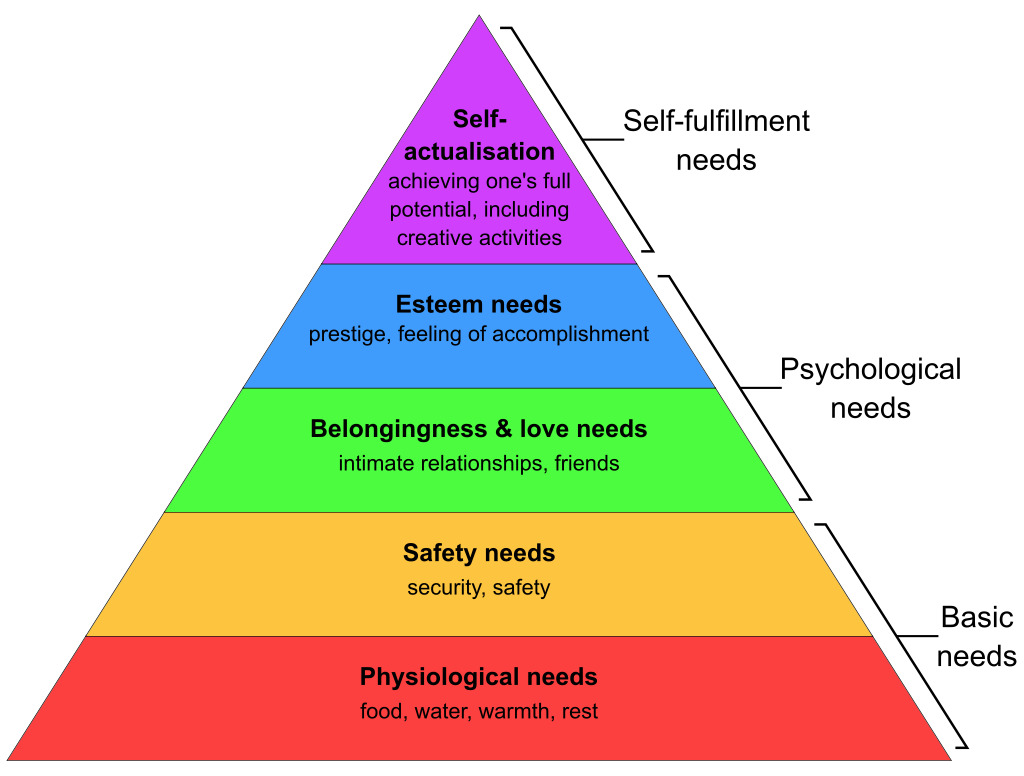
Self-actualisation
most people have an innate desire to achieve for potential - To become the best they can possibly be
All follow lower levels of the hierarchy (Deficiency needs) Must be met before the individual can work towards self actualisation
Humanistic psychology regard personal growth as an essential part of what it is to be human- Personal is concerned with developing and changing as a person to become fulfilled and satisfied
The self, congruence and conditions of worth
The self is a term used to describe the way we view ourselves , The ideal self describes the person we want to be/the best version of ourselves
When there is a gap that is too large between the self and ideal self we experience incongruence. The constant negative feeling of low self-worth and low self-esteem prevent us from progressing through the hierarchy of needs so we cannot achieve self actualisation
When there is little to no gap between the staff and ideal self, we experience congruence allowing us to progress up the hierarchy
In order to reduce the gap, Rogers Developed counselling which helps the increase a person self-worth and reduces levels of incongruence
Conditions of worth Is when a parent places a limit or boundaries on their love of their children. this store psychological problems in the child
Strengths
One strength of the humanistic approach is that it is optimist - Humanistic psychologists have been praised for promising a positive image of the human condition. Freud So human beings as prisoners of their past and claimed all of us exist to somewhere between ‘ Common and happiness and absolute despair’. In contrast, humanistic Psychologists see all people as good, Free to work onto towards the achievement of their potential And in control of their lives
One strength is that Rogers’ Counselling therapy has a major impact in psychology and is now used them both USA and the UK. This therapy is beneficial due to acknowledging that individuals do have free will and do have the ability to improve themselves. This contrasts Freud’s Theory of psychoanalysis, which tends to dwell on childhood experiences
Limitations
One limitation of the humanistic approach is that it may be culturally biased - Many of the ideas from humanistic psychology, such as individual freedom and personal growth, would be much more readily associated with countries that have more individual Tendencies (e.g. The USA). Countries with collectivist tendencies emphasise more than needs of the group and interdependence. Therefore, it is possible that this approach does not apply universally
 Note
Note  Flashcards (132)