Competitive Effectiveness Exam #2
 Call Kai
 Learn
Learn Practice Test
 Spaced Repetition
 Match
Match Flashcards
 Knowt Play
1/193

There's no tags or description
Looks like no tags are added yet.
Name | Mastery | Learn | Test | Matching | Spaced | Call with Kai |
|---|
No analytics yet
Send a link to your students to track their progress
194 Terms
Value of Positive Relationships
Results in better physical and emotional well being
Helps people PERFORM BETTER, CONCENTRATE MORE on the task at hand
Seek to avoid the the dysfunctional communications: complimentary feedback is ‘easy’; difficult feedback is ‘hard’
strengthens individual performance, relationships, ultimately the team
‘Headwinds’/obstacles for Building Positive Relationships
Contributors to frequent organizational relationship problems
Reliance on technology
Dominance of e-mail
Less face-to-face communication
Too much information, low quality
High Quality Connections: Both Temporary & Long Term
Research support high quality connections yield:
Sense of energy & engagement for both parties
Sense of cooperation & responsiveness for both parties
Enhance physiological changes … YOU FEEL BETTER
Relationships Between Communication and Interpersonal Relationships
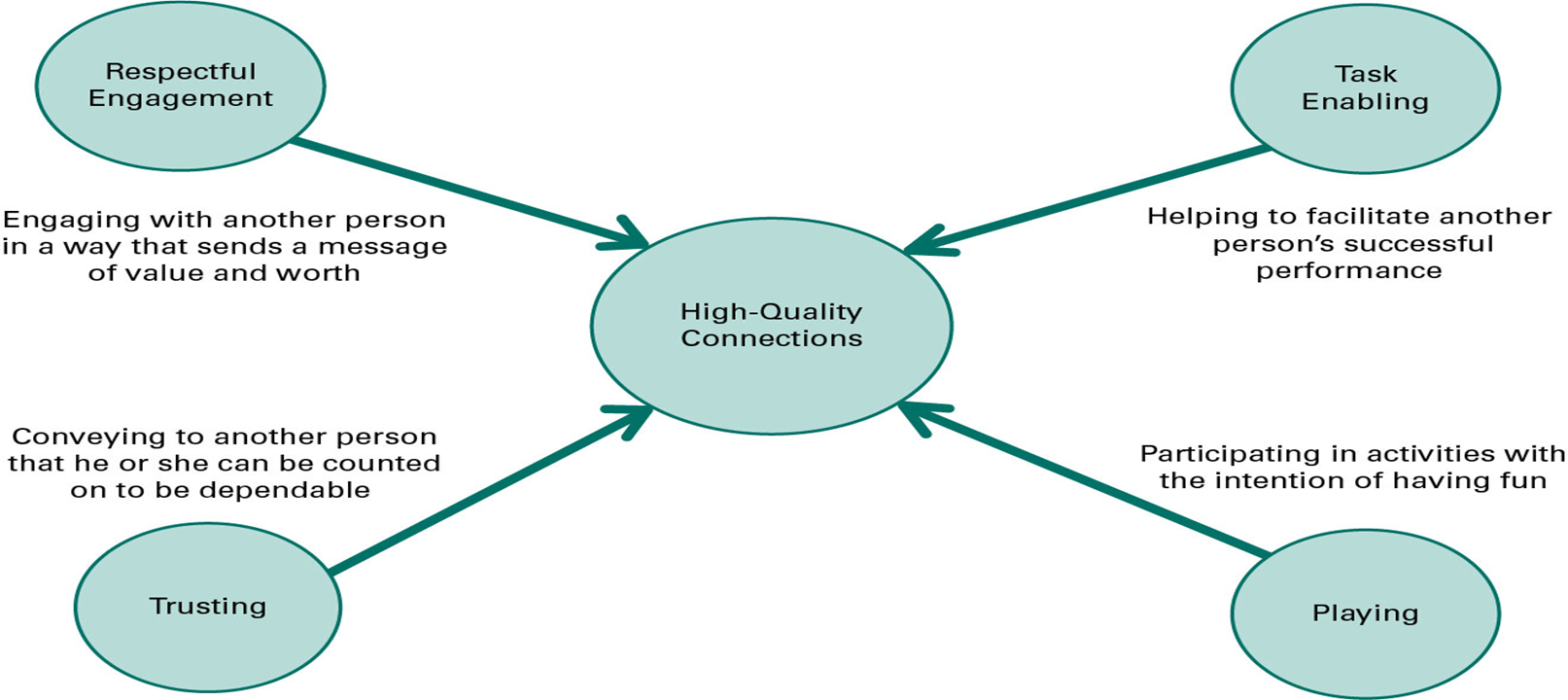
Supportive Communcations
Communication that builds/strengthens interpersonal relationships
Seeks to preserve healthy relationships in positive & challenging situations
Delivering both compliments and adverse feedback
Conveys feelings of mutuality and respect
Beyond just be a ‘nice person’
Important in any customer service environment (i.e., service issues, customer complaints, misunderstandings)
Coaching & Counseling
Coaching focuses on ABILITIES:
Giving advice, direction or information to improve performance
Lack of ability; insufficient information
I CAN HELP YOU DO THIS BETTER
Counseling focuses on ATTITUDES:Helping someone understand and resolve a problem him/herself by displaying understanding
Enhance understanding and increase insight
“I can help you understand the problem (opportunity) more clearly”
Two Major Obstacles to Supportive Communication
Defensiveness:
Energy is spent on constructing a defense rather than on listening
Aggression, anger, competitiveness, and avoidance are common reactions
Disconfirmation:Energy is spent trying to portray self-importance rather than on listening
Showing off, self-centered behavior, withdrawal, and loss of motivation are common reaction
Principles of Supportive Communications (8)
Congruent (vs. incongruence)
Descriptive (not evaluative)
Problem - Oriented (vs. person oriented)
Validating (vs. vagueness)
Specific (vs. too broad, general)
Conjunctive (stay on point with the point!)
Owned (take responsibility)
Supportive Listening (vs. One-way, Talk/Listen Ratio)
Congruent Communications
Communication is accurate and honest without jeopardizing interpersonal relationships
Minimize sugar coating
Descriptive not Evaluative Communication
Three Step Process
Describe the event, behavior, circumstance… objectively
Focus on the behavior, reactions, possible consequences, impact to team
Focus on solutions, not the person
Problem or Issues Orientated Feedback vs. Person Oriented
Aligned with Descriptive, focus on BEHAVIORS OR EVENTS
A “non-starter” - focusing on personality or traits
Link feedback to the norms/standards/expectations jointly developed and agreed upon by the Team in the Charter
Validating vs. Not Validaating
Ensure respectful collaborative interactions
Build to mutual recognition of problems and solutions
Recognized that MISTAKES HAPPEN, now you (and all) need to be part of the solution
Avoid NON-VALIDATING: ‘put downs’; ‘one-upmanship’;indifference
Pay attention to your non-verbal persona
Be Specific & Timely (useful) vs. Too General (non-useful)
Communications are specific and identify something that can be understood and acted upon
Avoid focusing on extremes and absolutes which deny any alternatives; “My way or the highway!”
Ensure constructive (not destructive) feedback occurs as close as possible to the event occurrence… recency matters
Conjunctive vs. ‘Wandering’/Irrelevant
Conjunctive - communications/interactions joined to a previous message (stay on point with current subjects, don’t focus too much on past stuff or get caught up in it)
Disjunctive - communications/interactions:
Lack of opportunity for others to speak
Extended Pauses
Minimal Topic Control
Rigorous Meeting Management
Taking turns speaking; time management; topic control
Owned vs. Disowned
Owned - Take responsibility, avoid deflecting the matter and being defensive
Yep this one is on me
Disowned - Not taking responsibility and getting defensive and using excuses as, ‘Well, I assumed/Most students would do the same/ lots of people say”
Supportive Listening
Requires active listening, responding effectively to someone’s statements
In skills important for managers, EFFECTIVE LISTENING WAS RANKED HIGHEST
Individuals usually understand about 25% of what is communicated
One Way Listening
Only listening to what you have to say or not listening to others ideas and only going with what you believe
Examples: “As I said before, I don’t understand your position”
The Four Types of Responses
Advising (More of a Direct Response)
Provides Direction, Evaluation, Personal Opinion, or Instruction
Creates listener control over the topic
Watch: can produce dependence - ensure transfer of knowledge
Deflecting
Switches the focus from the communicator’s problem to one selected by the listener
Appropriate if reassurance or expanded perspective is needed
Watch: must be clear not to imply that the communicator’s issues are not important … looking to BOOST MORALE
Probing
Asks questions about what the communicator said
Used to gather information
Four General Ways to Probe
Elaboration - can you tell me more
Clarification - what do you mean by that
Repetition - let’s make sure we’re clear
Reflection - hmmm, how long has this been an issue?
Reflecting (more of an open, nondirective response)
Mirror back to the communicator the message that was heard
Involves paraphrasing and clarifying
Shows understanding and empathy
Watch: it could appear that the listener isn’t listening
Personal Management Interview
Formal Structured interactions with direct reports using supportive communication techniques
Personal time with the manager (issues, transfer information, coaching and counseling … not performance appraisals)
ONE-ON-ONE meeting between management and subordinates
Step 1: A role-negotiation/clarfication session which sets expectations of employees and managers
Step 2: A set of ongoing one-on-one meetings to foster development and improvement
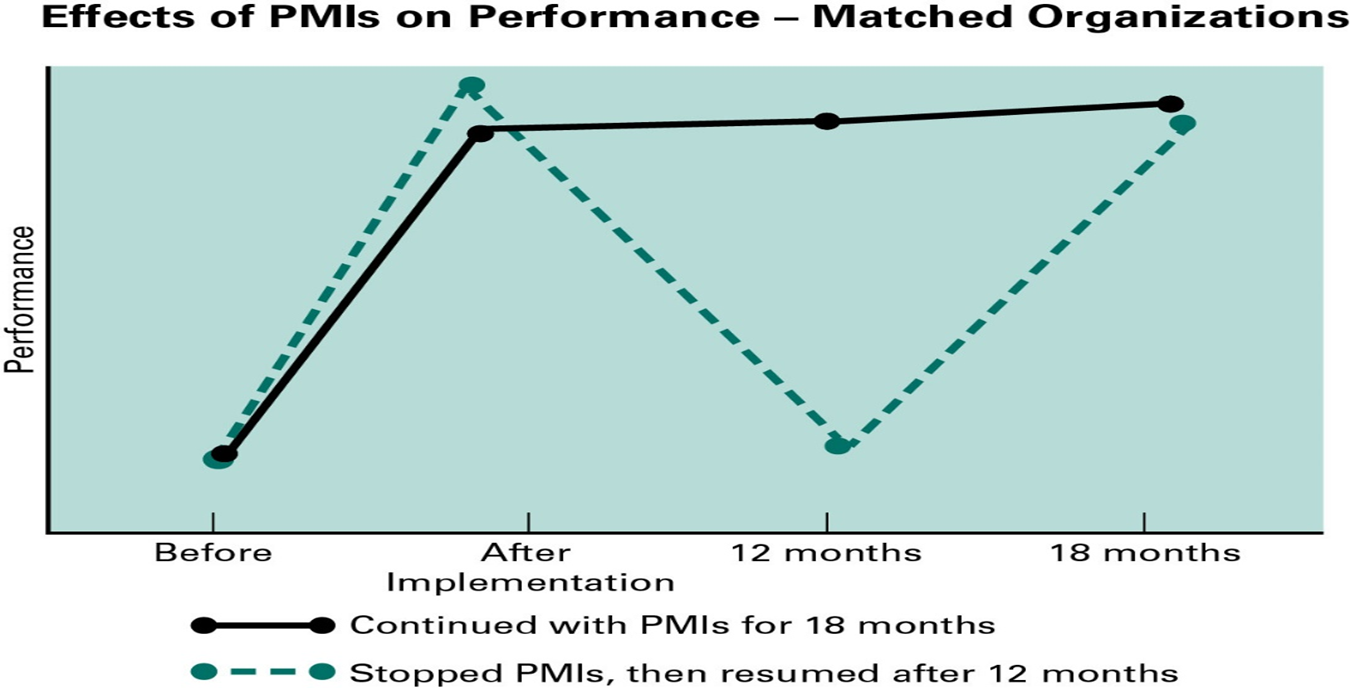
Culture and Supportive Communications
Language pattern and structures are dramatically different across cultures
There are, however, universal principles that apply to interpersonal problems
Research indicates that cultural differences are not significant enough to negate the principles of supportive communications
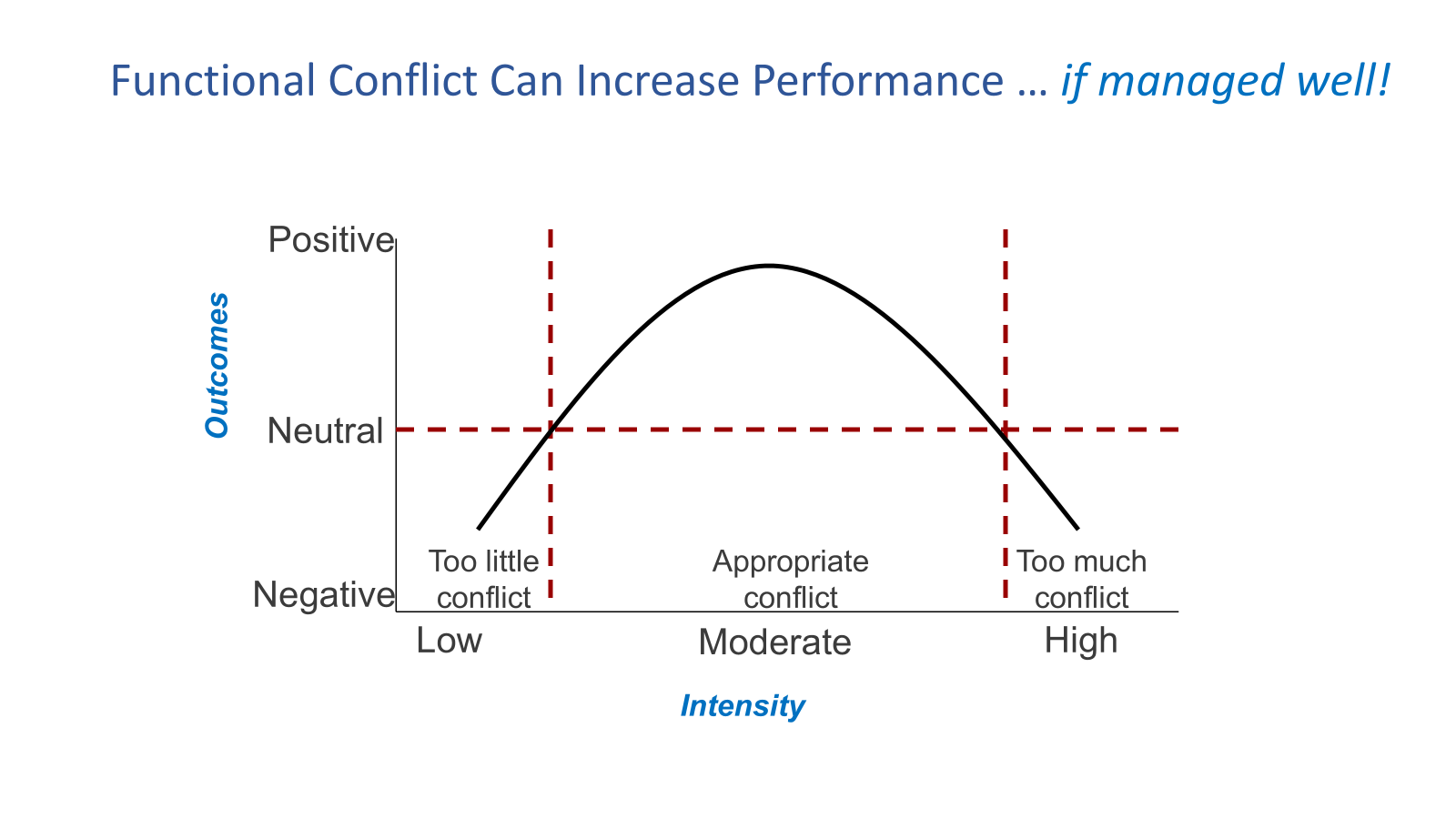
Conflict
Usually perceived as something that is negative
Healthy Conflict - competing business idea, solutions
Externally: contracts, MOA’s, terms sheets
Management - Conflict Management
Fundamentally, the goals of conflict management are to:
Don’t avoid the obvious situation
Leverage the positive aspects of conflict (clarity!)
Resolve organizational and interpersonal conflict
Minimize the impact of conflict on team/project goals and objectives
Two Primary tools for Managing conflict
Understanding the source and focus of a particular conflict
diagnosing properly
Selecting the appropriate strategy/approach for resolution
Matching approach to situation
Focus of the Conflicts
People Focused:
"In-your-face” confrontations in which emotions are fueled by moral indignation
Emotionally charged … misperceptions; feelings of resentment
Issue Focused:
Negotiations in which participants agree how to allocate scarce resources
Key persons for important projects; Capital allocations among SBU’s
Sources of Interpersonal Conflicts - 4 Common Types
Personal Differences: ‘we all bring something different to the table’
Always will be present … experiences, etc.
Conflicts stem from personal values and needs
Value of building and managing a diverse workforce!
Informational Deficiencies: Misinterpretations, incompleteness
Conflicts evolve from misinformation and misunderstanding
Usually less emotional, more easily resolved through clarification
Avoid ‘escalation of commitment’; don’t jump the gun
Role Incompatibility
Conflicts evolve from the perception that assigned goals and responsibilities compete with those of others
Example: Forecasted vs. Actual Sales … Operations vs. Production
Environmental Induced Stress: uncertainty & poor risk assessment
Conflict results from the stressful events of the organizational environment
Labor market (primarily healthcare jobs)
Negotiation
Process by which multiple parties come to an agreement
Distributive Negotiation
Win-lose, a battle so to speak
Better suited for non-repeated negotiations
Lack of building relationships, contentious
Integrative negotiation
Win-win, cede less important items
Each party focuses on the best outcome/solution for all
example, employment bonuses; construction contracts w/preferred subcontractors; railroad strike avoidance
Zone of Possible Agreement (ZOPA)
Boundaries for the negotiation
Buying an automobile; ebay transactions; trade deals
Best Alternative to a Negotiated Agreement (BATNA)
Your most desirable options in challenging negotiations balanced against what you are will to accept
Stronger BATNA = better positioned for the negotiation
BATNA is the best course of action you can take if a negotiation fails and no agreement is reached. It represents your backup plan or next best option outside the deal.
Reservation Price (PART OF BATNA)
Price you are willing to pay
Plan to know in advance - avoid mistakes, rushed decision
Important if part of a negotiating team
Anchoring
Set the expectation for an acceptable offer
Anchoring in negotiations is when one party sets an initial offer (the anchor) that shapes how both sides evaluate later offers and counteroffers.
Goals
Perhaps Obvious clearly defined goals are needed!
Distributed (buy for as low as possible)
integrative (build lt relationships); are better most of the time than distributed
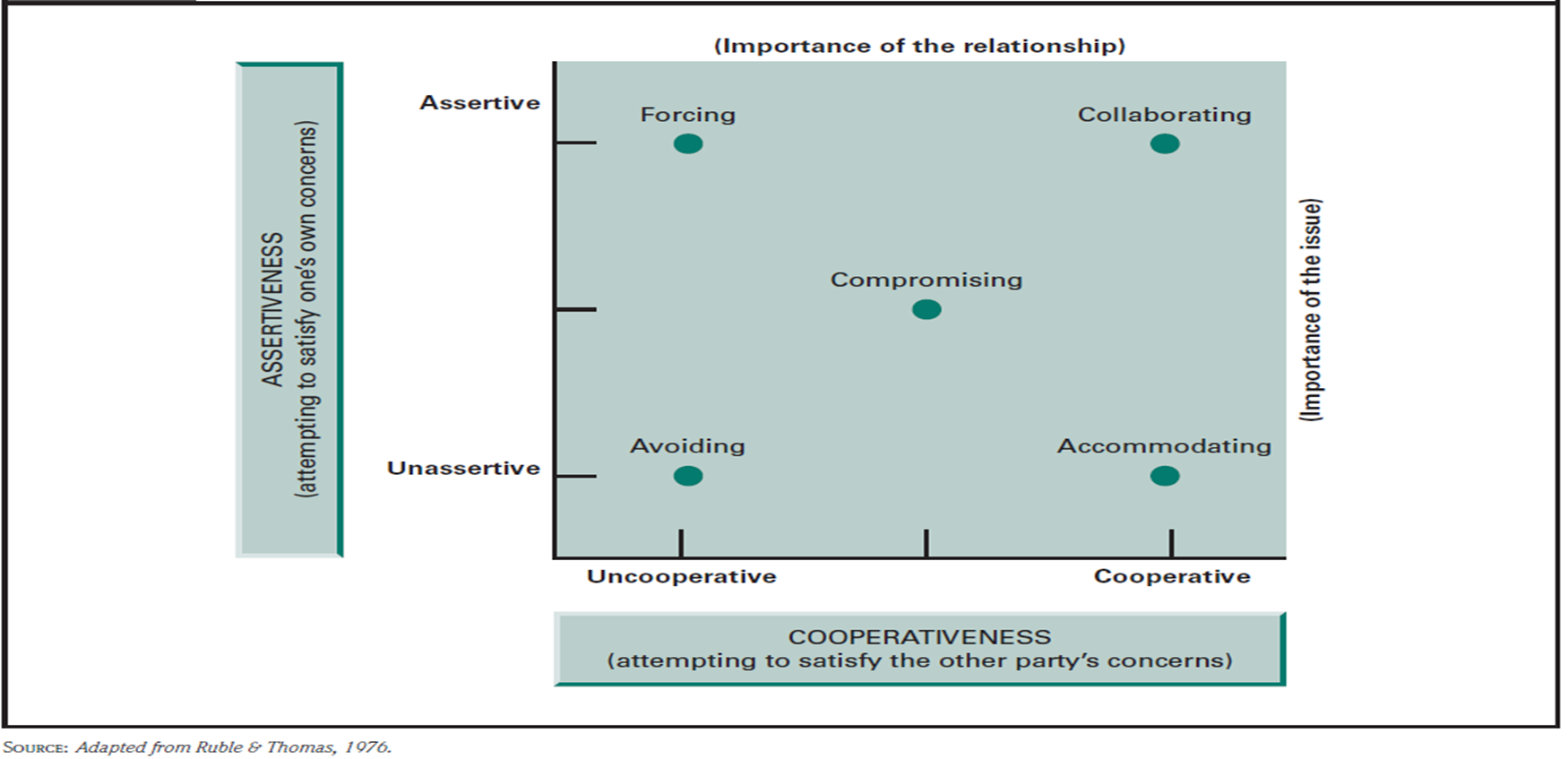
Five Categories of Responses in Negotiations or Conflict
Forcing
Accommodating
Avoiding
Compromising
Collaboration
Forcing Response
Satisfy Personal needs at the expense of the other person
Formal Authority, bullying, manipulation
Outcome: You feel vindicated; other person feels defeated
Avoiding Response
Neglects Interest of both parties by sidestepping or postponing
Reflects inability to handle emotion of conflict or cooling off period necessary
Outcome: nothing (or things get worse) long term frustration
Accommodating Response
Satisfying other part’s concerns but neglect your own
Preserve a relationship at the expense of genuine appraisal of issues
Outcome: Other person can advantage of you; decreased power and credibility
Compromising Response
Seek partial satisfaction for both parties; temporary vs. enduring
Expedient, not effective, solutions - ‘spread the pain’ evenly
Outcome: Gamesmanship and suboptimal resolutions likely
Collaborative Response
Seek to address concerns of both parties
No assignment of blame; agree on facts & solve the problem together
Outcome true “win-win” strategy out of the five categories
Aligned with “supportive communication in building positive relationships” concepts previously discussed
Situational Factors to Consider
Issue importance
Relationship importance
Relative Power
Time Constraints
(Collaboration generally yields the best outcomes; however, it is also the most difficult to implement!)
Four Phases of Collaborative Problem Solving
Problem Identification
Solution Generation
Action Plan Formulation and Agreement
Implementation and follow-up
Initiator
Frame what you will say, wait until emotions subside
Maintain personal ownership
•Describe problem in terms of behaviors, consequences
•Avoid drawing conclusions and attributing motives
•Encourage two-way discussion
•Approach problems incrementally – build rapport & understanding
Responder
Establish a climate for joint problem solving
Seek additional information by asking questions
Agree with some aspect of the concern complaint expressed
Things that should concern you (where you may become the initiator)
•Reduced assignments, others are doing your work
•Peers are working harder than you are
•You’re out of the loop
Mediator’s Role - HR Director, Colleague, etc.
•Establish a problem-solving framework.
•Maintain a neutral posture regarding the disputants.
•Serve as facilitator, not judge.
•Ensure discussion to ensure fairness.
•Focus on interests, not positions.
•Ensure all parties agree on the solution.
Organizing
Process of establishing orderly uses for resources within the management system
Organizing Skill
Creating a network of people throughout the organization who can help solve implementation problems as they occur
Organization (Chart)
End result of the organizing process
The Five Main Steps of the organizing process
Reflect on plans and objectives
Establish major tasks
Divide major tasks into subtasks
Allocate resources and directives for subtasks
Evaluate results of organizing strategy
Weber’s Bureaucratic Model
Bureaucracy is not an end in itself but rather a means to the end of a management system goal
Detailed procedures and rules
Clearly outlines organizational hierarchy
Impersonal relationships among organization members
Critcs of the Model
Ignores the human variables (people management)
Can lead to inefficiencies (hierarchies)
Bureaucracy
Bureaucracy is a structured, hierarchical system of administration used by governments and large organizations to manage complex tasks through specialized roles, fixed rules, and non-elected officials
Division of Labor
Individuals specialize in doing a part of the task/responsibility vs. the entire task
Ex. The assembly line in a production factory
Specialization
Skills in performing the task increase
Coordination
Synchronizing task to complete overall task and the organizations objectives
Relationships, communications fuel effective coordination … remember the team concepts
Formal Structures (Mechanistic)
Defined and depicted relationships
Informal Structures (Organic)
System or networks of interpersonal relationships that exist within an organizations
More spontaneous
Organization Chart (KEY MANAGEMENT DOCUMENT)
Graphic illustration of firm’s organization structure
Hierarchical, generally the skeleton of a company
Boxes are organizational entities represented by leadership & management positions
Lines designate formal communication lines
Vertical Dimension
Top down; ‘chain of command’
Hierarchy
Horizontal Dimension
Span of control of management
Large spans tend to produce flatter structures
Watch the layers, leads to bureaucracy
Scalar Relationship
Chain of management from ‘C-suite’ to the lowest identified organizational level
A clear line of site facilitates communication for any organization to achieve its objectives
Unity of Command
Individual has clear reporting relationships
an employee should receive orders and report to only one direct supervisor. This structure ensures clear accountability, prevents conflicting instructions, reduces confusion, and strengthens organizational discipline by establishing a single chain of command
Departmentalizing
Establishing the relevant departments from plans & objectives
lateral subdivisions or specialties within an organization
Departments
Unique group of resources established by management to perform organizational tasks
5 Types of Departmentalization
Functional
Product
Geographic
Customer
Matrix
Organizational Change Drivers
Structural Change - Growth Driven, M&A, competition, evolving goals and objectives
Technological Change - e-commerce; EV’s; robotics; R&D efforts; etc … alignment of human resources
Cultural Change - acknowledge, though be careful … understand the stakeholders groups
General Communication
Transfer of understanding and meaning from one person to another
Business Communication
Process of transmitting information about and within the organization
Example; Email agenda sent to your team with a list of items to be discussed at the next meeting (same for the minutes)
Communications Model Components
Source of sender = initiator
Encoding = skills, attitudes, knowledge, social cultural system
Channel = informal or formal medium
Decoding = translating the message
Receiver = skills, attitudes, knowledge, social cultural system
Feedback = message successfully understood
Factors Affecting Encoding
Skill
Attitudes
Knowledge
Social Cultural System
Written Communication
Tangible verifiable, more permanent than oral
More likely to be well-thought out
Marketing plan, Management Assignments
Tend to consume more time to produce/edit, etc. vs. oral
Oral Communications
Enables a more rapid response and dialogue
Prompt and better feedback mechanisms
Receiver can quickly summarize
Grapevine Communication
Beware of the grapevine - rumor mill
Managers need to be aware as it will always exist
How should they respond if approached
Usually evidence of truth but needs to be verified
Avoid Perpetuating
In business, the "grapevine" refers to the informal, unofficial communication network within an organization, often referred to as "water cooler talk" or gossip
The Importance of Delivery
Researchers found that 55+% of face-to-face conversation is communicated through body language!
Common Barriers to Effective Communications
Filtering - Deliberate filtering by sender - the spin for favorability
Perception - receiver’s side of filtering
Information overload - be judicious (rule of three)
Emotions
Language - industry jargon, buzzwords, technical
Culture - nuances
Gender - style differences
Techniques to Overcome Communication Barriers
Seek Feedback
Simplify Language
Active Listening
Regulate/Constrain Emotions
Watch Nonverbal Cues
Organizational Behavior
Study of the actions of people at work
Six Important Workplace Behaviors
Employee Productivity
Absenteeism - Physical and mentally in the game (costs the organization an average of 35% of payroll)
Turnover
Organizational Citizenship - teamwork, ‘above and beyond’, avoiding unhealthy conflicts, volunteering. etc
Job Satisfaction
Workplace Misbehavior
Three Psychological Factors in Understanding Individual Behavior
Attitudes and Attribution Theory
Personality
Perception
Three Components of Attitudes
Cognitive = beliefs, opinions, knowledge, and opinions held by a person
Affective = emotional, feeling of an attitude
Behavioral = intentionally act in a certain way based upon the cognitive and affective components
Cognitive Dissonance
Cognitive dissonance, proposed by Leon Festinger, is the mental discomfort experienced when holding two or more contradictory beliefs, values, or behaviors. It causes tension that motivates people to align their cognitions by changing behaviors, justifying actions, or ignoring new, conflicting information.
Influencers on Personality of Development
Physiological - stature, health, gender
Cultural - norms and values
Family & Social Group
Role Determinants
Situational - uncontrollable events (structural changes in family and/or environment)
Personality; Six primary ones to understand
Self-Esteem
Locus of control
Introversion - Extroversion
Authoritarianism - focus on clear power and status differences … reality its a balance and situational
Dogmatism - inflexibility, closed-mindedness
Dependability
5 Dimensions of Emotional Intelligence for Management
Self-awareness
Self-management
Self-motivation
Empathy
Social Skills
Perception
Is a process by which individuals interpret their sensory impressions to give meaning to their environment
Perceptual Selectivity
‘What we see’
the subconscious or conscious process of filtering the overwhelming, constant stream of environmental stimuli to focus on only a few relevant, meaningful, or intense inputs
Perceptual Organization
Familiarity
Meaning or recognition attached to an object, easier to determine appropriate action (i.e., higher than normal values)
Distinctiveness
behaviors in consistent situations vs. a unique behavior in a situation
Consensus
everyone responds similarly
Attribution Theory
Helps managers understand some of the causes of employee behavior
Can assist employees in understanding their thinking about their own behaviors
explains how individuals interpret the causes of behavior, successes, and failures, distinguishing between internal (dispositional) and external (situational) factors
Fundamental Attribution Error
Underestimating or overestimating influence of internal and external factors
Self-Serving Bias
Overestimating one’s ability
Selective Perception
Systematically screen or discredit information we don’t wish to hear
Perceptual Defense
Tendency to distort/ignore information this is personally threatening or culturally unacceptable
Halo Effect
General impression based upon single characteristic
Managing Diversity
Five Generations in the workforce perspectives, attitudes and behaviors tend to vary
Response Salience
Focus on more immediate needs (priorities), wages vs. workloads
Response Disposition
Tendency to recognize familiar objects more quickly (importance of past learnings), predispositions
Essence of Entrepreneurship
New business ideas and/or doing things differently
Three Primary Areas of Focus in Entrepreneurship
Risk Tolerance
Prior Experiences & Skills Evaluation
Personality orientation of the individual
Risk Tolerance
Individuals entrepreneurs must be aware of their risk tolerance and establish a business consistent with that tolerance

