MGEC51 Part 2: Imperfect Competition, Implications, Minimum Wages
 Call Kai
 Learn
Learn Practice Test
 Spaced Repetition
 Match
Match Flashcards
 Knowt Play
1/51

Earn XP
Description and Tags
Lecture 6 + 7
Name | Mastery | Learn | Test | Matching | Spaced | Call with Kai |
|---|
No analytics yet
Send a link to your students to track their progress
52 Terms
Definition of Perfect Competition for Labour Demand
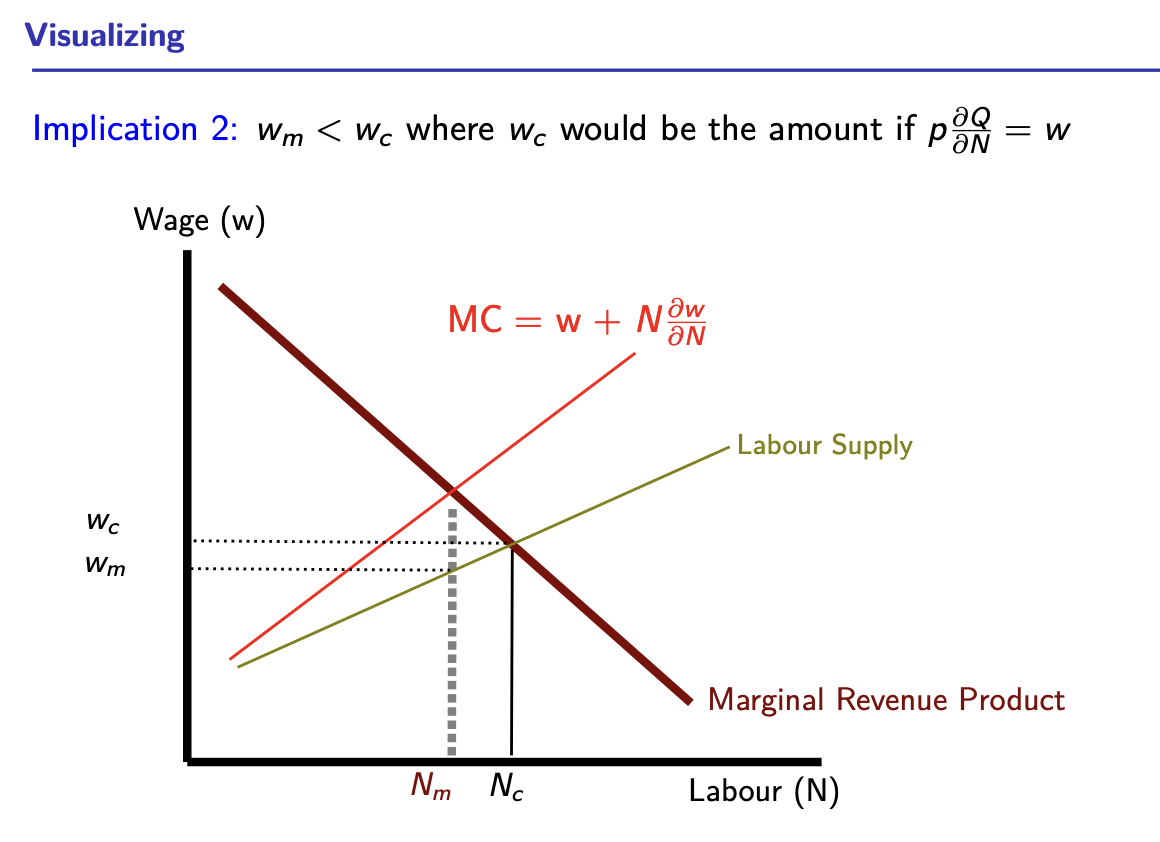
Horizontal Labour Supply: Hire has much as you want at prevalent wage
Definition of Imperfect Competition for Labour Demand
Upwards sloping demand curve: Must raise wages for ALL existing workers to hire more workers
What is the profit maximization condition for wages in Perfect Competition

What is the profit maximization condition for wages in Perfect Competition

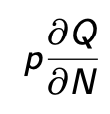
What does this term mean?
The additional revenue generated by hiring an additional worker
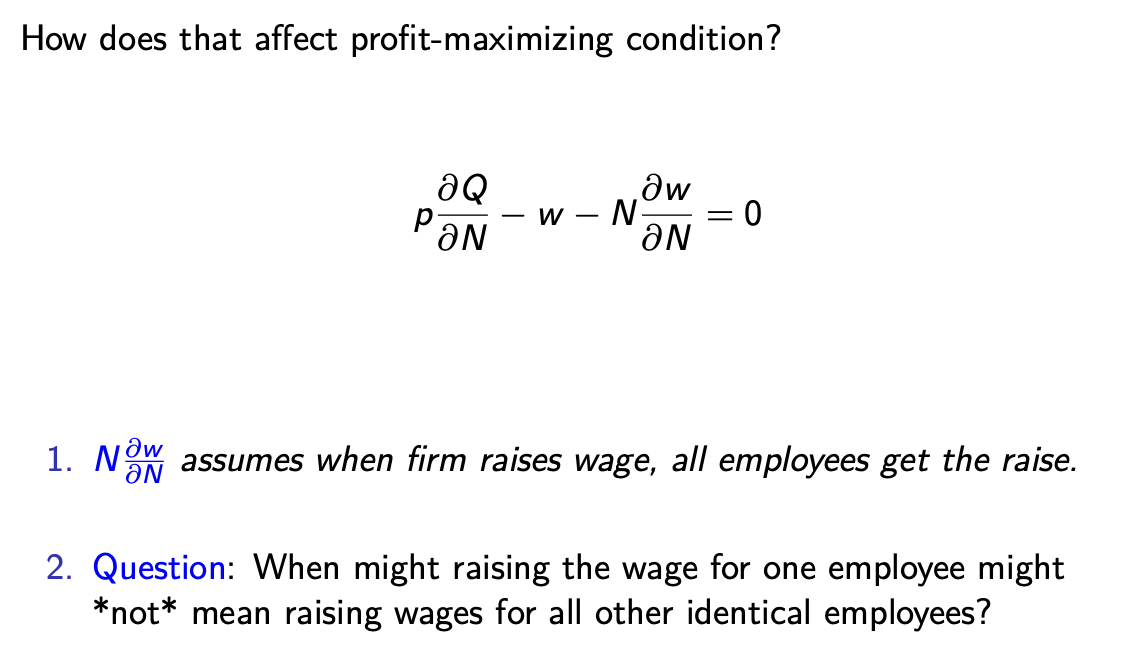
When might raising the wage for one employee might not mean raising wages for all other identical employees?
In the case the employer can price discriminate; salaries aren’t transparent
Draw the graph showing wage and labour given imperfect competition vs perfect competition
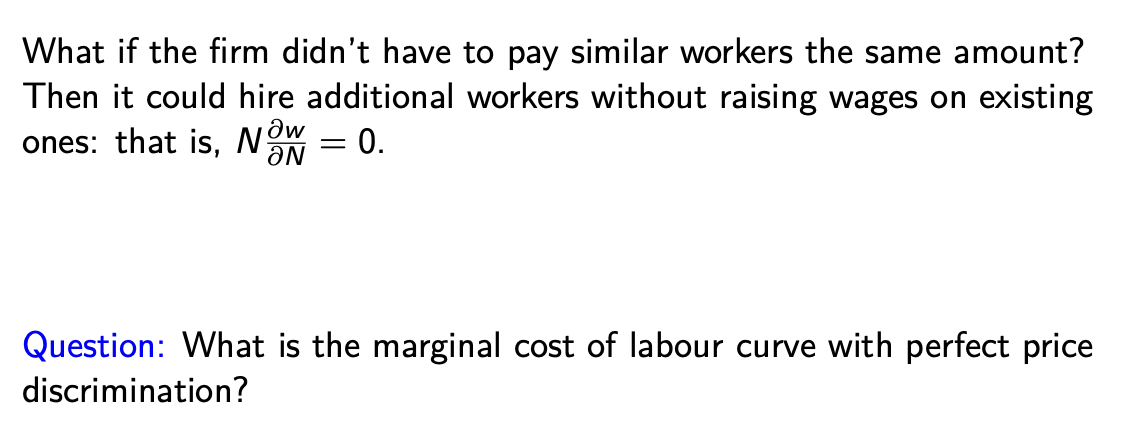
What if the firm didn’t have to pay similar workers the same amount?
Then the MC would equal the labour supply curve
What are real world examples of ways firms can price discriminate?
Information Asymmetry
Non-compete Clauses
Non-poaching agreements
Search Frictions
What are 4 sources of a imperfectly competitive labour market?
Size: Large employer relative to market
Search Friction: Hard for a worker to find a new job, disincentivizes workers to leave current company
Preferences: People have different preferences on working for a given company, need to use wage to incentivize them
Collusive Contract Issues: NPC and Non-Poaching Clauses makes it hard for workers to change companies
How was the mergers & wages hospital study conducted?
Difference-in-difference study
How did the mergers of hospitals affect wages in nurses & pharmacists?
Wage was lowered by ~10%
How did the mergers of hospitals affect wages in janitors, cafeteria workers?
Wages pretty stayed the same
What is the HHI index? How to calculate it? (Use example where Firm 1= 5% and Firm 2 = 95%)
A measure of a size of the firm in relation to total industry, we use it to calculate the increase of labour concentration

How do strong unions affect the market power of a hospital’s market power
Affect of the merger should have less affect on lowering wages
Define Right-to-Work Laws
Prevent unions from including in collective bargaining agreements the requirement that all employees at the firm have to be part of the union
Decrease union power
Which mergers had the biggest impact on lowering wages in hospital workers?
States with Right to work law + High increase in concentration changes
What was the California case study for?
Testing for upwards sloping demand curve: if increase hiring, wages should rise
What was the Calfifornia Labour Supply policy experiment?
Wanted to see if there was an upwards curving supply curve
Mandated a 3.2 hour HRPD employment2
This was meant to increase employment of nurse aids
What were the effects of the California HRPD policy?
Hospitals with less than 3.2 hours of HRPD increased hiring
Wages remained pretty much unchanged
The nurse aid market is perfectly competitive
How did the American DOT auction experiment run?
Tested what happens to employment & wage if output increased
DID experiment between winners & losers, and see the difference in revenue, employment, and wage
What were the results of the American DOT auction experiment?
Sales went up by 10~20% after winning the auction
Employment went up by 5~10%
Wages went up by 5~10% after winning auction
Mean earnings of ALL employees went up by 2~3%
We conclude that the construction firms are not perfectly competitive & can not price discriminate
Why do firms have NPC?
Don’t want to train employees just for them to leave
Don’t want propriety knowledge going straight to competitors
What are the trade offs of a NPC?
Increase training, increase productivity → Higher wages
Limit market competition → Lower wages
The US FTC focuses on the drawback, has proposed to ban ALL NPCs
What are some comments on American workers regarding NPCs?
NDA should be enough, no need for NPCs
Forces people to stay at bad jobs that are unsafe
Employers often use NPCs to intimidate workers, than to protect business interests
CEOs like NPCs, because they don’t want to train employees just for them to leave
Which country has the most NPCs?
America; around 20% of its labour force is under one
How do most countries use NPC contracts?
Only in specific cases, like CEOsH
When are most NPCs most common in?
High skill + High paying jobs
Are NPCs often enforced?
No, states like California & North Dakota refuses to enforce them; only used as intimidation by the employers
How many no poaching agreements were sign by franchisees in 2016?
58% of franchisors had non-poaching clauses in their contracts
What did hourly and salaried people do when signing a non-compete
Hourly workers read slowly and signed (52%)
Salaried workers read slowly and signed (59%)
Did hourly and salaried people negotiate when signing a non-compete?
Hourly workers: 4.5% negotiated
Salaried workers: 15% negotiated
Were hourly and salaried workers promised anything for signing non-competes?
Hourly: 90% no
Salaried: 84% no
What were the results of Oregon banning non-competes for hourly jobs?
Only small changes: salaries went up by 2.5% in Oregon, though evidence isn’t strong
How do non-competes affect tech workers
Workers in states that enforce non-competes saw 8% fewer jobs and 4.6 lower earnings
What does the evidence on non-competes suggest?
Lowers wages for both of them (very low evidence though)
Lots of abuse anecdotes
No strong evidence that it promotes more training
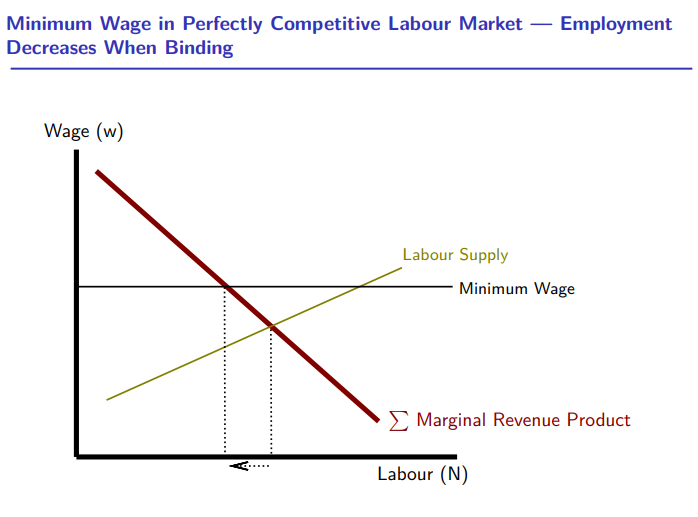
Draw the effect of minimum wage on Perfect Competition
Lowers employment
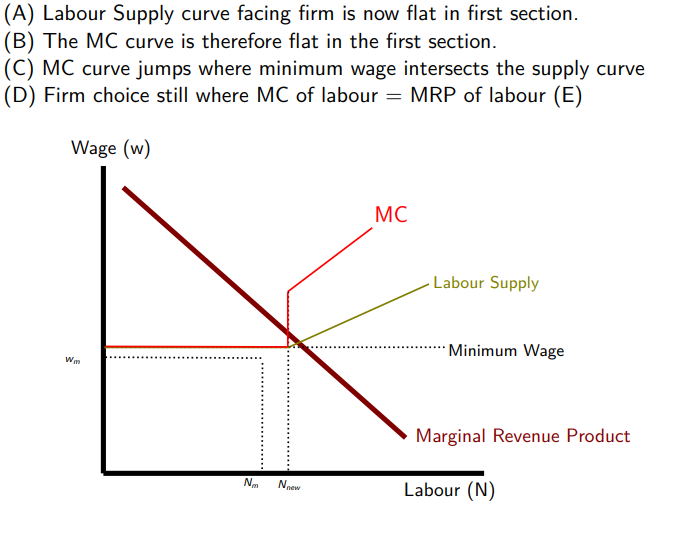
Draw the effect of minimum wage on Imperfect Competition
Increase in employment
Are monopsonies more common in low or high skilled labour markets?
High skill labour markets
Why might minimum wage policies not be effective in lower wage labour markets?
Low wage → more competitive → might decrease labour
What are the 4 points of minimum wage policy considerations as an anti-poverty tool
Lots of minimum wages are teenagers, not from poor families
Min wage doesn’t help non-working poor
In PC markets, lowers employments
In Imperfect Markets, increase employment (& wage)

