Substrates Final 1-1
 Studied by 0 people
 Call Kai
 Learn
Learn Practice Test
 Spaced Repetition
 Match
Match Flashcards
 Knowt Play
1/27

There's no tags or description
Looks like no tags are added yet.
Name | Mastery | Learn | Test | Matching | Spaced | Call with Kai |
|---|
No analytics yet
Send a link to your students to track their progress
28 Terms
There are a couple of factors affecting how humans perceive color. What are they?
Question 1
a. Light source
b.Object
c. Human observer
d. All of the above
d. all of the above
When two samples with different spectra appear to match under one illuminant but are different under another illuminant, this phenomenon is known as metamerism.
True or False
True
Which of the following measurement setting is used in the printing industry?
a. D50, 2°
b. D50, 10°
c. D65, 2°
d. D65, 10°
a. D50, 2°
Which of the following measurement setting was developed for the textiles industry?
a. D50, 2°
b. D50, 10°
c. D65, 2°
d. D65, 10°
D65, 10°
Which of the following is the color temperature of daylight?
a. 9300 K
b. 6500 K
c. 2850 K
d. 7300 K
b. 6500 K
A viewing booth white point in prepress is likely to have what color temperature?
a. D93
b. D75
c. D60
d. D50
d. D50
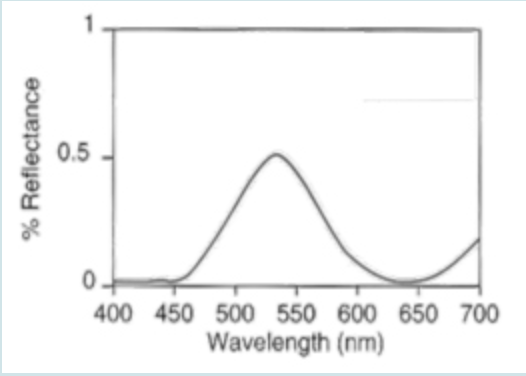
The figure shows the spectrum of a sample, the color of this sample is
b.
Green
The primary colors according to additive light theory are …
a. Black, white, and gray
b. Cyan, magenta, and yellow
c. Red, green, and blue
d. None of the above
c. Red, green, and blue
The primary colors of subtractive color theory are...
a. Black, white, and gray
b. Cyan, magenta, and yellow
c. Red, green, and blue
d. None of the above
b. Cyan, magenta, and yellow
According to subtractive color theory, a cyan ink film printed over a yellow ink film will yield which color?
a. Green
b. Blue
c. Red
d. Purple
a. Green
According to additive color theory, a red light combined with green light will yield which of the following colors?
Question 11Select one:
a. Blue
b. Yellow
c. Cyan
d. Magenta
b. Yellow
According to additive color theory, a blue light combined with green light will yield which of the following colors?
a. Blue
b. Yellow
c. Cyan
d. Magenta
c. Cyan
Rods found in the human eye are responsible for which of the following?
a. Perception of colorless, dim light
b. Perception of color
c. Both of the above
d. None of the above
a. Perception of colorless, dim light
Cones found in the human eye are responsible for which of the following?
a. Perception of colorless, dim light
b. Perception of color
c. Both of the above
d. None of the above
b. Perception of color
An LCD displays color using the
a. Additive color model
b. Subtractive color model
c. Munsell color model
d. HSB color model
a. Additive color model
A printing press reproduce color using the
a. Additive color model
b. Subtractive color model
c. Munsell color model
d. HSB color model
b. Subtractive color model
Which of the following is NOT a characteristic of an appealing printed photographic image?
a. Contrast
b. Balance
c. Density
d. Sharpness and detail
c. Density
Color correction is the informed adjustment of images to bring them into a state of visual optimization.
True
False
True
Color management is the informed control of the entire color reproduction process, from input through output, using specialized measurement devices, software, control elements, and practices.
True
False
True
The region of the electromagnetic spectrum between 380 and 720 nanometers.
Viewing Spectrum
Known spectral data established by the CIE for difference types of light sources.
CIE standard illuminants
A hypothetical observer having the tristimulus color-mixture data recommended in 1931 by the CIE for a 2° viewing angle. A supplementary observer for a larger angle of 10° was adopted in 1964.
CIE standard observer
A measurement of the color of light radiated by an object while it is being heated. This measurement is expressed in terms of degrees Kelvin.
Color Temperature
The CIE Standard Illuminant that represents a color temperature of 5000°K. This is the color temperature that is most widely used in graphic arts industry viewing booths.
D50
The CIE Standard Illuminant that represents a color temperature of 6500° K.
D65
The phenomenon where two colors appear to match under on one light source, yet do not match under a different light source.
Metamerism
Matching colors between an original image, scanner, monitor, color printer and final press sheet.
Color Management
Adjustment of images to bring them into a state of visual optimization
Color Correction
 Note
Note  Flashcards (117)