Foundations Unit 2 Exam - Clinical Decision Making
 Studied by 6 people
 Call with Kai
 Learn
Learn Practice Test
 Spaced Repetition
 Match
Match Flashcards
 Knowt Play
1/25

There's no tags or description
Looks like no tags are added yet.
Name | Mastery | Learn | Test | Matching | Spaced | Call with Kai |
|---|
No analytics yet
Send a link to your students to track their progress
26 Terms
How is “Assessment” used in clinical decision making?
Objective and subjective data is collected and can be validated data by using critical-thinking skills.
How is “Planning” used in clinical decision making?
the RN makes plans to address the client’s problems by formulating individualized interventions and goals to ensure the client achieves a positive outcome —> Goals can be short term or long term
Crackles in the posterior left lung, cool clammy skin, 20mL of amber-colored urine are all examples of what type of data?
Objective
Dull pain in the right knee, nausea for 2 days, report of difficulty breathing are all examples of what type of data?
Subjective
How is “Evaluation” used in clinical decision making?
The RN evaluates the effectiveness of the interventions provided and documents the client’s response. During evaluation, the RN should address the following questions: What did the client say or do? What did the nurse observe?
How would a nurse evaluate an intervention involving administering pain meds to a client?
Ask client to rate the pain from 1-10 again to see if there’s any improvement
What is delegation?
assigning a nursing activity or procedure to another person (e.g., from an RN to a PN or AP, or from a PN to an AP) who has the training appropriate for that activity or procedure.
What are the 5 Rights of Delegation?
Right circumstance, right person, right task, right supervision and evaluation, right communication and direction
When should a nurse delegate a task?
When it involves a stable client, falls under the PN or AP’s standard of scope, and PN or AP has appropriate training
What are tasks that cannot be delegated to UAPs?
Wound care, administration of meds, assessment of respiratory system, assessment of urine
What are tasks that CAN be delegated to UAPs?
Measurement of urine, measurement of pulse, collection of stool sample, ambulation to the bathroom
PNs (Practical Nurses) cannot do what tasks?
Assess data, cannot assume full responsibility for planning, manage unstable clients, administer intensive meds, and some procedures like dressing changes
Maslow’s Hierarchy of Needs
Psychological needs
Safety and security
Love and belonging
Self esteem
Self-actualization
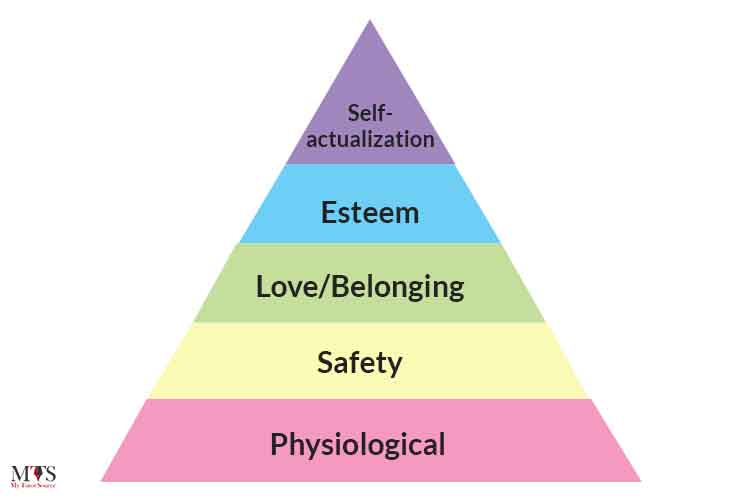
Which level of the Maslow’s Hierarchy of needs must be prioritized first?
Psychological needs
What are the components of the ABCDE priority setting framework?
A- Airway (1st)
B- Breathing
C- Circulation
D- Disability
E- Exposure
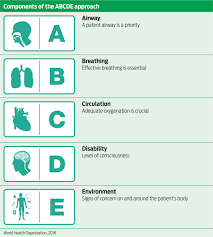
What does the nurse assess in “Airway” of the ABCDE framework
The nurse assesses if there is any airway obstruction, if airway is obstructed, the client is unable to speak and breath which requires immediate intervention
What does the nurse assess in “Breathing” of the ABCDE framework?
The nurse assesses client’s breathing status, after airway has been established. If a client is having difficulty breathing, continuously monitor the oxygen saturation and check other vital signs, nurse should also implement interventions such as fowler’s position or an oxygen mask
What does the nurse assess in “Circulation” of the ABCDE framework?
The nurse assesses for the adequacy of circulation. Manifestations of decreased circulation or perfusion may include: skin tone and temperature changes; decreased level of consciousness; prolonged capillary refill time; hypotension; changes in pulse rate, regularity, and volume; and decreased urine output.
What does the nurse assess in “Disability” of the ABCDE framework?
The nurse assesses for disability by determining a client’s neurologic status. This would include: client’s level of consciousness, response to verbal or painful stimulation, and level of orientation.
What does the nurse assess in “Exposure” of the ABCDE framework?
Check for the presence of internal or external bleeding, rashes or other indications of an allergic reaction, edema, deep vein thrombosis (blood clot)
Least Invasive/Least Restrictive
Always do the least invasive first, then do the invasive intervention as a last resort
Which are prioritized first: acute or chronic conditions?
Acute conditions because they can be severe and worsen rapidly
What is the order of prioritization of the Survival Potential Tags (mass casualty situation)?
Red Tag, Black Tag, Yellow Tag, Green Tag
Red - emergent, TREAT FIRST
Yellow - urgent or delayed
Green - nonurgent or minimal
Black - expected to die or deceased, comfort measures and allowed to die
A nurse is assisting with mass-casualty triage of clients following a gas explosion. Which of the following clients should the nurse recommend for priority treatment?
A client who is unable to walk, has burns on both legs, and reports hurting too much to move

What is the SOAP acronym? And what is it for?
S: Subjective
O: Objective
A: Assessment
P: Plan
The SOAP note is an organized communication tool for documentation
What is the IDEAL acronym for discharge planning?
I: Include the client and caregivers.
D: Discuss the five key areas—medications, home life, warning signs, test results, and follow-up.
E: Educate the client on the condition, the discharge process, and next steps.
A: Assess the effectiveness of the education.
L: Listen to the client’s goals and preferences.
 Note
Note  Flashcards (102)