Psych Chapter 7 LTM
 Studied by 0 people
 Call Kai
 Learn
Learn Practice Test
 Spaced Repetition
 Match
Match Flashcards
 Knowt Play
1/23

There's no tags or description
Looks like no tags are added yet.
Name | Mastery | Learn | Test | Matching | Spaced |
|---|
No study sessions yet.
24 Terms
What are the differences btw LTM and STM?
LTM
only a little bit of the processed info reaches
retains abstract semantic info
the info that does may be kept forever
must be retrievable
STM
retains specific sensory details of a physical stimulus
info only kept for 15-30 seconds.
Amnesia and Henry Gustav Molaison
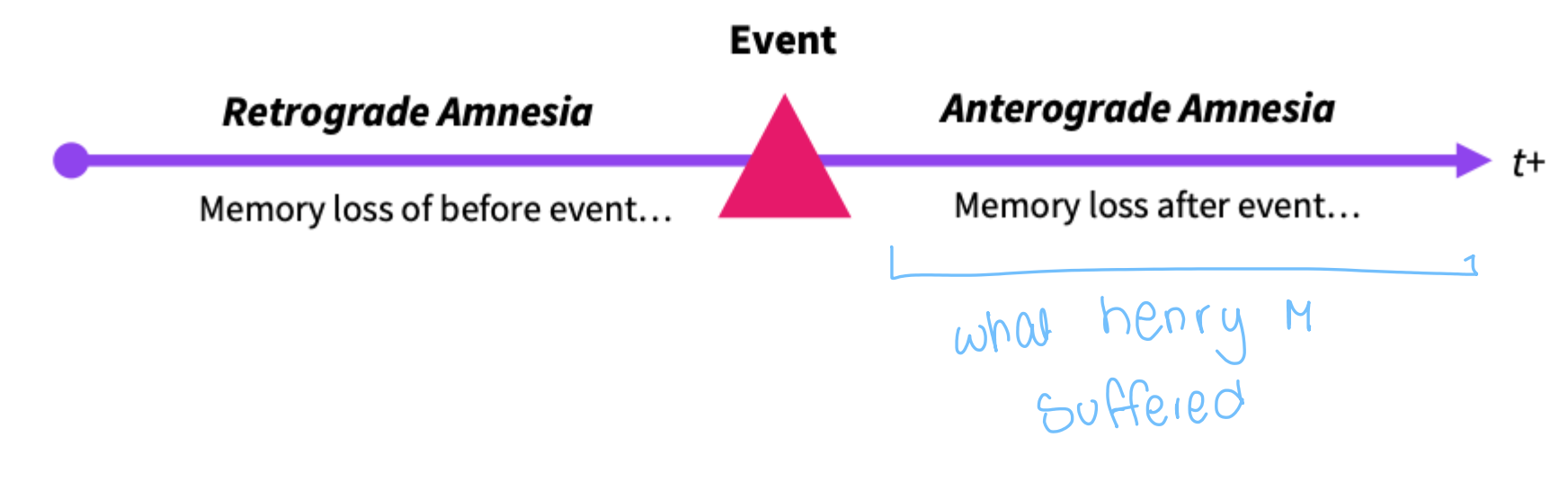
Amnesia: severely impaired LTM due to brain trauma
Retrograde Amnesia: difficulty remembering events that occurred leading up to the event
Anterograde Amnesia: difficulty remembering any new information they encounter.
Henry Gustav Molaison: fell of his bike, started having seizures so the doctors removed the left hippocampus.
after the surgery he stopped having seizures, maintained cognitive and intellectual functioning however he could not form new long term memories
interestingly, his short term memory remained intact
could repeat lists of words to rmr a sentence that was said to him and reply meaninfully
reportedly maintained information for up to 15 minutes,
taken as info that STM and LTM rely on diff brain mechanisms.
Clive Wearing
rare herpes induced infection that led to encephalitis
ex concert pianist and musicologist
suffered retrograde and anteretrograde amnesia
couldn’t rmr the names of his children or life events. greets his wife as if he hasn't seen her in years
cant form LTM
DID rmr language, how to play the piano, and basic world facts
INTACT STM: could rmr things that took place 10-15 seconds ago so he lived mostly in STM
Patient K.F
sustained a head injury from a motorcycle accident and he was able to form new LTMs but only had an STM capacity of 2-3 items
their injuries to the left hemisphere near regions of the parietal lobe (verbal process) were similar to that of another patient
supported the claim that damage to the hippocampus results in difficulties recalling and encoding information into LTM but preserves STM functioning.
more severe manifestation of this type of deficit is found in Alzheimers disease.
Double Dissociation
Double Dissociation: Gold standard of neuropsychological evidence for different mechanisms.
Damage to the hippocampus causes difficulties recalling or encoding information into LTM while preserving STM.
Damage to other cortical regions involved in STM or WM processing causes damage to STM processes while preserving LTM functioning.
What Information Enters Long-Term Memory?
Atkinson & Shiffrin Model:
Maintenance Rehearsal: Repeating information without any additional thought.
Elaborative Rehearsal: More effective! Repeating information while considering its meaning.
Serial Position Effect
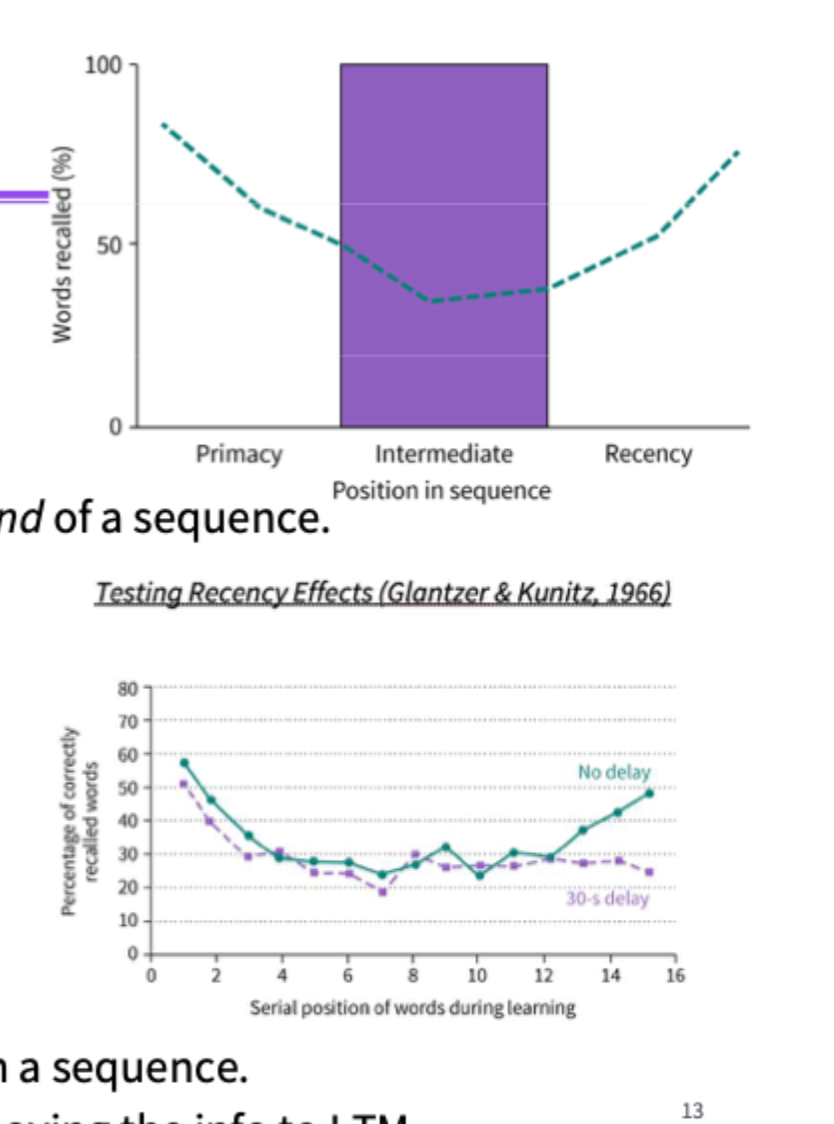
Serial Position Effect: When given a long string of numbers to repeat, recall performance is U-shaped.
Primacy Effect: The tendency to remember information presented earlier in a sequence.
Recency Effect: The tendency to remember information presented at the end of a sequence. Still likely in short-term memory. With a delay of 30 seconds after presentation, the recency effect goes away.
Levels of Processing Theory
Levels of Processing Theory (Craik & Tulving, 1972): The more deeply people process a word, the better they remember it.
In an experiment, participants were asked a yes/no question about a word:
Was the word upper/lower case?
Did it rhyme with another word?
Does the word fit the sentence?
Best performance occurred when the word was part of a sentence completion task.
important factor in determining encoding: the level at which the info was initially processed, emphasizes the importance of encoding. information must be retrieved before its considered truly remembered.
Memory retrieval cues: something u are familiar with from everyday life that can help you recalled info stored in LTM. mnemonic devices.
Transfer-Appropriate Processing
Encoding Specificity
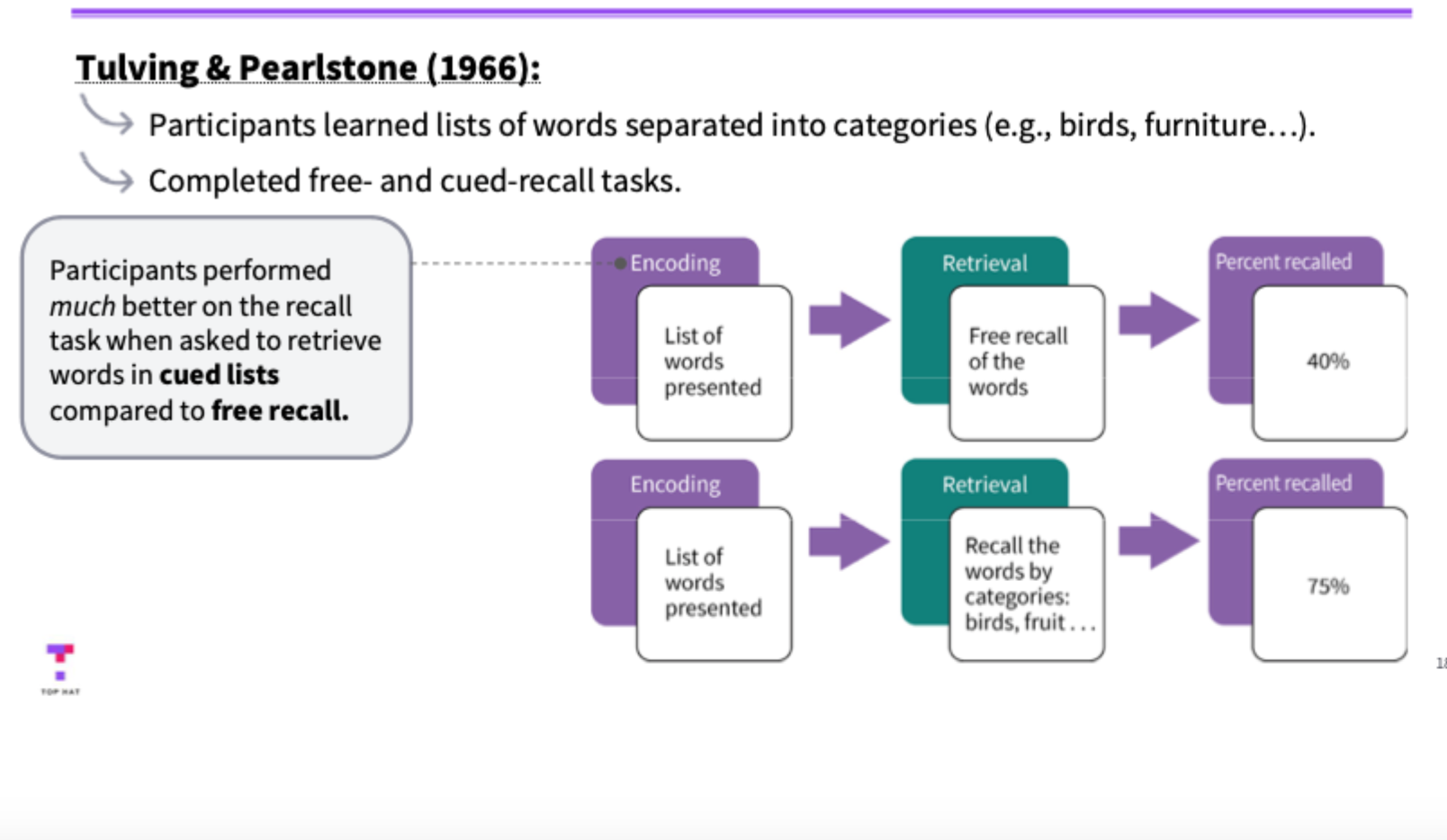
Encoding Specificity: Any cue associated with encoding can help facilitate later retrieval.
Godden & Baddeley (1975): People studied and recalled a list of words under two conditions:
Underwater in scuba gear: learned on land more
Standing on land. learned underwater more
Context-Dependent Memory: Memory is improved when we have consistent environments at the time of encoding and retrieval.
State-Dependent Memory:
Memory is improved when we have consistent internal states (such as mood or physiological state) at the time of encoding and retrieval.
Example: Being in the same mood when you study and when you take the test can improve recall.
But why? the brain encodes associations btw experiences and the world
Spacing Affect vs Testing effect
Spacing Effect: Recall is higher when information is repeated over multiple spaced-out periods.
It is best to study multiple times spaced out, compared to cramming.
Cepeda et al. (2008): Review information 10-20% of the interval at which it will be retrieved
Front: Testing Effect
Back:
Testing Effect: Information is better remembered if the individual has to retrieve it on their own, rather than being passively exposed to it.
When studying for a test, answering questions about the material on your own is better than re-reading a book chapter.
Types of Long-Term Memory
There is substantial evidence that there are different types of long-term memory:
Explicit/Declarative Memory: Memories that we can verbally describe or declare.
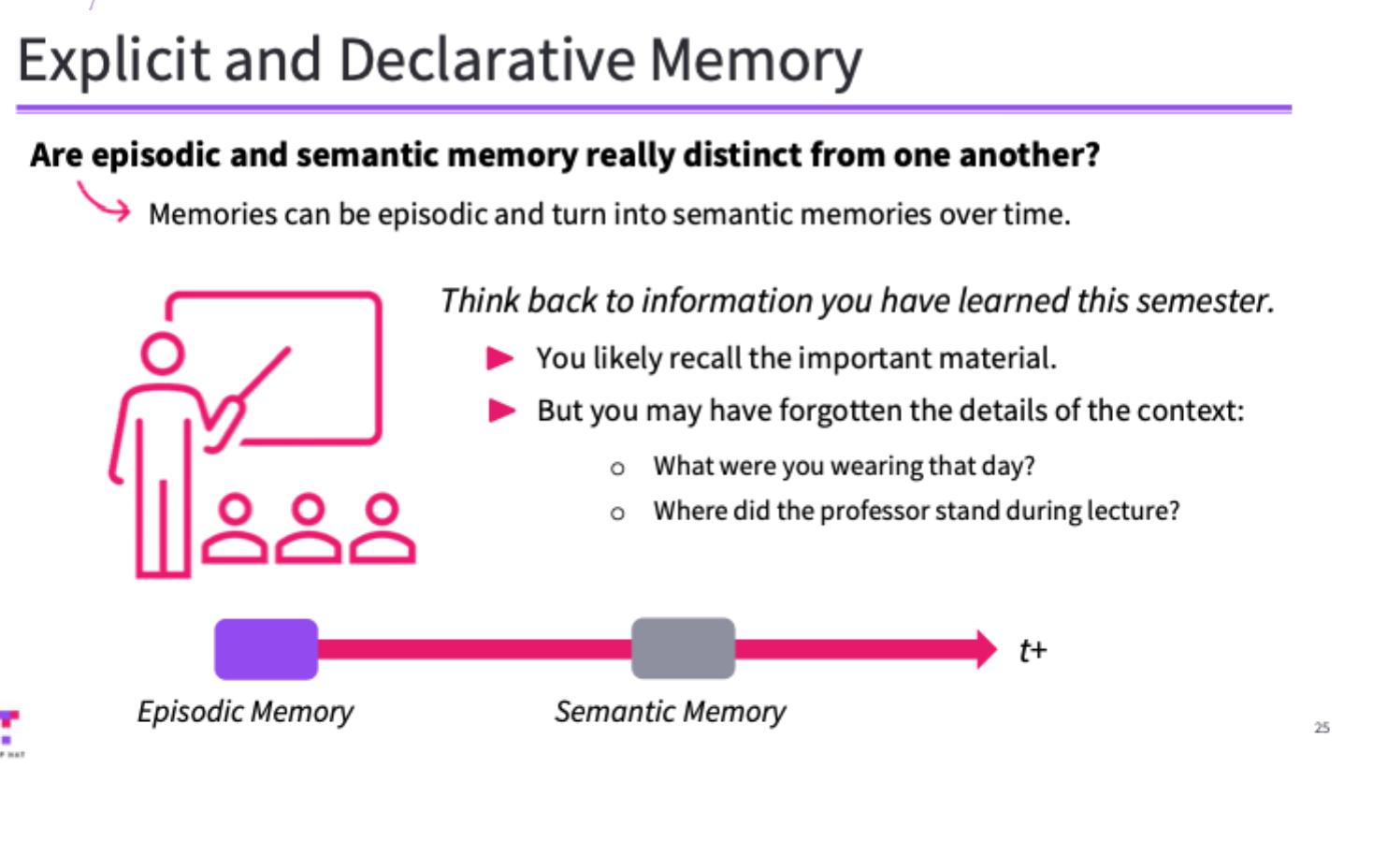
Episodic Memory: Memories of events that have happened directly to us.
Can recall sensory information in sequence, like mental time travel.
Semantic Memory: Memories of information without sensory details.
Includes the meaning of words, your address, phone number, etc.
Patients for explicit and declarative memory
Patient K.C.: Suffered hippocampal damage from a motorcycle accident.
Had no episodic memory, but some semantic memory was intact.
Could learn new information about his life but could not recall specific events from his life.
Patient with Semantic Memory Deficits: Suffered encephalitis from an infection.
Had intact episodic memory (could recall old and create new memories).
Showed deficits in semantic memory (forgot meanings of words and identities of famous people).
What are the neurological Differences in Episodic and Semantic Memory
Levine et al. (2004):
Participants recorded themselves describing basic facts about the world and events from their own lives. They then recorded fMRI data as they listened back to the recordings.
Listening to basic facts (semantic memory): Activation in the frontal and parietal lobes. (Executive function areas)
Listening to personal accounts (episodic memory): Activation in the occipital and temporal lobes. (Sensory encoding areas)
Episodic memory depends on the reactivation of the same brain regions that were engaged during the first encoding, while semantic memory depends on abstracted representations.
Implicit Memory
Implicit Memory: Information that is encoded and stored, then retrieved outside of consciousness.
Procedural Memory: Learned abilities to perform automatic behaviors/actions (e.g., walking, swimming, bicycling).
The brain encodes patterns of movement. It is particularly immune to forgetting compared to other types of memory.
Implicit memory and prejudice
Prejudice: Automatic negative judgments of an individual or group, even if judgments/attitudes are outside of conscious awareness.
Implicit Association Test (IAT) Greenwald et al:
A computerized test that aims to detect unconscious bias attitudes using reaction times.
Example: Classify words into categories as quickly as possible (e.g., sorting STEM jobs into “Man” and “Woman” categories).
Shorter reaction times indicate implicit biases.
Implicit Memory and Bias
The IAT has been used to examine prejudice and bias in various domains:
Race, Ableism, Domesticity, Religion
Results demonstrate how unconscious bias can influence behavior.
Not all implicit bias is negative.
Familiarity Effect: People tend to rate something more favorably if they've encountered it before, even if they don’t remember seeing it.
Propaganda Effect: People rate statements they’ve heard before as more truthful, even if the statements are not accurate.
Implicit Memory and Conditioning
Conditioning as Implicit Memory: Conditioning produces stable, long-term associations.
Operant Conditioning: Voluntary responses.
Classical Conditioning: Involuntary responses (e.g., phobias and fears).
Fear Conditioning: A form of implicit memory based on the amygdala.
Patient S.M.: Suffered bilateral amygdala damage and could not experience fear, even when exposed to fear-inducing stimuli like snakes and spiders. suggests amygdala is responsible for fear
The Durability of Implicit Memory
mplicit Memory is less susceptible to forgetting than explicit memory.
Patient H.M.:
Remembered procedural tasks even though he had severe amnesia after a bicycle accident.
Could still perform mirror-drawing tasks (copying images using only the reflection in a mirror) despite not remembering the task after multiple attempts.
Long-Term Memory and the Brain - System Consolidation
Two brain mechanisms have been identified as participating in LTM storage:
Consolidation: The process of making memories durable (sometimes permanent).
Synaptic Consolidation: Occurs at the synapses (the space between neurons where neurotransmitters pass from one to another).
Long-Term Potentiation (LTP): Receiving neurons become more likely to fire over time.
System Consolidation
System Consolidation:
Depends on the brain laying down new connections between neurons in the cortex.
The hippocampus works together with the cortex.
Some researchers posit:
The hippocampus initially stores memories and then moves them to the cortex for permanent memory.
Others think:
The hippocampus merely coordinates the storage of LTM in the cortex.
Hippocampal Replay
Hippocampal Replay:
A sequence of brain activity is repeated (or replayed) after initial encoding of an event.
Replay is typically faster than the first encoding but maintains temporal order.
Some believe this replay is essential for systems consolidation.
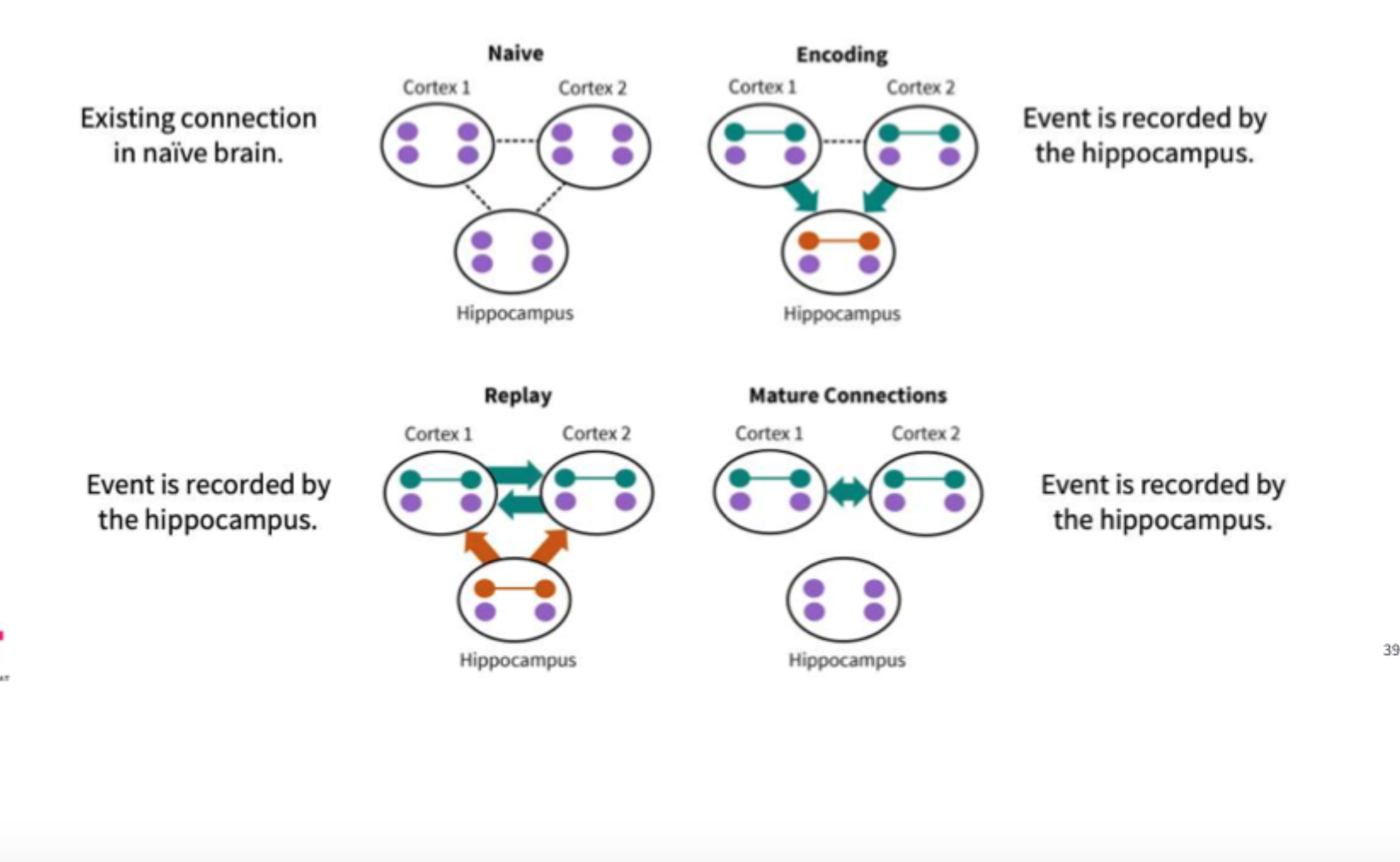
System consolidation can last a lifetime
Can last a lifetime.
It is much slower than synaptic consolidation.
As time goes on, memories that are consolidated may become more stable.
After a car accident, victims often forget events that occurred hours leading up to the event, but they usually do not forget longer-term memories.
Older memories had the chance to be consolidated.
 Note
Note  Flashcards (83)