CS 474 - First Midterm
0.0(0)
 Studied by 9 people
 Call Kai
 Learn
Learn Practice Test
 Spaced Repetition
 Match
Match Flashcards
 Knowt Play
Card Sorting
1/178

Earn XP
Last updated 11:20 PM on 3/18/23
Name | Mastery | Learn | Test | Matching | Spaced | Call with Kai |
|---|
No analytics yet
Send a link to your students to track their progress
179 Terms
1
New cards
Object-Oriented
Programming style where data and code are bundled together in *objects*
2
New cards
(Programming) Languages
A vocabulary and set of rules for instructing a computer to perform a task
3
New cards
Environments
* Languages do not exist in isolation; they need a set of tools to work
* E.g. build system (ant, makefile), compiler (clang, gcc), IDE (eclipse)
* E.g. build system (ant, makefile), compiler (clang, gcc), IDE (eclipse)
4
New cards
Goal
Understand what it means for a language to be OO, how it helps, what the choices are, how it affects the way we program
5
New cards
Modularity
* A system that is composed of modules is called modular
* Modularity allows the principle of **separation of concerns** to apply
* When dealing with details of each module in isolation
* When dealing with the overall characteristics of all modules and their relationships
* Modularity allows the principle of **separation of concerns** to apply
* When dealing with details of each module in isolation
* When dealing with the overall characteristics of all modules and their relationships
6
New cards
Horizontal modularity
* unrelated parts of a system are implemented separately
* E.g., implementation of Established state is separate from implementation of Closed state
* E.g., implementation of Established state is separate from implementation of Closed state
7
New cards
Vertical modularity
implementation of behavior is separate from its use
8
New cards
Separation of Concerns
Each state only reasons about properties directly related to that state
9
New cards
Practical benefits of modularity
* Decompose complex systems into simpler elements
* Divide and conquer
* Compose complex systems from existing modules
* Understand the system in terms of its elements, and modify the system by modifying a small number of its elements
* Divide and conquer
* Compose complex systems from existing modules
* Understand the system in terms of its elements, and modify the system by modifying a small number of its elements
10
New cards
Cohesion
relationships between elements within a module
11
New cards
Coupling
dependencies between modules
12
New cards
Abstraction
* Ignore nonessential details of objects
* Deal with a generalized, idealized models
* Recognize the class and object hierarchies within a complex software system
* Interfaces, design patterns, etc. are mechanisms for achieving abstraction
* Need to balance between hiding details that won’t be used, and exposing information that users will need
* Abstraction is taking a bunch of complicated code/ideas and figuring out general principles that describe most of it
* Deal with a generalized, idealized models
* Recognize the class and object hierarchies within a complex software system
* Interfaces, design patterns, etc. are mechanisms for achieving abstraction
* Need to balance between hiding details that won’t be used, and exposing information that users will need
* Abstraction is taking a bunch of complicated code/ideas and figuring out general principles that describe most of it
13
New cards
Refinement
Refinement is the opposite of abstraction
* Refinement is taking a high-level idea and gradually implementing more and more of the details/special cases
* Refinement is useful for improving or perfecting code once it’s written
* E.g., stepwise refinement: write complex programs by progressively introducing implementation details into simpler programs
* Refinement is taking a high-level idea and gradually implementing more and more of the details/special cases
* Refinement is useful for improving or perfecting code once it’s written
* E.g., stepwise refinement: write complex programs by progressively introducing implementation details into simpler programs
14
New cards
Incrementality
* Many software development activities proceed in a stepwise fashion, or in increments
* Feedback plays important role in incremental software processes
* Identify functions that constitute the core of software functionality
* Progressively add functions to the application being developed
* Identify intermediate stages for a software product
* Rapid prototyping is a way of progressively developing an application hand in hand with understanding its requirements
* Feedback plays important role in incremental software processes
* Identify functions that constitute the core of software functionality
* Progressively add functions to the application being developed
* Identify intermediate stages for a software product
* Rapid prototyping is a way of progressively developing an application hand in hand with understanding its requirements
15
New cards
Object
* An object is a kind of **first-class value** – it can be stored in a variable, passed as an argument, returned from a function, etc.
* An object contains both **state** and **behavior**
* In a typed language with classes, a class is usually a **type**, and objects are **instances** of that type
* Objects usually have a concept of **identity** that is separate from **equality**
* In most OO languages, an object’s behavior is **dynamically dispatched** – which version of a behavior we’ll see depends on the specific object we have at runtime
* An object contains both **state** and **behavior**
* In a typed language with classes, a class is usually a **type**, and objects are **instances** of that type
* Objects usually have a concept of **identity** that is separate from **equality**
* In most OO languages, an object’s behavior is **dynamically dispatched** – which version of a behavior we’ll see depends on the specific object we have at runtime
16
New cards
First-Class Values
* Can we assign it to a variable?
* Can we pass it to a function?
* Can we use it inside a function?
* Can we return it from a function?
* If any answer is “no”, then it is not a first-class value
* Can we pass it to a function?
* Can we use it inside a function?
* Can we return it from a function?
* If any answer is “no”, then it is not a first-class value
17
New cards
Composite Values
* More complex types made of other types
* Compare to primitive types like int, bool, float, that have only 1 value
* Example: structs in C
* Example: classes in OO languages
* Compare to primitive types like int, bool, float, that have only 1 value
* Example: structs in C
* Example: classes in OO languages
18
New cards
Identity and Equality
* For a primitive type, the answer is just “yes” – if the values are the same, then they’re equal.
* Java’s answer is No. obj1 and obj2 are different objects (stored in different places in memory), and that’s what == checks.
* Yes: obj1 and obj2 contain the same data (Equality)
* No: obj1 and obj2 are not the same object (Identity)
* Objects have an identity that is separate from equality
\
* Java’s answer is No. obj1 and obj2 are different objects (stored in different places in memory), and that’s what == checks.
* Yes: obj1 and obj2 contain the same data (Equality)
* No: obj1 and obj2 are not the same object (Identity)
* Objects have an identity that is separate from equality
\
19
New cards
Strings in Java
* Unlike with int/Integer, String can be treated as both primitive and a class type!
* Strings are composite types in Java
* Have equality and identity
* But Java caches string constants
* All equal string constants also have the same identity
* E.g., s1 and s2 in the previous slide
* It’s a good idea to __**never use == on Strings**__
* Unless you’re implementing a cache, you want to use equals
* Strings are immutable
* You cannot change a string
* If you try to change a string, you get another string with the change
* E.g., replace in the previous slide
* Strings are composite types in Java
* Have equality and identity
* But Java caches string constants
* All equal string constants also have the same identity
* E.g., s1 and s2 in the previous slide
* It’s a good idea to __**never use == on Strings**__
* Unless you’re implementing a cache, you want to use equals
* Strings are immutable
* You cannot change a string
* If you try to change a string, you get another string with the change
* E.g., replace in the previous slide
20
New cards
Identity vs Equality in Java
* You can define your own logic for equality
* Add a method equals to your class
* Identity is built-in, you cannot change it
\
* How to check for identity?
* Use == for composite types
* Primitive types do not have identity
\
* How to check for equality?
* Use .equals for composite types
* Use == for primitive types
* Add a method equals to your class
* Identity is built-in, you cannot change it
\
* How to check for identity?
* Use == for composite types
* Primitive types do not have identity
\
* How to check for equality?
* Use .equals for composite types
* Use == for primitive types
21
New cards
What makes a language *object-oriented*?
* It has objects in it
* Programming in the language is *centered* *around* objects
* Programming in the language is *centered* *around* objects
22
New cards
Encapsulation
* Encapsulation is the enforcement mechanism for abstraction
* Encapsulation separates the contractual *interface* of an abstraction from its *implementation*
* E.g., interface List vs class LinkedList
* Clients can use the interface, but cannot access the implementation (private fields, etc.)
* Encapsulation separates the contractual *interface* of an abstraction from its *implementation*
* E.g., interface List vs class LinkedList
* Clients can use the interface, but cannot access the implementation (private fields, etc.)
23
New cards
Modules
* Group **data (variables)** and **behavior (functions)** together while avoiding conflicts with existing similar names
* Complex visibility rules
* Some elements should be visible from the outside
* Other elements must not be visible from the outside
* Complex visibility rules
* Some elements should be visible from the outside
* Other elements must not be visible from the outside
24
New cards
Namespaces as Modules
* Static scope
* Modules live as long as the program
\
* No name collisions
* set_seed can be accessed through rand_mod::set_seed
* No problem if there’s another set_seed defined elsewhere
\
* All module internals accessible/visible from outside the module
\
* Only allows one random generator
* But we can actually fix that
* Modules live as long as the program
\
* No name collisions
* set_seed can be accessed through rand_mod::set_seed
* No problem if there’s another set_seed defined elsewhere
\
* All module internals accessible/visible from outside the module
\
* Only allows one random generator
* But we can actually fix that
25
New cards
Classes as modules
* Static scope
* Avoids name collisions
* We can control what to make visible and what to hide
* No external access to internal variable seed
* Better syntax for clients to use this module
* We can even have classes inside modules, which helps with abstraction
* Many invisible classes may work behind a visible class
* Avoids name collisions
* We can control what to make visible and what to hide
* No external access to internal variable seed
* Better syntax for clients to use this module
* We can even have classes inside modules, which helps with abstraction
* Many invisible classes may work behind a visible class
26
New cards
Hierarchy
* Simon’s law: __Hierarchical structures reduce complexity__
* Hierarchy is a ranking or ordering of abstractions
* In OO languages hierarchy is implemented using **inheritance**
* A class can be derived from one or more superclasses
* Languages may support single and/or multiple inheritance
* Hierarchy is a ranking or ordering of abstractions
* In OO languages hierarchy is implemented using **inheritance**
* A class can be derived from one or more superclasses
* Languages may support single and/or multiple inheritance
27
New cards
Inheritance
* Inheritance is a generalization/specialization hierarchy
28
New cards
Inheritance and Aggregation
* Inheritance expresses “is-a” relationship
* A Hawk “is-a” Bird
* A Car “is-a” Vehicle
* Aggregation expresses “has-a” relationship
* A Car “has-a” engine and 4 wheels
* A Bicycle “has-a” 2 pedals and 2 wheels
* Both cars and bicycles “is-a” vehicles
* A Hawk “is-a” Bird
* A Car “is-a” Vehicle
* Aggregation expresses “has-a” relationship
* A Car “has-a” engine and 4 wheels
* A Bicycle “has-a” 2 pedals and 2 wheels
* Both cars and bicycles “is-a” vehicles
29
New cards
Single Inheritance
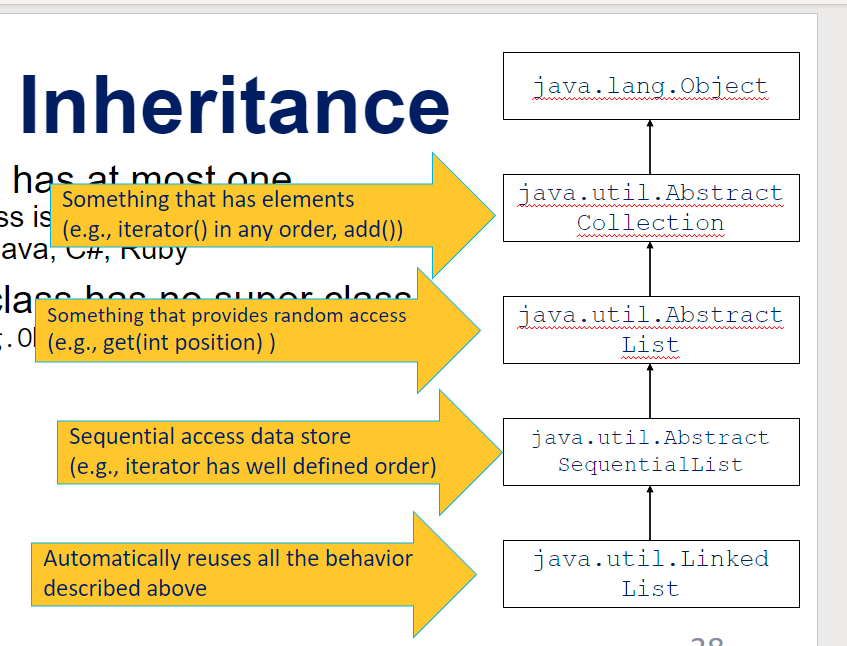
* Each class has at most one
* Superclass is also called parent class
* Used in: Java, C#, Ruby
* Topmost class has no superclass
* java.lang.Object in Java has no superclass
* Superclass is also called parent class
* Used in: Java, C#, Ruby
* Topmost class has no superclass
* java.lang.Object in Java has no superclass
30
New cards
Multiple Inheritance
* Each class may have many superclasses
31
New cards
Typing
* The type of an object is the __range of values__ that the object is allowed to take
* int : -231; …; -1,0; 1; 2; …; 231
* float: 2.33; 3.1415; …
* Point: { x = 1, y = 2 }; { x = 5, y = 12 }; …
* Types are flexible: we can substitute in subclasses
* List: List, LinkedList, ArrayList
* Type checking makes sure variables have a consistent type, and operations take operands of appropriate types
* If typing is not possible: compiler error
* int : -231; …; -1,0; 1; 2; …; 231
* float: 2.33; 3.1415; …
* Point: { x = 1, y = 2 }; { x = 5, y = 12 }; …
* Types are flexible: we can substitute in subclasses
* List: List, LinkedList, ArrayList
* Type checking makes sure variables have a consistent type, and operations take operands of appropriate types
* If typing is not possible: compiler error
32
New cards
Subtyping
* If B is a subtype of A, then an object of B can be used where an object of A is expected
* SortedLinkedList is a subtype of LinkedList
* An object of SortedLinkedList can be used wherever an object of LinkedList is expected
* SortedLinkedList is a subtype of LinkedList
* An object of SortedLinkedList can be used wherever an object of LinkedList is expected
33
New cards
Static vs Dynamic Types
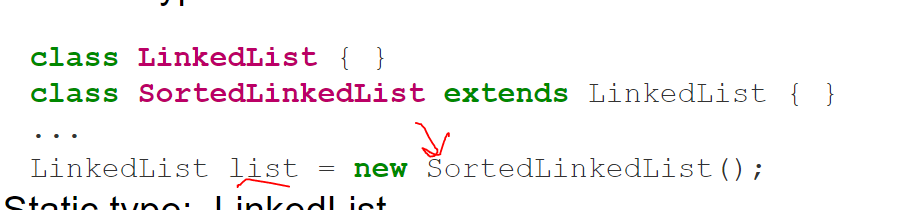
* Static type: LinkedList
* We can use any operation of LinkedList
* We cannot use operations only defined in SortedLinkedList
* Dynamic type: SortedLinkedList
* The implementation of SortedLinkedList will be used at runtime
* We can use any operation of LinkedList
* We cannot use operations only defined in SortedLinkedList
* Dynamic type: SortedLinkedList
* The implementation of SortedLinkedList will be used at runtime
34
New cards
Subtype Polymorphism
* Many shapes (poly: many, morph: shape)
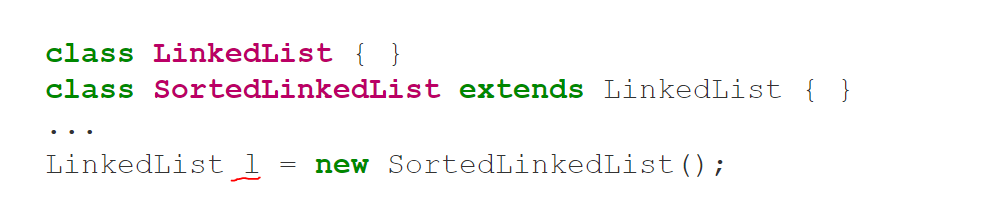
* A SortedLinkedList can “take on the shape” of a LinkedList
* A reference to a LinkedList could actually contain a SortedLinkedList
* A SortedLinkedList can “take on the shape” of a LinkedList
* A reference to a LinkedList could actually contain a SortedLinkedList
35
New cards
Dynamic Dispatch
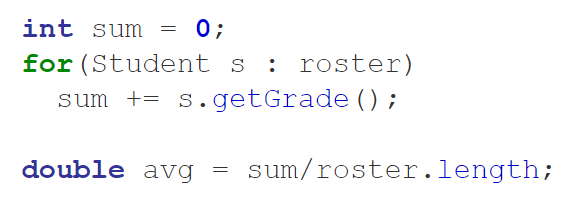
* s.getGrade() is a polymorphic call
* Calls the most specific method, depending on the runtime type of s
* The subclasses of Student __override__ the getGrade method with their own implementations
* Calls the most specific method, depending on the runtime type of s
* The subclasses of Student __override__ the getGrade method with their own implementations
36
New cards
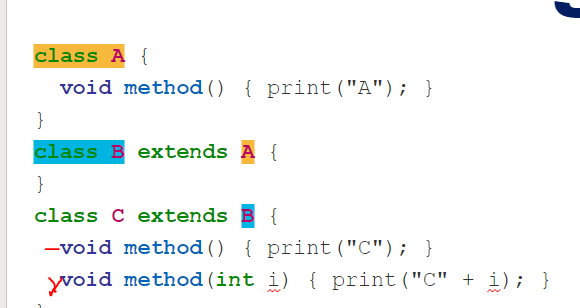
What are the conditions for overriding
A method has the __same signature__ as another **non-private** and **non-static** method in __one of__ the parent classes
* Same name
* Same return type
* Same number of arguments
* Same argument types
* Same name
* Same return type
* Same number of arguments
* Same argument types
37
New cards
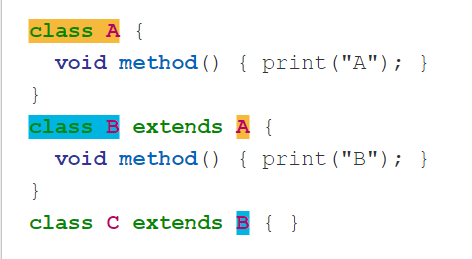
What does overriding do
Overriding is the thing we do in code that makes dynamic dispatch happen when the program runs.
\
Bound at method call time (runtime)
* Calls the most specific method
* new A().method() -> A
* new B().method() -> B
* new C().method() -> B
* Same call site may call different methods (dynamic dispatch)
\
Bound at method call time (runtime)
* Calls the most specific method
* new A().method() -> A
* new B().method() -> B
* new C().method() -> B
* Same call site may call different methods (dynamic dispatch)
38
New cards
What are the conditions for OVERLOADING
A method has the __same name and return__, **but different arguments**, than another method **on the same class**
39
New cards
How is overloading done behind the scenes?
* Bound at compile-time
* Compiler decides which method to call, based on the number and type of arguments in a method call
* May not be the most specific method possible
* Same call-site always calls the same overloaded method
* Compiler decides which method to call, based on the number and type of arguments in a method call
* May not be the most specific method possible
* Same call-site always calls the same overloaded method
40
New cards
Overriding vs Overloading
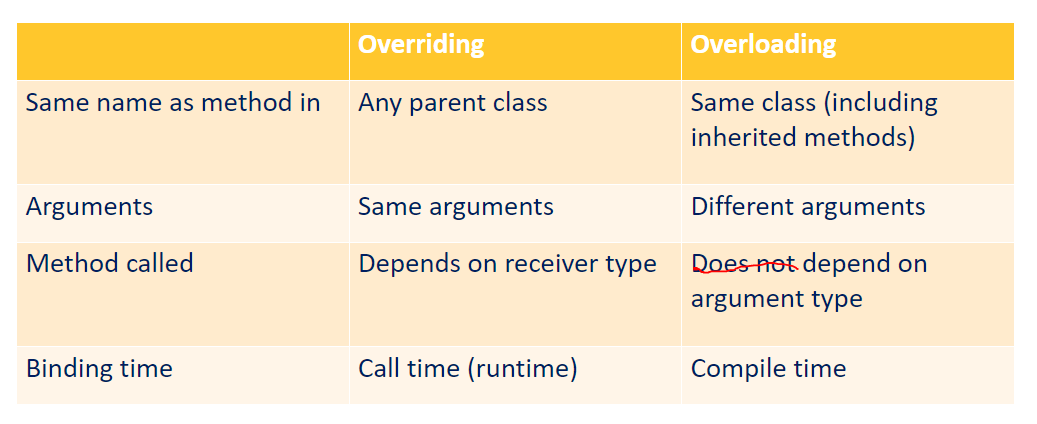
An overloaded method has the __same name and return__, **but different arguments**, than another method on the same class (including inherited methods)
\
An overridden method has the __same name and signature__ as another **non-private** method in __one of__ the parent classes
\
An overridden method has the __same name and signature__ as another **non-private** method in __one of__ the parent classes
41
New cards
Diamond Problem
Which method to call if a class extends from multiple parents simultaneously that override the same method
42
New cards
Method Resolution Order
MRO is the algorithm that Python uses to turn multiple inheritance into a single line
43
New cards
Java Abstract Classes
* Can declare fields that are not static (interfaces can only declare static fields)
* Abstract classes can extend other classes and implement interfaces (interfaces can only “implement” other interfaces)
* Similar to interfaces, abstract methods do not require implementation. Concrete classes extending abstract classes must implement all abstract methods
* Abstract classes can extend other classes and implement interfaces (interfaces can only “implement” other interfaces)
* Similar to interfaces, abstract methods do not require implementation. Concrete classes extending abstract classes must implement all abstract methods
44
New cards
Multiple Inheritance
* Allows to reuse code easily
* The code on default methods can be reused among many classes with ease
* Dangerous in practice
* Diamond problem
* Use only if needed, only when needed
* The code on default methods can be reused among many classes with ease
* Dangerous in practice
* Diamond problem
* Use only if needed, only when needed
45
New cards
Classes and Traits
* Classes are **instance generators** __first__, and **units of reuse** __second__
* Traits are units of reuse **only**
* Classes have a single line of hierarchy
* Avoid multiple line problems of multiple inheritance
* Still allows for incrementality
* Traits are essentially a set of methods with the state they keep
* State is per-instance, not per-class (unlike Java interfaces)
* Traits are units of reuse **only**
* Classes have a single line of hierarchy
* Avoid multiple line problems of multiple inheritance
* Still allows for incrementality
* Traits are essentially a set of methods with the state they keep
* State is per-instance, not per-class (unlike Java interfaces)
46
New cards
Inheritance Root
* In many OO languages, everything is an object
* Which means that there is an inheritance root
* Java: java.lang.Object
* Not true in C++, no inheritance root
* Top type
* Denoted as ⊤
* All objects are instances of ⊤
* Which means that there is an inheritance root
* Java: java.lang.Object
* Not true in C++, no inheritance root
* Top type
* Denoted as ⊤
* All objects are instances of ⊤
47
New cards
Inheritance bottom
* Denoted as ⊥
* Opposite of inheritance top
* Instances of any type is also an instance of ⊤
* Everything is a java.lang.Object
* Instances of ⊥ are also instances of all types
\
* Null can go anywhere an object (reference type) can go
* There is a single instance of null
* Close to ⊥ but not quite
* Opposite of inheritance top
* Instances of any type is also an instance of ⊤
* Everything is a java.lang.Object
* Instances of ⊥ are also instances of all types
\
* Null can go anywhere an object (reference type) can go
* There is a single instance of null
* Close to ⊥ but not quite
48
New cards
Public
* **Public**: All classes can access
49
New cards
Private
* **Private**: Only defining class can access
* Uses static dispatch, unlike all other modifiers
* Uses static dispatch, unlike all other modifiers
50
New cards
Protected
* **Protected**: Private + subclasses
51
New cards
Default
* **Default**: Package private, only classes in the same package can access
52
New cards
Minimum number of classes with a specific access modifier?
* A Java source file may have many classes
* Only one public class, zero or more default classes
* Only one public class, zero or more default classes
53
New cards
Static
* **Static**: Field/method belongs to the class
* Does not belong to an instance
* Consequences:
* Static methods use static dispatch
* All instances share the same value for a static field
* Does not belong to an instance
* Consequences:
* Static methods use static dispatch
* All instances share the same value for a static field
54
New cards
Final in Java
* Final class: Cannot be extended
* Final field: Read-only
* Not initializing it is a compilation error
* Final method: Cannot be overriden
* Opposite of __virtual__ in C++
* Final local variable or argument: Read-only
* Allows anonymous inner classes (and lambdas) to refer to that variable
* Final field: Read-only
* Not initializing it is a compilation error
* Final method: Cannot be overriden
* Opposite of __virtual__ in C++
* Final local variable or argument: Read-only
* Allows anonymous inner classes (and lambdas) to refer to that variable
55
New cards
Opaque Type
* An object with no state or methods available from the outside
* Can’t access members of the object, but can still assign it to variables, pass it as an argument, etc.
* Can’t access members of the object, but can still assign it to variables, pass it as an argument, etc.
56
New cards
Casting
* Casting allows to re-interpret an existing object __a__ of type __A__ as an object of another type __B__
* In Java, C++, C#: (B) a
* In Java, C++, C#: (B) a
57
New cards
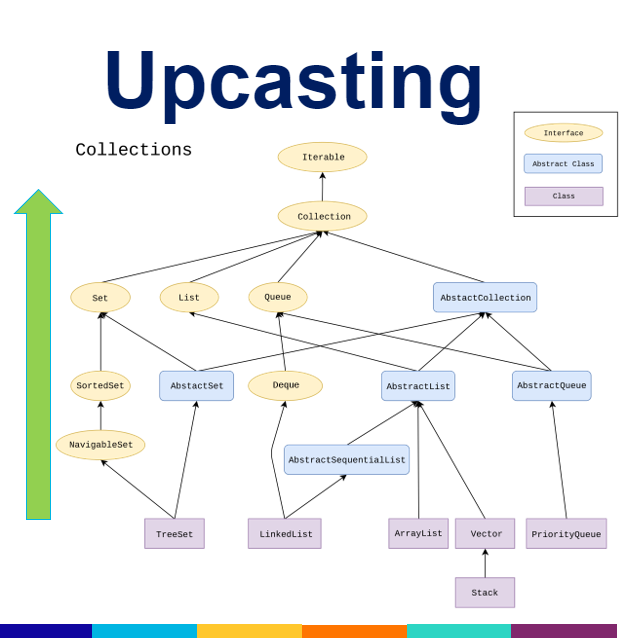
Upcasting
* __t__ has type __T__
* **T
* **T
58
New cards
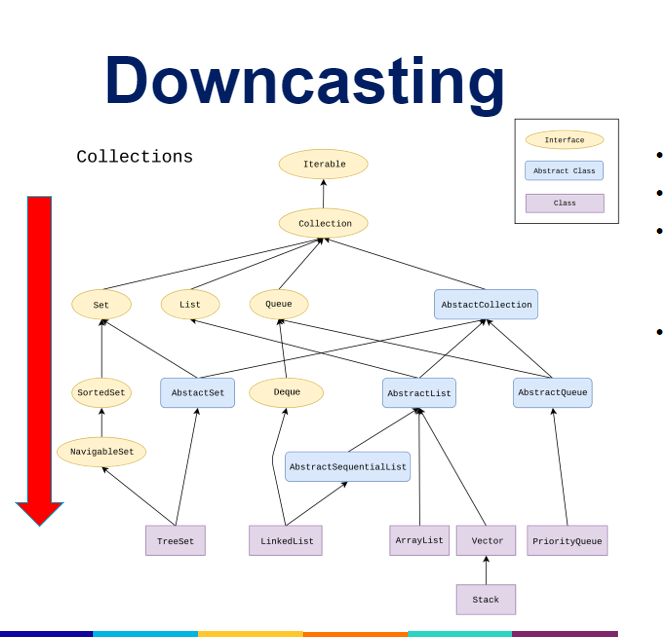
Downcasting
* __s__ has type __S__
* **T
* **T
59
New cards
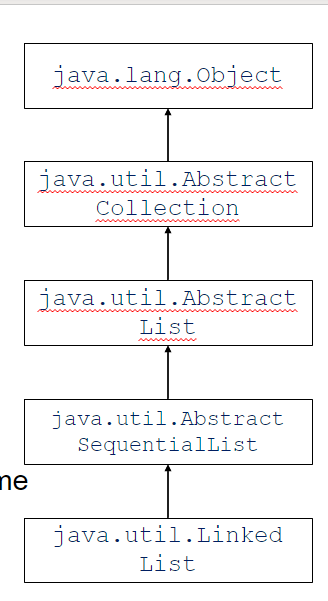
Static vs. Dynamic Types
AbstractCollection c = **new** LinkedList();
\
What is the type of c?
* Static type: AbstractCollection
* We can use any operation of AbstractCollection
* We cannot use operations only defined in LinkedList
* Dynamic type: LinkedList
* The implementation of LinkedList will be used at runtime
\
What is the type of c?
* Static type: AbstractCollection
* We can use any operation of AbstractCollection
* We cannot use operations only defined in LinkedList
* Dynamic type: LinkedList
* The implementation of LinkedList will be used at runtime
60
New cards
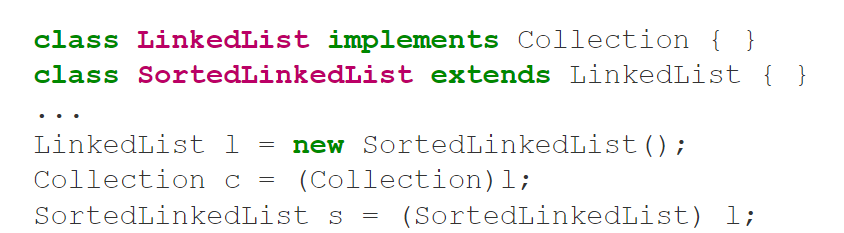
What does casting do at runtime?
* Casting doesn’t do anything at runtime! (except for checks and exceptions for downcasts)
* l, c, and s are all references to exactly the same object
* l, c, and s are all references to exactly the same object
61
New cards
When is casting unsafe?
* Downcasting is __unsafe__
* May fail at runtime
* __c__ may be a LinkedList, or it may be any other collection
* E.g., a HashMap
* Compiler inserts runtime check
* If failed, throws a java.lang.ClassCastException
* May fail at runtime
* __c__ may be a LinkedList, or it may be any other collection
* E.g., a HashMap
* Compiler inserts runtime check
* If failed, throws a java.lang.ClassCastException

62
New cards
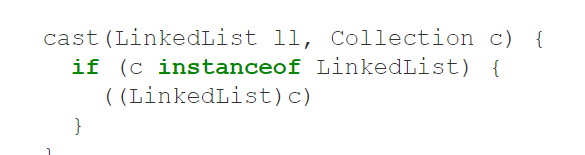
How could you make downcasting safer?
* Never fails
* We know that
* But compiler still inserts check
* Think twice before using instanceof
* You may be breaking abstraction/encapsulation
* Typically, there’s a better way around it
* We know that
* But compiler still inserts check
* Think twice before using instanceof
* You may be breaking abstraction/encapsulation
* Typically, there’s a better way around it
63
New cards
instanceof
* Checks the dynamic type of an object
* obj instanceof Class
* True if obj is an instance of Class
* Or an instance of a subclass of Class
* obj instanceof Interface
* True if obj’s class implements Interface
* Directly or transitively
* obj instanceof Class
* True if obj is an instance of Class
* Or an instance of a subclass of Class
* obj instanceof Interface
* True if obj’s class implements Interface
* Directly or transitively
64
New cards
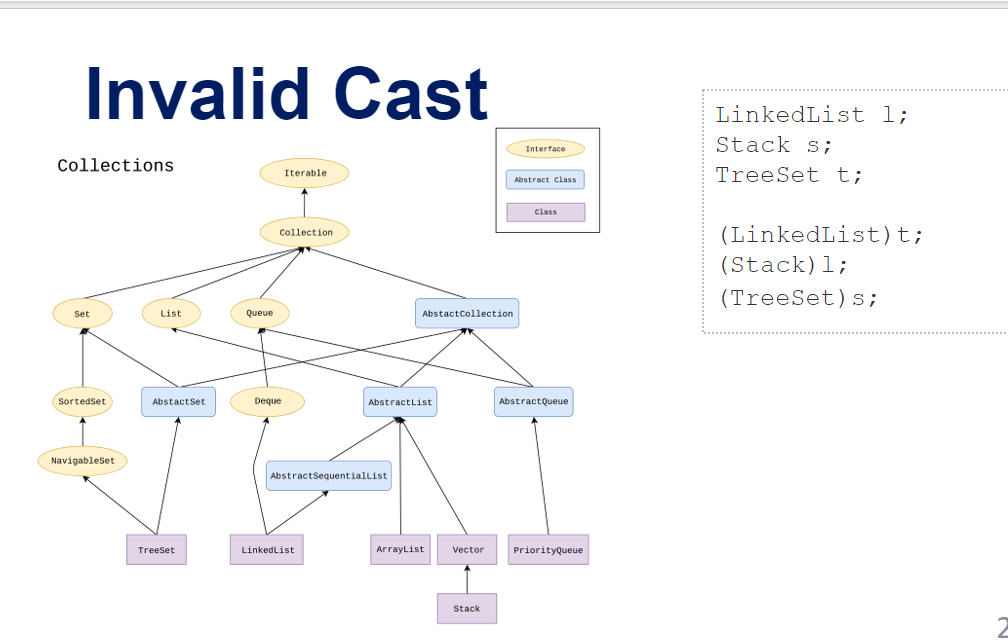
Are sideway casts valid?
NO!
“Sideways” casts fail at compile time (which makes sense, because they’d always fail at runtime!).
“Sideways” casts fail at compile time (which makes sense, because they’d always fail at runtime!).
65
New cards
Summarize Casting
* Upcast
* Never fails, always succeeds
* Checked by the compiler
* No check at runtime
* Downcast
* May fail
* Checked by the compiler
* Checked at runtime
* Unsafe cast
* Downcasts are unsafe casts
* Invalid cast
* Never succeeds
* Rejected by the compiler (compilation error)
* Casts don’t change the underlying object in any way!
* Never fails, always succeeds
* Checked by the compiler
* No check at runtime
* Downcast
* May fail
* Checked by the compiler
* Checked at runtime
* Unsafe cast
* Downcasts are unsafe casts
* Invalid cast
* Never succeeds
* Rejected by the compiler (compilation error)
* Casts don’t change the underlying object in any way!
66
New cards
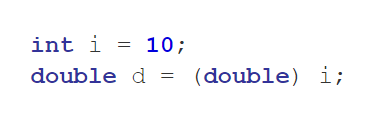
Type Coercion
* The two types are fundamentally different
* int is not a double, double is not an int
* However, one can be converted into the other
* The language knows how to do it automatically
* You can express that by using a type coercion
* Alternative: convert the types yourself
* int is not a double, double is not an int
* However, one can be converted into the other
* The language knows how to do it automatically
* You can express that by using a type coercion
* Alternative: convert the types yourself

67
New cards
Static Typing
* A Java program only compiles if all the types make sense
* Lots of guarantees:
* Methods exist
* A variable contains only objects of the declared type
* A method call is valid, all arguments are correct
* A Python program (dynamically typed) does not provide any of these guarantees
* More bugs
* Lots of guarantees:
* Methods exist
* A variable contains only objects of the declared type
* A method call is valid, all arguments are correct
* A Python program (dynamically typed) does not provide any of these guarantees
* More bugs
68
New cards
Dynamic Typing
* A Python program runs if the program text can be parsed
* Less guarantees:
* Methods may not exist
* A variable contains different types of objects
* Argument types in method calls may be wrong
* These errors only happen at runtime!
* Programs that use static types are free of these errors
\
* Faster implementation
* Types may slow you down at the start
* “I’m prototyping some code, types slow me down”
* “I’ll add types later”
* Less guarantees:
* Methods may not exist
* A variable contains different types of objects
* Argument types in method calls may be wrong
* These errors only happen at runtime!
* Programs that use static types are free of these errors
\
* Faster implementation
* Types may slow you down at the start
* “I’m prototyping some code, types slow me down”
* “I’ll add types later”
69
New cards
Gradual Typing
* Add types as you can, the language will figure out the rest
* Still an active research area with lots of open questions
* Still an active research area with lots of open questions
70
New cards
Subtyping
* If B is a subtype of A, then an object of B can be used where an object of A is expected
* LinkedList is a subtype of
* AbstractSequentialList
* AbstractList
* AbstractCollection
* Object
* An object of LinkedList can be used wherever an object of its super types is expected
* On this course, **B
* LinkedList is a subtype of
* AbstractSequentialList
* AbstractList
* AbstractCollection
* Object
* An object of LinkedList can be used wherever an object of its super types is expected
* On this course, **B
71
New cards
Static vs Dynamic Types Example
\
AbstactCollection c = **new** LinkedList();
\
What is the type of c?
\
AbstactCollection c = **new** LinkedList();
\
What is the type of c?
* Static type: AbstractCollection
* We can use any operation of AbstractCollection
* We cannot use operations only defined in LinkedList
* Dynamic type: LinkedList
* The implementation of LinkedList will be used at runtime
* We can use any operation of AbstractCollection
* We cannot use operations only defined in LinkedList
* Dynamic type: LinkedList
* The implementation of LinkedList will be used at runtime
72
New cards
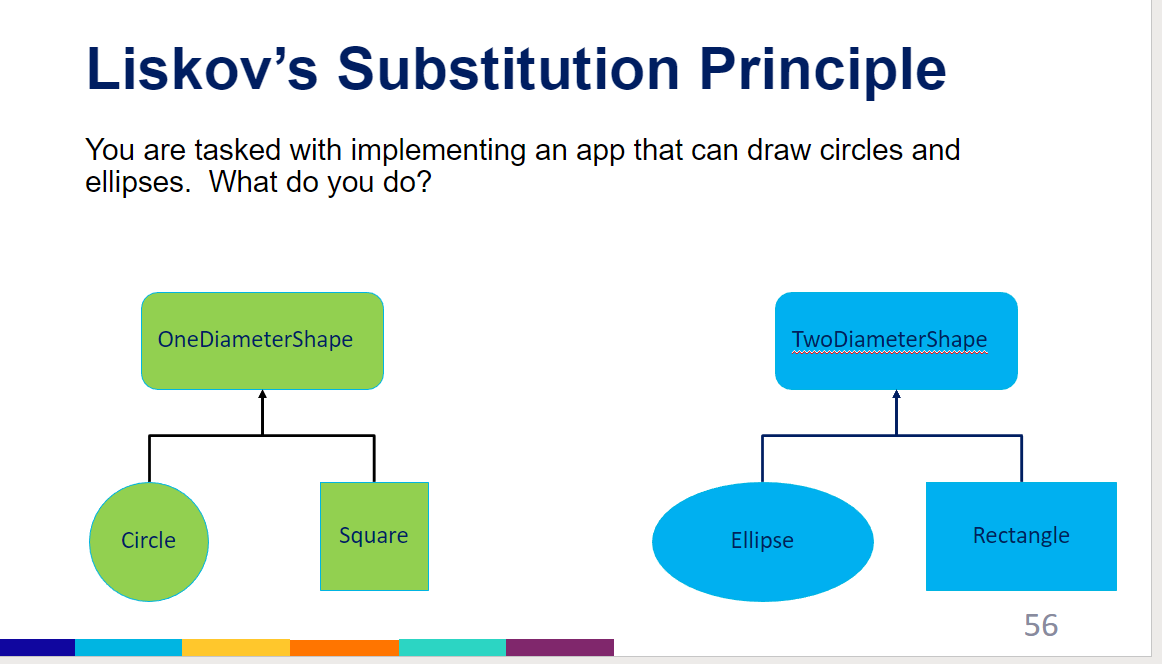
Liskov’s Substitution Principle
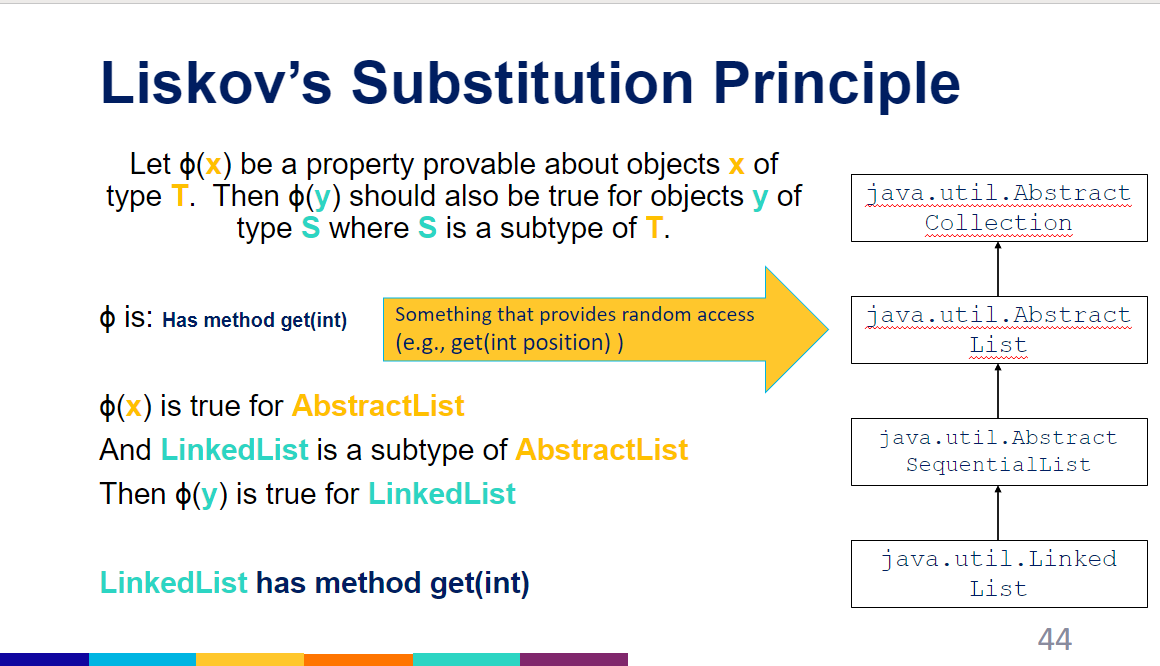
Let ϕ(**x**) be a property provable about objects **x** of type **T**. Then ϕ(**y**) should also be true for objects **y** of type **S** where **S** is a subtype of **T**.
* E.g., **T** has method/field m
* More general and abstract than subtyping
* You should consider this when you design your own OO programs
* E.g., **T** has method/field m
* More general and abstract than subtyping
* You should consider this when you design your own OO programs
73
New cards
Circle-Ellipse Problem
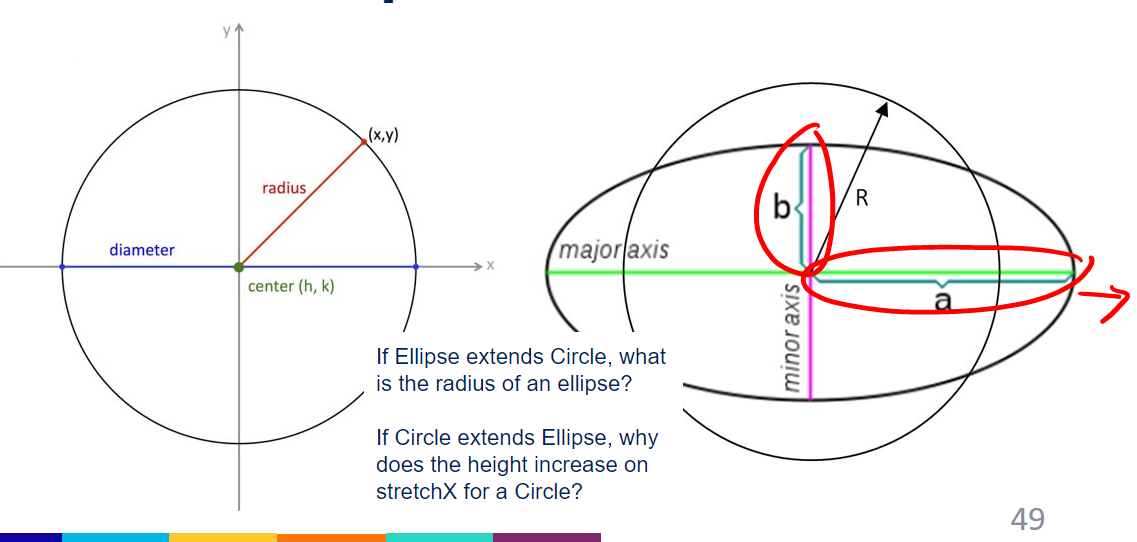
74
New cards
Barbara Liskov
* Turing Award recipient in 2008
* “Nobel Prize” for Computer Science
* Turing lecture and interviews: __https://amturing.acm.org/award_winners/liskov_1108679.cfm__
* Invented the language CLU in 1975
* Abstract Data Types
* Iterators
* Exceptions
* Subtype Polymorphism
* Liskov’s Substitution Principle
* **And many more contributions!**
* “Nobel Prize” for Computer Science
* Turing lecture and interviews: __https://amturing.acm.org/award_winners/liskov_1108679.cfm__
* Invented the language CLU in 1975
* Abstract Data Types
* Iterators
* Exceptions
* Subtype Polymorphism
* Liskov’s Substitution Principle
* **And many more contributions!**

75
New cards
Constructor Order (Java, C++)
* From most abstract to most specific
\
1. Run inline initializers for current class
2. Call the super constructor
1. Explicitly
2. Implicitly calls the constructor without arguments
3. Run the body of the constructor
\
1. Run inline initializers for current class
2. Call the super constructor
1. Explicitly
2. Implicitly calls the constructor without arguments
3. Run the body of the constructor
76
New cards
Constructor Forwarding (Java)
* Forwarding to a constructor on the parent (i.e., **super**()) must:
* Be done at most once
* Be the first thing done in a constructor
* Forwarding to **super**() can be omitted __if there is a constructor without arguments__ on the parent class
* There is an implicit call to super() on all constructors
* Be done at most once
* Be the first thing done in a constructor
* Forwarding to **super**() can be omitted __if there is a constructor without arguments__ on the parent class
* There is an implicit call to super() on all constructors
77
New cards
How do constructors behave like?
Constructors behave like overloaded methods
* Static dispatch: The compiler decides which constructor to run
* No dynamic dispatch
* new A((List) new LinkedList()) would call A(Object)
* There is no constructor for List, even though there is one for LinkedList
* Only looks at static type
* Static dispatch: The compiler decides which constructor to run
* No dynamic dispatch
* new A((List) new LinkedList()) would call A(Object)
* There is no constructor for List, even though there is one for LinkedList
* Only looks at static type
78
New cards
Limitations of constructors
Java/C++ Limitations:
* Cannot have different constructors with same args
* Hard to express all combinations of optional arguments
* Cannot have different constructors with same args
* Hard to express all combinations of optional arguments
79
New cards
**Named and Optional Arguments (C# 4.0)**
Better solution than overloading

80
New cards
**Keyword and Optional Arguments in Python**
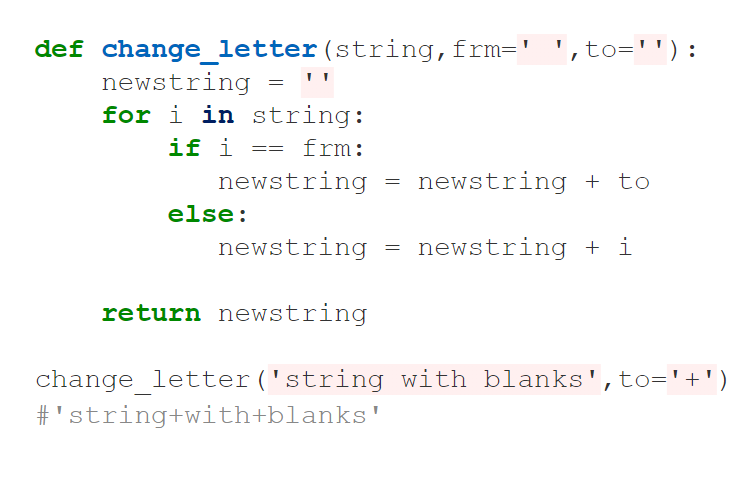
81
New cards
Constructors in C++
A a; // Calls A::A()
A **b**(**10**, 'x'); // Calls A::A(int,char)
A **c**{**10**, 'x’}; // Same as above since C++11
A \*d; // No constructor called
A &e; // No constructor called
A **b**(**10**, 'x'); // Calls A::A(int,char)
A **c**{**10**, 'x’}; // Same as above since C++11
A \*d; // No constructor called
A &e; // No constructor called
82
New cards
Copy Constructors in C++
* Intent: Declare a new object which content is “the same” as an existing object
* **Copy Constructors**: Constructors with a single argument, which has the same type as the class being constructed
* **Copy Constructors**: Constructors with a single argument, which has the same type as the class being constructed
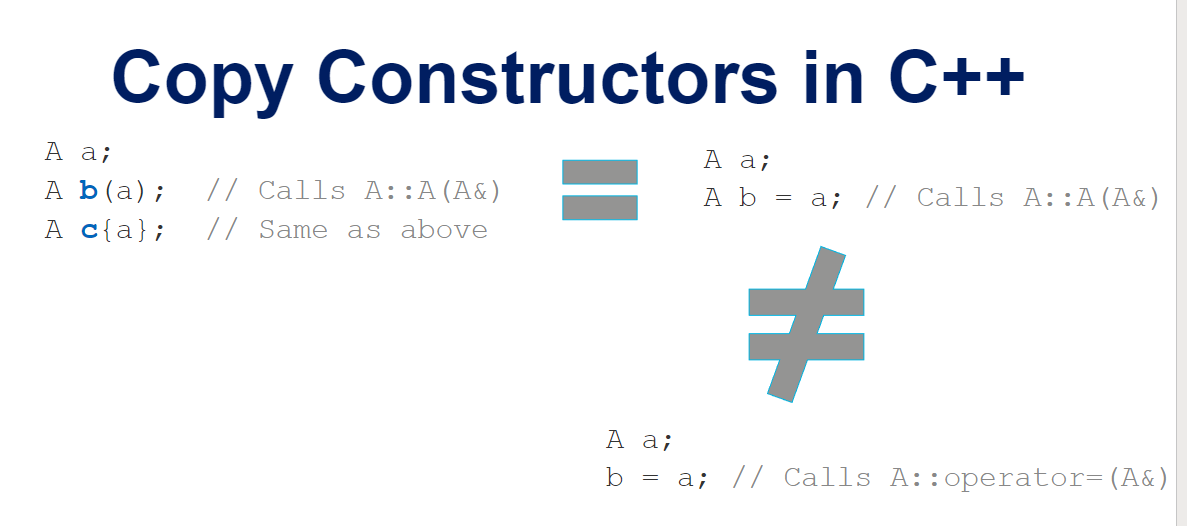
83
New cards
Constructor Forwarding (C++)
**class** **List** {
**int** size;
List(**int** size) { **this**.size = size; }
List() : List(**0**) { }
}
**class** **LinkedList extends List** {
Node \*first;
LinkedList(Node \*first) : List(**1**) { **this**.first = first; }
LinkedList() : List(**0**) { **this**.first = NULL; }
}
**int** size;
List(**int** size) { **this**.size = size; }
List() : List(**0**) { }
}
**class** **LinkedList extends List** {
Node \*first;
LinkedList(Node \*first) : List(**1**) { **this**.first = first; }
LinkedList() : List(**0**) { **this**.first = NULL; }
}
84
New cards
Explicit Destruction
* C++ needs explicit destructors due to manual memory management
* Destructors called in reverse order of constructors, on delete
* From specific class to its parents
* Destructors called in reverse order of constructors, on delete
* From specific class to its parents
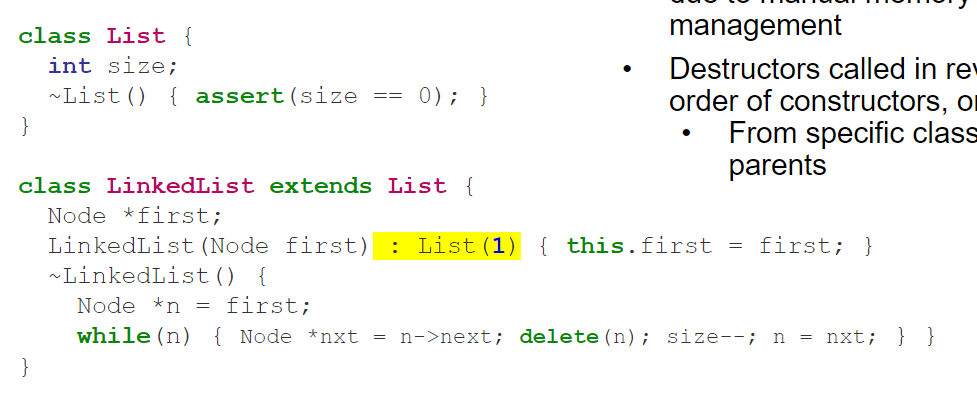
85
New cards
Implicit Destruction (C++)
* C++ calls destructors implicitly when stack frames go out of scope
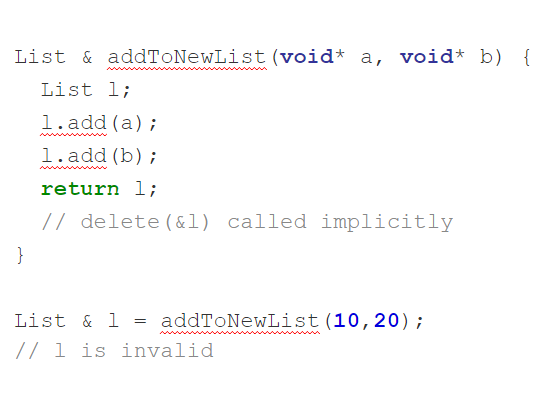
86
New cards
Implicit Destruction (Rust)
* Rust only uses implicit destruction
* No GC
* Automatic memory management
* Rust tracks lifetime of allocated memory
* References “own” the data
* Assigning transfers ownership
* Returning transfers ownership
* Functions can borrow data
* Get ownership for the duration and return ownership at the end
* No GC
* Automatic memory management
* Rust tracks lifetime of allocated memory
* References “own” the data
* Assigning transfers ownership
* Returning transfers ownership
* Functions can borrow data
* Get ownership for the duration and return ownership at the end
87
New cards
**Garbage Collection and Finalizers**
* Finalizers are methods that are called when an object is reclaimed by the garbage collector
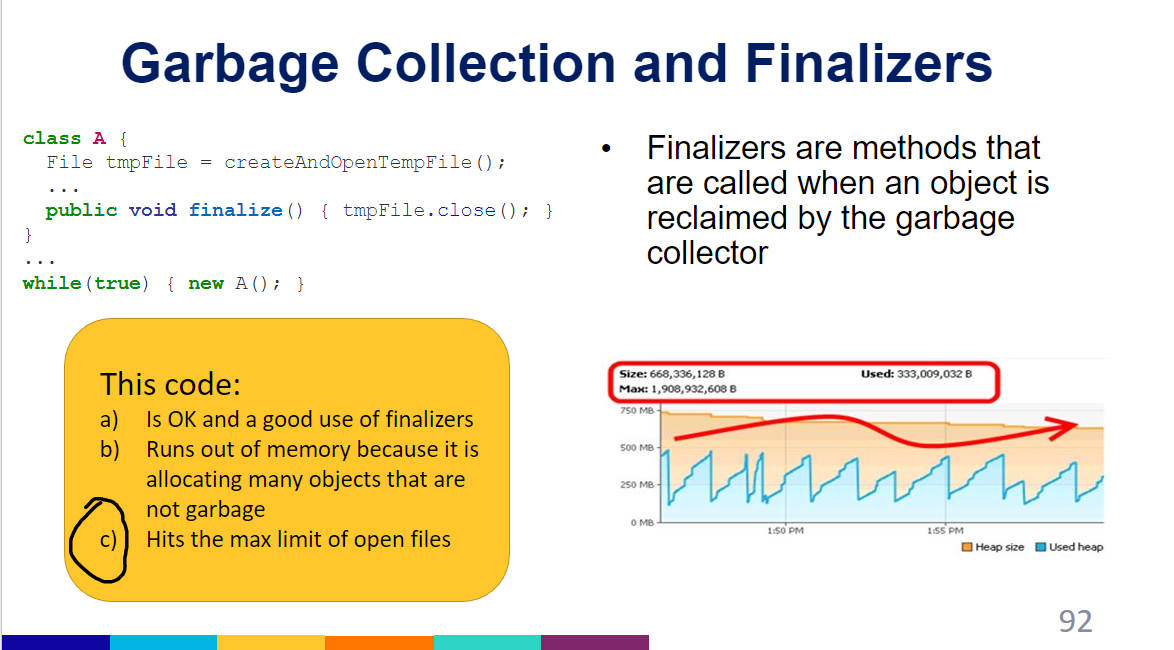
88
New cards
**You Should not use Finalizers**
* You don’t have any guarantee that finalizers will ever run
* Relying on them may cause your program to crash in weird and unexpected ways (e.g., see prev slide)
* Finalizers are slow and inefficient
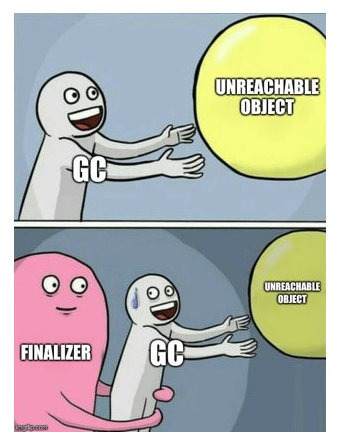
* The code below is valid, which means that the GC cannot reclaim an object that has a finalizer on the current cycle
* Needs to keep it around until the next GC cycle
\
**class** **A** {
**static** Object IDontLikeGC;
**public** **void** **finalize**() { A.IDontLikeGC = **this**; }
}
* Relying on them may cause your program to crash in weird and unexpected ways (e.g., see prev slide)
* Finalizers are slow and inefficient
* The code below is valid, which means that the GC cannot reclaim an object that has a finalizer on the current cycle
* Needs to keep it around until the next GC cycle
\
**class** **A** {
**static** Object IDontLikeGC;
**public** **void** **finalize**() { A.IDontLikeGC = **this**; }
}
89
New cards
**Java Weak/Soft References**
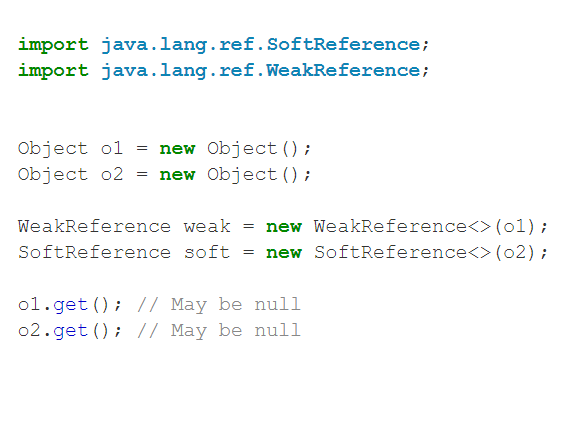
* Object only reachable through weak or soft references are considered garbage and can be collected
* **Weak References**: Collected eagerly as soon as possible
* **Soft References**: Left as floating garbage for as long as possible
* Useful for implementing caches
* **Weak References**: Collected eagerly as soon as possible
* **Soft References**: Left as floating garbage for as long as possible
* Useful for implementing caches
90
New cards
**Java Phantom References**
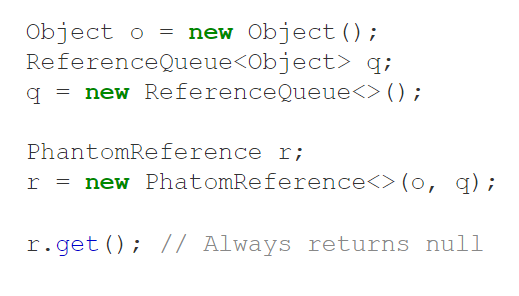
* Finalizers done better
* You get notified when a phantom reference is enqueued
* You then must do the clean-up and then dequeue the object
* Only then will the object be collected
* No way to get the original reference back
* If it is enqueued, you already lost all references
* You get notified when a phantom reference is enqueued
* You then must do the clean-up and then dequeue the object
* Only then will the object be collected
* No way to get the original reference back
* If it is enqueued, you already lost all references
91
New cards
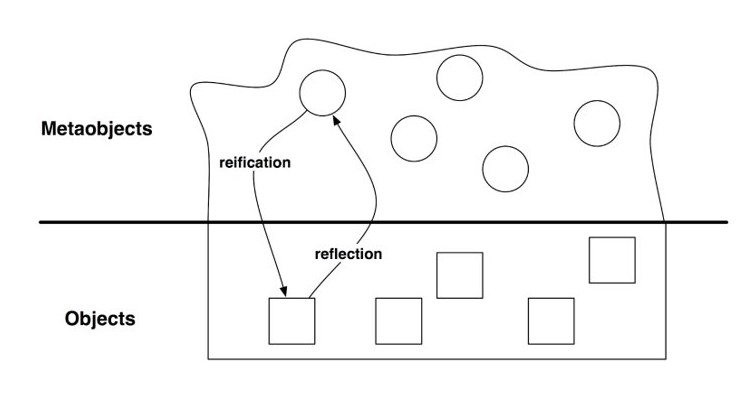
**Reification (to reify)**
* When you think of or treat something abstract as a physical thing.
* To consider or represent (something abstract) as a material or concrete thing : to give definite content and form to (a concept or idea)
* Process by which an abstract idea about a computer program is turned into an explicit data model or other object created in a programming language
* To consider or represent (something abstract) as a material or concrete thing : to give definite content and form to (a concept or idea)
* Process by which an abstract idea about a computer program is turned into an explicit data model or other object created in a programming language
92
New cards
How do different languages handle reification?
* __C__ reifies memory addresses
* E.g., **char**\* buffer = (**char**\*) **0xB800000**;
* __Java__ reifies generics
* E.g., List, List
* __Javascript__, __Python__ reify their own interpreter
* Function eval
* E.g., **char**\* buffer = (**char**\*) **0xB800000**;
* __Java__ reifies generics
* E.g., List
* __Javascript__, __Python__ reify their own interpreter
* Function eval
93
New cards
Reflection
* **Reification** is necessary for reflection
* We need to represent the program as objects that the program itself can manipulate
* **Introspection**: Ability to __observe__ the structure of the program
* E.g., list the methods of a class
* **Intercession**: Ability to __modify__ the structure of the program
* E.g., add a new method, modify existing methods
* Sometimes called “self-modifying code”
* We need to represent the program as objects that the program itself can manipulate
* **Introspection**: Ability to __observe__ the structure of the program
* E.g., list the methods of a class
* **Intercession**: Ability to __modify__ the structure of the program
* E.g., add a new method, modify existing methods
* Sometimes called “self-modifying code”
94
New cards
Is reflection widely used in practice?
**Reflection is widely used in practice**
\
* How does JUnit know to run this test method?
* Use reflection to list all methods
* Look for methods that have the @Test annotation
* Earlier JUnit versions just looked for methods whose name started with test
* E.g., testFeature1, testFeature2
\
**public** **class** **Test01** {
**@Test**
**public** **void** **test**() {
…
Map
\
* How does JUnit know to run this test method?
* Use reflection to list all methods
* Look for methods that have the @Test annotation
* Earlier JUnit versions just looked for methods whose name started with test
* E.g., testFeature1, testFeature2
\
**public** **class** **Test01** {
**@Test**
**public** **void** **test**() {
…
Map
95
New cards
How is reflection used in practice?
* Test libraries
* Every company that uses Java use JUnit
* Integrated Desktop Environments (IDEs)
* Eclipse/Netbeans are IDEs for Java written in Java
* Use reflection to reason about developed program
* Serialization libraries
* Generic libraries that can convert objects into text, and text into objects
* Debuggers, analysis tools, etc.
* Every company that uses Java use JUnit
* Integrated Desktop Environments (IDEs)
* Eclipse/Netbeans are IDEs for Java written in Java
* Use reflection to reason about developed program
* Serialization libraries
* Generic libraries that can convert objects into text, and text into objects
* Debuggers, analysis tools, etc.
96
New cards
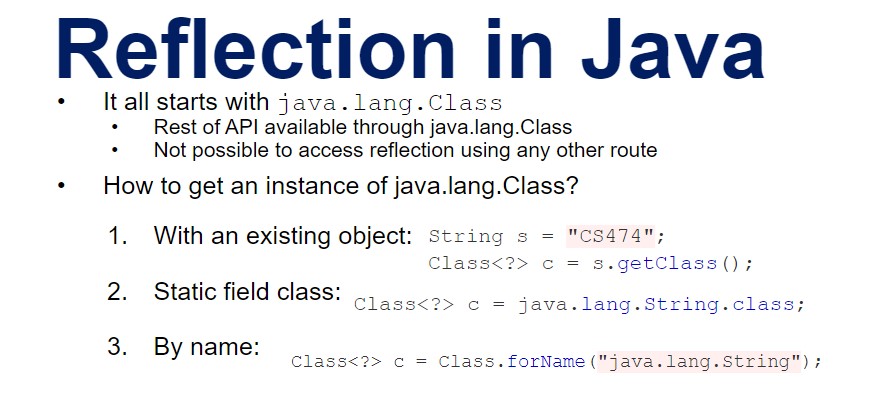
Reflection in Java
* Located in package java.lang.reflect
* Class java.lang.Class is also part of the reflection API
* Allows to:
* Get **R**un-**T**ime **T**ype **I**nformation (RTTI)
* Classes, superclasses, interfaces, methods, fields
* Create objects by class name
* Invoke methods by name and argument types
* Get/set contents of fields
* Throws a ton of exceptions
\
Basically, reflection lets you write code that does at runtime the things you usually do at compile time!
* Class java.lang.Class is also part of the reflection API
* Allows to:
* Get **R**un-**T**ime **T**ype **I**nformation (RTTI)
* Classes, superclasses, interfaces, methods, fields
* Create objects by class name
* Invoke methods by name and argument types
* Get/set contents of fields
* Throws a ton of exceptions
\
Basically, reflection lets you write code that does at runtime the things you usually do at compile time!
97
New cards
Meta-classes
* A meta-class is a class that represents other classes
* java.lang.Class in Java
* Instances of a meta-class are classes
* Meta-classes define the state and behavior of other classes
* Just as classes define the state and behavior of instances
* java.lang.Class in Java
* Instances of a meta-class are classes
* Meta-classes define the state and behavior of other classes
* Just as classes define the state and behavior of instances
98
New cards
Refleciton/Reification
99
New cards
Meta-Object Protocol
* Description of how an object-oriented system works
* E.g., rules for overriding and dynamic dispatch
* E.g., rules for how single/multiple inheritance works
* In most languages, it cannot be modified
* E.g., Java, C#, C++, Python
* Some languages allow the developer to modify the MOP __while the program is running__
* E.g., LISP, CLOS, Smalltalk
\
* In CLOS, it is possible to change the following as the program is running:
* How to access fields (e.g., fields are never hidden)
* Which method to call
* Perform dynamic dispatch on the receiver? (Java)
* Treat overloading as more dynamic dispatch?
* E.g., rules for overriding and dynamic dispatch
* E.g., rules for how single/multiple inheritance works
* In most languages, it cannot be modified
* E.g., Java, C#, C++, Python
* Some languages allow the developer to modify the MOP __while the program is running__
* E.g., LISP, CLOS, Smalltalk
\
* In CLOS, it is possible to change the following as the program is running:
* How to access fields (e.g., fields are never hidden)
* Which method to call
* Perform dynamic dispatch on the receiver? (Java)
* Treat overloading as more dynamic dispatch?
100
New cards
Class Info in java.lang.Class
* **getName**: Fully qualified name of the class
* E.g., java.lang.String
* **getSimpleName**: Class name as defined in the source code
* E.g., String
* **getModifiers**: int that encodes modifiers
* E.g., java.lang.String
* **getSimpleName**: Class name as defined in the source code
* E.g., String
* **getModifiers**: int that encodes modifiers
 Note
Note  Flashcards (42)