Old Flexible Structures Final
 Studied by 0 people
 Call Kai
 Learn
Learn Practice Test
 Spaced Repetition
 Match
Match Flashcards
 Knowt Play
1/8

There's no tags or description
Looks like no tags are added yet.
Name | Mastery | Learn | Test | Matching | Spaced | Call with Kai |
|---|
No analytics yet
Send a link to your students to track their progress
9 Terms
Q1: Explain chain saw protective clothing how it works and the fabric structure (Chapter 16 Slide 12)
Loosely woven or knit fabrics
Yarns in the fabric “shred out” in less than 0.15s and jam the drive sprocket of the chainsaw and bring it to a dead stop
6 layers of aramid woven and needle punched fabric
Q2: Calculate the arrestance given
Q3: How do seat belts and air bags work together to reduce risk of injury in a major car accident, explain the timing (Chapter 17)
Seat belts are made to prevent the movement of the wearer in a controlled manner during a sudden deceleration of a vehicle
Crash sensors deploy the airbag which fully inflates within around 55 milliseconds to cushion the already slowed occupants head and chest
Together, the seat belt and airbag reduce the peak forces and prevent impact of the occupant with the hard interior surface of the vehicle
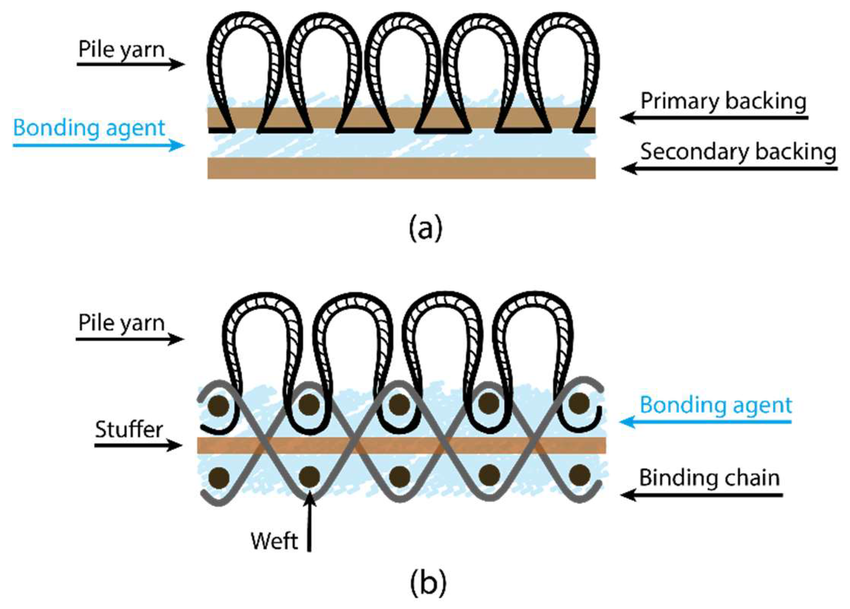
Q4: Draw tufted carpet structure and explain the function of each component (Chapter 7)
Includes these components:
Surface yarns
Nylon, polyester
Primary Backing
Usually woven
Split film polypropylene yarns
Coating
Latex
Secondary Backing
Either spun jute or fibrillated polypropylene yarns
Q5: Given a schematic of 3 fabrics and geotextiles and their corresponding flow rate, pick the best fabric for erosion control (Answer is none of them apparently) (Formulas in Chapter 11)
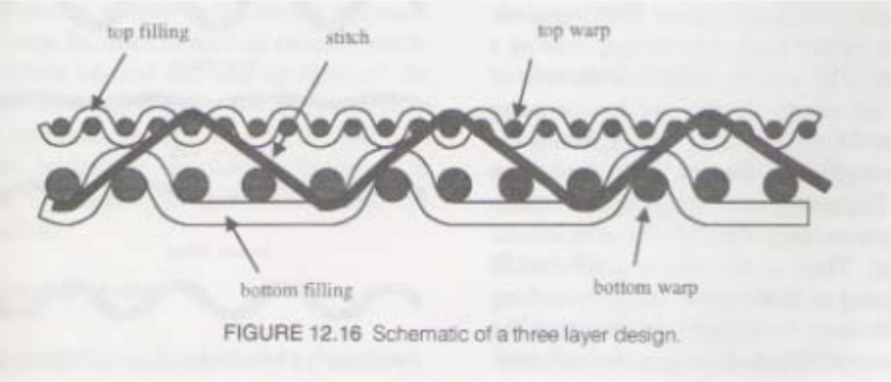
Q6: Draw a schematic of your choice of 3 layers of a filling (weft) profile for paper making. Label it
Q7: Calculate the ballistic limit of a vest given the number of material layers, a mass value, and a value with units of grams*mass/seconds
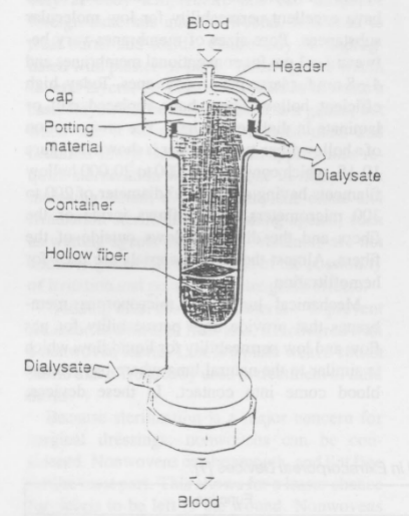
Q8: Draw a schematic of a hollow dialyzer, give the number of fibers in it, the fiber dimensions, and explain the overall dialysis process
High efficient
Hollow fibers
Blood flows inside of the fibers
Dialysate flows outside of the fibers
Cleaned blood exits and the used dialysate is discarded
Q9: Calculate the strength for each yarn given warp and weft counts per cm, the safety factor, and the applied force in units of N/cm
 Note
Note  Flashcards (150)