HINES WWII
 View linked note
 Call Kai
 Learn
Learn Practice Test
 Spaced Repetition
 Match
Match Flashcards
 Knowt Play
1/37

Earn XP
Description and Tags
Goat
Name | Mastery | Learn | Test | Matching | Spaced | Call with Kai |
|---|
No analytics yet
Send a link to your students to track their progress
38 Terms
Adolf Hitler
Nation: Germany
Government: Nazism (fascist)
Main Goals: Establish Aryan supremacy, expand German territory (Lebensraum), destroy communism, eliminate Jews and other perceived enemies (Holocaust), reverse outcome of WWI
Expansion Targets: Europe
Lebensraum
The goal of expanding German territory to provide living space for the Aryan race.
Benito Mussolini
Nation: Fascist Italy
Government: Fascism
Main Goals: Restore the Roman Empire, expand Italy’s influence, strengthen the economy through state control
Expansion Targets: North Africa
Franklin Roosevelt
Nation: United States
Government: Democracy
Main Goals: Defeat Axis powers, support allies (Lend-Lease Act), strengthen the U.S. economy through the New Deal
D-Day
The Allied invasion of German occupied Normandy, France on June 6, 1944, marking a significant turning point in the European theater of the war. The allies won the battle, pushing the Germans back
Pearl Harbor
Japanese surprise attack on the U.S. naval base on December 7, 1941, leading the U.S. to enter WWII.
Battle of Midway
A crucial naval battle in the Pacific theater, marking a turning point with a significant U.S. victory against Japan.
Iwo Jima
A pivotal battle in the Pacific where U.S. forces captured the island to establish a base for bombing Japan.
Kamikazes
Japanese flying planes directly into their target in suicide attacks
The Japanese navy was mostly destroyed
They were also running low on trained pilots and it's much easier to train a pilot if they never have to land
Pilots are volunteers
The Good War
A term referring to WWII, viewed as a period that ultimately benefited America despite its destruction. This is because it allowed for the growth of civil rights, and got America out of the great depression.
Axis Powers
The alliance of Germany, Japan, and Italy during WWII.
Total War
A war strategy that involves mobilizing civilian populations and resources for war efforts.
Fascism
Far-right authoritarian political ideology characterized by nationalism and suppression of opposition.
Kristallnacht
A violent anti-Semitic event in 1938, known as the Night of Broken Glass, signaling increased persecution of Jews. “Caused” by a young Jewish teenager assassinating a Nazi official, but in reality the Nazi’s orchestrated most of it, and just used the assassination as an excuse to carry it out. First time Nazi antisemitism became violent
Einsatzgruppen
Nazi special action groups responsible for mass shootings of Jews and communists during WWII. Execute about 1 million people within 6 months. The Nazi’s didn’t see this as enough, especially because the group’s use of shooting was considered an inefficient way to kill Jews. More and more of the members started to exhibit signs of PTSD as the war progressed.
Final Solution
The Nazi plan for the systematic extermination of the Jewish people, primarily through gas chambers.
SS (Schutzstaffel)
Hitler’s bodyguards and protection squads initially
Organization grew and they became known as the elite
Responsible for running the concentration camp system and carrying out the holocaust
Nuremberg Laws
Jews no longer German citizens
Jews can’t hold government positions including military
Jews and Germans can’t marry or have sexual relations
Manhattan Project
The secret U.S. project during WWII to develop atomic bombs.
Combat Fatigue
An earlier term for PTSD, describing the psychological effects of warfare on soldiers.
Japanese-American Internment
Forced relocation and incarceration of Japanese Americans in camps during WWII.
⅔ of them were citizens, and al were given no trial
Could only take what they could carry
Appealed to supreme court and lost
Some young men volunteered to fight in the war regardless
Winston Churchill
Nation: United Kingdom
Government: Democracy
Main Goals: Defeat Nazi Germany, preserve the British Empire, maintain global balance of power
Stalin
Nation: Soviet Union
Government: Communism
Main Goals: Defeat Nazi Germany, expand Soviet influence, industrialize the USSR, spread communism
Expansion Targets: Eastern Europe
Hirohito
Nation: Japan
Government: Monarchy (with military control)
False god, didn’t really actually do much
Hideki Tojo
Nation: Japan
Government: Military dictatorship
Main Goals: Expand Japan’s empire, defeat Western colonial powers in Asia, secure resources for Japan’s economy
Expansion Targets: China, Southeast Asia, Pacific Islands (Philippines, Indonesia, etc.)
Dwight Eisenhower
Nation: United States
Government: Democracy
Main Goals: Lead Allied forces in Europe, plan and execute D-Day, defeat Nazi Germany
Harry Truman
Nation: United States
Government: Democracy
Main Goals: End WWII (approved atomic bombings), contain Soviet expansion (Truman Doctrine), rebuild Europe (Marshall Plan)
Map of the war in Europe
Germany invades Poland (September 1, 1939) – Germany attacks Poland, leading Britain and France to declare war, starting WWII.
Britain and France declare war on Germany (September 3, 1939) – In response to the invasion of Poland, Britain and France enter the war against Germany.
Germany invades France, Belgium, and the Netherlands (May 1940) – Germany quickly overruns Western Europe using blitzkrieg tactics.
France surrenders to Germany (June 22, 1940) – France falls, and Germany occupies much of the country, leaving Britain to fight alone.
Battle of Britain (July–October 1940) – Germany launches an air campaign to weaken Britain, but the RAF resists successfully.
Germany invades the Soviet Union (June 22, 1941) – Hitler breaks the Nazi-Soviet Pact, launching Operation Barbarossa, the largest invasion in history.
Battle of Stalingrad begins (August 1942) – A turning point in the war, where Soviet forces begin pushing Germany back.
Allies invade Italy (September 1943) – The Allies land in Italy, leading to Mussolini’s downfall and Italy switching sides.
D-Day: Allied invasion of Normandy (June 6, 1944) – The Allies launch a massive amphibious invasion to liberate Western Europe.
Germany surrenders (V-E Day) (May 8, 1945) – Hitler is dead, Berlin falls, and Germany unconditionally surrenders, ending the war in Europe.
Map of the course of the war in the Pacific
Pearl Harbor
Japanese surprise attack the U.S, destroying part of their fleet
Midway
“Reverse pearl harbor”, surprise attack on Japan
U.S attack Japanese fleet, destroying 4 carriers while losing only one
Turning point of the war in favor of the U.S
Battle of Okinawa
Last island on the road to Japan
Bloodiest battle (50k American casualties, 12k dead, 117k Japanese casualties, 110k dead)
Many Japanese citizens commit suicide because the Japanese military told them America would torture them there
Atomic Bombing of Hiroshima and Nagasaki
Based on Okinawa and island hopping, America believes that an invasion of Japan will be extremely bloody
President Truman decides to use the atomic bomb on Hiroshima (78k dead) as a way to force Japan into surrender
When they still refuse to do so, he sends another atomic bomb to Nagasaki (25k dead)
Island hopping
American commanders decide to “hop” their way to Japan, one island at a time
Islands which are captured serve as bases and air fields for U.S forces
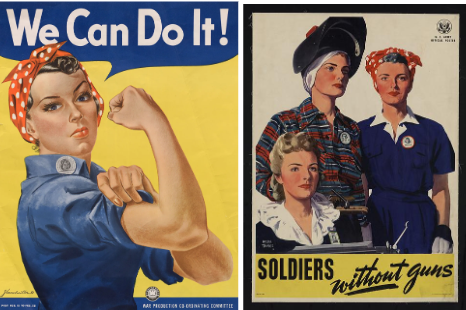
Rosie the Riveter
Symbol of feminism because woman joined the workforce, taking on job which were traditionally done by men
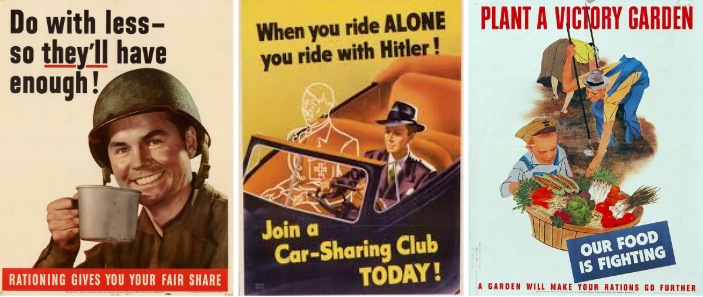
Rationing
Limiting of items that civilians can buy to ensure adequate supplies for the war
Strategic bombing
Bombing enemy cities to compromise enemy infrastructure (factories, etc.)
Initially used mostly by the axis powers
Japanese bomb Shanghai in China
Germans bomb Warsaw in Poland
Germans bomb London in Britain
Germans bomb Stalingrad in USSR
Later in the war, the Allies retaliated
British bomb Hamburg in Germany
Brits and America bomb Berlin in Germany
Brits and America bomb Dresden in Germany
America bombs Tokyo (bloodiest bombing of the war, even more so than the atomic bombings)
“Double V Campaign”
U.S military remains segregated
Black troops used for manual labor not combat
Eventually, government made all black fighting units due to pressure from black leaders
“Victory at home against racism and segregation and victory in the war”
Facism
Far-right authoritarian ideology. Nationalism, dictatorship, militarism, suppression of opposition. Anti-democratic, state-controlled economy, strict social order. Ex: Nazi Germany, Fascist Italy
Combat fatigue
The old term for PTSD
Symptoms:
Psychological: Anxiety, depression, confusion, mood swings, nightmares.
Physical: Fatigue, shaking, rapid heartbeat, headaches, insomnia.
Behavioral: Irritability, withdrawal, startle response, trouble following orders
“Big Three” at the Yalta Conference
Churchill, FDR, Stalin meet to discuss the end of the war
Stalin promises to allow free elections in eastern Europe and not to impose communism
USSR also promises to join the war against Japan
FDR dies soon after