Psych1001- Ch.13
 Call Kai
 Learn
Learn Practice Test
 Spaced Repetition
 Match
Match Flashcards
 Knowt Play
1/57

There's no tags or description
Looks like no tags are added yet.
Name | Mastery | Learn | Test | Matching | Spaced | Call with Kai |
|---|
No analytics yet
Send a link to your students to track their progress
58 Terms
social psychology
an area of psychology that studies how people’s thoughts, feelings, and behaviours are influenced by the actual, imagined, or implied presence of others. -Gordon Allport
“It is not so much the kind of person a man is, as the kind of situation in which he finds himself that determines how he will act.” -Stanley Milgram
Social cognition
the way in which people perceive and interpret themselves and others in their social world
Attitudes- relatively stable and enduring evaluations of things and people. They can influence how we think about and act toward others
Several Questions:
What comprises attitudes?
How do they develop (strengthen or change)?
Do they influence our behaviour?
Are we always aware of our attitudes?
Are we always aware of our attitudes?
How do attitudes toward groups arise?
What comprises attitudes?
-ABC model of attitudes
The affective component-how we feel toward something
The behavioural component-how we behave toward it
The cognitive component-what we believe about it /
External factors
Some (many) develop early on through socialization by parents, peers, schools, and media (learning)
e.g. positive reinforcement e.g. praise for adopting parents’ values; acceptance in social circle
Or, adopt attitudes to avoid being rejected by parents or peers (in social settings)
Vicarious learning- from watching rewards and punishments of others who express attitudes
Internal factors
-Our own thinking shapes attitudes
The more time we spend thinking about something, the stronger our attitudes become
Mere thought effect: Merely thinking about something inflates its importance and therefore strengthens our attitude toward it
Note: we may also experience increased confidence as more favouring arguments are considered (confirmation bias may also be at play)
-Our behaviour shapes (and can even change) attitudes!!
Attitudes may determine our behaviours but much evidence that attitudes often follow behaviours
When we engage in behaviours we develop attitudes consistent with the behaviour
You buy an EV, so you develop stronger attitudes about climate change
You give small donation to PeTA, so you develop pro-animal rights attitudes (Must believe what they say since I supported them)
Classic study: Leon Festinger and Carlsmith (1959)
Showed that attitudes follow behaviour especially when there is no other justification for the behaviour
Gave participants long boring tasks (e.g. turning pegs for hours)
Then told study was over but asked to help researchers by telling the next participant that the experiment was really exciting (obviously not true)
Offered either $1 ($10 today) or $20 ($200 today) for talking up the experiment
They were then asked to rate their own enjoyment of the task
-Those paid less money, found the task more enjoyable!
Cognitive dissonance theory
We experience discomfort (dissonance) when we are inconsistent, e.g. when we are aware that our action is not consistent with our attitudes
-To relieve ourselves of this tension we develop an attitude that is consistent with our actions (can’t change the fact that we engaged in the behaviour)
-If you told someone an activity was exciting even though you thought it was boring, there would be distance…to reduce dissonance you change your attitude toward the activity (I guess I enjoyed it)
-If the behaviour appears justified (paid $200), there is less dissonance so you don’t need to adjust you attitude
The self-perception alternative
suggests that attitudes follow behaviour because we infer (deduce) our attitudes by examining our own behaviour (not to reduce dissonance)
Especially explains situations in which our attitudes are uncertain to begin with
our behaviours serve as clues for our attitudes
Example: What do you think about homeless crisis? Well, I usually give homeless people a few dollars. I even gave one guy my gloves so, yeah, we should do way more!
Persuasion
the act of casting people to do or believe something
-Involves source, message, and receiver
-Two paths to persuasion:
Central route
Peripheral route
Central route persuasion
relies on content, factual information, and/or logic to change attitudes
peripheral route
focuses on superficial features of speaker (e.g. appearance) to change attitudes
Foot-in-the-door (persuasion technique)
get them to agree to something small so they will agree to something larger later
-Someone asks if you will put a campaign sign on your lawn. A week later, the ask if you would be willing to donate money to the campaign
Door-in-the-face (persuasion technique)
ask for something very big knowing you will get turned down, but then ask for the smaller item you really wanted
-”Dad, can I have $500? No. Well how about $50?”
Do attitudes influence behaviour?
Intuition would suggest yes…We have negative attitudes toward smoking (cause cancer) so we don’t smoke
However, some studies suggest expressed attitudes fail to predict behaviour
Example: LaPiere (1934). Mailed survey to hotels and restaurants across U.S. 90% said they wouldn't accommodate Chinese persons. He then had a Chinese couple visit 250 locations across U.S. Only one refused them service!
Surveys indicate most people who believe eating healthy is a good thing, eat first food anyway
What people say and do are often not the same
However, two factors increase how well attitudes predict behaviour: attitude specificity, attitude strength
attitude specificity
the more specific an attitude, the more likely it is to predict behaviour (example, what is your attitude toward use of stimulant drugs may not predict how much coffee you drink…your attitude toward coffee would better predict coffee intake)
attitude strength
stronger attitudes predict behaviour more accurately than weak or vague attitudes (attitudes that are well entrenched and significant to a person are likely to predict behaviour)
Are people honest about their attitudes?
sometimes not and difficult to ascertain
may explain inability to often predict behaviour from stated attitudes
two reasons people misrepresent attitudes: social desirability factor, implicit attitudes
social desirability factor
like personality assessments, people may not want to disclose how they really feel (the ugly truth)
-Bogus pipeline procedure: leads people to believe you can tell if they are lying, more truthful responses
implicit attitudes
unconscious attitudes people possess and which may guide behaviour (unknowingly)
-Every man has reminiscences which he would not tell to everyone but only his friends. He has other matters in his mind which he would not reveal even to his friends, but only to himself, and that in secret. But there are other things which a man is afraid to tell even to himself, and every decent man has a number of such things stored away in his brain -Fyodor Dostoyevsky
-How to assess? Implicit Association Test
stereotypes
generalized impressions based on social categories
may be positive or negative
Examples: age, race, beliefs
prejudice
negative stereotypical attitudes toward all members of a group
Examples: racism, sexism, ageism
realistic conflict theory
Robbers Cave experiment
Amount of actual conflict between groups determines the amount of prejudice between groups (conflict over resources)
direct experience with rival group is necessary
Social identity theory
-Involves identify processes:
social categorization: naturally form categories to organize thinking about world (black-white, liberal-conservative) -mere categorization effect
social identity: personally identify with a social group -Adopt/maintain norms/attitudes of group
social comparison: bolster self-image by perceiving your group as better -can lead to negative attitudes
Note: Competition often over which group is best
How do we explain behaviour of others (and ourselves)?
Examples:
How would you explain a person who is absent from work every other day?
How would you explain someone cutting you off on the Outer Ring?
What about a Nazi who killed and tortured people in death camps?
Attribution theory
Fritz Heider (1958)
-Considered how people explain the behaviour of others…We make attributions: casual explanation of behaviour
-We either attribute behaviour to internal factors of a person (dispositional attributions) or to external factors (situational attributions)
fundamental attribution error
We are more likely to make dispositional than situational attributions when explaining the behaviour of others
-The result is that we are more likely to “blame” a person for the behaviour (attribute it to their character)
-Example: See someone drop a dish…More likely to conclude they are clumsy (dispositional attribution) than the fact that the dish was slippery (for example)
-Someone speeding is reckless (not off to emergency room)
Famous study (Jones and Harris, 1967):
subject asked to rate how pro-Castro speechwriters were
despite being told speechwriters were randomly assigned, still made dispositional attributions
actor-observer effect
as the doer of the action (actor) we are more aware of contributing factors for our own behaviour (and therefore make situational attributions)
-as observers of others’ behaviour, we are less aware of contributing factors and so assume dispositional influences
Self-serving bias
We tend to make dispositional attributions when evaluating our success (and situational dispositions for our failures)
E.g. Did well on math test because I am smart…failed the math test because I had another exam that day
Also when looking back on remote past behaviour, we make dispositional attributions (like we were another person)
The effects of attribution
Marriage (Heaven or hell): happy couples make situational attributions to explain negative behaviour of other
-Miserable couples make dispositional ones (I can’t believe I married that jerk)
Specific persuasion techniques
Foot in the door phenomenon: tendency for people who have agreed to a small request to comply later to a larger one
-Freedman and Fraser (1966)
-Pretended to be charity promoting safe driving
-Asked homeowners to place large sign on lawn only 17% said yes
-Asked others to place 3” sign on lawn most agreed
-2 weeks later made request to place the large sign
-76% said yes!
Chameleon effect
tendency to unconsciously mimic the expressions, gestures, and postures of others
-exmaples: yawn, laugh, look-up, rub face, shake foot, etc
Many social forces at work which influence our behaviour in social contexts (some subtle some not so subtle):
Social Norms (rules)
Conformity (peer pressure)
Social Roles (expectations and duties)
Obedience (compliance with direct commands)
Norms
social rules about how members of a society are expected to act
-Provide order and predictably
-Some norms are explicit (openly stated)
e.g. No smoking on campus!
-Others are implicit (not openly stashed)
e.g. How you ride in an elevator
conformity
the tendency to yield to social pressure
Solomon Asch (1955): subjects (participants) recruited to take part in a “participation” study
Real purpose of study was to study conformity
subjects were placed at a table in room with several other subjects and given a simple judgement task
main factors affecting conformity
-Unanimity (if even one other person goes against group, others may not conform as well)
-Size of group (effect peaks with 3 others in group); over 4-5 people no greater effect
other factors (that increase conformity):
if one is made to feel incompetent or insecure
if person admires the groups status and attricteness
fear of reprisals from group (normative social influence)
in situations of uncertainty (informational social influence)
social role
a set of norms ascribed to a persons social position
for example:
teacher should be organized, dedicated, responsible
judges should be fair, impartial, etc
positive effect: society functions smoothly
negative effect: people are often limited by their prescribed social roles (e.g. men less likely to seek therapy/counselling when needed…men should be tough)
-All the worlds a stage, And all the men and women merely players; They have their exits and their entrances, And one man in his time plays many parts… -Bill Shakespeare
Power of roles-The Stanford Prison Experiment:
Philip Zimbardo (1971)
famous experiment examined the power of roles in shaping behaviour
-Demonstrated how quickly and dramatically people can be transformed by roles “demanded” by social situations
obedience
The act of following direct commands, usually given by an authority figure
Many people comply with social pressures but how do they respond to outright commands?
-Stanly Milgram (1963)
perhaps most famous social psychology experiment
studied obedience of ordinary people to authority figures who instructed them to inflict harm on another person
conducted at Yale University
participants recruited from local newspaper ad…”Persons needed for a study of memory”
Milgram methods
-participant(“s”) met by experimenter in lab coat
-only one participant (other person was a confederate)
-told study examined effects of punishment on memory
-one participant would be the “teacher”, the other the “learner”
-learner given a list of word-pairs to memorize, then asked to recall paired word when one word given
-if wrong, would receive a shock
-rigged: participant always teacher (who would administer the “shock”)
To more convincing, teacher given a 75 volt shock. The learner (actor “Mr. Wallace”) was then strapped in chair and hooked to shocker. Experimenter and teacher (subject) sat in adjacent room
Milgram study (Yale university)
teacher seated in front of “shock controller”
teacher told to increase shock intensity with each incorrect response
15 volts increments from 15 volts up to 450 volts!
learner heard screaming/objecting in next room (silence after 300 volts)
-what percentage of particapants delivered all shocks up to 450 volts?
15 percent
30 percent
65 percent
85 percent
-Milgram surveyed 100 psychiatrists…no more than 1% and these would be deranged psychopaths
verbal prompts given by experimenter
please continue
the experiment requires that you continue
it is absolutely essential that you continue
you have no other choice, you must go on
(in some instances, the experimenter states he will “take responsibility”)
Milgram study results
26 out of 40 participants administrated all shocks (65%)!
follow-up studies (examined additional factors)
women: same rate of obedience…65%
moved from Yale university to downtown office…41%
subject told to place learner’s hand on shock plate…30%
two others teachers, both refused at some point…10%
conflicting authority figures (experimenters)…0%
Milgram Study lessons learned
Milgram interested in conduct of Germans in Nazi death camps
implied ordinary Americans capable of same atrocities if placed in similar circumstances
we all face moral dilemmas…do we adhere to our standards or comply with those of others (however evil)?
Milgram: “Ordinary people, simply doing their jobs, and without any particular hostility on their part, can become agents of a terrible destructive process”
Note downplay of personality factors…
group
an organized, stable collection of individuals who share a common identity and in which the members are aware of influence one another
group dynamics
how memberships or participation in a group influences our thoughts and behaviours
social facilitation
improvement in performance because others are present. Operates for both physical and mental tasks (Norman Triplett, 1890)
social loafing
tendency to exert less effort in a group task than one would if working alone
increased with group size (more diffusion of responsibility)
reduced if individual efforts are made known to group
group polarization
intensification of initial attitudes following discussions within groups
when a group is like-minded, discussion strengthens its prevailing opinions and attitudes
opposing groups become more polarized
strengthens with time and isolation
explains strengthening of prejudices, political views, etc
groupthink
faulty (disastrous) group decision making as a result of trying too hard to agree
Conditions setting the stage for groupthink:
high group cohesiveness (similar goals and attitudes)
high perceived threat (elevated stress)
insulated from outside influence (other perspectives)
directive leader
high emphasis on unanimity
-often direct pressure to conform (opposing views suppressed)
-dispel each others doubts
-results in illusion of invulnerability (overconfidence)
-Famous example: Bay of Pigs Invasion (1961)
-other groupthink examples; 2003 invasion of IRAQ, NASA Columbia Disaster (2003)
-groupthink is less likely if group encourages expression of dissenting or opposing opinions!!!
Deindividuation
loss of self-identity or self-restraint in group setting (crowd)
-due to arousal of group coupled with diminished sense of personal responsibility
-uninhabited behaviour from wild cheering at sports event to vandalism in riot
alturism
self-sacrificing behaviour carried out for the benefit of others
-factors increasing altruistic behaviour:
if you identify with person in need (similarity)
if you are in a close relationship (more caring?)
people who are generally more trusting of others (low neuroticism, high agreeableness?)
Arland Williams Jr.
bystander effect (apathy)
the tendency to refrain from helping someone in need of help due to the presence of others
-Diffusion of responsibility- the perception that we are less personally responsible when others are present
-Case of Kitty Genovese: at least 38 witness to NY stabbing (lasting over 30 min). No one called for help
-Latane and Darley (1968): studied participants in variety of situations requiring helping action e.g. smoke, someone having seizure, witness to a theft
-Discovered people more likely to respond if alone, less helping behaviour as number of others increase
To intervene, bystanders must:
notice the event
interpret the event as an emergency
feel personal responsibility for acting
consider what form of assistance is needed and act accordingly
Important: if someone is singled out in crowd, and asked for help directly, person more likely to respond
Interpersonal attraction
what makes us attracted to others?
like attitudes, three components of attraction: cognitive (thinking), affective (feeling), behavioural
Liking: fondness and affection for another person
Loving: more extreme affection perhaps
physical appearance
similarity
proximity
self-disclosure
situational factors
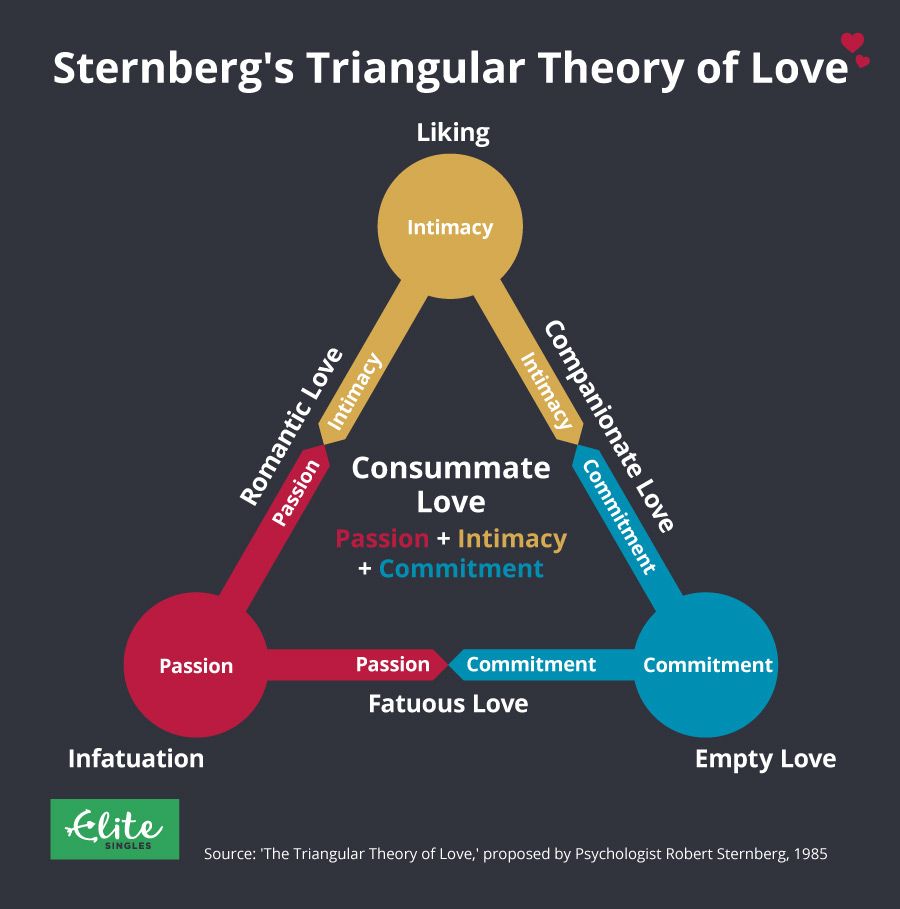
Sternberg’s triangular theory of love
posits that love is composed of three interconnected components—intimacy, passion, and commitment—which form the vertices of a triangle. These components combine to create eight different types of love, ranging from non-love to the ideal "consummate love," which requires a balance of all three.
social neuroscience
study of brain systems involved in social thinking and behaving
what areas of the brain are active?
pre-frontal cortex: evaluating intentions of others, emotional state, facial expressions, moral reasoning and assessments, empathy
insula (below pre-frontal cortex): active when we observe others in pain (empathy)
amygdala (temporal lobe): assess potential threats (identification of harmful stimuli)

