Dinosaurs Final Exam Study Guide !!
 Studied by 35 people
 Call Kai
 Learn
Learn Practice Test
 Spaced Repetition
 Match
Match Flashcards
 Knowt Play
1/144

There's no tags or description
Looks like no tags are added yet.
Name | Mastery | Learn | Test | Matching | Spaced | Call with Kai |
|---|
No analytics yet
Send a link to your students to track their progress
145 Terms
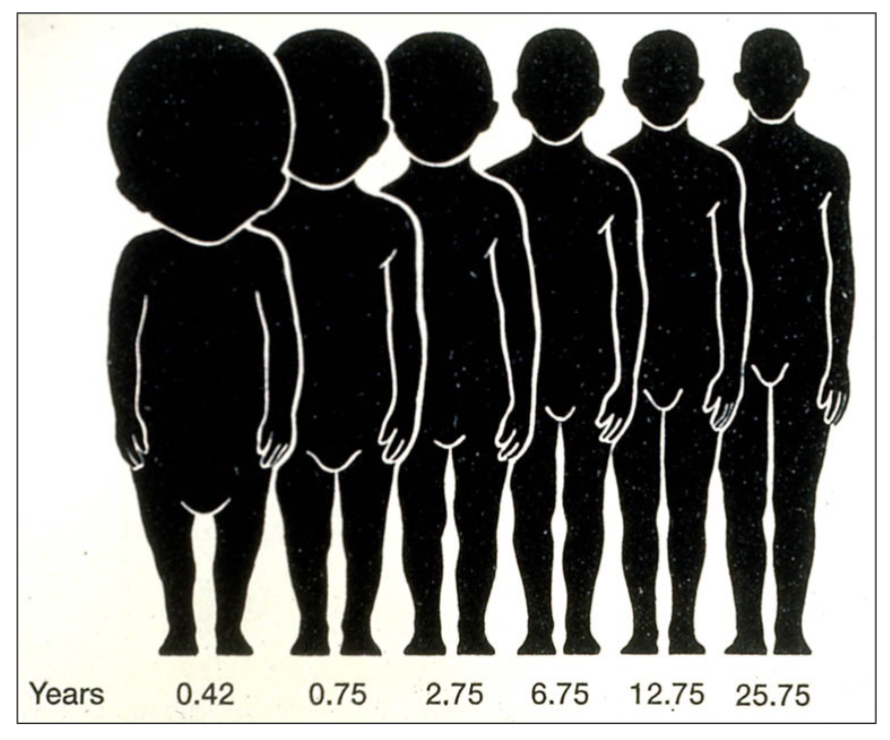
Allometry
Different parts of the body grow at different rates; Ex: puppies paws are very large in comparison to the rest of the body, but over time the body grows into them
Amniote
Evolutionary Novelties:
Amniotic Egg
Internal fertilization
Waterproof skin
Complex lungs
Synapsids and Reptiles in this group
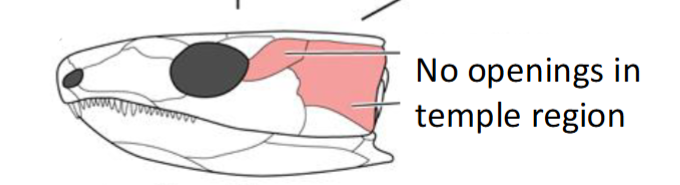
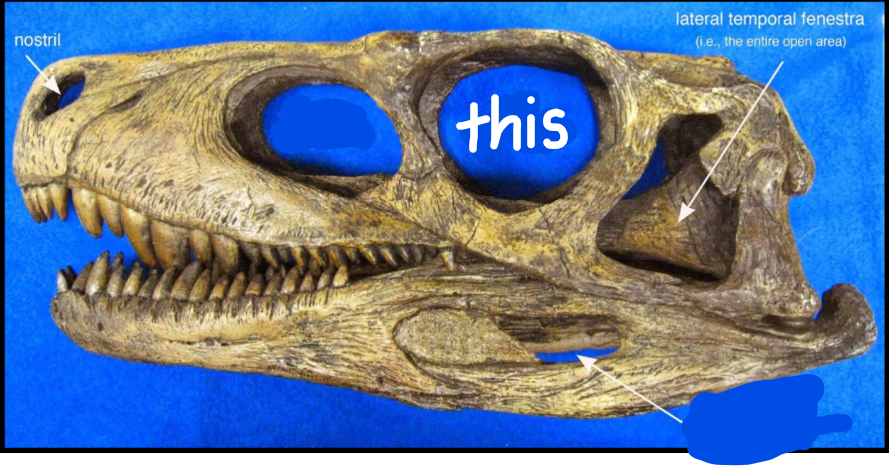
Anapsid
a skull condition with no temporal fenestrae. This is an ancestral condition (i.e., early tetrapods and early amniotes were
Ankylosaurians
A type of Thyreophoran; “Fused lizards”; Dorsal Shield (Fused dermal bone, Symmetrically arranged into bony plates and spines, Not just on head!); Large size & Quadrupedal; Stout limbs; Broad hands; Stubby fingers
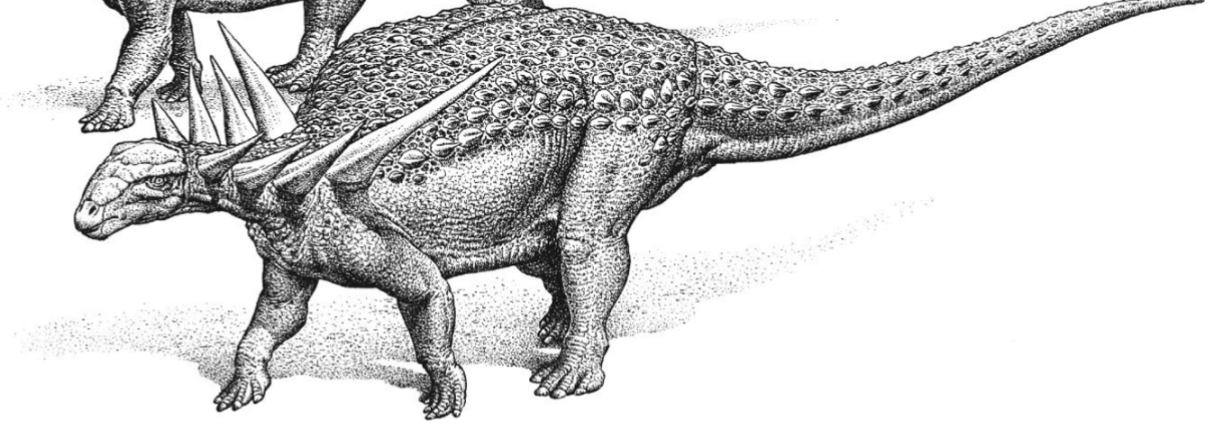
Nodosaurid
many had huge parascapular spines; a type of Ankylosaurian
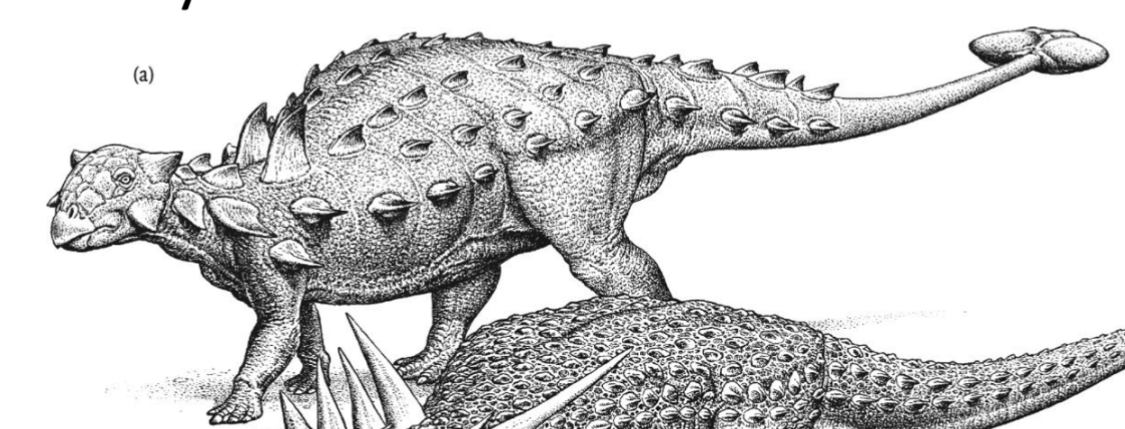
Ankylosaurid
Evolutionary Novelties:
Skulls with horns
Clubbed tail
Antorbital fenestra
Archosaur evolutionary novelty; a hole in the front part of the skull, just anterior of the eye. Hole in front of eye socket.
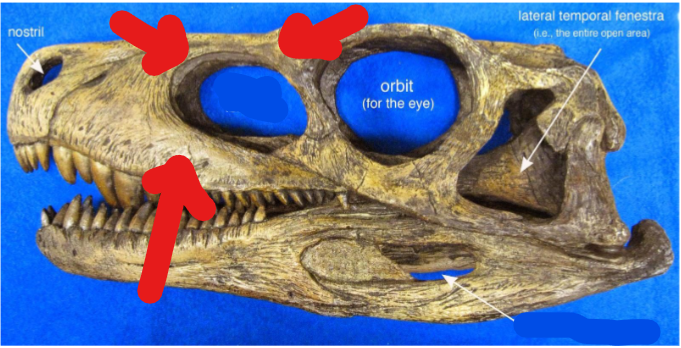
Archaeopteryx
First specimen discovered in 1860/1861. Given a name that means “ancient feather/wing.” Has teeth, a long bony tail, and unfused fingers (different from modern birds). Has relatively long arms with large asymmetric feathers, possibly for powered flight (similar to modern birds).
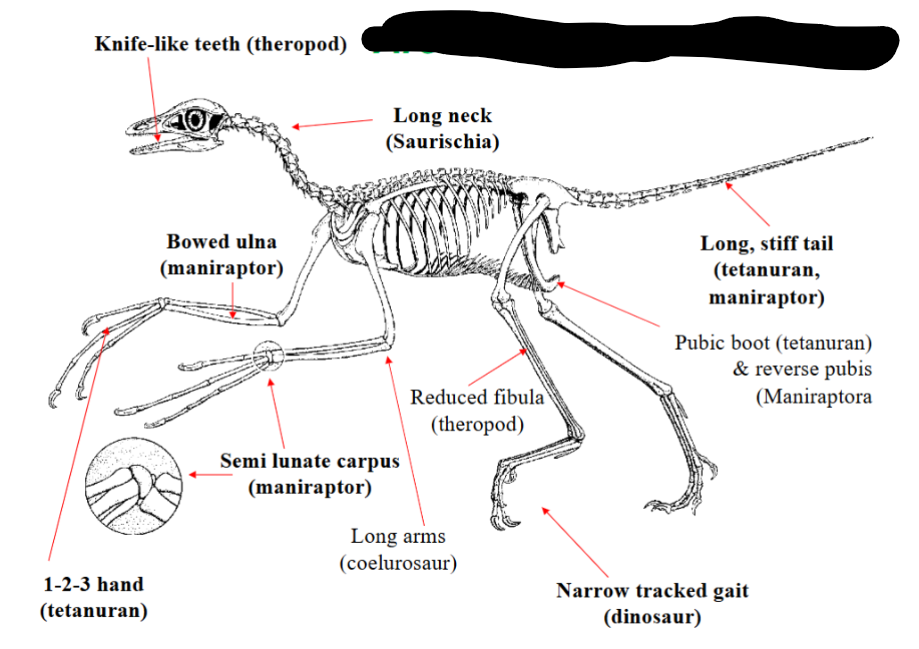
Archosaur
Evolutionary Novelties:
Thecodonty
Antiorbital fenestrae
Mandibular fenestrae
Parental care
Types: Crocodiles & kin, Pterosaurs, Dinosaurs (& birds)
Aves
The most recent common ancestor of all living birds (also includes many extinct forms). Both fossils and DNA suggest that this group first appeared during Late Cretaceous. Novelty: no teeth; group explodes in diversity during the Cenozoic, after the K-Pg mass extinction. Includes Paleognaths and Neognaths
Avialae
May be defined by flapping wings (powered flight); Basically includes Archaeopteryx through modern birds; also have complex asymmetrical feathers, eggs laid sequentially, and an enlarged fore-brain.
Bacterial Body Fossil
single celled organisms that were preserved. Some of the oldest clear evidence of life. 3.5 billion years old (3,500 million)
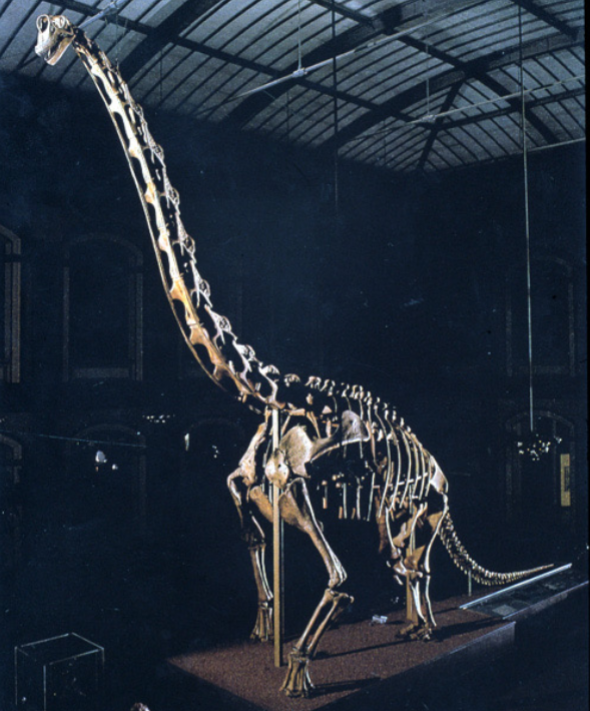
Brachiosaurus
“Arm lizard;” Late Jurassic, Western n. America, ~13 m tall, ~25 m long; Not the largest sauropod, but among the largest known from relatively complete skeletons; Stance suggest that neck was often held up high (note size of front legs). A sauropod.
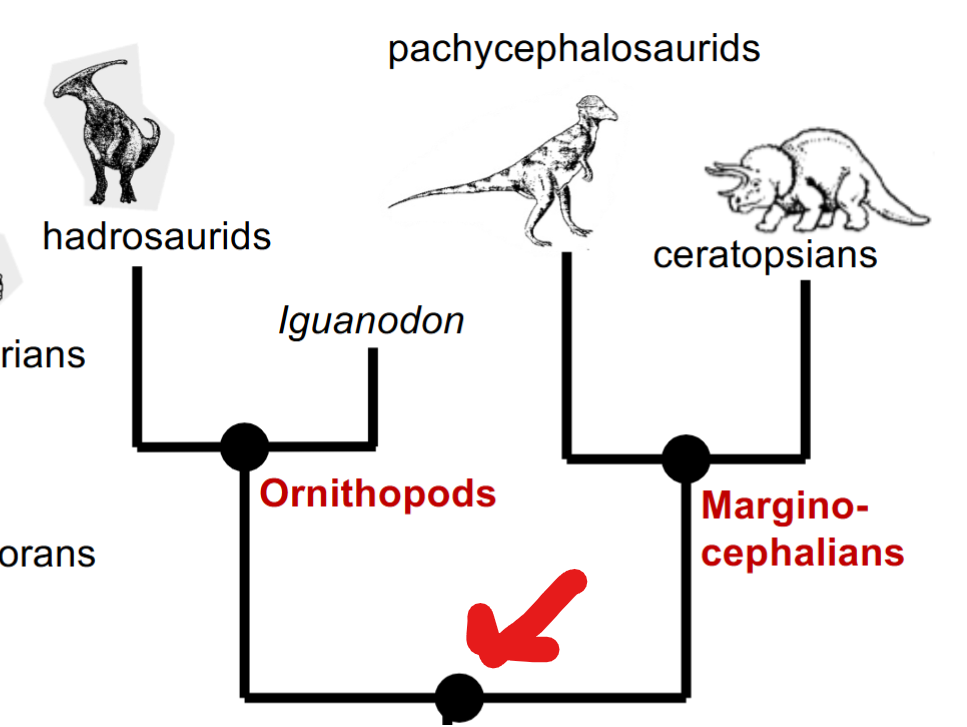
Cerapoda
Includes Marginocephalians (Ceratopsians + Pachycephalosaurids) and Ornithopods (Hadrosaurids and relatives)
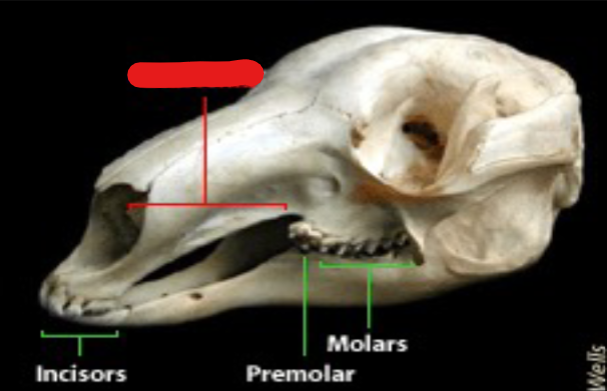
Evolutionary Novelty: Diastema (gap between front and back teeth, specialization for herbivory)
Ceratopsians
“Horned faces;” Evolutionary novelty: Rostral bone; a category of Marginocephalians
Ceratopsid + Protoceratopsid novelties
Frill
Dental Batteries
Quadrupedal
Ceratopsids
Evolutionary Novelty: Horns (on their skulls)
Ex: Triceratops, Styracosaurus, Centrosaurus
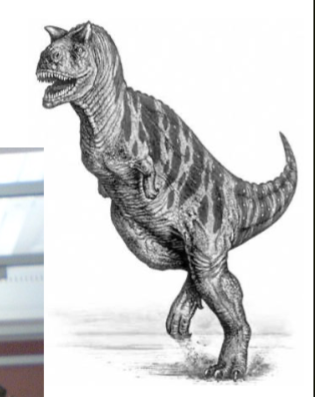
Ceratosaurs
“horned lizard;” Jurassic and Cretaceous; a Theropod
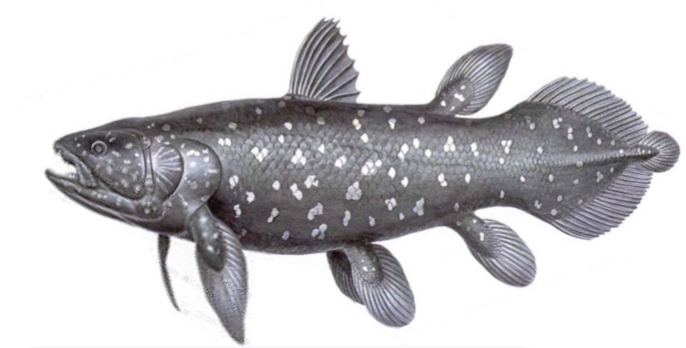
Coelacanth
A fleshy-limbed vertebrate (Sarcopterygii); were thought to be extinct after the Mesozoic (fossils disappeared in the record after that period) but were found out to be still alive in the 1930s
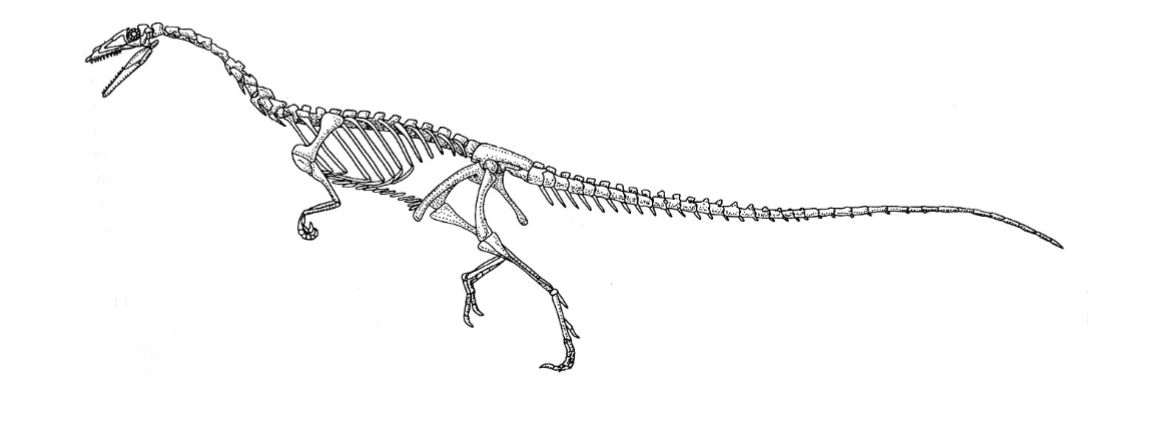
Coelophysis
~216 Ma, Late Triassic; approximates the general body form of the ancestral dinosaur (small-bodied biped); carnivorous.
Coelurosaurs
Evolutionary Novelty: Simple feathers
A type of Tetanuran; includes Tyrannosauroids, Compsognathids, Ornithomimids, and Maniraptors.
Convergent Features
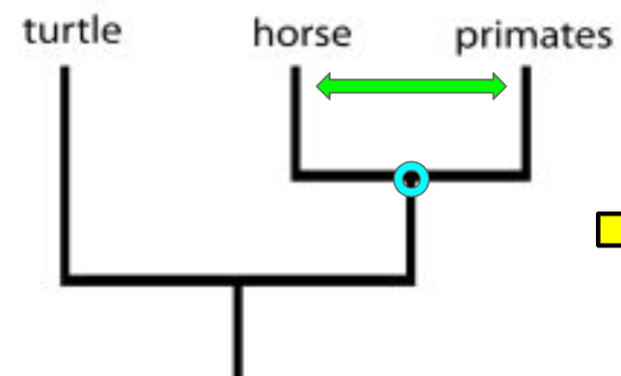
similarities not inherited from a common ancestor (independently acquired); The most recent common ancestor that 2 specimens share did not have this shared characteristic. Ex: Birds and bats both have wings, but their shared common ancestor did not.
Homologous Features
similar because they were inherited from a common ancestor; characters that are fundamentally the same biologically
Crocs & kin
Crocodiles, Alligators, Caimans, and Gharials; a type of Archosaurs; have some huge (30-50 ft) extinct ancestors
Darwin’s contributions to the theory
of evolution
Common Descent with Modification
Natural selection
argued that life is all related; acquired characteristics aren’t passed down but surviving traits are passed down
Common Descent with Modification
All living organisms are related, descending from a single common ancestor; traits change over time due to natural selection
Dermal Armor
Bone within skin; Become scutes/osteoderms, and spikes in Ankylosaurians; Become plates or spikes in Stegosaurians
Lung complexity in amniotes
Amniotes had more oxygen requirements than earlier tetrapods because they were more active (better adapted to land), so they developed more complex lungs
Development of limbs
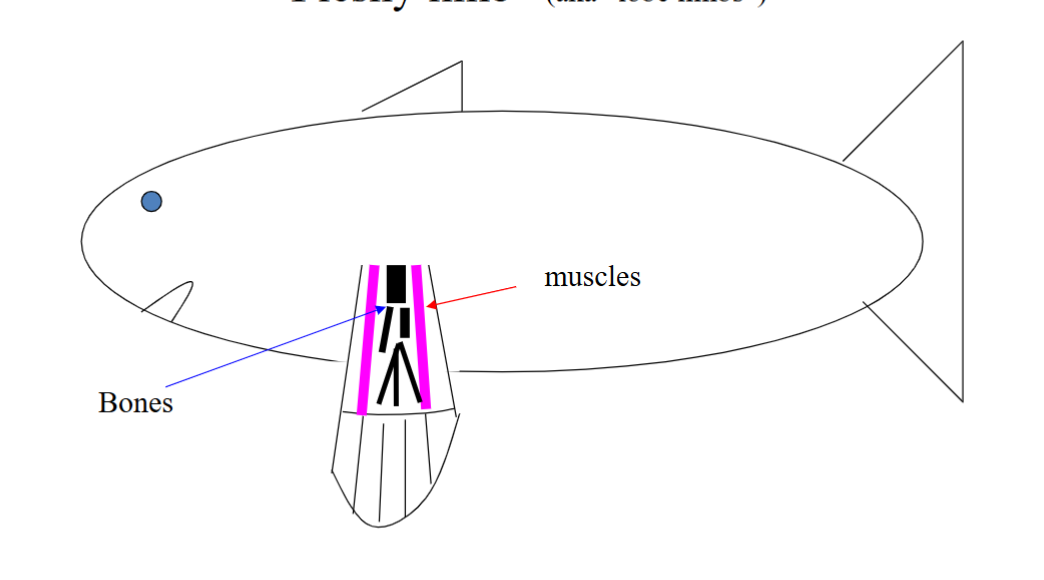
Osteichthyes (“bony fish”): ray-finned “fish” and fleshy-limbed vertebrates. Fleshy-limbed vertebrates → tetrapods (over time)
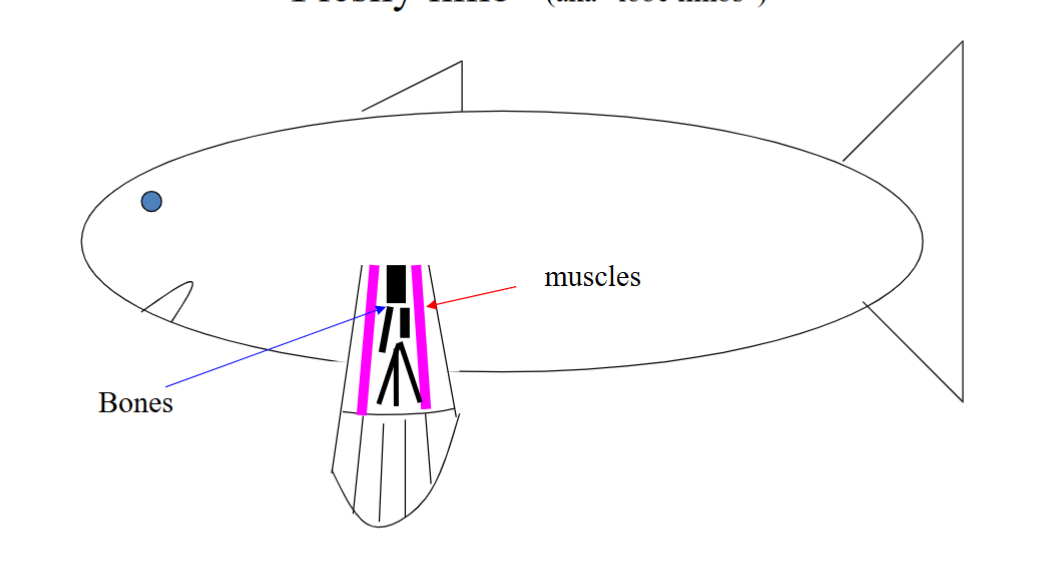
Bones of fleshy-limbed vertebrates
Flesh and muscle at the base of their limbs (fins); covers bones
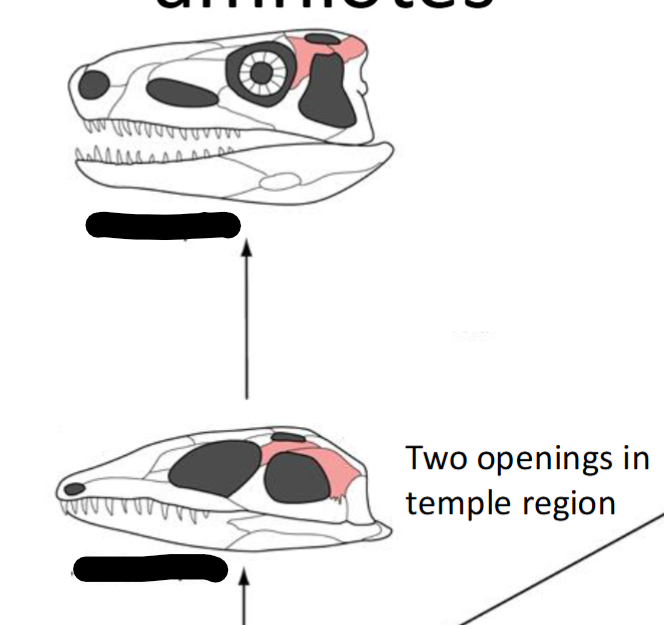
Diapsid
2 pairs of temporal fenestrae
Diastema
gap between front & back teeth; specialization for herbivory
Deinonychus
Early Cretaceous, United States; a type of Dromaeosaurid (aka “Fast-running lizards” or ‘raptors’)
Dromaeosaurids
“fast-running lizards” aka raptors
Late Jurassic to End Cretaceous; diverse and worldwide
Includes Utahraptor, Deinonychus, Velociraptor
Dinosauria
Groups: Theropods, Sauropodomorphs, Ornithischians
Novelties: Erect posture & narrow tracked gait, Opening hip socket bordered by bony upper ridge, Upright Femur, Femur with inturned head
Ancestrally small and bipedal, some species became large and quadrupedal
Diplodocids
A type of Sauropodomorph, includes: Diplodocus (Late Jurassic, N. America), Amargasaurus (Early Cretaceous, Argentina), and Apatosaurus (Late Jurassic, incorrectly known as Brontosaurus)
Dorsal Shield
Fused dermal bone symmetrically arranged into bony plates and spines; not just on head. An Ankylosaurian evolutionary novelty.
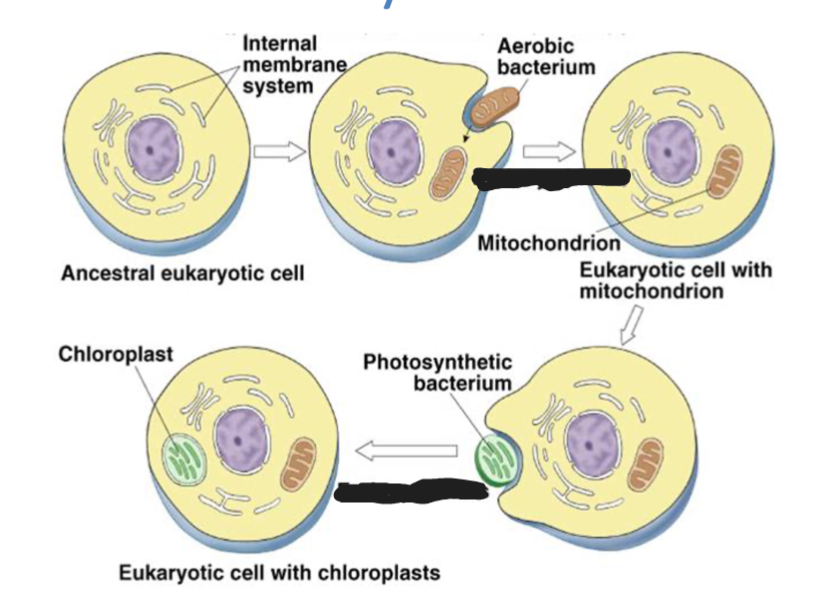
Endosymbiosis theory
how organisms went from prokaryotes to eukaryotes; Aerobic bacteria became incorporated into an ancestral eukaryotic cell, becoming the mitochondria. at the same time, photosynthetic bacterium was engulfed in these protoeukaryotes and they became the chloroplasts
End Cretaceous (K-Pg) extinction
The 5th most severe extinction
Worldwide
The best studied mass extinction
Usually focus is on dinosaurs
Extinctions on land and oceans
Causation Hypothesis: Extraterrestrial impact (worldwide iridium spike, tektites, shocked quartz, tsunami deposits, Chicxulub crater)
End-Permian Extinction
~250 Ma
Earth’s most severe extinction event
~80% of all marine species went extinct!
~70% of all terrestrial vertebrate species became extinct!
~10-30 million years for recovery of global diversity
Likely caused by the formation of Pangea and Volcanic Eruptions
Eukaryote
organism with an advanced cell structure, including a nucleus, organelles (like the mitochondria) and chloroplasts (where photosynthesis takes place)
include plants and animals; evolved via endosymbiosis
Falsifiability
Hypotheses and the predictions scientists make must be vulnerable to being proven wrong.
First definitive fossils
Fossil Stromatolites, Bacterial body fossils (sulphate reducers?)
Fossil Stromatolites
Layered colonial structures or rocks; Formed in shallow waters as microorganisms (cyanobacteria)
trap sediment → microbial mats!
preserved from 3.5 billion years ago
“Fleshy-Limbed” vertebrates (Sarcopterygii)
They have flesh and muscle at the bases of their limbs/fins; Bones enveloped in clumps of muscles; a sub-group developed arms, legs, and digits and moved to live on land (tetrapods)
Foundations of scientific thinking
Scientific method (Observe, Hypothesize, Predict, Test Predictions), Falsifiability, Scientific Theory (an explanation that has been tested again and again and again but hasn’t been falsified)
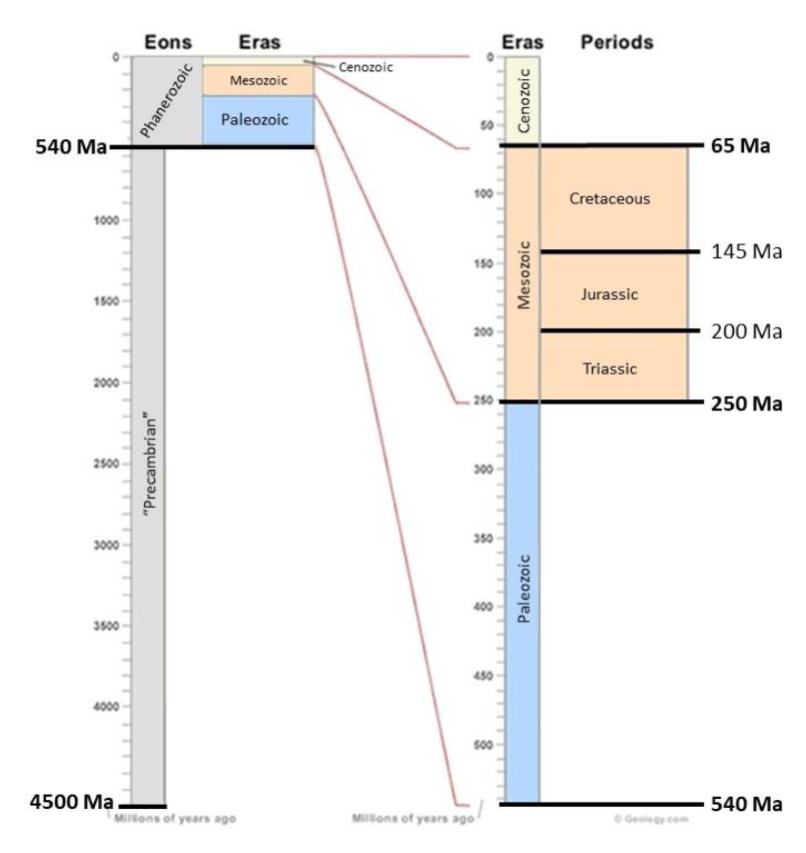
Geologic Time Scale
Precambrian (4500 Ma - 540 Ma)
Phanerozoic (540 Ma - Present):
Paleozoic (540 Ma - 250 Ma)
Mesozoic (250 Ma - 65 Ma):
Cenozoic (65 Ma - Present)
Mesozoic (250 Ma - 65 Ma):
Triassic (250 Ma - 200 Ma)
Jurassic (200 Ma - 145 Ma)
Cretaceous (145 Ma - 65 Ma)
Gnathostome
Vertebrates with jaws; “Jaw Mouths”
Half-life
the time required for one-half of the radioactive parent (unstable radioactive isotope) in a sample to decay into its daughter product (isotopes resulting from the decay of a parent)
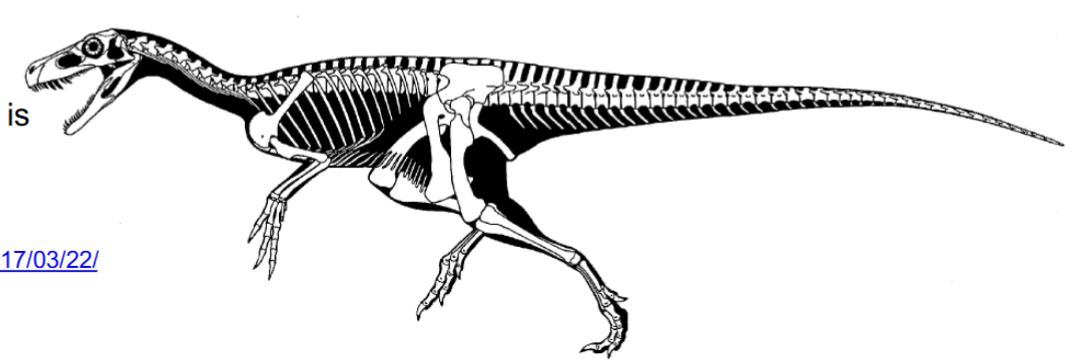
Herrerasaurus
Among the oldest dinosaurs known from relatively complete material; small (2-3 m long) and bipedal
uncertain if its a theropod or an early relative of sauropodomorphs
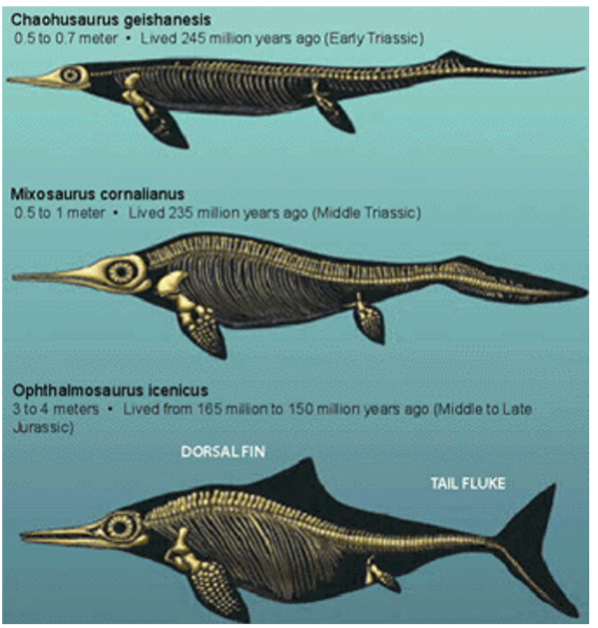
Ichthyosaurs
“fish lizards”; First known from Early Triassic; dominant in Jurassic; go extinct in the mid Cretaceous; some are among the largest animals that ever existed. Some species grow to ~70 feet long! discovered by long under-acknowledged paleontological pioneer, Mary Anning.
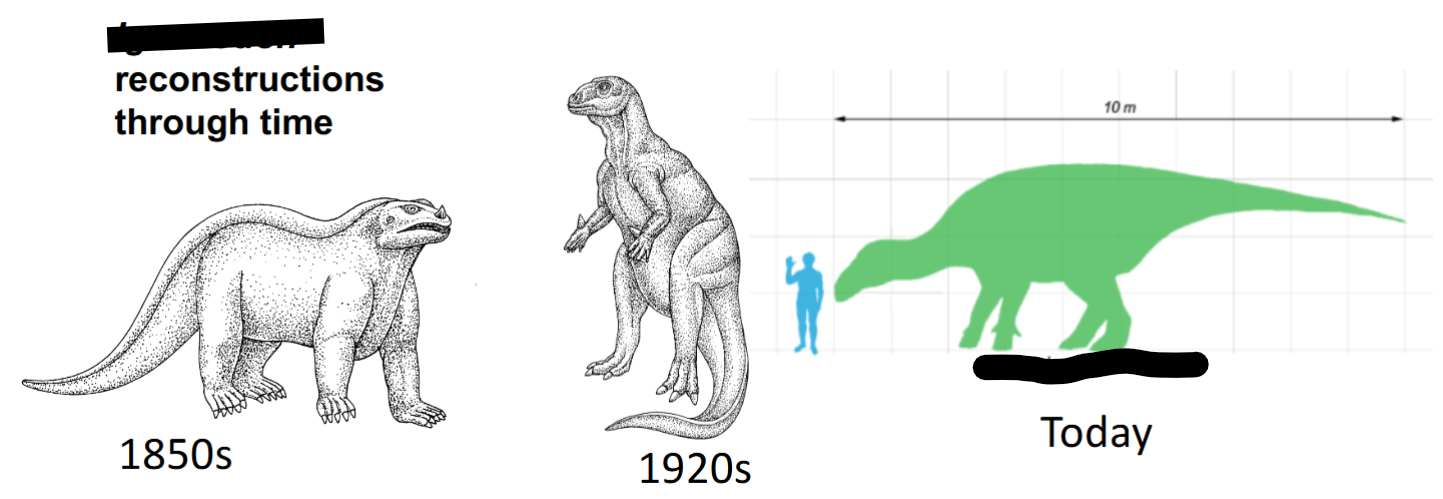
Iguanodontids
Novelty: Loss of upper front teeth (shared with Hadrosaurids); a member of this group was the second dinosaur ever named; our understanding of it shifted over time; it’s an Ornithopod
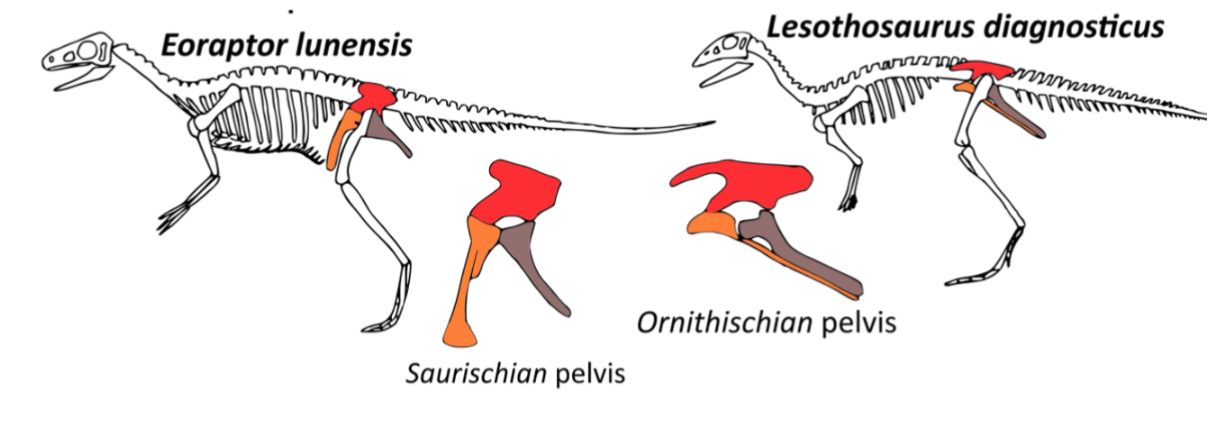
Ischium
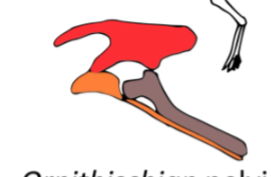
Back part of the dinosaur hip/pelvis structure (brown)
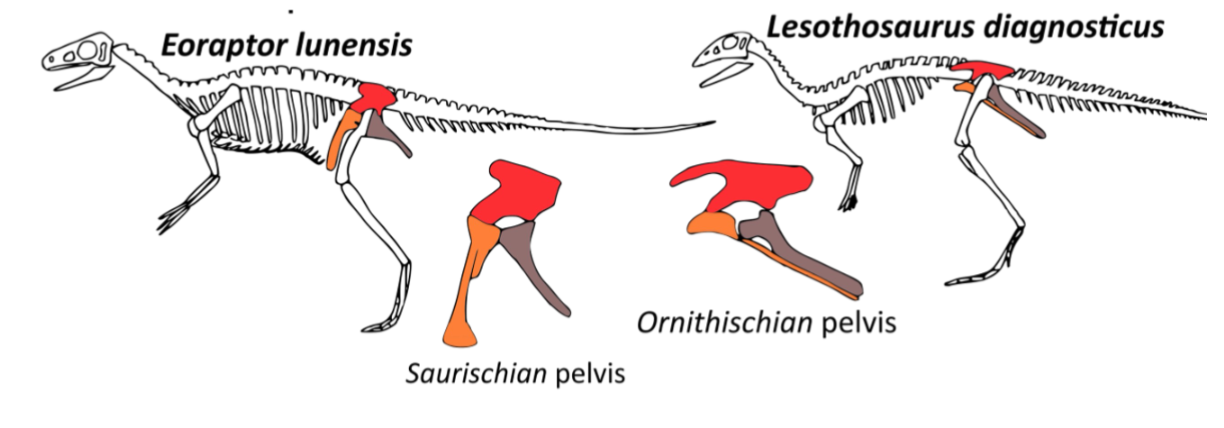
Ilium
Top part of the dinosaur hip/pelvis structure (red)
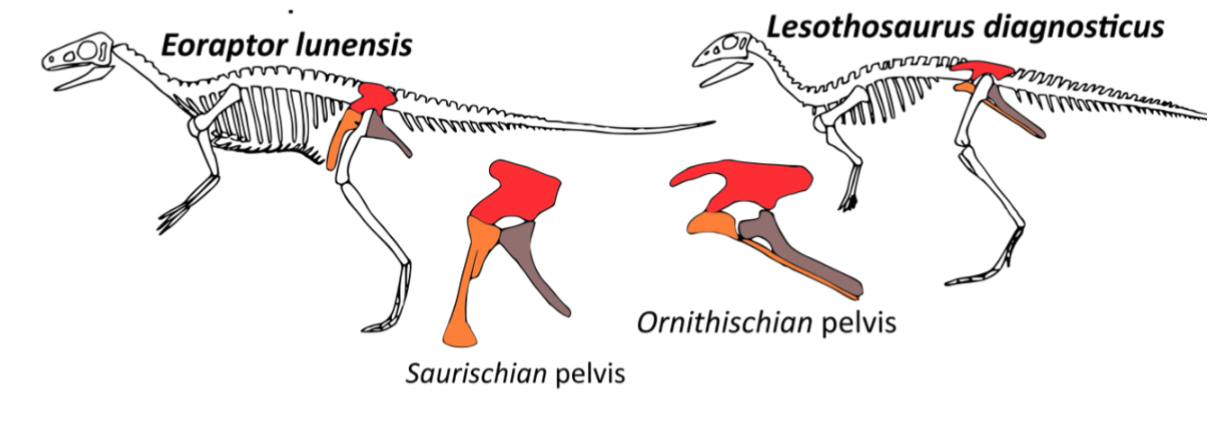
Pubis
Front part of the dinosaur hip/pelvis structure (orange); points forward ancestrally but points backwards (reverse) in Ornithischians and birds (convergent)
Isometric growth
proportions stay the same, animal just gets bigger over time; opposite of Allometry
Isotope
variants of the same element that have different numbers of neutrons. Two types: stable and unstable (break down over time)
Last common ancestor
represented by nodes (where two branches join) on cladograms. this is the most recent ancestor of groups before they split.
Lesothosaurus
~200 Ma; Ornithischian; small (~1m long); bipedal; good representative of early dinosaurs (small bipeds); Has a leaf-shaped tooth (characteristic of early ornithischians)
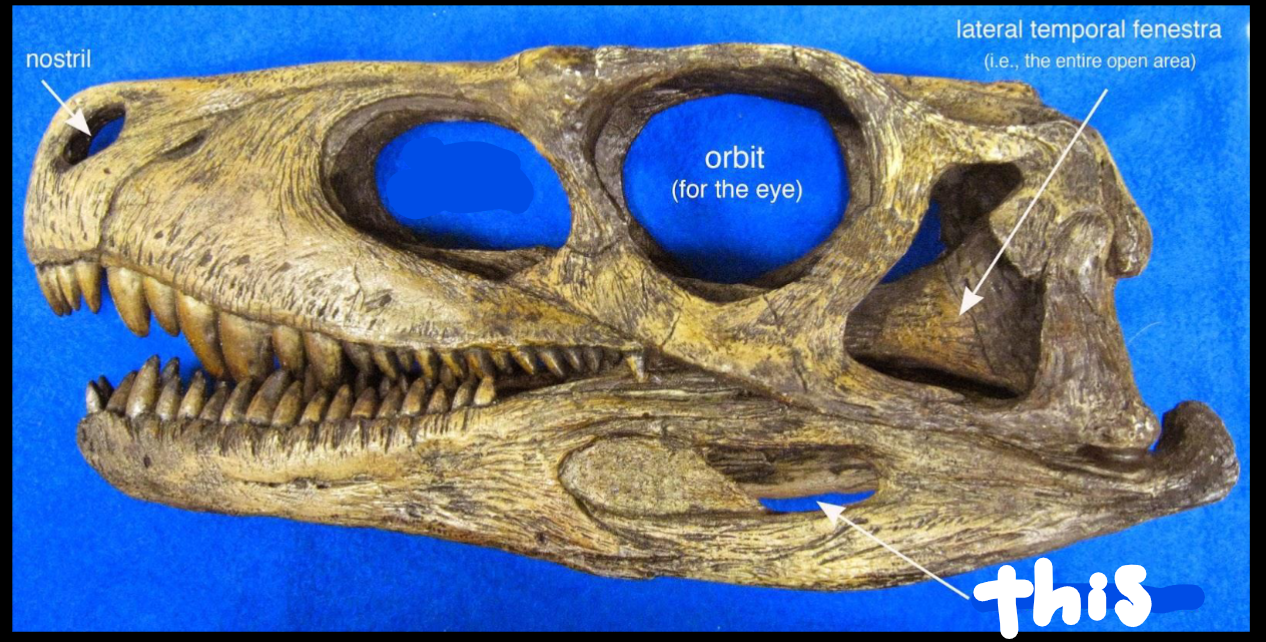
Mandibular fenestra
a hole in the lower jaw
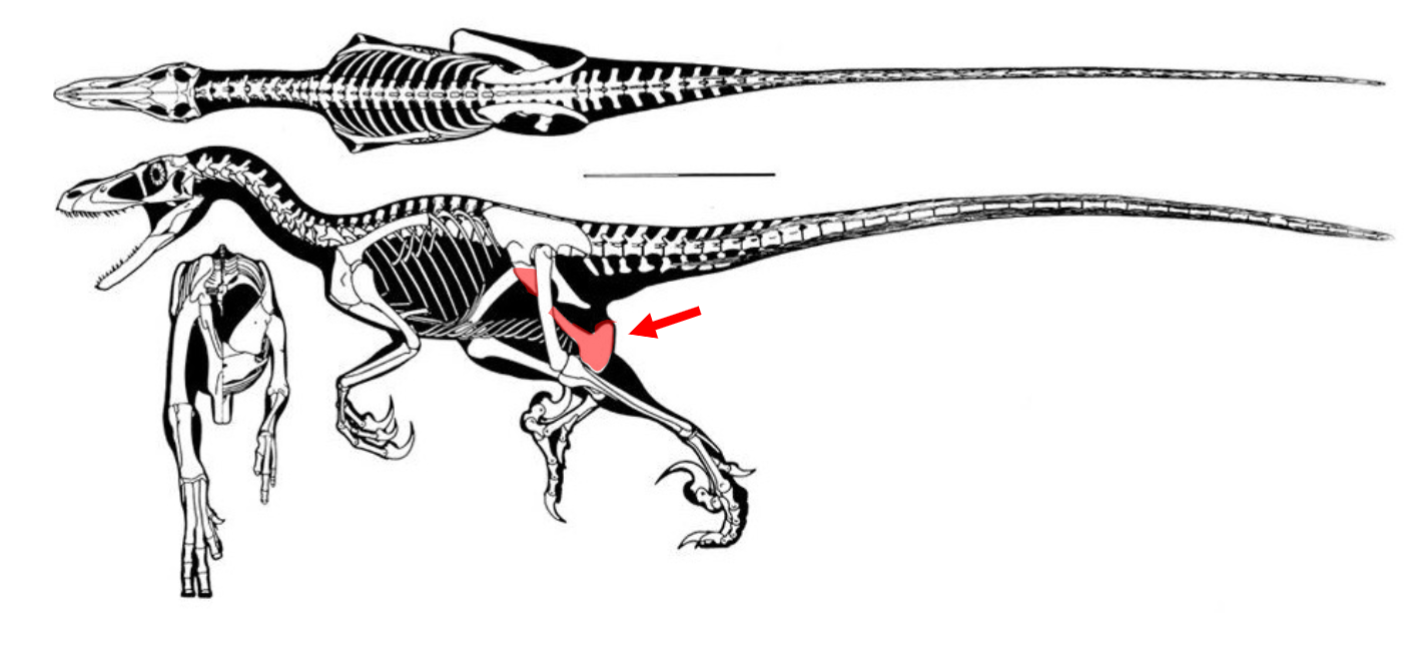
Maniraptors
Evolutionary Novelties: Semi-lunate carpal (carpus), reverse pubis
Birds fall under this group
Ex: Therizinosaurians
Mammalia
Monotremes, Marsupials, Placentals
Monotremes
Egg-laying mammals, 15 species.
Marsupials
Most of development takes place in the pouch, ~350 species
Placentals
Young born after long gestation, ~4000 species
Marginocephalians
Novelty: shelf along back of skull
Includes Pachycephalosaurids and Ceratopsians
Milk
The ancestors of mammals, small-bodied endotherms, faced a SA/V “problem,” that was solved by hair and this.
Mammals produce this to feed their young as they require a lot of food in comparison to their body size to stay warm.
Mosasaurs
Common at the end of the Cretaceous: Ichthyosaurs had become extinct and plesiosaurs were declining, so they filled the ecological vacuum.
Become extinct end Cretaceous (Mass extinction).
A type of lizard, some ~60 ft in length
Natural selection
Components:
Variation in a species
Differential survival and reproduction
Heritability of Variation
A mechanism that explains evolution.
Ornithischia
Evolutionary Novelties:
Reverse pubis
Predentary Bone
Low Jaw Joint
Groups:
Thyreophorans
Cerapods
Ornithodira
Dinosaurs and Pterosaurs
Evolutionary Novelties:
Mesotarsal Ankle
Digitigrade Stance
Ornithomimids
“bird mimics”
• lost teeth; herbivorous; fast
First evidence of feathers announced in 2012, based on fossils from Alberta, Canada.
Ornithopoda
Evolutionary Novelty:
Kinetic Skull
Include Hadrosaurids and Iguanodontids
Orbit
The opening in the skull when the eye is
Oviraptor
“Egg snatchers” (but not really — were thought to eat Protoceratopsid eggs, but the eggs were actually their own)
Cretaceous of Asia and North America
Pachycephalosaurs
“Thick-head-lizards”
Evolutionary Novelty: Thick skull (skull cap up to 20 cm thick)
Evidence that domes were used as ‘battering rams:’
Scars/Lesions on dome
Lesions on dome associated with damaging tissue infected bone.
Paraphyletic
Ancestor + SOME descendants = BAD (artificial, incomplete branch on evolutionary tree)
A group that includes an ancestor and some but not all of its descendants
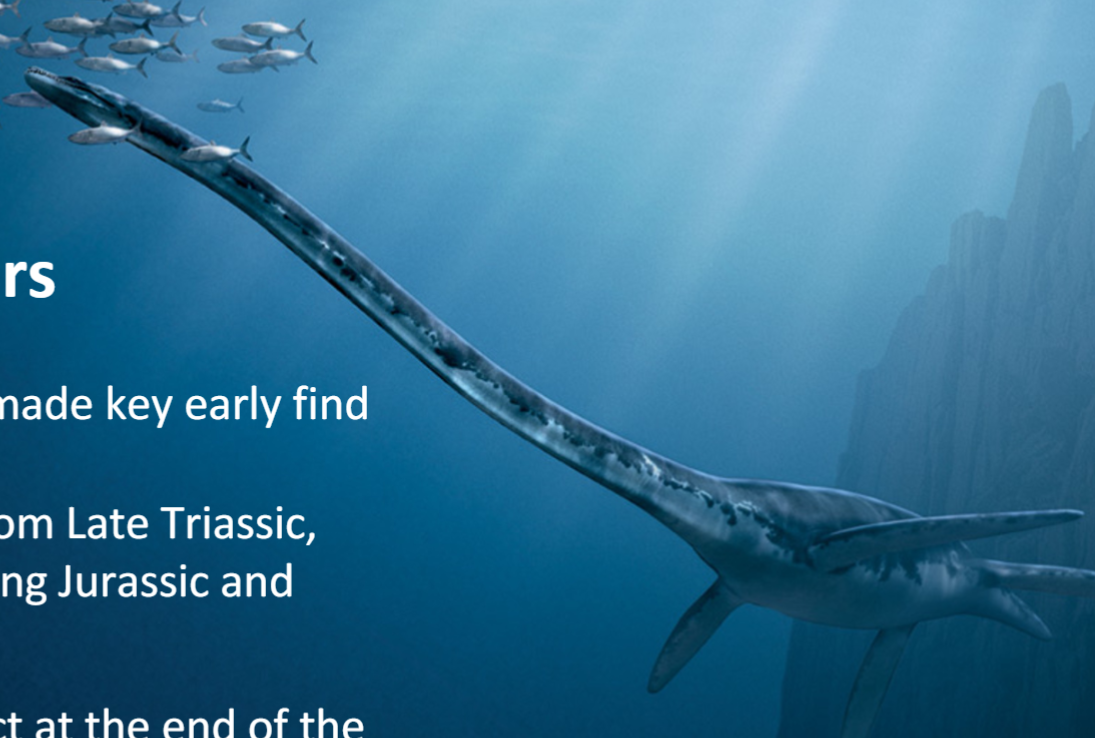
Plesiosaurs
First known from Late Triassic, dominant during Jurassic and Cretaceous
Become extinct at the end of the Cretaceous (mass extinction)
Sea turtles, best modern reptilian analog
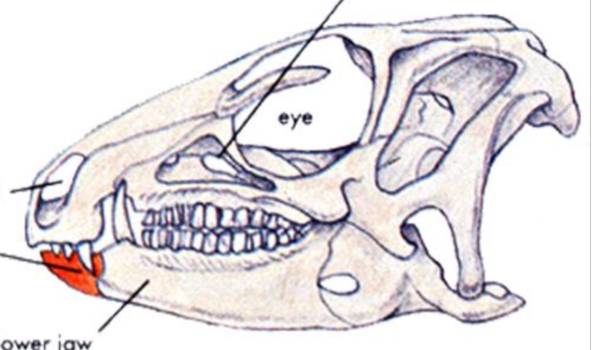
Predentary bone
lacks teeth (like a beak), for cropping vegetation; An Evolutionary Novelty of Ornithischians
Protoceratopsids
Cretaceous, Asia; No horns; a Ceretopsian
Has frill and dental batteries
Polytomy
When more than two branches stem off of a node; example: Dinosauria (due to uncertain relationship between 3 groups)
Dinosaur Polytomy
CLASSIC VIEW:
Saurischians & Ornithischians, theropods and sauropods are sister groups
New proposal:
theropods and ornithischians are sister groups! Ongoing debate.
Prosauropods
“before sauropods”
relatively small (2-10 m long)
Earliest were bipedal, later were capable of both bipedal & quadrupedal locomotion
Mid Triassic - Early Jurassic
paraphyletic group!
Psittacosaurs
About a dozen different species
Known from hundreds of specimens (one of the best known dinosaur groups)
Small bodied, bipedal animals that retained that shape over time
A type of Ceratopsian
Pterosaurs
First known from the Late Triassic
Dominate Jurassic skies
Some declined during the Cretaceous (as birds diversified)
Became extinct end Cretaceous (mass extinction).
Capable fliers:
Keeled sternum
hollow bones
Air sacs for unidirectional breathing
An Ornithodire
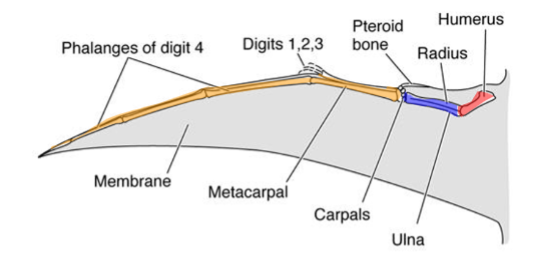
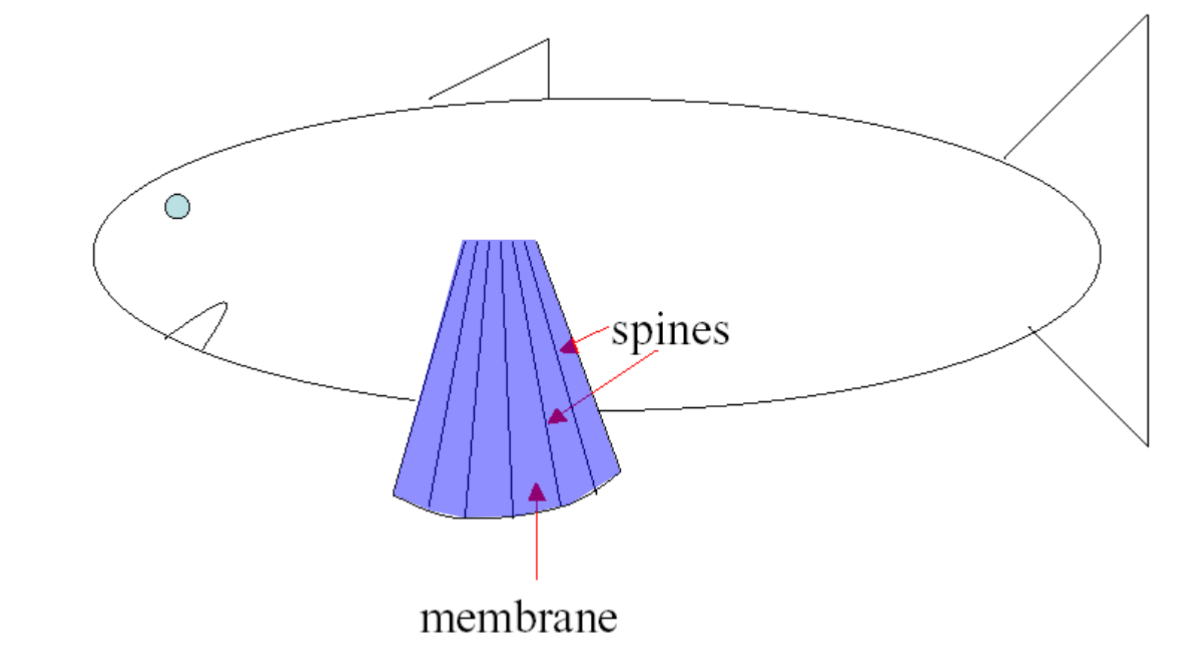
Ray-finned “fish” (Actinopterygii)
An Osteichthyes; “ray wing”; These fish have little needles of bone running from the ends of the fins to the body wall
Reptile
Evolutionary Novelty: B-keratin scales; two types: early anapsid and diapsid
Reverse pubis
An ornithischian and maniraptor evolutionary novelty; Ancestrally, this bone faces forward but it faces backwards in Ornithischians and Maniraptors
Secondary loss
A feature was developed and then a species lost that feature. An evolutionary novelty appeared and then was lost later. Ex: Snakes are tetrapods, their ancestors had limbs, but they lost those limbs later
Sedimentary Rock
Form from eroded pieces of other rocks (sediments) that accumulate in low lying areas. Sediments often bury organisms, preserving their remains. As sediments become rock, these remains become fossils. Often we can determine the RELATIVE ages of these rocks (not the absolute ages because that would just reveal the age of the sediments making up the larger rock).
Igneous Rock
Form from melts (magma, lava) that cool and solidify. Only rarely preserve fossils (ash). We can often determine their ABSOLUTE ages.
Metamorphic Rock
Underwent heating or pressure during their history, changing everything about them. Formed in places where rocks get carried to great depths (like seduction zones). Usually destroys any fossils that were in the rocks before pressure was applied (but rarely fossils can be found in them).
Sister group
The branches stemming from the same node; also known as closest relatives
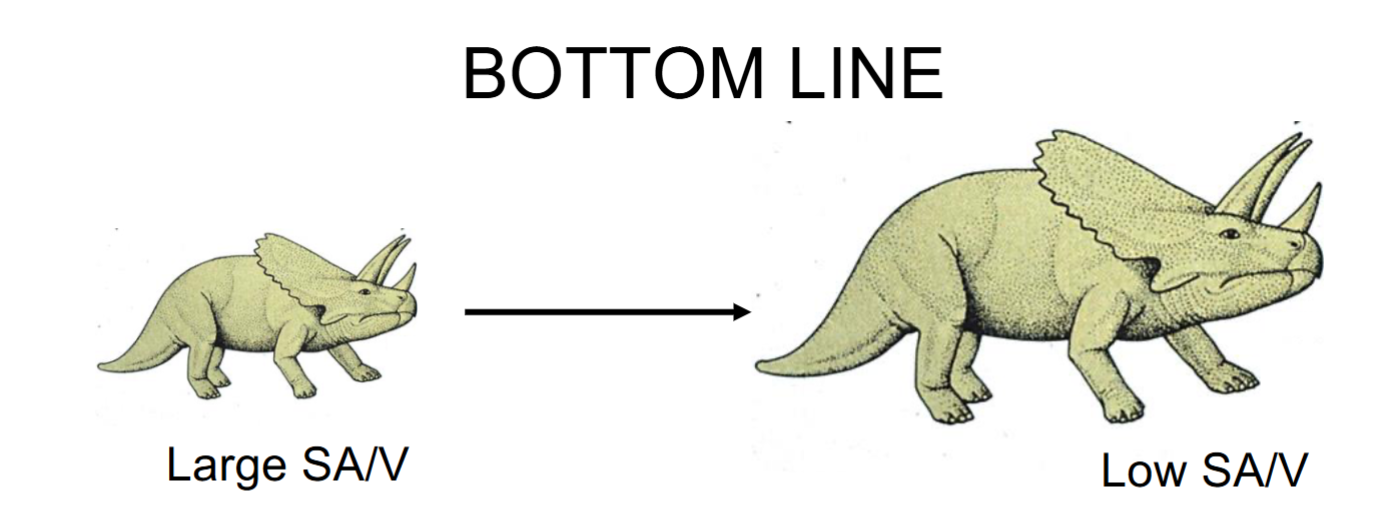
Surface area to volume ratios
Surface area (SA) increases as Volume (V) increases BUT NOT AT THE SAME RATE! Generation of heat is proportional to volume and Loss of heat is proportional to surface area
Small things loose heat more readily than big things -> greater relative surface area
Large animals need fewer calories to maintain heat (relative to size). Therefore, they can live off of lower quality food (but still need lots of it).
Stegosaurs
“roof lizard”
plates and spikes
quadrupedal (stout limbs, broad hands, stubby fingers)
simple teeth
Sauropodomorphs
First known from Late Triassic
Dominant in Jurassic, with worldwide distribution
Decline in Cretaceous
Evolutionary Novelties:
Long neck (at least 10 vertebrae)
Small heads relative to body size
Sauropods
Evolutionary Novelties:
Denser, columnar limb bones
Nasal openings on top of skull
Necks with at least 12 vertebrae
Even smaller heads
Includes Diplodocids, Brachiosaurus, and Titanosaurians
Snakes
A part of “lizards and kin”; a diapsid; saw secondary loss of legs (tetrapod ancestrally)
Synapsid
characterized by one temporal fenestra; includes mammals
Tetanurans
a type of theropod
evolutionary novelties:
Stiff tails
3-digit hands
complex branching air sacs
 Note
Note  Flashcards (22)