lab 15
 Call Kai
 Learn
Learn Practice Test
 Spaced Repetition
 Match
Match Flashcards
 Knowt Play
1/48

There's no tags or description
Looks like no tags are added yet.
Name | Mastery | Learn | Test | Matching | Spaced | Call with Kai |
|---|
No analytics yet
Send a link to your students to track their progress
49 Terms
These are the openings connecting the nasal cavity to the outside. Air passes through these openings during respiration
external nares
This is the cavity within the nose and above the palate. It is divided by the nasal septum into two passageways by the nasal septum. The cavity contains the olfactory epithelium and warms, moistens, and filters the air passing through the nose.
nasal cavity
These are the cavities located within the skull that lighten the skull and serve as resonating chambers for speech.
paranasal sinuses
These are the openings at the rear of the nasal cavity that open into the nasopharynx. Air passes though these openings into the nasopharynx.
internal nares
this passageway is known as the throat. It is composed of three regions, the nasopharynx, oropharynx, and laryngopharynx.
pharynx
This uppermost portion of the pharynx superior to the soft palate. The openings of the Eustachian, or auditory tubes, are located in this region
nasopharynx
This is the portion of the pharynx between the soft palate and the epiglottis (a flap of skin). It is the common passageway for the digestive and respiratory systems.
Oropharynx
the lower portion of the pharynx lying between the hyoid bone and the larynx
Laryngopharynx
this structure is also called the “voice box.” It connects the pharynx to the trachea. The epiglottis is a flap of tissue that covers the opening to the larynx, the glottis, during swallowing. The epiglottis prevents food and fluid from entering the lower portion of the respiratory system. Also contains the paired vocal cords used for speech.
larynx
This is a cartilage-reinforced tube that is commonly called the “windpipe.” It begins at the larynx and ends as it splits into the right and left bronchi, in the thorax. It is the passageway for air entering the lungs.
trachea
The two large respiratory organs located in the thoracic cavity. Site of external respiration, where oxygen diffuses into the bloodstream
lungs
Commonly called the “root” of the lung. Located on the medial edge of the lung, where the bronchi and blood vessels enter and leave the lung.
hilus
Passageway for air in the lungs. Primary bronchi are the two tubes that split from the base of the trachea and enter the right and left lungs. Secondary bronchi split from the primary bronchi. Tertiary bronchi split from the secondary bronchi.
bronchi
The tertiary bronchi split into these smaller tubes within the lungs.
This eventually lead to the alveoli.
bronchioles
Small sacs lined with simple squamous epithelium. They form the functional unit of the lungs where gas exchange occurs.
alveoli
A large, flat, skeletal muscle that separates the thoracic and abdominal cavities. It acts to change air pressure within the lungs during inhalation and exhalation.
diaphragm
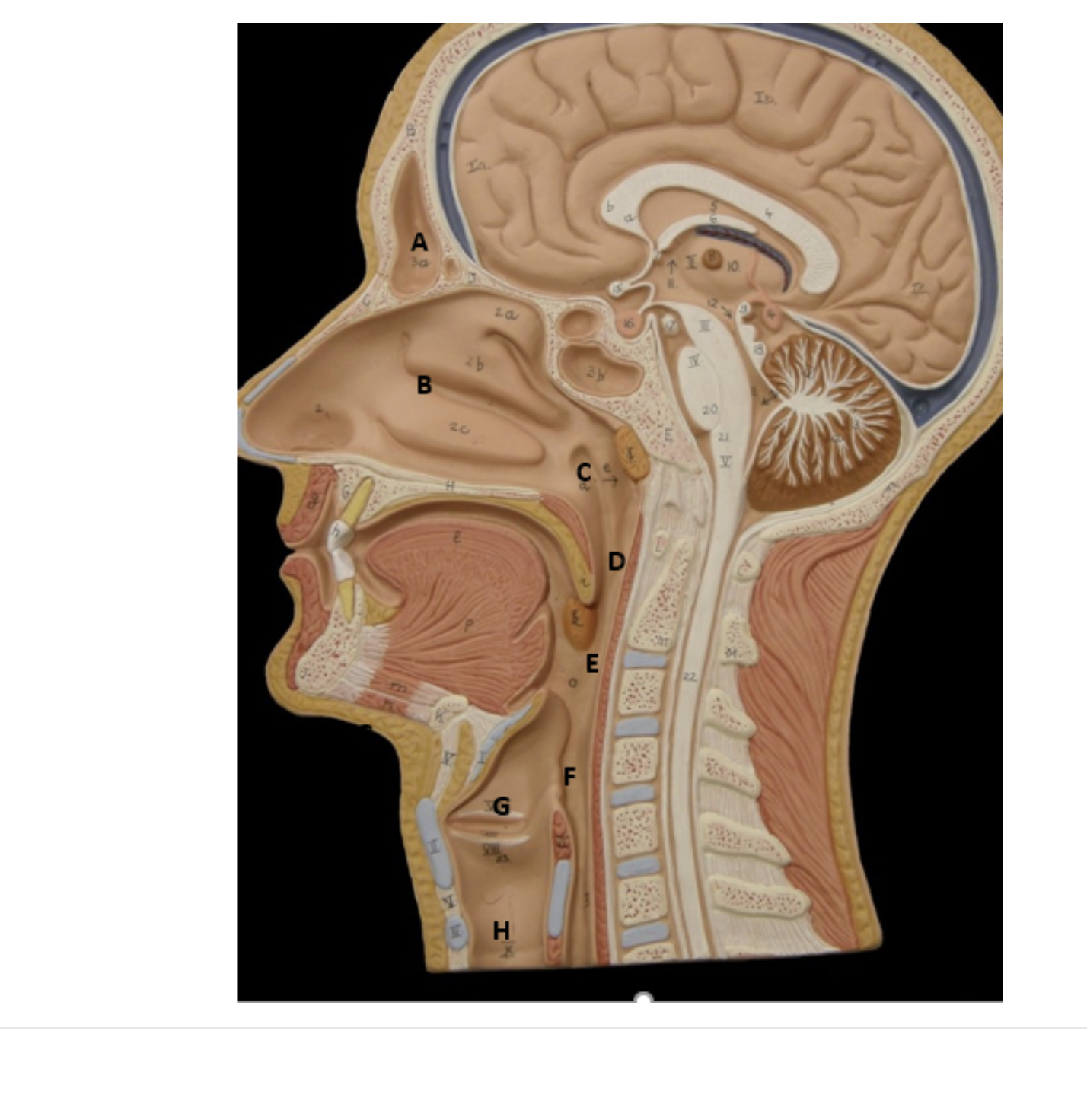
fill in the blanks:
A: paranasal sinus
B: nasal cavity
c: internal nares
d: nasopharynx
e: oropharynx
f: laryngopharynx
g: larynx
h: trachea
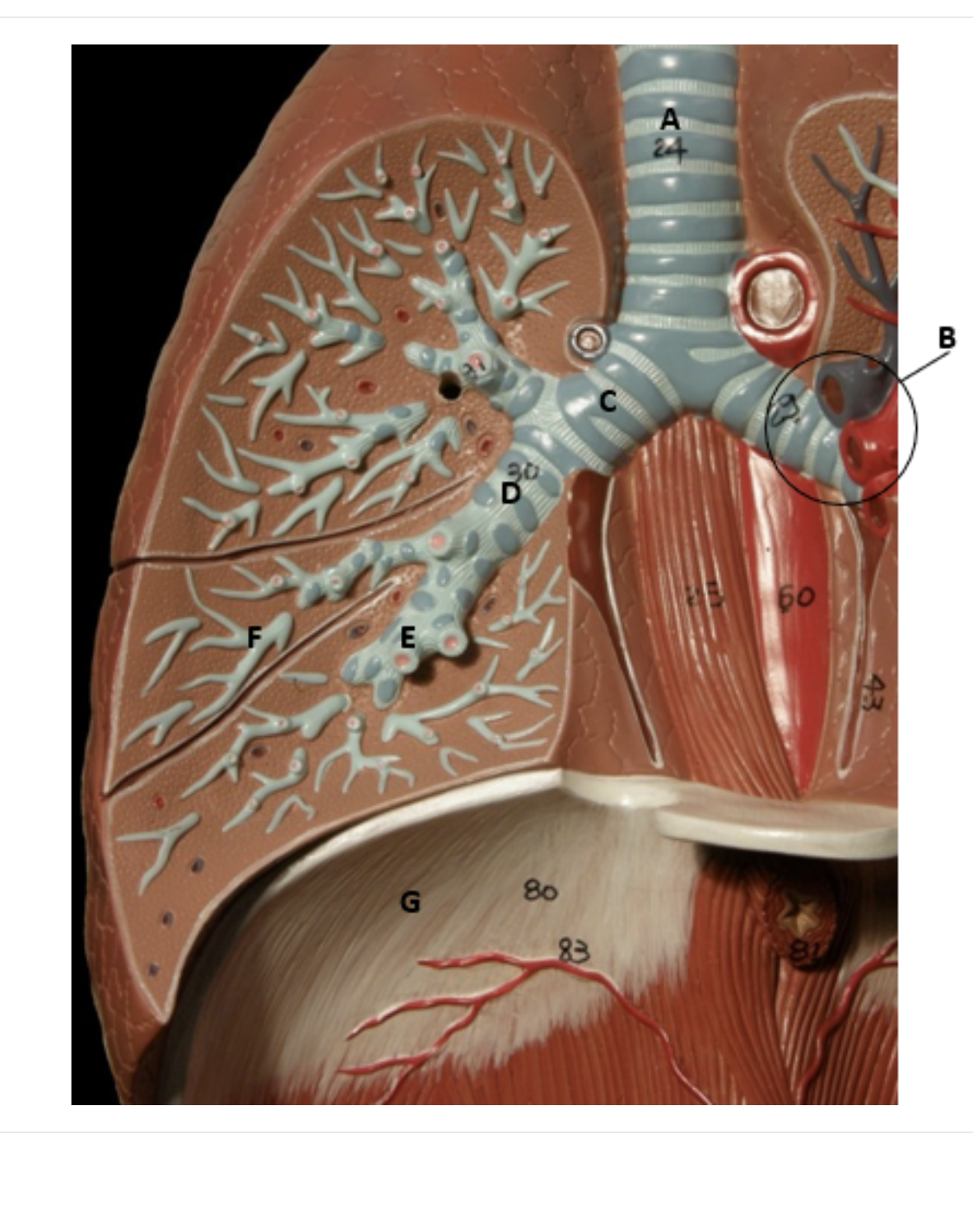
fill in the blanks:
a: trachea
b: hilus
c: primary bronchi
d: secondary bronchi
e: tertiary bronchi
f: bronchioles
g: diaphragm
What is the mL for the residual volume
1200 mL
What volume is being foung here?
The volume of a single inhalation during normal, quiet breathing. It varies among individuals, but the mean value is approximately 500 ml for a healthy individual. Approximately 70% of this volume reaches the respiratory surfaces the lungs. The remaining 30% stays in the non-respiratory parts of the system, (like the trachea, the various bronchi, and the bronchioles).
take three normal breaths by inhaling through your nose and exhaling through your mouth into the spirometer. Keep your mouth on the mouthpiece to prevent air from leaking out.
After three breaths, divide the TOTAL volume shown in the graph by three
tidal volume
What volume is being found here?
Breathe in and out normally.
After a normal exhalation, place the mouthpiece in your mouth and use the abdominal muscles to forcibly exhale all the remaining air out of the lungs.
Record the total volume.
Repeat the above procedure one more time.
Expiratory Reserve Volume (ERV)
What volume is being found here?
The maximum amount of air that can be exhaled after a deep inhalation. It is, on average, about 4800ml for males and 3100ml for females. It is the sum of inspiratory reserve volume, tidal volume and the expiratory reserve volumes.
Take three very deep breaths, forcibly inhaling and forcibly exhaling each time. If you feel dizzy, sit down before proceeding.
Inhale as deeply as possible a fourth time.
Place the mouthpiece in your mouth, and slowly but forcefully exhale as long as you can. Empty as much air out of your lungs as possible.
Repeat the above procedure one more time.
vital capacity (VC)
What volume is being found here?
The total volume of air that can be inhaled after the exhalation of the tidal volume. On average, it is about 3800ml for males and 2400ml for females. It the sum of the tidal volume and inspiratory reserve volume.
Inhale as deeply as possible.
Place the mouthpiece in your mouth and exhale normally. Do not forcefully exhale.
Repeat the above procedure one more time.
Inspiratory Capacity (IC)
What volume is being found here?
The volume of air inhaled each minute. It can be calculated by multiplying the tidal volume by normal breathing rate.
Example: Tidal volume is 500 ml and the breathing rate is 15 breathes per minute, the minute volume respiration is 7500 ml/min (500ml x 15).
Sit down and relax. Count the number of times you breathe for three minutes.
Divide the total number of breaths by three to obtain your breathing rate.
Multiply the breathing rate by the average tidal volume.
Minute Respiratory Volume (MRV):
What volume is being found here?
Amount of air inhaled when taking a very deep breath in. The average for healthy males is about 3300ml and 1900ml for healthy females.
Subtract the tidal volume from the inspiratory capacity, (IRV = IC - TV).
Sometimes a negative number. If this is the case, you made an error obtaining the tidal volume and / or the inspiratory capacity. The tidal volume should always be less than the inspiratory capacity, because the tidal volume is a normal breath and the inspiratory capacity is a forcible inhale.
Common mistakes are breathing too hard for the tidal volume, failing to re-zero the gauge, or dividing the tidal volume by 3. If the inspiratory reserve volume is a negative number, you will have to take these measurements a second time.
Inspiratory Reserve Volume (IRV)
What volume is being found here?
The total volume of air that can be inhaled. On average total volume is about 6000 ml for males and 4200ml for females. It is calculated by adding the average residual volume, expiratory reserve volume, tidal volume, and inspiratory reserve volume.
1. Calculate your volume by adding the residual volume, expiratory reserve volume, tidal volume, and inspiratory reserve volume.
Total lung volume (TLV)
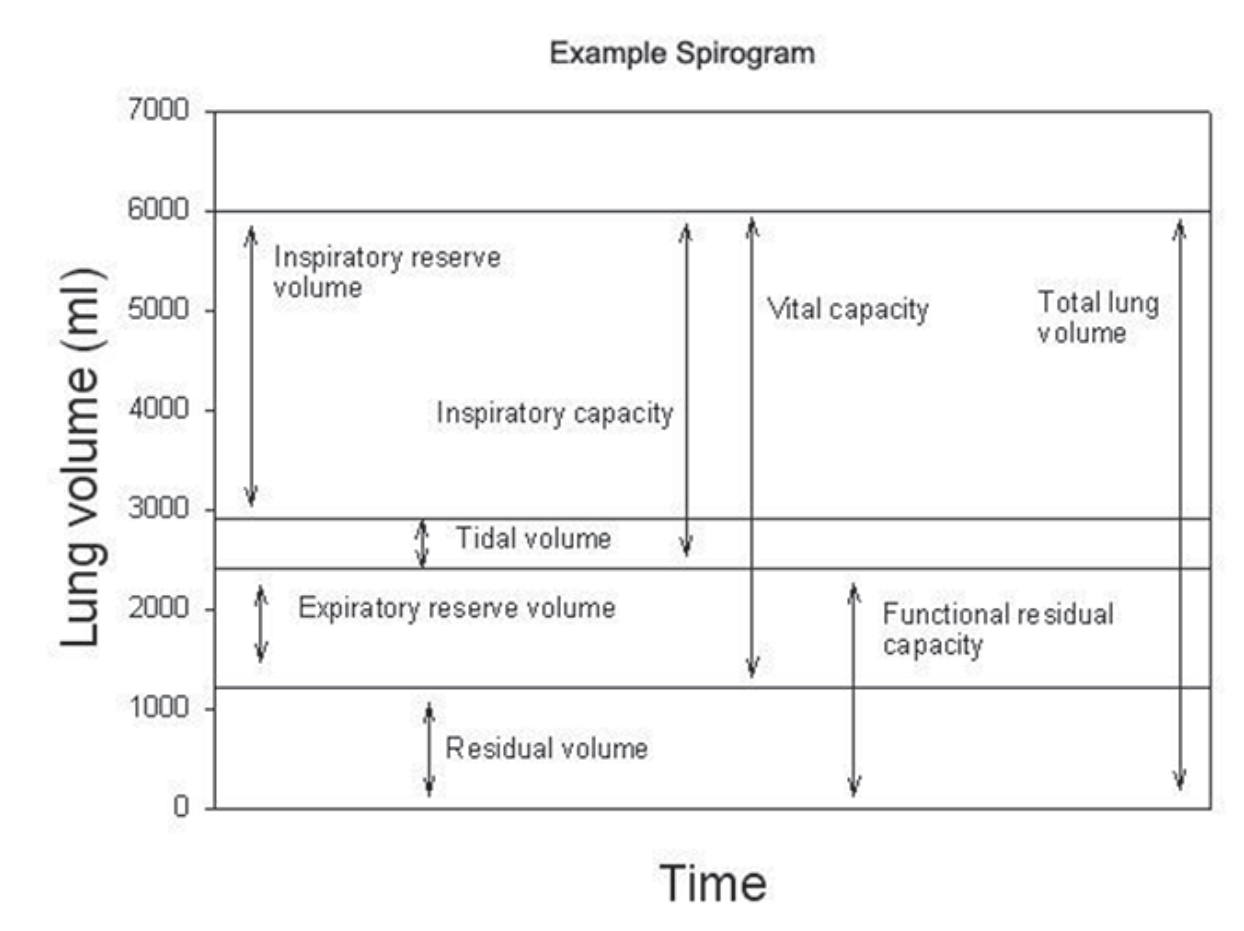
Make spirogram!
make spirogram!
what delivers air to the alveoli
bronchioles
boyle’s law states that pressure of a gas, in a closed container, is ________ related to the containers volume
negatively
If the container gets smaller, gas pressure will
increase
If the container gets larger, gas pressure will
decrease
intercoastal muscles and diaphragm, inhalation or exhalation
inhalation
intercoastal muscles and diaphragm relax, inhalation or exhalation
exhalation
increased pressure in the lungs, inhalation or exhaltion
exhalation
decreased pressure in the lungs, inhalation or exhalation
inhalation
What are the four variables that can affect the volume of air inhaled and exhaled?
Age
Body size
Health
Sex of an individual
Calculate the MRV:
#of breaths in 3 mins: 38
Tidal volume (TV): 1460
1 . Count number of times you breathe in 3 mins
2. divide the number of times you breathe in 3 mins by 3 to obtain your breathing rate
3. multiply the breathing rate by the tidal volume
Calculate the Inspiratory reserve volume (IRV):
IC: 2655
TV: 1460
1 . Subtract the tidal volume from the inspiratory capacity (IRV = IC - TV)
2 . IRV is sometimes a negative number. This mean a mistake was made in obtaining the TV and/ or the inspiratory capacity. TV should always be less than the IC.
Identify what lung volume is being found here:
The volume of a single inhalation during normal, quiet breathing.
tidal volume (TV)
Identify what lung volume is being found here:
Amount of air which can be forcibly exhaled after the tidal volume has been exhaled. The average for healthy males is about 1100ml while the average for healthy females is about 700ml
expiratory reserve volume (ERV)
Identify what lung volume is being found here:
The maximum amount of air that can be exhaled after a deep inhalation. It is, on average, about 4800ml for males and 3100ml for females. It is the sum of inspiratory reserve volume, tidal volume and the expiratory reserve volumes.
vital capacity (VC)
Identify what lung volume is being found here:
The total volume of air that can be inhaled after the exhalation of the tidal volume. On average, it is about 3800ml for males and 2400ml for females. It the sum of the tidal volume and inspiratory reserve volume.
inspiratory capacity (IC)
Identify what lung volume is being found here:
The volume of air inhaled each minute. It can be calculated by multiplying the tidal volume by normal breathing rate.
Minute respiratory Volume (MRV)
Identify what lung volume is being found here:
Amount of air inhaled when taking a very deep breath in. The average for healthy males is about 3300ml and 1900ml for healthy females.
Inspiratory Reserve Volume (IRV)
Identify what lung volume is being found here:
The total volume of air that can be inhaled. On average total volume is about 6000 ml for males and 4200ml for females. It is calculated by adding the average residual volume, expiratory reserve volume, tidal volume, and inspiratory reserve volume.
Total lung volume (TLV)

Be able to calculate respiratory volumes by reading a chart:
This entire graph is called?
Section D represents this persons ____ volume.
This persons vital capacity would be ___ ml?
It is called a Spirograph
Residual volume
4800
What is the portion of the pharynx which lies between the hyoid bone and the larynx?
laryngopharynx
Describe what occurs to the thoracic cavity to cause an increase in lung volume during inhalation?
The diaphragm, a large, flat skeletal muscle seprates the thoracic and abdominal cavities. It acts to change air pressure withing the lungs during inhalation and exhalation.
Which lung volume was tested when after a normal exhalation, you used your abdominal muscles to forcibly exhale all the remaining air from your lungs?
the expiratory reserve volume

