Wk 3 law enforcement challenges / Treaties
 Studied by 0 people
 Call Kai
 Learn
Learn Practice Test
 Spaced Repetition
 Match
Match Flashcards
 Knowt Play
1/12

There's no tags or description
Looks like no tags are added yet.
Name | Mastery | Learn | Test | Matching | Spaced | Call with Kai |
|---|
No analytics yet
Send a link to your students to track their progress
13 Terms
What is a fundamental reason why international law is different from domestic law?
It is based on the principle of sovereign equality, meaning no state can be compelled by another state or international body without its consent.
Where do international legal obligations primarily come from?
From treaties (which states voluntarily sign and ratify) and customary international law (which develops from state practice accepted as law).
What is the primary force that gives international law its binding nature?
The consent and political will of states.
What is one of the main enforcement tools of international law?
Sanctions.
What do sanctions rely on to be effective?
The cooperation, persuasion, or decentralized actions by other states or international organizations
According to the UN Charter, what must countries generally try before resorting to forceful methods?
Peaceful methods for responding to attacks.
What is a treaty
An international agreement concluded in written form between states or international organizations, governed by international law, which creates international legal rights and obligations.
Do treaties automatically apply to all countries?
No. States must agree to the terms of a treaty; they can opt out. Treaties only apply to states that have ratified them.
What is the difference between signing and ratifying a treaty?
Signed: "We agree in principle."
Ratified: "We are legally bound to this treaty under international law.”
What must happen for a ratified treaty to become part of Australian domestic law?
The Australian Parliament must pass new laws to implement the treaty (e.g., child protection laws for the Convention on the Rights of the Child).
Name three concerns or criticisms about how Australia engages with treaties.
Parliament must pass laws, so ratification doesn't automatically change Australian law.
Treaties may restrict Australia's independence (loss of sovereignty).
Implementation can be very costly.
Treaties can clash with each other or existing laws.
Australia sometimes ignores or delays full implementation.
The process is handled by the executive (Cabinet), not the people or Parliament directly.
The public often doesn't understand or engage with the process.
Australia picks and chooses which treaties to ratify
What is a sovergein state
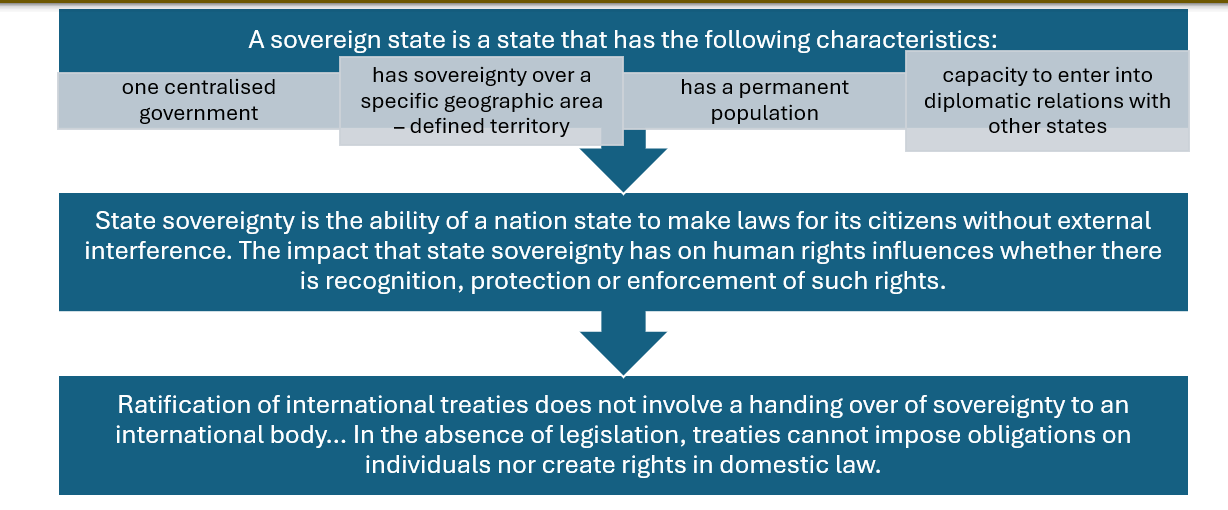
 Note
Note  Flashcards (20)