Programming + Analysis Exam
 Call Kai
 Learn
Learn Practice Test
 Spaced Repetition
 Match
Match Flashcards
 Knowt Play
1/69

There's no tags or description
Looks like no tags are added yet.
Name | Mastery | Learn | Test | Matching | Spaced | Call with Kai |
|---|
No analytics yet
Send a link to your students to track their progress
70 Terms
Planned Unit Development (PUD)
A development project, often involving a mixture of land uses and densities not permitted by normal zoning. It is allowed because the entire development is viewed as an integrated whole - density, sustainability, brownfield development, wetland restoration, etc. If approved, the city creates a special floating overlay zoning district specifically allowing the project as-proposed
Zoning Variance
an exception to the zoning ordinance applied to a particular piece of property. typically municipalities don't grant variances unless the application is peculiar to that one property. applicants often must prove that their variance request is in keeping with the spirit of the original zoning ordinance.
Overlay Districts
overlay a base zoning district (residential, commercial, industrial, etc.) to apply an additional later of standards that delineate a historic district, waterfront area, steep slope, wildfire hazard area, etc.
Easements
the right to use land for a specific and limited purpose. Utilities need easements across private property to run power lines or sewer pipes; sidewalks are easements. Gives someone PERMANENT access to the property.
Other easement examples
If you have a "landlocked" property without access to a public road, I may grant you an easement to put a driveway across my property. I can grant a conservation easement to the wildlife who live in the woods on my property, prohibiting development of those woods. A joint use easement: we agree to share some property, like the party wall that separates my townhome from yours. Solar access easement: before i put PV panels on my roof, I pay you $4,000 to grant me an easement so that no one will build a tall structure on your property that will shade my solar panels from 9am to 4 pm on the equinox.
Air rights
The right to use the open space above a property, usually allowing the surface to be used for another purpose. Can sometimes be sold to another building.
Eminent Domain
A law allowing the city to force me to sell my land for the betterment of everyone - to build a highway, park, dam, etc. Politically charged law because (1) it interferes with property rights concepts and (2) who decides if the government forcing me to sell my property to build a shopping center for the economic development value of the shopping center...is that really for "public use?"
Hot-arid climate
In this climate:
-Use materials with high thermal mass to take advantage of wide variations in day and night temps
-night ventilation helps remove heat built up during day
-Evaporative cooling can be very effective
-Use compact forms with the smallest possible surface area, but a bit longer in the east-west dimension (trying to minimize western exposure more than anything)
-Minimize opening sizes
-provide shade for all openings (shade from direct sunlight is important)
-use light colors on exterior
-the bottom of a valley and the south of a pond are the best locations to build.
hot-humid climate
In this climate:
-most likely need mechanical cooling
-long thin buildings with plenty of natural cross ventilation; use high ceilings and large openings too
-Shading is required; use double roofs or strategic vegetation
-Minimize thermal mass
-shade all openings
-light colors on exterior
-long east-west dimension, orientation to breezes
-top of a hill and the south of a pond area the best locations to build.
-Vapor control layer on the outside (warm side) of insulation
temperate climate
In this climate:
-Minimize northern Exposure and block winds to reduce heat loss
-Oriented to maximum southern exposure for soar heat gain
-Use deciduous trees or awning to reduce heat gain in the summer
-incorporate night time ventilation to exhaust hot air
-Passive and active Solar heating works well when there isn't excessive cloud cover.
-rectangular buildings with east west long orientation, face slightly east
-3/4 of the way up a hill is the best location the build
cold climate
In this climate:
-compact building form to minimize heat loss (little longer in the east-west dimension)
-insulation
-low-U-Value windows,
-air-tightness,
-plant evergreen trees on the windy side of the building as a buffer
-1/4 of the way up a hill and the north side of a pond are the best sirte3s to build on.
-vapor control layer on the inside (warm side) of the insulation
Preservation
Maintains and repairs existing historic materials - keep the old bank a bank, preserving it's old character
Rehabilitation
alters or adds to meet today's needs - turn the old bank into a tech startup
Restoration
depicts a property at a particular period of time, removing the evidence of other periods - restore the bank to it's original glory, demolishing old additions to the building
Reconstruction
Recreates non-surviving portions of a property - reconstruct the old bank after a fire, in the same way it had been before the fire
If the soil can't hold much weight, we can:
1. dig deeper to more competent soil
2. drive pilings or dig piers/caissons and rest our building on bedrock
3. drive friction pilings (in sand)
4. replace the soil with gravel or mix it with cement to make it stronger
5. distribute the load over a larger area with larger footings so that each square foot of soil needn't hold as much of the building's weight
ALTA/ACSM Survey
This is a very detailed survey often required by lending institutions and is strictly geared towards companies purchasing commercial property. Standards created by the American Land Title Association (ALTA) and the American Congress of Surveying and Mapping (ACSM) are used to create this type of survey. The location of all improvements in relation to property lines as well as any easements and setback requirements are shown on this survey as well as any encroachments that exist.
Plat
In a city, the survey would almost certainly come in play form, inclusive of the information from neighboring building and past surveys, when available. Many are based on ALTA/ACSM surveys
Metes and Bounds
A method of land description which involves identifying distances and directions and makes use of both the physical boundaries and measurements of the land. Considered outdated, but still used in rural areas where there are no available benchmarks.
ASTM E 1527: Phase I Environmental Site Assessment
Often required in commercial real estate before a bank loans money to develop a site, environmental engineers will attempt to determine if there is asbestos, lead paint, contaminated soil, etc. Phase I is a cursory evaluation, involving a walk-through, interviews with occupants, inspections of adjoining properties, and review of government records pertaining to the site. Was there a dry cleaner or gas station nearby that might have contaminated the soil? Does that pipe insulation look to be of an age that indicates it may have asbestos?
ASTM E 1903: Phase II Environmental Site Assessment
A more in-depth analysis often required in Phase I turns up a red flag. In Phase II, soil samples are taken; pipe insulation sample is taken to a lab.
ASHRAE 55 Thermal Comfort
Cited in LEED, this establishes ranges for temperature, humidity, airspeed, and thermal radiation as it relates to the clothing and activity of the occupants. It's easier to achieve low energy use if you allow the building to get too warm or too cold, so requiring that it meets ASHRAE 55 keeps the energy modeler honest.
ASHRAE 62: Ventilation and Indoor Air Quality (IAQ)
Cited in LEED. Establishes just how fresh "fresh air" must be, establishes required outside air ventilation rates, etc.
ASHRAE 90.1 Energy and Lighting
Also cited (and cited often) in LEED, this checks greenwashing by owners, architects, and energy consultants. It establishes minimum performance for Energy Use Intensity (EUI), which measures annual kBTUs-used per square foot of floor area. Recently, buildings are publishing their EUI, even in design publications and design awards announcements. Understanding EUI isn't a big part of these exams, but is becoming important to the profession. For instance, a warehouse has a median EUI of about 25 kBTU/sf (not much lighting or equipment or need for occupant thermal comfort. . . and spread over a large space). An office or school is 50, a mall is 100, a grocery store or hospital is 200 (lots of equipment), and a fast food restaurant is 400 (lots of equipment in a small total floor area). The goal then is to get your building well under those industry averages to drive down societal energy use.
Standards for Preservation
1- Use the property to maximize the retention of distinctive features.
2- Retain the historic character
3- Recognize the property as a physical record of its time
4- Preserve past renovations that have acquired historic significance in their own right
5- Repair historic features so that the new material, color, texture, and design match the old
6- Preserve archaeological resources in place.
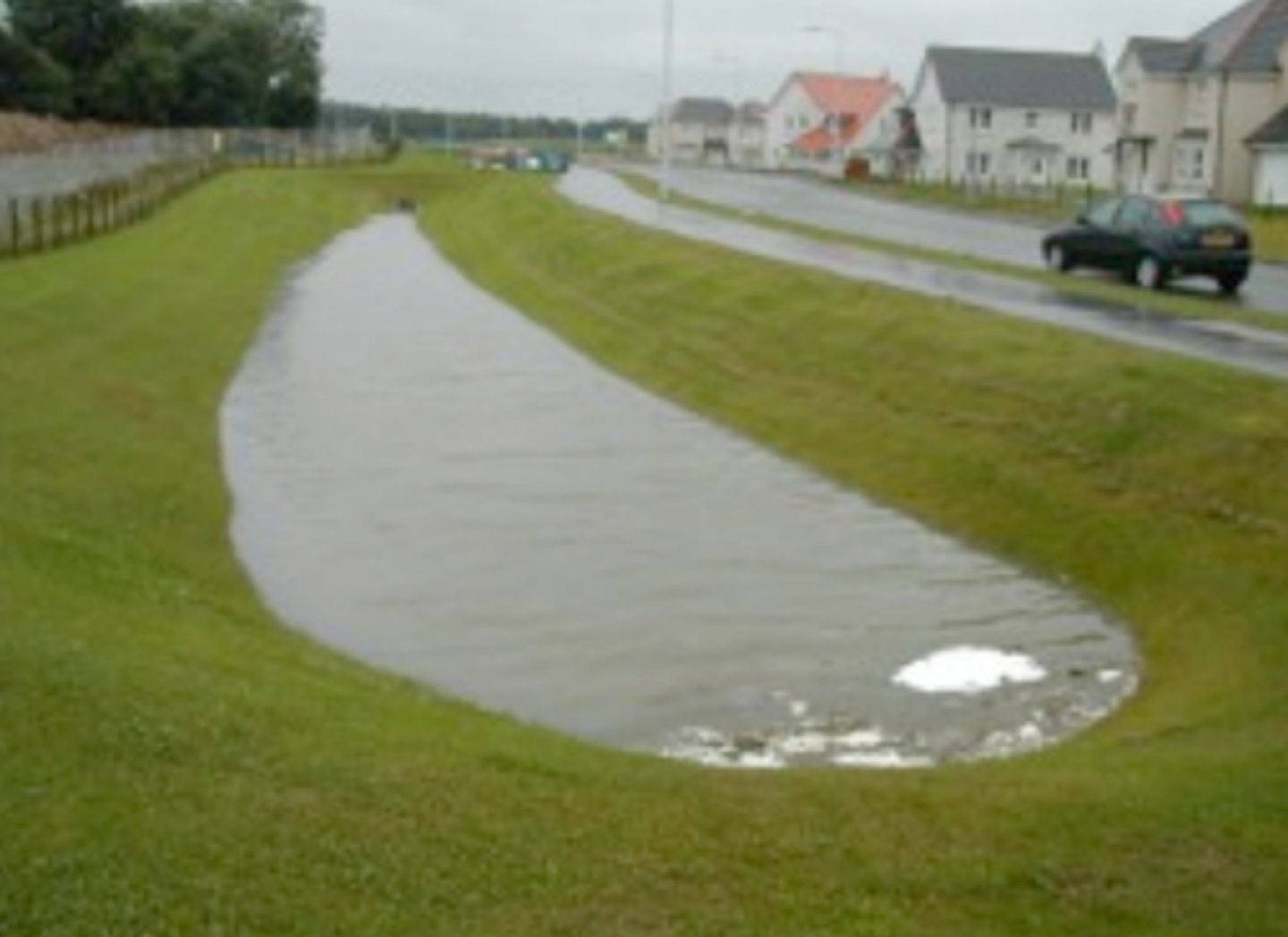
Detention Ponds
hold stormwater for a while, then slowly drain out. They are dry between storms, control flooding, require large amounts of space, and can breed mosquitoes.
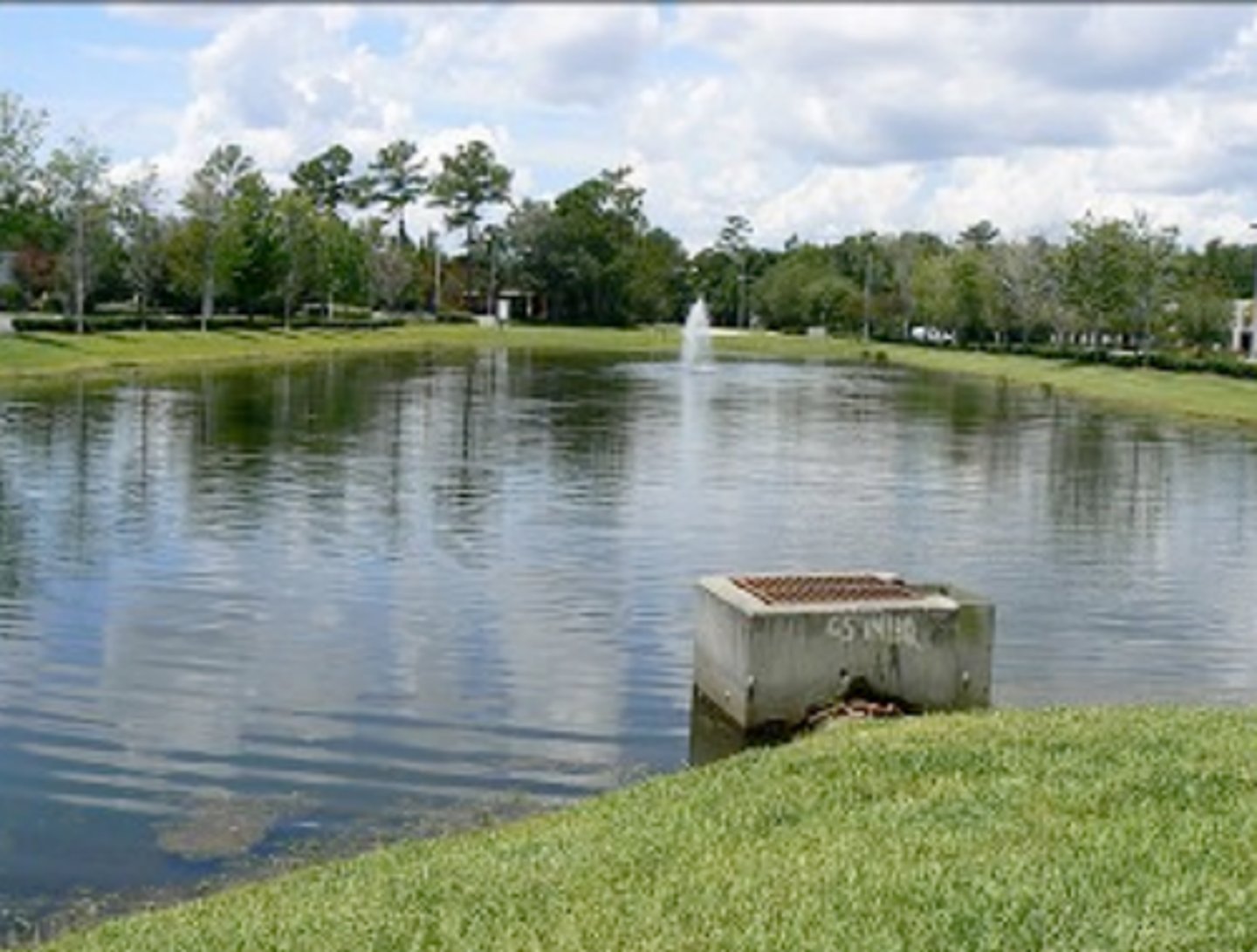
Rentention Ponds
Hold stormwater and are always wet. They looks like regular ponds (but uglier, if not design correctly). They both control flooding and promote higher water quality because the soil below them filters out pollutants from the water.
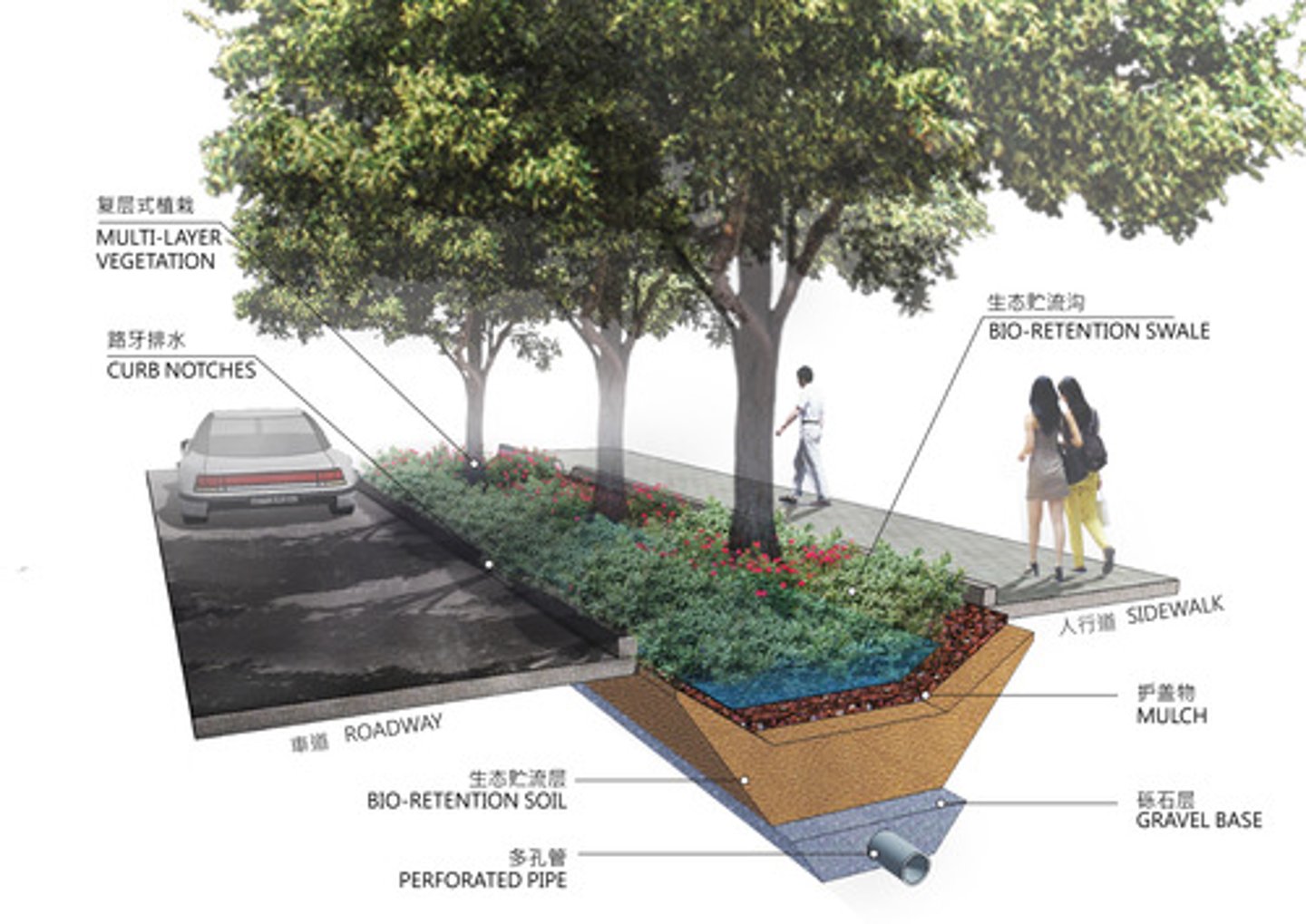
Bioswale
vegetated or mulched channels that convey stormwater away slowly enough to allow for water to seep into the soil, which removes pollutants before recharging groundwater: like an ecologically thoughtful version of a detention pond. Ecologically thoughtful version of a retention pond.
Cisterns
Underground temporary storage container for roof or pavement runoff. No extra space required and no mosquitos.
Zoning code limits building heights. What other restrictions is it likely to place?
Floor-Area-Ratio (FAR)
Lot building set-back distances (how close you can build to your front, back and side lot lines)
Parking Space number minimums (and, more recently, parking maximums)
What type of occupancy or program is allowed (no gun shop next to elementary schools)
how you must deal with your site's water runoff (maximum gallon per hour allowed into the sewer)
Building sign restrictions for businesses (height, size, number, type)
Form-Based Codes
zoning codes shift the emphasis from regulating building use (residential only in one area, commercial on opposite side of city, etc.) to an emphasis on regulating urban form. May includes mandates for street trees, sidewalks, alleys, public space. It may also limit front-facing parking lots, dumpster visibility and type of building materials available to the architect. Principles to encourage walkability and allow bakery and dentist offices to open near homes that they serve
Covenant
restrict what future owners can do on the property. If you plan on moving but promise your neighbors that no one will ever put up a fence higher than 5 feet around the property, you can add that in a covenant and it rides as a sidecar to your deed. Planned communities often use these to standardize aesthetics on homes.
steepest slope for planted area
2:1 (50% slope)
Steepest slope for parking lots
5% maximum
(1% minimum for runoff)
you have a high-water table on the site you plan to build on... now what?
foundation footing and basement slabs should sit above the water table (soil depth where wet all year long)
with a high water table, we may need to use a shallow footing (but below frost depth, of course) ... or mound up the earth below the building ... or use piles, pilings, piers, or caissons, which can be drilled or driven below the water table.
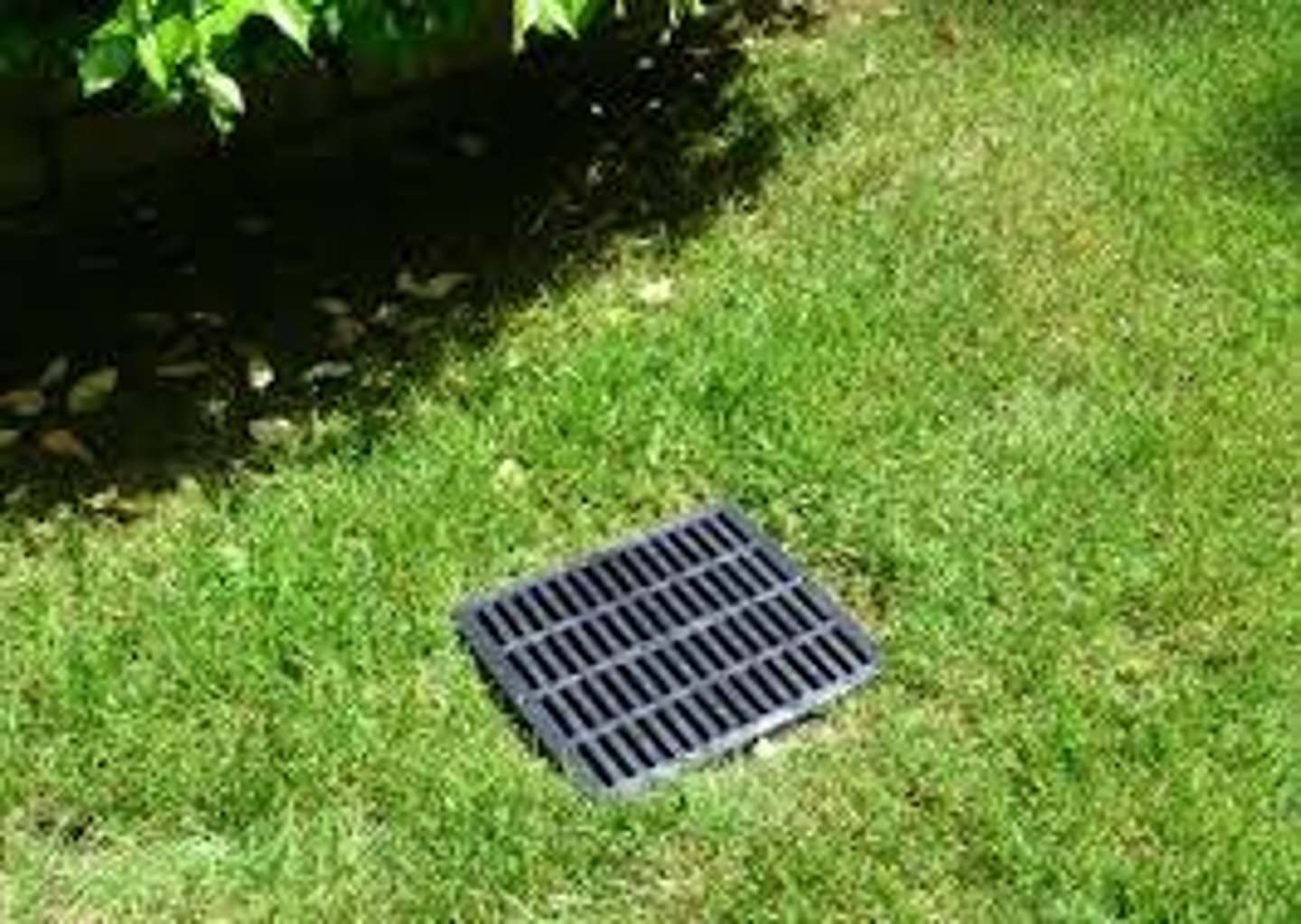
Catch Basin
the box below an outdoor drain
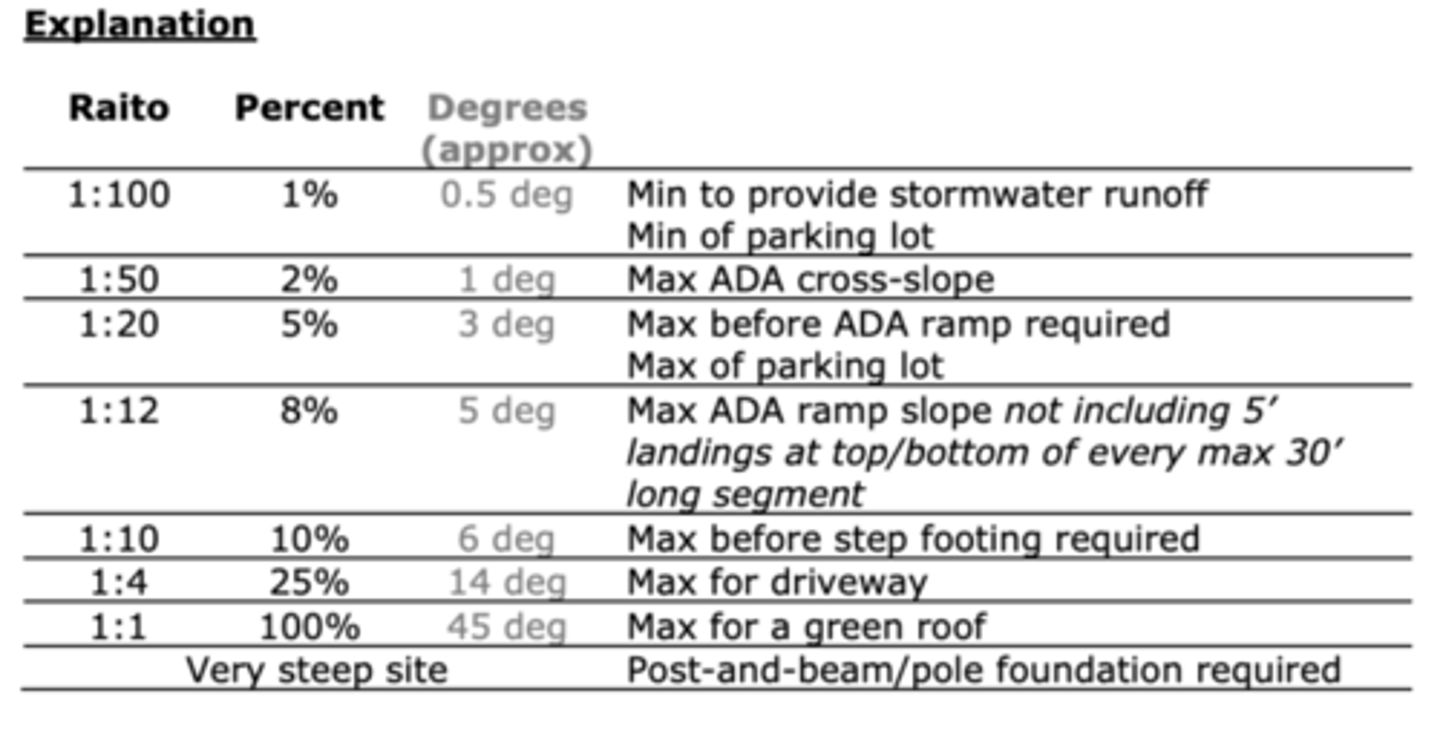
slopes
1%: minimum slope for swales to prevent standing water (1/100)
2%: maximum cross slope for ADA walkways (1/48)
5%: maximum slope before accessible ramps are required (1/20)
required land slopes
From a programming point of view, what makes a building more efficient?
Daylight availability (so electric light is not needed), summertime shading, central mechanical systems are more efficient that in room- systems (one fan and one compressor for multiple zones), sharing heat from core to perimeter (variable refrigerant systems), on-demand hot water heating (so that hot water needn't be stored for alter use), radiant hydronic heating and cooling systems, small openings in cold and hot-arid climates, large openings in hot-humid climates, and southern glass and thermal mass (cold, sunny climates)
Historical Cost (value)
assume it's still worth what you paid for it 15 years ago.
a highly conservative way to determine the price for a piece of property (ignores property appreciation)
Unit-In-Place Cost (value)
assume it is worth what it would cost to replace it (new) if it disappeared tomorrow
Sales Comparison (market) Approach (value)
assume it is worth what similar building sold for recently. Includes the comparables ("comps") many homebuyers and lender use to price one house based on what others in the neighborhood sold for in the last few months.
Income Approach (value)
includes the anticipation of future benefits: Converts future income from the property into a present worth or current market value. What would the prudent investor be willing to pay now for the right to receive the future income stream from renting this office building?
Early Stage Cost Estimating Technique
Rough order of magnitude cost estimate
Might be off by as much as 2X
Used for a "napkin estimate" before design to determine feasibility. Used in Pre-design/programming (PA exam)
As we move through design phases we get more specific and have more confidence that our estimate is close to the final construction cost, eventually where we want to be within 5%
For later, SD, DD, and CD stages:
"Unit-rate cost estimating" . . . early-on, we'll use estimates based on per square foot or per cubic foot estimates. Then later, as we know more about the project, our estimates will tally detailed units like "number of pipe bends" and "linear feet of conduit" and "estimated cost of labor to install 50,000 sf of EPDM roofing membrane."
Contaminated Soil Remediation: When to use SOIL SOLIDIFICATION / STABILIZATION
to address inorganic and radioactive pollutants ... like toxic heavy metals, pesticides, and fertilizers.
Mixes a soil binder (cement) with the on-site dirt to make the soil more solid and stable. Very expensive and therefore, not very common.
Polluted soil remediation: When do we use SOIL WASHING / SOIL FLUSHING?
when the soil in contaminated by inorganic materials (toxic metals)
In soil flushing, we inject water into the soil. The soil flushing solution includes additives that help with contaminant solubility. The contaminants are then flushed out of the soil and down to the groundwater and the groundwater is extracted and treated at the surface.
In soil washing, we'll excavate the soil out of the ground and wash off the contaminants, and then return the soil to the hole we dug.
Soil Remediation: When do we use SOIL VAPOR EXTRACTION?
soils contaminated by fuels and underground VOCs (but not useful for much else)
Wells dug into the soil pull contaminated vapor out with vacuum suction where it is filtered with activated carbon at the surface. one of the few that can run concurrently with building occupied.
Contaminated Soils: when do we use BIOREMEDIATION?
Can be used for VOCs, fuels, inorganics (toxic metals), and explosives
Inject helpful microbes into the soil that "eat" the contaminant, rendering it less harmful or inert altogether. Becoming more common.
1 acre
43,560 square feet
Gross Up Factor
Same as R/U Ratio, rentable/usable (greater-than 1)
Commercial tenants pay for some shared square footage, like their pro rated portion of common restrooms. That counts as rentable, but not usable, square footage.
Optimal Spans
80' - Glu-lam beams and columns
55' - reinforced concrete waffle slab
40'+ - Open web steel joists supported on wide flange beams and columns
25' - reinforced concrete flat plate
25' - wood I-joists spanning a wood post and beam system
25' - steel wide flange beams and columns with reinforced steel decking
E (education) occupancy only used for k-12 schools
higher education commonly classified a B (business) occupancy
Remember this
ADA was signed in 1990
Remember this
building on any kind of sloped earth is COSTLY ($$$)
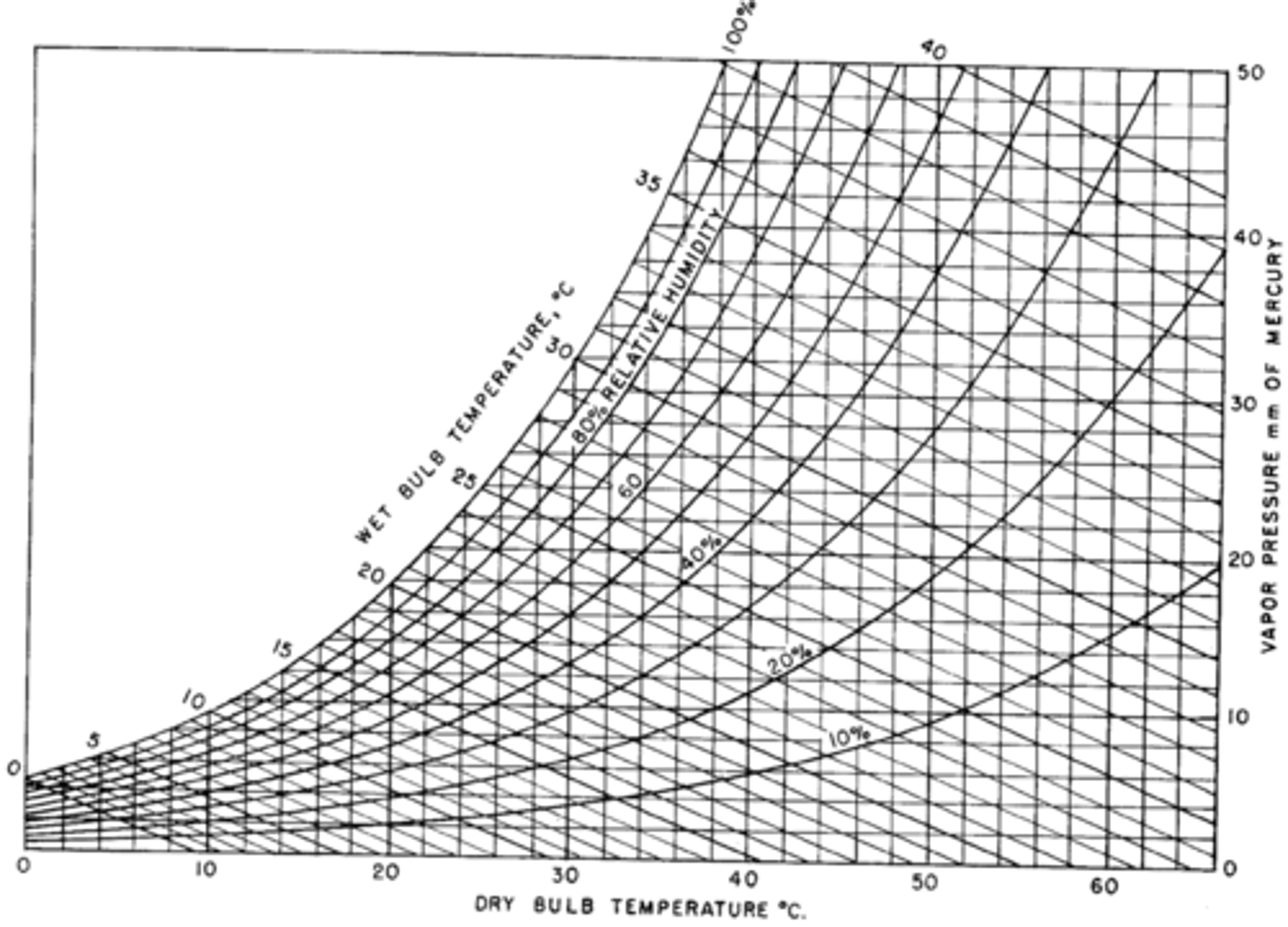
psychometric chart
A powerful graphic representation of temperature and relative humidity.
Remember this
you must request permission from utility company prior to building on an easement
Remember this
Wind does NOT promote cooling in an arid climate
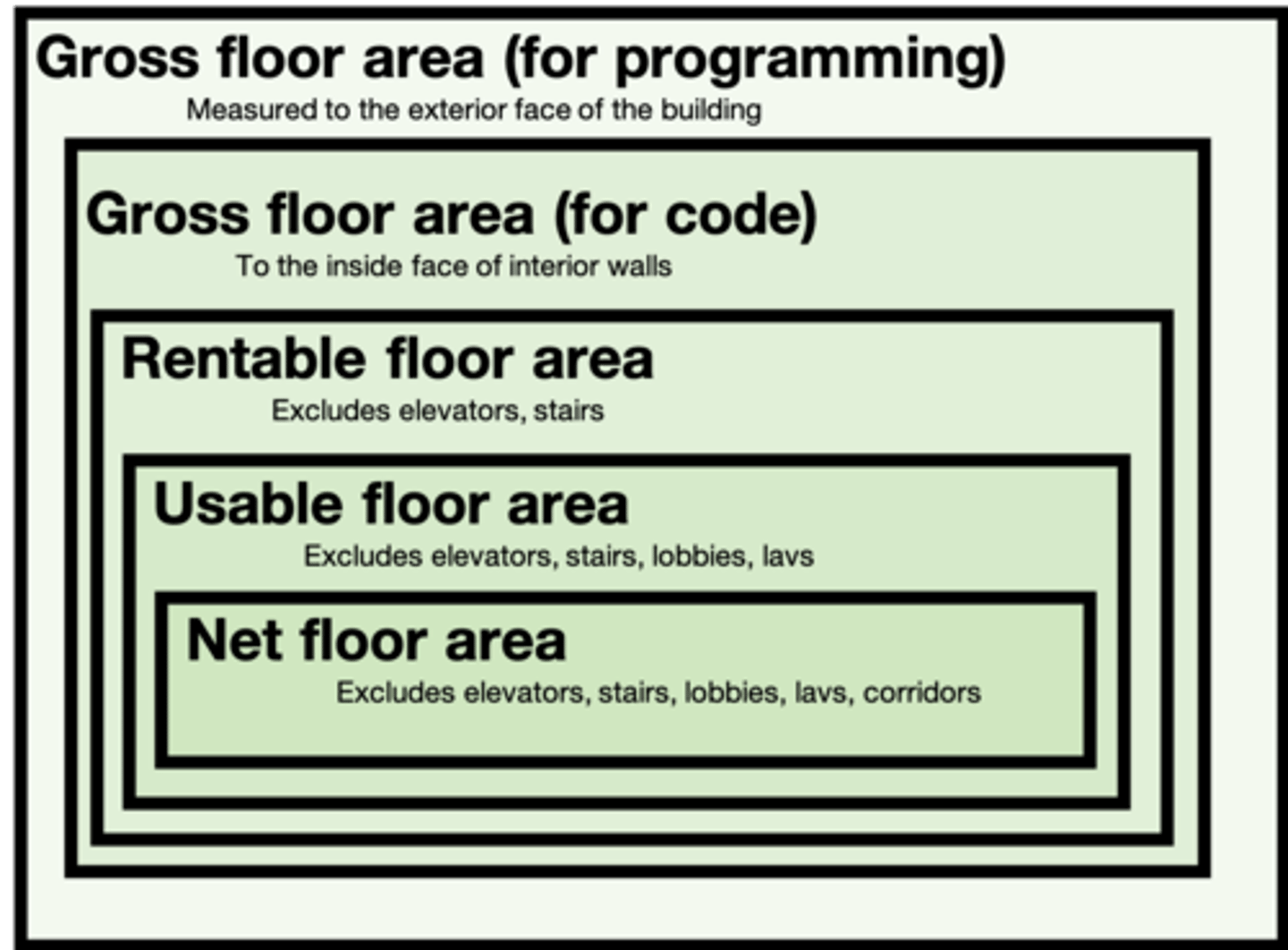
Gross Floor area
In matters of code, gross floor area is measured from the inside face of exterior walls. In other matters of programming and analysis (programming, pre-design, schematic design, or cost estimating), gross floor area is measured from the outside face of the exterior walls. It is a value used in the denominator of economic efficiency proportion measures like "net-to-gross" (interior area, excluding corridors, lobbies, elevators, bathrooms, and stairs, divided by gross floor area).
"Usable area," is like net area, except that it includes corridors.
"Rentable area" is like usable area, except that it includes bathrooms and lobbies.
"Grossing factor," is rentable area, divided by usable area. To make these concepts even more difficult to remember, their specific definition varies somewhat by region and industry, so you might have correctly heard one of these terms used in another way.
Having trouble remembering the order of these names? From largest to smallest floor area, use "Go RUN". . . Gross, Rentable, Usable, Net.. . . Rentable and Usable are the tricky ones to keep straight, so remember that Rentable doesn't include building volumes that are common to multiple tenants AND extend between floors (stairs and elevators). - see downloaded image
Bentonite vs EPDM
Bentonite Cay comes in medium-sized sheets that swell when they get wet - as clay tends to do. This gives it a self-healing quality. The sheets deteriorate when exposed to UV
EPDM membrane is often associated with roofs, but the industry has moved down-building to successfully offer UV-Resistant EPDM foundation membranes that also come in rolls of sheet - bigger than bentonite clay. These are not self-healing, requiring careful treatment at the seams, but they are fully-adhered to the concrete, which building scientists like.
Building efficiency ratio
The leasable space, divided by the total space = building efficiency ratio (think multifamily development summaries)
Floor Area Ratio (FAR)
The ratio of the gross floor area within a structure to the area of the lot on which the structure is situated.
FAR = total allowable SF / Site Area
Total Allowable SF = Site Area x FAR
Slab-on-Grade
A concrete surface lying upon, and supported directly by, the ground beneath. A cost-effective option, but no suitable for heavy loads or high column loads, susceptible to soil expansion.
Pier and beam
foundation rests on a series of isolated columns that extended above ground level (create crawl space). ore expensive to install, but it's better suited to area with high winds or shifting soils. Can trap moisture in areas with heavy rain and the material can crack in extreme temps.
Mat Foundation
A thick, slab-like heavily reinforced concrete footing supporting a number of columns or an entire building. Similar to slab on grade, but they can handle heavier loads and are better for uncompacted soil.
Pile (foundation)
transfers the building's loads to a stronger layer of soil below the surface. There are several types of piles - load-bearing, end-bearing, and friction piles
Floating foundation
Thick, reinforced concrete slab or mat that spreads the building's weight over a large area to help it stay stable and level. Thys type of foundation is often used in areas with weak or compressible soil.
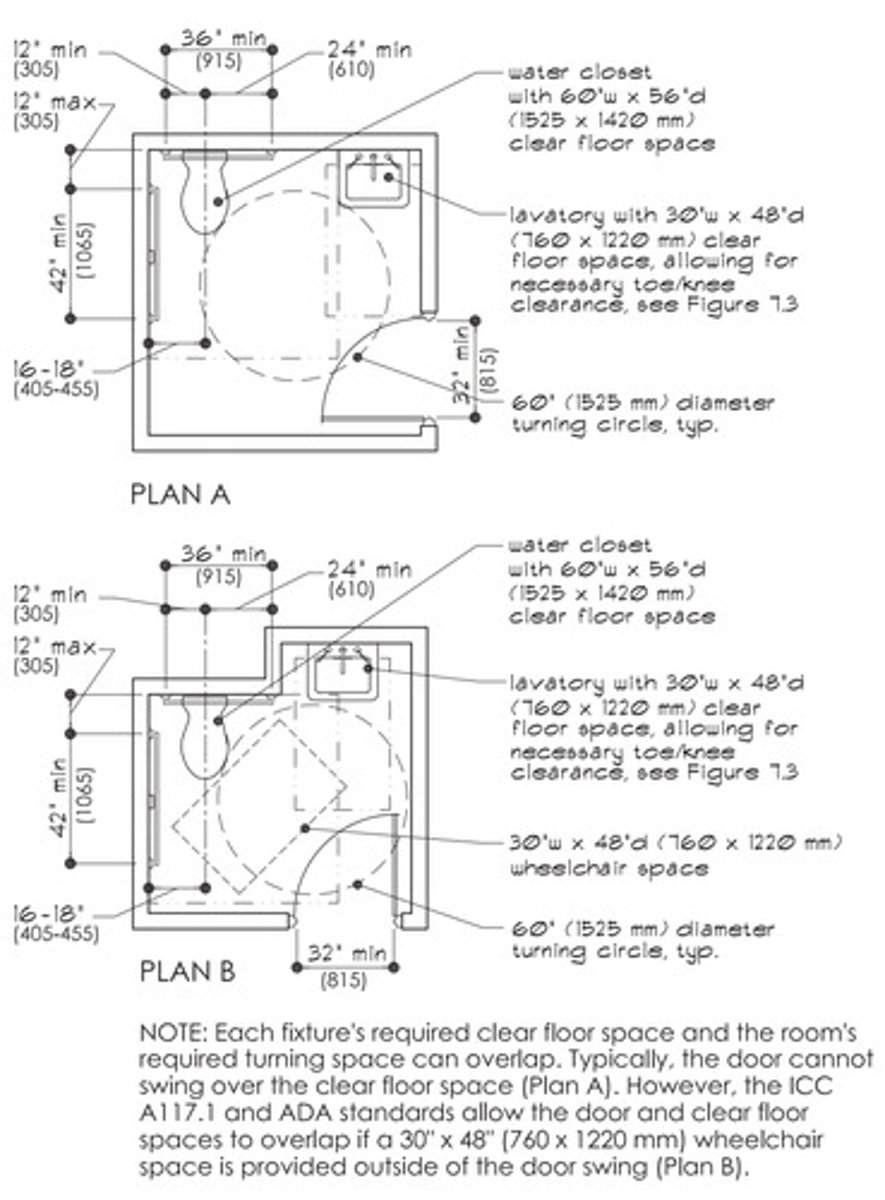
ADA clearances
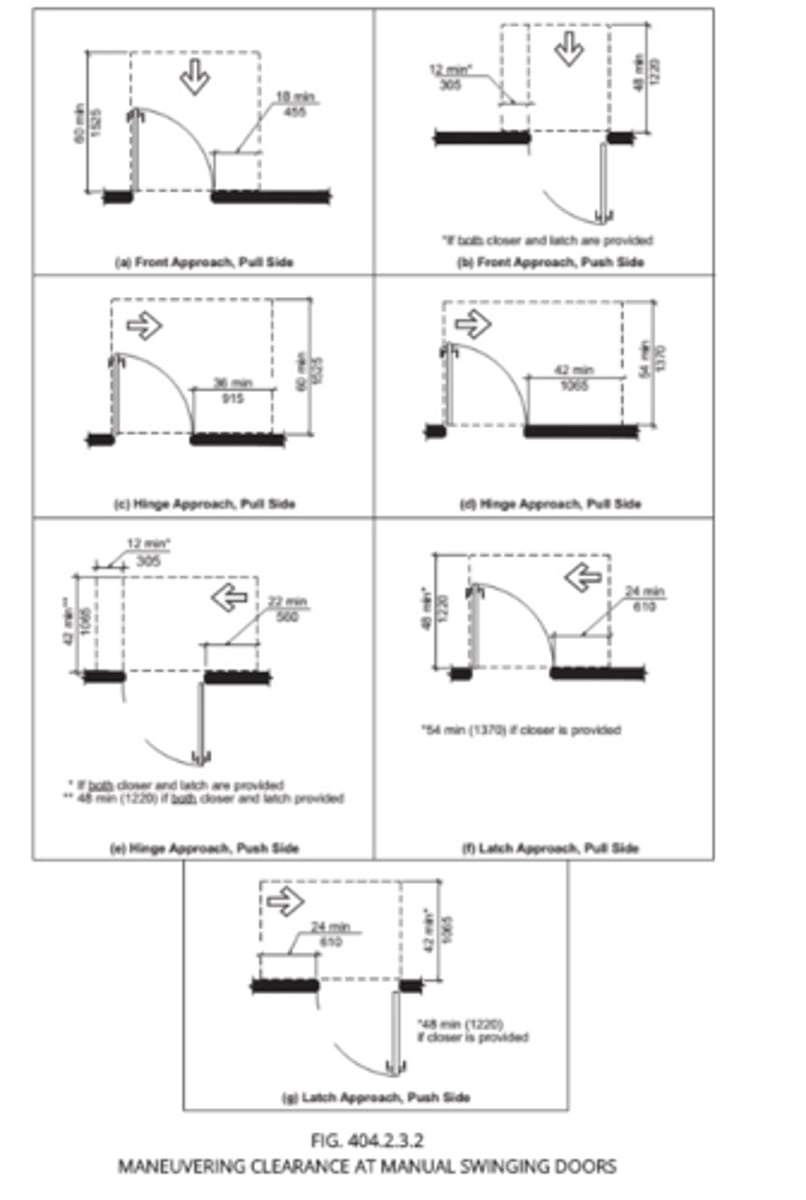
ADA clearances
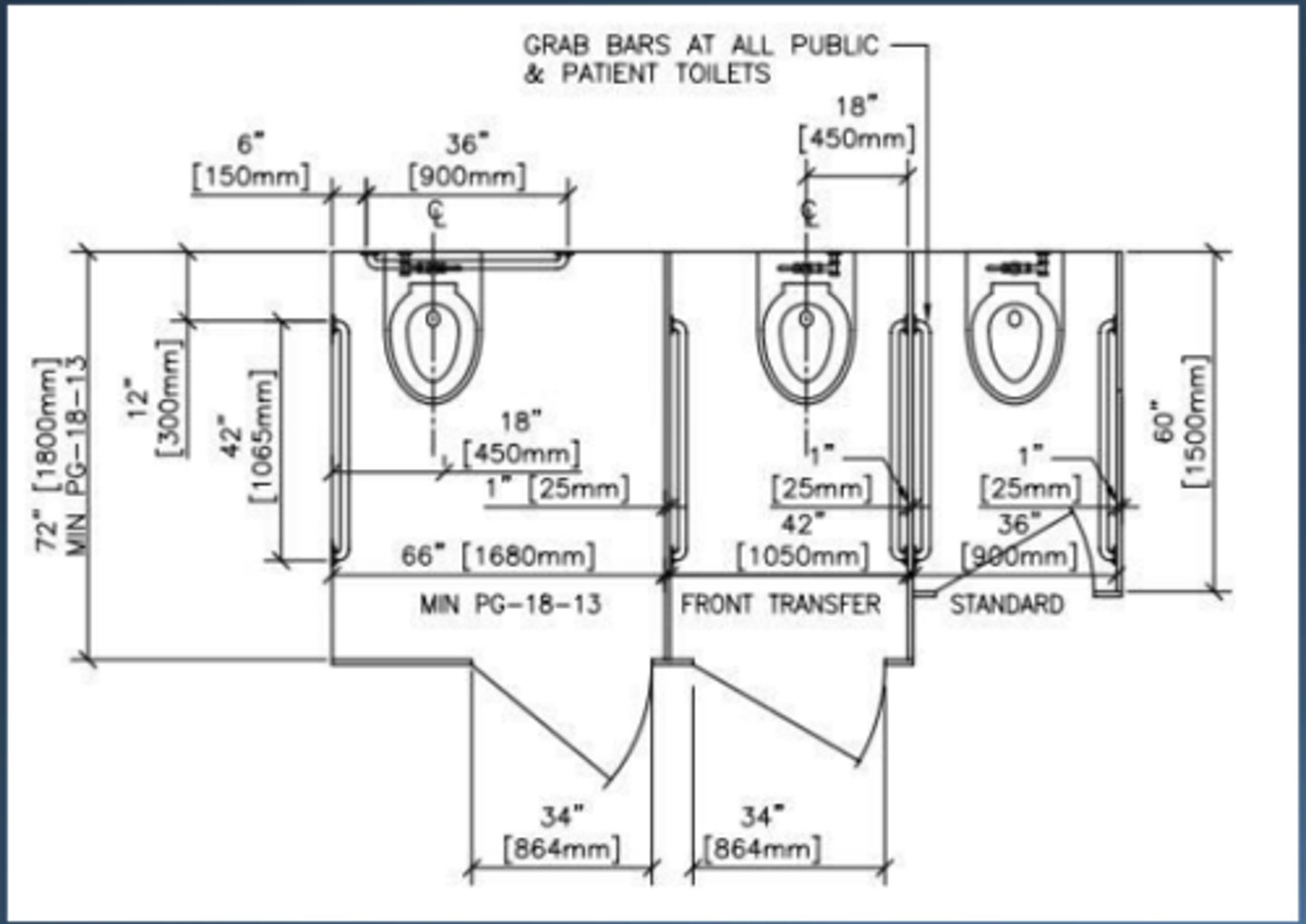
ADA restroom clearances
Still learning (14)
You've started learning these terms. Keep it up!
Explore top notes

