Soci Final
0.0(0)
 Studied by 4 people
 Call Kai
 Learn
Learn Practice Test
 Spaced Repetition
 Match
Match Flashcards
 Knowt Play
Card Sorting
1/124

There's no tags or description
Looks like no tags are added yet.
Last updated 2:39 AM on 4/18/23
Name | Mastery | Learn | Test | Matching | Spaced | Call with Kai |
|---|
No analytics yet
Send a link to your students to track their progress
125 Terms
1
New cards
The Case of Caster Semenya
\-A middle distance runner who “failed” gender testing
\
\-As an intersexed individual, she was humiliated when her situated was made public
\
\-Raised Important Questions about Sex and Gender - Did she fail the test? Or did the test fail her?
\
\-Ordered to take drugs to lower her testosterone
\
\-Transgender athletes?
\
\-As an intersexed individual, she was humiliated when her situated was made public
\
\-Raised Important Questions about Sex and Gender - Did she fail the test? Or did the test fail her?
\
\-Ordered to take drugs to lower her testosterone
\
\-Transgender athletes?
2
New cards
Sex
\-Biological traits of men and women
\
\-Chromosomal, gonadal, hormonal, sex organs
\
\-Chromosomal, gonadal, hormonal, sex organs
3
New cards
Gender
social, cultural and psychological traits linked to males and females
4
New cards
Heterosexual
sexually or romantically attracted exclusively to people of the other sex.
5
New cards
Homosexual
sexually or romantically attracted exclusively to people of one's own sex or gender.
6
New cards
Compulsory Heterosexuality
assumed by many that others are heterosexual and it is frowned upon when they do not follow traditional behavioral patterns
7
New cards
The Sexual Continuumm
\-1940s and 50s
\
\-Kinsey Argued that biologists and zoologists knew about animal sexuality but knew very little about humans
\
\-Controversial during that time
\
\-Argued there was a sexual continuum
\
\-Fruit Machine (1960s) - homosexuals were irrational security threats
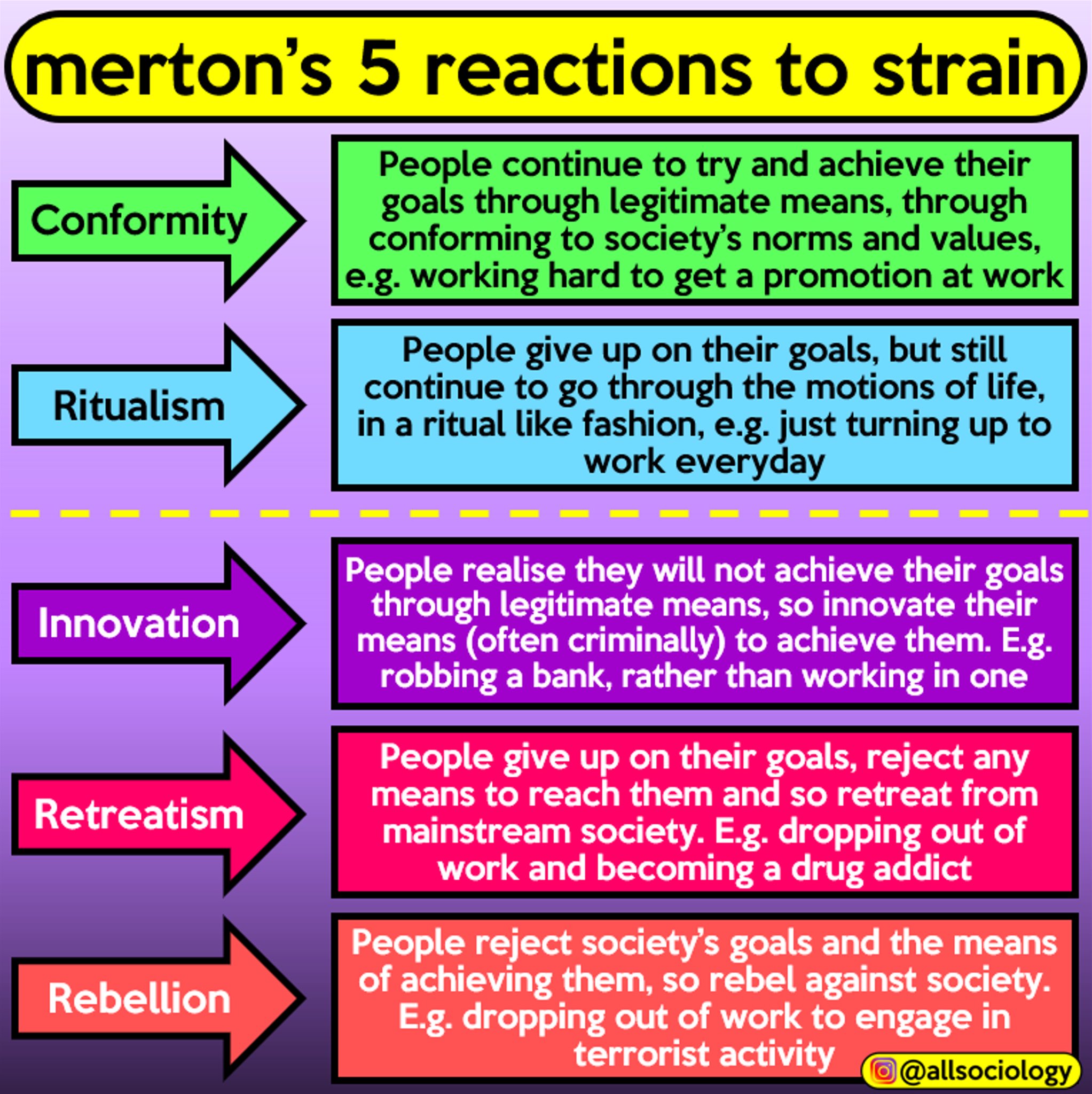
\
0 = Heterosexual, 6 = Homosexual
\
\-Kinsey Argued that biologists and zoologists knew about animal sexuality but knew very little about humans
\
\-Controversial during that time
\
\-Argued there was a sexual continuum
\
\-Fruit Machine (1960s) - homosexuals were irrational security threats
\
0 = Heterosexual, 6 = Homosexual
8
New cards
The David Reimer Case
\-Gender Conflict
\
\-Butchered circumcision on Bruce - Family concerned about his well-being
\
\-Dr. Money argued that sex and gender is malleable for the first 26 months of life
\
\-Bruce underwent medical procedures for a female body
\
\-Transition was not successful - “Brenda” was not feminine
\
\-Transitioned back to male at 15 years old
\
\-Parents chose his gender
\
\-Does this case “prove” that gender is biologically rooted?
\
\-Butchered circumcision on Bruce - Family concerned about his well-being
\
\-Dr. Money argued that sex and gender is malleable for the first 26 months of life
\
\-Bruce underwent medical procedures for a female body
\
\-Transition was not successful - “Brenda” was not feminine
\
\-Transitioned back to male at 15 years old
\
\-Parents chose his gender
\
\-Does this case “prove” that gender is biologically rooted?
9
New cards
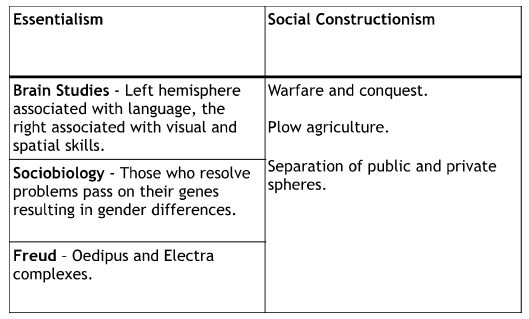
Sex Differences
\-Brain studies: left hemisphere associated with language, the right is associated with visual and spatial skills
\
\-Sociobiology: Those who resolve problems pass on their genes resulting in gender differences
\
\-Freud: Oedipus and Electra complexes
\
\-Sociobiology: Those who resolve problems pass on their genes resulting in gender differences
\
\-Freud: Oedipus and Electra complexes
10
New cards
Critiques of Essentialism
1\.Essentialists ignore the historical and cultural variability of gender and sexuality
\
2\.Essentialists ignore the fact that gender differences are declining rapidly and in some cases have already disappeared.
\
3\.The research evidence employed by essentialists is often deeply flawed
\
4\.Essentialists tend to generalize from the average, ignoring variations within gender groups
\
5\.Essentialists exaggerate the degree to which gender differences are unchangeable
\
6\.Essentialists offer explanations for gender differences that ignore the role of power
\
2\.Essentialists ignore the fact that gender differences are declining rapidly and in some cases have already disappeared.
\
3\.The research evidence employed by essentialists is often deeply flawed
\
4\.Essentialists tend to generalize from the average, ignoring variations within gender groups
\
5\.Essentialists exaggerate the degree to which gender differences are unchangeable
\
6\.Essentialists offer explanations for gender differences that ignore the role of power
11
New cards
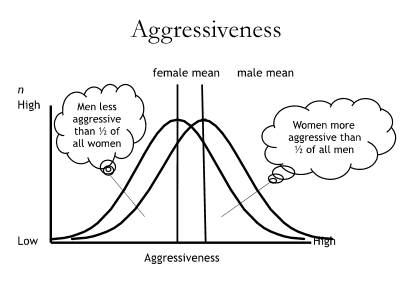
Essentialists tend to generalize from the average, ignoring variations within gender groups
-No formal definition of aggression
\-Not a great difference between females and males
\-Not a great difference between females and males
12
New cards
Essentialists ignore the historical and cultural variability of gender and sexuality
\-These variations in gender across cultures can be seen in Margaret Mead and the Arapesh in New Guinea
\
\-Rape rates vary widely across cultures
\
\-Societies change without any corresponding genetic change
\
\-Rape rates vary widely across cultures
\
\-Societies change without any corresponding genetic change
13
New cards
Essentialists ignore the fact that gender differences are declining rapidly and in some cases have already disappeared.
\-A review of 165 studies of verbal ability representing 1.4 million people found no difference in verbal abilities
\
\-A review of 100 studies in mathematics representing 4 million students showed a slight difference favoring females
\
\-Spatial Differences were minor
\
\-A review of 100 studies in mathematics representing 4 million students showed a slight difference favoring females
\
\-Spatial Differences were minor
14
New cards
The research evidence employed by essentialists is often deeply flawed
\-Sociobiologists have not be able to identify any of the genes that, they claim, cause male jealousy, female nurturance, or the unequal division of labor between men and women
15
New cards
Essentialists exaggerate the degree to which gender differences are unchangeable
more egalitarian societies reduce the age gap in female-male relationships
16
New cards
Economic Inequality - Double Work Day
Women have 2 jobs at home and work outside the home
17
New cards
Economic Inequality - Sex Segregation
Categorize jobs (areas of the economy) = oil and gas (men), hair dresser (women) - rooted in stereotyping
18
New cards
Economic Inequality - Sex Typing
the stereotypical categorization of people, or their appearance or behavior, according to conventional perceptions of what is typical of each sex or gender.
19
New cards
Economic Inequality - Glass Ceiling
women have moved slowly into higher status jobs but there is a certain point where they are unable to move up any further - can see through the ceiling but can not go through it (think a of an invisible maximum)
20
New cards
Economic Inequality - Nonstandard Work
refers to a work arrangement between an employer and employee that deviates from standard employment
\
temporary help, contingent, part-time, on-call, direct hire, agency, contract, app-based, on-demand, free-lancer, and gig workers
\
temporary help, contingent, part-time, on-call, direct hire, agency, contract, app-based, on-demand, free-lancer, and gig workers
21
New cards
Social Inequality
\-Gender stratification in which men, in general , hold greater power, prestige and wealth then women
\
\-Power: the ability to impose one’s will on others
\
\-Prestige: social ranking and respect
\
\-Wealth: economic resources to pay for the necessities in life
\
\-Power: the ability to impose one’s will on others
\
\-Prestige: social ranking and respect
\
\-Wealth: economic resources to pay for the necessities in life
22
New cards
Why have women become so involved in the labor force especially since 1961?
1. An increase in the demand for service sector workers
\
2. A decrease in the number of children born
\
3. Family Finances
23
New cards
4 Reasons that Explain Why Women Earn Less then Men
1. Gender differences in the characteristics that influence pay rates (education, experience, seniority)
\
2. Women are involved in sex-segregated, non-standard work
\
3. Simple discrimination - even in the same jobs women are often paid less then men
\
4. A general devaluation of the kind of work performed by women
24
New cards
Political Power
\-There has been one Canadian female Prime Minister (Kim Campbell). She “inherited” the position after the former male leader stepped down. She held the position for 4 months. PC Party Status was lost.
\
\-In 2013, there are 308 federal politicians. 64 are female
\
\-In 2013, there are 734 provincial politicians. 156 are female
\
\-Only 2/4 current female Premiers were elected
\
\-In 2015, there were 338 federal politicians. 88 were female.
\
\-There are NO female Premiers in 2019
\
\-In 2013, there are 308 federal politicians. 64 are female
\
\-In 2013, there are 734 provincial politicians. 156 are female
\
\-Only 2/4 current female Premiers were elected
\
\-In 2015, there were 338 federal politicians. 88 were female.
\
\-There are NO female Premiers in 2019
25
New cards
What are the 2 Sources of Women’s Oppression?
Capitalism and Patriarchy
26
New cards
Capitalism
\-Original thought of Marx Supporters
\
\-Women = Proletariat and Men = bourgeoise
\
\-Women = Proletariat and Men = bourgeoise
27
New cards
Patriarchy
Need to reconsider: many homeless men, powerful women
\
\-Current: capitalism mixed with patriarchy?
\
\-Women’s oppression comes with this
\
\-Current: capitalism mixed with patriarchy?
\
\-Women’s oppression comes with this
28
New cards
Socialist Feminism
\-Both capitalism and patriarchy must be substantially altered or eliminated to free women
\
\-Capitalists benefit greatly from women’s work, including raising of children, but do not pay for all of this work
\
\-State intervened with social programs (raising the federal debt)
\
\-Socialist Feminist believe that the laws of the state can be changed for positive social change in society
\
\-Insight is gained from looking at the intersections of oppression between class and gender
\
\-The struggles faced by, and resources available to, lower-class women can be different from those middle and upper class women, and feminist socialism is useful in identifying these
\
\-Capitalists benefit greatly from women’s work, including raising of children, but do not pay for all of this work
\
\-State intervened with social programs (raising the federal debt)
\
\-Socialist Feminist believe that the laws of the state can be changed for positive social change in society
\
\-Insight is gained from looking at the intersections of oppression between class and gender
\
\-The struggles faced by, and resources available to, lower-class women can be different from those middle and upper class women, and feminist socialism is useful in identifying these
29
New cards
T or F: Social Feminists believe they can work with state to benefit women's lives
F = for radical feminism because 'male' control of the state
30
New cards
Social Images
\-look at the mass media to determine the content of beauty norms for women
\
\-Cosmopolitan, Glamour and LouLou place a measure of pressure towards conformity
\
\-Cosmopolitan, Glamour and LouLou place a measure of pressure towards conformity
31
New cards
Social Self
\-While psychologists examine personality recall that sociologists examine the social self consisting of the I, ME and the generalized other
32
New cards
Mathews (2000)
\-In “The Body Beautiful: Adolescent Girls and Images of Beauty,” Matthews found:
\
\-Girls suggested that they were not passive victims of beauty images
\
\-Looking better means access to social groups and power
\
\-Other girls (not boys) were the most important audience and their harshest critics
\
\-Girls suggested that they were not passive victims of beauty images
\
\-Looking better means access to social groups and power
\
\-Other girls (not boys) were the most important audience and their harshest critics
33
New cards
4 Groups - Matthews
\-She identified 4 groups in Lethbridge, AB:
\
\-The Elite = young women who know they look good, know they have power, and enjoy using it; they like their positions
\
\-The '“Wannabees” = they recognize that if they could change just one little thing about themselves, they could join the elite
\
* this thing might be losing weight, slightly changing their appearance
\
* they aren't confident about themselves
\
\-Life in the Middle = happiest, take advantage of extracurriculars, base their identity on more then just beauty
\
\-The Fringe = do not feel like they can access the elite group, stopped trying, not treated well
\
\-The Elite = young women who know they look good, know they have power, and enjoy using it; they like their positions
\
\-The '“Wannabees” = they recognize that if they could change just one little thing about themselves, they could join the elite
\
* this thing might be losing weight, slightly changing their appearance
\
* they aren't confident about themselves
\
\-Life in the Middle = happiest, take advantage of extracurriculars, base their identity on more then just beauty
\
\-The Fringe = do not feel like they can access the elite group, stopped trying, not treated well
34
New cards
*Real Men Don't Eat Quiche*
* In 1982, American writer Bruce Fierstein published a short, tongue-in-cheek guide to male behavior.
\
* It was called *Real Men Don't Eat Quiche,* and its memorable title quickly entered public discourse, even among those who hadn't read the book. It was a standard quip in conversations about what men do (or don't do), particularly when those conversations centered on activities viewed in mainstream North America as traditionally feminine - activities like baking, gardening, or figure skating.
\
* But the title of Fierstein's satire on gender stereotypes was more then a punchline. In a decade when North American society was deeply suspicious of effeminate men and openly hostile toward homosexuals, "real men don't eat quiche" became a motto that defined the quest to identity guiding principles for the would-be "macho man", an idealized cisgendered heterosexual man embodying desirable male characteristics - good looks, sex appeal, toughness, self-assertiveness.
\
* Masculinity is a social construct: like femineity, it is a set of attitudes -belonging to a particular tie and place - about how men (or women) are supposed to behave
\
* It was called *Real Men Don't Eat Quiche,* and its memorable title quickly entered public discourse, even among those who hadn't read the book. It was a standard quip in conversations about what men do (or don't do), particularly when those conversations centered on activities viewed in mainstream North America as traditionally feminine - activities like baking, gardening, or figure skating.
\
* But the title of Fierstein's satire on gender stereotypes was more then a punchline. In a decade when North American society was deeply suspicious of effeminate men and openly hostile toward homosexuals, "real men don't eat quiche" became a motto that defined the quest to identity guiding principles for the would-be "macho man", an idealized cisgendered heterosexual man embodying desirable male characteristics - good looks, sex appeal, toughness, self-assertiveness.
\
* Masculinity is a social construct: like femineity, it is a set of attitudes -belonging to a particular tie and place - about how men (or women) are supposed to behave
35
New cards
Ann Oakley
\-was among the first to formally distinguish sex from gender as a social one. Canada West and Don Zimmerman believe sex is based on biology "a determination made through the application of socially agreed upon biological criteria"
\
\-However, they argued that a person could adopt a sex category that does not correspond to their assigned sex by taking on the manners and behaviors that society associates with the sex categories - girl, boy, woman, man.
\
\-When we place others into sex categories, we are not performing DNA tests or asking to see their genitals. Instead, we look for cues that, according to custom, signify membership in socially recognized sex categories. These cues include a whole range of displayed behaviors - the way a person dresses, walks, speaks, behaves, and interacts with others.
\
\-However, they argued that a person could adopt a sex category that does not correspond to their assigned sex by taking on the manners and behaviors that society associates with the sex categories - girl, boy, woman, man.
\
\-When we place others into sex categories, we are not performing DNA tests or asking to see their genitals. Instead, we look for cues that, according to custom, signify membership in socially recognized sex categories. These cues include a whole range of displayed behaviors - the way a person dresses, walks, speaks, behaves, and interacts with others.
36
New cards
Intersex
* is anyone born with both "male" and "female" sexual characteristics.
\
* Intersex people may identify with either the male or female sex category, or they may see themselves belonging to a unique sex category. They use terms like nonconforming and non-binary to signify their resistance to pressure to conform to either of the categories that Western society views as acceptable options
37
New cards
Gender Role
is a set of attitudes and expectations concerning behavior that relates to the sex we are assigned at birth
38
New cards
Liberal Feminism
\-Is about securing equal rights for women in all phases of public life, including access to education, jobs and pay. It is associated with the fight for pay equity.
\
\-Pay equity = the guarantee that women in female-dominated industries receive salaries similar to those of people working in comparable professions typically dominated by men
\
\-Critics of liberal feminism argue that it universalizes the position of white, middle-class, heterosexual, cisgender Western women, who have benefited in ways that other women have not. Liberal feminism has been far less successful in promoting the interests of women who differ in class, race, ethnicity, sexual orientation, and nationality.
\
\-Pay equity = the guarantee that women in female-dominated industries receive salaries similar to those of people working in comparable professions typically dominated by men
\
\-Critics of liberal feminism argue that it universalizes the position of white, middle-class, heterosexual, cisgender Western women, who have benefited in ways that other women have not. Liberal feminism has been far less successful in promoting the interests of women who differ in class, race, ethnicity, sexual orientation, and nationality.
39
New cards
Postmodernist Feminism
* Opposed to essentialist feminism
\
* Social constructivism is the idea that there is no natural basis for identities based on gender, ethnicity, "race" and so on.
\
* Dispute the existence of biological sex categories.
\
* See women as subjects rather than objects of sociological study, allowing the perspective of the women studied to guide their research.
\
* Queer Theory by Judith Butler
\
* Rejects the idea that male and female genders are natural binary opposites
\
* Argues that gender identity is related to the dramatic effect of a gender performance
\
* Not 2 categories but as a continuum
\
* Criticism: it leads to no conclusion. It merely problematizes other people's conclusions and generates no solid criteria for judging better or worse positions, but satisfies itself with "constructing a 'feminine' space where intellectuals aggressively play out tentative"
\
* Social constructivism is the idea that there is no natural basis for identities based on gender, ethnicity, "race" and so on.
\
* Dispute the existence of biological sex categories.
\
* See women as subjects rather than objects of sociological study, allowing the perspective of the women studied to guide their research.
\
* Queer Theory by Judith Butler
\
* Rejects the idea that male and female genders are natural binary opposites
\
* Argues that gender identity is related to the dramatic effect of a gender performance
\
* Not 2 categories but as a continuum
\
* Criticism: it leads to no conclusion. It merely problematizes other people's conclusions and generates no solid criteria for judging better or worse positions, but satisfies itself with "constructing a 'feminine' space where intellectuals aggressively play out tentative"
40
New cards
Socialist Feminism
* "revise their Marxism so as to account for gender, something Marx ignored. They want sexuality and gender relations included in analyses of society"
\
* Insight is gained from looking at the intersections of oppression between class and gender
\
* The struggles faced by, and resources available to, lower-class women can be different from those middle and upper class women, and feminist socialism is useful in identifying these
\
* Insight is gained from looking at the intersections of oppression between class and gender
\
* The struggles faced by, and resources available to, lower-class women can be different from those middle and upper class women, and feminist socialism is useful in identifying these
41
New cards
Women's Work During the 18th Century "Gin Craze" in London
* In 1720, there was a sudden rise in the sale and consumption if gin in London. The liquor was sold not just in bars but in the streets, from wheelbarrows and baskets, in alley ways stalls in shady one-room gin shops, and from boats floating on the Thames River
\
* Anyone selling gin without license was operating illegally. This was the case for the majority of the thousands of women involved in the gin trade, who couldn't afford the expensive license. They operated at great risk, and were primarily targets of the Gin Acts, which were passed chiefly to restrict the selling of gin to bars owned predominately by middle-class men. Women were more likely than men to be arrested and were more likely to be put in prison if convicted
\
* At the time, thousands of young women were immigrating to London from Scotland, Ireland, and rural England, looking for jobs and for husbands. The quality and availability of both were greatly lacking
\
* The Gin Acts pitted women against women. Enforcement depended heavily on the accusations of paid informants, half of whom were women.
\
* Anyone selling gin without license was operating illegally. This was the case for the majority of the thousands of women involved in the gin trade, who couldn't afford the expensive license. They operated at great risk, and were primarily targets of the Gin Acts, which were passed chiefly to restrict the selling of gin to bars owned predominately by middle-class men. Women were more likely than men to be arrested and were more likely to be put in prison if convicted
\
* At the time, thousands of young women were immigrating to London from Scotland, Ireland, and rural England, looking for jobs and for husbands. The quality and availability of both were greatly lacking
\
* The Gin Acts pitted women against women. Enforcement depended heavily on the accusations of paid informants, half of whom were women.
42
New cards
Women's Clerical Work in Canada, 1891-1971:
* Saw the feminization of clerical workers, along with the degradation of the role, as measured in terms of wages, skill level and opportunity for promotion
\
* Clerical work was traditionally a man's job. The male bookkeeper's varied duties required a lot of what we now call multitasking
\
* Assembly-line office work, in which several clerical workers were engaged in the rapid performance of repeated simple tasks , with little variety and few opportunities to move up in the company
\
* The growing belief that this was ideal work for women, who were supposed to be wives and mothers first and laborer second, was reinforced by discrimination that offered them few alternatives
\
* Job transformation got a big push during World War I, when women entered the workforce to replace men who had gone overseas to serve
\
* Clerical work was traditionally a man's job. The male bookkeeper's varied duties required a lot of what we now call multitasking
\
* Assembly-line office work, in which several clerical workers were engaged in the rapid performance of repeated simple tasks , with little variety and few opportunities to move up in the company
\
* The growing belief that this was ideal work for women, who were supposed to be wives and mothers first and laborer second, was reinforced by discrimination that offered them few alternatives
\
* Job transformation got a big push during World War I, when women entered the workforce to replace men who had gone overseas to serve
43
New cards
Gendered Work Today and the Pay Gap
* Certain jobs, as well as the college and university preparing people to work in those jobs, continue to be gendered
\
* One sex will be overrepresented among the people engaged in certain kinds of work or a particular program of study
\
* Jobs held by men shows greater share of roles associated with computer technology, trades and engineering
\
* Jobs held by women are care work, nursing, education, child care, social assistance and food services
\
* Emotional labor = describes the effort required to manage our emotions and the emotions of others "in accordance with organizationally defined rules and guidelines"
\
* Involves manipulating the emotions of others through our own display of emotion
\
* One sex will be overrepresented among the people engaged in certain kinds of work or a particular program of study
\
* Jobs held by men shows greater share of roles associated with computer technology, trades and engineering
\
* Jobs held by women are care work, nursing, education, child care, social assistance and food services
\
* Emotional labor = describes the effort required to manage our emotions and the emotions of others "in accordance with organizationally defined rules and guidelines"
\
* Involves manipulating the emotions of others through our own display of emotion
44
New cards
4 Ways of Acting out Male Gender Roles
1. Hegemonic Masculinity
\
* Serve to normalize and naturalize men's dominance and women's subordinate
\
2. Subordinate Masculinity
\
* Behavior's and presentations of self that could threaten the legitimacy of hegemonic masculinity
\
* Gay men, effeminate men, and men who eschew competition or traditional definitions of success are examples frequently cited…These men are vulnerable to being abused and ridiculed by others
\
3. Marginalized Masculinity
\
* Represent the adaption of masculinities to such issues as race and class
\
* For example, a Black man may enjoy certain privileges that stem from success as a small business owner, yet still find himself unable to hail a cab
\
4. Complicit Masculinity
\
* Those that do not embody hegemonic processes per se, but benefit from the ways in which hegemonic masculinities construct the gender order and local gender regime
45
New cards
Race and Gender: Intersecting Oppression
* Race and gender often intersect to amplify oppression
\
* Racial prejudice reinforces gender bias
\
* Prejudice often draws on stereotypes of the "other," and when gender and race intersect, the double-barrelled oppression sometimes produces a pair of opposing gender/race stereotypes
\
* Black women have also faced being characterized by one of a pair of opposing race/gender stereotypes.
\
* The sexually objectified black women is a familiar figure in music videos. White performers have occasionally been criticized for both objectifying and dehumanizing their black female back-up dancers in their videos and on stage
\
* Indigenous women have long been subject to the opposing gender/race stereotypes of the "Indian princess" and the "squaw"
\
* In the United States the Indian Princess is a heroine at the heart of the American master narrative of how their country was built
\
* The Indian princess is not part of the master narrative of Canada
\
* While the stereotype of the Indian princess has not been used as a metaphor for the mythologized open-armed acceptance of European Settlers by North American Indigenous people, the squaw is a figure that has been used by white writers to characterize First Nations people as savages, providing ample justification for white colonial dominance
\
* Racial prejudice reinforces gender bias
\
* Prejudice often draws on stereotypes of the "other," and when gender and race intersect, the double-barrelled oppression sometimes produces a pair of opposing gender/race stereotypes
\
* Black women have also faced being characterized by one of a pair of opposing race/gender stereotypes.
\
* The sexually objectified black women is a familiar figure in music videos. White performers have occasionally been criticized for both objectifying and dehumanizing their black female back-up dancers in their videos and on stage
\
* Indigenous women have long been subject to the opposing gender/race stereotypes of the "Indian princess" and the "squaw"
\
* In the United States the Indian Princess is a heroine at the heart of the American master narrative of how their country was built
\
* The Indian princess is not part of the master narrative of Canada
\
* While the stereotype of the Indian princess has not been used as a metaphor for the mythologized open-armed acceptance of European Settlers by North American Indigenous people, the squaw is a figure that has been used by white writers to characterize First Nations people as savages, providing ample justification for white colonial dominance
46
New cards
Richard Dawkins
\-A well known atheist
\
\-He argues that atheists are oppressed in many societies because they are forced to accept or endure ideas they disagree with
\
\-Book: The God Delusion
\
\-He argues that atheists are oppressed in many societies because they are forced to accept or endure ideas they disagree with
\
\-Book: The God Delusion
47
New cards
What is Religion?
\
A system of meaning for interpreting the world.
\
\-It is a unified system of beliefs with a supernatural referent
\
* Religions are often hierarchical and can be divided along the usual social fault lines of race, ethnicity, class and especially gender, reflected in persistent beliefs about appropriate roles for men and women
\
* Promotes a code of moral values that identifies right and wrong actions to help guide the social behavior of religious members
\
* Sociologically defined, religion is a social institution with ritualistic practices, value-driven behavior, and often socially divisive elements of "race", ethnicity, class and gender featuring other-than-human beings who are believed to intervene in the natural world of humans and who are venerated in ways deemed socially appropriate by the group
A system of meaning for interpreting the world.
\
\-It is a unified system of beliefs with a supernatural referent
\
* Religions are often hierarchical and can be divided along the usual social fault lines of race, ethnicity, class and especially gender, reflected in persistent beliefs about appropriate roles for men and women
\
* Promotes a code of moral values that identifies right and wrong actions to help guide the social behavior of religious members
\
* Sociologically defined, religion is a social institution with ritualistic practices, value-driven behavior, and often socially divisive elements of "race", ethnicity, class and gender featuring other-than-human beings who are believed to intervene in the natural world of humans and who are venerated in ways deemed socially appropriate by the group
48
New cards
Humanist Perspectives
\-Contrast to Religion
\
\-Human perspectives such as communism are human centered
\
\-Often Science Based
\
\-Religions suggest that “our existence has meaning” whereas humanists maintain that “life has no meaning, we have to give it meaning”
\
\-When we study religion from a sociological standpoint. We develop theories and hypotheses and test them with rigorous scientific methods
\
\-Human perspectives such as communism are human centered
\
\-Often Science Based
\
\-Religions suggest that “our existence has meaning” whereas humanists maintain that “life has no meaning, we have to give it meaning”
\
\-When we study religion from a sociological standpoint. We develop theories and hypotheses and test them with rigorous scientific methods
49
New cards
Reginald Bibby
\-University of Lethbridge Professor
\
\-States that Alberta is not the bible belt of Canada
\
\-It has the second highest rate of responses of “no religion” or “no religious affiliation”
\
\-He argues that Albertans and Canadians in general, are still trying to figure life out
\
\-”They still pursue efforts to deal with mystery and meaning…but relatively few appear to be turning to traditional religion”
\
\-He adds that traditional religion does not seem to connect some people with the spirituality they need
\
\-States that Alberta is not the bible belt of Canada
\
\-It has the second highest rate of responses of “no religion” or “no religious affiliation”
\
\-He argues that Albertans and Canadians in general, are still trying to figure life out
\
\-”They still pursue efforts to deal with mystery and meaning…but relatively few appear to be turning to traditional religion”
\
\-He adds that traditional religion does not seem to connect some people with the spirituality they need
50
New cards
Marx and Opium
1. Religion/God is a human creation
2. Religion is the “opium of people”
3. Religion maintains an unequal, exploitive society
4. It delays the inevitable transition to communism
5. Religion will eventually fade away
51
New cards
Durkheim and “Holey” Answers
1. Religion is a social/human construction
2. Religion contributes to the collective conscience
3. Religion identifies this as sacred and profane
4. Religion will continue to impact people and their behavior
52
New cards
Functions of Religion - Durkheim
\-Fosters cohesion
\-Offer support during crises
\-Addresses ultimate questions
\-Provides social service
\-Legitimizes political authority
\-Influences social change
\-Offer support during crises
\-Addresses ultimate questions
\-Provides social service
\-Legitimizes political authority
\-Influences social change
53
New cards
Weber and “Spirit”
1. Weber wrote The Protestant Ethic and the Spirit of Capitalism
2. We should examine religion in terms of how it affects the wats in which we behave
3. Religion has been instrumental in shaping modern day capitalism
4. Religion creates power for some leaders
54
New cards
Personal Religiosity
\-Bibby argues that we should consider the following dimensions of religion to assess its impact upon us:
\
1. Belief (in God) - 8/10 believe in God
2. Practice (prayer) - 7/10 believe in life after death
3. Experience (see or speak directly to God) -
4. Knowledge (knowledge of the Bible)
\
\-8/10 believe in God
\-7/10 believe in life after death
\-6/10 pray at least once a month
\-1/4 consider religion to be “very important” to them
\
1. Belief (in God) - 8/10 believe in God
2. Practice (prayer) - 7/10 believe in life after death
3. Experience (see or speak directly to God) -
4. Knowledge (knowledge of the Bible)
\
\-8/10 believe in God
\-7/10 believe in life after death
\-6/10 pray at least once a month
\-1/4 consider religion to be “very important” to them
55
New cards
Collective Religiosity
\-Durkheim said we need to know how people feel individually, but we also need to know how people behave collectively
\
\-We can interpret religions as splintering from other churches (church-sect typology) or by taking an organizational approach
\
\-We can interpret religions as splintering from other churches (church-sect typology) or by taking an organizational approach
56
New cards
The Organizational Approach
\-According to Bibby, we might want to consider an “organization approach” which includes assessing religions in terms of:
\
1. The sources of members
2. The goals of the group
3. Norms and roles used to establish purpose
4. Sanctions to ensure conformity
5. Its overall “success
\
1. The sources of members
2. The goals of the group
3. Norms and roles used to establish purpose
4. Sanctions to ensure conformity
5. Its overall “success
57
New cards
What causes people to become religious?
\-Reflection: if you think about ultimate questions more then others you will find benefit from religion (NO)
\
\-Socialization: Socialization is the process whereby an individual's standards, skills, motives, attitudes, and behaviors change to conform to those regarded as desirable and appropriate for his or her present and future role in any particular society (YES)
\
\-Deprivation: refers to denial of access to resources required for self-development and fulfillment of basic necessities (NO)
\
\-Socialization: Socialization is the process whereby an individual's standards, skills, motives, attitudes, and behaviors change to conform to those regarded as desirable and appropriate for his or her present and future role in any particular society (YES)
\
\-Deprivation: refers to denial of access to resources required for self-development and fulfillment of basic necessities (NO)
58
New cards
Religion in Canada
1. High Degrees of religious tolerance and separation of church and state
2. Catholics and Protestants have the most followers, but numbers are now declining
3. Islamic, Hindu, Sikh and Buddhist followers are increasing due to immigration
59
New cards
Religious Percentages in Canada
\-Roman Catholic 45%
\-Protestant 29%
\
\-40% of Americans identify as born again
\-Protestant 29%
\
\-40% of Americans identify as born again
60
New cards
Fragmented Gods
\-Bibby claims that the fate of religion depends upon the ability of religious groups to meet the needs and interests of Canadians
\
\-Canadians are not leaving traditional organizations in favor of alternatives
\
\-They are also not following the “electronic church” on television
\
\-Canadians are turning to “fragments” of traditional religions
\
\-Canadians are not leaving traditional organizations in favor of alternatives
\
\-They are also not following the “electronic church” on television
\
\-Canadians are turning to “fragments” of traditional religions
61
New cards
Reiman and Leighton
\-Argue that crime is best understood as a “carnival mirror”
\
\-This is because of the reality of crime differs greatly from how it is presented in the media
\
\-Crime is an illusion in our society
\
\-This is because of the reality of crime differs greatly from how it is presented in the media
\
\-Crime is an illusion in our society
62
New cards
Norms
refer to expectations of human behavior
63
New cards
Deviance
refers to non-normative behaviour
\
\-violate a norm
\
\-social deviation refers to legal, but stigmatized behavior (mental illness, ex-convicts)
\
\-social diversion refers to how people appear to others. A person with many piercings for example.
\
\-Deviance comes down to how we define "the norm". It is also about WHO defines the norm, and the power of those who share the norm to define it and treat ithers as inferior or dangerous.
\
\-violate a norm
\
\-social deviation refers to legal, but stigmatized behavior (mental illness, ex-convicts)
\
\-social diversion refers to how people appear to others. A person with many piercings for example.
\
\-Deviance comes down to how we define "the norm". It is also about WHO defines the norm, and the power of those who share the norm to define it and treat ithers as inferior or dangerous.
64
New cards
Crime
\-breaking a law
\
\-a given act may be a crime, but not necessarily deviant
\
\-a given act may be a crime, but not necessarily deviant
65
New cards
Consensus Crimes
\-harshest and most severe sanctions, most harmful
\
\-Mala in se = evil
\
\-People demand harsh punishment
\
\-harshest sanctions
\
\-Mala in se = evil
\
\-People demand harsh punishment
\
\-harshest sanctions
66
New cards
Conflict Crime
no consensus, variation, conflict regarding how to best interpret them
67
New cards
Formal Control
type of control by the state and its institutions
\
\-91% of Americans admitted that had perpetuated a crime that if the state has found out would send them to prison
\
\-91% of Americans admitted that had perpetuated a crime that if the state has found out would send them to prison
68
New cards
Informal Controls
those exerted by friends, family and peers
\
\-This can include teasing by friends or a spanking from your mother
\
\-The most successful form of control is internalized self-control
\
\-This can include teasing by friends or a spanking from your mother
\
\-The most successful form of control is internalized self-control
69
New cards
Crime Rates
\-Dark figure
\
\-There are about 1.8 million crimes reported to police each year
\
\-Of reported crime, about 48% is property crime while 20% is considered violent crimes
\
\-The rest is deemed “other” offences such as mischief and bail violations
\
\-There are about 1.8 million crimes reported to police each year
\
\-Of reported crime, about 48% is property crime while 20% is considered violent crimes
\
\-The rest is deemed “other” offences such as mischief and bail violations
70
New cards
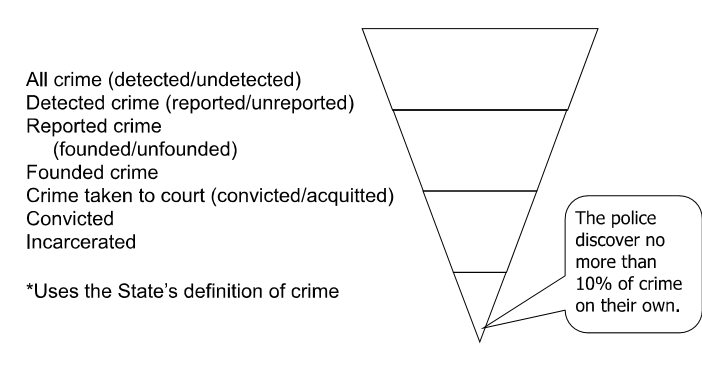
Crime Funnel
71
New cards
Moral Crusaders
\-people in society that try to change the behavior of others
\
\-that is, they believe that serious evil exists that must be eliminated
\
\-this results in moral panic
\
\-that is, they believe that serious evil exists that must be eliminated
\
\-this results in moral panic
72
New cards
Moral Panics
\-Concern: Awareness that the group in question may be harmful
\
\-Hostility: “they” become folk devils
\
\-Consensus: a large number of people become concerned about the group
\
\-Disproportionality: exaggerated fear
\
\-Volatility: arise and fade quickly
\
\-The issue at the heart of a moral panic is typically something very small that has been exaggerated so that it seems like a significant threat to social order; in some cases the issue has been fabricated entirely
\
\-Hostility: “they” become folk devils
\
\-Consensus: a large number of people become concerned about the group
\
\-Disproportionality: exaggerated fear
\
\-Volatility: arise and fade quickly
\
\-The issue at the heart of a moral panic is typically something very small that has been exaggerated so that it seems like a significant threat to social order; in some cases the issue has been fabricated entirely
73
New cards
Pluralists Explain Law
argue that law reflects what society deems important
\
\-everyone has a say in the construction of laws
\
\-everyone has a say in the construction of laws
74
New cards
Conflict Theorists Explain Law
\-argue that the bourgeoisie largely constructs the laws
\
\-the lower classes are criminalized
\
\-the lower classes are criminalized
75
New cards
Postmodernists Explain Law
maintain that society socially constructs crime
\
\-those who generate and disseminate crime news control the law
\
\-those who generate and disseminate crime news control the law
76
New cards
Strain Theory
\-Grew out of functionalism
\
\-It suggests that people behave deviantly when they are strained
\
\-Robert Merton
\
\-crime and deviance are the result of “rising expectations and falling realizations”
\
\-It suggests that people behave deviantly when they are strained
\
\-Robert Merton
\
\-crime and deviance are the result of “rising expectations and falling realizations”
77
New cards
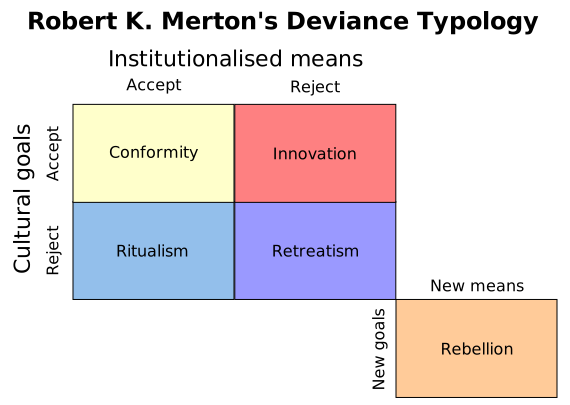
Merton’s Typology
\
78
New cards
Learning Theory
\-People simply learn crime and deviance just like any other kind of behavior
\
\-People learn by interacting with other deviants by “differential association”
\
\-People learn how to commit crimes and attitudes to accomplish it (i.e. people learn “techniques of neutralization”)
\
\-People learn by interacting with other deviants by “differential association”
\
\-People learn how to commit crimes and attitudes to accomplish it (i.e. people learn “techniques of neutralization”)
79
New cards
Control Theory
\-People are deviant because being deviant is really enjoyable
\
\-The real question is why do people conform?
\
\-People conform because they have been taught self-control by their parents, teachers, friends and relatives
\
\-Girls are more controlled than boys. This has implication later in life.
\
\-The real question is why do people conform?
\
\-People conform because they have been taught self-control by their parents, teachers, friends and relatives
\
\-Girls are more controlled than boys. This has implication later in life.
80
New cards
Labelling Theory
\-People behave deviantly when they are defined by society as such
\
\-For instance, if you are known by your high school teachers as a poor student, it is difficult to change their impressions of you later in life
\
\-labelling has a measure of power over people that may lead to further deviance
\
\-remember when we first said that internalized self-control is the most successful form of control
\
\-For instance, if you are known by your high school teachers as a poor student, it is difficult to change their impressions of you later in life
\
\-labelling has a measure of power over people that may lead to further deviance
\
\-remember when we first said that internalized self-control is the most successful form of control
81
New cards
What is a Cult?
\-A cult is a religion that is deviant in its beliefs and/or practices
\
\-Deviant is not a moral judgment of good or bad. Applied to cults, deviant means differing from, or offering an alternative to, older, established religions such as Islam, Judaism and Christianity
\
* Many cults are spinoffs of these established traditions, from which they may selectively borrow certain elements that they combine with secular practices into new religious forms.
\
* Cults tend to be newly arrived on the religious scene: through cults of different kinds have existed for centuries, they came to prominence during the 1960s and 1970s, when, thanks to a few notorious cases, they became associated with the larger counterculture movement of that era
\
* Peoples Temple in Jonestown, Guyana, in 1978 gave cults all around the world over a bad reputation. 914 members committed murder-suicide.
\
* Cults may develop around a single charismatic leader or a small group of people, but don't mistake cult in this sense from the related term "cult of personality," which is an excessive admiration for someone
\
\-Deviant is not a moral judgment of good or bad. Applied to cults, deviant means differing from, or offering an alternative to, older, established religions such as Islam, Judaism and Christianity
\
* Many cults are spinoffs of these established traditions, from which they may selectively borrow certain elements that they combine with secular practices into new religious forms.
\
* Cults tend to be newly arrived on the religious scene: through cults of different kinds have existed for centuries, they came to prominence during the 1960s and 1970s, when, thanks to a few notorious cases, they became associated with the larger counterculture movement of that era
\
* Peoples Temple in Jonestown, Guyana, in 1978 gave cults all around the world over a bad reputation. 914 members committed murder-suicide.
\
* Cults may develop around a single charismatic leader or a small group of people, but don't mistake cult in this sense from the related term "cult of personality," which is an excessive admiration for someone
82
New cards
Lorne Dawson
* hanging over the world cult. He identifies 4 types of new religious movement:
\
1. NRMs associated with Asian philosophy, mediation, and magic (International Society for Krishna Consciousness whose beliefs are based on Hindu scripture)
\
2. NRMs drawing on pop psychology's "human potential movement" (Church of scientology)
\
3. NRMS associated with occult revival (Wicca)
\
4. NRMs seeking spiritual salvation through contact with extraterrestrial beings (Heaven's Gate)
\
1. NRMs associated with Asian philosophy, mediation, and magic (International Society for Krishna Consciousness whose beliefs are based on Hindu scripture)
\
2. NRMs drawing on pop psychology's "human potential movement" (Church of scientology)
\
3. NRMS associated with occult revival (Wicca)
\
4. NRMs seeking spiritual salvation through contact with extraterrestrial beings (Heaven's Gate)
83
New cards
Aristotle
* Aristotle suggested that a society with a powerful king would likely have in its religion a commanding divine authority figure.
\
* A less hierarchical society of gods that is somewhat egalitarian, in their relationships both with one another and with human beings
\
* Aristotle was making is that people are likely to use the same language they use to describe their relationship with their god or gods
\
* In this way, the gods we worship are a mirror, reflecting our own social structure. Aristotle, its worth noting, spent over 20 years in Athens, the birthplace of democracy, where the Greeks worshipped a host of gods who, according to their mythology, would frequently interact with humans and be influenced by them
\
* By the late nineteenth century, this idea of the link between social and spiritual relationships became set in a social Darwinist, or evolutionary model. According to this model, the most "primitive" people had pesky spirits; "barbarians" had playful or nasty but ultimately impotent gods. Only "civilized" people had religion that reflected the prevailing social order in Europe, in which power was invested in a supreme ruler. This thinking justifies Canada's residential schools and European colonies.
\
* A less hierarchical society of gods that is somewhat egalitarian, in their relationships both with one another and with human beings
\
* Aristotle was making is that people are likely to use the same language they use to describe their relationship with their god or gods
\
* In this way, the gods we worship are a mirror, reflecting our own social structure. Aristotle, its worth noting, spent over 20 years in Athens, the birthplace of democracy, where the Greeks worshipped a host of gods who, according to their mythology, would frequently interact with humans and be influenced by them
\
* By the late nineteenth century, this idea of the link between social and spiritual relationships became set in a social Darwinist, or evolutionary model. According to this model, the most "primitive" people had pesky spirits; "barbarians" had playful or nasty but ultimately impotent gods. Only "civilized" people had religion that reflected the prevailing social order in Europe, in which power was invested in a supreme ruler. This thinking justifies Canada's residential schools and European colonies.
84
New cards
Religion and Class in Canada - Max Weber
* Religion and class intersect
\
* Protestant (work) ethic theory was developed by Max Weber to explain the rise of modern capitalism
\
* Weber was familiar with the Protestant belief in a predestined "elect" who would be saved during the second coming of Christ. A person demonstrated membership in this "elect" who would be saved during the second coming of Christ.
\
* According to Weber, this religious/cultural influence spurred people to accumulate with Protestantism, a key factor in the rise of capitalism. Were he alive, Weber might argue that the Protestant work ethic survives in the general prosperity of some religious groups over others.
\
* Protestant (work) ethic theory was developed by Max Weber to explain the rise of modern capitalism
\
* Weber was familiar with the Protestant belief in a predestined "elect" who would be saved during the second coming of Christ. A person demonstrated membership in this "elect" who would be saved during the second coming of Christ.
\
* According to Weber, this religious/cultural influence spurred people to accumulate with Protestantism, a key factor in the rise of capitalism. Were he alive, Weber might argue that the Protestant work ethic survives in the general prosperity of some religious groups over others.
85
New cards
Religion and Class in Canada - Karl Marx
* According to Karl Marx, religion generally functions as an instrument of hegemony. He famously called it the "opium of the people" with reference to religion's power to soothe the suffering of the working masses. Religion, he argued, serves the interests of the ruling class by dissuading oppressed members of the working class from organizing around their own class-based self0interests to challenge the inequality of society.
* Religion thus helps instil a false consciousness, Marx's terms for the worker's beliefs that the class-based hierarchy - in which they occupied the lowest position - was justified and to their advantage
* In Marx's critical view, Religion made members of the lower class believe that God had planned society to be the way it was, and that by toiling away under oppression conditions, they were really acting in the best interests of their class and would find their rewards ultimately in the "next life"
86
New cards
Religion and Radical Possibility
* Religion can bear "radical possibility" like socialized medicine and pensions that dramatically improved the lives of working-class people
* Seen in Canadian religious communities to the plight of Syrian refugees coming to Canada. Refugee sponsorship is strong in many Christian denominations, and was especially important in 2015, when the federal government under Stephen Harper was lagging behind church initiatives and public opinion on the matter.
87
New cards
Durkheim and the Elementary Forms of Religious Life
* Emile Durkheim had a profound effect on how sociologists view religion. Both suicide and religion were seen as being firmly rooted in the individual, not in groups or society, and there was strong resistance to his ideas among people studying psychology and religion at the time
* Durkheim's aim was to identify the basic elements of religion. He believed he could do this by studying religion of the most basic society then being discussed by social scientists: the Aborigines of Australia.
88
New cards
Durkheim’s Definition of Religion
* Durkheim's view was that "religion is social, social, social"
\
* In using the term moral community, Durkheim was recognizing that religious groups are "made up of individuals who have mutually recognized and recognizable identities on shared human terrain"
\
* God = society
\
* In using the term moral community, Durkheim was recognizing that religious groups are "made up of individuals who have mutually recognized and recognizable identities on shared human terrain"
\
* God = society
89
New cards
Totem
* Totem is a word that came into English in the late 18th century from the language of the Anishinaabe or Ojibwa people.
\
* Each clan was associated with a specific function and certain ideal characteristics of clan members. These characteristics connect with the clan's totem animal.
\
* A totem, then, is a symbolic representation both of a god and of the society that reveres it. Another way of looking at it is that societies fashion deities represented as having characteristics like the people themselves. These characteristics are then projected back onto both the culture and the individuals. The god and the people are one and the same.
\
* Each clan was associated with a specific function and certain ideal characteristics of clan members. These characteristics connect with the clan's totem animal.
\
* A totem, then, is a symbolic representation both of a god and of the society that reveres it. Another way of looking at it is that societies fashion deities represented as having characteristics like the people themselves. These characteristics are then projected back onto both the culture and the individuals. The god and the people are one and the same.
90
New cards
Collective Consciousness and the Sacred and Profane
Durkheim focused primarily on the group experiences and rituals of people belonging to a particular religion. These sacred experiences foster what Durkheim called a collective consciousness.
\
* Durkheim distinguished between experiences, acts, and objects that are sacred and those that are profane. Sacred objects and acts are set apart from more ordinary (profane) ones as being positively regarded, holy, and therefore deserving of reverence or respect. Sacred objects include prayer beads, crosses, flags and items in the medicine bundle of an Aboriginal shaman; sacred acts include prayer, some Aboriginal dances, and keeping kosher
\
* Haram Foods = Pork and its by-products, carnivorous animals, almost all reptiles and insects, animals that died before properly slaughtered, blood, and all alcoholic or intoxicating drinks.
\
* Haram Lifestyle = gambling, including lotteries; all drugs that cause intoxication, alter sensory perception or affect one's ability to reason and make sound judgments; and paying and accepting interest
\
* Durkheim distinguished between experiences, acts, and objects that are sacred and those that are profane. Sacred objects and acts are set apart from more ordinary (profane) ones as being positively regarded, holy, and therefore deserving of reverence or respect. Sacred objects include prayer beads, crosses, flags and items in the medicine bundle of an Aboriginal shaman; sacred acts include prayer, some Aboriginal dances, and keeping kosher
\
* Haram Foods = Pork and its by-products, carnivorous animals, almost all reptiles and insects, animals that died before properly slaughtered, blood, and all alcoholic or intoxicating drinks.
\
* Haram Lifestyle = gambling, including lotteries; all drugs that cause intoxication, alter sensory perception or affect one's ability to reason and make sound judgments; and paying and accepting interest
91
New cards
Durkheim's Study of Religion and Suicide
* In his 1897 study of suicide, Durkheim stated that Protestants committed suicide more often than Catholics did. He explained the difference by arguing that Protestants were less connected to society then Catholics were. The implication was that being Catholic made a person less likely to die from suicide.
* Operational Definition for Suicide:
* Catholics argue "sudden deaths" and "deaths from ill-defined or unspecified causes" as suicides than Protestants were
* They propose that suicide is a moral sin, meaning that a person dying by suicide could not be buried with religious rites in a Catholic graveyard. Catholics suicides were systematically underreported.
92
New cards
Religion and the Marginalized Family
* Religion is often applauded for promoting "family values"
* There are times when family and religion have stood in opposition, particularly when a certain kind of family situation has been negatively valued by state officials armed with religion
* In Ireland, the Catholic Church established institutions to "rehabilitate" prostitutes and unmarried mothers. They were called "Magdalene asylums" since women were often forced into hard labour laundering clothes to earn money for the institution.
* Residential Schools in Canada
93
New cards
Hutterites: Religion and Family
* In 2001, the Hutterites were the Canadian religious groups with the youngest median age. Children aged 0 to 14 made up 37% of their population, while young people aged 0 - 24 made up 54% of the total population.
\
* Hutterites have the maximum fertility rate possible for a single community. This is attributed to several sociological factors:
\
1. Cultural and religious norms opposing contraception
\
2. Farming as the main industry, requiring a large population of strong, young farm hands
\
3. The practice of communal living, which ensures that childcare, a shared responsibility is always available
\
* Hutterites have the maximum fertility rate possible for a single community. This is attributed to several sociological factors:
\
1. Cultural and religious norms opposing contraception
\
2. Farming as the main industry, requiring a large population of strong, young farm hands
\
3. The practice of communal living, which ensures that childcare, a shared responsibility is always available
94
New cards
Religion and Gender
* Organized world religions are often characterized by patriarchal power structure
* During the second wave of feminism in the 1960s and early 1970s women in North American and western Europe became increasingly critical of Christian practices. They viewed Christian embedded patriarchy as an influential cultural factor in the reproduction of gender inequality.
* Add to these points the Christian tradition of a wife's obedience, subservience, and even belonging to her husband, and you have some powerful examples that inform, transmit and reproduce patriarchal structures of inequality, including androcentrism and sexism
95
New cards
Canada and Religious Symbols
* Canada has had its own debate around the display of conspicuous religious symbols. Sikh officers in the Royal Canadian Mounted Police were prohibited from wearing turbans on duty until 1990, and Sikhs have frequently gone to court to defend their right to carry the kirpan, a small ceremonial knife, in schools, in government buildings, and on flights.
* In 2007, a nine-year old girl was kicked out of a soccer tournament in Quebec for wearing a headscarf
* In 2013, Quebec's Parti Quebecois government proposed a law to ban the wearing of all conspicuous religious symbols in public-sector workplaces, including not just government-run daycares, and public schools. The bill failed to pass before the PQ was defeated by the Liberals in the 2014 provincial election. Five years later, in June 2019, the ruling Coalition Avenir Quebec passed bill 21, which prohibits the province's public sector employees from wearing religious symbols while carrying out their civic duties.
* It applies to all visible minorities but it will dipropionate affect hijab-wearing Muslim teachers.
96
New cards
Neo-traditionalism
involves the reinterpretation of traditional beliefs and practices in ways that incorporate elements unique to one's own culture and others borrowed from Indigenous cultures elsewhere
97
New cards
Christian Religious Colonialism and Its Impact among Indigenous People in Canada
* When missionaries brought Christianity to Indigenous people in Canada, their actions were an integral part of colonization, designed to make the people more like Europeans, not just in beliefs but in other social areas such as gender roles and in their obedience to political authority
* They were not just victims of colonially imposed religions. As Indigenous prophets reacted to the new world of Christian beliefs and ensuing political turmoil, they began to promote innovative religious beliefs
* The Code of Handsome Lake combined traditional aspects of the Great Law of Peace, which had brought the initially 5 nations of the Iroquois together into one confederacy, with Quaker elements such as a strong opposition to witchcraft, sexual promiscuity and gambling
* Indigenous people developed new forms of Christianity by integrating European-based religion into their belief system and practices.
98
New cards
Missionairies
* The primary role of missionaries is to change people, to make them leave the religious path they are on and walk a new one, one that often bears the mark of a different culture.
\
* Missionaries exemplify the values that are at the core of the religion they represent, particularly the principle of charity
\
* The practice of sending missionaries into developing countries in need of financial assistance is sometimes called aid evangelism. The financial assistance is a kind of tied aid - money that comes with strings attached. A condition of aid is that the people receiving the aid must spend at least some of the assistance on products and services that come from the donor country
\
* Phantom Aid = captures the idea that the aid is not real but rather a form of investment
\
* Missionaries exemplify the values that are at the core of the religion they represent, particularly the principle of charity
\
* The practice of sending missionaries into developing countries in need of financial assistance is sometimes called aid evangelism. The financial assistance is a kind of tied aid - money that comes with strings attached. A condition of aid is that the people receiving the aid must spend at least some of the assistance on products and services that come from the donor country
\
* Phantom Aid = captures the idea that the aid is not real but rather a form of investment
99
New cards
France and Religious Symbols
* In 1905, the government of France passed a law separating church and state
\
* It stated that the government would not officially recognize or fund any religion. The law was invoked in the 1980s, during debates about French children wearing signs of their religion: Christians students wearing crosses, Jewish boys wearing yarmulkes, Sikh boys wearing turbans, and Muslim girls wearing headscarves.
\
* The debate centered around 2 principles: freedom of expression and laicite, or secularism of the French state
\
* It stated that the government would not officially recognize or fund any religion. The law was invoked in the 1980s, during debates about French children wearing signs of their religion: Christians students wearing crosses, Jewish boys wearing yarmulkes, Sikh boys wearing turbans, and Muslim girls wearing headscarves.
\
* The debate centered around 2 principles: freedom of expression and laicite, or secularism of the French state
100
New cards
Greta Thunberg
* Greta Thunberg is a deviant. She knowingly participated in demonstrably deviant behavior. This is not to say she or her behaviour is good or bad. It is to say that she did something different, engaging in unexpected activities that fall outside the boundaries of what is considered normal behaviour.
\
* At 15 years old she skipped school to sit outside the parliament building in the Swedish capital of Stockholm. She was on strike for 20 days and then proceeded to strike on Fridays only.
* It was deviant because it was different from what other schoolchildren were doing. Greta was not acting on behalf of any group or organization, or because her parents wanted her to.
* Her behaviour was subversive. She falls outside the culture of middle-aged and male. She was acting in opposition to the mainstream culture.
 Note
Note  Flashcards (20)