cell organisation
 Studied by 0 people
 Call with Kai
 Learn
Learn Practice Test
 Spaced Repetition
 Match
Match Flashcards
 Knowt Play
1/73

There's no tags or description
Looks like no tags are added yet.
Name | Mastery | Learn | Test | Matching | Spaced | Call with Kai |
|---|
No analytics yet
Send a link to your students to track their progress
74 Terms
Identify the structures labelled
Describe the sequence of events involved in the production and secretion of enzymes
mRNA produced by transcription leaves nucleus through nuclear pores
Protein synthesis on ribosomes
Vesicles containing protein pinch off rough ER and fuse with the Golgi body
Protein is modifiers in the Golgi body
Secretory vesicles pinch off Golgi body and transport enzyme to cell membrane
Vesicles containing enzyme fuse with the cell membrane and enzyme is released outside cell by exocytosis

Name of organelle and function In enzyme secretion
Mitochondria, produces ATP, ATP is a source of energy for exocytosis
Suggest and explain how mitochondria is able to self replicate
Mitochondria contain their own DNA
Mitochondria have ribosomes and can synthesise their own proteins
DNA can be replicated so both new organelles have copy of DNA
Importance of inorganic ions in living orgs
Mg - component of chlorophyll, essential for PT
Fe- component of Harmoglobin
Ca- strengthens bones and teeth
PO4 - phospholipids, ATP , nucleus acids of DNA, RNA
State which other part of the virus is made of proteins
Capsize/ protein coat
Function of ciliated epethial muscles
Moves mucus
Function of skeletal muscles
Movement/ locomotion/ contract
Function of nuclear pores
Allows mRNA/rRNA/ ribosomes to pass out of the nucleus
Function of nucleolus
synthesis of ribosomes
Function of chromatin
Condenses to form chromosomes/ involved in code for protein synthesis
nuclear envelope
separates DNA from rest of cellular contents/ holds DNA
Functions of the Golgi body
Modification of proteins - addition of sugar chains
Produces glycoproteins
Transport/ storage of lipids/ digestive enzymes
Synthesis of secretory vesicles/ lysosomes
Difference in the arrangement of DNA between eukaryotic and prokaryotic
Circular/ no chromosomes in prok
DNA forms chromosomes in eukaryotic
Difference in the position of the DNA between eukaryotic and prokaryotic cells
In prok it is free in cytoplasm
In eukaryotic it is in the nucleus/ bound by membrane
Explain the role of the Golgi body in the production of proteins
joining of PP into quarternary structure
Addition of carbohydrates/ glycosylation/ produce glycoproteins
Packaged into vesicles
Differences in the composition of the cell wall if present in eukaryotic vs prokaryotic cells
In prok it is made of murein peptidoglycan
In euk it is made of cellulose
Size of ribosomes in prokaryotic and eukaryotic cells
Prok: small/ 70s
Euk: large 80s
decribe the sequence of events that lead to the production of digestive enzymes in the cell with reference to nucleus, nuclear pores and ribosomes
nucleus contains DNA which codes for the production of proteins/ polypeptides, transcription of mRNA
Nuclear pores allow mRNA/ rRNA to leave the nucleus
Ribosomes carry out translation
with reference to RER, GB and transport vesicle describe the sequence of events that lead to the secretion of digestive enzymes in the cell
RER→ transports proteins through the cell to GB , package proteins into vesicles
GB→ packaging/ modification of protein
transport vesicle: transports proteins to the cell membrane where exocytosis of enzyme from the cell happens
Explain the role of mitochondria in the production and secretion of enzymes
Provides ATP for transcription/ translation/ protein synthesis
exocytosis
Explain why this org has been classified as an animal and a plant at different times
Chloroplast/ cellulose cell wall/ attach grains= plant
Flagellum/ small vacuoles/ eyespot = animal
Name the organelle responsible for producing lysosome and identify it in the electron micrograph and describe the general function of it
GB, contains digestive enzymes which break down (organelles/ macromolecules) OR transport / release of enzymes within cell
Name the epethelilal tissue type drawn
Where is the epithelial tissue type found in the body
Cuboidal→ proximal convoluted tubule of the kidney nephron
Ciliated → trachea/ oviduct/ fallopian tube
name the structures and organelles shown in the electron micrograph
Function of the nucleus
Contains DNA which codes for/ controls protein synthesis
DNA synthesis/ replication
Function of the nuclear pores
Transports mRNA/ rRNA
Function of nucleolus
Produces rRNA
Nucleus has pores in the envelope that surrounds is whilst mitochondria doesn’t describe another difference between membranes that surround mitochondria and those that surround the nucleus
Inner membrane is folded to form cristae and there are no ribosomes attached for mitochondria
For nucleus there is no folding of inner membrane, no cristae and there are rise ones attached to the membrane must be comparative
Difference between ribosomes in animal cells and those in prok cells
Ribosomes are not attached to membranes / ER in prok whilst some are in animal cells
Ribosomes are larger/ 80S in animal cells than PRO 70S
Identity in photograph and Describe function of mitochondria
Produced ATP in aerobic respiration, ATP synthesis
identify in photogrpah the GB and state it’s function
Modification of proteins (addition of sugar chains)
Produces glycoproteins
Synthesis of secretory vesicles/ lysosomes
Transport/ storage of lipids / digestive enzymes
Name a tissue that contains large number of mitochondria
Liver
Muscle
Nervous tissue
Functions of different structures in nucleus
Nuclear pores allows mRNA/ rRNA / ribosomes to pass out of nucleus
Nucleolus- synthesis of ribosomes
Nuclear envelope/ double nuclear membrane: separates the DNA from rest of cellular contents/ holds DNA
State the function of chromatins
Condenses to form chromosomes, involved in/ code for protein synthesis
State two visible differences between RED and SER
Presence of ribosomes and no ribosomes
Membranes in parallel/ regular lines/ more organised VS open network of membranes/ less organised
Two structures found in prokaryotic cells found in mitochondria
Loop of DNA
70S ribosomes
both possess plasma membrane
Difference between mitochondria and bacterial cells
MITOCH has double membrane
No cell wall, no capsule, no flagellum , no mesosome, no plasmids
Function RER
Site of protein synthesis
Polypeptide chains build up at ribosome
Transports polypeptides/ perkiness
Ribosomes read genetic code/ receive mRNA
GB function
Buds off vesicles/ package proteins into vesicles
Transport protein molecules to cell surface/ membrane
Synthesis of glycoproteins/ modification of proteins
Suggest why a cell that secretes hormones into the bloodstream contains a lot of mitochondria
Secretory cell involved in active processes/ metabolically active
ATP/ energy dependant and ATP is amyfactured by mitochondria
Hormone synthesis requires ATP
Two labels show the same type of organelle explain why they differ in appearnwvw
Cut in different plane
Function of mitochondria
1 mark for aerobic respiration
Produces ATP/ releases energy/ ATP for respiration
Name a cell that contains large numbers of mitochondria
Liver cells/ muscle cells
Function of nuclear pores
Allow the transport of mRNA / ribosomes
Name mitochondria organelle and the struactured cristae and matrix inside it
Why do liver cells have large number of mitochondria
Metabolically active cells, many chemical reactions occur in these cells so large amount of ATP produced/ required
Functions of mitochondria, cell wall, nucleolus, chloroplasts
Site of aerobic respiration/ ATP production
Confers rigidity, prevents bursting
rRNA synthesis/ assembles ribosomes
Photosynthesis
Explain why liver cells have large number of mitochondria
They are metabolically active/ many chemical reactions happen, large amount of ATP required
an organic compound found in the internal membranes of the chloroplast never occurs in any other plant or animal organelle
Chlorophyll
Chloroplasts are self replicating, name a structure that would be involved in the production of new chloroplasts
Circular DNA/ ribosomes
One way in which mitochondria is adapted to perform their function
Cylindrical→ decreases diffusion distance and larger SA for gas exchange
Folding of inner membrane (cristae) → increased SA for ATP production/ aerobic respiration
Larger SA:V ratio increased gas exchange
Explain the role of mitochondria in the production and secretion of digestive enzymes
Provide ATP FOR transcription/ translation/ protein synthesis / exocytosis
Two major biochemical components present in all viruses
Protein + nucleic acid (DNA/RNA)
Suggest the position of cholesterol molecules within the plasma membrane
Between the fatty acids/ hydrophobic tails
Explain how Ebola virus particles enter a host cell
Binding to receptor/ glycocalyx/ carbohydrate chains/ glycoprotein/ protein
Phagocytosis/ endocytosis
Plasma/ cell membrane encloses/ engulfs the virus in a vesicle
9 marker at the end of CTA test on SharePoint
Two structural features of mitchond and chloroplasts found in prok
Ribosomes
Circular DNA or loops of DNA
Two dominas which contain pron orgsanism
Archaebacteria
Eubacteria
Explain why hydrophobic molecule is found embedded in a thylakoid memebrsne rather than in the stroma
Fatty acids in membranes/ centre of phospholipid BL lare hydrophobic or non polar
Wheresss the stroma is hydrophobic or polar
Function of cholesterol
Stabilises membranes
Maintains fluidity or rigidity or flexibility
Location of ribosomes in bacterial and animal cells
Bacterial→ cytoplasm
Animal→ RER
Reason for different shapes of mitochondria other than cut in different planes
Self replication
Stage of division
Stage of development
Not fully formed
State why nitrogen and phosphorus are needed for plant growth
Nitrogen is needed for amino acid/ protein
P is needed for nucleotides such as ATP or phospholipids
describe the function of chloroplasts
absorbs light for PT producing carbohydrates/ sugars/ proteins
state the difference between a tissue and an organ
tissue is one type of cell
organ is many types of cells many tissues
Function of cell membranes
Controls movement of substances
Function of mesosome
Attachment of enzymes of aerobic respiration
Name the structure which connects the cytoplasm of adjacent plant cells
Plasmodesmata
Following processing by the Golgi body describe how protein was secreted from the cell
Check mark scheme of 2016
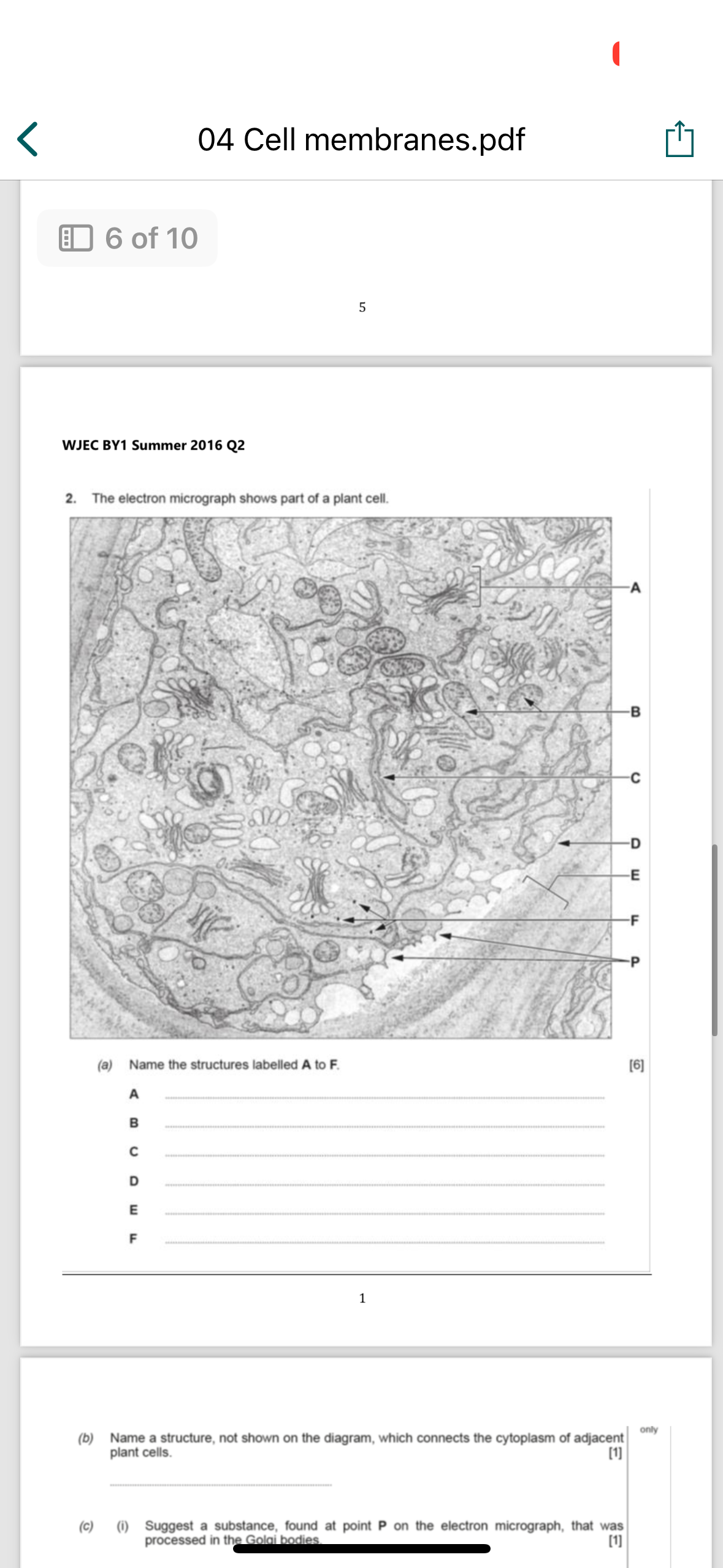
A- Golgi body
b- mitochondria
C- endoplasmix reticulum
D- cell membrane
E- cell wall
F- ribosomes
 Note
Note  Flashcards (49)