M5 Van- RNA makes protein - translation

0.0(0)
studied byStudied by 0 people
0.0(0)
full-widthCall Kai
learnLearn
examPractice Test
spaced repetitionSpaced Repetition
heart puzzleMatch
flashcardsFlashcards
GameKnowt Play
Card Sorting

1/8

encourage image

There's no tags or description

Looks like no tags are added yet.

Study Analytics
Name
Mastery
Learn
Test
Matching
Spaced

No study sessions yet.

9 Terms

1
New cards

how is the amino acid code redundant?

  • multiple codons can code for one amino acid

  • in these cases, it is the third base in the codon that is unimportant and can be different

  • these are called ‘wobble bases

  • normally the interchangeable bases will be the two purines or the two pyrimidines

  • in a few codons the third base can be anything
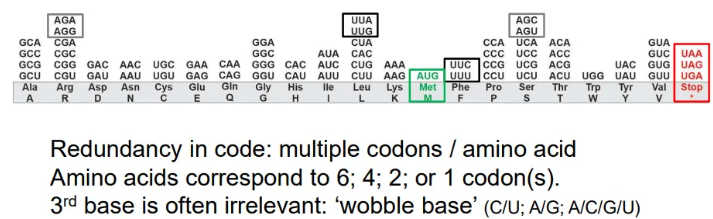
<ul><li><p><strong>multiple codons can code for one amino acid</strong></p></li><li><p>in these cases, it is the <strong>third </strong>base in the codon that is unimportant and can be different</p></li><li><p>these are called ‘<strong>wobble bases</strong>’</p></li><li><p>normally the interchangeable bases will be the two <strong>purines </strong>or the two <strong>pyrimidines </strong></p></li><li><p>in a few codons the third base can be anything</p></li></ul><p></p>
2
New cards

what are the start and stop codons in mRNA?

start

  • AUG

stop

  • UAA

  • UAG

  • UGA

<p>start</p><ul><li><p>AUG</p></li></ul><p></p><p>stop</p><ul><li><p>UAA</p></li><li><p>UAG</p></li><li><p>UGA</p></li></ul><p></p>
3
New cards

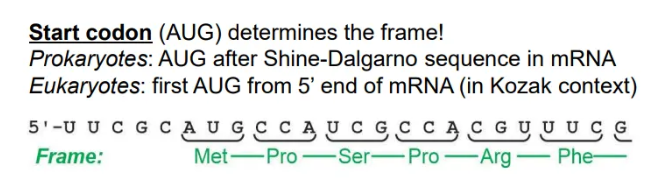
how is the correct open reading frame selected?

the first start codon (AUG) found will determine where translation starts, and hence the reading frame

  • since prokaryotic mRNA is polycistronic, this is the first AUG after the Shine-Dalgarno sequence

  • whereas in eukaryotes, this is just the first AUG from the 5’ end
<p>the<strong> first start codon (AUG)</strong> found will determine where translation starts, and hence the reading frame</p><ul><li><p>since <strong>prokaryotic </strong>mRNA is <strong>polycistronic</strong>, this is the first AUG after the Shine-Dalgarno sequence</p></li><li><p>whereas in <strong>eukaryotes</strong>, this is just the first AUG from the 5’ end</p></li></ul><p></p>
4
New cards

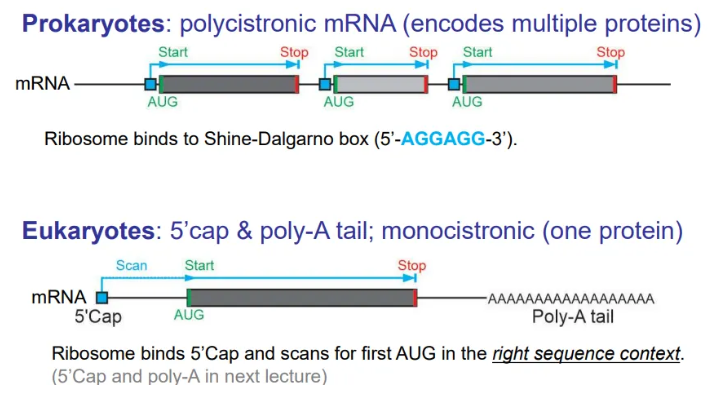
what are the general layouts of mRNA in prokaryotes and eukaryotes?

  • translation of prokaryotic mRNA begins before transcription is complete, because they don’t have membrane-bound nuclei, so the mRNA is polycistronic (encodes multiple proteins)

  • in eukaryotes the mRNA strands are cleaved and packaged to be sent to the ribosomes for translation, so the mRNA is in discrete chunks for each protein (monocistronic)
<ul><li><p>translation of <strong>prokaryotic </strong>mRNA begins before transcription is complete, because they don’t have membrane-bound nuclei, so the mRNA is <strong>polycistronic </strong>(encodes multiple proteins)</p></li><li><p>in <strong>eukaryotes</strong> the mRNA strands are cleaved and packaged to be sent to the ribosomes for translation, so the mRNA is in discrete chunks for each protein (<strong>monocistronic</strong>)</p></li></ul><p></p>
5
New cards

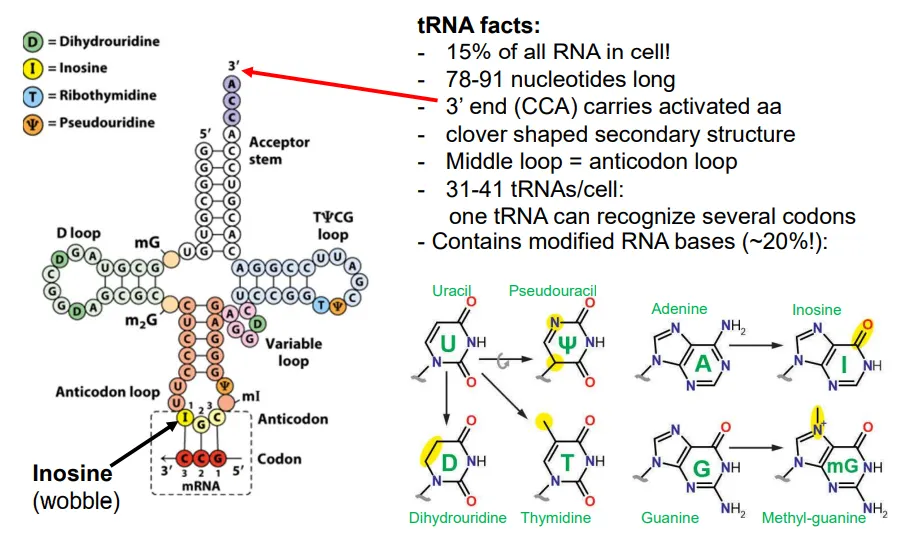
how do tRNA molecules deal with the redundancy of the genetic code?

  • there are only 31-41 distinct tRNAs per cell, compared to 60 codons, so many must have anticodons that can recognise the wobble bases

  • they do this by having their own modified RNA bases
<ul><li><p>there are only 31-41 distinct tRNAs per cell, compared to 60 codons, so many must have anticodons that can recognise the wobble bases</p></li><li><p>they do this by having their own modified RNA bases</p></li></ul><p></p>
6
New cards

how are tRNA molecules produced?

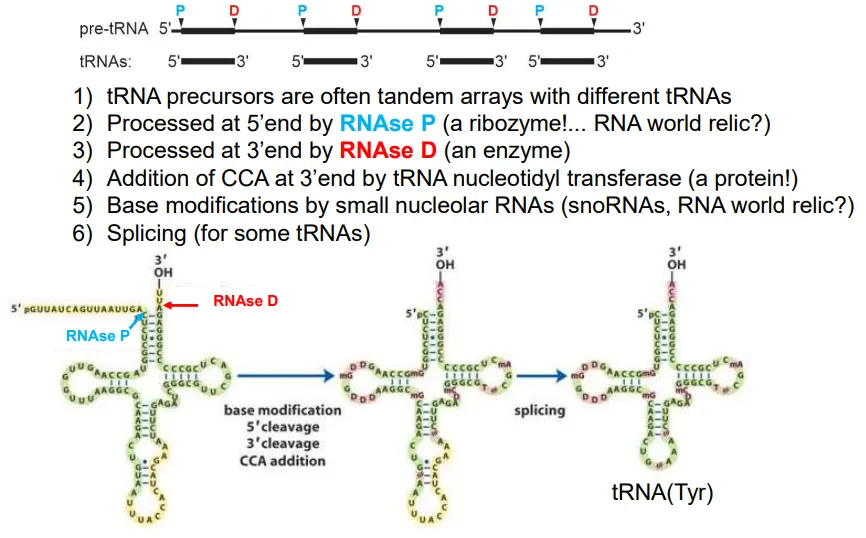
the pre-tRNA molecules normally contain the sequences for multiple tRNAs (tandem arrays)

  • the sequence is cleaved at multiple points

  • at the 5’ end of each tRNA this is done by RNAse P, and at the 3’ end it is RNAse D

  • then the enzyme tRNA nucleotidyl transferase adds CCA to the 3’ end

  • base modifications occur in some tRNA molecules to deal with the wobble bases, and some get spliced

  • these molecules are then ‘charged’ by an aminoacyl-tRNA synthetase (aaRS) to add on the relevant amino acid to the new 3’ adenosine (at the 3’OH) using ATP
<p>the pre-tRNA molecules normally contain the sequences for multiple tRNAs (tandem arrays)</p><ul><li><p>the sequence is <strong>cleaved </strong>at multiple points</p></li><li><p>at the <strong>5’ end</strong> of each tRNA this is done by<strong> RNAse P</strong>, and at the <strong>3’ end </strong>it is <strong>RNAse D</strong></p></li><li><p>then the enzyme <strong>tRNA nucleotidyl transferase</strong> adds <strong>CCA </strong>to the 3’ end</p></li><li><p><strong>base modifications</strong> occur in some tRNA molecules to deal with the wobble bases, and some get <strong>spliced</strong></p></li><li><p>these molecules are then ‘<strong>charged</strong>’ by an <strong>aminoacyl-tRNA synthetase</strong> (aaRS) to add on the relevant amino acid to the new 3’ adenosine (at the 3’OH) using ATP</p></li></ul><p></p>
7
New cards

how are tRNA molecules charged?

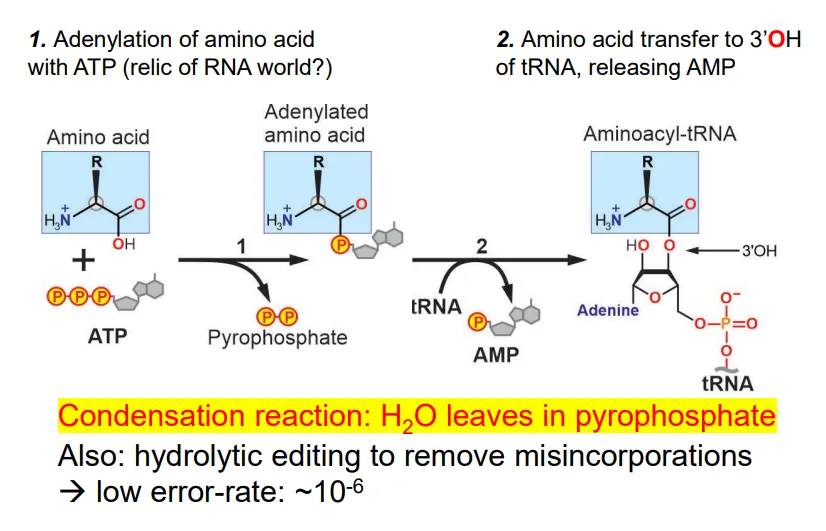
  • the amino acid reacts with ATP to produce an adenylated amino acid (bound to AMP) and a pyrophosphate (contains water- this is a condensation reaction)

  • the AMP is replaced by a reaction with the 3’OH of the 3’ adenosine in the tRNA molecule

  • this reaction is catalysed by aminoacyl-tRNA synthetase enzymes (aaRS)- only 1 per amino acid)
<ul><li><p>the amino acid reacts with ATP to produce an adenylated amino acid (bound to AMP) and a pyrophosphate (contains water- this is a condensation reaction)</p></li><li><p>the AMP is replaced by a reaction with the 3’OH of the 3’ adenosine in the tRNA molecule</p></li><li><p>this reaction is catalysed by aminoacyl-tRNA synthetase enzymes (aaRS)- only 1 per amino acid)</p></li></ul><p></p>
8
New cards

what is the structure of ribosomes?

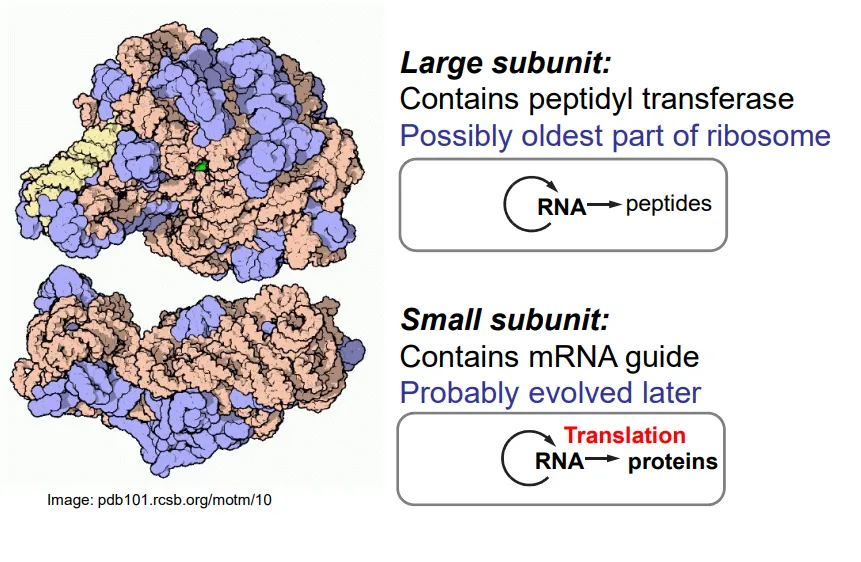
  • ribosomes are mostly composed of RNA, with some peripheral auxiliary proteins

  • the large subunit contains peptidyl transferase (a ribozyme), which connects the amino acids by catalysing the formation of peptide bonds

    • the tRNA molecules bind to the large subunit

  • the small subunit binds to the mRNA so that codon-anticodon pairing can occur with the tRNA
<ul><li><p>ribosomes are <strong>mostly composed of RNA</strong>, with some peripheral <strong>auxiliary proteins</strong></p></li><li><p>the <strong>large </strong>subunit contains <strong>peptidyl transferase</strong> (a <strong>ribozyme</strong>), which connects the amino acids by catalysing the formation of peptide bonds</p><ul><li><p>the tRNA molecules bind to the large subunit</p></li></ul></li><li><p>the <strong>small </strong>subunit binds to the mRNA so that codon-anticodon pairing can occur with the tRNA</p></li></ul><p></p>
9
New cards

what happens in the initiation phase of translation in prokaryotes?

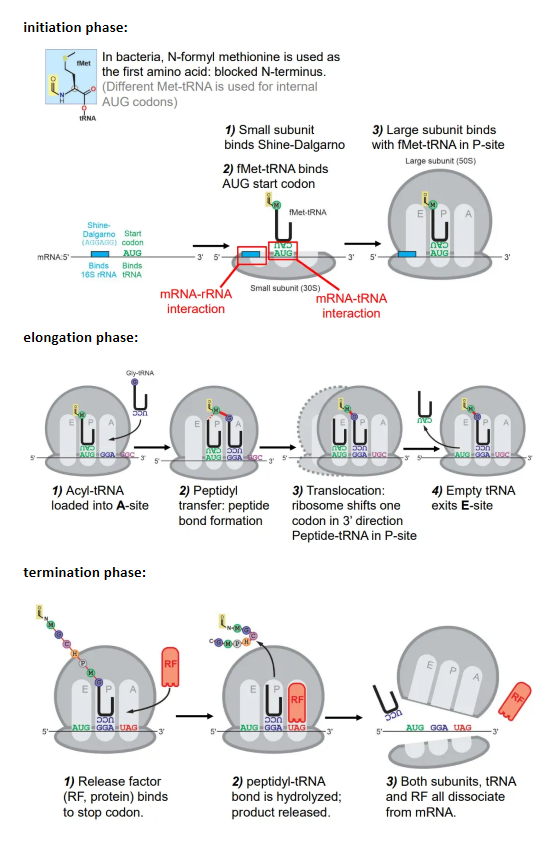
initiation:

  • the small subunit of the ribosome binds to the Shine-Dalgarno box

  • the Met-tRNA (methionine = start aa) binds to the first AUG codon after the Shine-Dalgarno box

  • the large subunit then binds to the Met-tRNA at the P site

elongation:

  • the charged tRNA molecule for the next codon is loaded into the A site, and a peptide bond forms between the two amino acids

    • the amino group of the incoming amino acid attacks the carbonyl carbon nucleophilically

    • this is catalysed by the peptidyl transferase ribozyme, which contains an adenine base that accepts and donates a proton to hydrolyse the peptide-tRNA bond

  • the ribosome shifts one codon, so the first tRNA is now in the E site, and exits

  • the second tRNA is now in the P site, so the process repeats, with new tRNA molecules being loaded into the A site and peptide bonds forming

termination:

  • a release factor (RF) protein binds to the stop codon at the A site

  • this causes the peptide-tRNA bond to be hydrolysed, so the peptide is released

  • both subunits, the tRNA and the RF protein dissociate from the mRNA
<p><strong>initiation:</strong></p><ul><li><p>the small subunit of the ribosome binds to the Shine-Dalgarno box</p></li></ul><ul><li><p>the Met-tRNA (methionine = start aa) binds to the first AUG codon after the Shine-Dalgarno box</p></li><li><p>the large subunit then binds to the Met-tRNA at the P site</p></li></ul><p></p><p><strong>elongation:</strong></p><ul><li><p>the charged tRNA molecule for the next codon is loaded into the A site, and a peptide bond forms between the two amino acids </p><ul><li><p>the amino group of the incoming amino acid attacks the carbonyl carbon nucleophilically</p></li><li><p>this is catalysed by the peptidyl transferase ribozyme, which contains an adenine base that accepts and donates a proton to hydrolyse the peptide-tRNA bond</p></li></ul></li><li><p>the ribosome shifts one codon, so the first tRNA is now in the E site, and exits</p></li><li><p>the second tRNA is now in the P site, so the process repeats, with new tRNA molecules being loaded into the A site and peptide bonds forming</p></li></ul><p></p><p><strong>termination:</strong></p><ul><li><p>a release factor (RF) protein binds to the stop codon at the A site</p></li><li><p>this causes the peptide-tRNA bond to be hydrolysed, so the peptide is released</p></li><li><p>both subunits, the tRNA and the RF protein dissociate from the mRNA</p></li></ul><p></p>