Final - Special Senses
 Studied by 0 people
 Call Kai
 Learn
Learn Practice Test
 Spaced Repetition
 Match
Match Flashcards
 Knowt Play
1/127

There's no tags or description
Looks like no tags are added yet.
Name | Mastery | Learn | Test | Matching | Spaced | Call with Kai |
|---|
No analytics yet
Send a link to your students to track their progress
128 Terms
What are the special senses?
Olfaction, Gustation, Vision, - Smell + Taste + Vision
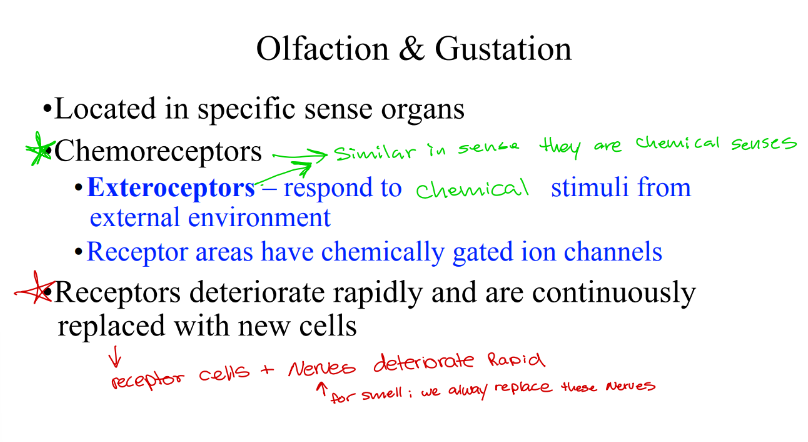
Olfaction & Gustation are located in
specific sense organs
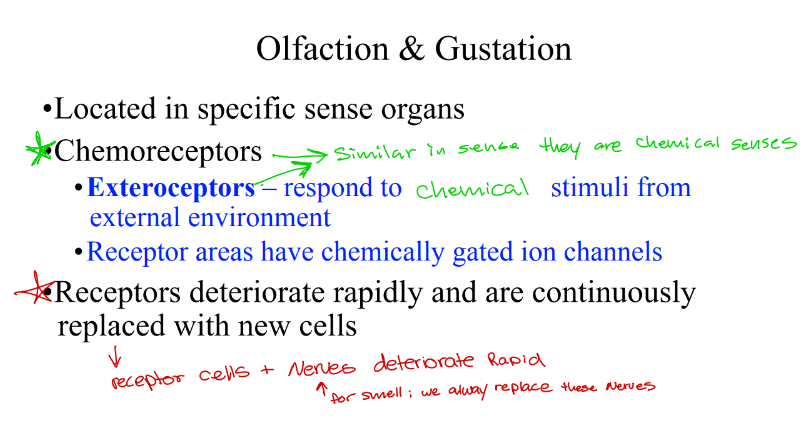
What are exteroreceptors? What is their relationship to chemoreceptors?
Exteroceptors are a type of chemoreceptor that respond to chemical stimuli from the external environment. Their receptor areas have chemically gated ion channels.
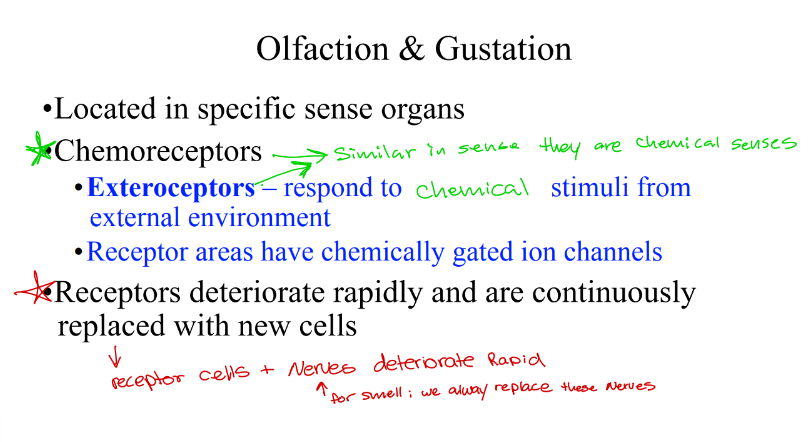
T/F: Olfactory and taste receptors deterioriate rapidly and are continuously replaced with new cells.
T
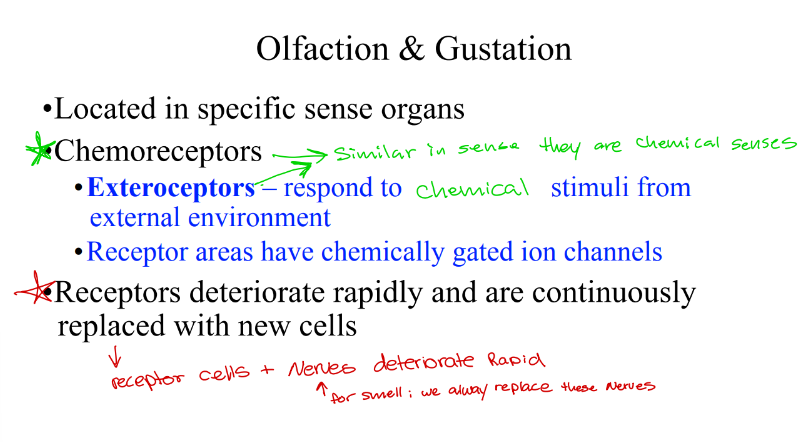
What two special senses are:
Special senses
That use chemoreceptors
To detect external chemicals
And have a high turnover of receptor cells
Olfaction (smell) and gustation (taste)
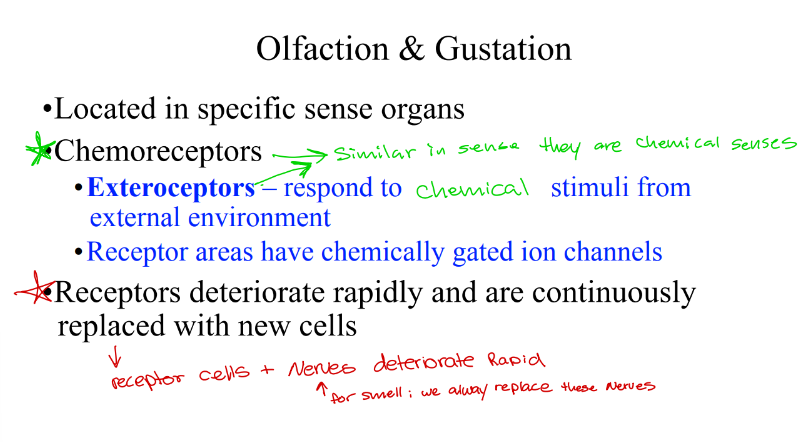
T/F: Only taste receptors deterioriate rapidly and are continuously replaced with new cells.
F. Olfactory and taste receptors deterioriate rapidly and are continuously replaced with new cells.
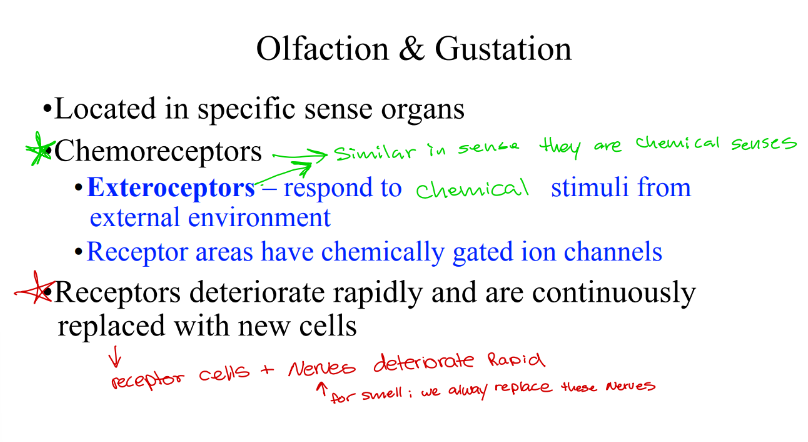
T/F: Only olfactory receptors deterioriate rapidly and are continuously replaced with new cells.
F. Olfactory and taste receptors deterioriate rapidly and are continuously replaced with new cells.
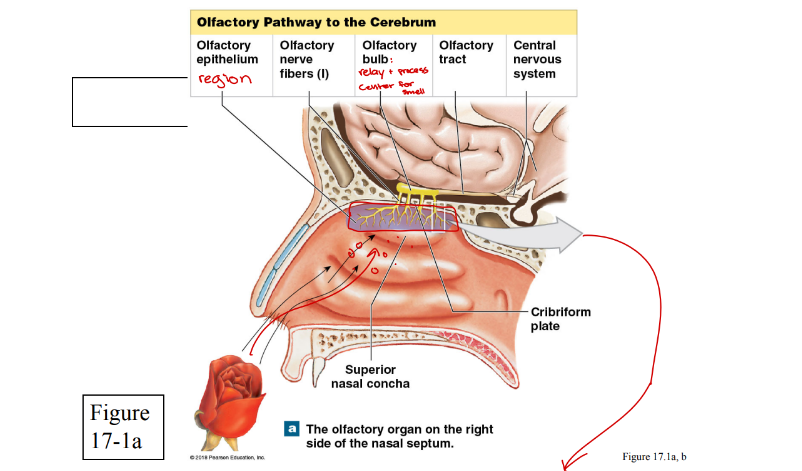
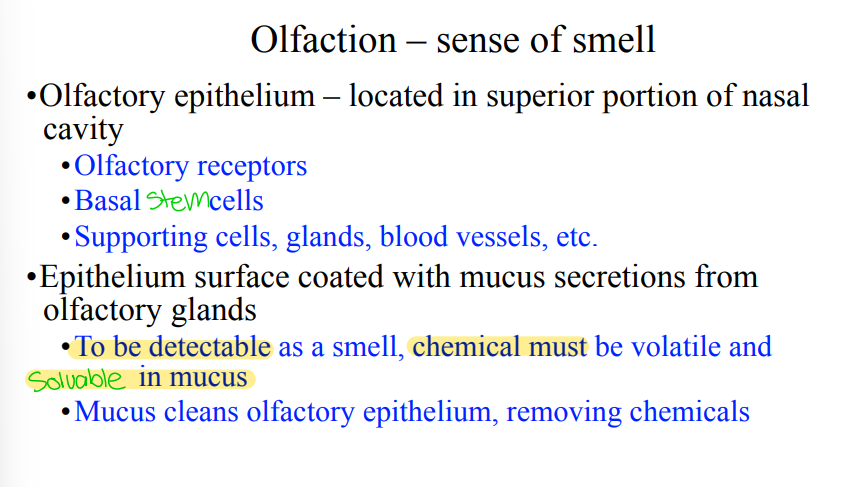
The olfactory epithelium is a specialized sensory epithelium designed to trap odorant chemicals, convert them into neural signals, and protect itself from constant chemical exposure. Where is the olfactory epithelium located?
located in superior portion of nasal cavity
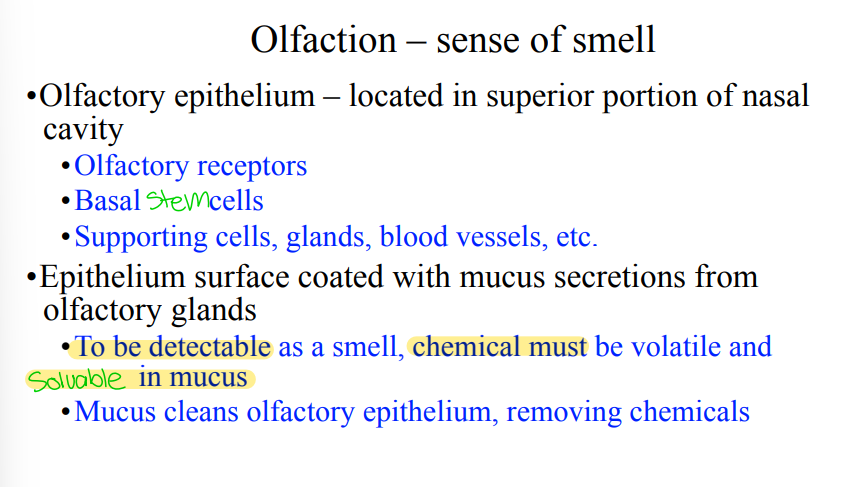
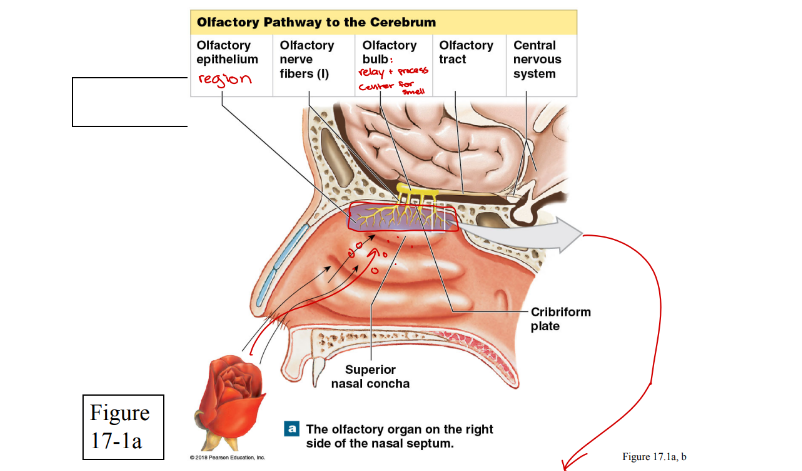
The olfactory epithelium is a specialized sensory epithelium designed to trap odorant chemicals, convert them into neural signals, and protect itself from constant chemical exposure. What are the different cell types of the olfactory epithelium?
Olfactory Receptor Cells (Chemoreceptors that are neurons (rare for epithelial tissue)
Basal stem cells (continously divide, replace damaged olfactory receptor neurons. This explains why smell can recover after injury)
Supporting cells, glands, and blood vessels
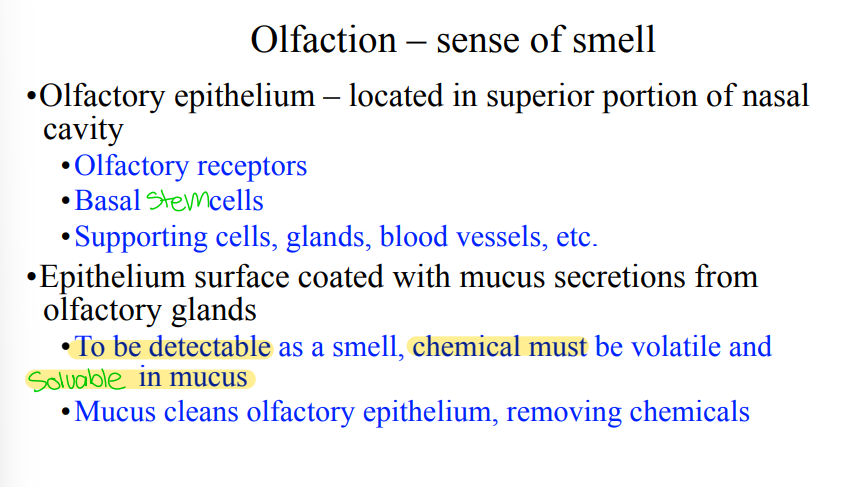
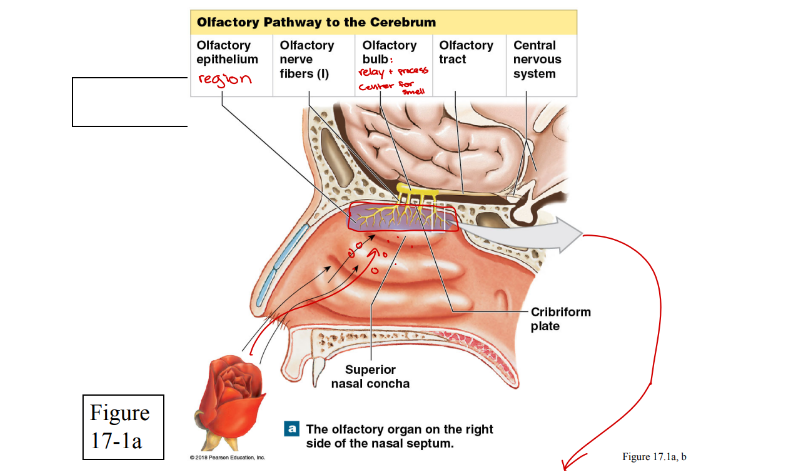
The _____ epithelium is a specialized sensory epithelium designed to trap odorant chemicals, convert them into neural signals, and protect itself from constant chemical exposure.
olfactory
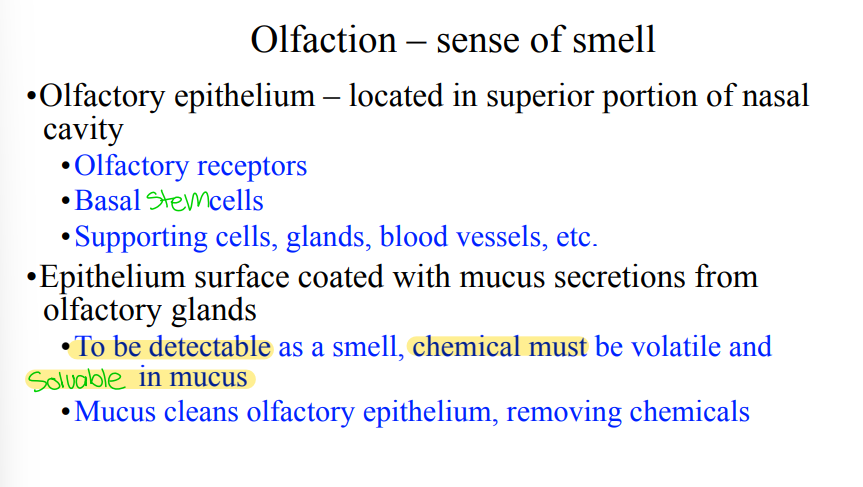

The olfactory epithelium is a specialized sensory epithelium designed to trap odorant chemicals, convert them into neural signals, and protect itself from constant chemical exposure. What is the epithelium surface coated with? Why? What is its role?
mucus secretions from olfactory glands. To be detectable as a smell, the chemical must be volatile and soluble in mucus.
It relies on mucus to dissolve volatile chemicals and protect the sensory surface.
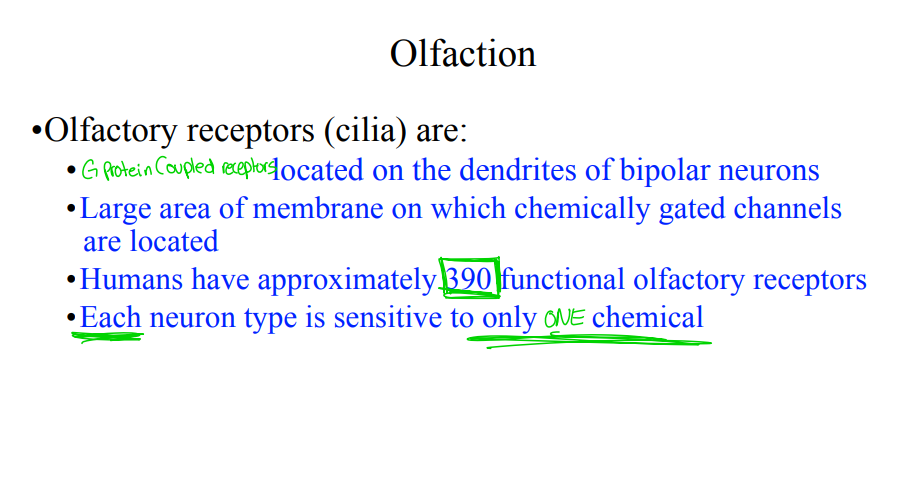
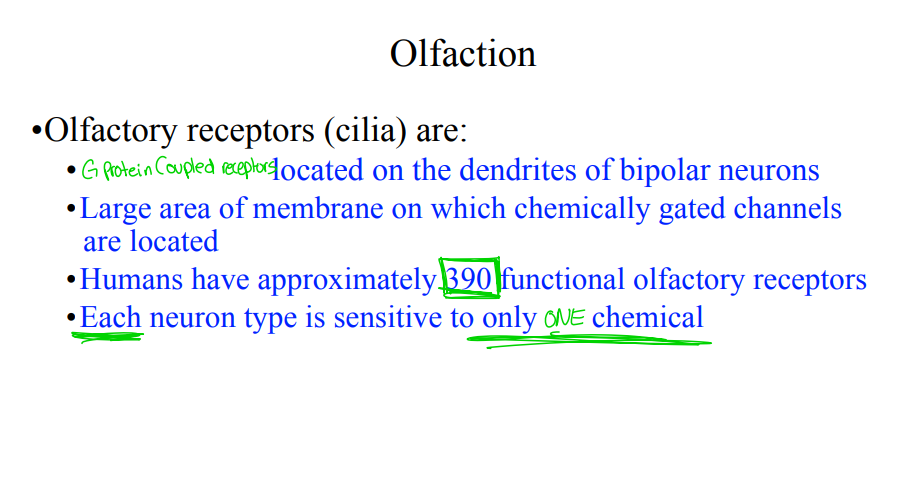
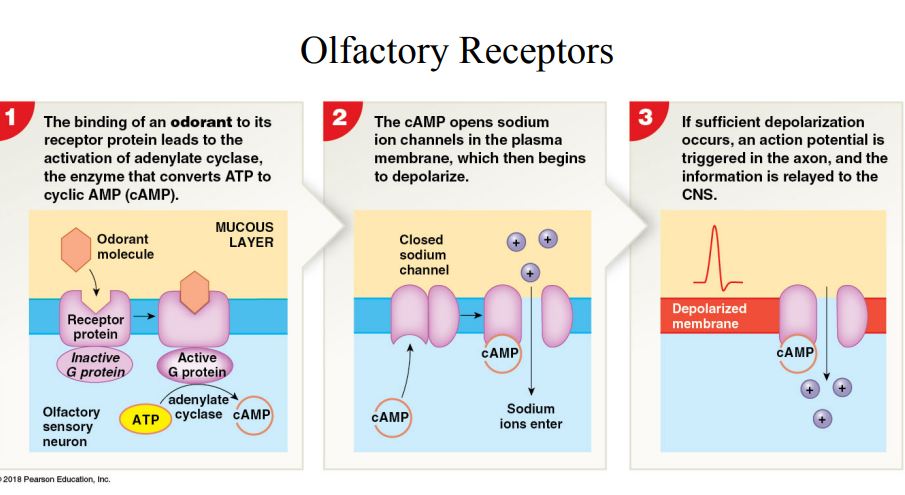
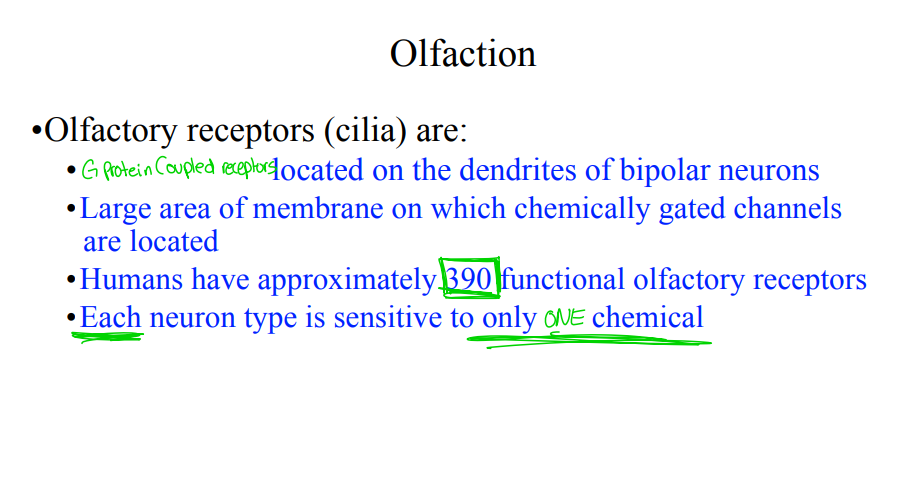
Olfactory receptors (cilia) are more specifically what type of receptors, located on the dendrites of bipolar neurons?
G protein–coupled receptors located on the dendrites of bipolar neurons. These receptors are GPCRs, not ion channels themselves
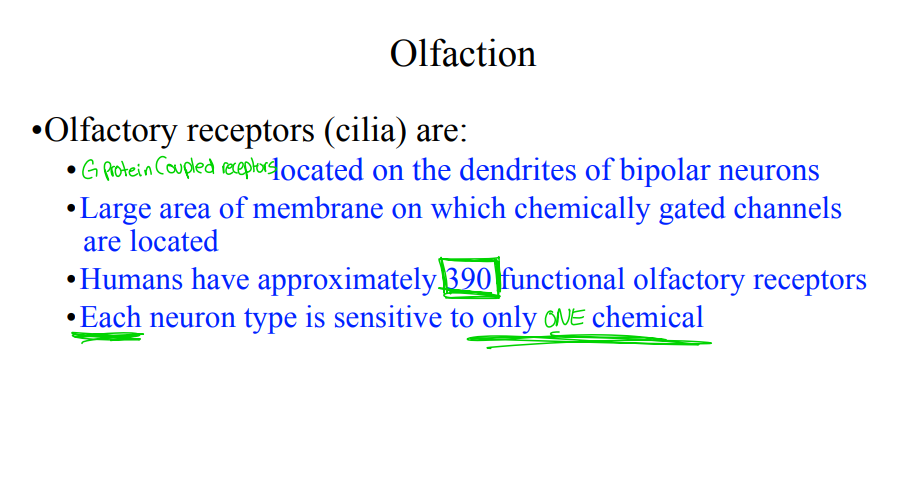
Humans have approximately how many functional olfactory receptors?
390

Why can very small amounts of odor be detected?
Cilia greatly increase surface area
More receptors = higher sensitivity
More ion channels = stronger graded potential
Large area of membrane on which chemically gated channels are located
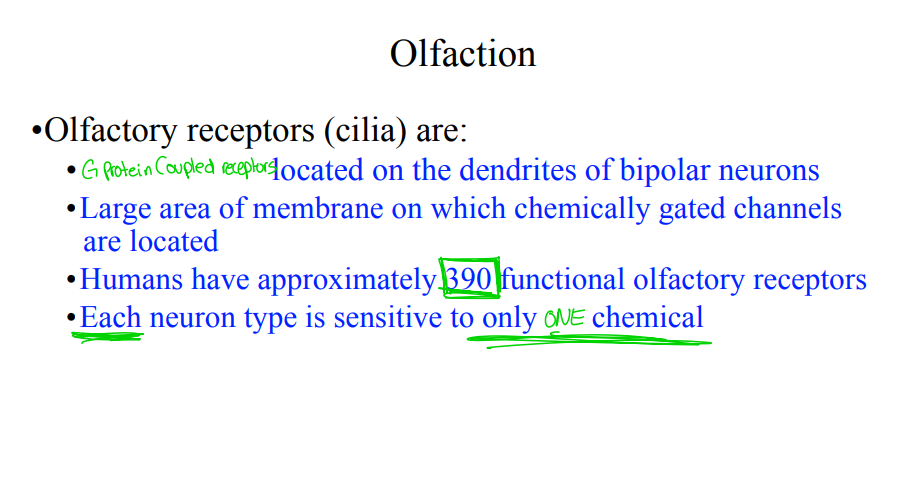
Each olfactory receptor neuron expresses how many receptor genes?
expresses only ONE receptor gene. that neuron responds best to one odorant type. BUT, a single odor usually activates multiple neuron types, and the brain interprets the pattern.
One neuron = one receptor
One odor = many receptors
Many receptors =
huge odor discrimination
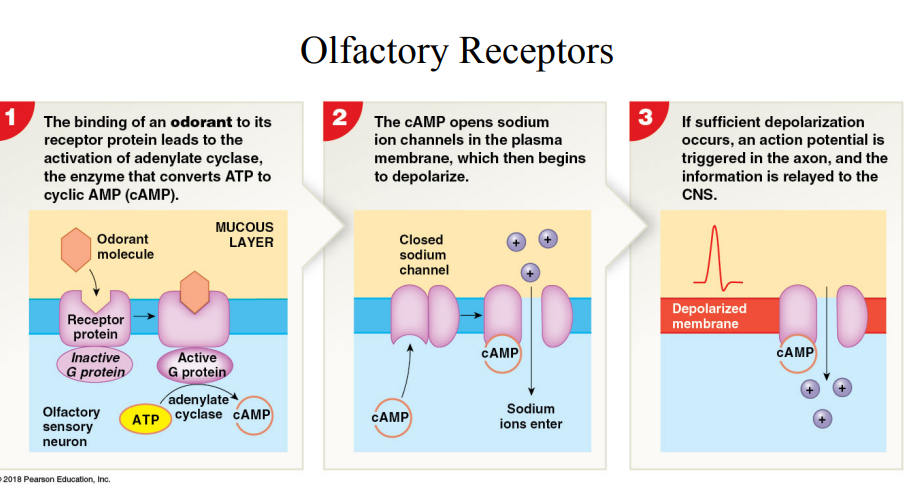

Which special sense uses GPCR’s as receptors and not ion channels?
olfaction
One neuron = one ______
One odor = many _______
Many _______ = huge odor discrimination
receptor; receptors; receptors
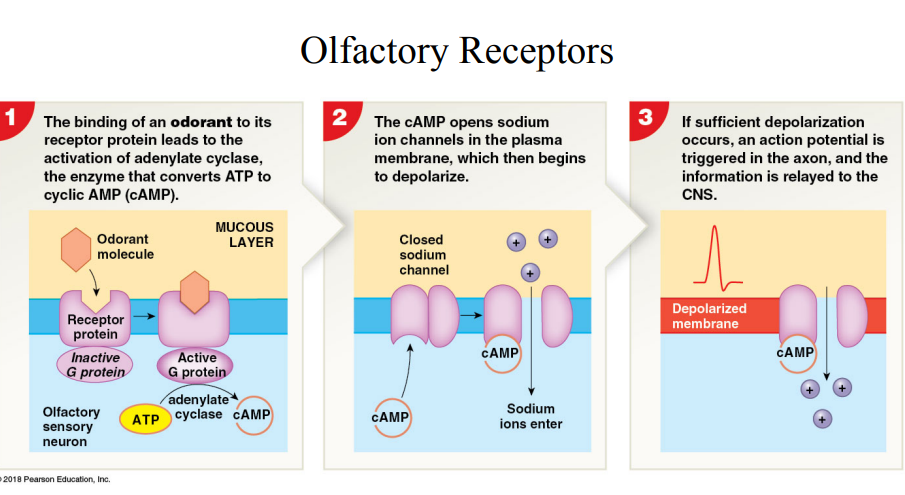
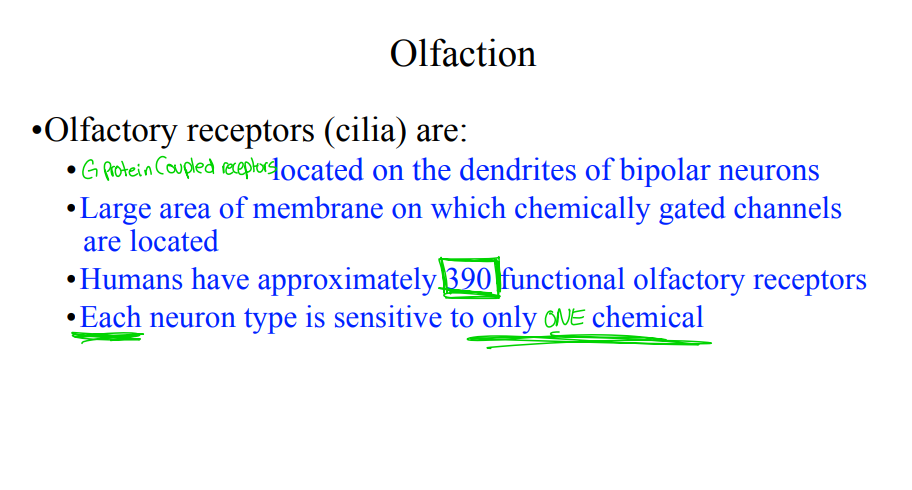
Olfactory receptor neurons are bipolar neurons with _____ on their cilia, each expressing one receptor type, and odors are identified by patterns of receptor activation.
GPCRs
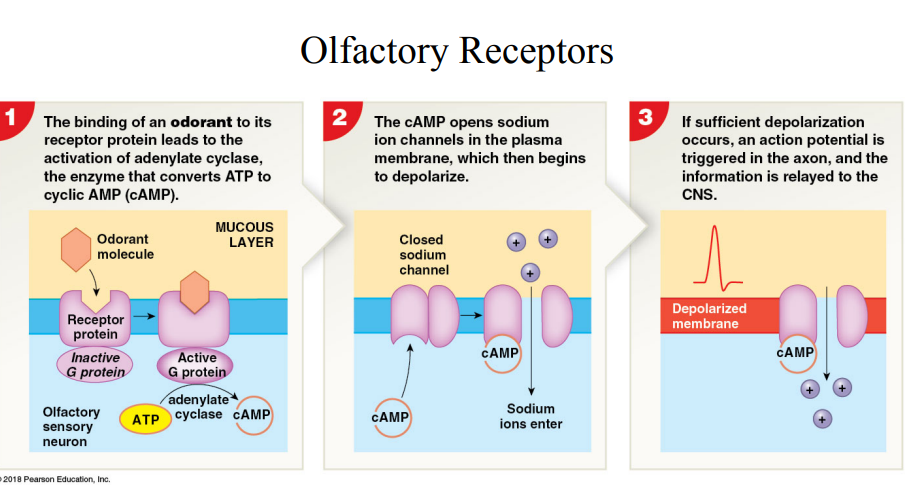
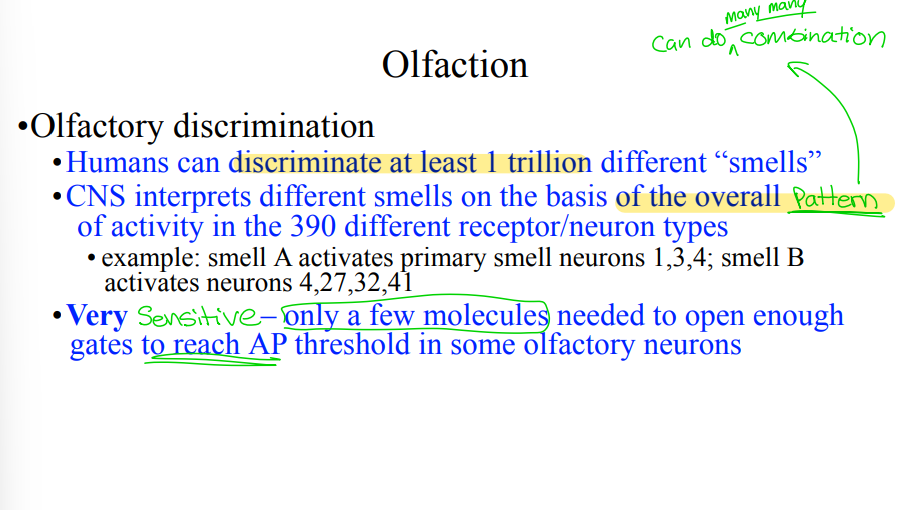
How many different smells can humans discriminate?
At least 1 trillion
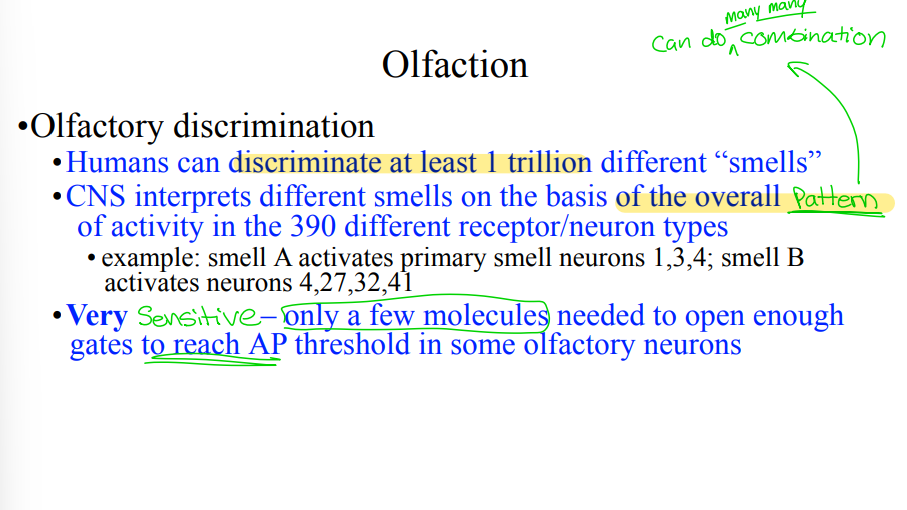
Humans can discriminate at least 1 trillion different “smells,” so what must the CNS interpret?
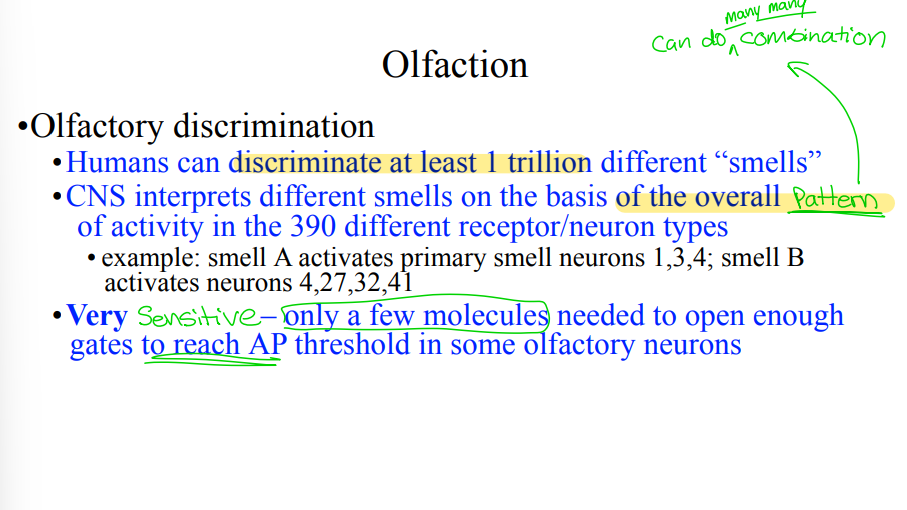
CNS interprets different smells on the basis of the overall pattern of activity in the 390 different receptor/neuron types

Olfactory discrimination can be very sensitive, meaning that
only a few molecules needed to open enough gates to reach AP threshold in some olfactory neurons
Why is olfaction as a special sense unusual? (i.e. what makes this sense ‘special’?)
Olfaction is unusual because:
The receptor is a neuron
It sends axons directly into the CNS

Name & describe the first step of the olfactory pathway (such as where they are located, perhaps most importantly).
Step 1: 1st-order neurons (the receptor cell in olfactory epithelium. the axon extends into CNS as cranial nerve I)
The olfactory receptor cells in the olfactory epithelium are the 1st-order neurons
They are bipolar neurons
Their axons:
Bundle together
Pass through the cribriform plate of the ethmoid bone (approximately 20 small bundles of axons go through the cribriform plate instead of one single peripheral nerve)
Enter the CNS as cranial nerve I (olfactory nerve)
Important distinction:
It’s not one big nerve
It’s many tiny bundles (fila olfactoria)
Name & describe the second step of the olfactory pathway. (such as where they are located, perhaps most importantly).
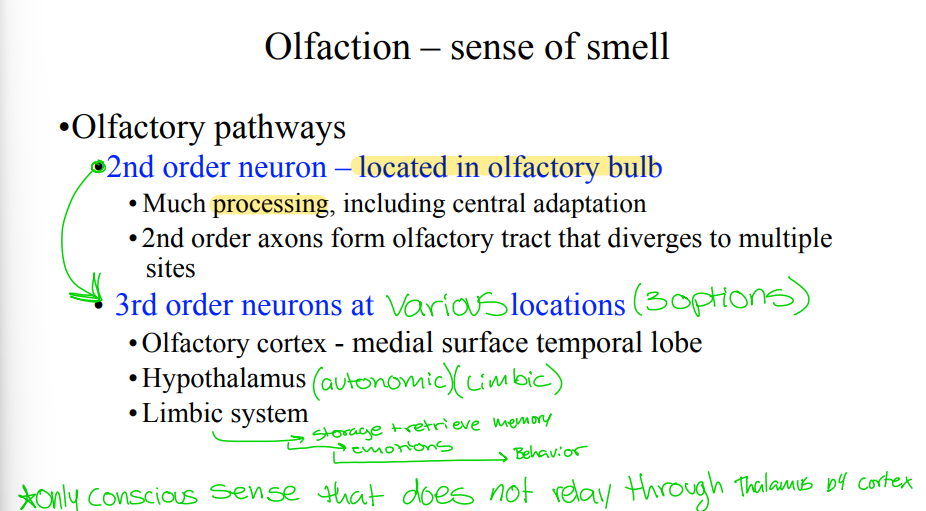
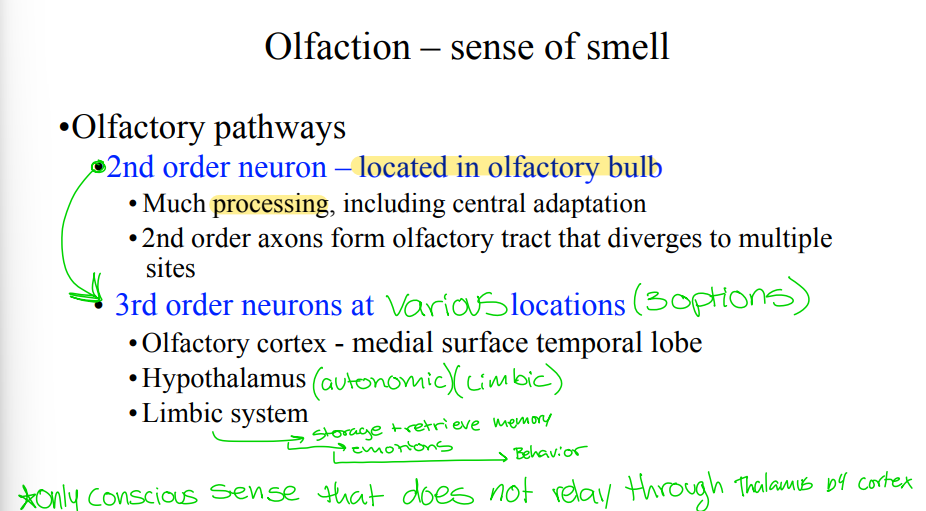
Step 2: 2nd-order neurons (olfactory bulb)
Located in the olfactory bulb
First major processing station!!
Functions include:
Signal integration
Central adaptation (reduced response to constant odors)
Refinement of odor signals
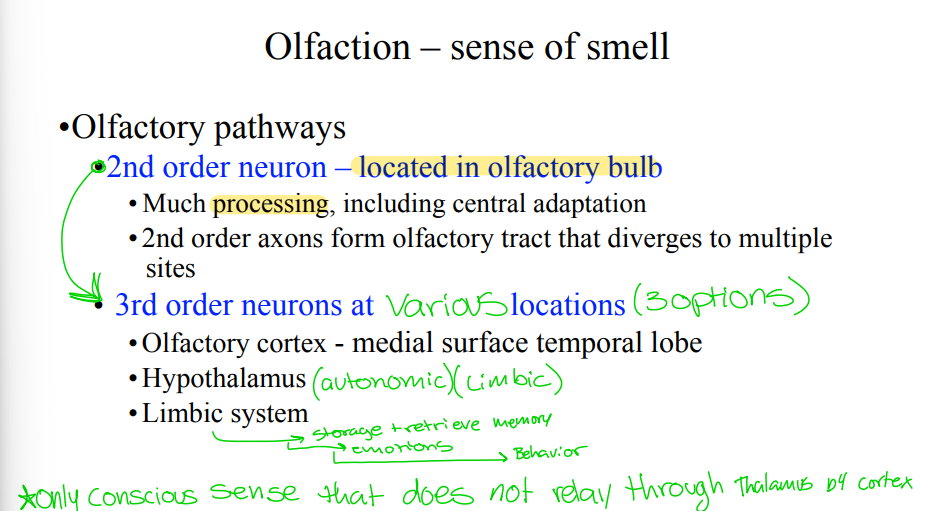
Axons of 2nd-order neurons form the olfactory tract that diverges to multiple sites
Name & describe the third step of the olfactory pathway. (such as where they are located, perhaps most importantly).
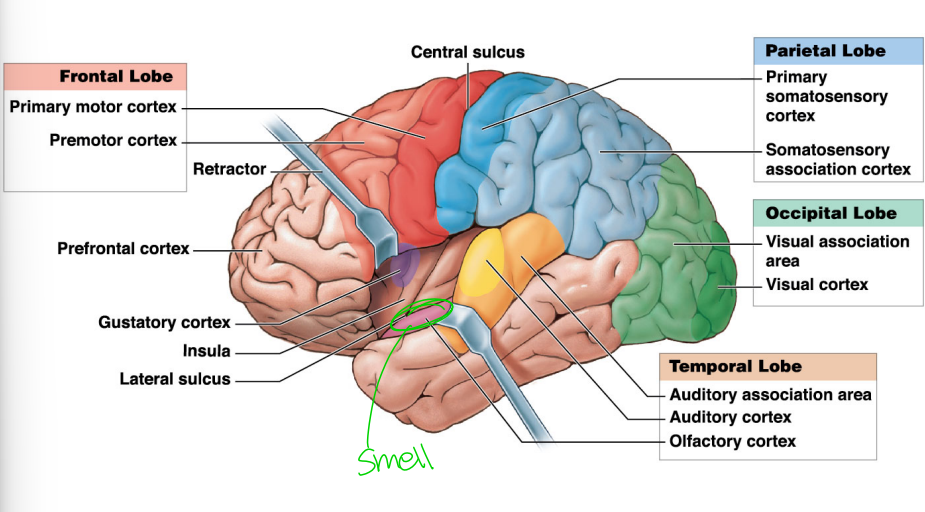
Step 3: Divergence to multiple brain areas (3rd-order neurons)
The olfactory tract splits and projects to several targets:
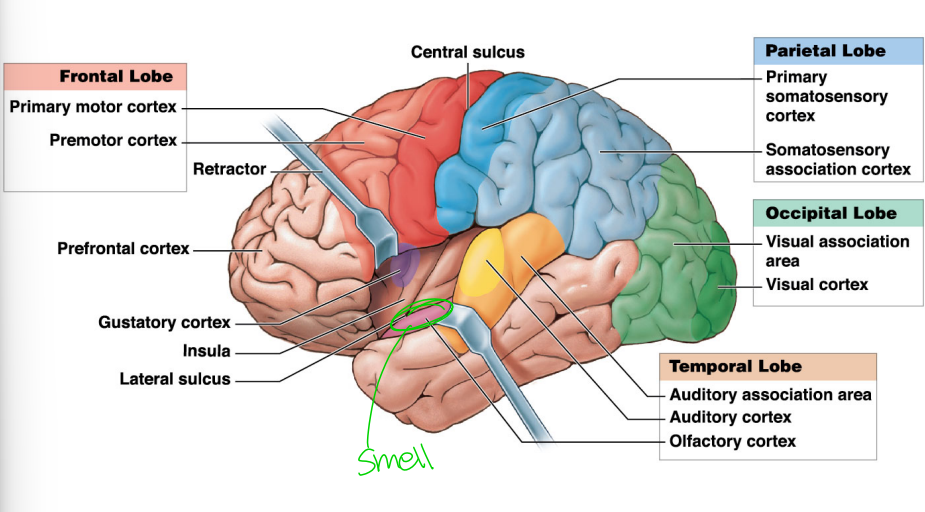
Olfactory cortex (medial temporal lobe)
Conscious perception of smell
Identification and discrimination of odors
How many tastes can humans detect?
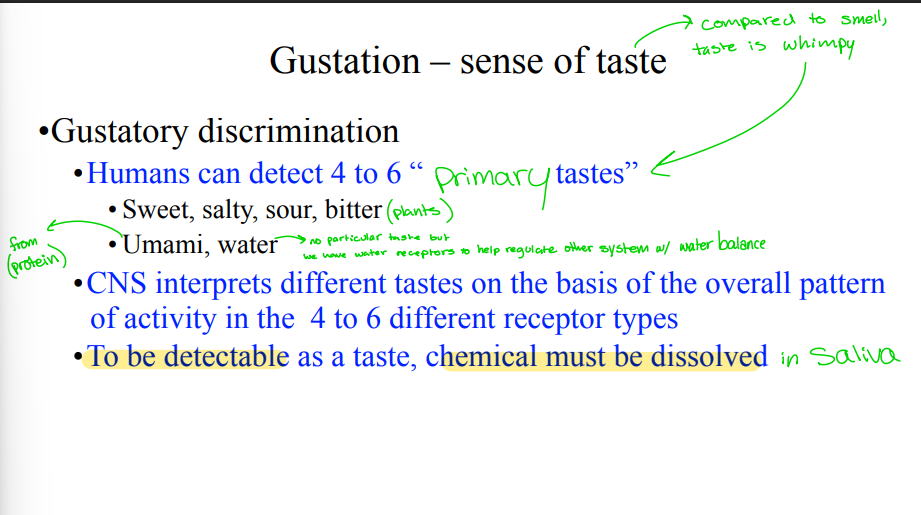
4-6 (at least compared to smell, taste is wimpy af)
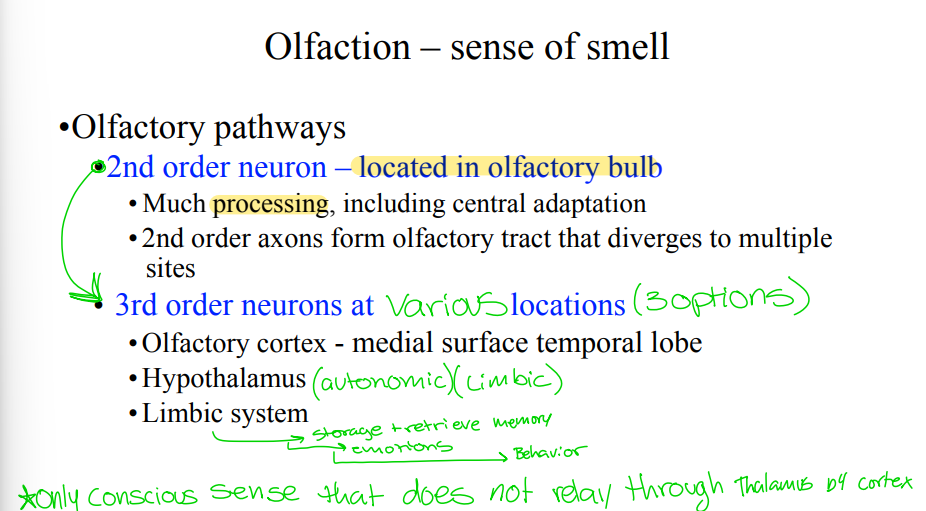
What is the only conscious sense that does NOT relay through the thalamus before the cortex of the brain?
Olfaction — our sense of smell
Damage to the cribriform plate will result in a lack of what special sense?
smell
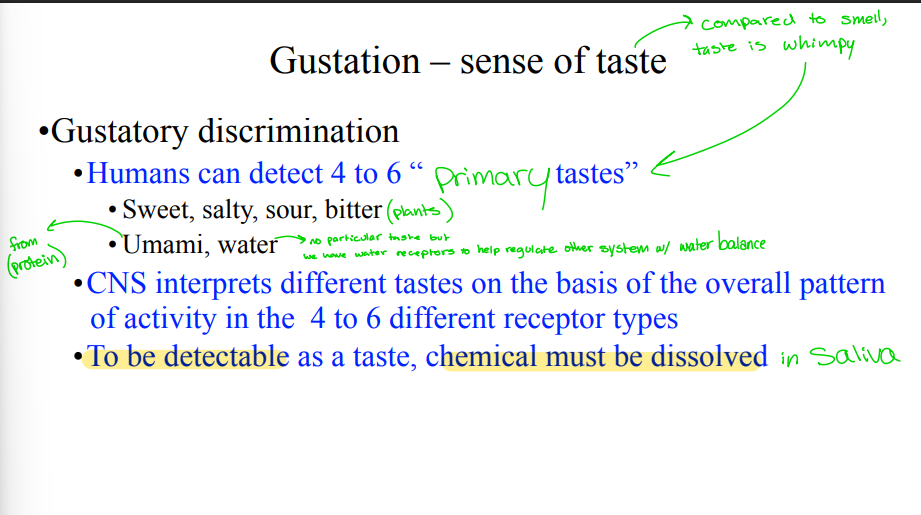
What are the 4-6 primary tastes humans can taste?
Sweet, salty, sour, bitter, umami, water
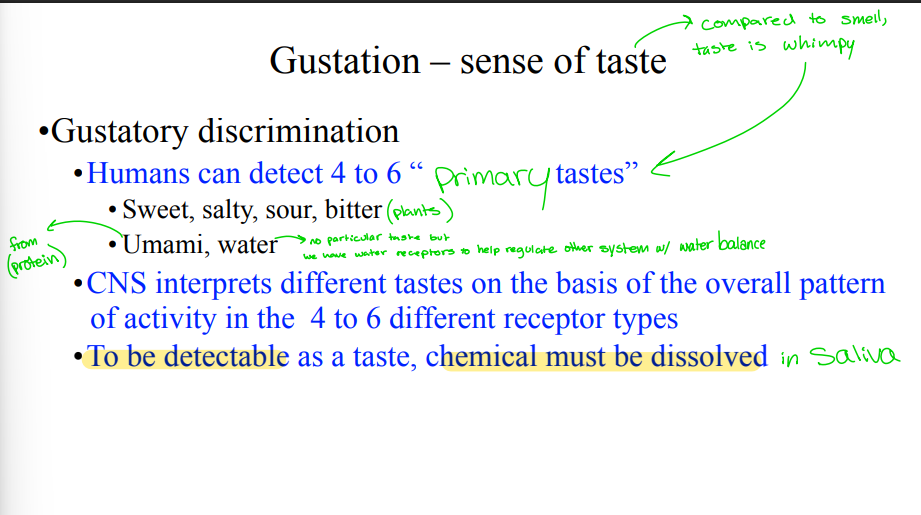
How does the CNS discriminate between tastes? (Gustatory discrimination)
CNS interprets different tastes on the basis of the overall pattern of activity in the 4 to 6 different receptor types
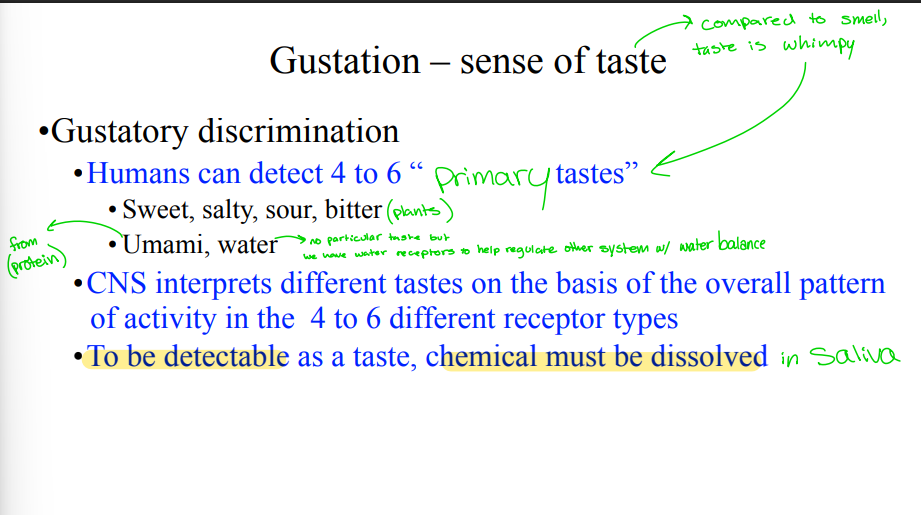
To be detectable as a taste, what must occur?
A chemical must be dissolved in saliva.
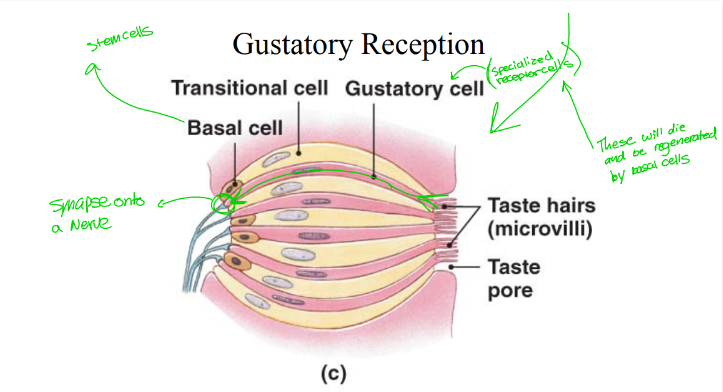
Taste buds contain what two types of cells?
gustatory receptor cells & basal stem cells
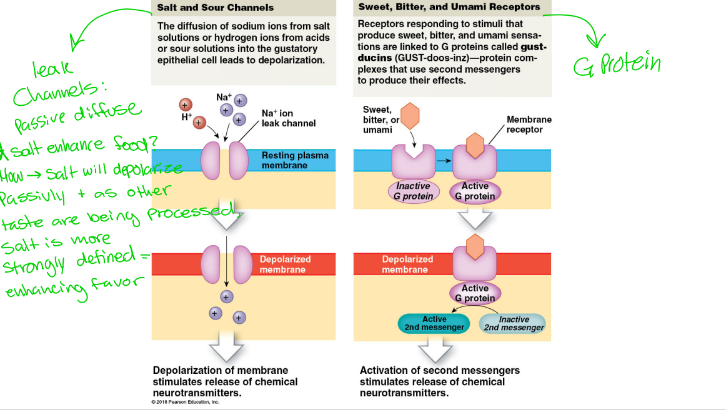
Describe the structure of salt and sour channels vs sweet, bitter, and umami receptors
Salt and sour: Leak channels
Sweet, Bitter, Umami: G Protein Coupled REceptors
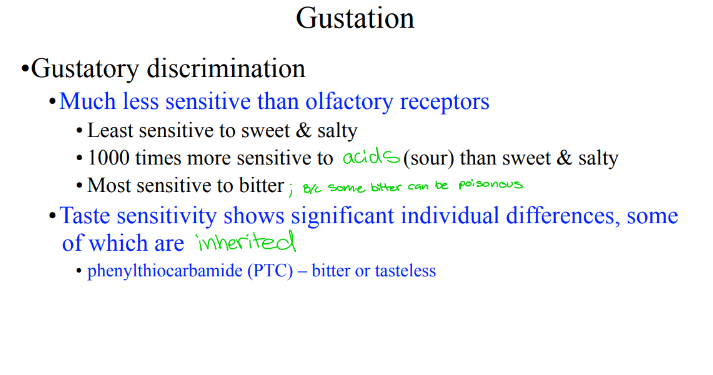
T/F: Gustatory discrimination is much less sensitive than olfactory receptors.
T
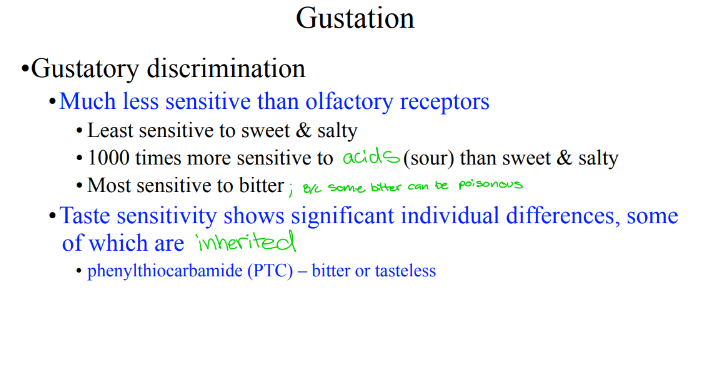
In terms of gustatory discrimination, which flavors are we least sensitive to? What about the most?
least sensitive to sweet & salty. We are 1000 times more sensitive to acids (sour) than sweet and salty, and we are most sensitive to bitter (bc bitter can be poisonous, evolutionary fact)
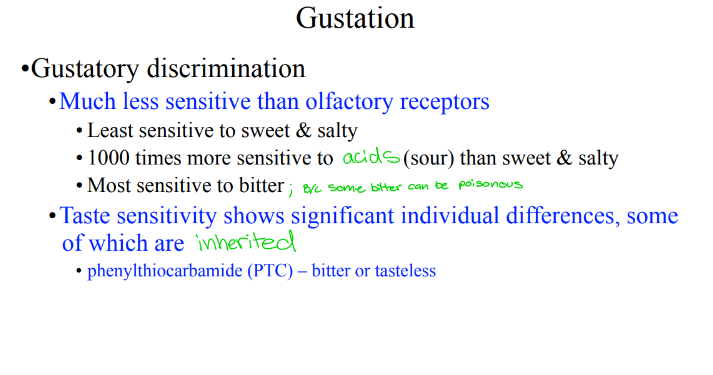
Taste sensitivtiy shows significant individual differences, some of which are _____
inherited
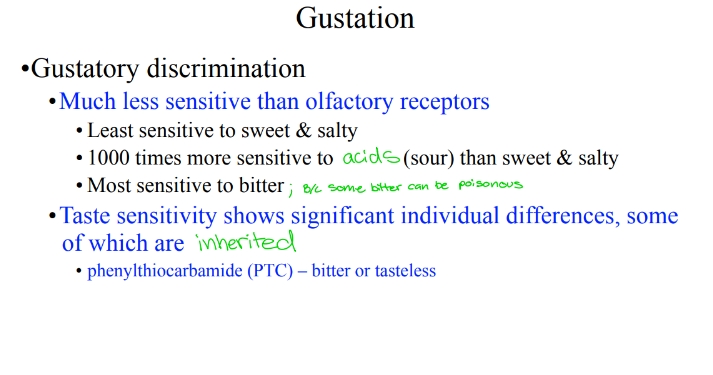
phenylthiocarbamide (PTC) tastes like what
either bitter or tasteless
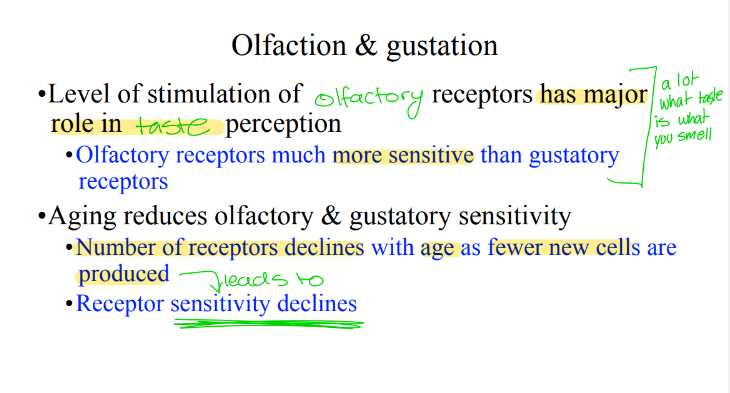
Which receptors are more sensitive, olfactory or gustatory?
Olfactory receptors much more sensitive than gustatory receptors

What happens to our olfactory & gustatory sensitivity as we age?
•Number of receptors declines with age as fewer new cells are produced
•Receptor sensitivity declines
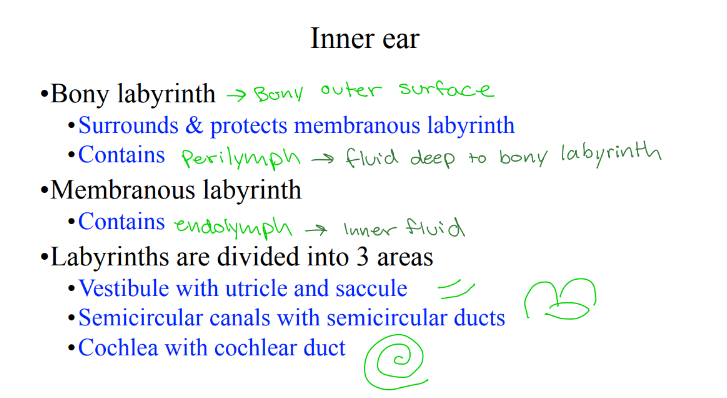
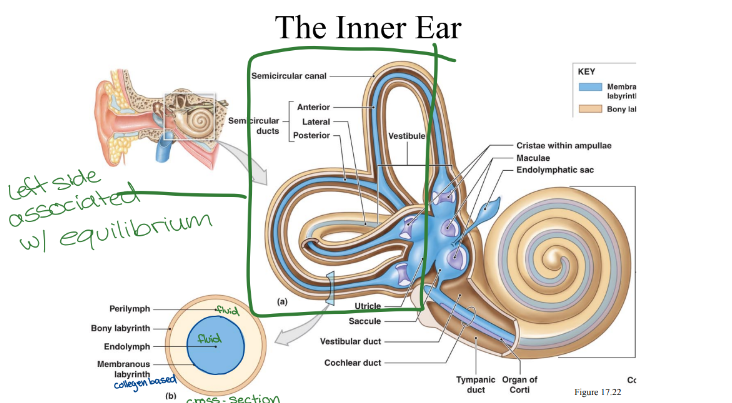
The inner ear consists of what 2 labryinths and what do they contain?
Bony labrynth (bony outer surface)
Contains perilymph, which is a fluid deep to the bony labryinth
Membranous labrynth
Contains endolymph, inner fluid
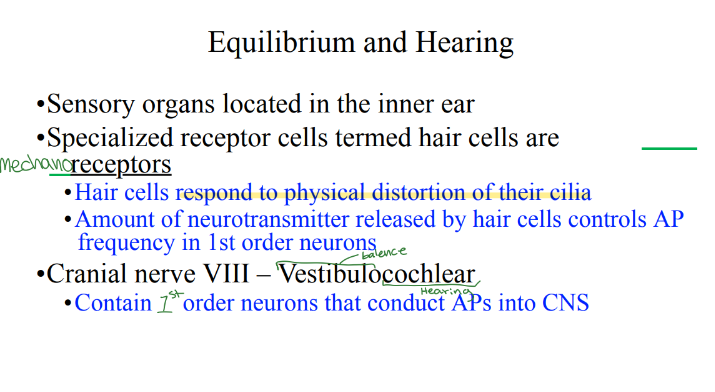
In our ear, there are specialized receptor cells called what? What kinds of receptors are they? What do they respond to?
Hair cels; mechanoreceptors; respond to physical distortion of cilia
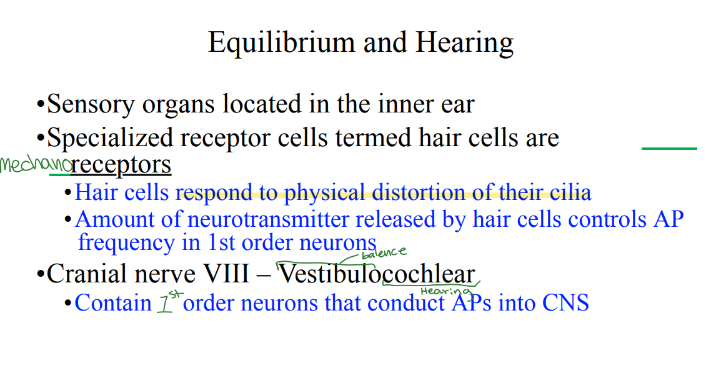
The amount of NT released by hair cells controls ___ frequency in first order neurons
AP
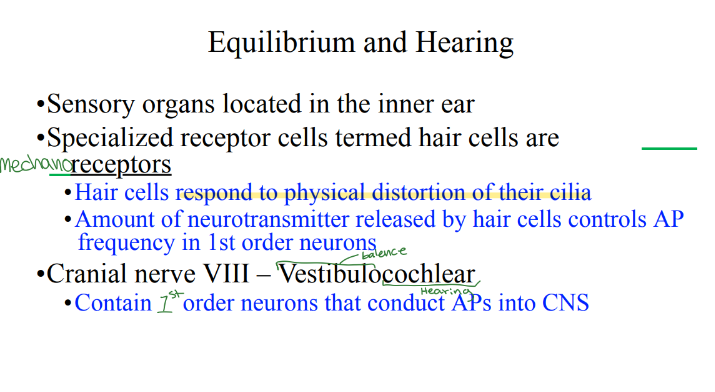
Which cranial nerve contains first order neurons that conduct APs into CNS?
Cranial nerve VIII - vestibulocochlear
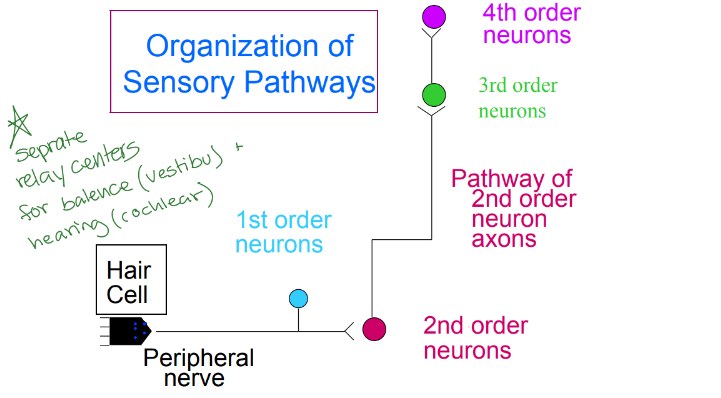
describe the organization of sensory pathways for a hair cell
hair cell → peripheral nerve → first order neuron → second order neurons → 3rd order neurons → 4th order neurons
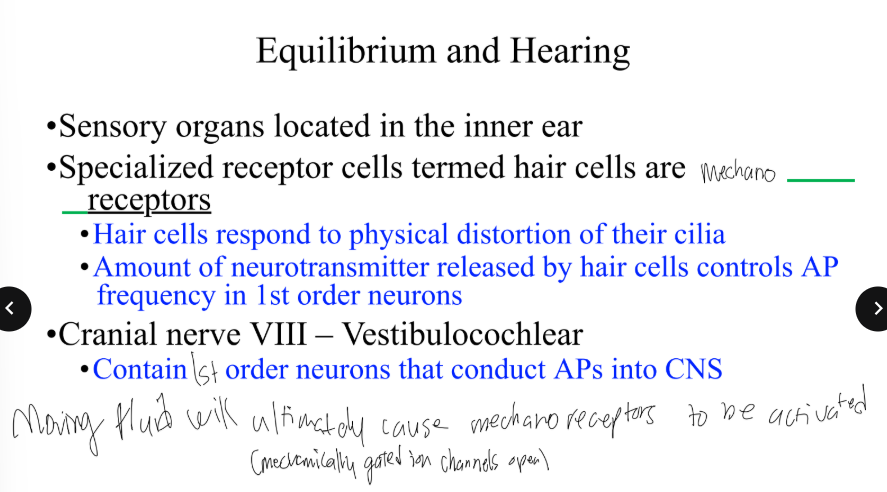
What will ultimately cause mechanoreceptors to be activated, where mechanically gated ion channels open (Equilibrium & hearing)?
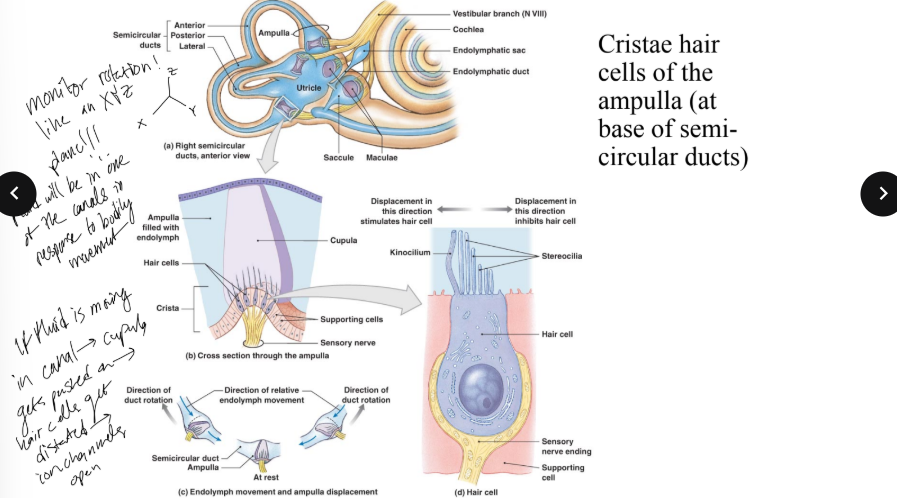
Moving fluid
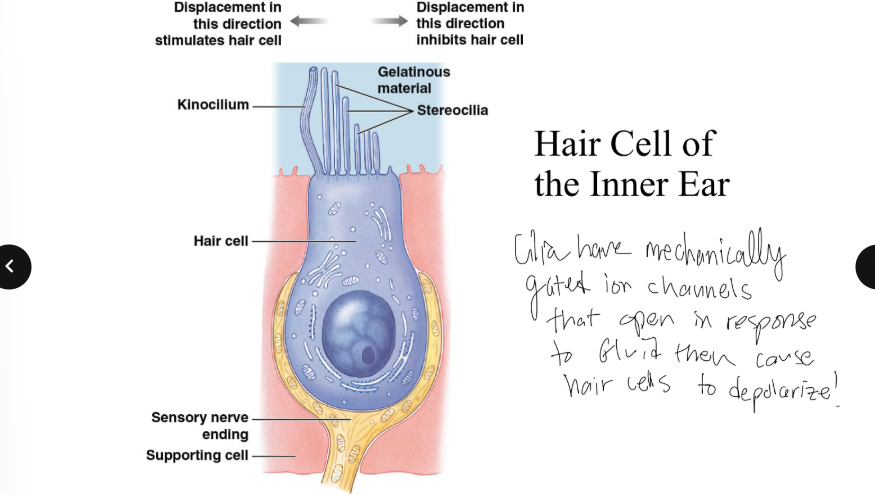
Cilia have mechanically gated ion channels that open in response to? Then what does it do?
fluid movement, then cause hair cells to depolarize?
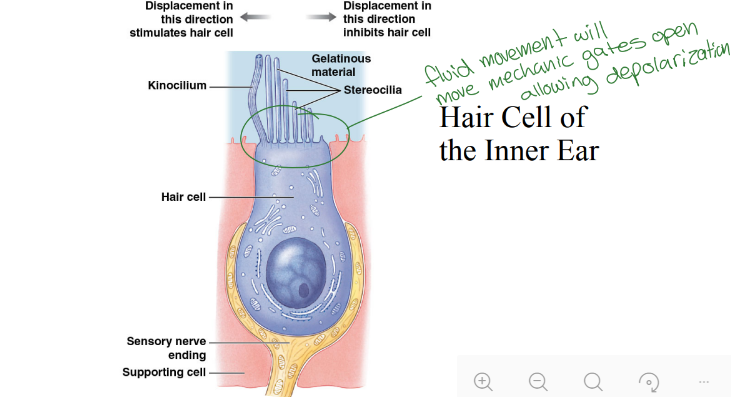
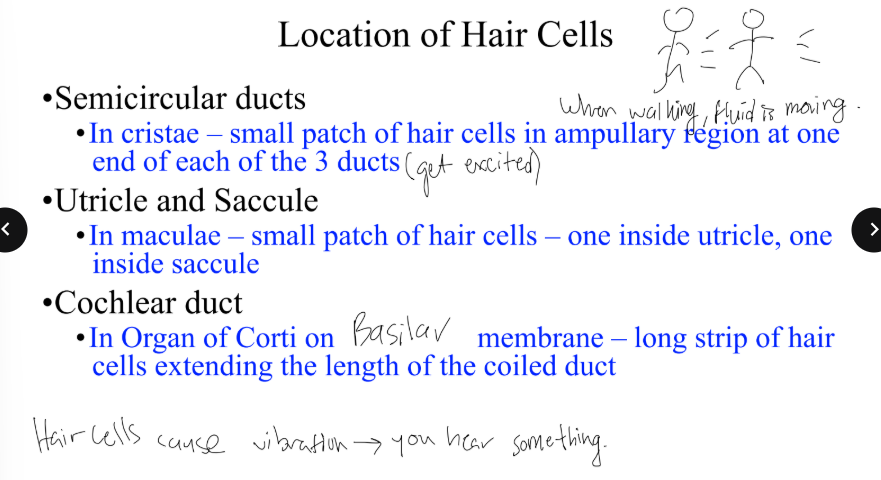
Where can you find hair cells?
semicircular ducts
utricle & saccule
cochlear duct
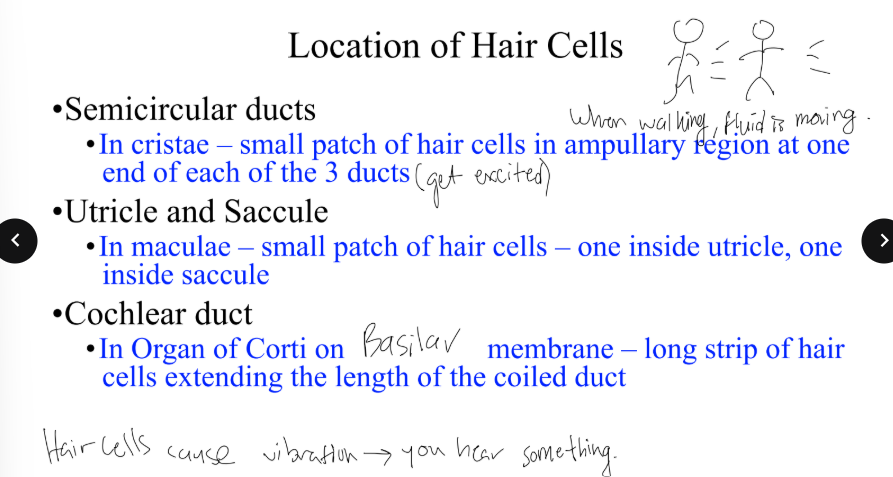
WHen do you hear something?
When hair cells cause vibration
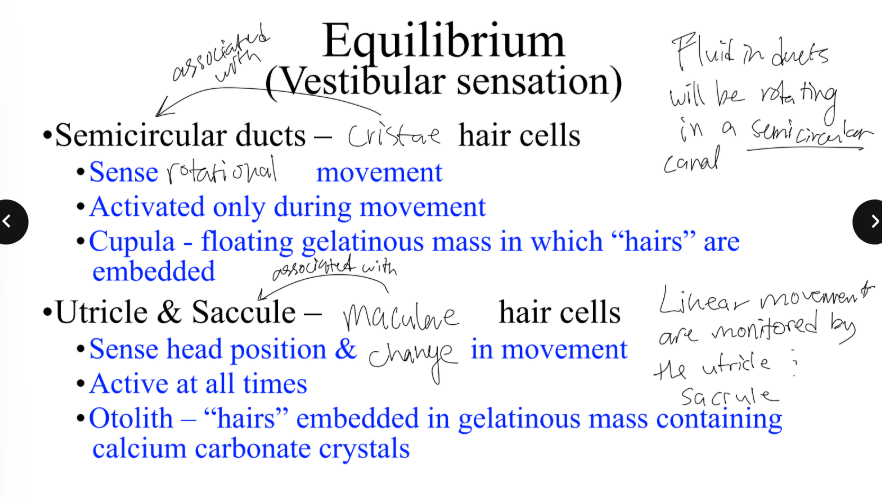
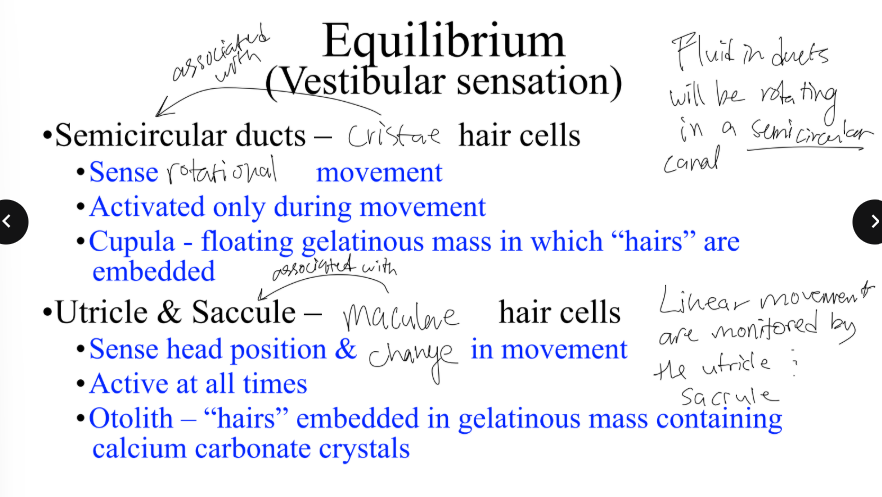
cristae hair cells are located where???
semicircular ducts

maculae hair cells are located where???
utricle & saccule
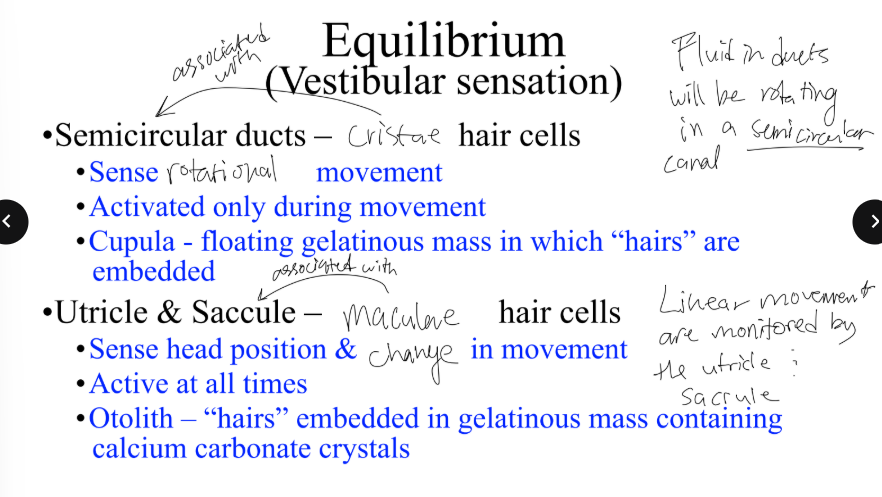
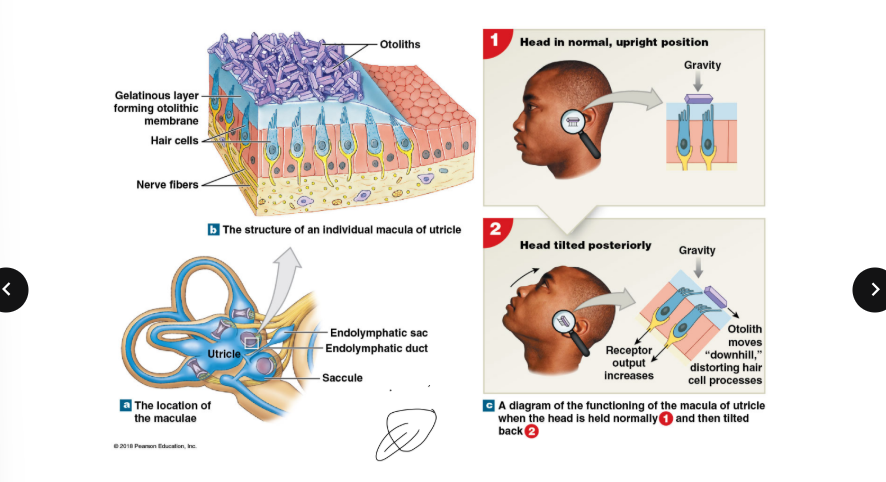
the utricle and saccule contain (cristae/maculae) hair cells
maculae!!!!!! hair cells
the semicircular ducts contain (cristae/maculae) hair cells
cristae!!! hair cells
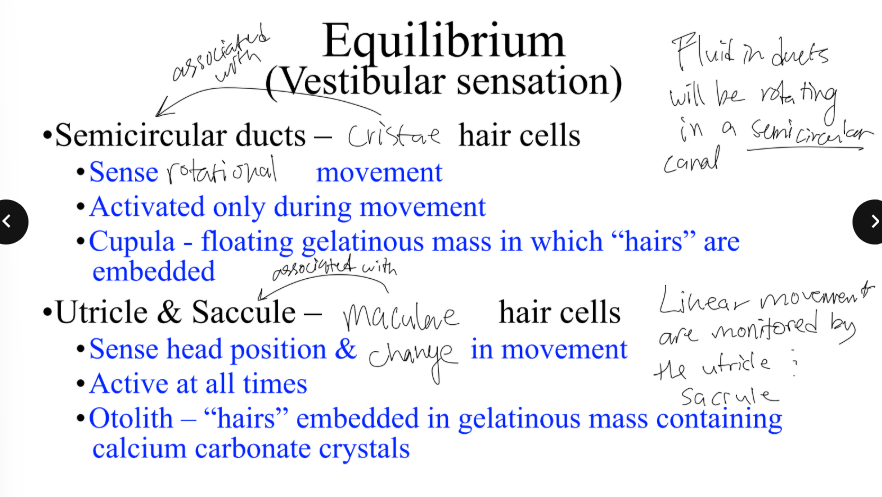
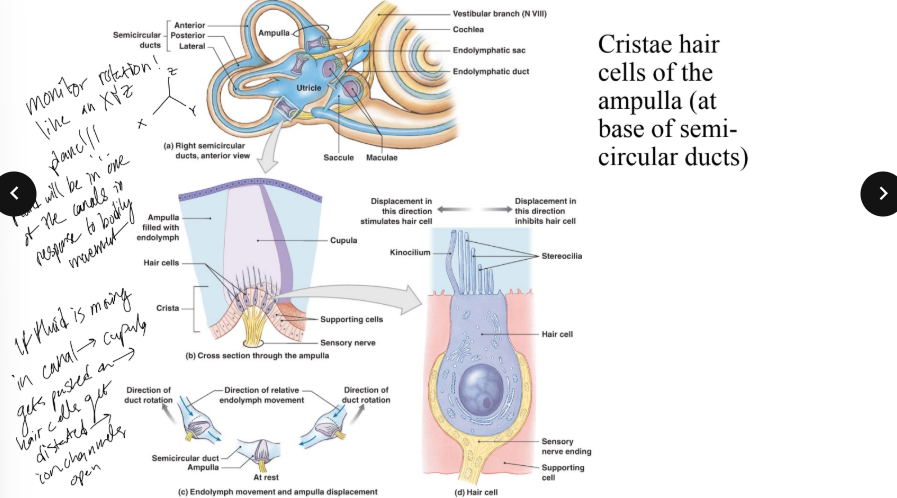
fluid in the ducts will be rotating in a semicircular canal, therefore what kind of movement do the semicircular ducts sense?
rotational movement
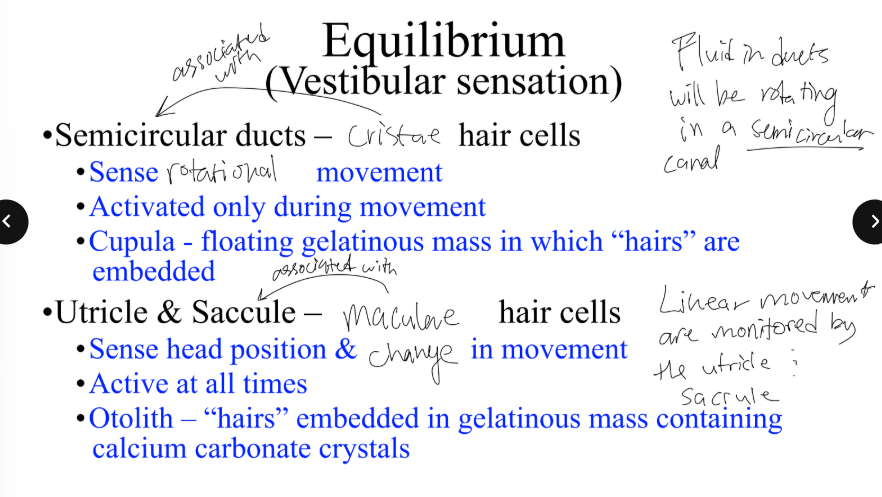
what is the cupula (in the semicricular ducts)?
a floating gelatinous mass in which “hairs” are embdedded
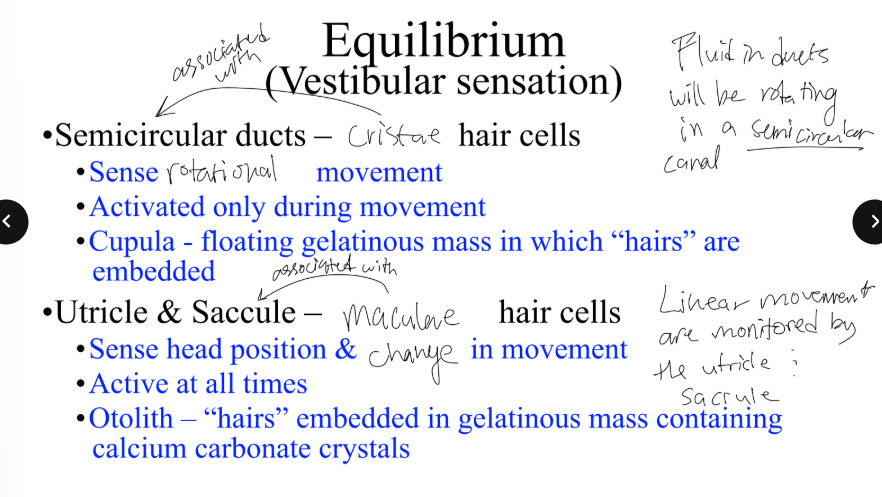
semicircular ducts sense rotational movement, whereas the utricle & saccule sense what kind of movement?
head position & change in movement!
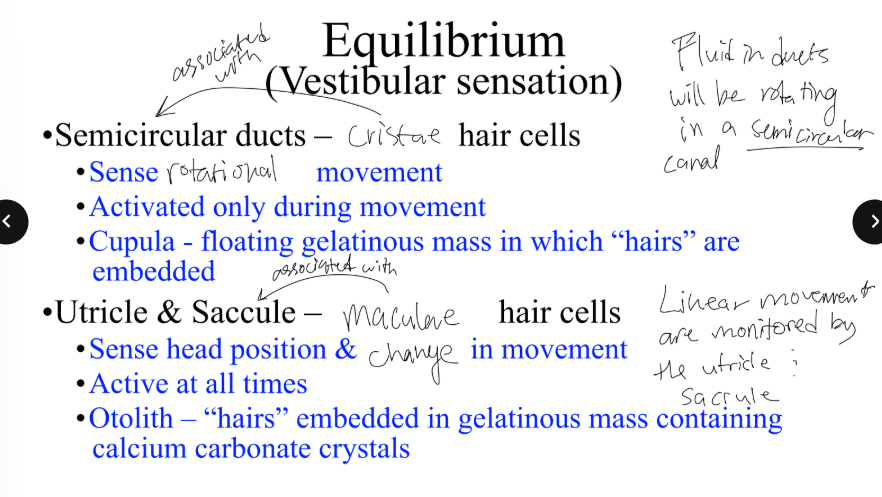
which one is active at all times in terms of sensing movement, semicircular ducts or the utricle & saccule?
the utricle & saccule are always active when sensing movement because we are constnatly monitoring our head position and change in movement (which is what the utricle & saccule control)

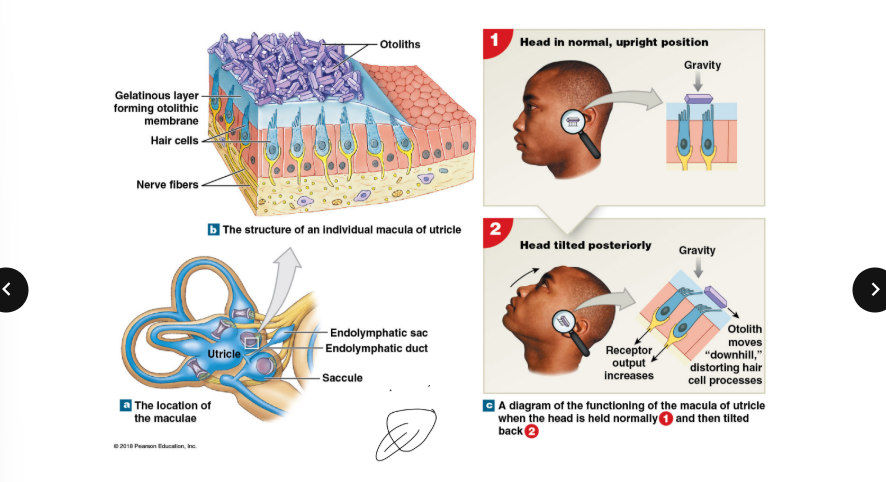
cupula is in what area of the ear, versus otoliths?
cupula - semicircular canal, otolith - utricle & saccule
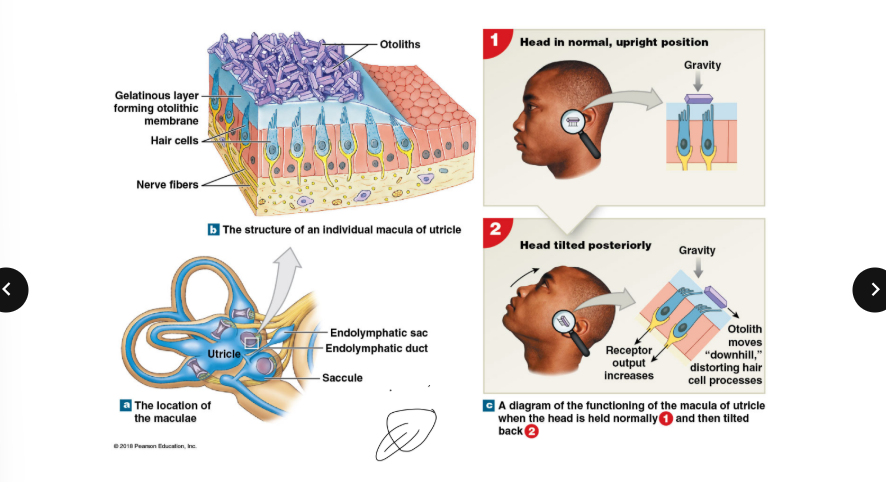
what is an otolith?
“hairs” embedded in gelatinous mass containing calcium carbonate crystals
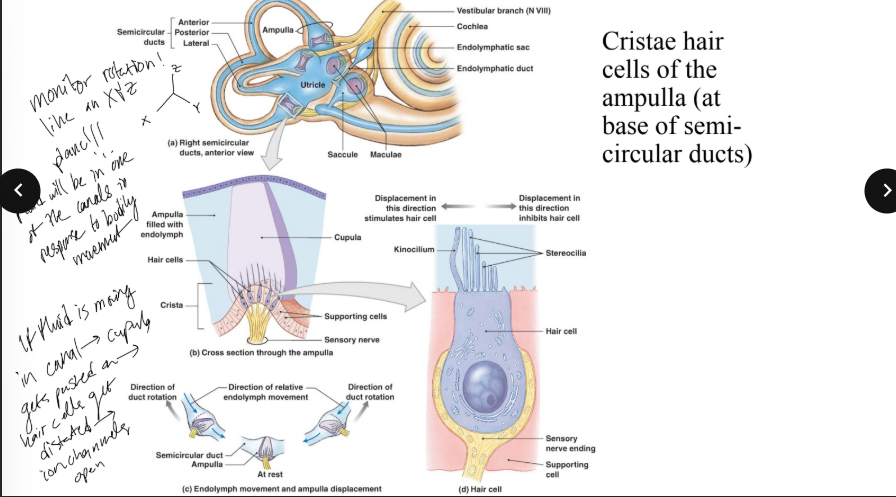
the semicircular ducts monitor rotation kinda like an ____ plane in mathematics
XYZ
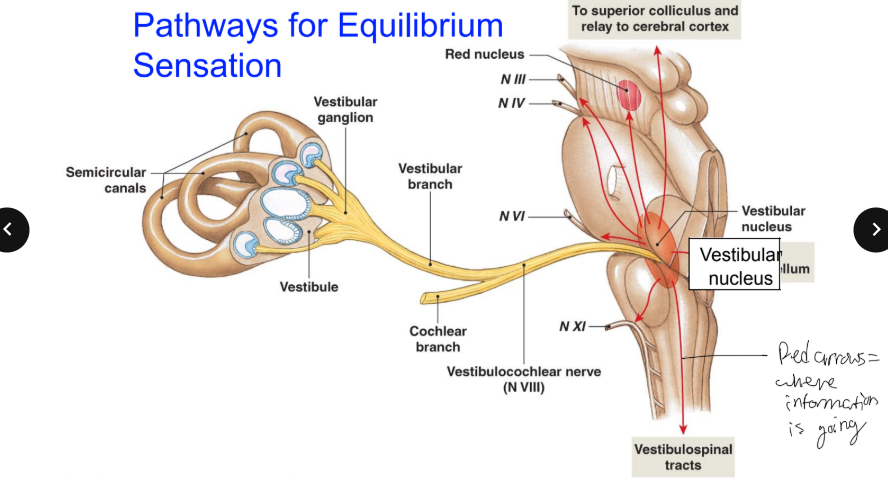
Hair cells synapse onto 1st order sensory neurons, which enter the CNS as what? Where are 2nd-order neurons located? They integrate input from where? WHere do they send the information to?
vestibular branch of CN VIII (vestibulocochlear nerve)
•2nd order neurons located in vestibular nuclei of the brainstem
•Integrate input from left and right inner ears
•Send information to the somato-sensory cortex
•Send information to the cerebellum
•Send information to motor nuclei in BS and SC for reflex control of eye, head, neck
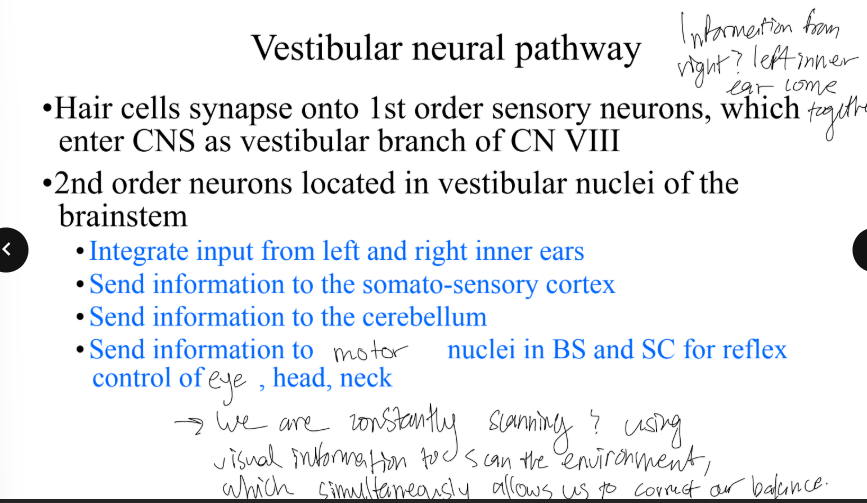
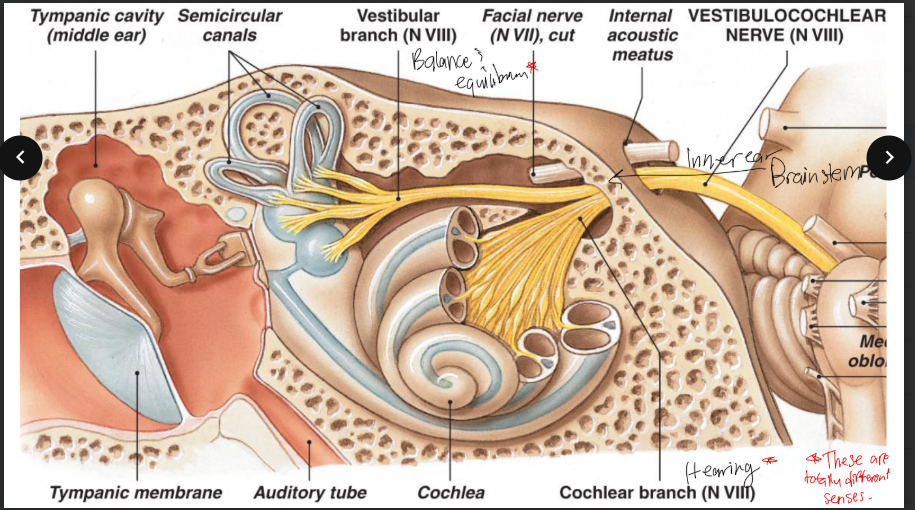
T/F: Balance & equilibrium in comparison to hearing are 2 completely different senses
T!!!
In terms of disorders, there is a very important relationship betwen equilibrium and what other special sense?
Vision
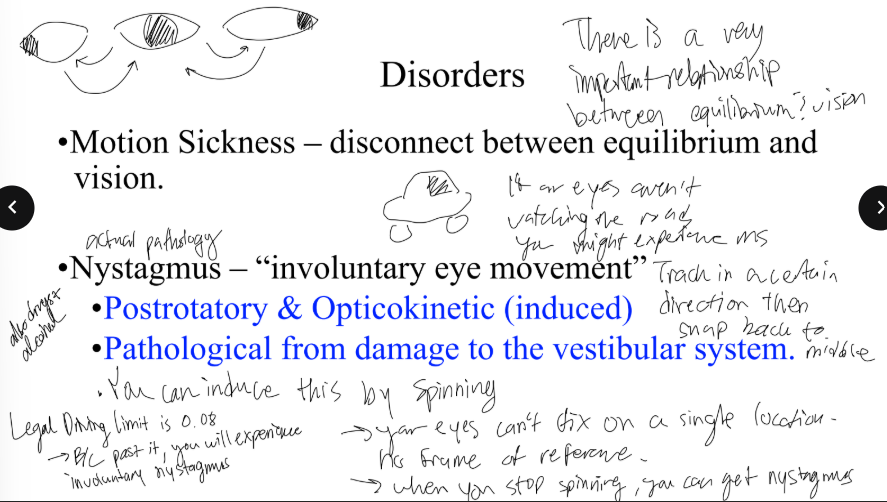
What is motion sickness?
the disconnect between equilibrium and vision

what is nystagmus?
involuntary eye movement
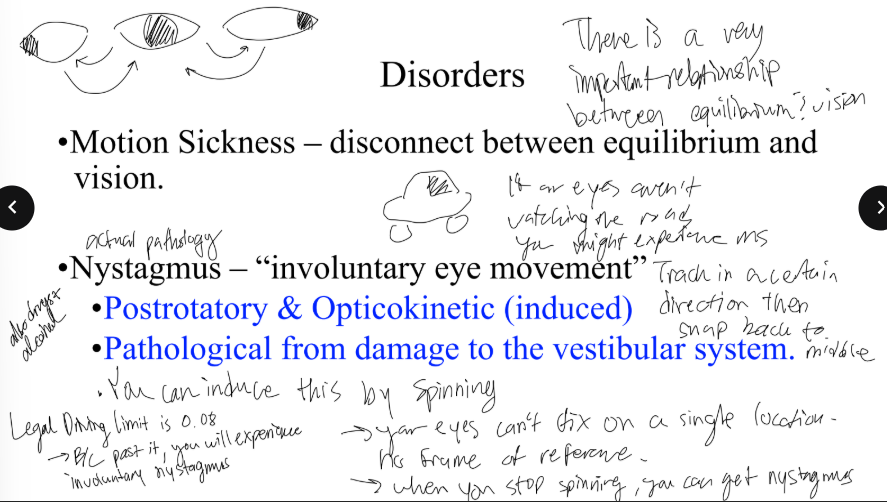
describe nystagmus
when your eyes track in a certain direction then snap back to the middle.
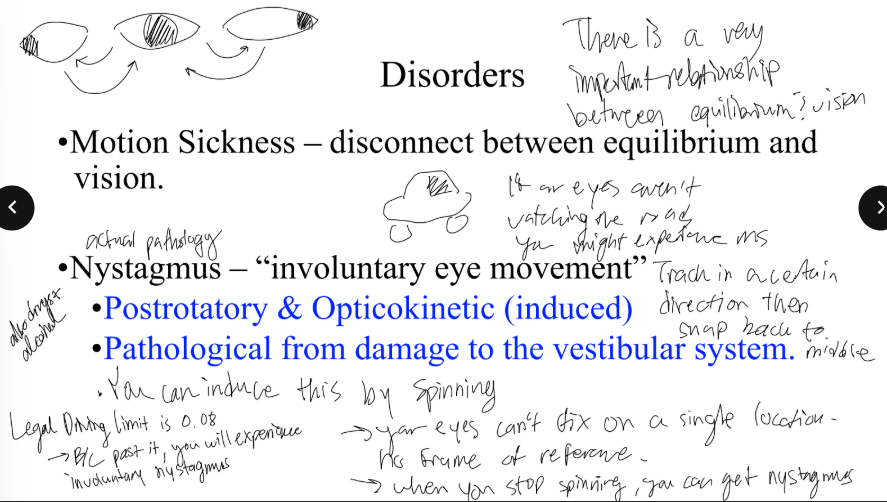
can nystagmus be induced?
yes, by spinning
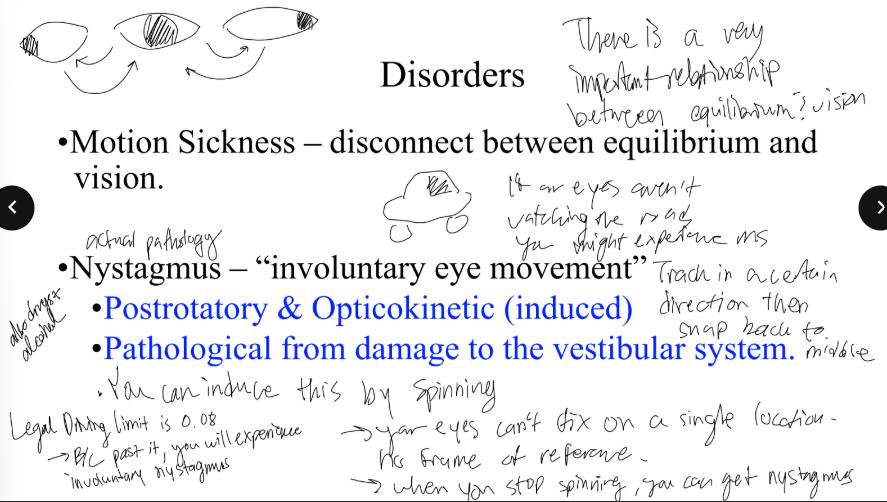
how does one get nystagmus?
u can induce it by spinning (postrotatory and opticokinetic) or it can be pathological from damage to the vestibular system
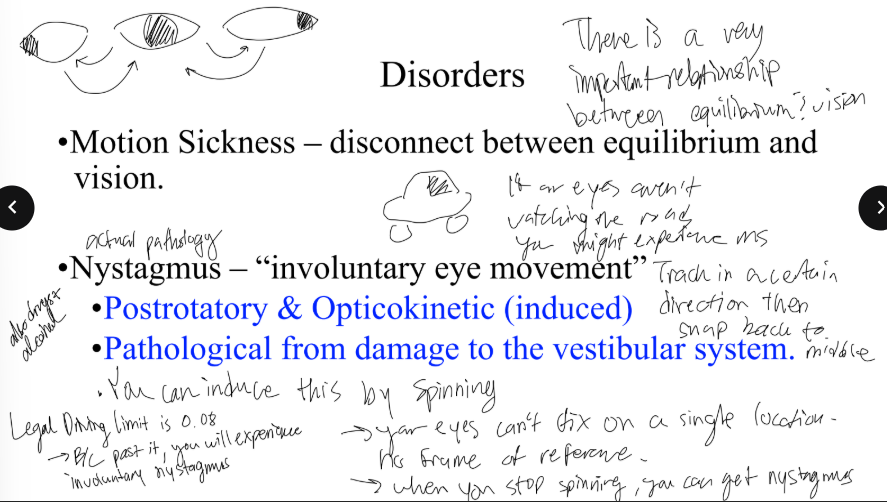
why is the legal driving limit 0.08
becuse past it, you will experience involuntary nystagmus
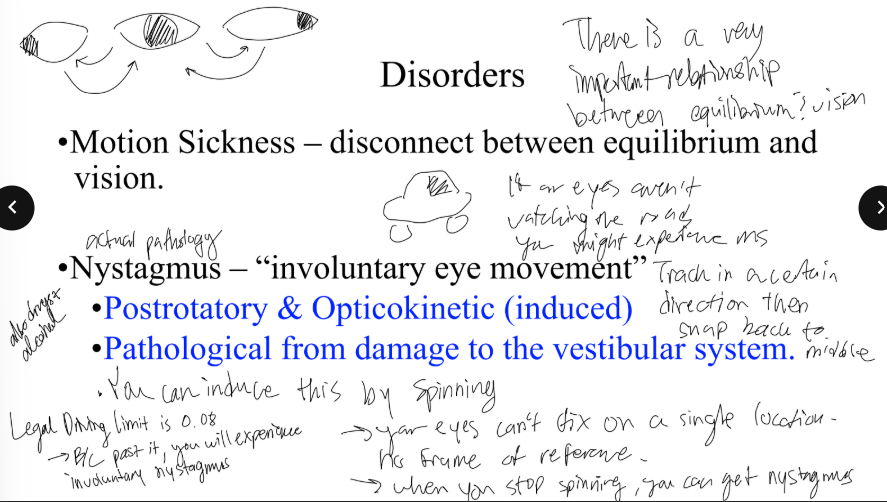
when will you expeirence involtunary nystagmus
if you go past 0.08 BAC
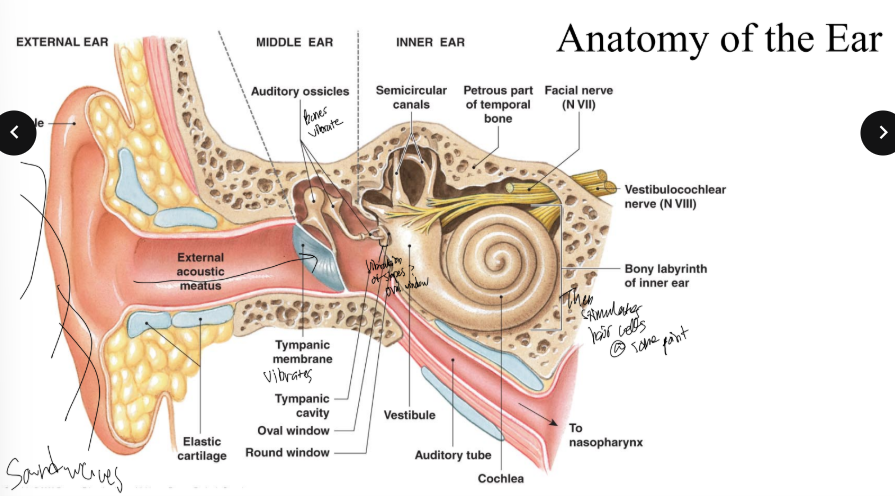
the inner ear is associaed with which sense of hearing?
vestibular sense
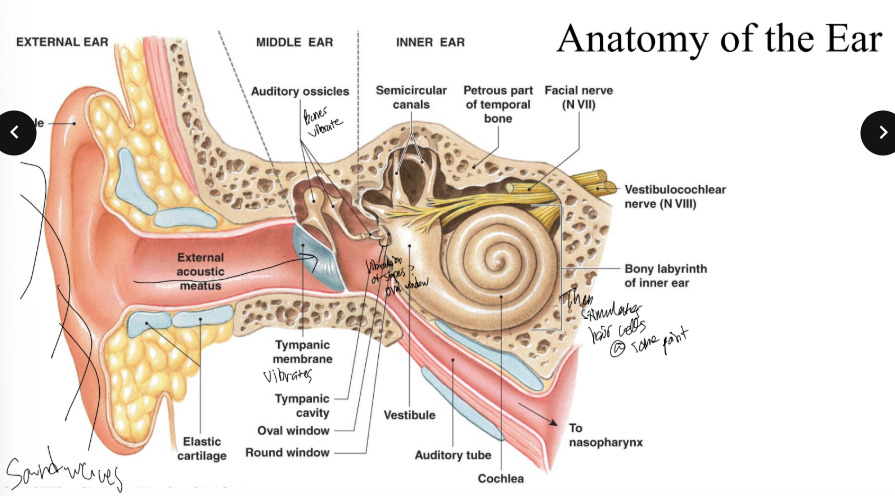
the middle and external ear are associated with which sense of hearing?
auditory sense
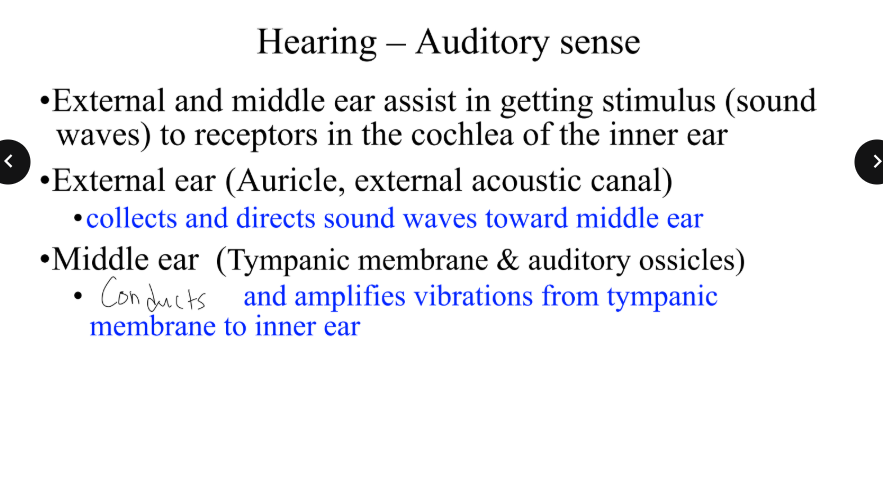
which parts of the ear assist in getting the stimulus (which are sound waves) to receptors in the cochlea of the inner ear?
external and middle ear
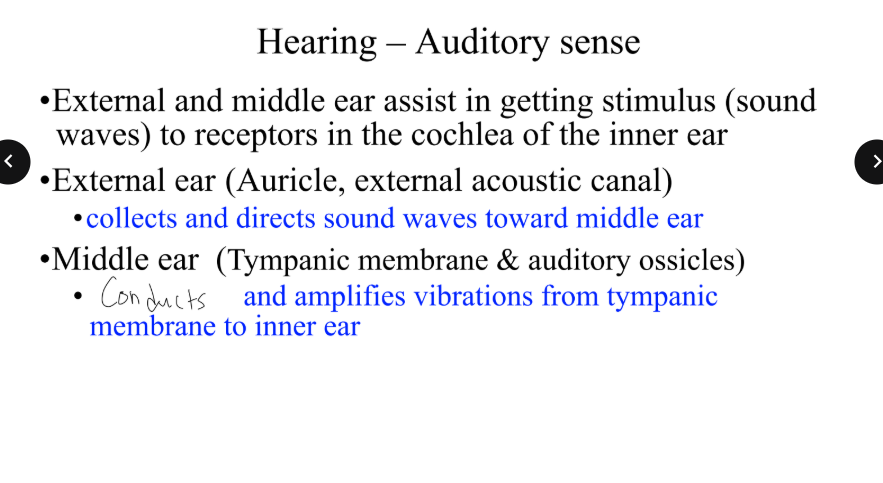
what does the external ear collect?
it collects and directs SOUND WAVES toward the middle ear
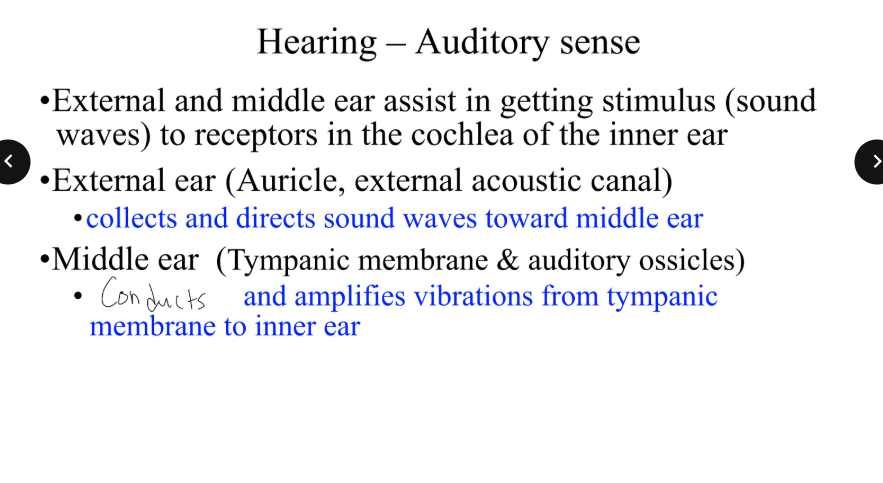
what does the middle ear, consisting of the tympanic membrane and auditory ossicles, do once the external ear collects sound waves?
the middle ear conducts & amplifies vibrations from the tympanic membrane to the inner ear
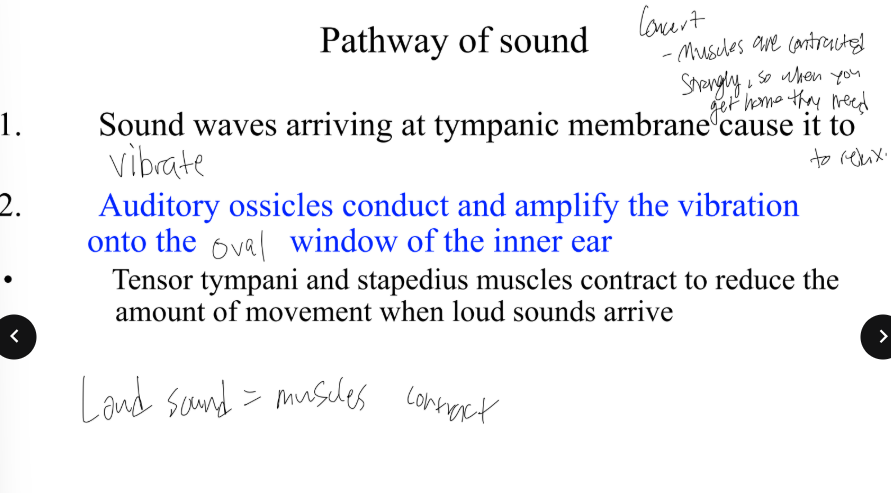
describe the pathway of sound
sound waves arriving at the tympanic membrane cause it to vibrate
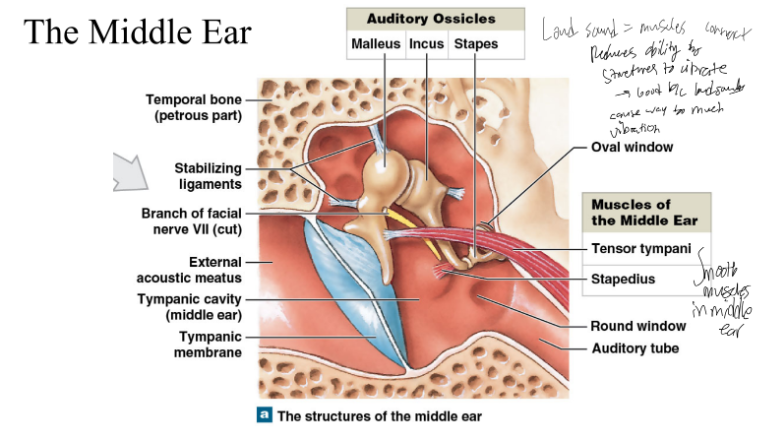
the auditory ossicles conduct and amplify the vibration onto the oval window of the inner ear
in/out movement of the oval window creates a pressure wave in the perilymph of the cochlea
pressure waves vibrate the basilar membrane area of the cochlear duct
hair cells at the organ of corti are pushed against the tectorial membrane
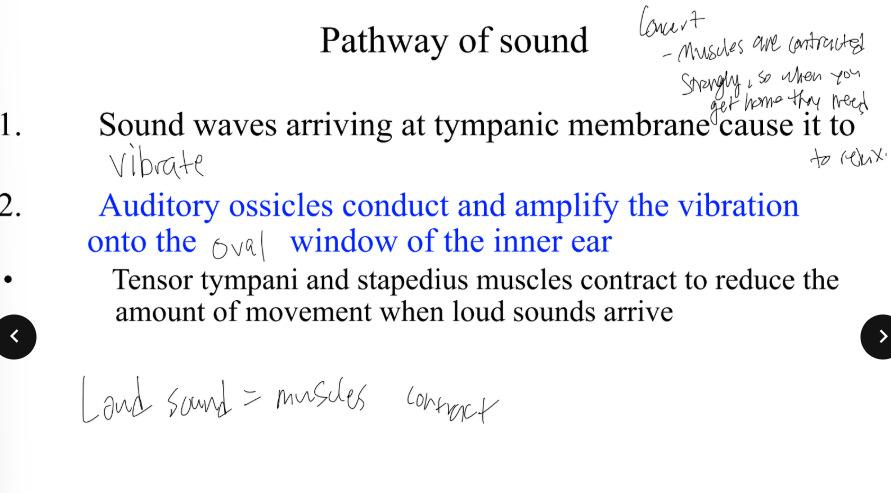
what muscles contract in the auditory ossicles to reduce the amount of movement when loud sounds arrive?
the tensor tympani and stapedius muscles

where is the one exception in the nervous system where K+ is used for depolarization rather than repolarization?
in hair cell depolarization
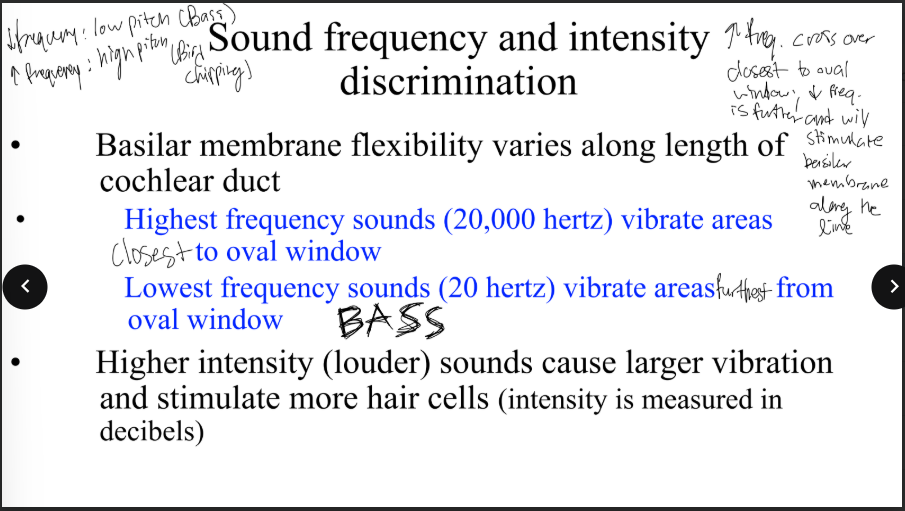
low frequency = what type of pitch and sound?
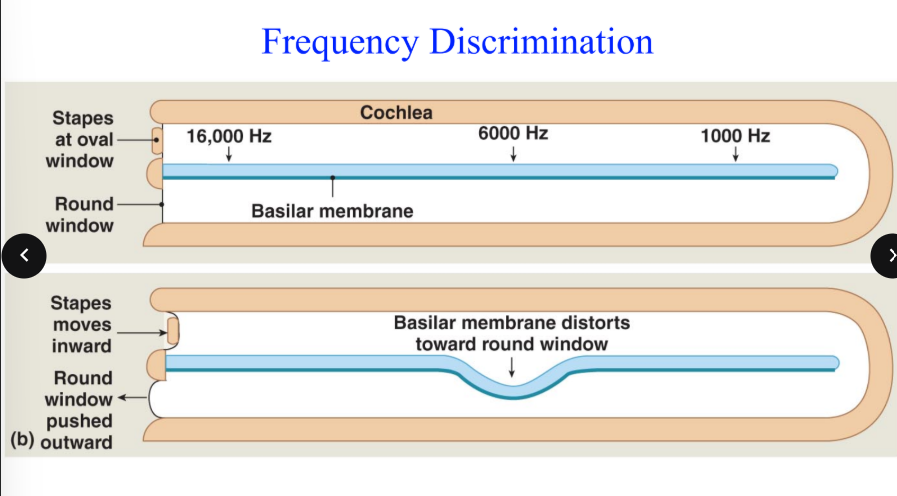
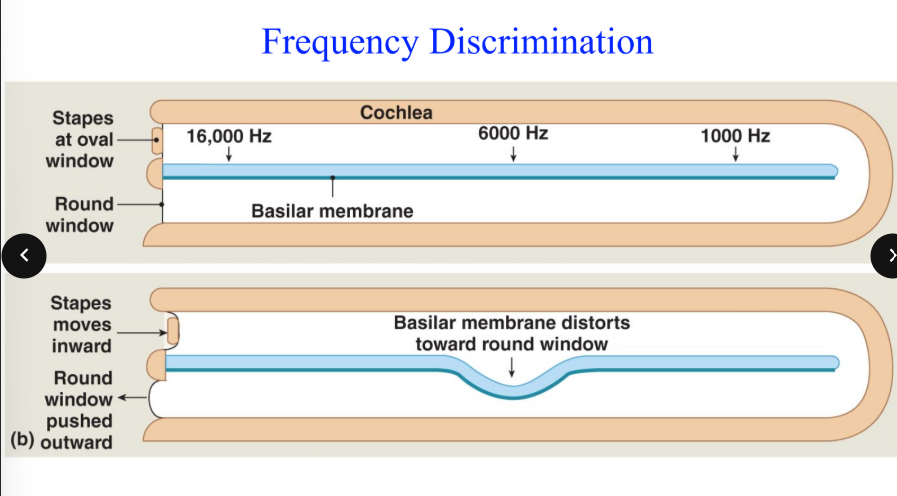
low frequency sounds (like 20 hertz) vibrate areas furthest from the oval window, resulting in bass sound
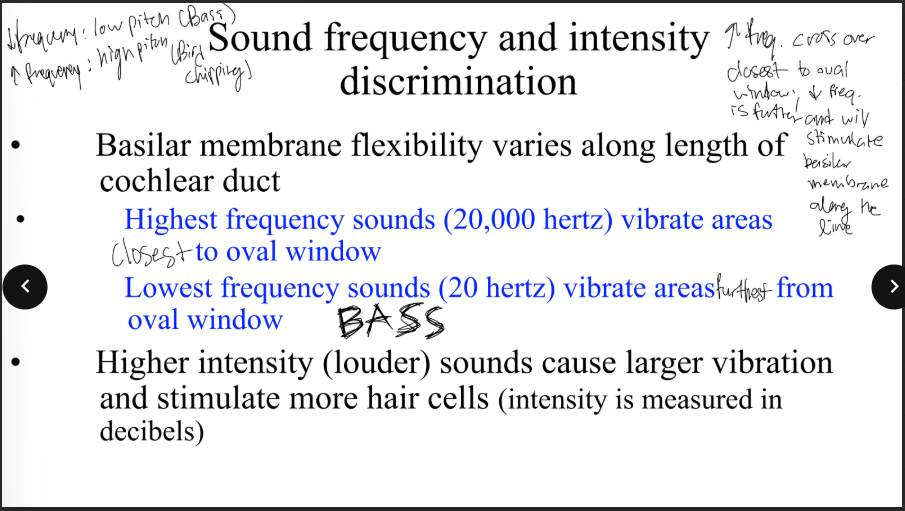
high frequency = what type of pitch and sound?
highest frequency sounds (like 20,000 hertz) vibrate areas closest to the oval window, which result in high pithced sounds (ex. bird chirping)
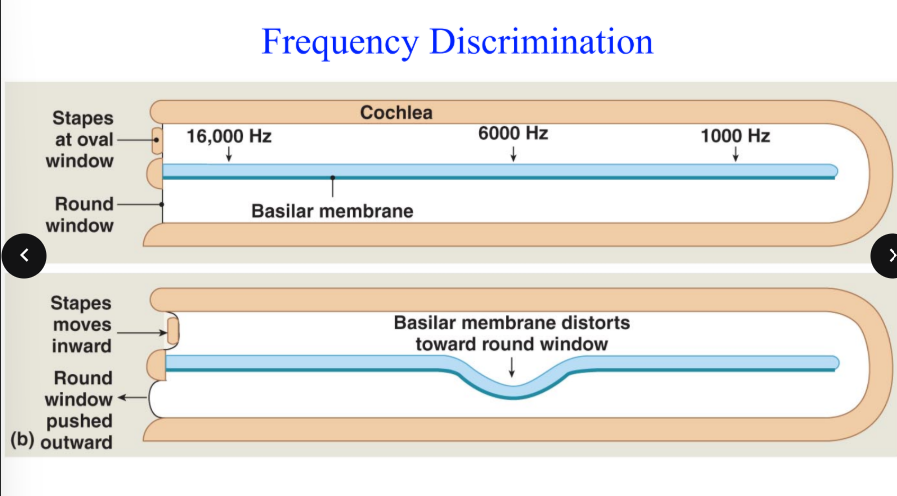
_______ intensity (louder) sounds cause larger vibration and stimulate more hair cells (intensity is measured in _____)
higher; decibels
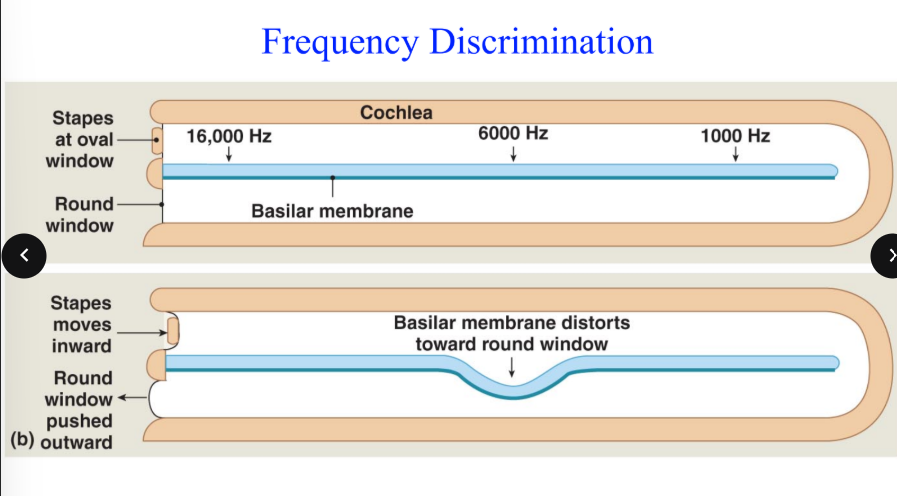
the closer the vibration is to the oval window, the (higher/lower) the hertz
higher
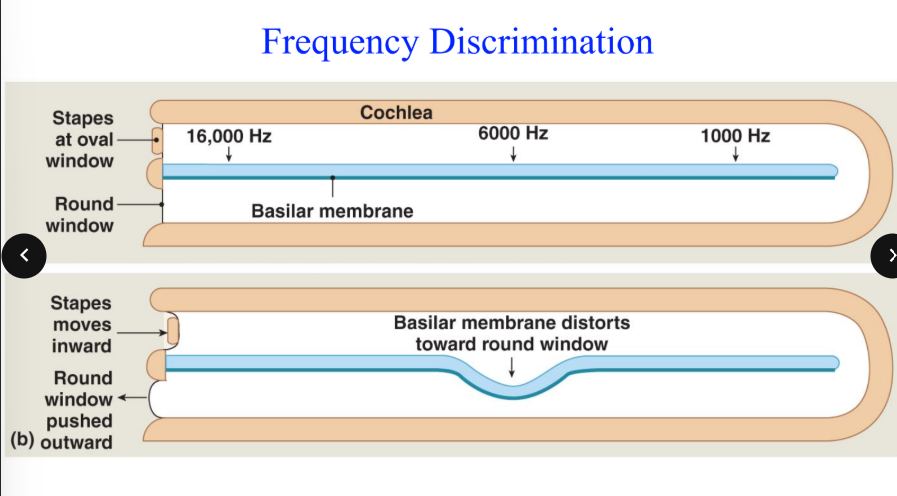
the basilar membrane distorts what window?
the roudn window
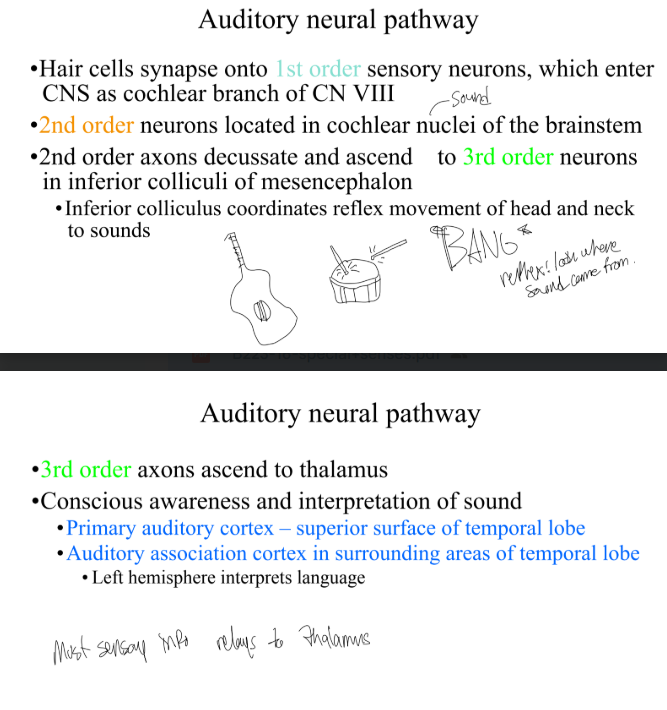
describe the auditory neural pathway. how do the second order nerves differ from the balance sense?
Hair cells synapse onto the first order sensory neurons, which enter the CNS as the cochlear branch of CN VIII
2nd order neurons located in the cochlear nuclei (sound) of the brain stem dessucate and ascend to 3rd order neurons in the inferior colliculi of the mesencephalon
3rd order axons ascend to the thalamus, which ledas to our conscious awareness and interpretation of sound (cerebral cortex)
Primary and auditory cortex = superior surface of temporal lobe
auditory association cortex in suddounding areas of temporal love
Left hemisphere interprets language


what colliculus coordinates reflex movement of the head and neck to sounds?
inferior colliculus
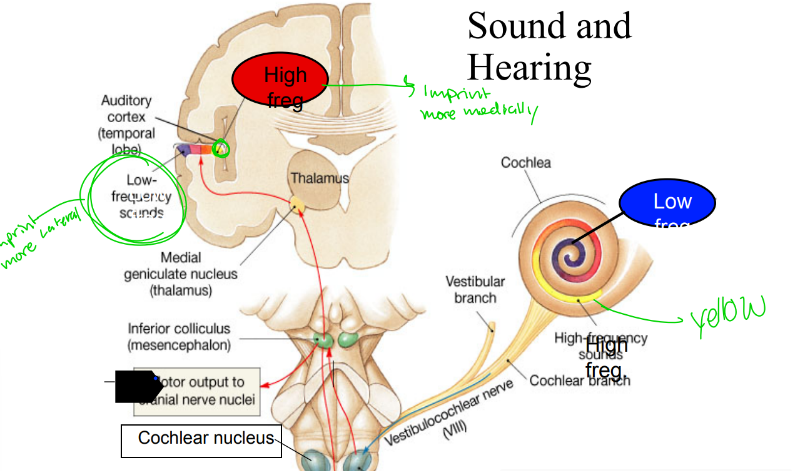
where are high frequency sounds imprinted on our brain
more medially
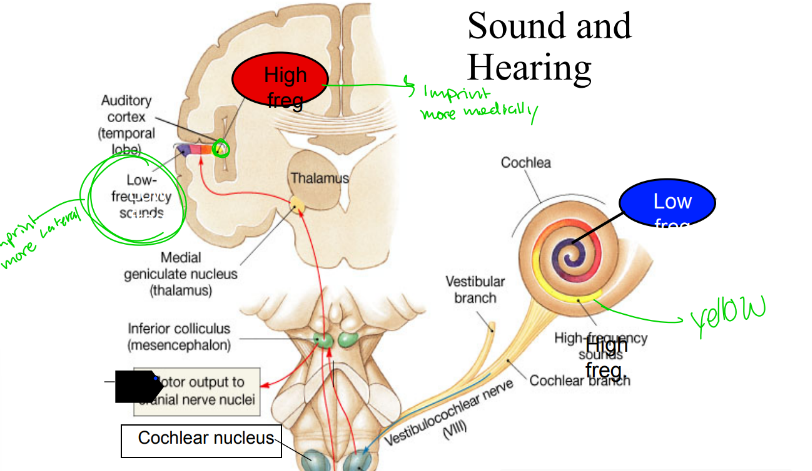
where are low frequency sounds imprinted on our brain
more laterally
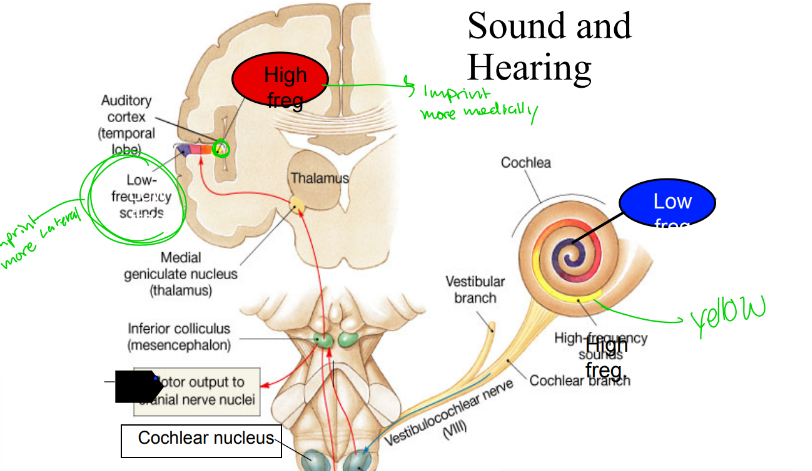
where are low frequency sounds imprinted in the cochlea?
more inside
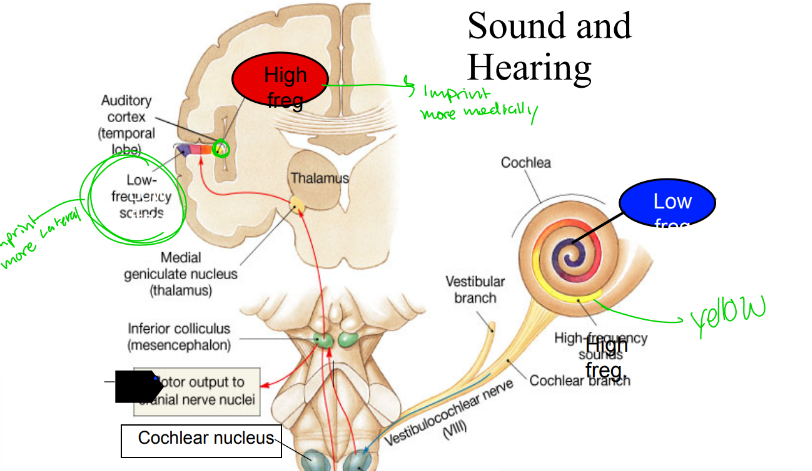
where are high frequency sounds imprinted in the cochlea?
more outside
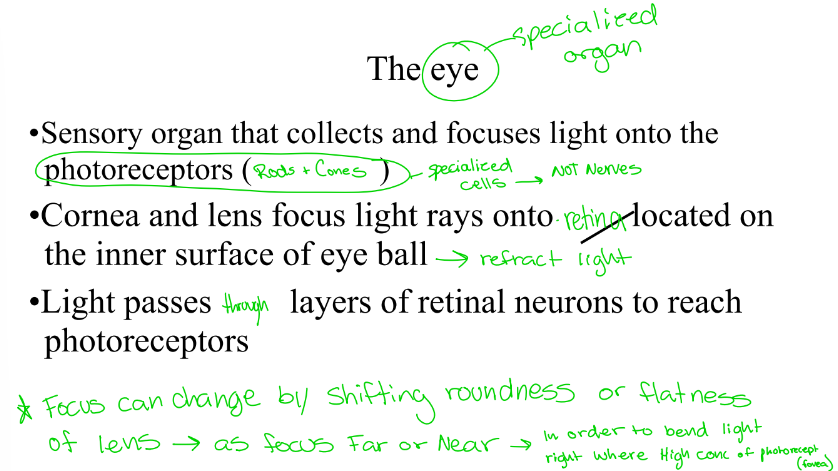
the eye is the sensory organ that collects and focuses light onto the photoreceptors. what are the photo receptors?
rods + cones
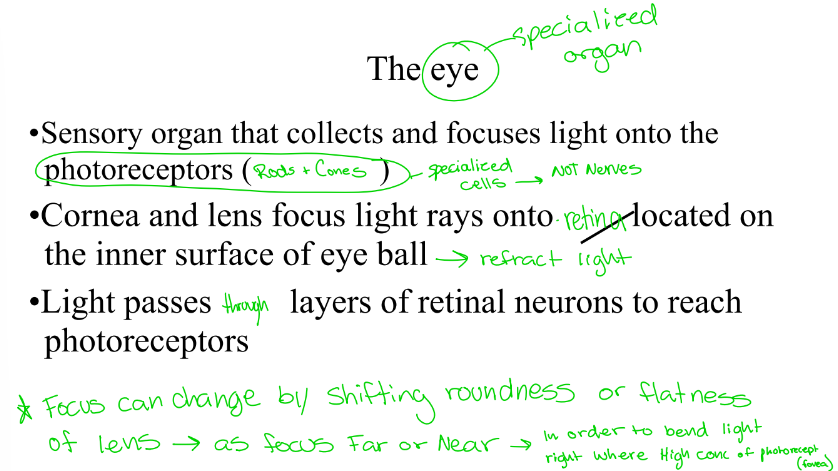
T/F: Rods + Cones are nerves
F!!! Rods + cones ar especialized cells
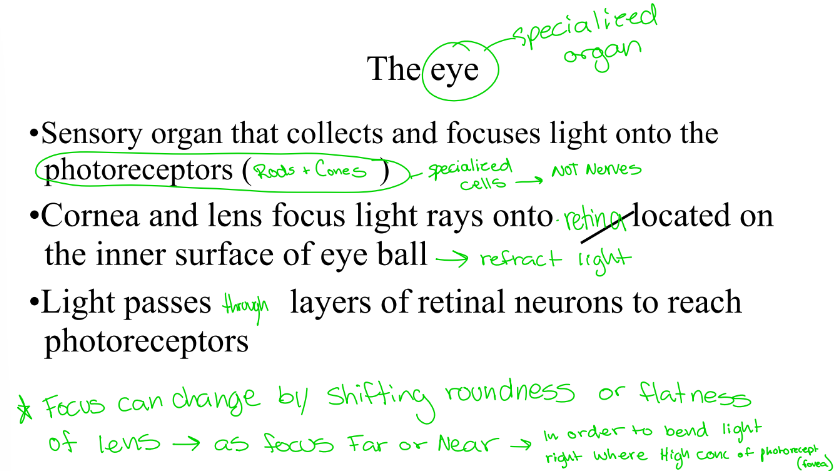
The cornea and lens focus light rays onto the ____ located on the inner surface of the eye ball to refract light
retina
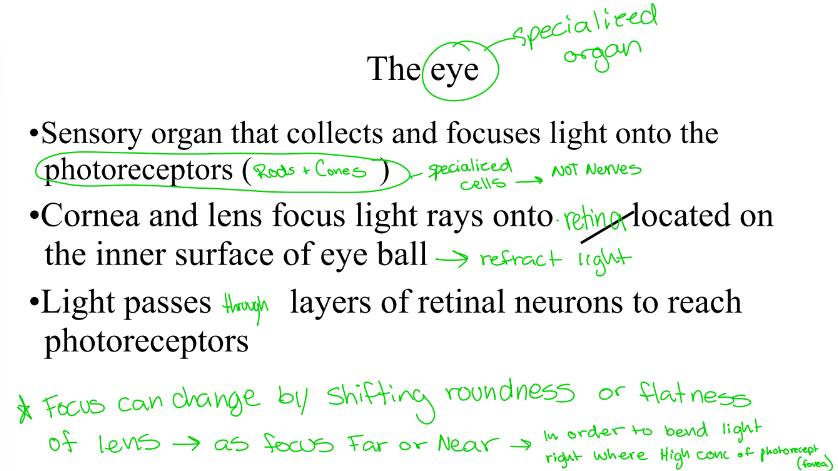
Light passes layers of retinal neurons to reach _____
photoreceptors
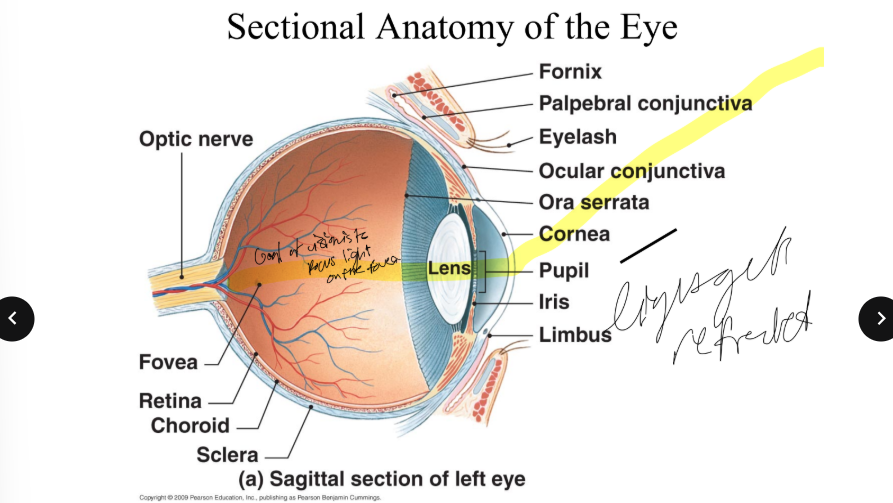
what is the goal of vision?
to focus light onto the fovea
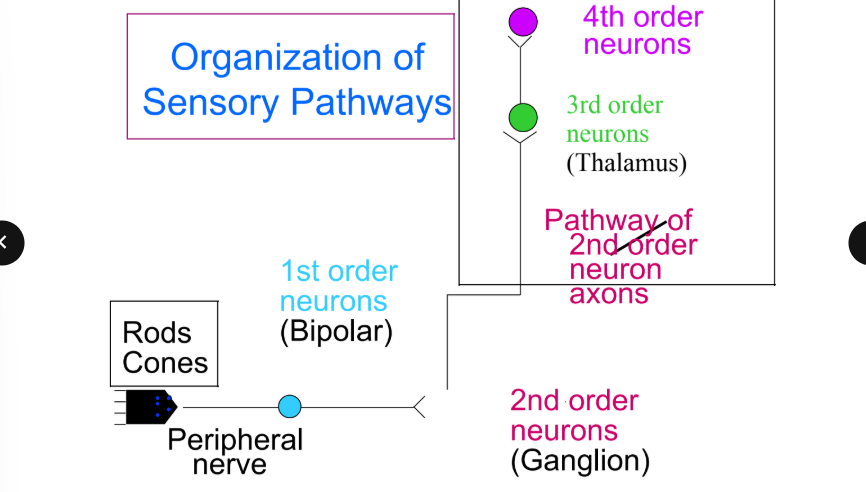
describe the structure of the retina and the organization of sensory pathways within it
outer pigmented portion absorbs excess light and transports nutrients to the neural part
the inner neural part contains
photoreceptors: rods & cones
1st order neurons: bipolar cells
2nd order neurons: ganglion cells, axons form the optic nerve and tract
embryologic origin: outgrowth from brain
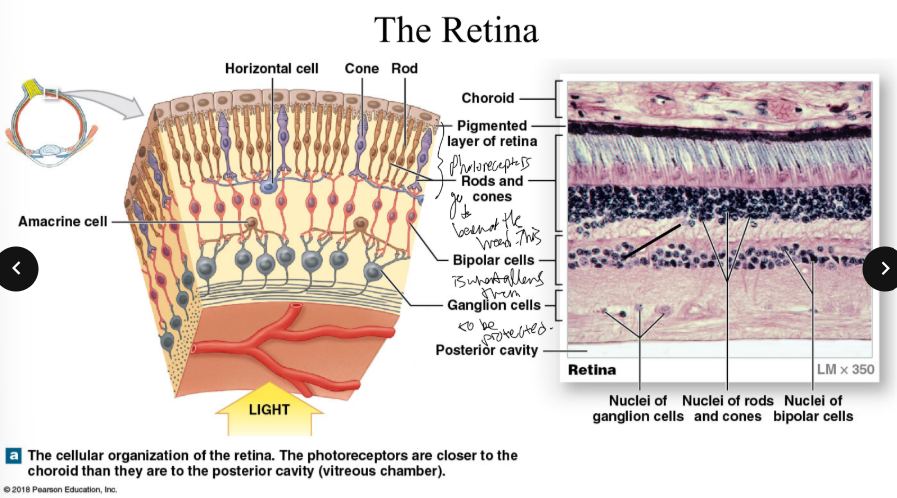
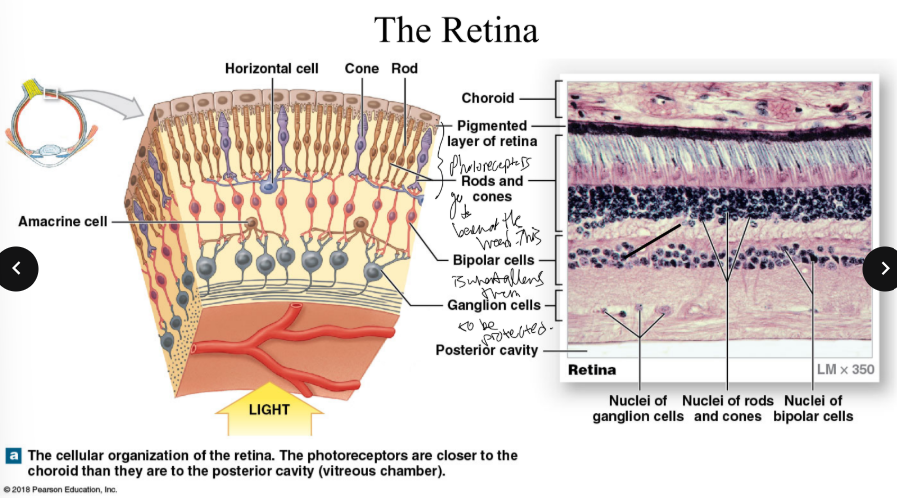
memorization trick: cones for _____
color
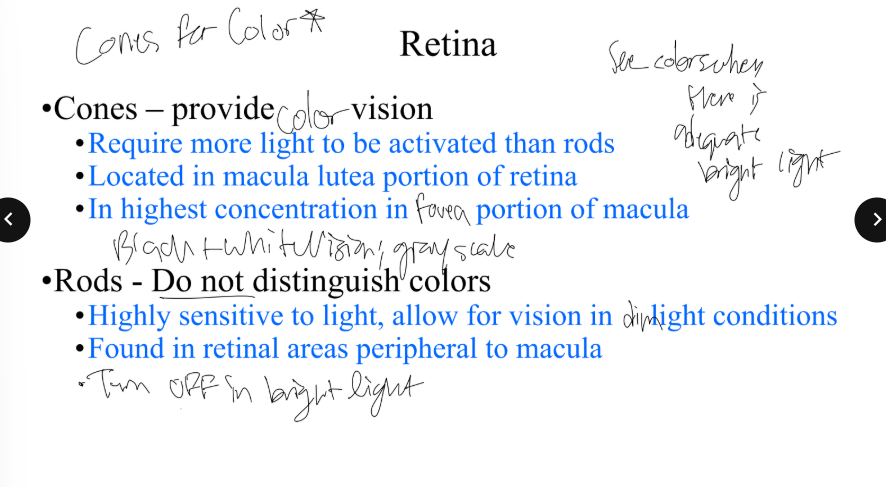
compare & contrast cones and rods. (light sensitivity, location, etc)
cones provide color vision, whereas rods cannot distinguish colors.
cones require mroe light to be activated than rods. rods are highly sensitive to light so they allow for vision in dim light conditions.
cones are located in the macula lutea portion of th re retbina, whereas rods are foudn in the retinal areas peripheral to the macula.

when do rods turn off?
in bright light (they are sensitive to light)
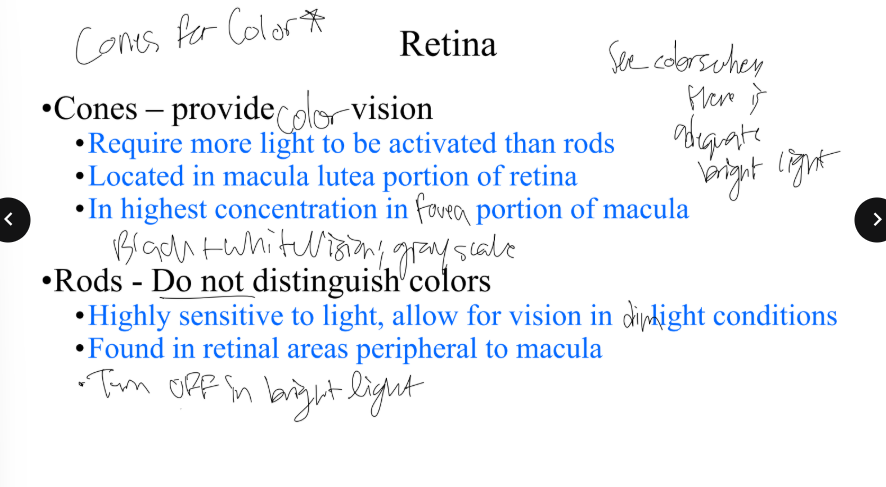
we see colors when there is adequate bright light because
cones need more light to be activated than rods
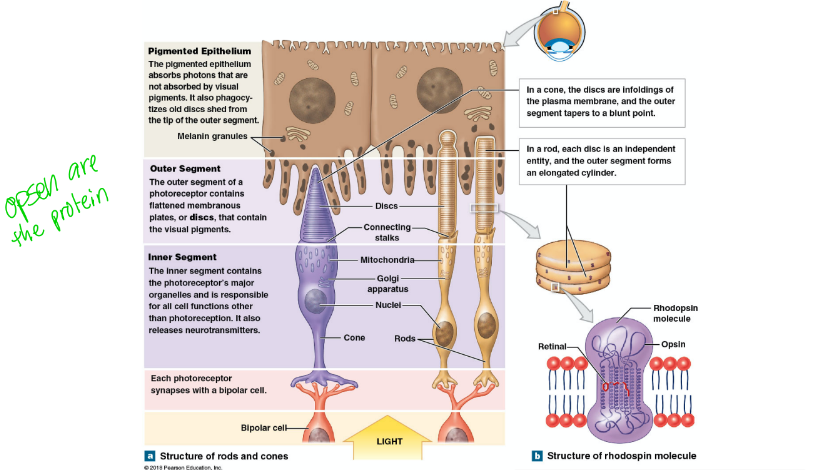
what is the role of the outer pigmented portion of our retina?
to absorb excess light and tranposrting nutrients to the neural part
 Note
Note  Flashcards (94)