Earthquakes
 Studied by 6 people
 Call with Kai
 Learn
Learn Practice Test
 Spaced Repetition
 Match
Match Flashcards
 Knowt Play
1/45

There's no tags or description
Looks like no tags are added yet.
Name | Mastery | Learn | Test | Matching | Spaced | Call with Kai |
|---|
No study sessions yet.
46 Terms
How does an earthquake form?
Plates get stuck due to friction
Stress builds up and the rock rock bends and deforms
Stress becomes too great and the rock slips releasing seismic waves.
Seismic waves allow us to feel an earthquake.
What is elastic rebound?
Tectonic blocks move past each other = elastic strain builds up due to friction.
Stress > rock strength = elastic energy released as seismic waves.
What is the difference hypocentre (focus) and epicentre?
Hypocentre - where the earthquake rupture starts.
Epicentre - point directly above hypo centre.
What is time period and its formula?
Time between adjacent peaks (cycle).
P = 1/f
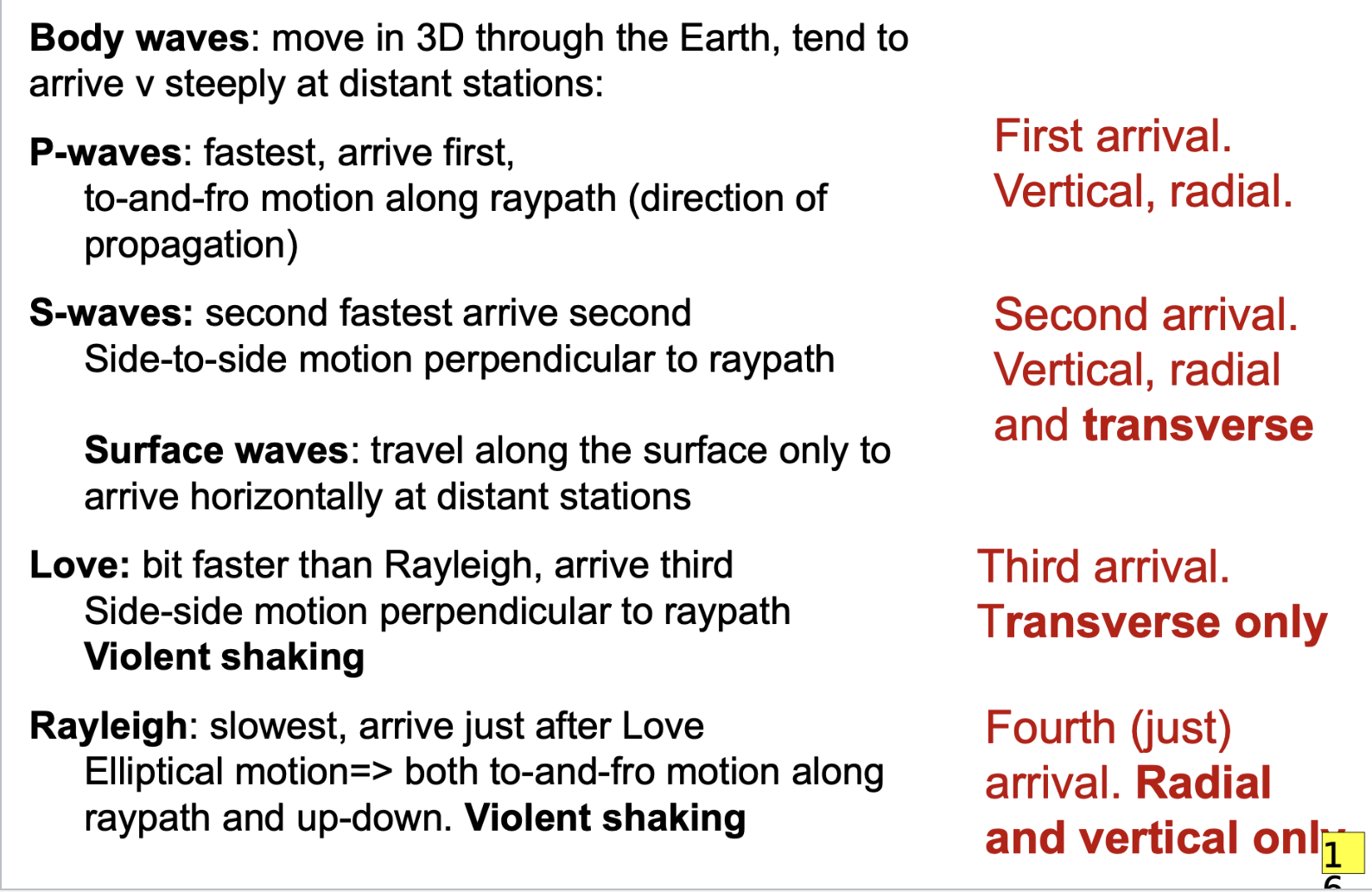
What are Body waves?
Seismic waves that pass deep into the Earth, spread in 3D.
Two types:
Primary - travel as compressions and dilations e.g. sound waves. Arrive steeply so show strongly on vertical.
Secondary - travel side to side or up and down. They do not travel in liquids so cannot pass through the molten outer core. High amplitude.
Which type of body wave is the fastest?
Primary waves, that’s why called primary as they arrive first.
What are surface waves?
They are the slowest and do not go deep.
propagate only in 2D and are the most destructive.
Two types:
Love - side to side shaking at 90 degrees.
Rayleigh - ground moves up, down and side to side.
What is the order of wave arrival?
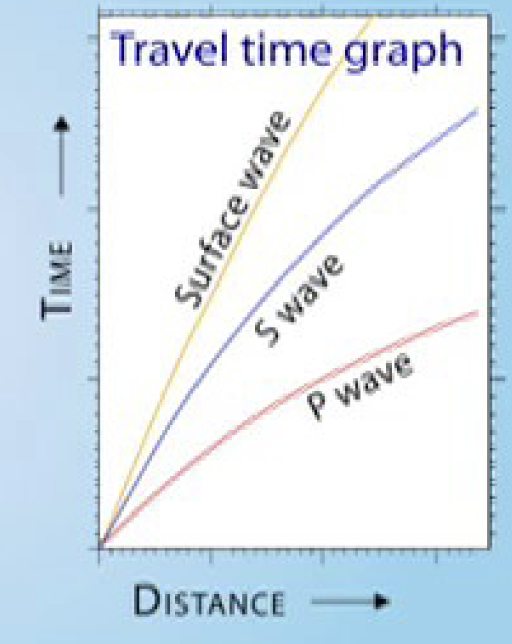
How can you determine the distance to an earthquake?
Use a travel-time graph
Find the S–P time difference between the first 2 waves on the graph
Read across to find the distance from the epicentre.
How can you find the epicentre?
The S-P time interval between 3 or more stations all intersect at epicentre.

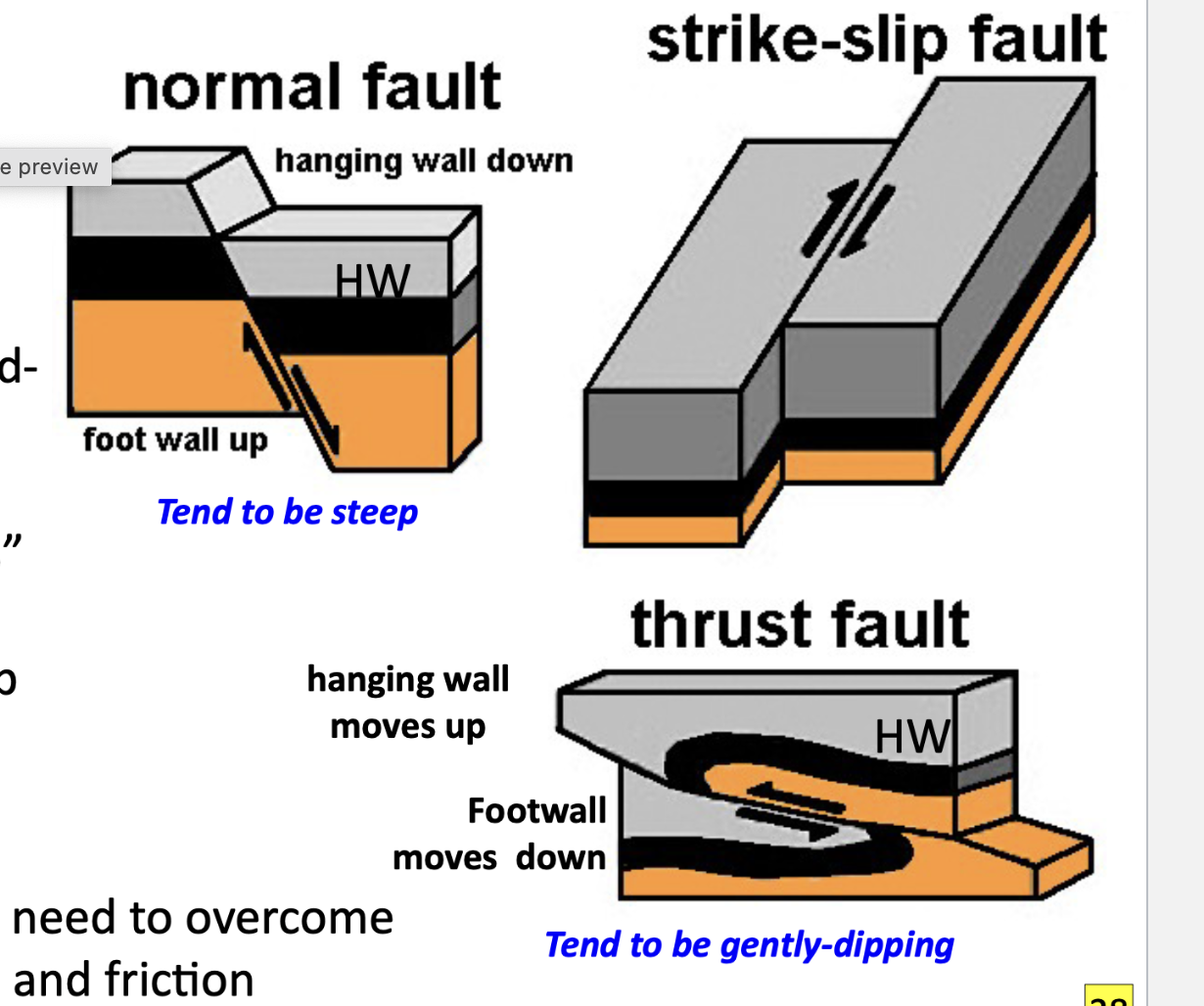
What are the 3 fault types?
Normal - hanging wall moves down relative to footwall.
Strike-slip - blocks move past each other.
Thrust (reverse) - hanging wall moves up relative to footwall.
What are the types of strike-slip faults?
Right-lateral (dextral) strike-slip fault
If you stand on one side of the fault, the block on the opposite side moves to the right
The most common type
Example: San Andreas Fault (USA).
Left-lateral (sinistral) strike-slip fault
If you stand on one side of the fault, the block on the opposite side moves to the left.
What is the focal mechanism?
Mapping out the regions of initial compression and dilation to find the nodal planes.
How an earthquake fault moved during rupture and the direction of stress that caused it.
Strike-slip
Thrust
Normal
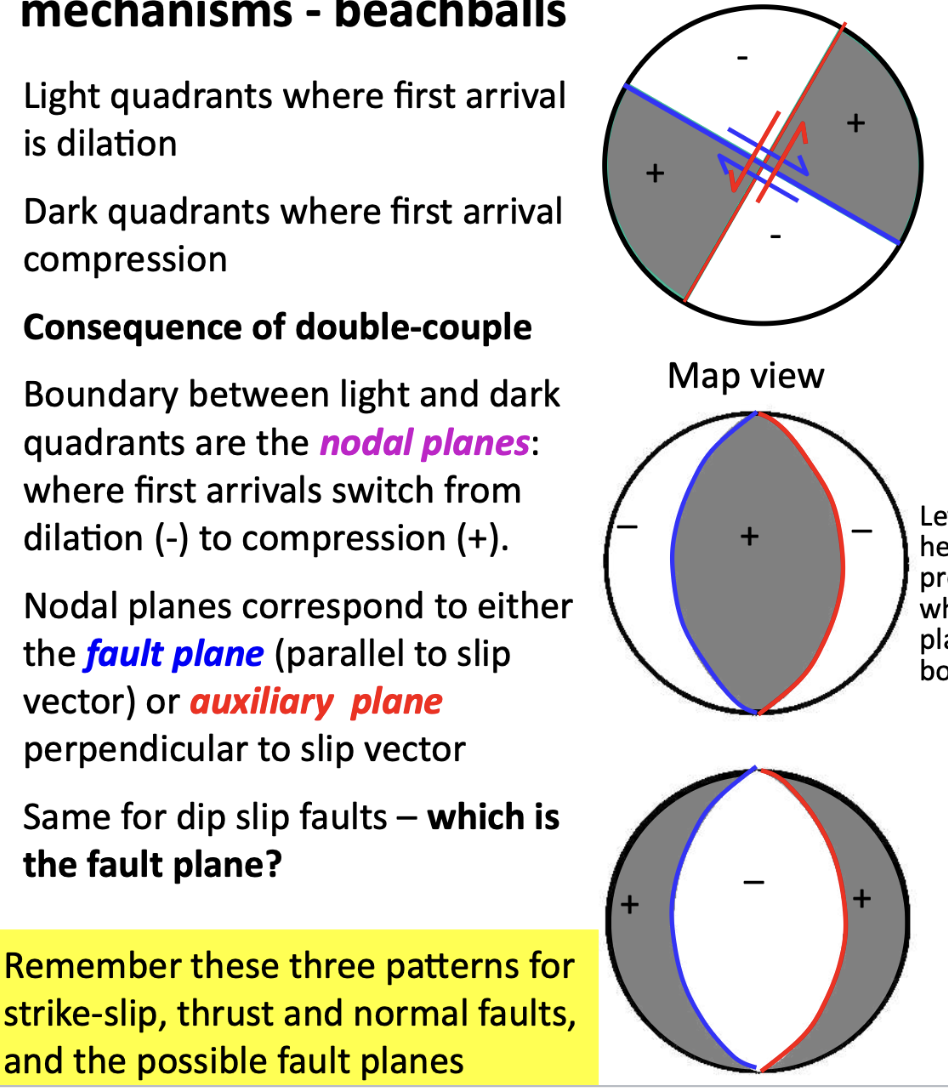
How can you work out which is the fault plane?
Look for aftershocks
Plotting isoseismals - zones of equal damage.
Looking at surface deformation.
What are the problems with the Richter scale?
Only measures the highest secondary wave amplitude.
Designed for local earthquakes in S California
Underestimates the size of large scale earthquakes.
What is Moment Magnitude?
Measures total energy release.
Energy = shear modulus x area x displacement
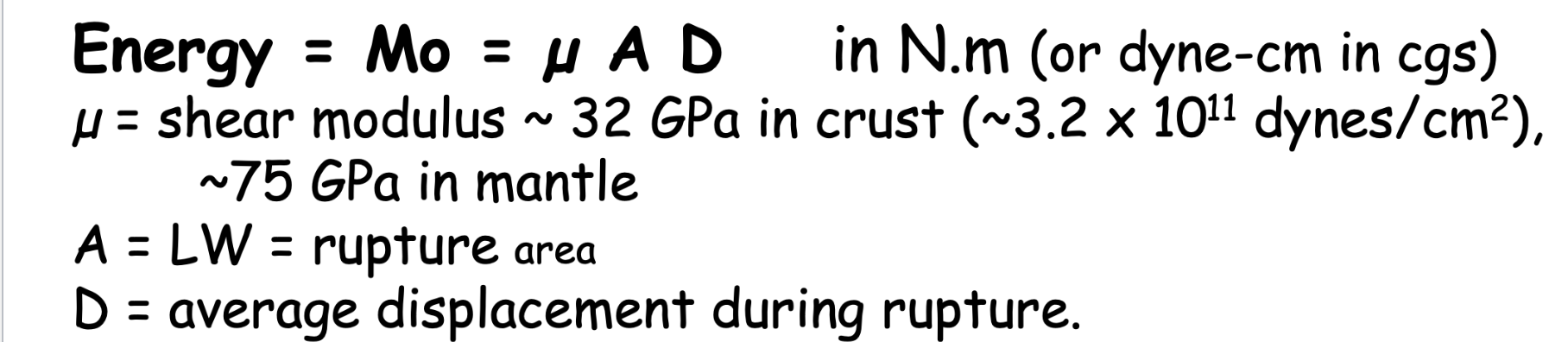
What is the shear modulus in crust and mantle?
32GPa Crust
75 GPa Mantle
x10^9
What is Moment Magnitude?
2/3(logMo - 9.05)
to the power of 2/3 in other terms.

How can you determine what is an aftershock using Bath’s law?
The difference between moment magnitude and the largest aftershock is 1.1-1.2.
What is Omori’s law?
Omori’s law describes how the frequency of aftershocks decays with time after a main earthquake.

What method would you use for short earthquakes and which for large and long duration earthquakes?
Richter scale - okay for local earthquakes.
Body, surface waves - large, long duration earthquakes.
How can you tell the difference between a bomb and an earthquake?
Bombs are compressional (P wave) and earthquake mainly shear (S wave).
What is a surface rupture and what magnitude earthquakes are responsible for this?
A surface break (also called surface rupture) is when an earthquake fault actually breaks and displaces the ground at the Earth’s surface.
Only earthquakes with a significant magnitude causes a surface break.

How do the different faults produce different earthquakes?

What is the Mercalli intensity scale?
How strongly an earthquake is felt and the damage it causes, rather than the energy released.
depends on where you are.
The magnitude is the energy from the epicentre.
What feature of an earthquake causes the most damage?
Acceleration
F = ma
rate of change is the velocity in destructive shaking.
What equation does Richter scale give?
based on observations, rather than deep understanding of physics.

What controls earthquake intensity? (4)
Effect of earthquake depth.
Effect of earthquake magnitude.
Effect of distance.
Effect of local geology.
Would deep earthquakes be more/less dangerous?
Less dangerous as they do not generate high amplitude surface waves.
Do short or long duration earthquakes release the most energy for a given amplitude?
Longer shaking = increases damage and perceived intensity.
How does intensity behave with respect to distance?
Intensity decreases with increasing distance.
Why are surface waves more dangerous than body waves?
The energy of body waves fall as 1/R².
The energy of surface waves falls off as 1/R.
How does local geology affect intensity?
Amplification of ground motion by soft sediments.
Liquefaction of soft sediments, water-based sediments and landfill = most damage.
Choice of building materials.
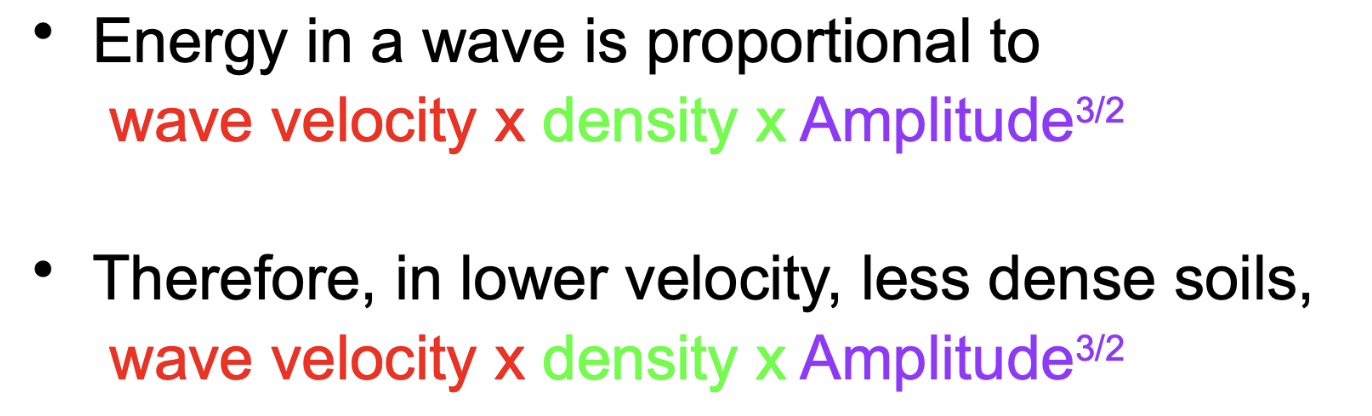
How does energy behave in lower velocity, less dense soils?
Lower amplitude.
What factors help predicting the occurrence of an earthquake?
Animal behaviour
Foreshocks
Electromagnetic variations
Changes in seismic velocity, groundwater levels, or radon emissions.
What is Haicheng known for?
The most widely cited prediction success.
Public prepared to abandon the city when told to.
What is predicting?
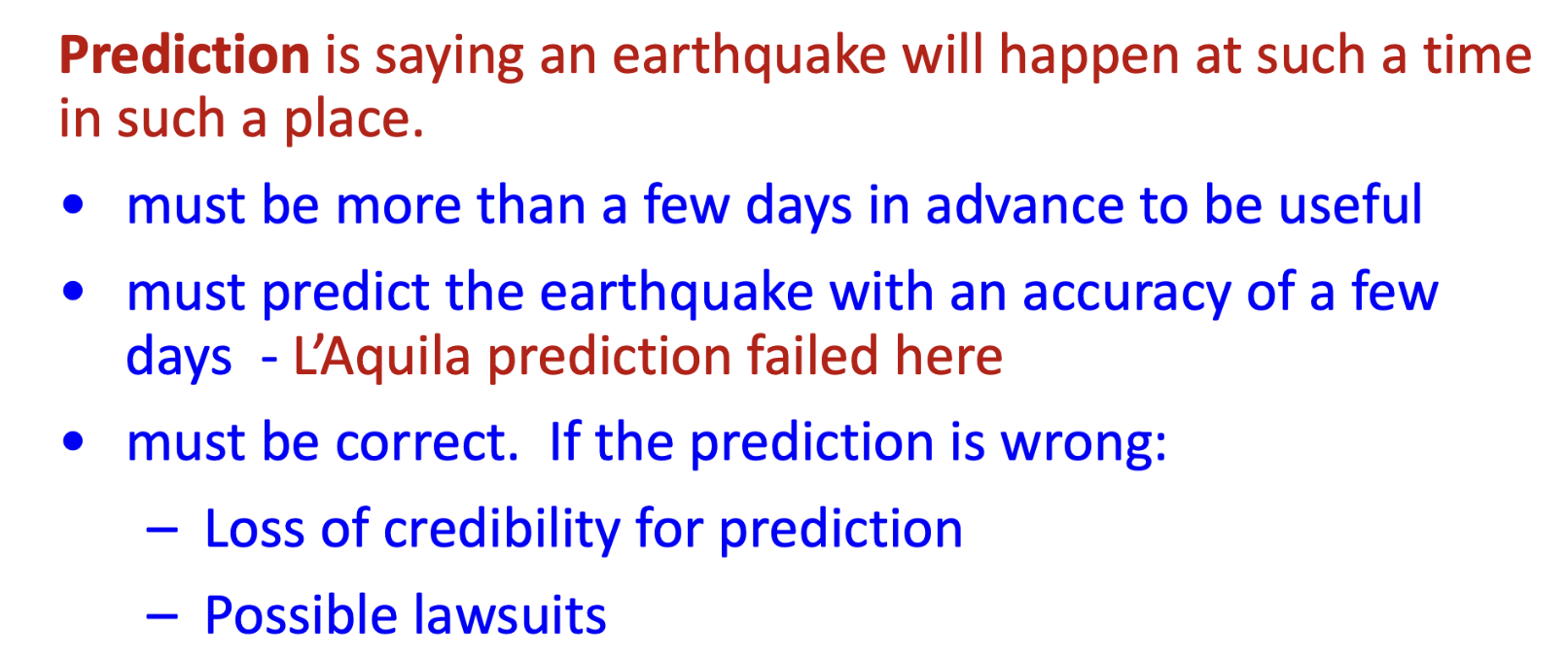
What is forecasting?
It is combined with a ground motion model to give an assessment of the earthquake hazard.
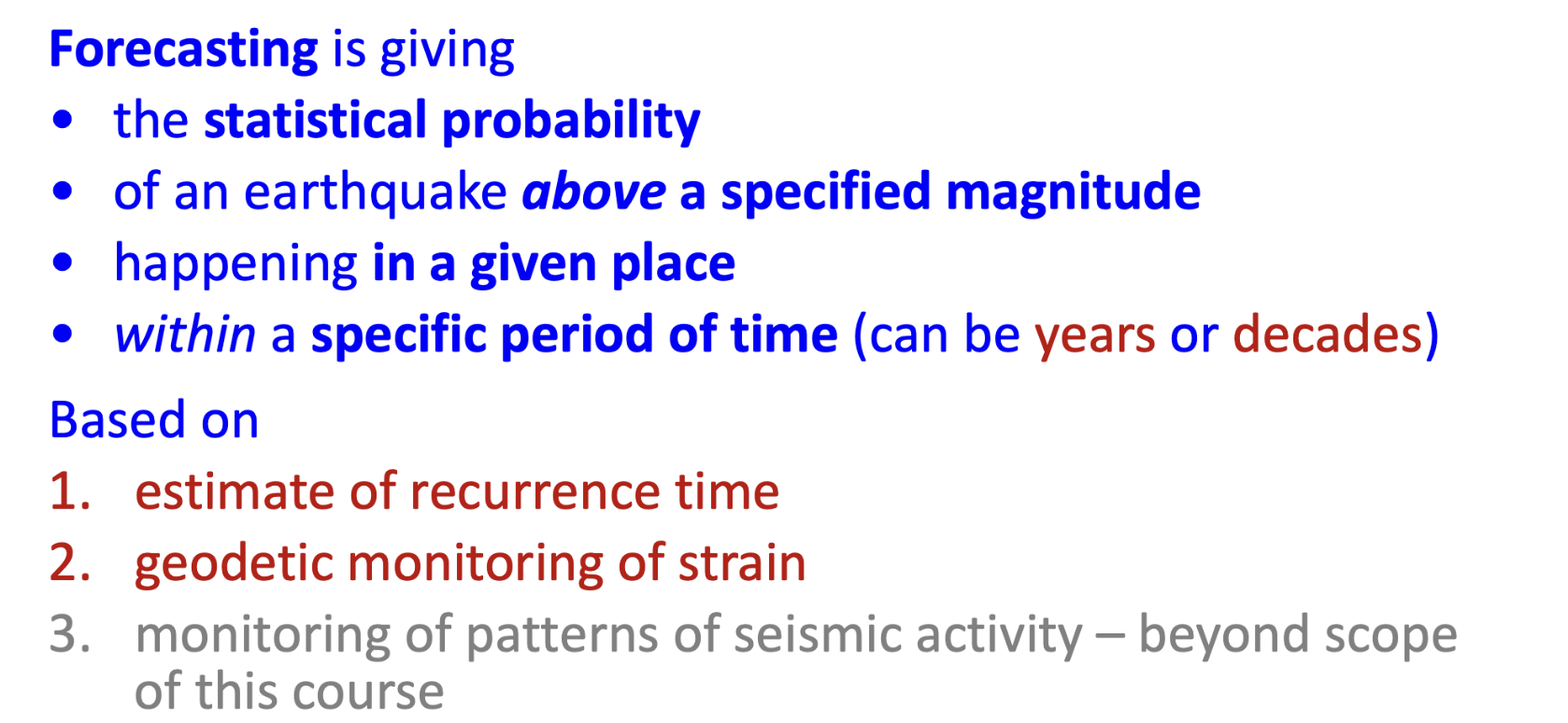
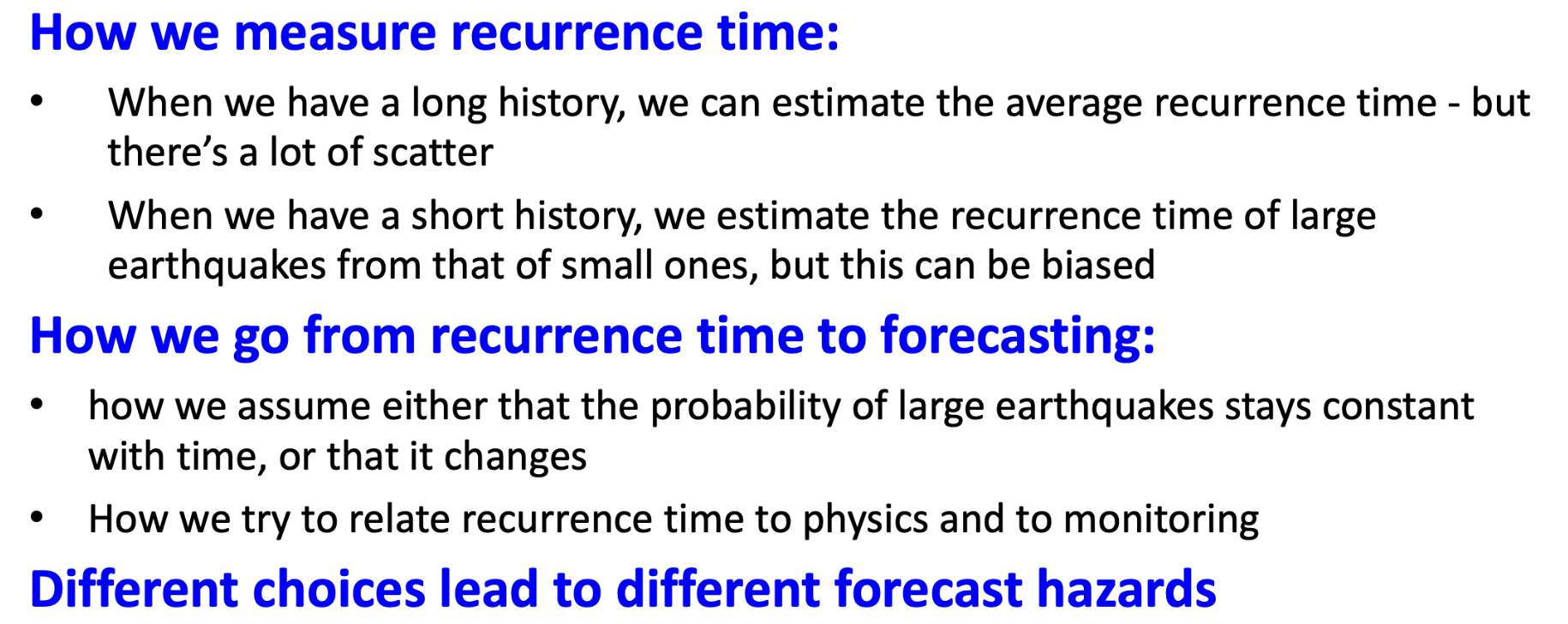
What is recurrence time?
Time between earthquakes of a specific magnitude.
Helps better forecast the next earthquake.
Results vary with area sampled.
What is a time-dependent recurrence model?
The probability of an earthquake is low just after the last event and increases as time passes toward the average recurrence interval.
Time since last event = 2/3 x T
What is the best method for measuring interseismic strain?
GPS
Provides where and how big?
What is a seismic gap?
Seismic gaps are where the fault is typically locked, awaiting the next big rupture.
Not always good to have no seismic activity.
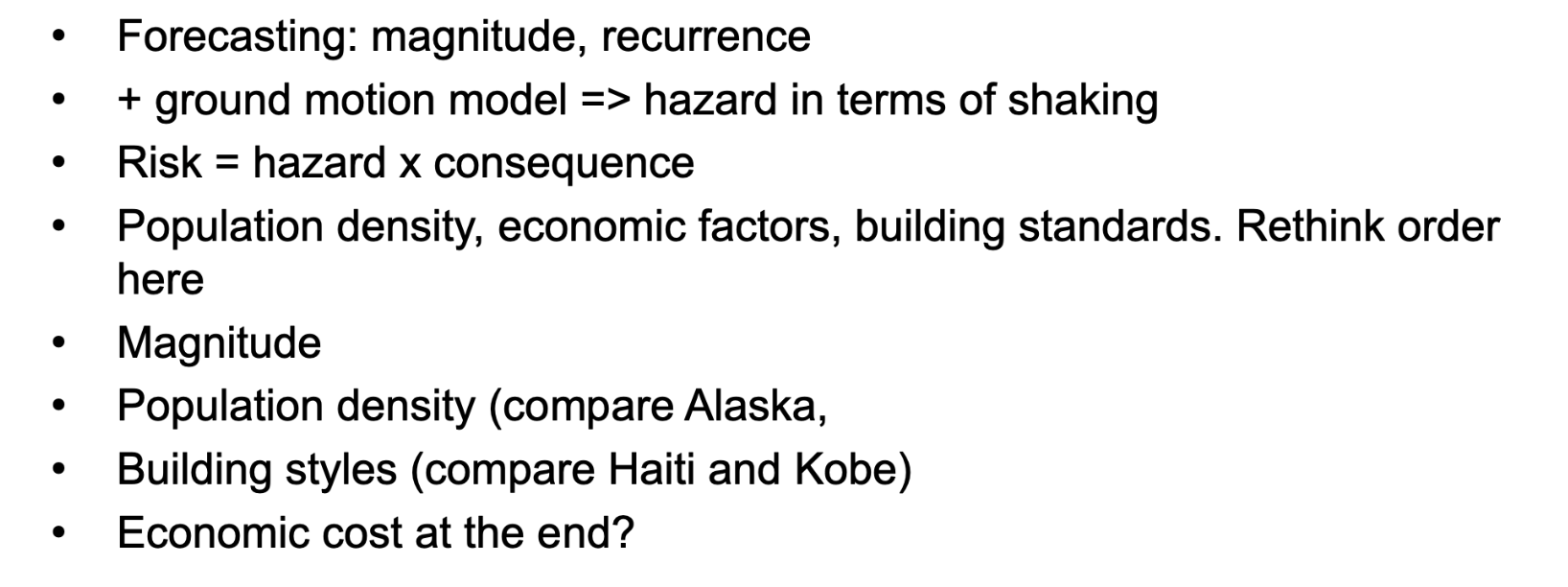
What is the formula for seismic hazard?

What are the essentials to seismic risk?
Areas with high hazard and population density are the most vulnerable… but the building is the killer.
steel is the best for houses.
How are buildings designed?
We do not design buildings to be totally earthquake proof but knowing they will be damaged. Designed to not kill people.
What happens at a locked subduction zone before, during, and after a great earthquake, and why tsunamis are generated?
Subduction zone megathrusts are huge fault surfaces where one tectonic plate is forced beneath another, and they are responsible for the largest earthquakes on Earth.
Plates lock (interseismic)
Stress builds up
Fault suddenly slips (coseismic)
Seafloor moves upward (tsunami).
 Note
Note  Flashcards (39)