13- Case 13: Aches and pains and loss of interest
 Studied by 0 people
 Call Kai
 Learn
Learn Practice Test
 Spaced Repetition
 Match
Match Flashcards
 Knowt Play
1/19

Earn XP
Description and Tags
Page: 35-36
Name | Mastery | Learn | Test | Matching | Spaced | Call with Kai |
|---|
No analytics yet
Send a link to your students to track their progress
20 Terms
Correct answer: C. Major depressive disorder with somatic (melancholic) features
Explanation:
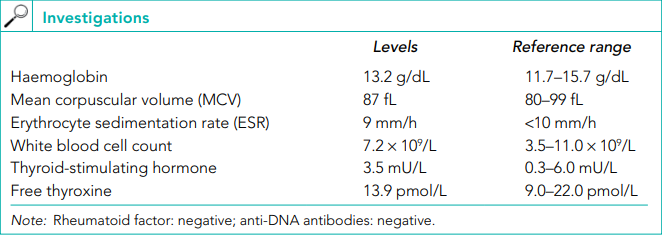
The patient has core depressive symptoms (anhedonia, reduced energy), somatic symptoms (early morning awakening, weight loss), cognitive features (guilt, poor concentration), and symptoms lasting >2 weeks. Normal hemoglobin, ESR, and thyroid function exclude anemia, inflammatory disease, and hypothyroidism. This presentation is most consistent with major depressive disorder with somatic/melancholic features.
Likely diagnosis
A 52-year-old woman presents with 3 months of generalized body aches, non-radiating low back pain, fatigue, early morning waking, weight loss, anhedonia, guilt, and psychomotor retardation. Physical examination is normal. Investigations show:
Hemoglobin: 13.2 g/dL (reference range 11.7–15.7 g/dL)
ESR: 9 mm/h (reference range <10 mm/h)
TSH: 3.5 mU/L (reference range 0.3–6.0 mU/L)
Free T4: 13.9 pmol/L (reference range 9.0–22.0 pmol/L)
What is the most likely diagnosis?
A. Fibromyalgia
B. Somatic symptom disorder
C. Major depressive disorder with somatic (melancholic) features
D. Hypothyroidism
E. Polymyalgia rheumatica
Correct answer: D. Anhedonia
Explanation:
Core symptoms of depression are:
Low mood
Reduced energy
Anhedonia
Early morning awakening, appetite change, weight loss, and reduced libido are somatic symptoms, not core symptoms.
Core symptoms of depression
Which of the following symptoms is considered a core symptom of depression?
A. Early morning awakening
B. Weight loss
C. Reduced libido
D. Anhedonia
E. Poor appetite
Correct answer: B. Two core symptoms plus three additional symptoms for at least 2 weeks
Explanation:
A diagnosis of depression requires:
At least two core symptoms
Plus three or more additional symptoms
Present for at least 2 weeks
This patient clearly meets these criteria.
Diagnostic threshold for depression
Which of the following best describes the minimum diagnostic threshold for depression?
A. One core symptom plus two additional symptoms for 1 week
B. Two core symptoms plus three additional symptoms for at least 2 weeks
C. Three core symptoms for any duration
D. Four somatic symptoms for at least 1 month
E. Persistent fatigue with normal investigations
Correct answer: B. Early morning awakening, diurnal mood variation, psychomotor retardation
Explanation:
Somatic/melancholic features include:
Early morning awakening
Mood worse in the morning (diurnal variation)
Psychomotor retardation or agitation
Loss of appetite or weight
These features indicate a biologically driven depressive subtype.
Somatic (melancholic) features
Which of the following symptom clusters best supports somatic syndrome (ICD-10) / melancholic features (DSM-5)?
A. Panic attacks and insomnia
B. Early morning awakening, diurnal mood variation, psychomotor retardation
C. Chronic pain with normal mood
D. Fatigue without mood change
E. Mood worse in the evening
Correct answer: C. To exclude physical causes of depressive symptoms
Explanation:
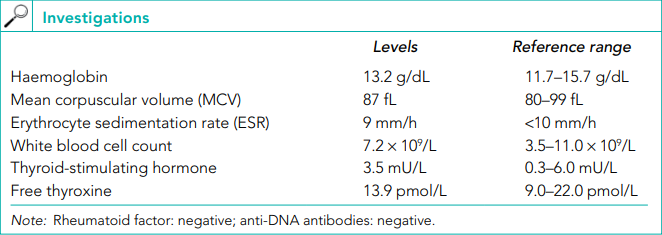
There is no diagnostic blood test for depression. Investigations are used to exclude medical conditions that can mimic depression, such as:
Anemia (Hb 13.2 g/dL; normal 11.7–15.7 g/dL)
Hypothyroidism (TSH 3.5 mU/L; normal 0.3–6.0 mU/L)
Inflammatory disease (ESR 9 mm/h; normal <10 mm/h)
What this (Anemia (Hb 13.2 g/dL; normal 11.7–15.7 g/dL)) means clinically is:
Anemia was considered
Hemoglobin was checked
The result was normal
Therefore, anemia was ruled out
It does NOT mean: “The patient has anemia.”
A clearer phrasing would be: “Anemia was considered and excluded (Hb 13.2 g/dL, within normal range).”
Purpose of investigations
Why are investigations most appropriately performed in this patient?
A. To confirm depression biochemically
B. To diagnose fibromyalgia
C. To exclude physical causes of depressive symptoms
D. To monitor antidepressant response
E. To confirm inflammatory arthritis
Correct answer: C. Somatic presentation without obvious psychological symptoms
Explanation:
Depression is significantly less likely to be diagnosed when patients present predominantly with somatic symptoms (e.g., pain, fatigue) rather than overt low mood. This patient initially presents with physical complaints, masking the underlying depression.
Missed diagnosis in primary care
Which factor most commonly leads to underdiagnosis of depression in primary care?
A. Lack of clinician training
B. Female gender
C. Somatic presentation without obvious psychological symptoms
D. Normal blood tests
E. Older age
Correct answer: C. Three or more somatic symptoms should prompt screening for depression
Explanation:
A practical clinical rule of thumb (not a formal diagnostic criterion) is to screen for depression when three or more somatic symptoms are present, regardless of investigation results.
Screening rule (clarification)
Which statement regarding screening for depression in somatic presentations is most accurate?
A. Screening is unnecessary if ESR and thyroid tests are normal
B. Screening should only occur if the patient reports low mood
C. Three or more somatic symptoms should prompt screening for depression
D. Screening replaces formal diagnostic criteria
E. Screening is only valid in psychiatric clinics
Correct answer: C. Melancholic features
Explanation:
ICD-10 uses the term somatic syndrome, while DSM-5 uses melancholic features. They describe the same clinical phenotype.
Terminology clarification
The ICD-10 term “somatic syndrome” most closely corresponds to which DSM-5 specifier?
A. Atypical features
B. Psychotic features
C. Melancholic features
D. Seasonal pattern
E. Catatonia
Correct answer: C. ESR 9 mm/h (normal <10 mm/h)
Explanation:
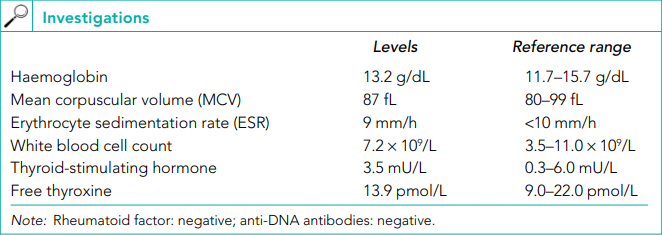
Polymyalgia rheumatica is typically associated with a markedly elevated ESR. An ESR of 9 mm/h, within the normal range (<10 mm/h), makes this diagnosis very unlikely.
Excluding polymyalgia rheumatica
Which investigation result most strongly argues against polymyalgia rheumatica?
A. Hemoglobin 13.2 g/dL (normal 11.7–15.7 g/dL)
B. White cell count 7.2 × 10⁹/L (normal 3.5–11.0 × 10⁹/L)
C. ESR 9 mm/h (normal <10 mm/h)
D. TSH 3.5 mU/L (normal 0.3–6.0 mU/L)
E. Negative rheumatoid factor
Correct answer: C. Using open-ended questions and linking physical symptoms to stress
Explanation:
Good communication skills—such as open-ended questions, adequate consultation time, and gently linking physical symptoms to psychological stress—significantly improve detection of depression, especially in somatic presentations.
Improving diagnostic accuracy
Which clinician behavior is most likely to improve diagnosis of depression in this patient?
A. Ordering repeated inflammatory markers
B. Prescribing stronger analgesics
C. Using open-ended questions and linking physical symptoms to stress
D. Immediate referral to rheumatology
E. Avoiding discussion of mood
Correct answer: C. Melancholic (somatic) depression
Explanation:
Diurnal variation with morning worsening is a classic biological feature of melancholic (somatic) depression and is uncommon in anxiety or functional somatic disorders.
Diurnal variation significance
A patient with suspected depression reports that her pain and mood are worst in the morning and improve as the day progresses. This pattern most strongly suggests:
A. Anxiety disorder
B. Fibromyalgia
C. Melancholic (somatic) depression
D. Somatic symptom disorder
E. Chronic fatigue syndrome
Correct answer: D. Improves as the day progresses
Explanation:
Pain that improves as the day progresses parallels diurnal mood variation and supports a depressive etiology rather than mechanical or inflammatory back pain.
Pain characteristics in depression
Which characteristic of this patient’s back pain most strongly supports a non-organic (depressive) cause?
A. Located in the lower back
B. Non-radiating
C. Improves when lying down
D. Improves as the day progresses
E. Poor response to NSAIDs
Correct answer: C. Reduced emotional reactivity
Explanation:
Viewing weight loss positively despite illness reflects blunted emotional reactivity, a feature associated with melancholic depression rather than intentional weight control or eating pathology.
Appetite and patient insight
The patient describes weight loss as a “silver lining to the cloud.” This response most strongly reflects:
A. Body image distortion
B. Eating disorder
C. Reduced emotional reactivity
D. Secondary gain
E. Normal coping
Correct answer: B. Long latency before answering questions
Explanation:
Psychomotor retardation is characterized by slowed thinking, speech, and movement, seen here as delayed responses and slow speech.
Psychomotor retardation
Which clinical feature best demonstrates psychomotor retardation?
A. Reduced eye contact
B. Long latency before answering questions
C. Poor sleep
D. Reduced libido
E. Weight loss
Correct answer: D. More common in certain cultural and ethnic groups
Explanation:
Somatic presentations are more common in some cultural and ethnic groups, but they are not exclusive to them and are common across many medical specialties.
Cultural presentation (clarification)
Somatic presentations of depression are:
A. Rare in Western populations
B. Limited to ethnic minorities
C. Equally common across primary and secondary care
D. More common in certain cultural and ethnic groups
E. Diagnostic of somatic symptom disorder
Correct answer: C. Medically unexplained symptoms
Explanation:
A significant proportion of patients in secondary care present with medically unexplained symptoms, many of which are later linked to mood or anxiety disorders.
Medically unexplained symptoms (MUS)
Up to 40% of patients presenting to specialties such as neurology or rheumatology have:
A. Undiagnosed autoimmune disease
B. Factitious disorder
C. Medically unexplained symptoms
D. Somatic delusions
E. Malingering
Correct answer: D. Has no impact on diagnostic validity
Explanation:
Not all somatic symptoms must be present. Reduced libido is not required for a diagnosis of depression or somatic/melancholic subtype.
Libido and diagnosis (clarification)
The absence of reduced libido in this patient:
A. Excludes depression
B. Suggests anxiety instead
C. Weakens the diagnosis significantly
D. Has no impact on diagnostic validity
E. Suggests atypical depression
Correct answer: C. Cognitive symptom of depression
Explanation:
Feelings of guilt and self-blame are cognitive symptoms of depression. They are not delusional unless grossly unrealistic or fixed despite evidence.
Guilt in depression
The patient’s guilt about not wanting to see her grandchildren is best classified as:
A. Delusional guilt
B. Obsessional guilt
C. Cognitive symptom of depression
D. Normal emotional reaction
E. Anxiety-related guilt
Correct answer: C. Somatic presentation masking psychological symptoms
Explanation:
Somatic presentations often require more time to explore psychological contributors, normalize discussion of mood, and avoid premature diagnostic closure.
Role of time in assessment
Which factor most justifies offering this patient a longer GP appointment?
A. Her age
B. Number of investigations required
C. Somatic presentation masking psychological symptoms
D. Need for referral
E. Risk of inflammatory disease
Correct answer: C. Somatic symptoms can precede mood symptoms
Explanation:
In many patients, somatic symptoms precede emotional complaints, making early screening essential even when physical tests are normal.
Key screening principle (advanced)
Which principle best supports screening for depression regardless of investigation results?
A. Depression is a diagnosis of exclusion
B. Normal tests rule out mood disorders
C. Somatic symptoms can precede mood symptoms
D. Depression always presents with low mood
E. Screening increases stigma
 Note
Note  Flashcards (31)