P2.2 - Forces (Ai generated with instructions by me)
 Call Kai
 Learn
Learn Practice Test
 Spaced Repetition
 Match
Match Flashcards
 Knowt Play
1/19

There's no tags or description
Looks like no tags are added yet.
Name | Mastery | Learn | Test | Matching | Spaced | Call with Kai |
|---|
No analytics yet
Send a link to your students to track their progress
20 Terms
What is a force?
A push or pull that acts on an object due to interaction with another object. Forces can change speed, direction and shape. Measured in newtons (N)
What are contact forces?
Forces between objects that are physically touching. Examples: friction, air resistance, tension, normal/reaction force, upthrust
What is friction?
A contact force that opposes motion between two surfaces in contact
What is air resistance?
A contact force that opposes the motion of an object moving through air
What is tension?
A contact force that pulls objects connected by a rope or string — acts along the length of the rope
What is the normal/reaction force?
A contact force that acts perpendicular to a surface, pushing back against an object resting on it
What are non-contact forces?
Forces that act between objects without physical contact, due to a field. Examples: gravitational force, electrostatic force, magnetic force
What is Newton's Third Law?
When object A exerts a force on object B, object B exerts an equal and opposite force on object A — forces always act in pairs on DIFFERENT objects
Give an example of a Newton's Third Law pair
A person standing on the ground: their weight pulls the ground down → the ground exerts an equal reaction force upward on the person
What is a resultant force?
The single force that has the same effect as all forces combined acting on an object. Found by adding forces in the same direction and subtracting opposing forces
How do you find the resultant of forces in the same direction?
Add them together. If forces are in opposite directions, subtract the smaller from the larger — direction is that of the larger force
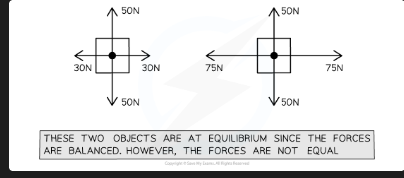
What does a resultant force of zero mean?
All forces are balanced — object is in equilibrium (stationary or moving at constant velocity)
What happens when resultant force is NOT zero?
Object accelerates in the direction of the resultant force
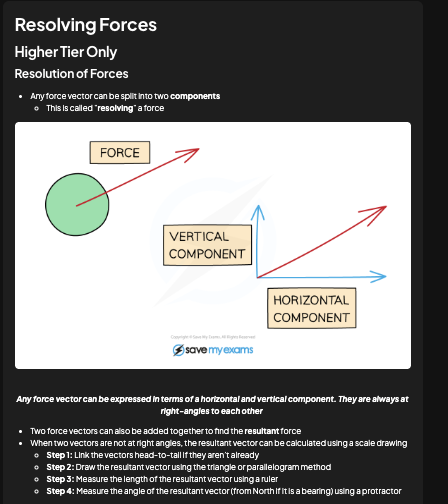
[HIGHER] What is resolving a force?
Splitting a single force into two perpendicular components (horizontal and vertical). Any force vector can be split into components at right angles
[HIGHER] What are free body diagrams used for?
To model all forces acting on an object — each force shown as an arrow indicating magnitude (length) and direction. Used to find resultant force and show if object is in equilibrium
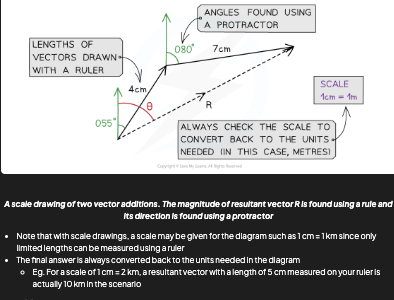
[HIGHER] How do you find the resultant of two forces at an angle using a scale drawing?
Draw both force vectors to scale at the correct angle tip-to-tail → draw resultant from start of first to end of second → measure length and convert back to newtons using scale
[HIGHER] What does it mean for forces to be in equilibrium?
All forces are balanced — resultant force is zero. Object is stationary or moving at constant velocity. On a vector triangle, forces form a closed triangle (tip-to-tail back to start)
[HIGHER] What is circular motion?
An object moving in a circle at constant speed but continuously changing direction — so velocity is always changing, meaning the object is always accelerating
[HIGHER] Why is an object in circular motion always accelerating even at constant speed?
Velocity is a vector — direction is always changing even if speed is constant. Changing direction = changing velocity = acceleration
[HIGHER] What is the centripetal force in circular motion?
The resultant force that acts towards the centre of the circle, causing the object to follow a circular path — it is always perpendicular to the velocity

