Exam 2 (Chapters 4-6)
 Studied by 2 people
 Call Kai
 Learn
Learn Practice Test
 Spaced Repetition
 Match
Match Flashcards
 Knowt Play
1/244

There's no tags or description
Looks like no tags are added yet.
Name | Mastery | Learn | Test | Matching | Spaced | Call with Kai |
|---|
No analytics yet
Send a link to your students to track their progress
245 Terms
high-bulk yarn
acrylic spun yarns that are lofty, bulky, and soft
yarn
a continuous strand of textile fibers, filaments, or materials in the form suitable for knitting, weaving, or otherwise intertwining to form a textile fabric
factors that affect yarn properties
fiber content - thick/thin, shape, surface structure, regularity, luster, if it is spun or filament, basic properties, etc
fiber length
amount of twist
yarn size
regularity of the yarn
uniformity of the yarn
we generally classify and identify yarns by:
fiber content and length
yarn twist
yarn size
regularity/irregularity
smooth filament yarn
no twist or low twist yarns
monofilament yarn
a single-coarse filament fiber
tape and network yarns
made from splitting an extruded film and heat-stretching the fibers
multifilament yarns
several, uniform, individual fibers
flat
tape or network yarns
bulk yarns
modified filament yarns that produce greater volume or apparent covering than a conventional yarn of similar linear density and of the same basic material with normal twist
tape yarns
coarse; usually used in carpet backing, rope, cord, fishnet, bagging, and interior support fabrics
network yarns
bulkier and less dense than multifilament, monofilament, and tape yarns; made of fibers than are connected in a network arrangement; have ribbon-like characteristics
pros and cons of textured yarns
Pros:
higher stretch and/or bulk with greater cover than smooth filament yarns
greater breathability, insulation, and/or absorption
softer and drier hand
spunlike yarn characteristics
more wrinkle resistant than spun yarns or smooth (regular) filament yarns
Cons:
tendency to snag and damage to fabric is likely greater since it is a filament fiber
not suitable for apparent intended for “rough use” (children’s garments)
growth problems
poor abrasion resistance
easy soil penetration
How are staple fibers processed into spun yarn?
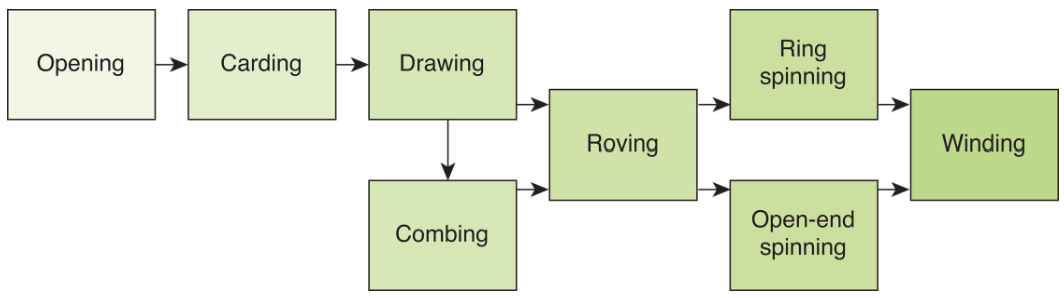
opening
loosens, cleans, blends the fibers
carding
partially align the fibers and form them into a thin web that is brought together as a soft, very weak rope of fiber called a carded sliver
drawing:
process than increases parallelism of the fibers and combines several carded or combed slivers into drawn sliver
if long staple fibers are to be spun, another step is added:
the combing step
combing
aligns the fibers in a parallel arrangement and removes short fibers so that fibers in the combed sliver will be more uniform in length
roving
reduced the drawn sliver, increases the parallel alignment of the fibers, and inserts a small amount of twist in the strand
Methods of spinning
ring spinning, open-end (OE) spinning
which fibers must be carded?
staple fibers
carded yarns
carded yarns from cotton or cotton-blend fibers
combed yarns
combed yarns from cotton or cotton-blend fibers
woolen yarns
carded yarns made of wool or wool-blends. they are fizzier, uneven
worsted yarns
combed yarns made of wool or wool-blends. they are smooth, have little fizziness, and are more even
tow linen yarns
yarns made of short flax fibers; they are irregular and coarse
line linen yarns
combed flax yarns; they are long and produce a smooth and fine linen used for fine table linen and lightweight blouses
why do fibers for fine, lightweight yarns need to be combed?
you need the longer fibers to ensure proper strength
combed yarns have ___ fibers
longer
why are combed yarns so expensive?
more steps in the process, fewer fibers are used
what are some cases where combed yarns are less desirable than carded yarns?
napped fabrics - needs short fibers to give it the fuzzy surface
denim - carded yarns give it the rugged, natural look
terry cloth - fuzzy, soft bulkiness of carded yarns allow the terry cloth to remove moisture
Carded Yarn Properties
Fiber length: short staple
Yarn:
size and appearance: less regular
twist: medium-to-low
protruding ends: more
final result: bulkier, softer, fuzzier
abrasion resistance: more sensitive to abrasion
fibers present: more
Fabric:
may become baggy in areas of stress
fabrics vary from soft to firm
always used in blankets
wide range of uses
less expensive
Yarn term based on fiber type:
cotton: carded
flax: tow or hackled
wool: woolen
Combed Yarn Properties
Fiber length: long staple
Yarn:
size and appearance: more regular
twist: medium-to-higher
protruding ends: fewer
final result: fewer protruding ends
abrasion resistance: longer wearing, stronger
fibers present: fewer
Fabric:
smoother surface, lighter weight
do not sag
take and hold press
fabrics range from sheers to suitings
more expensive
Yarn term based on fiber type:
cotton: combed
flax: line or well-hackled
wool: worsted
most common method of yarn spinning
ring spinning method
ring/conventional spinning
consists of a series of operations designed to clean and make parallel fibers, draw them out into a finer strand and twist them to keep them together and give them strength
open-end rotor spinning
eliminated formation of roving, less operator supervision needed, production speed is about 10 times higher than that of ring spinning
characteristics of ring spun yarns
finer
smoother
comfortable hand
better quality
more uniform
create fewer problems in fabrication
characteristics of OE spun yarns
harsher hand
weaker
limited to coarse- and medium-sized yarns
improved abrasion resistance
more uniform and regular in appearance
more opaque in appearance
improved absorption
characteristics of a spun yarn
Structure: more air between fibers than for filament; fuzzy, with protruding ends (high twist yarns are less “hairy”)
Appearance: protruding ends contribute to dull luster, fuzzy appearance (especially with low twist)
Comfort: more comfortable, breathable, and absorbent; spun yarns with low twist has more air spaces than spun yarns with high twist and thus better insulating characteristics
Durability: sheds lint, pills
Strength: depend on the individual fiber strength, the fibers’ cohesiveness or slinging power and on the points of contact resulting from twist or other binding mechanisms used to produce spun yarn; long staple, high twist yarns are stronger
characteristics of filament yarns
Structure: long, continuous strand; can be one strand (monofilament) or multiple strands (multifilament)
Appearance: smooth, lustrous; twist, texturing, and delustering reduce luster
Comfort: less comfortable than spun yarns; high bulk yarns resemble spun yarns more
Durability: do not shed lint or pill
Strength: stronger than spun yarns; the strength depends on the strength of each filament fiber and number of filament fibers used, but they are in general stronger than spun yarns
either no or very little twist; twist is only needed to keep multiple filaments together; or very high (crepe twist)
spun yarns vs filament yarns
uniformity: filament yarns are more uniform
smoothness and luster: filament yarns are smoother and generally higher luster
strength: filament yarns tend to be stronger
twist
the spiral arrangement of the fibers around the yarn’s axis
amount of twist affects:
strength
cost
yarn hairiness
comfort
linting
s or z twist
refers to the direction of the twist
s-twist
the spirals conform to the direction of the slope of the center portion of the letter S
Z-twist
the spirals conform to the direction of the slope of the center portion of the letter Z
TPI
twists-per-inch
Low/soft twist yarn
used to maintain integrity within smooth multifilament yarns
twists in low twist yarn
2-3 tpi
low twist yarn characteristics
smooth or bulky; twist may be hard to see
napping twist
produces lofty, spun yarns; used in filling yarns of fabrics that are to be napped; napping teases out the ends of the staple fibers and creates the soft, fuzzy surface
twists in napping twist yarn
8-15 tpi
characteristics of napping twist yarn
bulky, soft, fuzzy, may be weak
average twist
used most commonly for yarns made of staple fibers but seldom for filament yarns; most durable
twists in average twist yarn
15-30 tpi
characteristic of average twist yarn
most common, smooth, regular, durable, comfortable; produces smooth, regular fabrics
voile/hard twist
produces a harsh hand; fibers are close together and compacts the yarn; twist-on-twist
twist-on-twist
the direction of twist in the single yarn is the same as that of the plying twist, so it increases the total amount of yarn twist
twist in voile twist yarn
30-40 tpi
twists in hard twist yarn
20-30 tpi
characteristics of voile/hard twist yarn
strong, fine yarns; fabrics have harsher hand due to yarn twist
crepe twist
highest number of tpi, also know as unbalanced yarns and twist and kink on themselves; require twist-set before they can be used in knitted or woven fabrics
twists in crepe twist yarns
40-80 tpi
characteristics of crepe twist yarn
lively yarns that kink and twist in fabrics with good drape and texture
yarn count system
most commonly used for spun yarns; indirect system
indirect system
the finer the yarn, the larger the number
yarn numbering system
most commonly used for filament yarns; direct system; yarn denier/yarn tex
direct system
the finer the yarn, the smaller the number
single yarn
has one strand and is the simplest type
ply yarn
made by a second twisting operation that combines two or more single yarns; each part of the yarn is called a ply
simple yarns
alike in all its parts
what direction are ply yarns twisted
in the opposite direction of that of the twist of the single yarns
cord
made by a third twisting operation which twists ply yarns together
rope
heavy, thick cord; braided, twisted; core covered sheaths
blended
made of two or more fiber types
novelty yarns (fancy yarns)
deliberately have unlike parts that are irregular at intervals
stretch yarns
bare elastic
covered yarns
core-spun yarns
textured yarns
types of fancy yarns
Single: tweed, slub, metallic
Ply: ratine, spiral, knot, snarl, boucle, slub, metallic, chenille, braided, knit, stitched
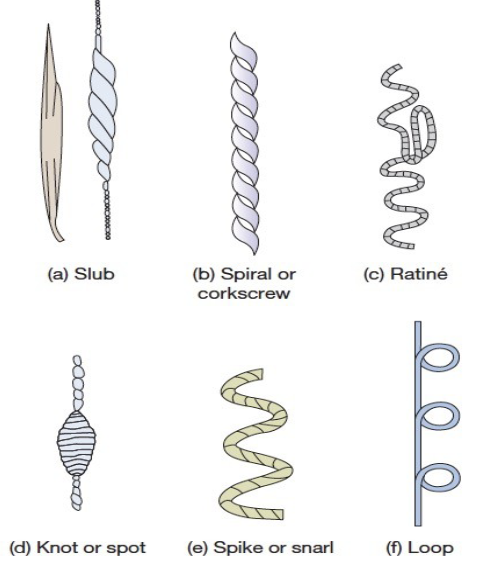
nips
thin spots in the yarn
air-jet method
a jet of high-velocity air is directed at a multifilament yarn, which separates the fibers, forcing some filaments to form loops and turns
bare elastic yarn
Stretch fiber component: spandex
Stretch type: power
Recovery power: moderate
Uses and features: lightweight foundations, swimwear, athletic wear—gym clothing, bike shorts
covered elastic yarn
Stretch fiber component: spandex or rubber
Stretch type: power
Recovery power: high
Uses and features: heavy foundations, elastic bandages, surgical stockings, athletic supporters; rubber has higher power and recovery than spandex but poor shelf life—it begins to decay in one year
core-spun yarns
Stretch fiber component: spandex
Stretch type: comfort
Recovery power: very low to low
Uses and features: active sportswear, stretch denim
textured yarn
Stretch fiber component: nylon or polyester
Stretch type: comfort
Recovery power: low
Uses and features: blouses, sportswear, stretch pants, hosiery, polyester men’s socks; polyester has a tendency to pill
chenille yarn
have soft pile protruding from their surface
appearance resembles pipe cleansers without the wire
woven fabric cut lengthwise into narrow strips; each strip is a chenille yarn
can be made up of any fiber
low abrasion resistance
cotton count system
count system for cotton and cotton blends, are designated as “c.c” or “Ne”; expressed by 2 numbers: first is yarn size and second indicates the yarn ply
decitex system
used to measure the weight of yarn in grams of 10,000 meters of length
tex system
grams per 1000 meters of yarn; direct system
denier system
grams per 9000 meters; direct system; used for filament fibers and filament yarns
false-twist method
most widely used technique for producing textured yarns in finer deniers; yarns are twisted, heat-set, and untwisted in one operation
gear crimping
passing the filament yarn through a series of heated rollers or sets of heated gears that deform the filaments; a type of textured yarn
growth
unrecovered stretch in textile fabrics
knife-edge method
passing the filaments over a heated roll and then pulling them over a sharp edge at an acute angle to create a textured yarn
knit-deknit method
produces bulk textured yarn that has more stretch than yarn produced by other methods; knit into a narrow-diameter tubular form; fabric is rolled up, heat set, then unraveled
lea
spun yarn count expression for linen; used for flax jute, hemp, or ramie fibers; NeL is also used
metallic yarns
flat and ribbonlike; used mostly for decorative purposes; can be supported by loosely twisting one or more fine-filament yarns around them to increase both strength and abrasion resistance
metric yarn count
expresses the number of kilometers of yarn per kilogram of weight - “Nm”
run
woolen or woolen blends of yarn
set-textured
accomplished in some instances by winding previously textured stretch yarns onto spools under moderate tension and then heat-setting the yarn a second time
 Note
Note  Flashcards (20)