BIO 300 Lecture15.IntroToRespiratory.PhysiologyReview.pptx

0.0(0)
Studied by 0 people
call kaiCall Kai
learnLearn
examPractice Test
spaced repetitionSpaced Repetition
heart puzzleMatch
flashcardsFlashcards
GameKnowt Play
Card Sorting

1/12

flashcard set

Earn XP

Description and Tags

BIO 300 Pathophysiology

Last updated 10:09 PM on 3/30/26
Name
Mastery
Learn
Test
Matching
Spaced
Call with Kai

No analytics yet

Send a link to your students to track their progress

13 Terms
1
New cards
term image

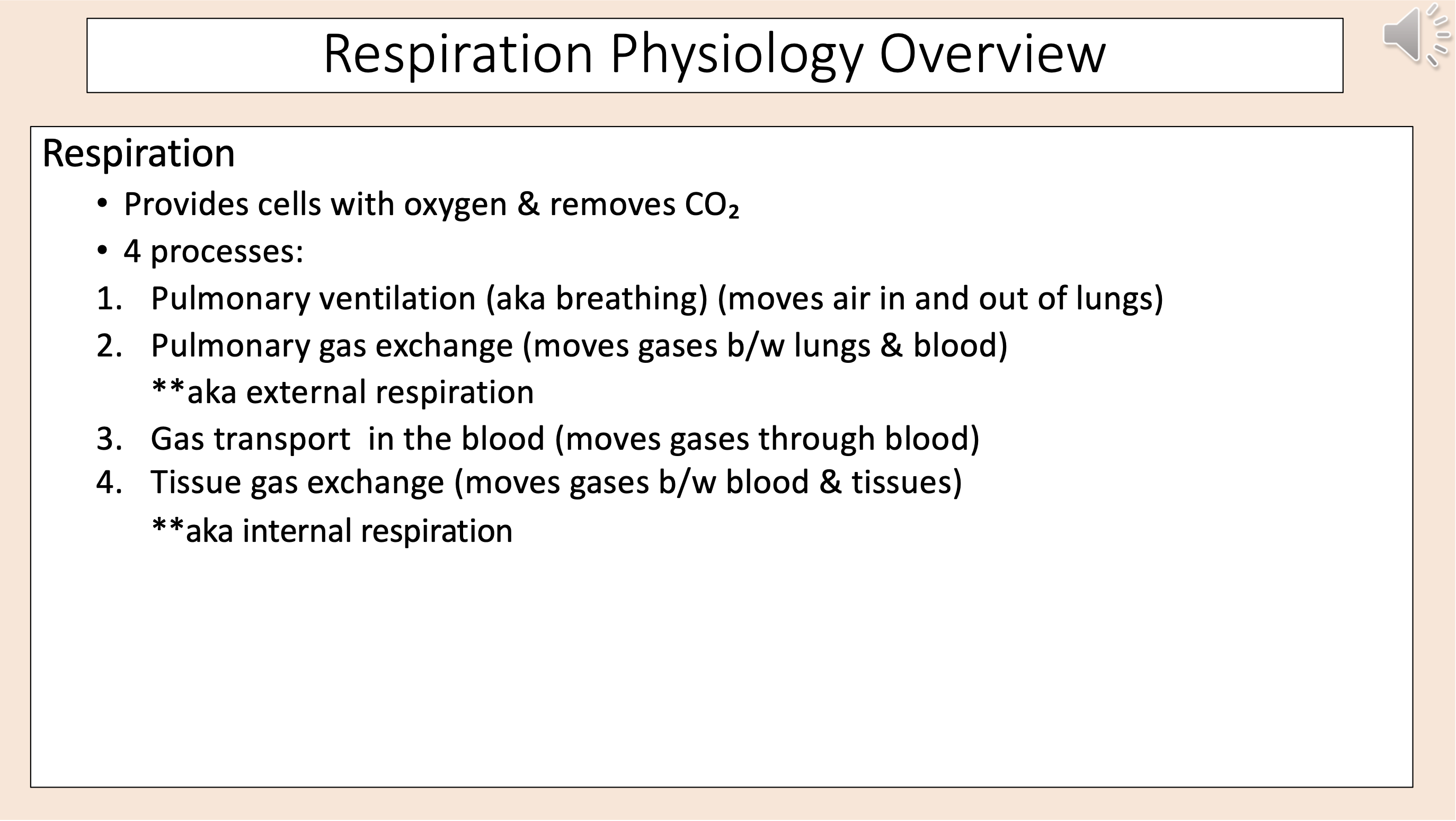
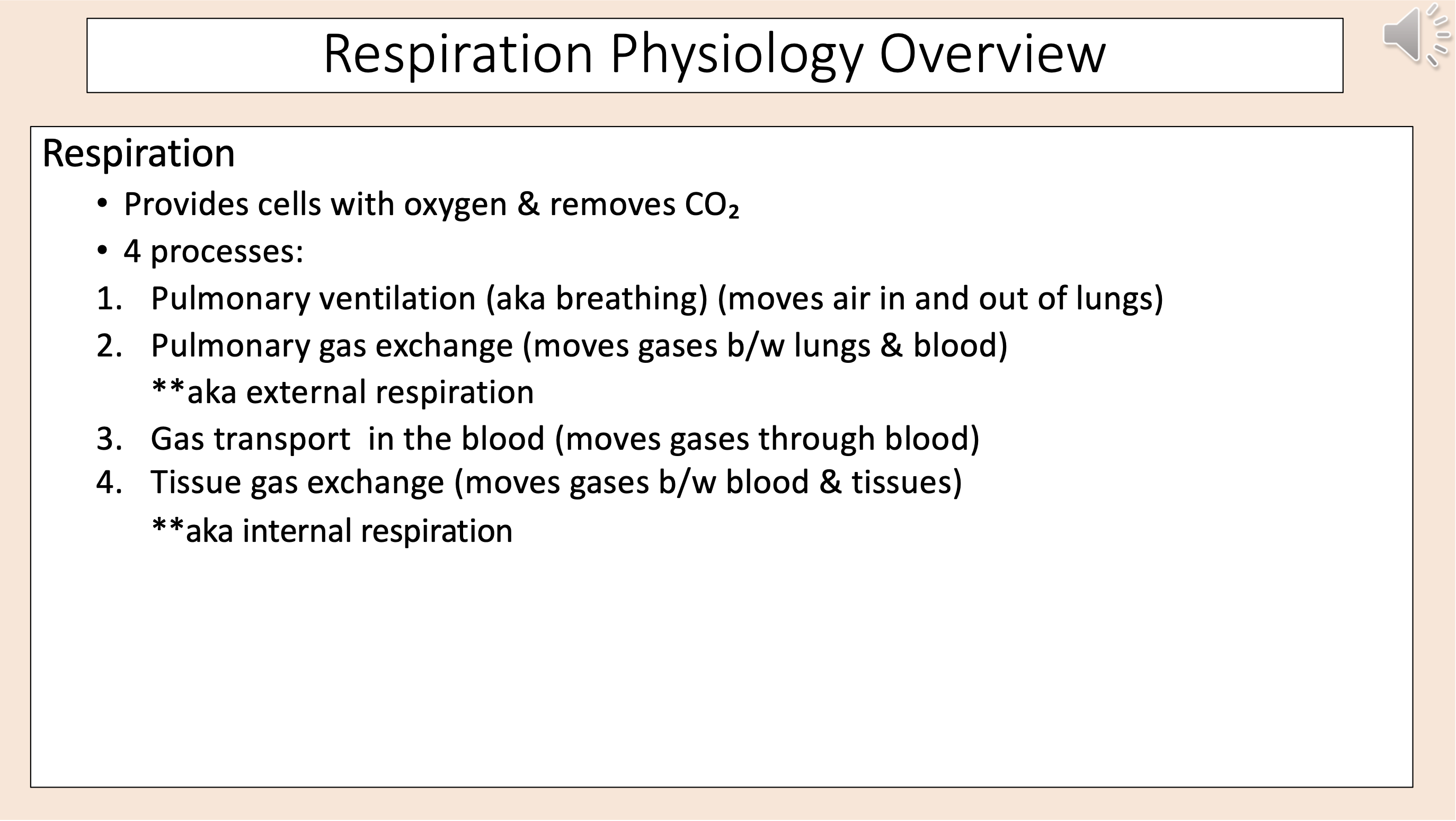
Respiration Physiology Overview.

Respiration.

• Provides cells with oxygen & removes CO2.

• 4 processes:.

1. Pulmonary ventilation (aka breathing) (moves air in and out of lungs).

2. Pulmonary gas exchange (moves gases between lungs & blood).

**aka external respiration.

3. Gas transport in the blood (moves gases through blood).

4. Tissue gas exchange (moves gases b/w blood & tissues).

**aka internal respiration.
<p><span>Respiration Physiology Overview.</span></p><p><span>Respiration.</span></p><p><span>• Provides cells with oxygen &amp; removes CO<sub>2</sub>.</span></p><p><span>• 4 processes:.</span></p><p><span>1. Pulmonary ventilation (aka breathing) (moves air in and out of lungs).</span></p><p><span>2. Pulmonary gas exchange (moves gases between lungs &amp; blood).</span></p><p><span>**aka external respiration.</span></p><p><span>3. Gas transport in the blood (moves gases through blood).</span></p><p><span>4. Tissue gas exchange (moves gases b/w blood &amp; tissues).</span></p><p><span>**aka internal respiration.</span></p>
2
New cards
term image

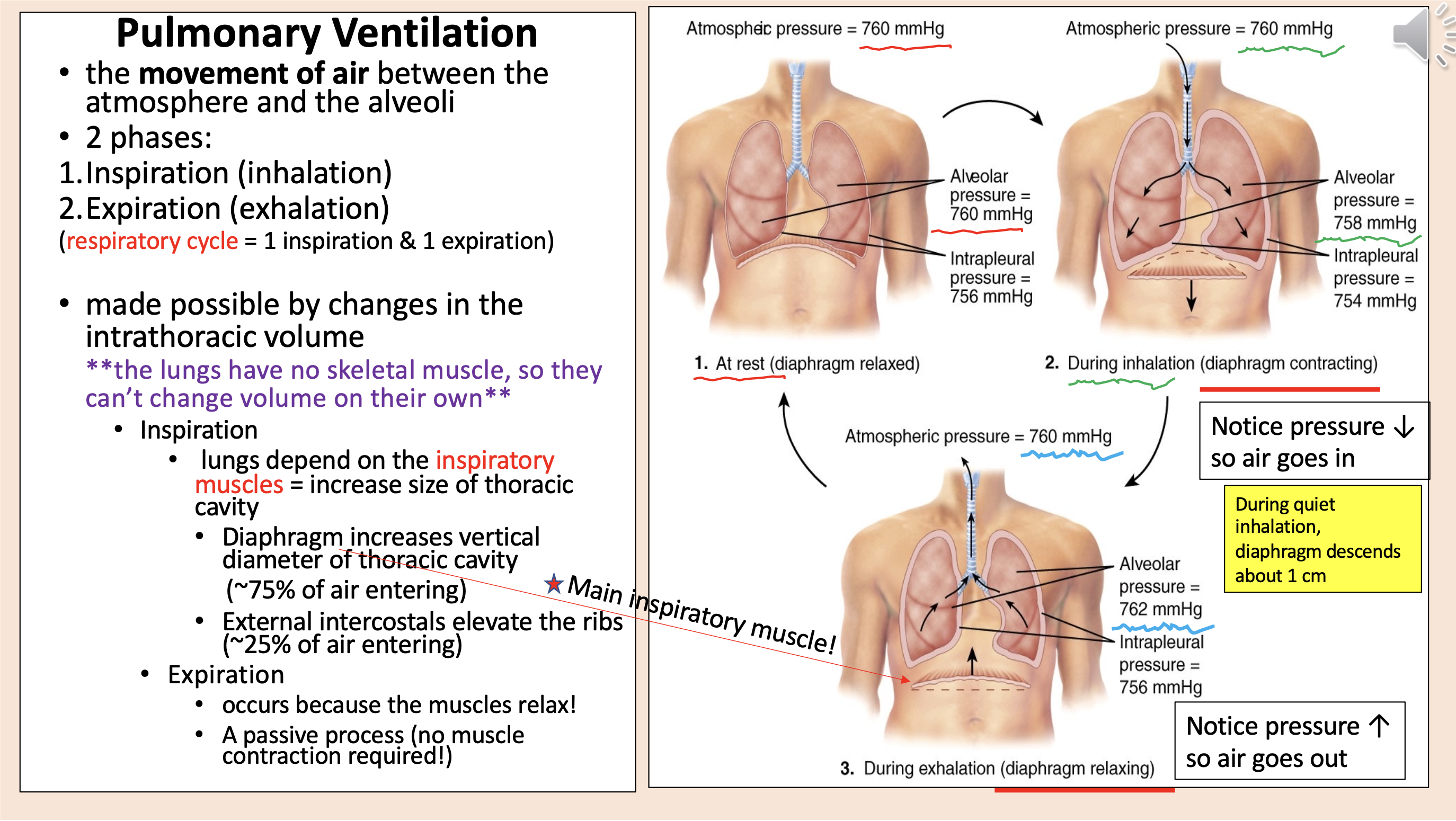
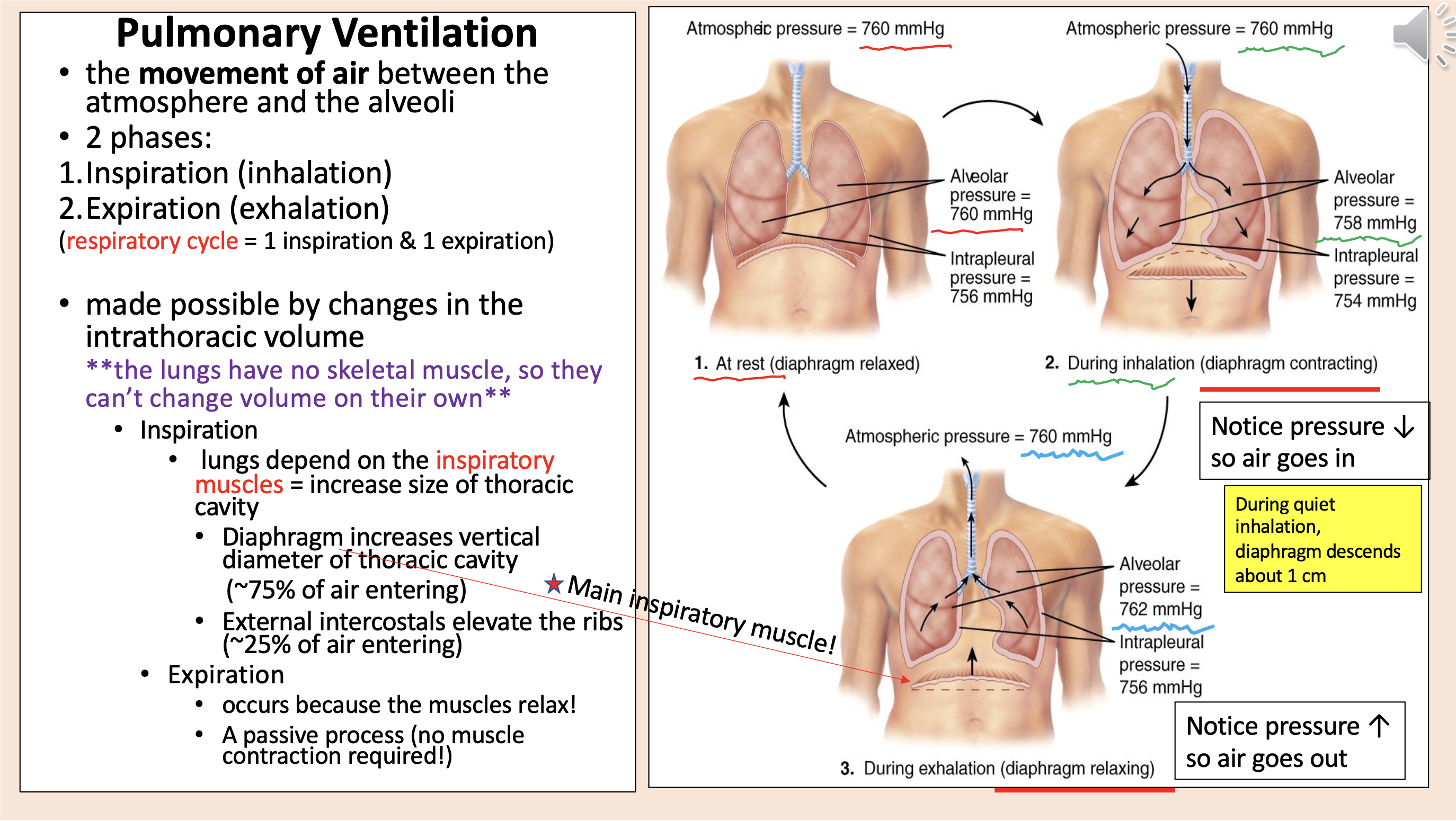
Pulmonary Ventilation.

• the movement of air between the atmosphere and the alveoli.

• 2 phases:.

1. Inspiration (inhalation).

2. Expiration (exhalation).

(respiratory cycle = 1 inspiration & 1 expiration).

• made possible by changes in the intrathoracic volume.

**the lungs have no skeletal muscle, so they can’t change volume on their own**.

• Inspiration.

• lungs depend on the inspiratory muscles = increase size of thoracic cavity.

Diaphragm increases vertical diameter of thoracic cavity (~75% of air entering).

• External intercostals elevate the ribs (~25% of air entering).

• Expiration.

occurs because the muscles relax!

A passive process (no muscle contraction required!).

1. At rest (diaphragm relaxed).

2. During inhalation (diaphragm contracting).

Notice pressure ↓ so air goes in.

During quiet inhalation, diaphragm descends about 1 cm.

3. During exhalation (diaphragm relaxing).

Notice pressure ↑ so air goes out.

<p><span><strong>Pulmonary Ventilation.</strong></span></p><p><span>• the <strong>movement of air </strong>between the atmosphere and the alveoli.</span></p><p><span>• 2 phases:.</span></p><p><span>1. Inspiration (inhalation).</span></p><p><span>2. Expiration (exhalation).</span></p><p><span>(</span><span style="color: rgb(255, 0, 0);">respiratory cycle </span><span>= 1 inspiration &amp; 1 expiration).</span></p><p><span>• made possible by changes in the intrathoracic volume.</span></p><p><span style="color: rgb(112, 48, 160);">**the lungs have no skeletal muscle, so they can’t change volume on their own**.</span></p><p><span>• Inspiration.</span></p><p><span>• lungs depend on the </span><span style="color: rgb(255, 0, 0);">inspiratory muscles </span><span>= increase size of thoracic cavity.</span></p><p>•<span> Diaphragm increases vertical diameter of thoracic cavity (~75% of air entering).</span></p><p><span>• External intercostals elevate the ribs (~25% of air entering).</span></p><p><span>• Expiration.</span></p><p>• <span>occurs because the muscles relax!</span></p><p>•<span> A passive process (no muscle contraction required!).</span></p><p><span>1. At rest (diaphragm relaxed).</span></p><p><span>2. During inhalation (diaphragm contracting). </span></p><p><span>Notice pressure ↓ so air goes in.</span></p><p><span>During quiet inhalation, diaphragm descends about 1 cm.</span></p><p>3. During exhalation (diaphragm relaxing). </p><p><span>Notice pressure ↑ so air goes out.</span></p>
3
New cards
term image

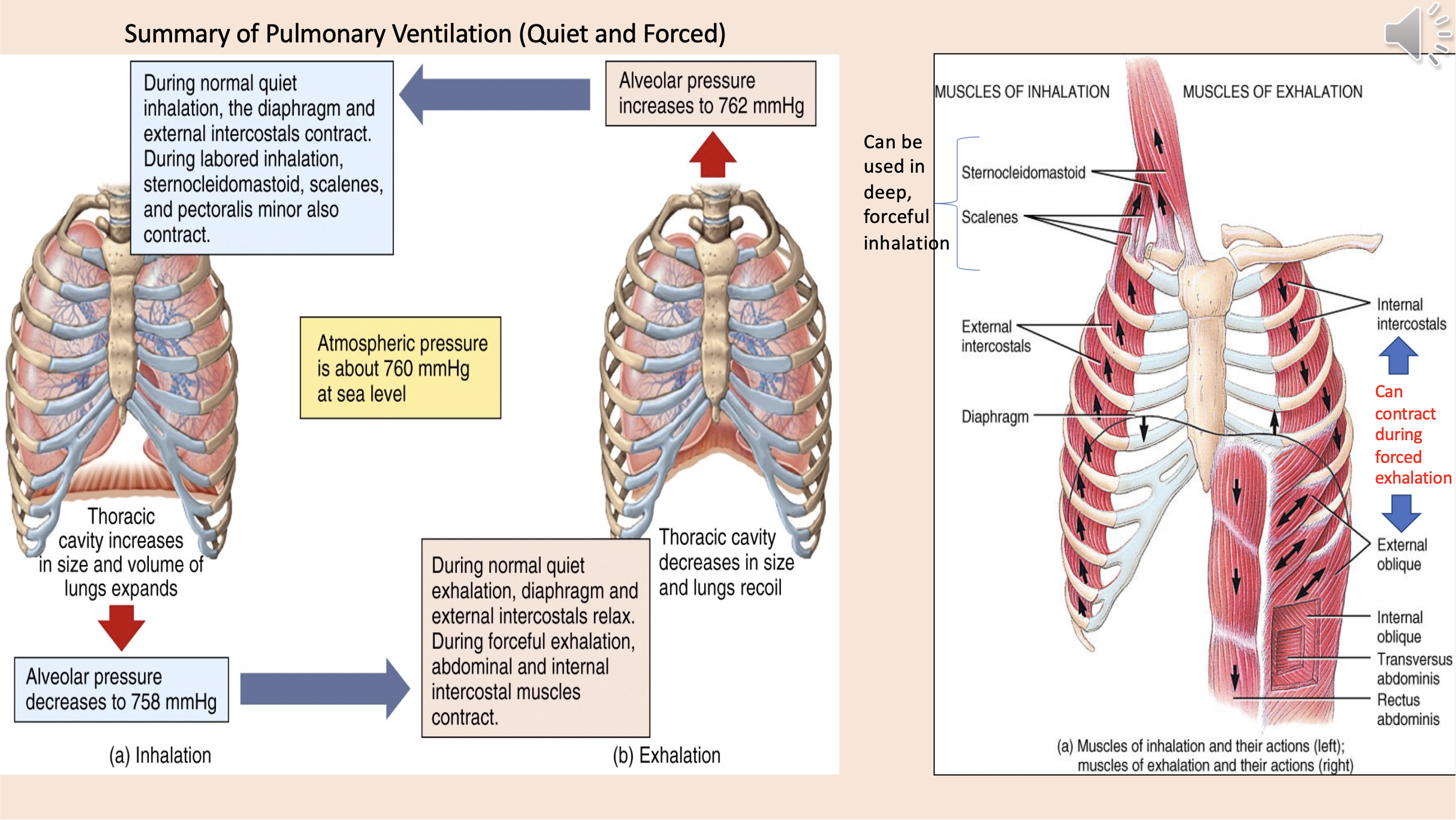
Summary of pulmonary Ventilation (Quiet and Forced).

Thoracic cavity increases in size and volume of lungs expands.

Alveolar pressure decreases to 758 mmHg.

(a) Inhalation.

During normal quiet exhalation, exhalation, diaphragm and external intercostals relax. During forceful exhalation, abdominal and internal intercostal muscles contract.

(b) Exhalation.

Thoracic cavity decreases in size and lungs recoil.

Alveolar pressure increases to 762 mmHg.

During normal quiet inhalation, the diaphragm and external intercostals contract. During labored inhalation, sternocleidomastoid, scalenes, and pectoralis minor also contract.

Atmospheric pressure is about 760 mmHg at sea level.

Thoracic cavity increases in size and volume of lungs expands.

Sternocleidomastoid.

Scalenes.

Can be used in deep, forceful inhalation.

Internal intercostals.

External oblique.

Can contract during forced exhalation.

<p>Summary of pulmonary Ventilation (Quiet and Forced).</p><p>Thoracic cavity increases in size and volume of lungs expands.</p><p>Alveolar pressure decreases to 758 mmHg.</p><p>(a) Inhalation.</p><p>During normal quiet exhalation, exhalation, diaphragm and external intercostals relax. During forceful exhalation, abdominal and internal intercostal muscles contract. </p><p>(b) Exhalation.</p><p>Thoracic cavity decreases in size and lungs recoil. </p><p>Alveolar pressure increases to 762 mmHg.</p><p>During normal quiet inhalation, the diaphragm and external intercostals contract. During labored inhalation, sternocleidomastoid, scalenes, and pectoralis minor also contract. </p><p>Atmospheric pressure is about 760 mmHg at sea level.</p><p>Thoracic cavity increases in size and volume of lungs expands. </p><p>Sternocleidomastoid.</p><p>Scalenes.</p><p>Can be used in deep, forceful inhalation. </p><p>Internal intercostals.</p><p>External oblique.</p><p>Can contract during forced exhalation. </p>
4
New cards
term image

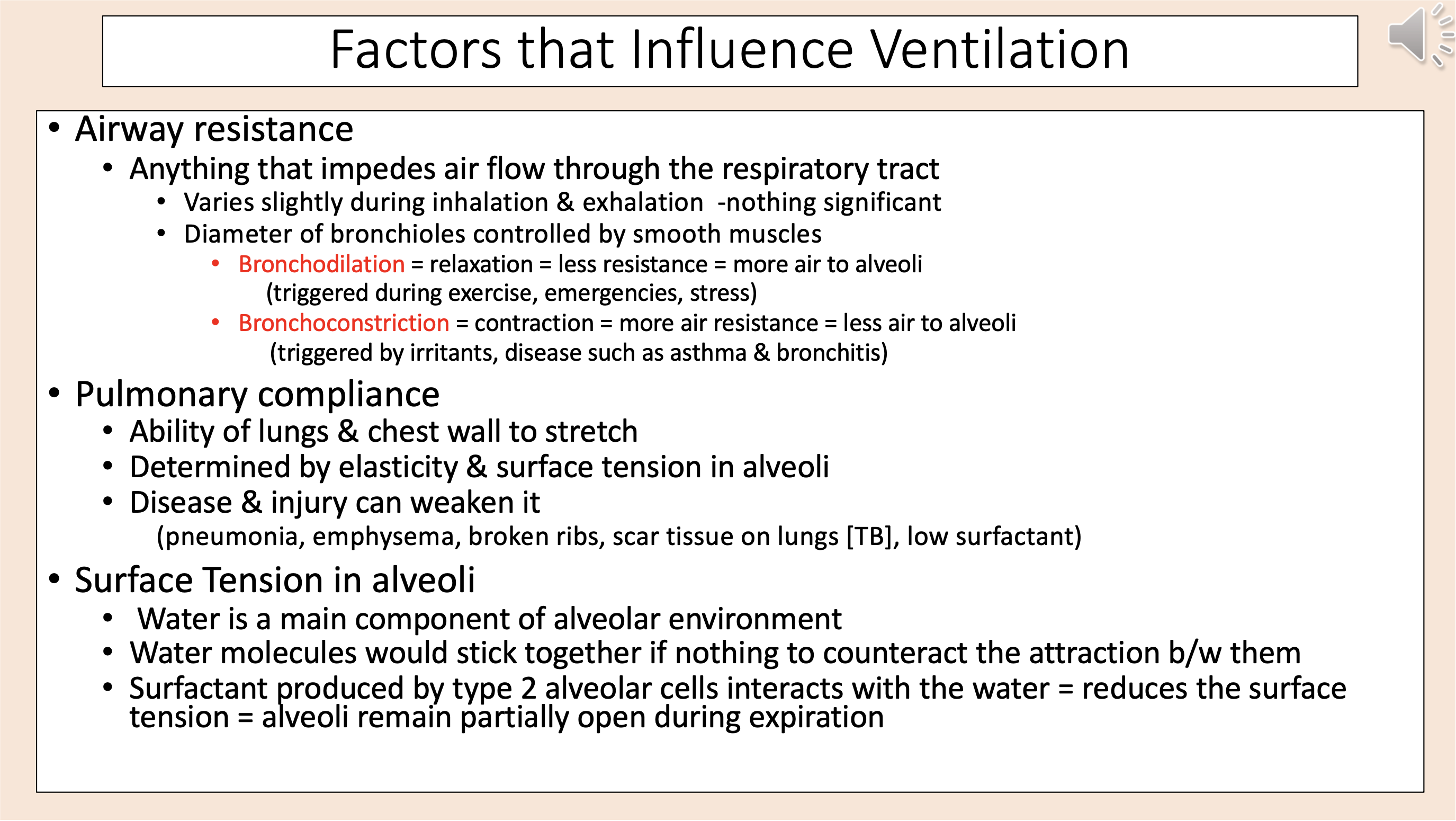
Factors that Influence Ventilation.

• Airway resistance.

• Anything that impedes air flow through the respiratory tract.

• Varies slightly during inhalation & exhalation -nothing significant.

• Diameter of bronchioles controlled by smooth muscles.

Bronchodilation = relaxation = less resistance = more air to alveoli (triggered during exercise, emergencies, stress).

Bronchoconstriction = contraction = more air resistance = less air to alveoli (triggered by irritants, disease such as asthma & bronchitis).

• Pulmonary compliance.

• Ability of lungs & chest wall to stretch.

• Determined by elasticity & surface tension in alveoli.

• Disease & injury can weaken it (pneumonia, emphysema, broken ribs, scar tissue on lungs [TB], low surfactant).

• Surface Tension in alveoli.

• Water is a main component of alveolar environment.

• Water molecules would stick together if nothing to counteract the attraction between them.

• Surfactant produced by type 2 alveolar cells interacts with the water = reduces the surface tension = alveoli remain partially open during expiration.

<p><span>Factors that Influence Ventilation.</span></p><p><span>• Airway resistance.</span></p><p><span>• Anything that impedes air flow through the respiratory tract.</span></p><p><span>• Varies slightly during inhalation &amp; exhalation -nothing significant.</span></p><p><span>• Diameter of bronchioles controlled by smooth muscles.</span></p><p><span style="color: red;">•</span><span style="color: rgb(255, 0, 0);"> Bronchodilation </span>= relaxation = less resistance = more air to alveoli <span>(triggered during exercise, emergencies, stress).</span></p><p><span style="color: red;">•</span><span style="color: rgb(255, 0, 0);"> Bronchoconstriction </span><span>= contraction = more air resistance = less air to alveoli (triggered by irritants, disease such as asthma &amp; bronchitis).</span></p><p><span>• Pulmonary compliance.</span></p><p><span>• Ability of lungs &amp; chest wall to stretch.</span></p><p><span>• Determined by elasticity &amp; surface tension in alveoli.</span></p><p><span>• Disease &amp; injury can weaken it (pneumonia, emphysema, broken ribs, scar tissue on lungs [TB], low surfactant).</span></p><p><span>• Surface Tension in alveoli.</span></p><p><span>• Water is a main component of alveolar environment.</span></p><p><span>• Water molecules would stick together if nothing to counteract the attraction between them.</span></p><p><span>• Surfactant produced by type 2 alveolar cells interacts with the water = reduces the surface tension = alveoli remain partially open during expiration.</span></p>
5
New cards
term image

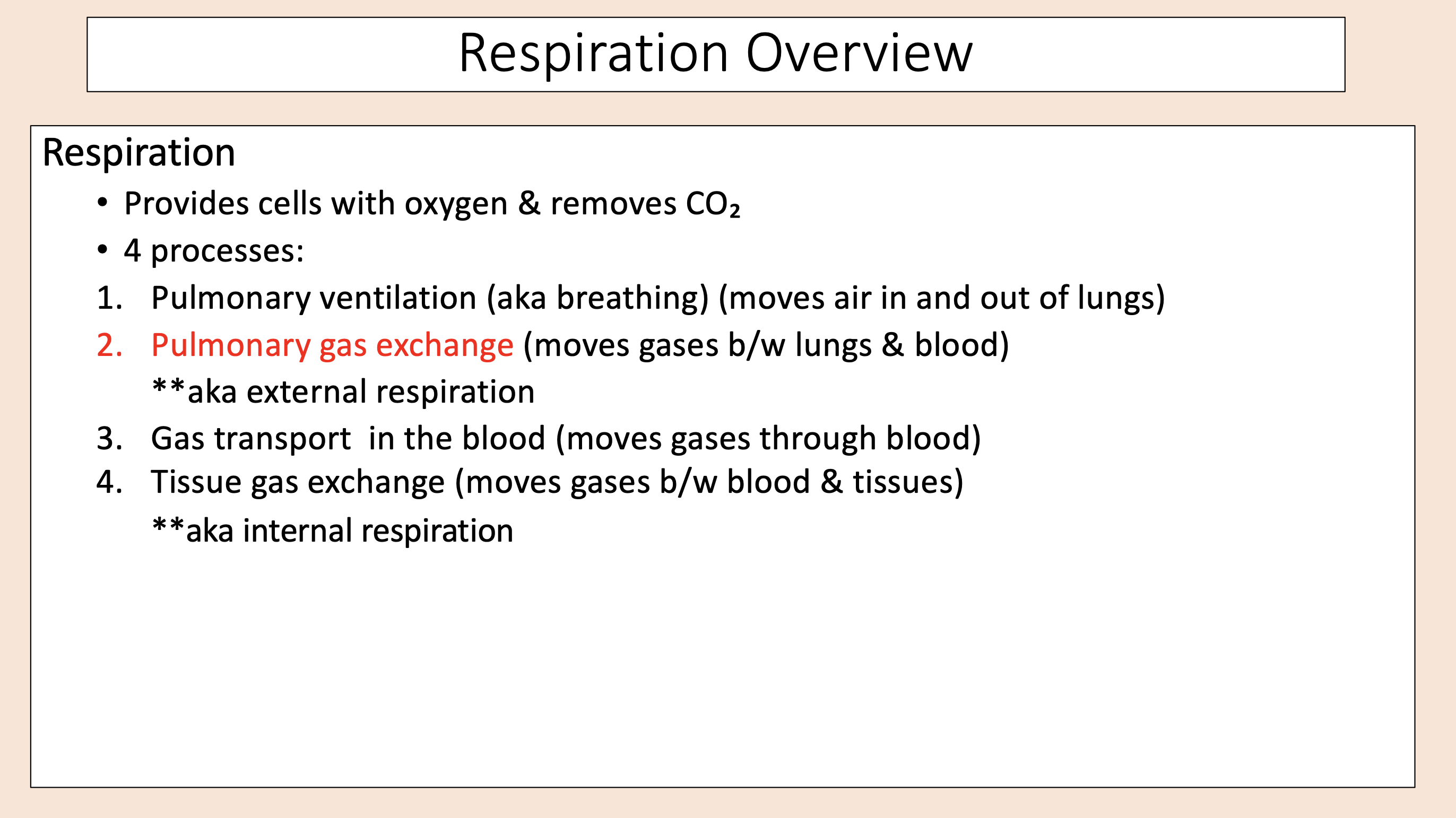
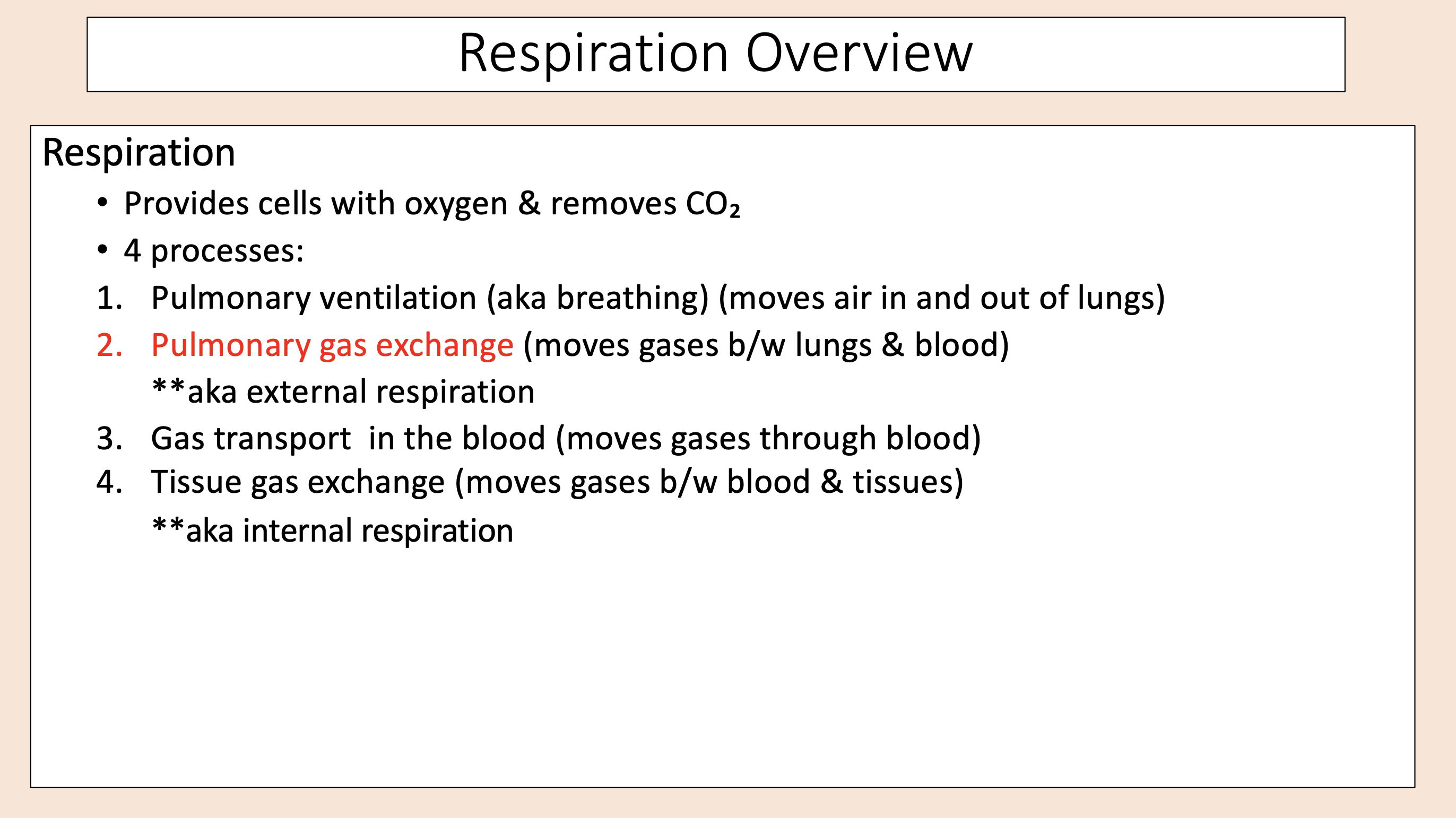
Respiration Overview.

Respiration.

• Provides cells with oxygen & removes CO2.

• 4 processes:.

1. Pulmonary ventilation (aka breathing) (moves air in and out of lungs).

2. Pulmonary gas exchange (moves gases between lungs & blood).

**aka external respiration.

3. Gas transport in the blood (moves gases through blood).

4. Tissue gas exchange (moves gases between blood & tissues).

**aka internal respiration.

<p><span>Respiration Overview.</span></p><p><span>Respiration.</span></p><p><span>• Provides cells with oxygen &amp; removes CO<sub>2</sub>.</span></p><p><span>• 4 processes:.</span></p><p><span>1. Pulmonary ventilation (aka breathing) (moves air in and out of lungs).</span></p><p><span style="color: rgb(255, 0, 0);">2. Pulmonary gas exchange </span><span>(moves gases between lungs &amp; blood).</span></p><p><span>**aka external respiration.</span></p><p><span>3. Gas transport in the blood (moves gases through blood).</span></p><p><span>4. Tissue gas exchange (moves gases between blood &amp; tissues).</span></p><p><span>**aka internal respiration.</span></p>
6
New cards
term image

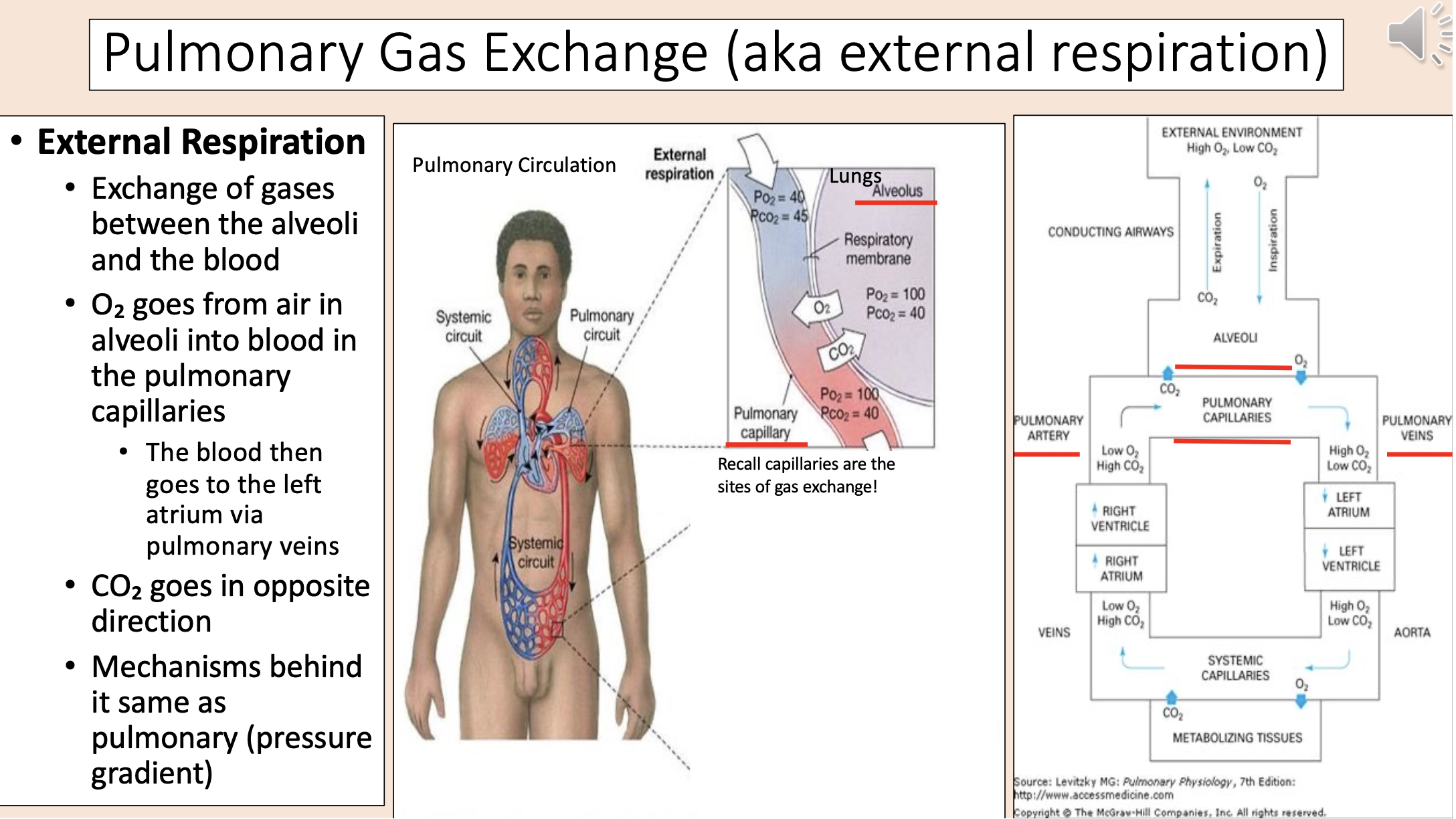
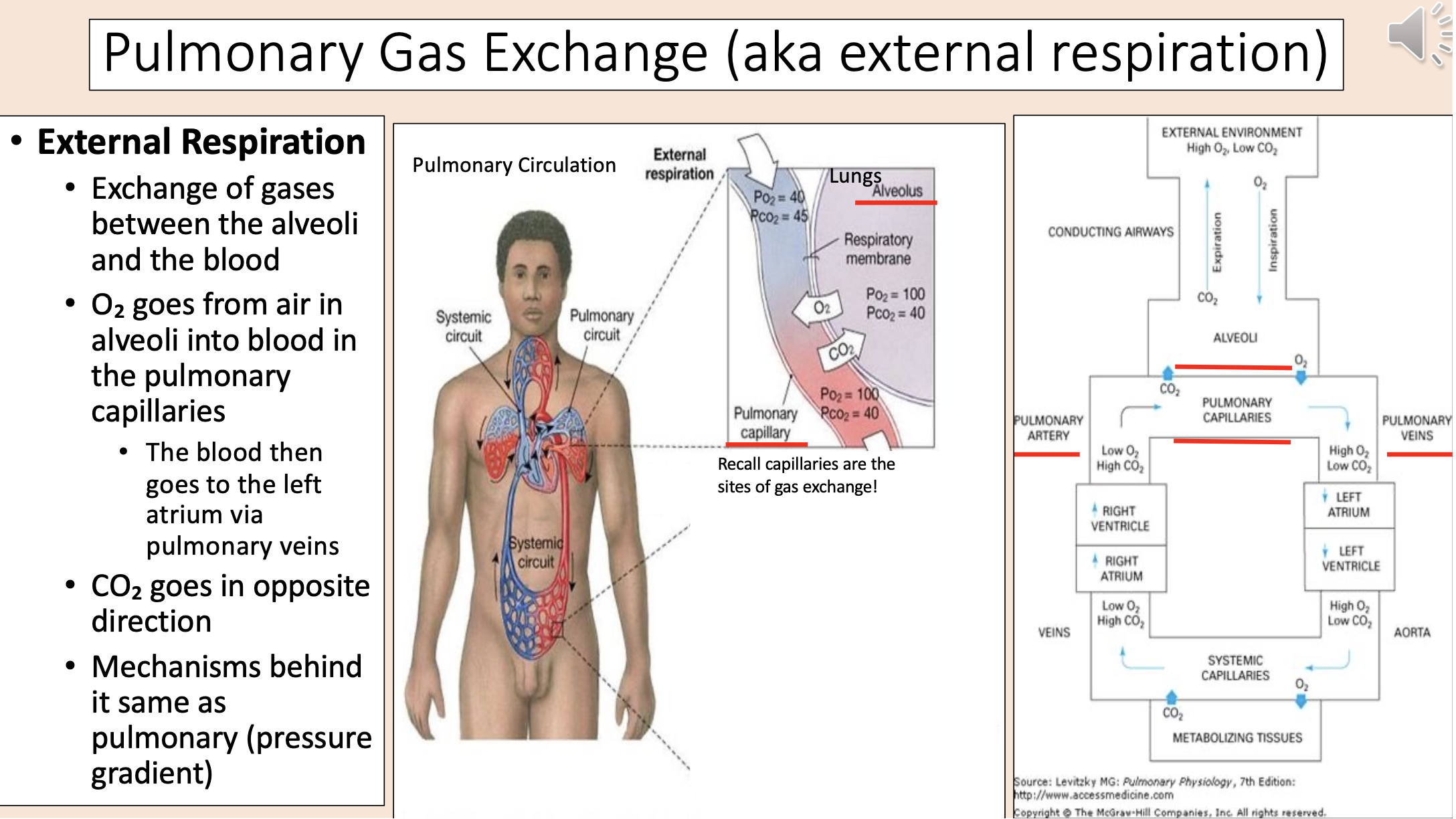
Pulmonary Gas Exchange (aka external respiration).

External Respiration.

Exchange of gases between the alveoli and the blood.

O2 goes from air in alveoli into blood in the pulmonary capillaries.

• Thebloodthen goes to the left atrium via pulmonary veins.

CO2 goes in opposite direction.

Mechanisms behind it same as pulmonary (pressure gradient).

Alveolus Lungs.

Pulmonary capillary.

Recall capillaries are the sites of gas exchange!

<p><span>Pulmonary Gas Exchange (aka external respiration).</span></p><p>•<span> <strong>External Respiration.</strong></span></p><p>•<span> Exchange of gases between the alveoli and the blood.</span></p><p>• <span>O<sub>2</sub> goes from air in alveoli into blood in the pulmonary capillaries.</span></p><p><span>• Thebloodthen goes to the left atrium via pulmonary veins.</span></p><p>• <span>CO<sub>2</sub> goes in opposite direction.</span></p><p>• <span>Mechanisms behind it same as pulmonary (pressure gradient).</span></p><p><span>Alveolus Lungs.</span></p><p><span>Pulmonary capillary.</span></p><p><span>Recall capillaries are the sites of gas exchange!</span></p>
7
New cards
term image

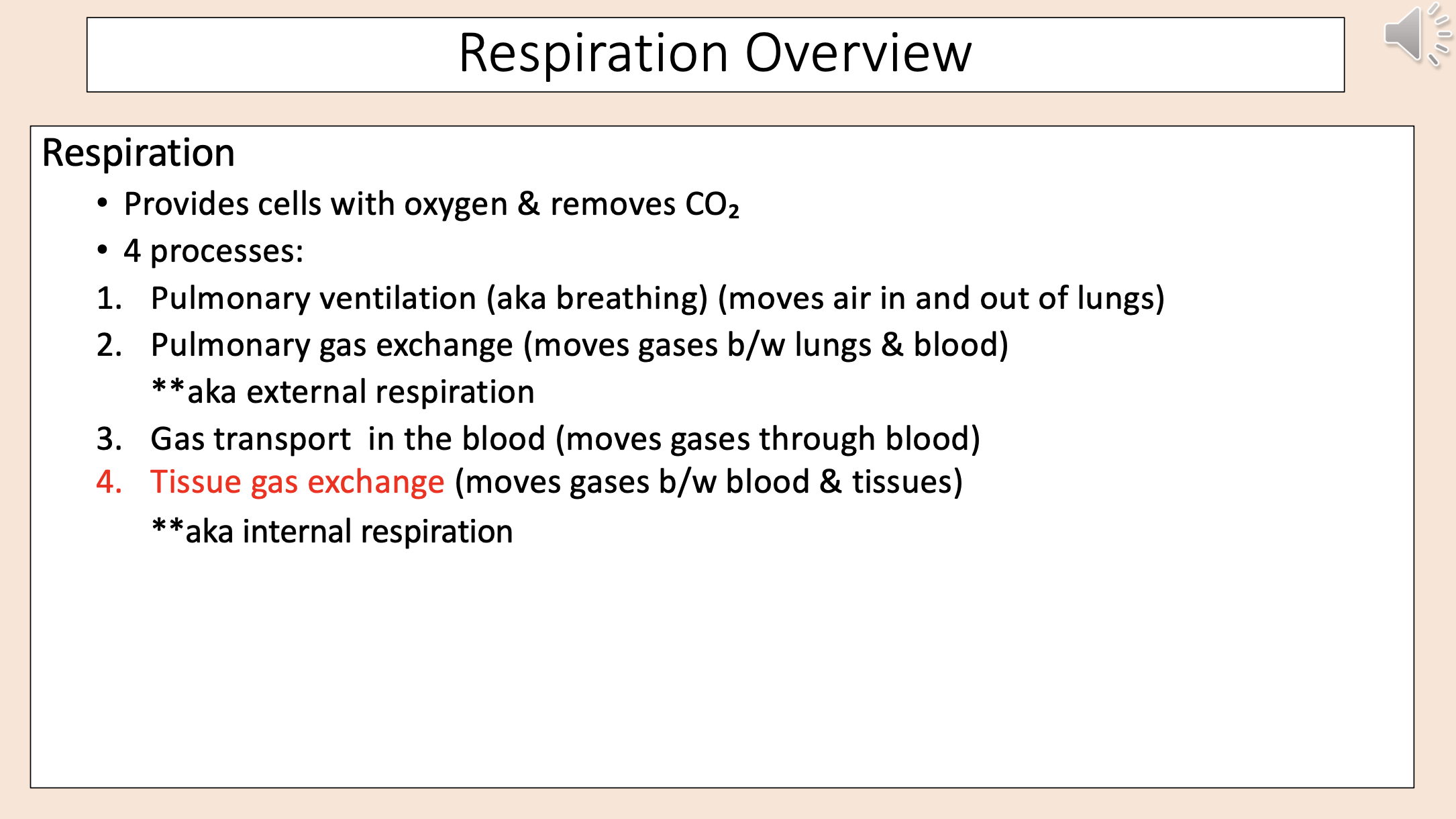
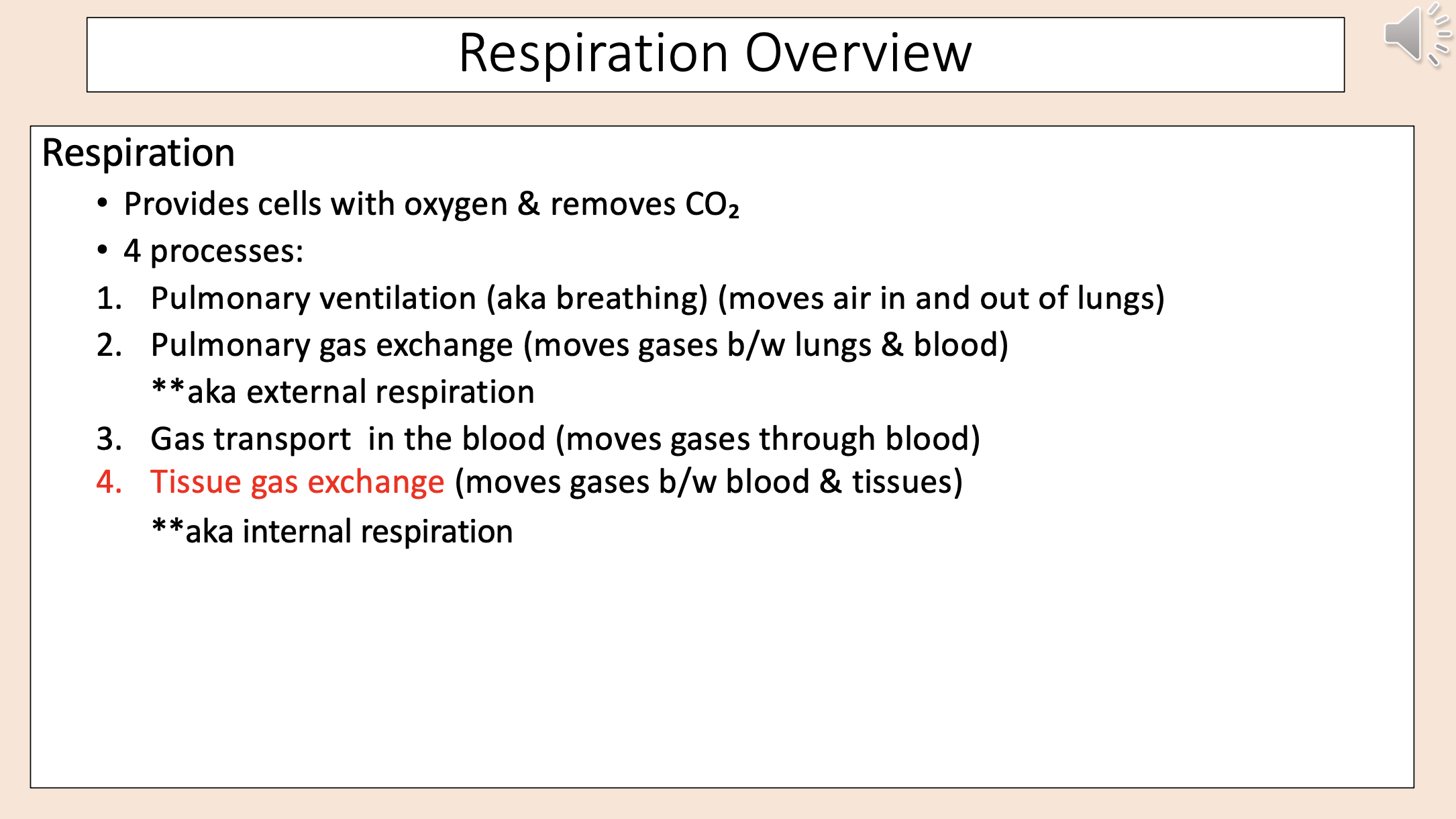
Respiration Overview.

Respiration.

• Provides cells with oxygen & removes CO2.

• 4 processes:.

1. Pulmonary ventilation (aka breathing) (moves air in and out of lungs).

2. Pulmonary gas exchange (moves gases b/w lungs & blood).

**aka external respiration.

3. Gas transport in the blood (moves gases through blood).

4. Tissue gas exchange (moves gases b/w blood & tissues).

**aka internal respiration.
<p><span>Respiration Overview.</span></p><p><span>Respiration.</span></p><p><span>• Provides cells with oxygen &amp; removes CO<sub>2</sub>.</span></p><p><span>• 4 processes:.</span></p><p><span>1. Pulmonary ventilation (aka breathing) (moves air in and out of lungs).</span></p><p><span>2. Pulmonary gas exchange (moves gases b/w lungs &amp; blood).</span></p><p><span>**aka external respiration.</span></p><p><span>3. Gas transport in the blood (moves gases through blood).</span></p><p><span style="color: rgb(255, 0, 0);">4. Tissue gas exchange </span><span>(moves gases b/w blood &amp; tissues).</span></p><p><span>**aka internal respiration. </span></p>
8
New cards
term image

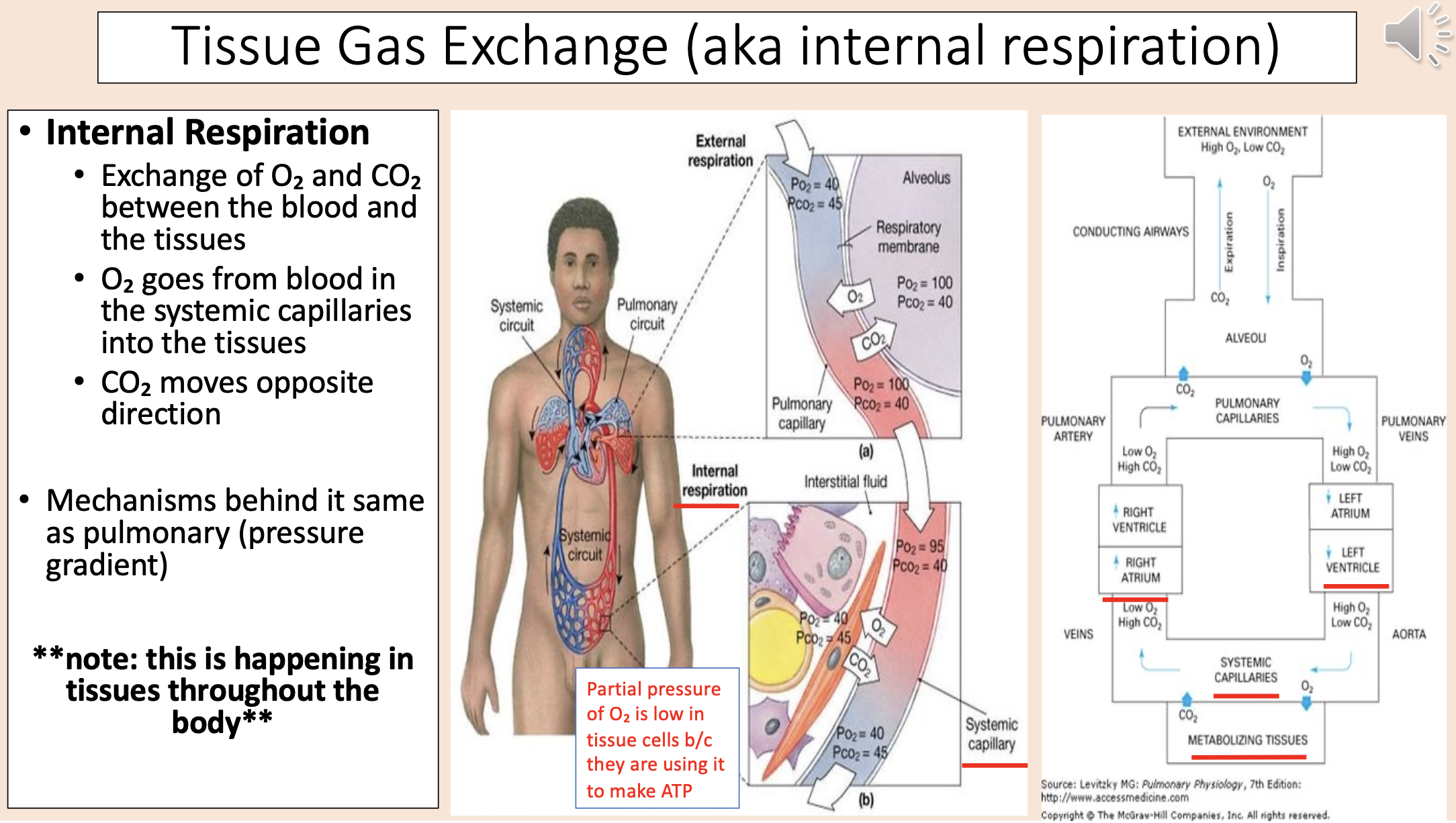
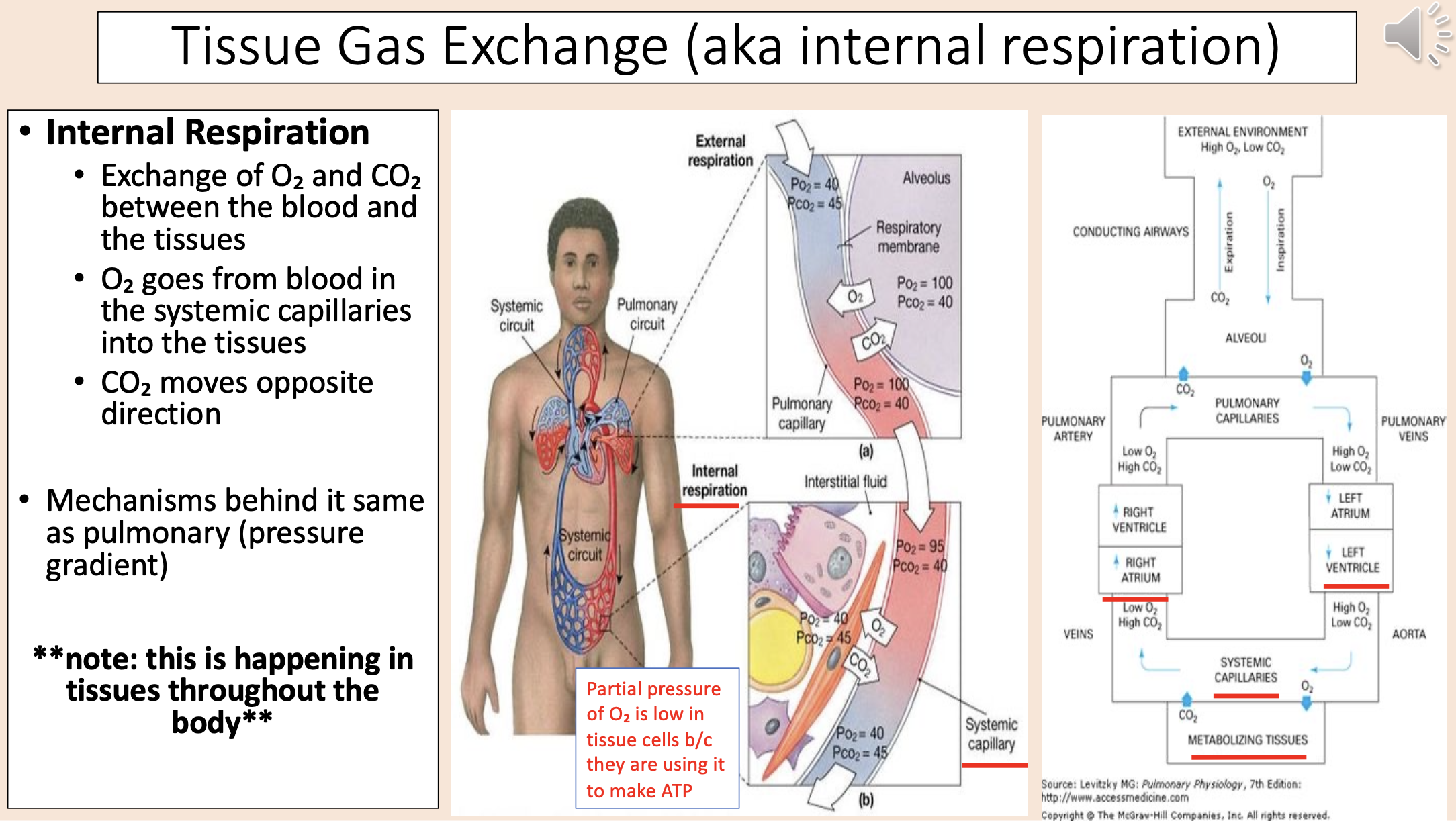
Tissue Gas Exchange (aka internal respiration).

Internal Respiration.

• Exchange of O2 and CO2 between the blood and the tissues.

• O2 goes from blood in the systemic capillaries into the tissues.

• CO2 moves opposite direction.

• Mechanisms behind it same as pulmonary (pressure gradient).

**note: this is happening in tissues throughout the body**.

Partial pressure of O2 is low in tissue cells because they are using it to make ATP.

<p>Tissue Gas Exchange (aka internal respiration).</p><p>• <strong>Internal Respiration.</strong></p><p>• Exchange of O<sub>2 </sub>and CO<sub>2</sub> between the blood and the tissues.</p><p>• O<sub>2</sub> goes from blood in the systemic capillaries into the tissues.</p><p>• CO<sub>2</sub> moves opposite direction.</p><p>• Mechanisms behind it same as pulmonary (pressure gradient).</p><p><strong>**note: this is happening in tissues throughout the body**.</strong></p><p><span style="color: rgb(255, 0, 0);">Partial pressure of O<sub>2</sub> is low in tissue cells because they are using it to make ATP.</span></p>
9
New cards
term image

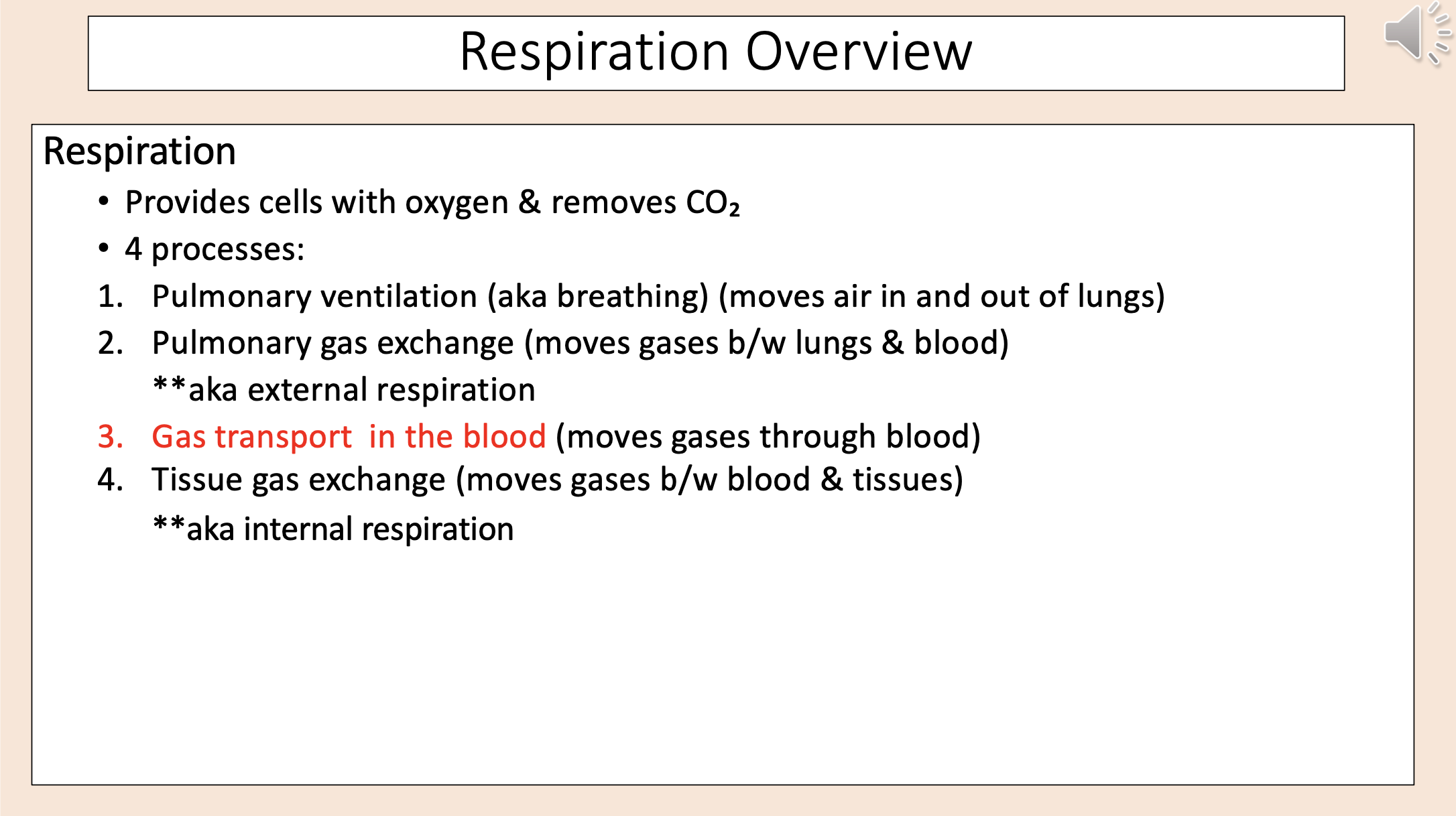
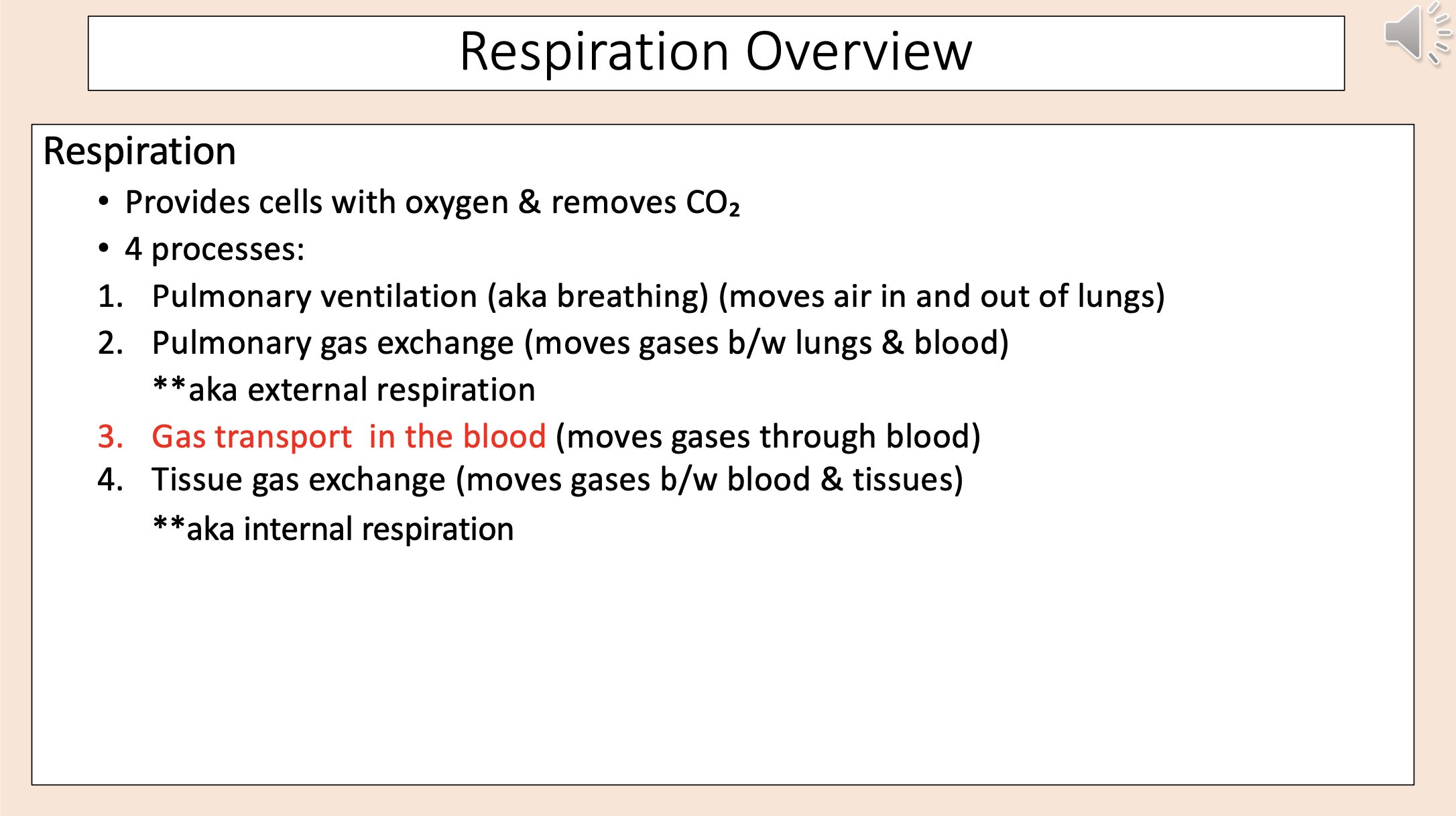
Respiration Overview.

Respiration.

• Provides cells with oxygen & removes CO2.

• 4 processes:.

1. Pulmonary ventilation (aka breathing) (moves air in and out of lungs).

2. Pulmonary gas exchange (moves gases b/w lungs & blood).

**aka external respiration.

3. Gas transport in the blood (moves gases through blood).

4. Tissue gas exchange (moves gases b/w blood & tissues).

**aka internal respiration.
<p><span>Respiration Overview.</span></p><p><span>Respiration.</span></p><p><span>• Provides cells with oxygen &amp; removes CO<sub>2</sub>.</span></p><p><span>• 4 processes:.</span></p><p><span>1. Pulmonary ventilation (aka breathing) (moves air in and out of lungs).</span></p><p><span>2. Pulmonary gas exchange (moves gases b/w lungs &amp; blood).</span></p><p><span>**aka external respiration.</span></p><p><span style="color: rgb(255, 0, 0);">3. Gas transport in the blood </span><span>(moves gases through blood).</span></p><p><span>4. Tissue gas exchange (moves gases b/w blood &amp; tissues).</span></p><p><span>**aka internal respiration.</span></p>
10
New cards
term image

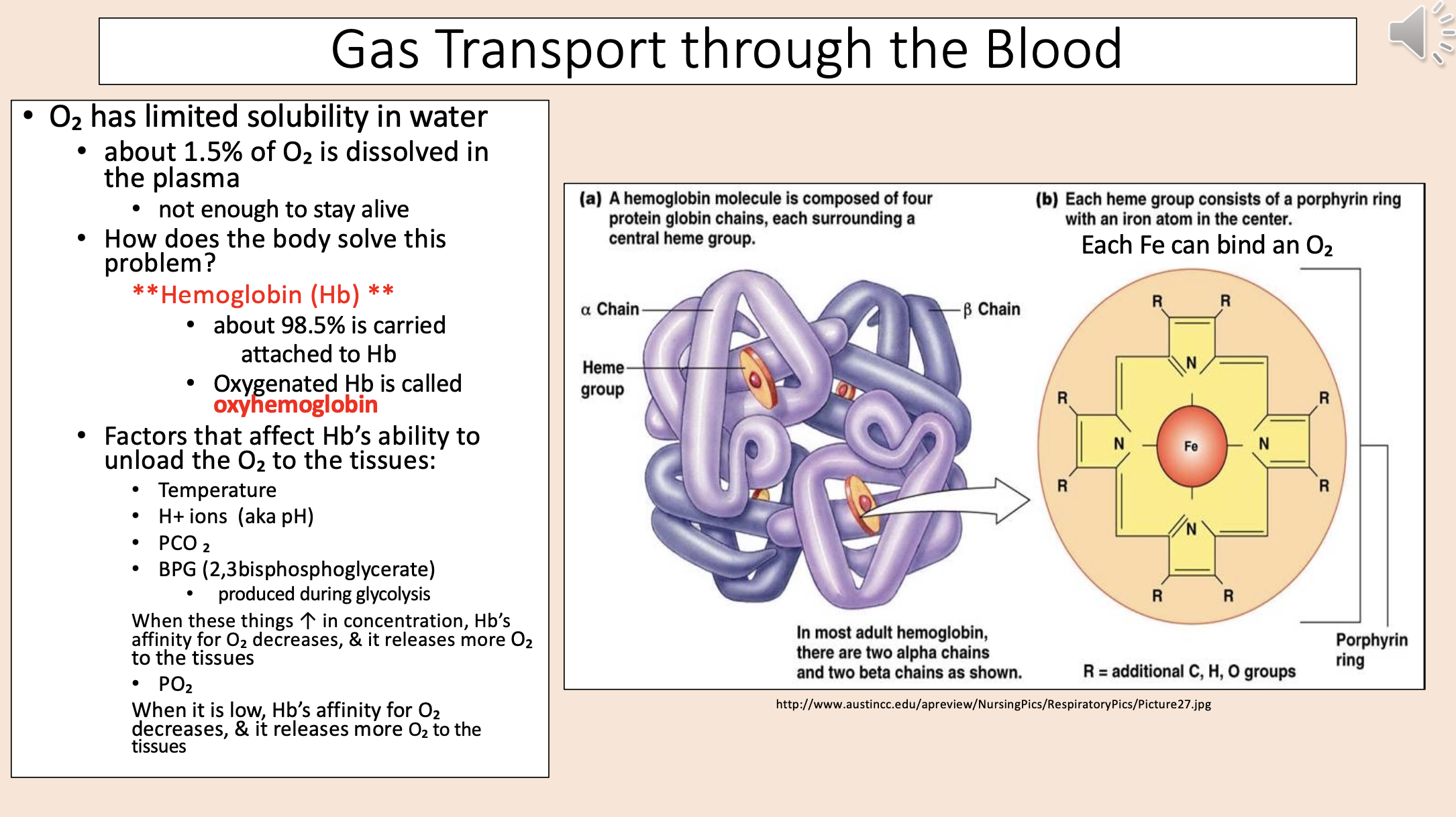
Gas Transport through the Blood.

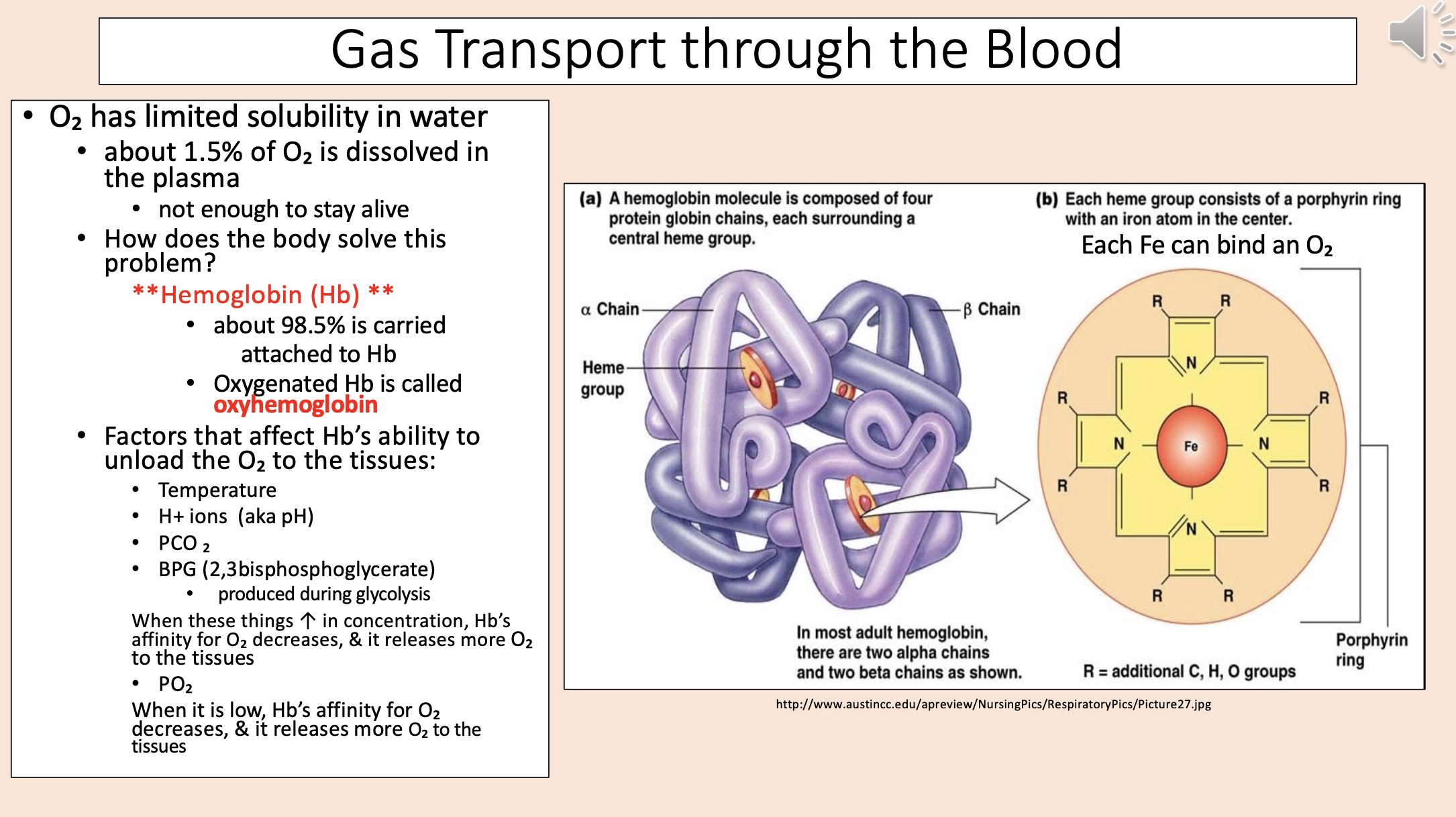
• O2 has limited solubility in water.

• about 1.5% of O2 is dissolved in the plasma.

• not enough to stay alive.

How does the body solve this problem?

**Hemoglobin (Hb)**.

about 98.5% is carried attached to Hb.

Oxygenated Hb is called oxyhemoglobin.

Factors that affect Hb’s ability to unload the O2 to the tissues:.

• Temperature.

H+ ions (aka pH).

PCO2.

BPG (2, 3 bisphosphoglycerate).

• produced during glycolysis.

When these things ↑ in concentration, Hb’s affinity for O2 decreases, & it releases more O2 to the tissues.

• PO2.

When it is low, Hb’s affinity for O2 decreases, & it releases more O2 to the tissues.
<p><span>Gas Transport through the Blood.</span></p><p><span>• O<sub>2</sub> has limited solubility in water.</span></p><p><span>• about 1.5% of O2 is dissolved in the plasma.</span></p><p><span>• not enough to stay alive.</span></p><p>• <span>How does the body solve this problem?</span></p><p><span style="color: rgb(255, 0, 0);">**Hemoglobin (Hb)**.</span></p><p>• <span>about 98.5% is carried attached to Hb.</span></p><p>•<span> Oxygenated Hb is called </span><span style="color: rgb(255, 0, 0);"><strong>oxyhemoglobin.</strong></span></p><p>•<span> Factors that affect Hb’s ability to unload the O2 to the tissues:.</span></p><p><span>• Temperature.</span></p><p>• <span>H<sup>+</sup> ions (aka pH).</span></p><p>• <span>PCO<sub>2</sub>.</span></p><p>•<span> BPG (2, 3 bisphosphoglycerate).</span></p><p><span>• produced during glycolysis.</span></p><p><span>When these things ↑ in concentration, Hb’s affinity for O<sub>2</sub> decreases, &amp; it releases more O<sub>2</sub> to the tissues.</span></p><p><span>• PO<sub>2</sub>.</span></p><p><span>When it is low, Hb’s affinity for </span>O<sub>2</sub><span> decreases, &amp; it releases more </span>O<sub>2</sub><span> to the tissues.</span></p>
11
New cards
term image

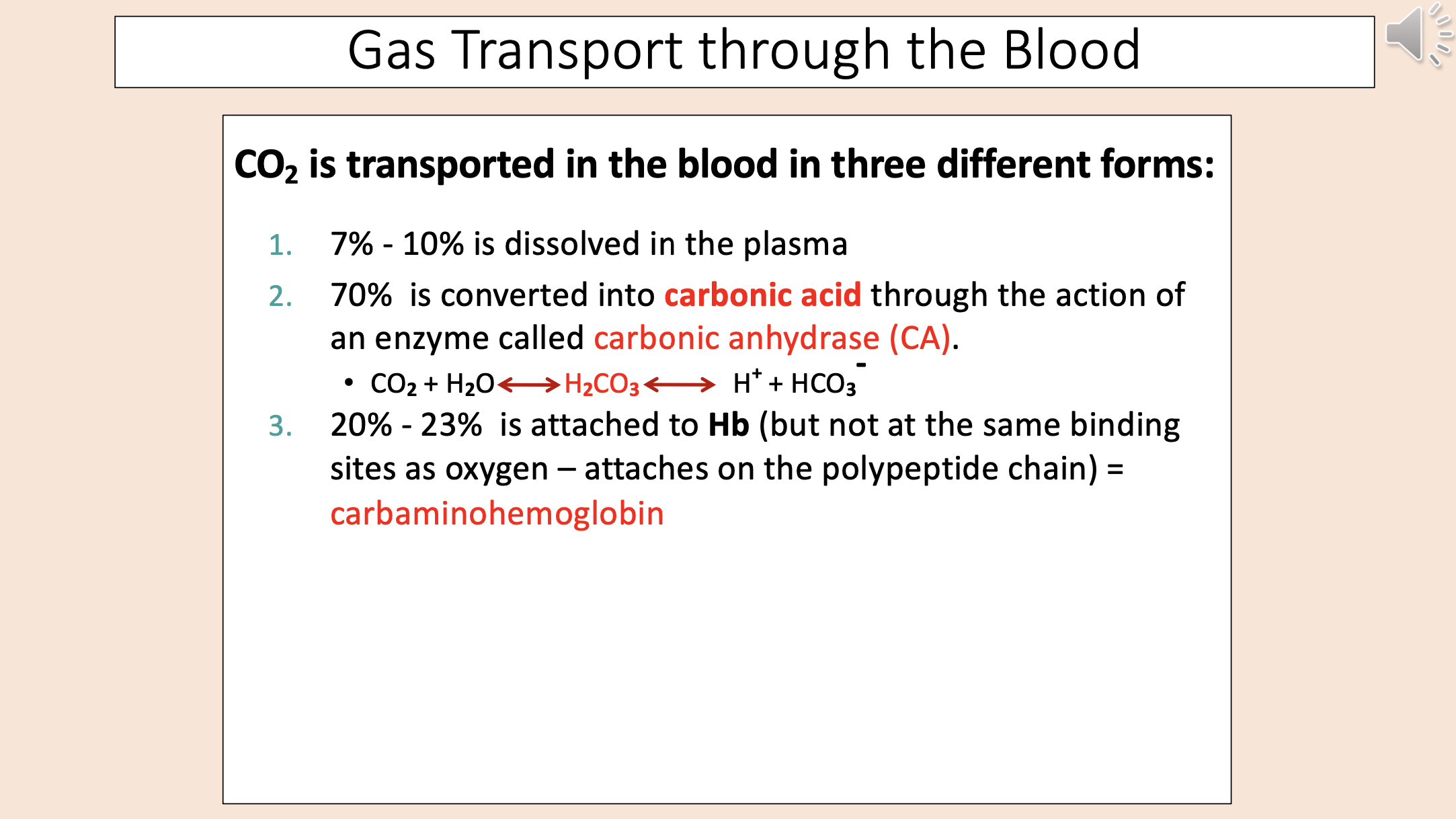
Gas Transport through the Blood.

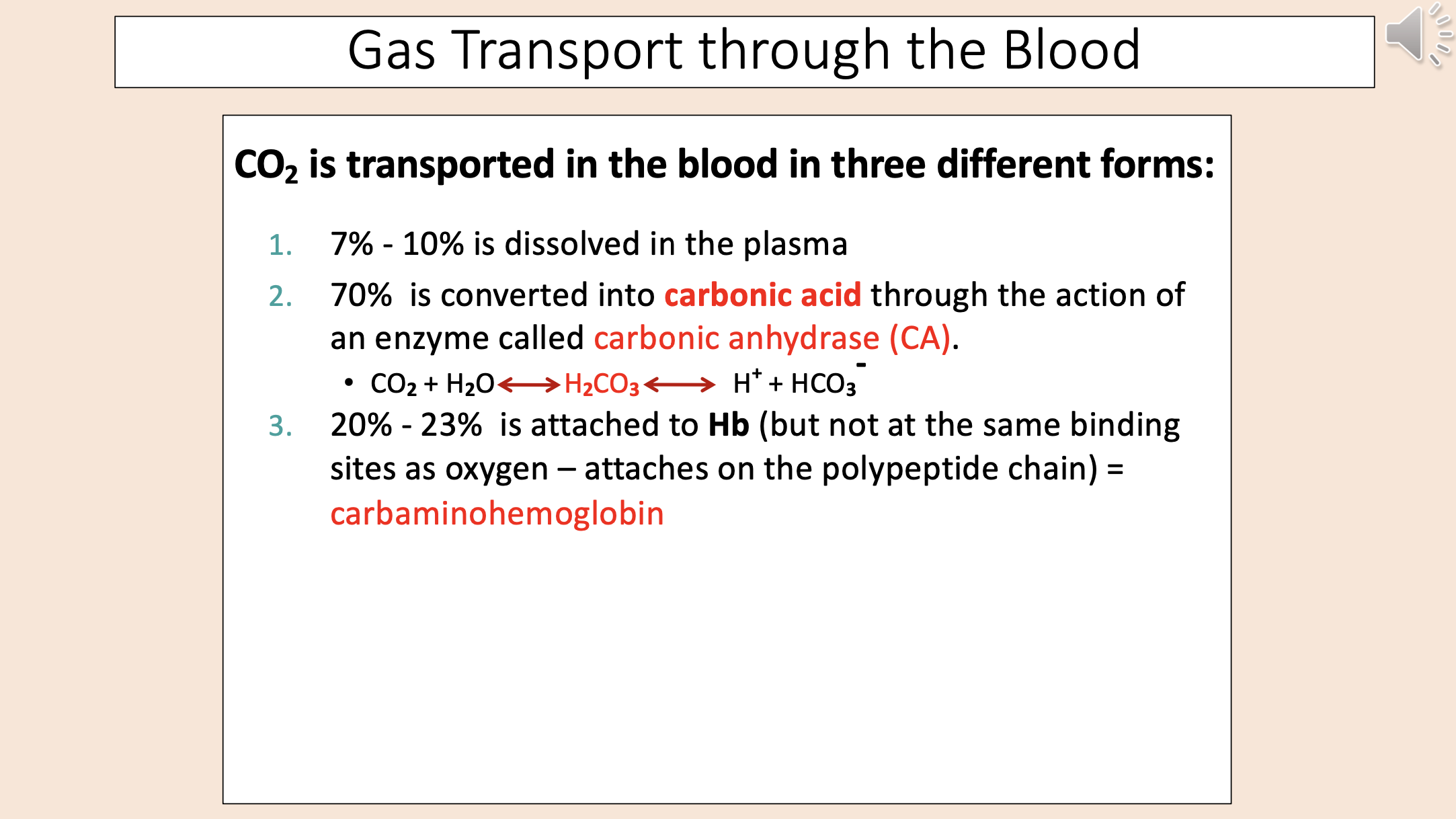
CO2 is transported in the blood in three different forms:.

7% - 10% is dissolved in the plasma.

70% is converted into carbonic acid through the action of an enzyme called carbonic anhydrase (CA).

• CO2 + H2O H2CO3 H+ + HCO3-.

20% - 23% is attached to Hb (but not at the same binding sites as oxygen – attaches on the polypeptide chain) = carbaminohemoglobin.
<p><span>Gas Transport through the Blood.</span></p><p><span><strong>CO2 is transported in the blood in three different forms:.</strong></span></p><p><span>7% - 10% is dissolved in the plasma.</span></p><p><span>70% is converted into </span><span style="color: rgb(255, 0, 0);"><strong>carbonic acid </strong></span><span>through the action of an enzyme called </span><span style="color: rgb(255, 0, 0);">carbonic anhydrase (CA)</span><span>.</span></p><p><span>• CO<sub>2</sub><strong> </strong>+ H<sub>2</sub>O </span><span style="color: rgb(255, 0, 0);">H<sub>2</sub>CO<sub>3</sub><strong> </strong></span><span>H<sup>+</sup><strong> </strong>+ HCO<sub>3</sub><strong>-.</strong></span></p><p><span>20% - 23% is attached to <strong>Hb </strong>(but not at the same binding sites as oxygen – attaches on the polypeptide chain) = </span><span style="color: rgb(255, 0, 0);">carbaminohemoglobin.</span></p>
12
New cards
term image

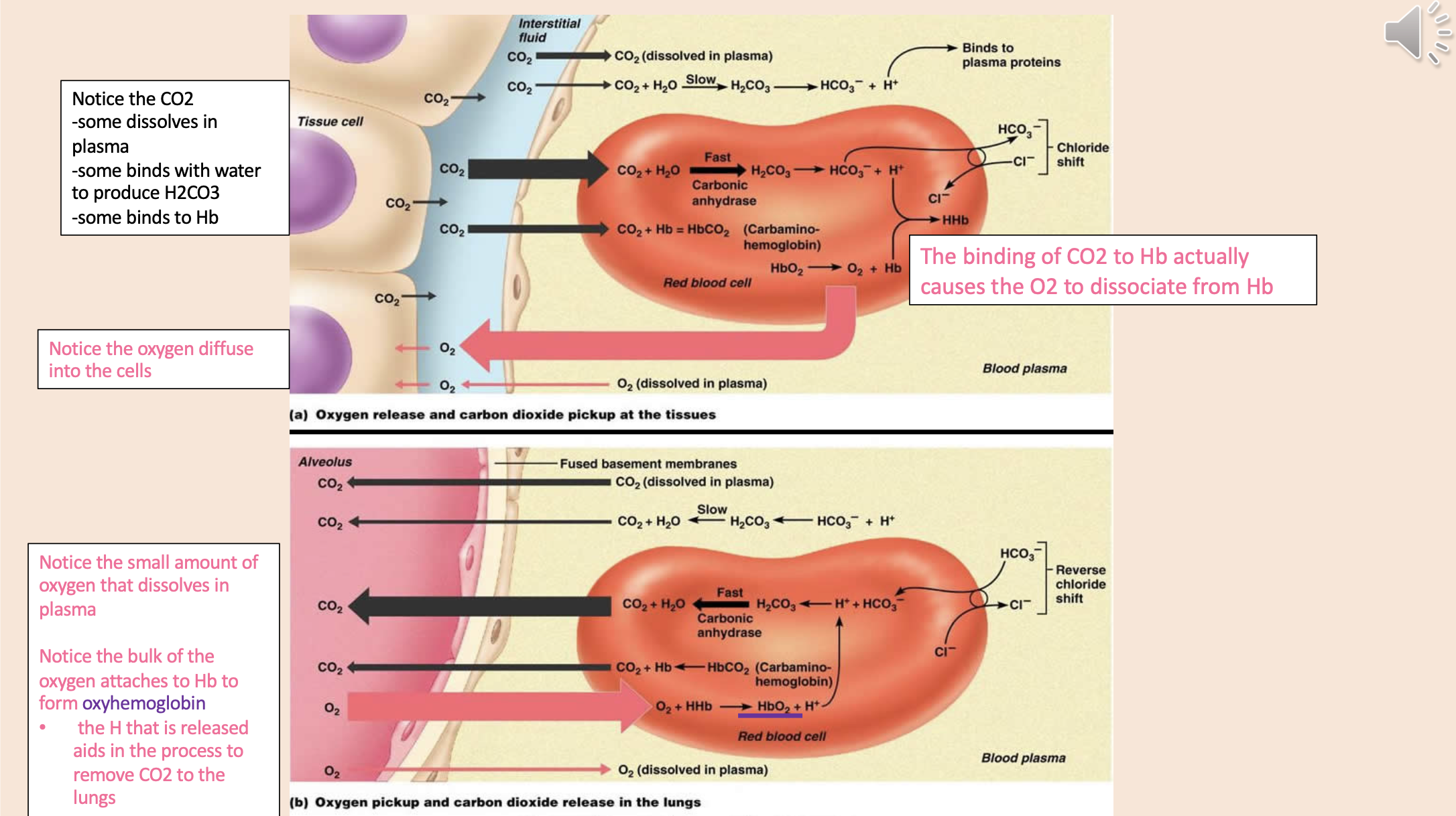
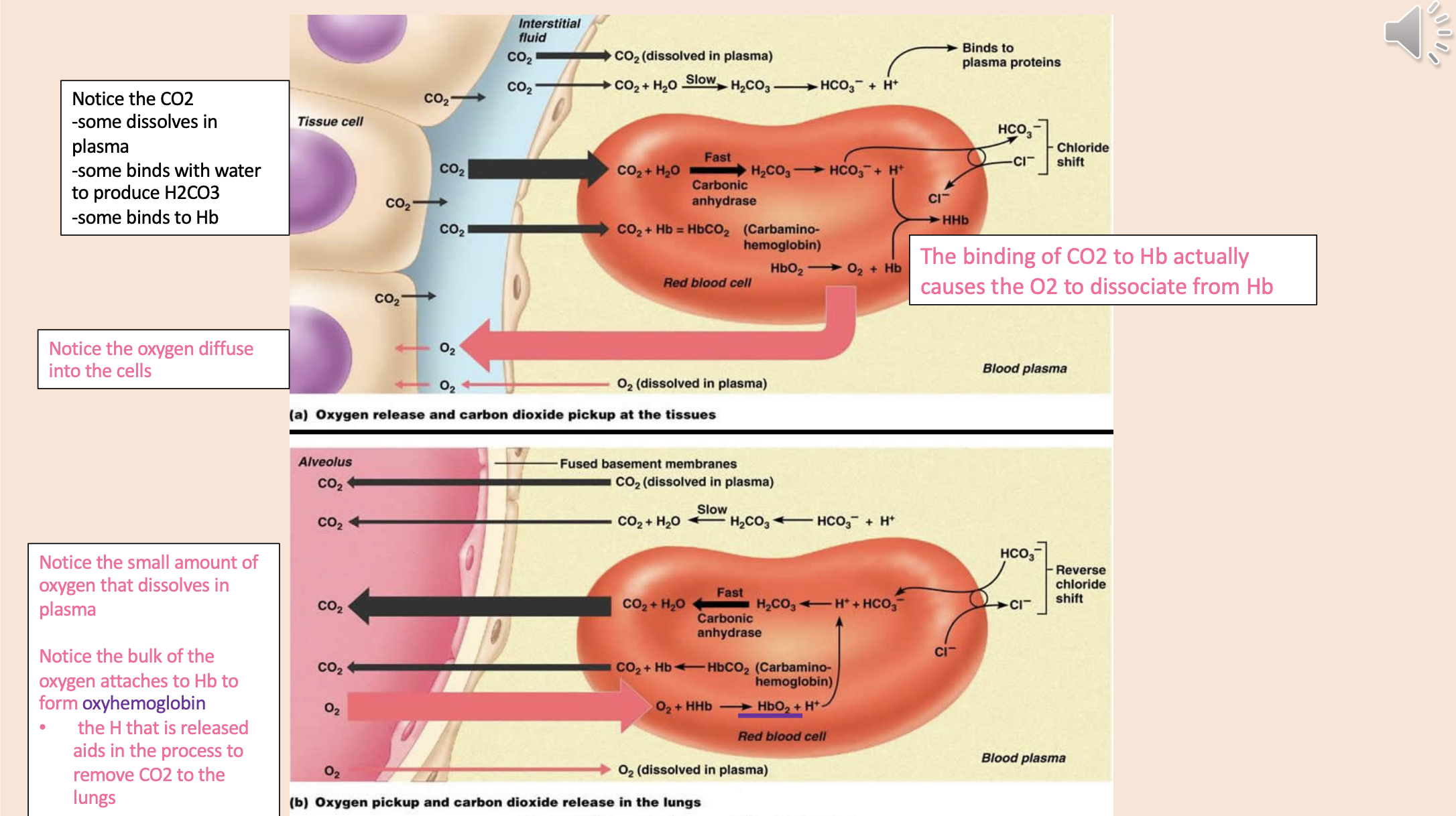
Notice the CO2.

- some dissolves in plasma.

- some binds with water to produce H2CO3.

- some binds to Hb.

Notice the oxygen diffuse into the cells.

Notice the small amount of oxygen that dissolves in plasma.

Notice the bulk of the oxygen attaches to Hb to form oxyhemoglobin.

• the H that is released aids in the process to remove CO2 to the lungs.

The binding of CO2 to Hb actually causes the O2 to dissociate from Hb
<p><span>Notice the CO<sub>2</sub>.</span></p><p><span>- some dissolves in plasma.</span></p><p><span>- some binds with water to produce H<sub>2</sub>CO<sub>3</sub>.</span></p><p><span>- some binds to Hb.</span></p><p><span style="color: rgb(255, 102, 153);">Notice the oxygen diffuse into the cells.</span></p><p><span style="color: rgb(255, 102, 153);">Notice the small amount of oxygen that dissolves in plasma.</span></p><p><span style="color: rgb(255, 102, 153);">Notice the bulk of the oxygen attaches to Hb to form </span><span style="color: rgb(112, 48, 160);">oxyhemoglobin.</span></p><p><span style="color: rgb(255, 102, 153);">• the H that is released aids in the process to remove CO<sub>2</sub> to the lungs.</span></p><p><span style="color: rgb(255, 102, 153);">The binding of CO<sub>2</sub> to Hb actually causes the O<sub>2</sub> to dissociate from Hb</span></p>
13
New cards
term image

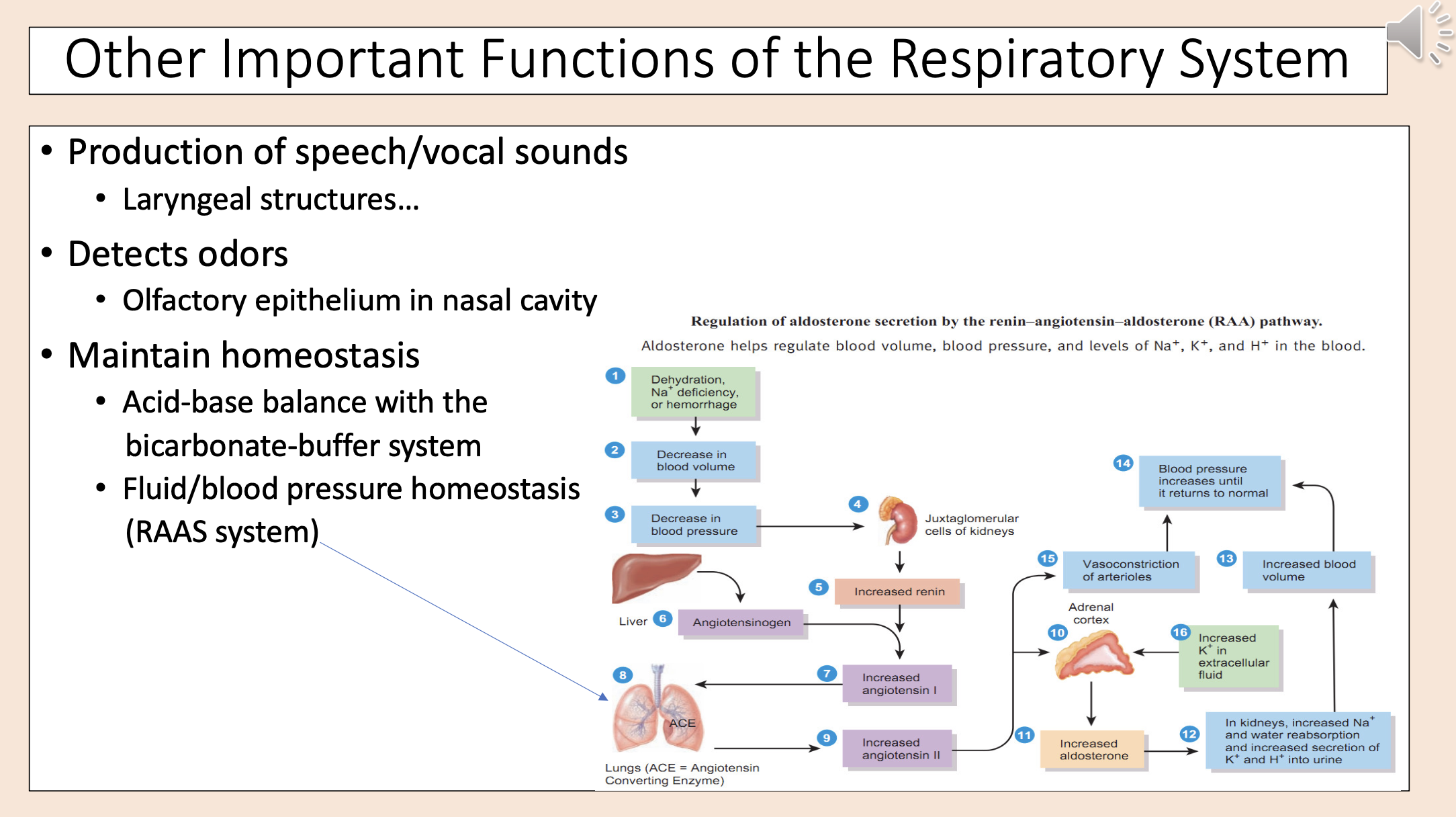
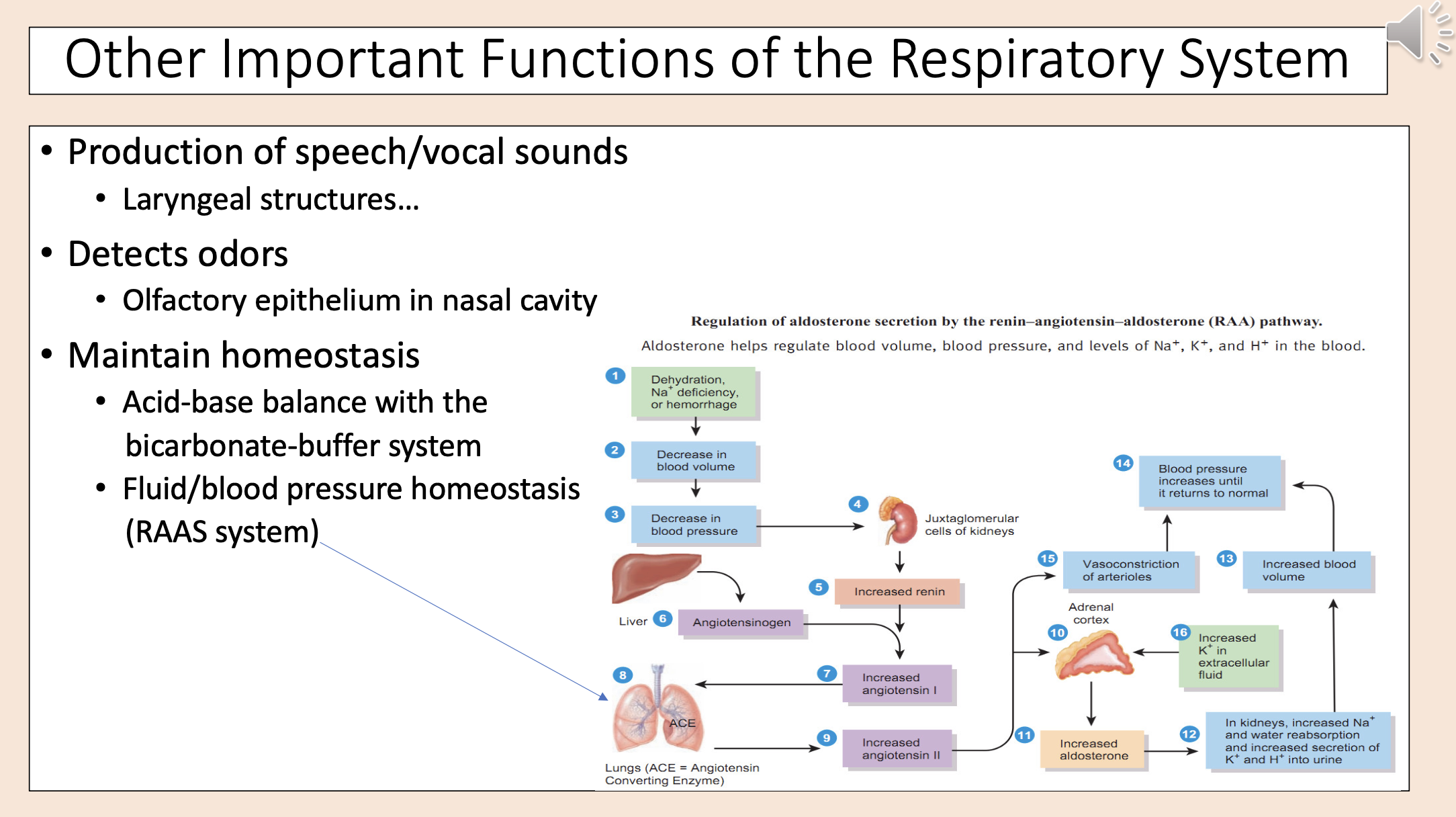
Other Important Functions of the Respiratory System.

• Production of speech/vocal sounds.

• Laryngeal structures...

• Detects odors.

• Olfactory epithelium in nasal cavity.

• Maintain homeostasis.

• Acid-base balance with the bicarbonate-buffer system.

• Fluid/blood pressure homeostasis (RAAS system).

Regulation of aldosterone secretion by the renin - angiotensin - aldosterone (RAA) pathway.

Aldosterone helps regulate blood volume, blood pressure, and levels of Na+, K+, and H+ in the blood.

1. Dehydration, Na+ deficiency, or hemorrhage.

2. Decrease in blood volume.

3. Decrease in blood pressure.

4. Juxtaglomerular cells of kidneys.

5. Increased renin.

Liver.

6. Angiotensinogen.

7. Increased angiotensin I.

8. ACE.

Lungs (ACE = Angiotensin Converting Enzyme).

9. Increased angiotensin II.

10. Adrenal cortex.

11. Increased aldosterone.

12. In kidneys, increased Na+ and water reabsorption and increased secretion of K+ and H+ into urine.

13. Increased blood volume.

14. Blood pressure increases until it returns to normal.

15. Vasoconstriction of arterioles.

16. Increased K+ in extracellular fluid.
<p><span>Other Important Functions of the Respiratory System.</span></p><p><span>• Production of speech/vocal sounds.</span></p><p><span>• Laryngeal structures...</span></p><p><span>• Detects odors.</span></p><p><span>• Olfactory epithelium in nasal cavity.</span></p><p><span>• Maintain homeostasis.</span></p><p><span>• Acid-base balance with the bicarbonate-buffer system.</span></p><p><span>• Fluid/blood pressure homeostasis (RAAS system).</span></p><p><span>Regulation of aldosterone secretion by the renin - angiotensin - aldosterone (RAA) pathway.</span></p><p><span>Aldosterone helps regulate blood volume, blood pressure, and levels of Na<sup>+</sup>, K<sup>+</sup>, and H<sup>+</sup> in the blood.</span></p><p><span>1. Dehydration, Na<sup>+</sup> deficiency, or hemorrhage. </span></p><p><span>2. Decrease in blood volume.</span></p><p><span>3. Decrease in blood pressure. </span></p><p><span>4. Juxtaglomerular cells of kidneys. </span></p><p><span>5. Increased renin.</span></p><p><span>Liver. </span></p><p><span>6. Angiotensinogen. </span></p><p><span>7. Increased angiotensin I.</span></p><p><span>8. ACE.</span></p><p><span>Lungs (ACE = Angiotensin Converting Enzyme).</span></p><p>9. Increased angiotensin II. </p><p>10. Adrenal cortex.</p><p>11. Increased aldosterone. </p><p>12. In kidneys, increased Na<sup>+</sup> and water reabsorption and increased secretion of K<sup>+ </sup> and H<sup>+</sup> into urine.</p><p>13. Increased blood volume. </p><p>14. Blood pressure increases until it returns to normal.</p><p>15. Vasoconstriction of arterioles. </p><p>16. Increased K<sup>+</sup> in extracellular fluid. </p>

Explore top notes

note
Nutrition Assessment
Updated 894d ago
0.0(0)
note
Chapter 7: The Plan: Preproduction
Updated 1234d ago
0.0(0)
note
SPH3U - Unit 1 - Kinematics
Updated 179d ago
0.0(0)
note
4.1 The role of marketing
Updated 1336d ago
0.0(0)
note
Chem - Chapter 6
Updated 1140d ago
0.0(0)
note
2.4 Transport Across Membranes
Updated 1157d ago
0.0(0)
note
Chapter 34: Neurotoxics
Updated 1089d ago
0.0(0)
note
Nutrition Assessment
Updated 894d ago
0.0(0)
note
Chapter 7: The Plan: Preproduction
Updated 1234d ago
0.0(0)
note
SPH3U - Unit 1 - Kinematics
Updated 179d ago
0.0(0)
note
4.1 The role of marketing
Updated 1336d ago
0.0(0)
note
Chem - Chapter 6
Updated 1140d ago
0.0(0)
note
2.4 Transport Across Membranes
Updated 1157d ago
0.0(0)
note
Chapter 34: Neurotoxics
Updated 1089d ago
0.0(0)

Explore top flashcards

flashcards
GUMS M3.2
20
Updated 299d ago
0.0(0)
flashcards
what to know: Shakespeare
30
Updated 1080d ago
0.0(0)
flashcards
Science test one definitions
69
Updated 146d ago
0.0(0)
flashcards
Micro ch. 10-15
117
Updated 1260d ago
0.0(0)
flashcards
History Chapter 2
85
Updated 200d ago
0.0(0)
flashcards
Español Dos Study Guide
22
Updated 1057d ago
0.0(0)
flashcards
MEA 200 Exam 1 Knowledge
138
Updated 932d ago
0.0(0)
flashcards
GUMS M3.2
20
Updated 299d ago
0.0(0)
flashcards
what to know: Shakespeare
30
Updated 1080d ago
0.0(0)
flashcards
Science test one definitions
69
Updated 146d ago
0.0(0)
flashcards
Micro ch. 10-15
117
Updated 1260d ago
0.0(0)
flashcards
History Chapter 2
85
Updated 200d ago
0.0(0)
flashcards
Español Dos Study Guide
22
Updated 1057d ago
0.0(0)
flashcards
MEA 200 Exam 1 Knowledge
138
Updated 932d ago
0.0(0)