bio103 lect 3
 Call Kai
 Learn
Learn Practice Test
 Spaced Repetition
 Match
Match Flashcards
 Knowt Play
1/23

There's no tags or description
Looks like no tags are added yet.
Name | Mastery | Learn | Test | Matching | Spaced | Call with Kai |
|---|
No analytics yet
Send a link to your students to track their progress
24 Terms
types of observation
qualitative & quantitative
what is qualitative
observation that involves descriptive data and characteristics rather than numerical measurements. (in words)
define quantitative
observation that involves numerical measurements and data analysis (in numbers)
important points about observation
must be completed and detailed
must avoid value judgement
must not confuse observation with interpretation
limitation of observation
we are biased toward sight
our sense limited
why do we classify
identifies organisms
shows evolutionary relationships
allows global communication
prevents confusion with common names
modern classification based on:
DNA evidence
evolutionary relationships
Draw hierarchy diagram
as you go up groups become smaller, organisms become more similar
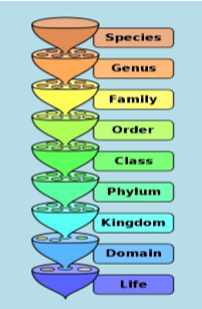
scientific method steps to prediction
observation
question
hypothesis
prediction
test
support or reject hypothesis
difference between hypothesis and prediction
H: explanation
P: if… then statement
what happens if prediction fails
hypothesis may be wrong
what happens if hypothesis survives many tests
may become part of a theory
what is independent
factor you change
what is dependent
what’s measured
what is treatment group
receives independent variable
replication in bio
experiment must be repeated
replication reduce random error
adequate replication depends on:
variation in organism
complexity of system
statistical analysis
Lamark’s proposed idea on acquired characteristics
is the theory that organisms can pass on traits acquired during their lifetime to their offspring.
example: giraffe stretch necks—> offspring have longer necks
weissmann proposed idea on acquired characteristics
is the theory that organisms cannot pass on traits acquired during their lifetime to their offspring, emphasizing genetic inheritance over acquired traits.
example: chop tail off of rats, the children won’t change and have no tails bc it doesn’t change their traits
Van Helmont belief on spontaneous generation
is the idea that living organisms can spontaneously arise from nonliving matter, such as how grains of wheat were thought to produce mice.
red (1668) belief on spontaneous generation
showed that maggots arise from flies attracted to decaying meat, not from spontaneous generation.
needham (1745) belief on spontaneous generation
is the belief that microorganisms could arise from nonliving matter, demonstrated in his experiments with boiled broth that later became cloudy with microbial life.
spallanzani (1765) belief of spontaneous generation
is the belief that microorganisms do not arise from spontaneous generation, demonstrated through his sealed experiments that showed no microbial growth in sealed boiled broth.
pasteur (1862) belief on spontaneous generation
is the belief that microorganisms arise from other microbes, demonstrated through his swan-neck flask experiments which disproved spontaneous generation.

