Lecture 6 - Emotional Development, Attachment & Temperament-Based Parenting Interventions
 Studied by 0 people
 Call Kai
 Learn
Learn Practice Test
 Spaced Repetition
 Match
Match Flashcards
 Knowt Play
1/32

There's no tags or description
Looks like no tags are added yet.
Name | Mastery | Learn | Test | Matching | Spaced | Call with Kai |
|---|
No analytics yet
Send a link to your students to track their progress
33 Terms
comparative perspective
→ Darwin
• claimed that emotional capabilities subject to natural selection → traced links between expressions of emotion in animals to human equivalents
action units
• facial muscles we use in facial expressions (e.g. in expression of emotions)
constrained method
• in research on emotion: e.g. give picture of expression and multiple choice options to choose answer from
unconstrained method
• in research on emotion: e.g. give picture of expression and let people do “free-labeling” (let them come up with emotion)
What are the dimensions in developmental theories in regard to emotional development?
• Darwin & Ekman: nature, passive
• Feldmann Barrett (constructivism): nurture, active
ethology
• approach which emphasizes evolutionary origins of many behaviors that are important for survival
Four questions by Tinbergen
• mechanism (causation) → how does this behavior occur in an individual?
• ontogeny (development) → how does this behavior arise in an individual?
• adaptive value (function) → why is this behavior adaptive for the species?
• phylogeny (evolution) → how does this behavior arise in the species?
Similarities between Erikson’s psychosocial stages and Freud’s psychosexual stages
• developmental stages in which conflict needs to be resolved
Differences between Erikson’s psychosocial stages and Freud’s psychosexual stages
• social conflicts rather than sexual/internal conflicts
Psychosocial stages
• trust vs. mistrust: if needs met, development of basic trust
• autonomy vs. shame/doubt: toddlers learn to exercise will and do things for themselves/doubt abilities
• initiative vs. guilt: preschoolers learn to initiate tasks, carry out plans/feel guilty about efforts to be independent
• industry vs. inferiority: children learn pleasure of applying themselves to tasks/feel inferior
• identity vs. confusion: teenagers work at refining sense of self by testing roles, integrating them to form single identity/become confused about who they are
• intimacy vs. isolation: young adults struggle to form close relationships, to gain capacity for intimate love/feel socially isolated
• generativity vs. stagnation: middle-aged discovers sense of contributing to word/feel lack of purpose
• integrity vs. despair: older adult may feel sense of satisfaction/failure when reflecting on life
Bowlby’s theory
• infant attachment: universal need for close emotional bond between caregiver and child
• innate and universal tendency: proximity of caregiver increases survival chances of child
attachment styles
• secure: healthy communication style, able to ask for help when needed, can self-regulate emotions
• anxious: clinginess, fear of abandonment, needs constant reassurance
• avoidant: difficulty expressing emotions, emotional withdrawal from others, unwilling to ask for help
• disorganized: characteristics of anxious and avoidant style, fear of rejection but difficulty with intimacy, low self worth
internal working models
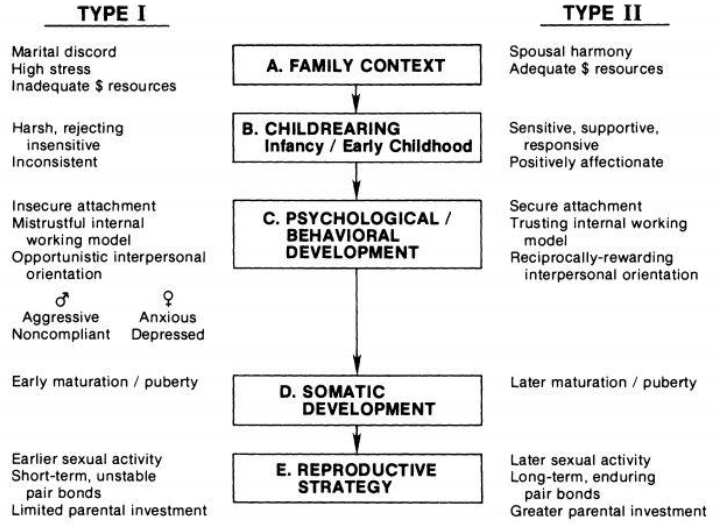
• evolutionary theory of socialization
• relevant aspects: family context, childrearing (infancy, early childhood), psychological/behavioral development, somatic development, reproductive strategy
• 2 possible types: Type I (atypical, often “unhealthy”), Type II (typical, “healthy”)
emotion
• emotion ranges from simple emotions such as happiness, sadness, fear and anger, to more complex emotions such as self-consciousness and jealousy.
basic emotions
• happiness, interest, surprise, disgust, sadness, distress, anger, fear
complex emotions
• pride, shyness, jealousy, guilt, shame, embarrassment
social referencing
• infants and young children look to their caregiver for ‘advice’ when faced with a difficult or uncertain situation and seek social cues (such as smiling or frowning) to guide their actions.
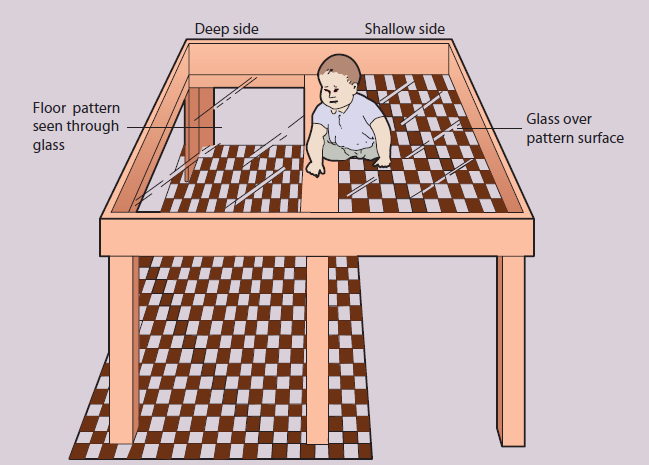
visual cliff
• a piece of apparatus used to study depth perception in infants, consisting of a glass table with a checkerboard pattern immediately beneath the glass on one half (shallow side) and on the floor below on the other half (deep side).
script
• a generalised framework for commonly experienced events or situations, with a stored representation of what one would expect to happen in such situations.
emotional ambiguity
• the realisation that a person’s feelings may not be clear-cut or match your own emotional response.
peer
• companion of approximately the same age and developmental level.
false belief
• incorrectly believing something to be the case when it is not. Often used in theory of mind research.
mind-mindedness
• caregivers who are able to ‘read’ their infant’s signals appropriately. Maternal mind-mindedness is a good predictor of attachment security.
callous-unemotional traits
• include general poverty of affect, showing lack of remorse and disregard for accepted values
emotion regulation
• adjusting one’s emotional state to a suitable level of intensity. This prevents emotional ‘overload’ and allows one to function in a consistent manner.
temperament
• biologically-based, relatively stable over time, consists of affective, attentional, sensory and behavioral response systems → individual differences
clusters of temperament (6)
• unregulated
• regulated
• high reactivity
• bold
• average
• well-adjusted
unregulated cluster
• high activity, low inhibition, under-controlled → difficult to deal with at home/in classroom
→ benefit from consistent positive interactions, gentle discipline
• Big 5: low on conscientiousness, high on extraversion
regulated cluster
• low activity, anger and approach; high inhibition and attention focus
• well-behaved, over-controlled, reserved
→ benefit from encouragement to try new things
• Big 5: high on conscientiousness, low on extraversion
high reactivity cluster
• high on anger, approach, fear, shyness
• low activity, inhibition and attention focus
→ experience life intensively, easily overwhelmed
→ benefit from consistent positive interactions
• Big 5: high on neuroticism
bold cluster
• high activity and approach, low fear and shyness
• easily excitable, jump into tasks with little hesitation, confident, natural curiosity
→ benefit from organized, structured activities
• Big 5: high on extraversion + openness to experience
average cluster
• average on all temperament traits
• easygoing, but maybe also unmotivated/uninterested
→ may fly under radar, may need extra attention to avoid disengagement from activities
• Big 5: average
well-adjusted cluster
• average on all temperament traits, high on inhibition and attention focus
• easygoing → get along well at school/home
• Big 5: average, high on conscientiousness
 Note
Note  Flashcards (39)