H2 Lewis- Single-species populations IV: Metapopulations and other spatially-structured populations
 Studied by 0 people
 Call with Kai
 Learn
Learn Practice Test
 Spaced Repetition
 Match
Match Flashcards
 Knowt Play
1/3

There's no tags or description
Looks like no tags are added yet.
Name | Mastery | Learn | Test | Matching | Spaced | Call with Kai |
|---|
No analytics yet
Send a link to your students to track their progress
4 Terms
how does metapopulation dynamics inform conservation efforts?
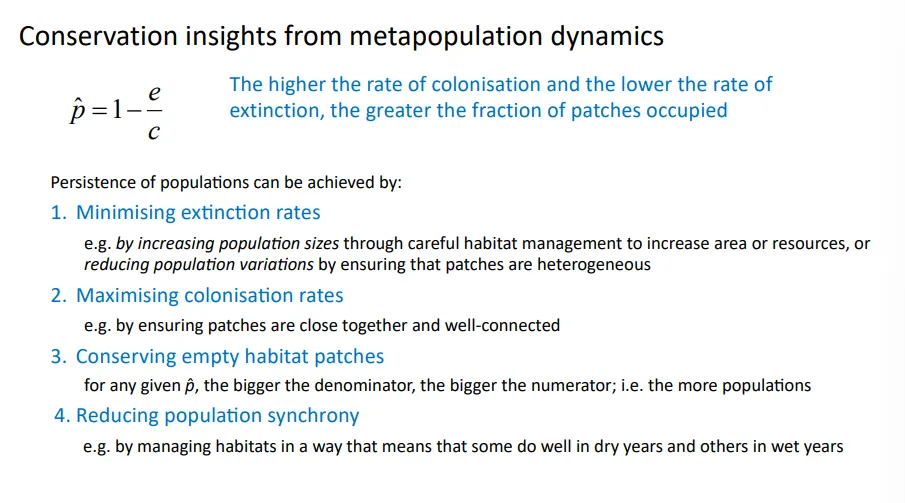
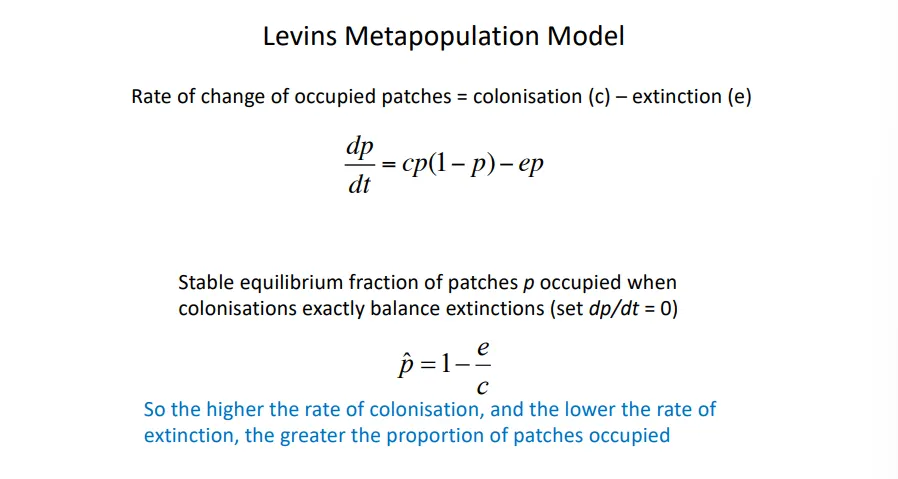
what is the lewis metapopulation model?
in fragmented ecosystems, the population of a species is controlled by the rate at which it colonises new patches and the rate of local extinction in patches
high colonisation + low extinction = a greater proportion (p) of patches occupied
colonisation rates change in a quadratic model, whereas extinction rates change in a linear model
this is still a semi-theoretical model, as it must be relatively rare, but still possible, for individuals to move between patches (without really affecting the population size, unless establishing a new population), and they must still be extinction-prone
otherwise it is just a mainland-island model, as one patch can still support a large, stable popualtion
why are fragmented populations more extinction-prone?
the fragmentation of habitats (anthropogenic or natural) leaves small patches of habitats with incomplete resources
these patches have much smaller carrying capacities and small existing populations, making species extinction-prone, because they are more susceptible to:
environmental stochasticity
demographic stochasticity
genetic effects (drift)
allee effects
what are the different kinds of fragmented populations? include examples
metapopulation- a population continually colonises patches and goes locally extinct, at relatively equal rates eg. the glanville fritillary butterfly lives in meadow fragments in an archipelago in finland
panmictic population- like a metapopulation, but the extinction rate is much lower than the colonisation rate, so patches are rarely not occupied eg. holly leafminer are very able to move between holly bushes
mainland-island- peripheral patches are periodically colonised by individuals from the large, stable mainland population, and can go extinct eg. edith’s checkerspot butterfly which needs serpentine grassland
source-sink- the sink is only occupied because the population is being continually topped up by immigration from the source population exporting individuals eg. sea rocket (source = beach, sink = dunes)
 Note
Note  Flashcards (25)